
Recent from talks
Edzell Castle
Knowledge base stats:
Talk channels stats:
Members stats:
Edzell Castle
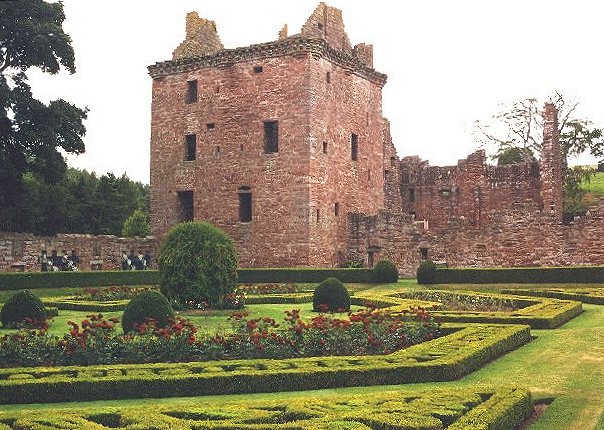
Edzell Castle is a ruined 16th-century castle, with an early-17th-century walled garden. It is located close to Edzell, and is around 5 miles (8 km) north of Brechin, in Angus, Scotland. Edzell Castle was begun around 1520 by David Lindsay, 9th Earl of Crawford, and expanded by his son, Sir David Lindsay, Lord Edzell, who also laid out the garden in 1604. The castle saw little military action, and was, in its design, construction and use, more of a country house than a defensive structure. It was briefly occupied by English troops during Oliver Cromwell's invasion of Scotland in 1651. In 1715 it was sold by the Lindsay family, and eventually came into the ownership of the Earl of Dalhousie. It was given into state care in the 1930s, and is now a visitor attraction run by Historic Environment Scotland (open all year; entrance charge). The castle consists of the original tower house and building ranges around a courtyard. The adjacent Renaissance walled garden, incorporating intricate relief carvings, is unique in Scotland. It was replanted in the 1930s, and is considered to have links to esoteric traditions, including Rosicrucianism and Freemasonry.
The first castle at Edzell was a timber motte and bailey structure, built to guard the mouth of Glenesk, a strategic pass leading north into the Highlands. The motte, or mound, is still visible 300 metres (980 ft) south-west of the present castle, and dates from the 12th century. It was the seat of the Abbott, or Abbe, family, and was the centre of the now-vanished original village of Edzell. The Abbotts were succeeded as lords of Edzell by the Stirlings of Glenesk, and the Stirlings in turn by the Lindsays. In 1358, Sir Alexander de Lindsay, third son of David Lindsay of Crawford, married the Stirling heiress, Katherine Stirling. Alexander's son, David, was created Earl of Crawford in 1398.
Edzell became the property of a junior branch of the Lindsay family descended from the 3rd Earl, and in 1513 it was inherited by David Lindsay (d. 1558). Around 1520, David Lindsay decided to abandon the original castle, and built a tower house and barmkin, or courtyard, in a more sheltered location nearby. The selection of a site overlooked by higher ground to the north suggests that defence was not the primary concern. David became the Earl of Crawford in 1542, on the death of his cousin the 8th Earl, who had disinherited his own son Alexander, the "Wicked Master". He proceeded to extend the simple tower house, in around 1550, by the addition of a large west range, incorporating a new entrance gate and hall. Lord Crawford also built Invermark Castle, 12 miles (19 km) north of Edzell, possibly as a hunting lodge, at around the same time.
Mary, Queen of Scots, came to Edzell on 25 August 1562. A plan to meet Elizabeth I in England had been abandoned, and she was making a progress to Aberdeen and Inverness.
David Lindsay, the 9th Earl's son, was educated in Paris and Cambridge, and travelled in continental Europe. His father had nominated the son of Alexander, the Wicked Master, as heir to the earldom, returning the title to the senior line of the family, and thus Lindsay did not succeed to the earldom on his father's death. However, he was knighted in 1581, became a Lord of Session (a senior judge), taking the title Lord Edzell, in 1593, and in 1598 was appointed to the Privy Council. A Renaissance Man, he undertook improvements to his estates, including mining and woodland planting. Two German prospectors from Nuremberg, Bernard Fechtenburg and Hans Ziegler, were invited to search for precious metals around Edzell.
In August 1562, David Lindsay received Mary, Queen of Scots, at Edzell. The Queen was on a Royal progress, with the aim of subduing the rebellious George Gordon, 5th Earl of Huntly, and spent two nights at Edzell. During her stay, she convened a meeting of the Privy Council, attended by the nobility of Scotland. Her son, King James VI, visited Edzell twice; on 28 June 1580, and in August 1589. On 5 August 1589 the Earl of Erroll came to James VI at Edzell and submitted to his mercy, while accusing the 6th Earl of Huntly of further treasons. The next day the news arrived at Edzell that Henry III of France had been assassinated at Saint-Cloud by a Dominican friar, Jacques Clément.
Sir David further extended the castle in the late 16th century, with the addition of a large north range with round corner towers. He laid out the garden in 1604, with symbols of England, Scotland and Ireland, to celebrate the Union of the Crowns of the previous year, when James VI acceded to the English throne on the death of his cousin, Elizabeth I. Sir David died in 1610, heavily in debt as a result of fines handed down for the unruly conduct of his son, and with both the garden and the north range incomplete.
Edzell was not affected by the campaigns of the Royalist Marquess of Montrose in the 1640s, although other properties of the Covenanting Presbyterian David Lindsay (son of Sir David), were attacked. During the Third English Civil War, Oliver Cromwell invaded Scotland and, in September 1651, his troops took Edzell, and were stationed there for one month. By the time of the Presbyterian settlement of 1689, the Lord of Edzell, David's son John Lindsay, had switched allegiances from Presbyterianism to Episcopalianism. Along with the parish minister, he was barred from the parish church, and Episcopal services were held in the great hall at Edzell.
Hub AI
Edzell Castle AI simulator
(@Edzell Castle_simulator)
Edzell Castle
Edzell Castle is a ruined 16th-century castle, with an early-17th-century walled garden. It is located close to Edzell, and is around 5 miles (8 km) north of Brechin, in Angus, Scotland. Edzell Castle was begun around 1520 by David Lindsay, 9th Earl of Crawford, and expanded by his son, Sir David Lindsay, Lord Edzell, who also laid out the garden in 1604. The castle saw little military action, and was, in its design, construction and use, more of a country house than a defensive structure. It was briefly occupied by English troops during Oliver Cromwell's invasion of Scotland in 1651. In 1715 it was sold by the Lindsay family, and eventually came into the ownership of the Earl of Dalhousie. It was given into state care in the 1930s, and is now a visitor attraction run by Historic Environment Scotland (open all year; entrance charge). The castle consists of the original tower house and building ranges around a courtyard. The adjacent Renaissance walled garden, incorporating intricate relief carvings, is unique in Scotland. It was replanted in the 1930s, and is considered to have links to esoteric traditions, including Rosicrucianism and Freemasonry.
The first castle at Edzell was a timber motte and bailey structure, built to guard the mouth of Glenesk, a strategic pass leading north into the Highlands. The motte, or mound, is still visible 300 metres (980 ft) south-west of the present castle, and dates from the 12th century. It was the seat of the Abbott, or Abbe, family, and was the centre of the now-vanished original village of Edzell. The Abbotts were succeeded as lords of Edzell by the Stirlings of Glenesk, and the Stirlings in turn by the Lindsays. In 1358, Sir Alexander de Lindsay, third son of David Lindsay of Crawford, married the Stirling heiress, Katherine Stirling. Alexander's son, David, was created Earl of Crawford in 1398.
Edzell became the property of a junior branch of the Lindsay family descended from the 3rd Earl, and in 1513 it was inherited by David Lindsay (d. 1558). Around 1520, David Lindsay decided to abandon the original castle, and built a tower house and barmkin, or courtyard, in a more sheltered location nearby. The selection of a site overlooked by higher ground to the north suggests that defence was not the primary concern. David became the Earl of Crawford in 1542, on the death of his cousin the 8th Earl, who had disinherited his own son Alexander, the "Wicked Master". He proceeded to extend the simple tower house, in around 1550, by the addition of a large west range, incorporating a new entrance gate and hall. Lord Crawford also built Invermark Castle, 12 miles (19 km) north of Edzell, possibly as a hunting lodge, at around the same time.
Mary, Queen of Scots, came to Edzell on 25 August 1562. A plan to meet Elizabeth I in England had been abandoned, and she was making a progress to Aberdeen and Inverness.
David Lindsay, the 9th Earl's son, was educated in Paris and Cambridge, and travelled in continental Europe. His father had nominated the son of Alexander, the Wicked Master, as heir to the earldom, returning the title to the senior line of the family, and thus Lindsay did not succeed to the earldom on his father's death. However, he was knighted in 1581, became a Lord of Session (a senior judge), taking the title Lord Edzell, in 1593, and in 1598 was appointed to the Privy Council. A Renaissance Man, he undertook improvements to his estates, including mining and woodland planting. Two German prospectors from Nuremberg, Bernard Fechtenburg and Hans Ziegler, were invited to search for precious metals around Edzell.
In August 1562, David Lindsay received Mary, Queen of Scots, at Edzell. The Queen was on a Royal progress, with the aim of subduing the rebellious George Gordon, 5th Earl of Huntly, and spent two nights at Edzell. During her stay, she convened a meeting of the Privy Council, attended by the nobility of Scotland. Her son, King James VI, visited Edzell twice; on 28 June 1580, and in August 1589. On 5 August 1589 the Earl of Erroll came to James VI at Edzell and submitted to his mercy, while accusing the 6th Earl of Huntly of further treasons. The next day the news arrived at Edzell that Henry III of France had been assassinated at Saint-Cloud by a Dominican friar, Jacques Clément.
Sir David further extended the castle in the late 16th century, with the addition of a large north range with round corner towers. He laid out the garden in 1604, with symbols of England, Scotland and Ireland, to celebrate the Union of the Crowns of the previous year, when James VI acceded to the English throne on the death of his cousin, Elizabeth I. Sir David died in 1610, heavily in debt as a result of fines handed down for the unruly conduct of his son, and with both the garden and the north range incomplete.
Edzell was not affected by the campaigns of the Royalist Marquess of Montrose in the 1640s, although other properties of the Covenanting Presbyterian David Lindsay (son of Sir David), were attacked. During the Third English Civil War, Oliver Cromwell invaded Scotland and, in September 1651, his troops took Edzell, and were stationed there for one month. By the time of the Presbyterian settlement of 1689, the Lord of Edzell, David's son John Lindsay, had switched allegiances from Presbyterianism to Episcopalianism. Along with the parish minister, he was barred from the parish church, and Episcopal services were held in the great hall at Edzell.
Recent media