Hubbry Logo
Eight of WandsEight of WandsMain
Open search
Eight of Wands
Community hub
Eight of Wands
logo
8 pages, 0 posts
0 subscribers
Be the first to start a discussion here.
Eight of Wands
Eight of Wands
from Wikipedia
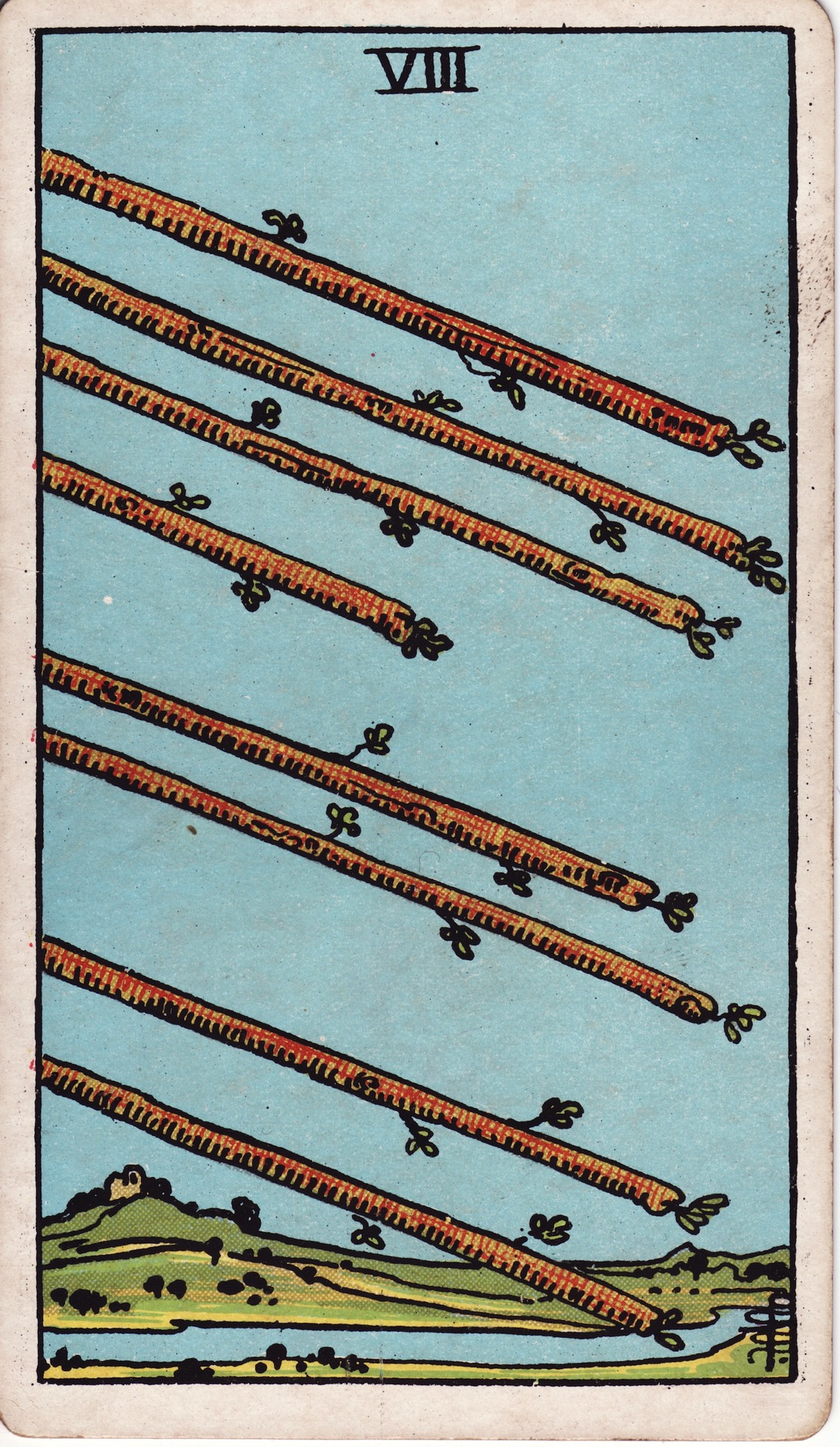
Eight of Wands from the Rider–Waite tarot deck

The Eight of Wands is a Minor Arcana tarot card. In the Rider–Waite deck, the card shows eight diagonal staves of staggered length angled across an open landscape with river, as designed by artist Pamela Colman Smith.

Tarot cards are used throughout much of Europe to play tarot card games.[1] In English-speaking countries, where the games are largely unknown, tarot cards came to be utilized primarily for divinatory purposes.[1][2]

Divinatory purposes

[edit]

A card of action; swiftness. Conveys immediate information or action. News swiftly travelling. Because the suit of wands relates to information, look for new communication and unexpected news. Depending on surrounding cards in the draw, may indicate the speed of these events.

Key meanings

[edit]

The key meanings of the Eight of Wands:[3]

  • Hasty actions
  • Journey and travel
  • A journey or flight
  • Motion
  • End to a delay

References

[edit]
Revisions and contributorsEdit on WikipediaRead on Wikipedia
from Grokipedia
The Eight of Wands is a card from the of the deck, belonging to the , which represents the element of fire and themes of action, inspiration, and growth. In the iconic Rider-Waite-Smith deck, illustrated by under the guidance of , the card depicts eight wooden wands hurtling diagonally through a clear blue sky over an open, green landscape, evoking a sense of unhindered motion and motion towards an end without any human figures present. This imagery symbolizes rapid progress and the culmination of efforts. According to Waite, the upright card signifies activity in undertakings, swiftness, great haste, great hope, and arrows of love. Modern interpretations often expand this to include fast-paced change, travel, incoming news, and sudden opportunities. In the reversed position, Waite describes arrows of jealousy, internal disputes, stingings of conscience, quarrels, and domestic disputes. Contemporary readings frequently interpret it as delays, frustration, and setbacks. Historically rooted in the esoteric traditions of the late 19th and early 20th centuries, the card reflects influences from the Hermetic Order of the Golden Dawn, where the relates to creative will and elemental fire.

History and Origins

Early Tarot Development

The Eight of Wands emerged during the as part of the in early decks, such as the Visconti-Sforza deck, which dates to approximately 1450 and was produced in for the ruling aristocracy. These decks functioned primarily as playing cards for games like tarocchi, with the consisting of four suits—swords, cups, coins, and wands (also called batons or )—each containing numbered pip cards from to ten and court cards. The Wands suit, derived from the Italian equivalent of clubs in standard playing cards and originally representing batons or associated with rural or martial pursuits in 15th-century courtly life, symbolized action and vitality in later esoteric interpretations. The inclusion of the Eight of Wands as a pip card continued in subsequent Italian-influenced decks, notably the Tarot de Marseille pattern, which developed in and during the 17th and 18th centuries. In these decks, the card featured a simple arrangement of eight wooden staffs or batons scattered across a plain background, without any human figures or additional narrative elements, emphasizing the numerical and suit-based structure typical of pip cards. This design reflected the standardization of for both gaming and emerging divinatory uses in . The transition to esoteric Tarot occurred in the 18th and 19th centuries through French occultists, beginning with Antoine Court de Gébelin's 1781 publication Le Monde Primitif, which reinterpreted Tarot as an ancient Egyptian wisdom system and assigned symbolic meanings to the suits, linking Wands broadly to themes of action and vitality. Building on this, Jean-Baptiste Alliette (Etteilla) produced the first dedicated esoteric Tarot deck in 1789, known as the Grand Etteilla or Tarot Égyptien, where he provided the initial documented divinatory interpretations for all cards, including the Eight of Batons (Wands). Etteilla's meanings for this card focused on themes of rural tranquility and joyful activity, such as countryside pleasures and pastoral harmony, without explicit numerological analysis, marking a shift from purely recreational use to occult symbolism. These early developments laid the foundation for later esoteric decks, such as the Rider-Waite-Smith Tarot of 1909, which retained the Eight of Wands while introducing more illustrative elements.

Depictions in Historical Decks

The Visconti-Sforza deck, dating to approximately 1450 and attributed to the workshop of Bonifacio Bembo in , presents the Eight of Wands as eight simple batons arranged in a symmetrical pattern, often forming a or without any narrative scene or figures, reflecting the deck's heraldic and decorative style for the . This arrangement emphasizes multiplicity and abundance through repetition of the suit symbol, aligning with the deck's overall function as luxury playing cards for the nobility rather than divinatory tools. In the Tarot de Marseille pattern, which emerged in the in and , the Eight of Wands (or Batons) depicts eight wands arranged diagonally or in a crosshatched formation against a plain background, with floral motifs at the ends to denote growth and energy, underscoring a sense of multiplicity and potential action without explicit motion. This standardized woodblock-printed design prioritized clarity and portability for gaming, influencing subsequent European decks. A notable variation appears in the Sola Busca deck of 1491, where the Eight of Wands is rendered as eight flowering rods contained within a vase-like form, evoking themes of fertility and containment that differ from the stark linearity of later pip decks. This engraved and hand-colored Venetian deck's illustrative approach to the prefigures more narrative styles, tying the wands to organic growth absent in subsequent standardized versions.

Iconography and Symbolism

Core Visual Elements

In the Rider-Waite-Smith tarot deck, created by and illustrated by in 1909, the Eight of Wands features eight wooden wands soaring through the air in a dynamic, diagonal arrangement that conveys a sense of rapid propulsion. These wands, depicted as slender rods with budding leaves at their tips, are staggered in length and angled across the composition, suggesting they are in mid-flight toward a destination. The scene unfolds against a vast, clear blue sky that dominates the upper portion of the card, providing an unobstructed expanse that emphasizes the wands' unimpeded . Below, a lush stretches out, characterized by rolling hills and a winding river that meanders through the terrain, evoking a sense of natural progression and vitality in the environment. Notably, the card contains no human or animal figures, focusing solely on the elemental motion and setting to highlight the forces at play. The color palette employs vibrant blues for the sky, rich greens in the landscape, and warm brown tones for the wooden wands. This visual scheme, rooted in the deck's evolution from earlier pip card traditions where displayed simple suit symbols without scenes—such as eight upright or crossed wands in decks like the —establishes a baseline for modern depictions.

Interpretations of Symbols

The , to which the Eight of Wands belongs, corresponds to the classical element of in the Hermetic Order of the Golden Dawn's Tarot system, embodying passion, creative impulse, and the rapid ignition of ideas into action. here signifies transformative energy that propels and , distinguishing the Wands from the more static or suits. This association underscores the card's core theme of dynamic momentum, where ideas burst forth with unbridled enthusiasm and purpose. Numerologically, the number eight evokes the infinity symbol (∞)—formed by rotating the numeral sideways—representing eternal cycles, balance, and fluid progression in esoteric traditions. In , this ties to structured yet fluid action through cyclical patterns. The Eight of Wands thus illustrates rapid evolution within this , channeling energy toward resolution. The depicted flying wands evoke motion symbolizing travel, swift communication, or accelerating events. These are frequently aligned with the archetype of Hermes (the Greek equivalent of Roman Mercury) due to astrological ties to Mercury's velocity and intellect. In Crowley's , explicitly attributed to Mercury in Sagittarius, this motion etherealizes fire into pure, high-velocity forms like light or electricity, denoting unobstructed transmission of will and ideas across distances. Landscape features in the Rider-Waite-Smith depiction, such as the winding river beneath the airborne wands, suggest a flow of that supports the fiery , integrating with for grounded advancement. In , often represents and emotional flow.

Divinatory Meanings

Upright Position

In the upright position, the Eight of Wands signifies swift progress, rapid developments, and the arrival of important messages or news, often indicating momentum in travel plans or unexpected opportunities that propel situations forward. This card embodies fast-paced change and alignment, where obstacles from prior challenges clear, allowing energy to flow freely and actions to yield quick results. Its symbolism ties briefly to the element of , evoking speed and dynamic propulsion. In contemporary yes/no tarot readings, the upright Eight of Wands is generally interpreted as "yes." It signifies swift progress, rapid movement, exciting news, and positive momentum toward a goal. In career and financial contexts, the upright Eight of Wands points to sudden job offers, accelerated project momentum, or financial windfalls arising from decisive, bold actions, urging alignment of efforts with long-term goals for optimal outcomes. Professionals may experience rapid growth, such as business trips or swift completions of tasks, fostering impactful advancement without unnecessary delays. For relationships, this card highlights fast-moving romances, heightened excitement, and clear communication that resolves lingering issues, often sweeping partners into passionate, forward-directed connections. Singles might encounter sudden attractions or commitments, while established pairs benefit from surprises that reinvigorate their bond through open expression. Regarding and , the upright Eight of Wands suggests quick recovery from ailments, bursts of inspirational , or spiritual breakthroughs, as positive supports and focused personal growth. High levels encourage proactive steps toward , while spiritually, it signals an upswing in and alignment with universal energies for manifestation. Astrologically, the Eight of Wands is associated with Mercury in Sagittarius, channeling expansive, direct energy that amplifies communication, optimism, and swift intellectual or exploratory pursuits.

Reversed Position

In the reversed position, the Eight of Wands signifies disruptions to momentum, often manifesting as delays, miscommunications, or scattered energy that halts progress. This inversion contrasts the upright card's rapid advancement by introducing obstacles that require patience and reevaluation, such as unfinished business or bad timing leading to frustration. Common interpretations emphasize the need to address past actions' repercussions, fostering a sense of impatience or negativity when energy feels blocked. In contemporary yes/no tarot readings, the reversed Eight of Wands often means "no" or "not now" due to delays or setbacks. In career and financial contexts, the reversed Eight of Wands points to frustrated plans, such as delayed projects, cancelled travel for work, or impulsive decisions resulting in errors and setbacks. It may indicate slow career progression, financial delays, or stagnation from disagreements, urging caution against rushing into ventures without alignment. For instance, missed opportunities or poor timing can lead to impulsive spending or halted advancements, advising a strategic pause to avoid further complications. Regarding relationships, this card reversed highlights arguments stemming from poor timing, misunderstandings, or stalled connections that sour initial passion. It suggests hesitation or jealousy disrupting the flow, where communication breakdowns create barriers, recommending clear dialogue and space to prevent escalation. In love readings, resistance to change may impede relational growth, contrasting the upright's swift harmony. For and , the reversed Eight of Wands warns of burnout from overexertion or blocked creative flow, potentially leading to slow recovery, , or declining . It indicates a lack of or negative influences stalling , such as inactivity causing illness or scattered focus hindering spiritual progress. Practitioners often interpret this as a call to realign physical and emotional states through rest, avoiding extremes that exacerbate stagnation. As advice in readings, the reversed Eight of Wands encourages pausing to realign priorities, reflecting on goals, and seeking clarity before proceeding, thereby transforming delays into opportunities for thoughtful action. This counsel promotes patience over haste, helping to resolve miscommunications and restore balanced energy.

Cultural and Modern Interpretations

Contemporary Usage and Variations

In contemporary practices, the Eight of Wands continues to evoke themes of rapid progress and swift communication, adapted across diverse modern decks to reflect minimalist aesthetics and inclusive narratives. The Wild Unknown Tarot, created by artist Kim Krans and published in 2012, reimagines the card with eight wands arranged in a circle, resembling wheel spokes in a , with a rainbow ray descending from above to merge with the top wand, emphasizing speed, , and meaningful coincidences in a nature-inspired style. Therapeutic applications of the card have integrated into digital wellness tools, where it supports and personal growth. The Seluna: Tarot & Affirmations app, updated as of October 2025, incorporates cards like the Eight of Wands in daily readings and affirmations to promote momentum and decisiveness in practices. This approach aligns the card's traditional upright meaning of quick advancement with modern routines, promoting mental agility in fast-paced lives. Cultural variations highlight evolving inclusivity, particularly in decks catering to marginalized communities. The Modern Witch Tarot, illustrated by Lisa Sterle and released in , depicts the Eight of Wands as a leather-clad motorcyclist speeding through a turbulent, cloud-filled sky toward freedom, underscoring themes of dynamic travel and with diverse, queer-inclusive representations that resonate with contemporary audiences seeking in movement and expression. Since 2020, online readings have increasingly linked the Eight of Wands to digital-age phenomena, interpreting its energy as the haste of viral social media trends and instantaneous online interactions. In platforms like and , practitioners describe the card as signaling rapid idea dissemination or content going viral, adapting its symbolism to the accelerated pace of virtual connectivity and global information flow.

References

Add your contribution
Related Hubs
User Avatar
No comments yet.