Hubbry Logo
Knight of WandsKnight of WandsMain
Open search
Knight of Wands
Community hub
Knight of Wands
logo
8 pages, 0 posts
0 subscribers
Be the first to start a discussion here.
Knight of Wands
Knight of Wands
from Wikipedia

Knight of Wands or Knight of Batons is used in Latin-suited playing cards including tarot decks. It is part of what tarot card readers call the Minor Arcana. Tarot cards are used throughout much of Europe to play tarot card games.[1]

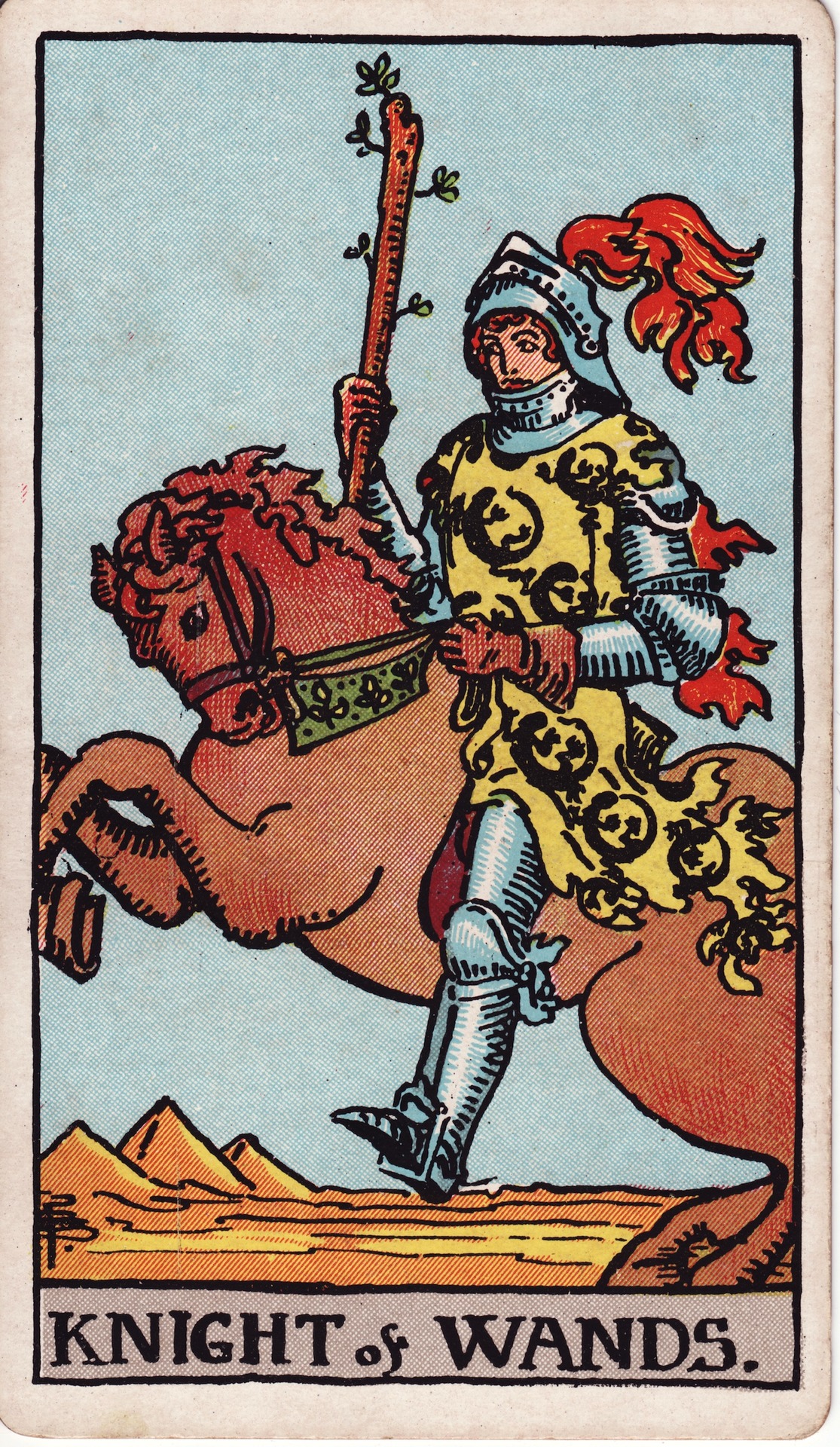
Knight of Wands from the Rider–Waite tarot deck

In English-speaking countries, where the games are largely unknown, Tarot cards came to be utilized primarily for divinatory purposes.[1][2]

Divination usage

[edit]

The questing knight, this man traditionally signifies travel, and progress. This also refers to new ideas and inventions. He looks forward, intelligent and knowledgeable, and yet ready for battle and full of fire.

The reversed meaning of the card is insecurity and fear of revealing one's true self.

Key meanings

[edit]

The key meanings of the Knight of Wands are: challenge, determination, foreign travel, leadership, and unpredictability.[3]

See also

[edit]

References

[edit]
Revisions and contributorsEdit on WikipediaRead on Wikipedia
from Grokipedia
The Knight of Wands is a court card in the within the Tarot's , embodying the fiery qualities of action, adventure, and impulsive energy in and symbolic interpretation. As one of the four court cards (Page, , Queen, and ) in this suit, it represents a youthful, masculine driven by passion and movement, often signifying travel, change, or the pursuit of bold ideas. The itself, corresponding to the element of , draws from medieval traditions where it symbolized and , evolving from the "batons" or "rods" suit in early Italian decks. Tarot decks, including the Knight of Wands, originated in around the mid-15th century as luxury playing cards used for games like tarocchi, with the earliest known examples such as the Visconti-Sforza deck featuring hand-painted court figures in opulent style. The court cards, including knights, were adaptations of the "knave" or "valet" from standard 52-card decks, but in , they gained layered symbolic depth through later revivals in the 18th and 19th centuries. By the 19th century, esoteric societies like the Hermetic Order of the Golden Dawn incorporated astrological and elemental associations, linking the Knight of Wands to the fire signs (Aries, Leo, Sagittarius) and mutable fire energy, emphasizing adaptability and enthusiasm. In the influential Rider-Waite-Smith deck of 1909, illustrated by Pamela Colman Smith under the guidance of Arthur Edward Waite, the Knight of Wands is depicted as an armored young man charging forward on a rearing horse across a arid landscape dotted with pyramids, clutching a sprouting wand that symbolizes burgeoning potential and inexhaustible drive. Waite described the figure as "shewn as if upon a journey, armed with a short wand, and although mailed is not on a warlike errand," with the horse's restless motion highlighting a "precipitate mood" of haste and volatility. Upright, the card denotes departure, flight, emigration, or the friendly spirit of a dark-haired young man, often indicating positive change like relocation or new ventures; reversed, it warns of rupture, discord, or interrupted progress. This imagery and interpretation have become foundational in modern Tarot practice, influencing countless decks and readings focused on personal growth and decisive action.

Origins and History

Early Development in Tarot

The Knight of Wands, originally known as the Knight of Batons, emerged as part of the court cards in the earliest known Tarot decks, which originated in during the early (around the 1430s) as playing cards for the game of tarocchi. These decks derived their structure from earlier playing cards introduced to via trade routes, adapting suits including batons (later wands), cups, swords, and coins to represent social classes, with batons associated with rural or peasant life. The , one of the oldest surviving examples dated around 1450 and attributed to the workshop of Bonifacio Bembo in , featured court cards depicting and figures, including kings, queens, knights, and knaves (or valets). In this deck, the Knight of Batons appears as a mounted nobleman in armor, holding a staff or baton, symbolizing action, , and martial prowess within the context of gameplay rather than . Some early Italian decks, like the Cary-Yale Visconti (c. 1440s), even included female counterparts to the knights, reflecting the courts of patrons such as the Visconti family. Initially confined to recreational card games among the Italian , the 's court cards, including the of Batons, carried no esoteric connotations, serving instead as symbolic representations of hierarchical social orders. The suit of batons evoked themes of growth, labor, and vitality tied to agrarian pursuits, aligning with the era's feudal structures. By the 16th and 17th centuries, the spread across , evolving into standardized patterns like the Tarot de Marseille, which first appeared around 1650 in and retained the Italian suits. In this influential pattern, the of Batons is depicted in profile astride a , gripping a tall staff in his right hand while clad in simple armor and a feathered , underscoring readiness for or without elaborate symbolic details. The shift toward esoteric interpretations of the Tarot, including the Knight of Batons, occurred in the amid the Enlightenment's revival. French Freemason and scholar , in the eighth volume of his 1781 work Le Monde Primitif, reimagined as an ancient Egyptian wisdom system, assigning elemental correspondences to the suits and linking batons (wands) to , rural existence, and creative energy. This marked the card's transition from a gaming figure to a of dynamic, passionate action in divinatory practices, though Gébelin's Egyptian origins claim was later debunked as speculative. Prior to this, no historical evidence supports divinatory use of early decks.

Evolution in Major Decks

The occult revival in France during the , emerging in the wake of the French Revolution's social upheavals, profoundly influenced 's esoteric development, transforming it from a primarily gaming tool into a system of symbolic . Éliphas Lévi, a pivotal figure in this revival, integrated into his magical philosophy in works like Dogme et Rituel de la Haute Magie (1854–1856), where he assigned the element of fire to the (Batons), symbolizing creative will and spiritual energy. Lévi further characterized the Knight of Wands as embodying dynamic, impulsive force— a restless traveler driven by passion and adventure, contrasting the suit's broader fiery vitality with the Knight's specifically martial and exploratory zeal. This esoteric framework gained prominence in the Rider-Waite-Smith deck, published in 1909 by A.E. Waite and illustrated by Pamela Colman Smith under the auspices of the Hermetic Order of the Golden Dawn. Departing from earlier unillustrated minor arcana, the Knight of Wands depicts a armored figure charging forward on a rearing horse across a barren desert landscape dotted with distant pyramids, evoking themes of exotic quests and hasty departure rather than warfare. Waite's accompanying The Pictorial Key to the Tarot (1910) describes the card as portraying "a dark man, departure, absence, flight," with the pyramids underscoring an aura of ancient mystery and bold exploration, solidifying the Knight's role in divinatory readings as a harbinger of change and enthusiasm. Aleister Crowley's , whose accompanying book was published in 1944 (the full-color deck first issued in 1969) and whose cards were painted by over five years from 1938 to 1943, reimagined the court cards with astrological and kabbalistic depth, renaming the Knight as the Prince of Wands to reflect the airy aspect of fire. In (1944), Crowley portrays the Prince as a solar of —swift, noble, and transformative, ruling the zodiac from the 21st degree of Cancer to 20 degrees of Leo, embodying the Sun's vital energy blended with Aries' violence and Sagittarius' reflection. Harris's abstract illustrations feature the Prince as a muscular warrior in scale mail, wielding a Phoenix amid flames and a lion-drawn , using vibrant reds, golds, and dynamic lines to convey explosive motion and spiritual volatility. Following , Tarot's popularity surged in English-speaking countries like the and , propelled by the movement's emphasis on personal growth and healing, which accelerated the shift from its historical gaming roots to predominant divinatory and therapeutic use. This era saw widespread commercialization and accessibility, with decks like the Universal Waite Tarot (1991, recolored by Mary Hanson-Roberts based on the Rider-Waite-Smith original) standardizing the Knight's imagery—a charging equestrian figure against a fiery, adventurous backdrop—to facilitate intuitive readings for a broad audience, reinforcing its association with impulsive action and exploration in modern esotericism.

Description and Symbolism

Traditional Iconography

The Knight of Wands in traditional Tarot decks features a central figure of an mounted on a , dynamically posed to suggest forward momentum, while gripping a or staff that often bears sprouting leaves or buds. In the Rider-Waite-Smith deck, the charges ahead on a rearing steed, embodying urgency and , with the horse's legs captured in dynamic motion to indicate rapid progress. The 's attire typically includes partial armor for , a plumed adding a flourish of flair, and a forward-facing with a resolute expression that conveys . This youthfulness, portraying the figure as a man in his mid-20s, sets the apart from the more seasoned and Queen of the , highlighting a phase of energetic . The he holds is short and active, sometimes used as a riding , underscoring themes of initiative without overt . Background elements vary by deck tradition: the Tarot de Marseille presents a minimalist neutral field, focusing attention on the figure and horse without scenic distractions, while the Rider-Waite-Smith version incorporates an arid desert landscape with distant pyramids, roaming lizards, and a barren horizon to evoke exotic, untamed terrains. In early Italian decks like the Visconti-Sforza, the knight figure appears in a more static pose without landscape details. These differences reflect the Rider-Waite-Smith's evolution toward illustrative symbolism from the plainer Marseille style.

Key Symbolic Motifs

The wand grasped by the Knight of Wands in the Rider-Waite deck serves as a staff adorned with fresh leaves and buds, embodying creative fire, growth, and unharnessed potential inherent to the , which is intrinsically linked to inspiration, enterprise, and the spark of . The horse beneath the Knight, depicted with a flowing mane in warm tones and in restless motion, symbolizes raw, untamed energy and an insistent drive for exploration and adventure, often associated in astrological correspondences with the zodiac sign of Sagittarius, reflecting the mutable fire within Golden Dawn traditions. Dominant colors such as , , and orange throughout the card—evident in the Knight's , the horse's , and the blazing sky—evoke the elemental force of , signifying passion, , and intellectual fervor; in some interpretations, these hues align with alchemical transformation, reinforced by salamander motifs on the armor that allude to the mythical creature's affinity for . The pyramids visible in the Rider-Waite background represent and the allure of distant quests, providing a stark contrast to the Knight's impulsive charge by underscoring themes of enduring ambition and the pursuit of profound, timeless goals.

Divination Interpretations

Upright Meanings

The Knight of Wands in its upright position embodies enthusiasm, adventure, and bold action, signaling a surge of passionate energy that propels individuals toward new ventures, travel, or creative endeavors. This card represents a dynamic force driven by inspiration and courage, encouraging the pursuit of ideas with unwavering determination and a clear vision for the future. In the Rider-Waite tradition, it evokes themes of departure and change, such as or relocation, often personified as a friendly, dark-haired young man ready to embark on a journey. In relationships, the upright Knight of Wands suggests the arrival of a charismatic and exciting partner who brings a rush of romantic energy and spontaneity, fostering connections marked by and mutual passion. However, it also hints at the potential for fleeting intensity, where the thrill may wane if not nurtured beyond the initial spark. Astrologically linked to the fiery sign of Sagittarius, this card advises channeling its expansive, freedom-seeking energy productively to sustain momentum and prevent exhaustion. Regarding career and finances, the Knight of Wands indicates opportunities for , , and sudden progress, such as launching a new , pursuing entrepreneurial risks, or relocating for growth. It symbolizes a pioneering spirit that thrives in uncertain environments, urging calculated boldness to transform ambitious ideas into tangible achievements while harnessing the card's inherent fire element for sustained vitality.

Reversed Meanings

In the reversed position, the Knight of Wands embodies a perversion of its upright , manifesting as recklessness, impatience, and scattered efforts that undermine . This orientation often signals delays in travel, projects, or personal endeavors due to poor planning and a lack of focus, where enthusiasm dissipates into aimless activity. Within relationships, the reversed Knight of Wands highlights and volatility, often indicating arguments fueled by or a partner's restless avoidance of commitment. This placement suggests a dynamic marked by fleeting passions that lead to emotional turbulence rather than deepening bonds. In career and financial contexts, the card cautions against impulsive decisions that precipitate setbacks, such as hasty job-hopping without strategic focus or risky investments driven by overconfidence. These actions can result in burnout, financial losses, or stalled opportunities, urging a reevaluation of priorities to channel energy more effectively.

Cultural and Modern Significance

Representations in Media and Art

The Knight of Wands, embodying dynamic and adventurous spirit, has influenced visual through modern decks that reinterpret traditional in innovative styles. In Salvador Dalí's Universal de (1984), the Knight of Wands is depicted featuring from Benozzo Gozzoli's 15th-century The Procession of the Magi. In literature, the Knight of Wands archetype manifests as the questing hero, a figure of bold exploration and unbridled passion seen in classic and fantasy narratives. ' Don Quixote (1605) exemplifies this through the titular character's impulsive chivalric quests, tilting at windmills in fiery pursuit of idealized adventure, mirroring the card's reckless enthusiasm. Film and television often echo the Knight of Wands in impulsive protagonists of adventure genres, where fiery energy propels narratives. George Lucas's works, including the Star Wars saga (1977–) and series (1981–2008), reflect themes of passion and creativity associated with the card. In video games, fantasy RPGs draw on adventurous archetypes similar to the Knight of Wands, though direct Tarot influences vary.

Applications in Psychology and Esotericism

In psychology, the Knight of Wands represents an adventurer archetype associated with motivation, optimism, and action, often used to encourage overcoming hesitation and embracing change. Sallie Nichols' 1980 work, Jung and Tarot: An Archetypal Journey, applies Carl Jung's theories to the deck, exploring court cards like the Knight of Wands through archetypal lenses. In modern esoteric traditions, including spirituality and Wiccan practices, the Knight of Wands is invoked during rituals and spells to channel fire-element energy for themes of travel, adventure, and creative inspiration, drawing on its associations with the planet Mars for assertive drive and the Hebrew letter Shin as a symbol of transformative fire. For instance, practitioners may meditate on the card to amplify intentions for journeys—physical or metaphorical—or to ignite artistic endeavors, aligning its vibrant symbolism with elemental invocations for momentum and vitality. For self-development, digital tools like the Labyrinthos Tarot app, available since , integrate the into daily readings and affirmations, encouraging users to embrace change by linking the card's passionate energy to practices that cultivate sustained and resilience. These features promote reflective exercises where the card's upright essence inspires bold steps forward, while its reversed form—briefly referenced in therapeutic contexts—signals frustrations from stalled progress, prompting to realign inner fire.

References

Add your contribution
Related Hubs
User Avatar
No comments yet.