Hubbry Logo
El Capitan (train)El Capitan (train)Main
Open search
El Capitan (train)
Community hub
El Capitan (train)
logo
8 pages, 0 posts
0 subscribers
Be the first to start a discussion here.
El Capitan (train)
El Capitan (train)
from Wikipedia

El Capitan
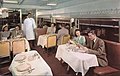
The El Capitan depicted on a 1950s postcard at some point after receiving its Hi-Level equipment
Overview
Service typeInter-city rail
StatusDiscontinued
LocaleMidwestern and Southwestern United States
First serviceFebruary 22, 1938
Last serviceApril 29, 1973
SuccessorSouthwest Chief
Former operatorsSanta Fe
Amtrak (1971–1973)
Route
TerminiChicago
Los Angeles
Average journey time39 hrs 30 min
Train numbers21 and 22
Line usedSouthern Transcon
Technical
Track gauge4 ft 8+12 in (1,435 mm) standard gauge

The El Capitan was a streamlined passenger train operated by the Atchison, Topeka and Santa Fe Railway ("Santa Fe") between Chicago, Illinois, and Los Angeles, California. It operated from 1938 to 1971; Amtrak retained the name until 1973. The El Capitan was the only all-coach or "chair car" (non-Pullman sleeper) to operate on the Santa Fe main line between Chicago and Los Angeles on the same fast schedule as the railroad's premier all-Pullman Super Chief. It was also the first train to receive the pioneering Hi-Level equipment with which it would become synonymous.

History

[edit]
The new El Capitan at Albuquerque, New Mexico, on March 1, 1938
The combined Super Chief / El Capitan, led by EMD F7s in the Warbonnet paint scheme, pulls into Track 10 at Los Angeles' Union Passenger Terminal (LAUPT) on September 24, 1966.

The El Capitan debuted on February 22, 1938, on a twice-weekly schedule, using two five-car sets of streamlined equipment built by the Budd Company.[1] Like the Pennsylvania Railroad's Trail Blazer, it offered "low-cost passage with high-speed convenience". The fare from Chicago to Los Angeles was $5.00 above the $39.50 regular coach fare in 1938.

Originally conceived as the Economy Chief, the name "El Capitan" was chosen to commemorate the Spanish conquistadors; it competed for passenger traffic with Union Pacific's Challenger. Unique in charging an extra fare despite being a coach train, it pioneered such features as "RideMaster" seats optimized for sleeping.

On its inaugural run the El Capitan left the main line at Williams and traveled up the Grand Canyon Railway to Grand Canyon Depot. In regular operation passengers bound for the Grand Canyon would connect at Williams.[2]

An EMD F3 #19, assigned to that day's El Capitan, smashed through a concrete barrier at Los Angeles Union Station in January 1948

In its first year and a half the El Capitan ran at 80% capacity, superior to similar services. Reservations had to be made weeks in advance.[3] In 1942 the consist expanded to 12 cars.[citation needed] Heavy traffic during World War II forced the Santa Fe to lengthen the train's schedule by two hours in July 1942; it restored the old schedule on June 2, 1946.[4] On September 29, 1946, the El Capitan began running every other day, departing Los Angeles and Chicago on odd-numbered days (except the 31st). Together with the Super Chief on even-numbered days, the two trains formed what the Santa Fe billed as "the first and only daily ⁠39+3/4 hour service between Chicago and California".[5] On January 25, 1948, one of the locomotives assigned to the El Capitan crashed through a steel bumper post and concrete wall at Los Angeles' Union Passenger Terminal, ending with the locomotive dangling about 20 feet above Aliso Street.[6] In 1948 the Santa Fe received additional equipment which permitted the Super Chief and El Capitan to start operating daily; the new schedules went into effect on February 29.[7] The extra-fare charges were dropped from both El Capitan and the Chief on December 14, 1953.[citation needed]

El Capitan was one of the first Santa Fe trains to use the Budd-built "Big Dome"-Lounge cars. These were soon given to the Chief (another AT&SF Chicago-to-Los Angeles special), and replaced by new double-decker "Hi-Level" chair cars (coaches) developed by Budd and the railroad in 1954–1956. These experimental cars had a quieter ride, increased seating capacities, and better views.[8][9]

The Santa Fe combined the Super Chief and El Capitan on January 12, 1958. The combined train used the Super Chief's numbers, 17 and 18, but the Santa Fe continued to use both names.[10] On its formation Amtrak continued the combined Super Chief/El Capitan designation until April 29, 1973, when it dropped the El Capitan portion.[11] Today the route of the El Capitan is served by Amtrak's Southwest Chief. Many Amtrak trains used a combination of refurbished former Santa Fe Hi-Level cars with newer Superliner railcars until the early 2000s.[citation needed]

Equipment

[edit]
Sample consists
February 1938
TrainOriginal consists
  • Locomotive: EMC E1 Locomotive #5 / #6
  • Baggage-Dormitory-Chair car (32 seats) #3480 / #3481
  • Chair car (52 seats) #3103 / #3104
  • Lunch Counter-Diner #1505 / #1506
  • Chair car (52 seats) #3105 / #3106
  • Round-end Chair car / Observation (50 seats) #3198 / #3199
[12]
Summer 1956
TrainWestbound #21
  • Locomotives: 4 x EMD F3/EMD F7
  • Baggage (storage mail)
  • Baggage
  • Baggage-Dormitory (transition car)
  • Hi-Level Step Down Chair Car (68 seats)
  • Hi-Level Chair Car (72 seats)
  • Hi-Level Chair Car (72 seats)
  • Hi-Level Diner
  • Hi-Level Lounge
  • Hi-Level Chair Car (72 seats)
  • Hi-Level Chair Car (72 seats)
  • Hi-Level Chair Car (72 seats)
  • Hi-Level Step Down Chair Car (68 seats)
[13]

The El Capitan debuted in February 1938 with consists of two all-lightweights manufactured by the Budd Company. Each included a baggage-dormitory-coach, two coaches, a lunch counter-dining car, and coach-observation car. The baggage-dormitory-coach had a small baggage area forward, followed by bunks for the train's crew and 32 coach seats. Both coaches seated 52 and featured men's and women's restrooms at opposite ends. In the observation car the restrooms were located forward, followed by 50 coach seats. During periods of high demand additional cars were added from the Scout's pool.[14] The Santa Fe also employed its experimental pendulum car.[15]

Between 1946 and 1948, the Santa Fe increased the length of the El Capitan and added new cars built during and after World War II. The new El Capitan included a storage mail car, baggage-dormitory, eight 44-seat "leg-rest" coaches, two lunch counter-dining cars, a club-lounge, and a coach-observation car. Most of the coaches were built by Pullman-Standard.[16] The reduced seating in the coaches was given over to improved leg room for passengers.[17]

Between 1954 and 1956, the El Capitan's consist included the "Big Dome"-Lounge that replaced the mid-train club-lounge car. On July 15, 1956, the new, "Hi-Level" streamliner consist debuted. Santa Fe purchased enough "Hi-Level" equipment for consists of five nine-cars. Six of the railroad's older baggage-dormitory cars had a cosmetic fairing applied to the rear roofline to create the distinctive "transition" cars and maintain a streamlined appearance on the El Capitan. The real transition cars were the 68-seat step down chair cars, which had a regular-height diaphragm at one end and a high-level at the other. The dining cars rode on six-wheel trucks due to their massive weight (all other cars rode on four-wheel trucks). The "Big Domes" were transferred to the Chief pool.[18][19]

As on many "named" long haul trains of the era, the rear of the observation car bore a lighted "drumhead".[20] These signs included "El Capitan" in a distinctive logotype with the railroad's logo.[21]

See also

[edit]

Notes

[edit]

References

[edit]
[edit]
Revisions and contributorsEdit on WikipediaRead on Wikipedia
from Grokipedia
The El Capitan was a renowned all-coach operated by the Atchison, Topeka and Santa Fe Railway (commonly known as Santa Fe), providing economy-class service between , , and , , from 1938 until discontinued the name in 1973. Launched on February 22, 1938, as a streamlined counterpart to the upscale , the El Capitan targeted budget-conscious travelers with comfortable seating in air-conditioned coaches but no sleeping cars, covering the 2,227-mile route via Kansas City in a swift 39¾-hour schedule. Initially running twice weekly and becoming daily in 1948, it featured innovative equipment upgrades, including Budd-built stainless-steel cars in the 1940s and lounge-dining facilities to enhance the journey through the scenic Southwest. A major milestone came in with the introduction of pioneering double-deck coaches—the first of their kind in the U.S.—offering expanded seating capacity, panoramic dome lounges, and lower-level galleys, which later influenced Amtrak's Superliner cars. From 1958 onward, except during peak seasons, the was combined with the for efficiency, sharing locomotives and crew while maintaining distinct all-coach consists under train numbers 17 and 18, a practice that continued into the early era. Santa Fe service ended on April 30, 1971, coinciding with 's assumption of most intercity passenger routes, after which Amtrak continued the combined / until 1973; the route was later served by Amtrak's (renamed in 1975), and the cars remained in use for decades on various routes.

Route and Service Overview

Route and Stops

The El Capitan followed a primary route from Chicago, , to Los Angeles, , covering approximately 2,227 miles across the Midwestern and , traversing the states of , , , , , , and . This path utilized the Atchison, Topeka and Santa Fe Railway's main line, providing a direct transcontinental connection through diverse landscapes from urban centers to remote expanses. Key stops along the route included Chicago's as the eastern terminus, Kansas City in , Newton in , Dodge City in , La Junta in , Raton in , Albuquerque in , Gallup in , Flagstaff and Williams in , Barstow and San Bernardino in , and Los Angeles Union Passenger Terminal as the western endpoint. These stations served as major points for passenger boarding, connections to local services, and brief service intervals, with the train making selective halts to maintain efficiency on the long-distance journey. The route's terrain presented notable challenges and scenic highlights, including the ascent over the via at an elevation of 7,834 feet and subsequent navigation through the expansive deserts of the Southwest. Minor route variations occurred during wartime periods or for maintenance, involving occasional detours or alignments to accommodate operational needs.

Operational Schedule and Duration

The El Capitan launched on February 22, 1938, operating on a twice-weekly schedule with departures from on Tuesdays and Saturdays at 5:45 PM, arriving in approximately 39¾ hours later, and return trips from on Tuesdays and Fridays at 1:30 PM, taking about 39¾ hours eastbound. This timetable positioned it as the fastest all-coach of its era between the two cities. Service frequency increased post-World War II, transitioning to every-other-day runs starting September 29, 1946, before achieving daily operations by early 1948, allowing consistent availability for passengers on the Chicago-Los Angeles route. In January 1958, the El Capitan was consolidated with the Super Chief during off-peak periods, operating under shared train numbers (17 westbound and 18 eastbound) while retaining distinct consists for coach and Pullman services, which streamlined operations without altering the core schedule. The train's schedule emphasized efficiency, averaging 56 mph overall across its 2,227-mile route despite multiple stops, with sustained speeds up to 100 mph achieved on level prairie sections in and . This performance highlighted the advantages of its Budd-built stainless-steel and diesel . Upon 's formation on May 1, 1971, the combined / continued daily service with a slightly extended duration of about 40 hours and 30 minutes westbound due to operational adjustments. Santa Fe operations ended in 1971, with retaining the name until April 29, 1973.

Historical Development

Inception and Pre-War Era

The Atchison, Topeka and Santa Fe Railway launched the on February 22, 1938, as the nation's first streamlined, all-coach transcontinental , designed to provide an affordable alternative to luxury Pullman services like the flagship while matching its 39-hour, 45-minute schedule between and . This innovative service aimed to democratize long-distance rail travel, attracting middle-class passengers with modern amenities in a non-sleeper configuration. The debut featured public tours at Chicago's , drawing over 30,000 visitors, and underscored the Santa Fe's push into economy streamliners amid growing competition from automobiles and airlines. The train's development involved close collaboration between Santa Fe executives and , which constructed the lightweight, all-stainless-steel to emphasize speed, comfort, and durability. The initial consist comprised five : a baggage-dormitory-coach, two 52-seat coaches, a lunch-counter , and a coach-lounge , all optimized for daytime travel over the 2,227-mile route. One-way fares were set at $44.50 from to , significantly undercutting premium options and positioning the El Capitan as an accessible transcontinental choice. From inception, the operated twice weekly in each direction, powered by EMC E1 diesel locomotives that delivered reliable performance across varied terrain, including the demanding . It quickly gained popularity, achieving capacity operations and requiring advance reservations, which highlighted its appeal as a fast, efficient coach service averaging over 56 mph. As escalated, the train faced heightened demands, running at full occupancy to accommodate military personnel and war-related traffic, which strained resources but reinforced its role in national mobilization efforts through 1945.

Post-War Innovations and Peak

Following , the Atchison, Topeka and Santa Fe Railway resumed operations of the El Capitan with every-other-day service in 1946, reflecting the broader recovery of the U.S. passenger rail network amid material shortages and labor transitions. By October 1947, the schedule shifted to tri-weekly runs, and daily service commenced on February 29, 1948, replacing the discontinued heavyweight Scout train and solidifying the El Capitan's role as the premier all-coach between and . This expansion coincided with the adoption of and F7 diesel locomotives, painted in the iconic red-and-silver Warbonnet , which provided reliable power for the 2,200-mile route and marked a transition from steam to diesel-electrification across Santa Fe's fleet. A pivotal operational advancement occurred on January 12, 1958, when the merged with the all-Pullman during off-peak periods, operating as a single train under numbers 17 (westbound) and 18 (eastbound) with segregated coach and sleeping car sections to optimize crew, track usage, and . This combination reduced costs while maintaining the 's identity as an economy-class service, allowing it to run on a 39.5-hour schedule that preserved the route's competitive edge against emerging . The merger proved successful, with the trains separating only during holiday peaks, and it exemplified Santa Fe's adaptive strategies to sustain long-distance passenger volumes into the late 1950s. Technological innovation peaked with the introduction of bilevel passenger cars, the first such equipment on American rails, beginning with prototypes in 1954 and a full consist debuting on July 8, 1956. Built by , these 15-foot-8-inch-tall cars featured upper-level seating for panoramic views, lower-level baggage and restrooms, and integrated lounges and diners, boosting the standard nine-car consist's capacity to 496 passengers—146 more than the prior single-level setup—while shortening the train length by two cars. Earlier in 1954, the El Capitan also adopted Budd's "Big Dome" observation lounges, transferred from other Santa Fe services like the Kansas City Chief, which enhanced passenger enjoyment of the Southwest's dramatic scenery through elevated, 360-degree vistas. These upgrades drove ridership highs in the , with the combined /El Capitan averaging strong loads that underscored the viability of innovative rail design amid growing automobile and airline competition.

Amtrak Era and Discontinuation

When assumed nationwide intercity passenger rail operations on May 1, 1971, the Atchison, Topeka and Santa Fe Railway transferred control of the to the new entity, allowing it to continue as a distinct all-coach service integrated into the daily combined / train running between and . This transition preserved the route's structure, with the providing economy seating options alongside the 's sleeping cars, utilizing Santa Fe's inherited passenger cars for double-decked capacity. However, 's operational challenges soon emerged, including deferred maintenance on the aging fleet, which led to mechanical reliability issues and service disruptions on the transcontinental run. Under Amtrak, the train's schedule was adjusted to reflect broader network constraints, maintaining daily frequencies but with extended travel times of about 40 hours compared to the Santa Fe era's more efficient runs, partly due to shared track priorities with freight traffic. The service faced mounting pressures from a significant decline in ridership—down roughly 50% from the 1960s peaks amid competition from air and highway travel—as well as escalating operational costs, including fuel expenses amid early signs of economic strain. Amtrak's mandate for cost-cutting, driven by limited federal funding and the need to streamline unprofitable long-distance routes, further compounded these issues, prompting reductions in onboard amenities and crew efficiency. The made its final run on April 29, 1973, after which fully merged its all-coach elements into the , dropping the separate name to simplify operations and branding. This discontinuation was influenced by ongoing ridership erosion, rising fuel and maintenance costs, and 's aggressive efforts to eliminate redundant services, aligning with broader network rationalization under federal oversight. In the immediate aftermath, surviving cars were repurposed for other routes, with some remaining in into the before retirement in the mid-2020s. The route's core infrastructure was absorbed into the renamed Southwest Limited (later ), ensuring continuity of Chicago-Los Angeles connectivity.

Equipment and Technology

Early Streamlined Consists

The El Capitan debuted on February 22, 1938, as an all-coach streamlined operated by the Atchison, Topeka and Santa Fe Railway, featuring two identical five-car consists built by using lightweight stainless-steel construction. Each consist was powered by a pair of EMC E1 diesel locomotives, with each unit delivering 1,800 horsepower for a combined output of 3,600 horsepower, allowing the train to reach speeds of up to 100 mph and maintain a fast schedule matching the flagship . The cars included a baggage-dormitory-chair with 32 reclining seats and crew accommodations, two 52-seat chair cars equipped with leg rests, a lunch-counter-diner seating 36 passengers, and a coach-observation with 50 seats, providing a total passenger capacity of approximately 222 seats per consist. Design innovations emphasized comfort and efficiency, with all fully air-conditioned—a pioneering feature for an all-coach —and featuring wide interiors over nine feet across, wood-veneered side walls, carpeted floors, and deep in the seating areas. The streamlined coach-observation at the rear offered panoramic rearward views through its rounded-end , enhancing the experience on the Chicago-to-Los Angeles route. These Budd-built were noted for their smooth ride and modern aesthetics, contributing to the 's reputation as a "pocket " optimized for speed and economy. Throughout the pre-war and wartime periods up to 1955, the consists saw operational variations to meet growing demand, including the rotation of cars between the two sets for maintenance and the addition of extra coaches in the to increase capacity as service frequency expanded from twice-weekly to daily runs. During , material constraints limited major expansions, but the existing equipment underwent routine upkeep with minimal modifications to sustain reliability amid heightened wartime traffic. By the mid-1950s, these single-level streamlined sets had established the El Capitan's role in high-speed, all-coach transcontinental travel before transitioning to advanced configurations.

Hi-Level Cars and Upgrades

The cars, introduced in 1956 for the , represented the first bilevel passenger cars designed for long-distance service in the United States, built by . These innovative double-decker coaches featured seating primarily on the upper level, with the lower level dedicated to , restrooms, and mechanical equipment, allowing for expanded passenger capacity without increasing train length. The initial consist included four diesel locomotives in an A-B-B-A configuration to haul the all-coach train, comprising Hi-Level chair cars seating 72 passengers per upper level, diners with kitchens on the lower level serving 80 passengers upstairs, and lounges accommodating 80 passengers across both levels. Technically, the Hi-Level cars stood 15 feet 6 inches tall, significantly taller than conventional single-level cars, which boosted overall passenger capacity to approximately 520 seats in a typical nine-car passenger consist. Constructed from lightweight , they provided enhanced stability and smoother performance at speeds up to 100 mph, with large windows on the upper level offering superior views of the route's scenic passages. The design included center stairwells for access, four-wheel trucks on lighter coaches for efficiency, and Timken roller bearings to minimize friction and support high-speed operation. Over time, the fleet evolved with upgrades to improve versatility and comfort. In the 1960s, additional step-down lounges were introduced, featuring lower-level entry vestibules for seamless integration with single-level cars on combined trains. During the era starting in 1971, modifications were made to the cars' end configurations, including added fairings and transition boots on baggage-dormitories, ensuring compatibility when paired with sleeping cars for joint operation between and . These changes extended the cars' service life into the late 1970s under , with some lounge cars continuing in use until 2018, influencing later bilevel designs like Amtrak's Superliners. A distinctive feature of the consists was the signage on the rear cars, displaying the iconic "" name in script lettering above a stylized mountain silhouette, illuminated at night to evoke the train's namesake peak in . This signage, mounted on step-down coaches or lounges serving as observation cars, became a hallmark of the train's identity through 1973.

Passenger Experience and Cultural Impact

Onboard Amenities and Service

The El Capitan distinguished itself as an all-coach by emphasizing comfort in its seating arrangements, which were engineered for extended transcontinental travel without sleeping accommodations. Each coach featured wide, upholstered reclining seats equipped with adjustable leg rests and fingertip controls for multiple recline positions, allowing passengers to relax during the 39-hour journey from to . Individual reading lights and spacious legroom further enhanced the experience, positioning the train as an accessible form of deluxe rail travel for budget-conscious riders seeking luxury without the premium cost of Pullman sleepers. Onboard service was attentive and personalized, with dedicated stewards assigned to each coach car to assist passengers, distribute , and ensure overall comfort. Complimentary newspapers and magazines were available in the lounge areas, fostering a sense of that contributed to the train's for superior care. This level of , combined with the absence of sleeping cars, allowed the El Capitan to cater to families, business travelers, and tourists alike, offering a refined yet economical alternative to other long-distance services. Dining aboard the El Capitan was handled by the renowned , which provided full-service meals in dedicated diner cars featuring white-tablecloth settings and menus highlighting fresh steaks, regional Southwestern dishes, and classic American fare like and fresh salads. Breakfast options included eggs, fruits, and cereals, while dinners often centered on grilled meats served with and desserts such as pies or . Meals were reasonably priced for the era, typically costing between $2 and $5 in the 1950s, making accessible to all coach passengers and underscoring the train's commitment to quality without extravagance. Lounge facilities elevated the passenger experience, evolving from the early Pleasure Dome observation cars with their expansive glass-enclosed upper levels for panoramic views, to the 1954 Big Dome lounges that included fully stocked bars and cocktail seating for socializing. By 1956, the introduction of double-decker lounges added upper-level observation areas with card tables, snacks, and additional seating, providing quiet spaces for reading or games while attendants served beverages from morning until late evening. These amenities, integrated seamlessly into the all-coach consist, helped maintain high levels of passenger satisfaction throughout the and , with the train achieving near-capacity loads and widespread acclaim for its service standards.

Legacy and Successors

Following the Santa Fe's discontinuation of the El Capitan in 1971, Amtrak continued the service under the combined /El Capitan name until April 1973, when the El Capitan designation was dropped. The route continued under and was renamed the in 1978, which operates much of the original Chicago-to-Los Angeles path today. initially utilized the El Capitan's cars on the route that became the in the early 1970s, before transitioning to Superliner cars; the design influenced Amtrak's bilevel fleet, with original cars remaining in service on other routes until their retirement in 2018. The El Capitan's innovative cars significantly influenced subsequent bilevel passenger designs in the United States, serving as the direct prototype for Amtrak's Superliner cars introduced in the 1970s. These Superliners, which expanded on the 's double-deck configuration for increased capacity and improved sightlines, were deployed on routes including services like the and San Diegan (predecessor to the ). The design's emphasis on upper-level seating and panoramic views set a standard for modern equipment in . The train's legacy extends to cultural and hobbyist spheres, where it has been chronicled in numerous rail history books, such as Patrick C. Dorin's Santa Fe Super Chief and El Capitan 1936-1971, which details its operational evolution and passenger appeal. The El Capitan has been featured in popular culture, including films like '3:10 to Yuma' (1957) and various rail-themed documentaries, cementing its status as an icon of mid-20th-century American travel. It has also inspired extensive modeling in the railroading community, with detailed replicas of its consists produced by manufacturers like Walthers and American Z Line, reflecting its enduring popularity among enthusiasts. Collectible memorabilia, including posters and brochures, further underscores its iconic status in American rail heritage. Preservation efforts have ensured that examples of equipment survive for public display. The Heart of Dixie Railroad Museum in houses Santa Fe Chair Car No. 2931, a 1950-built coach originally assigned to the train for long-distance service. In 2023, the Arizona Railway Museum acquired a 1956 lounge car (No. 576), marking the third such piece in its collection and highlighting ongoing interest in the train's pioneering bilevel technology. In the 2020s, discussions around high-speed rail have revived interest in transcontinental passenger concepts akin to the El Capitan's route. The proposed Transcontinental Chief, a private high-speed service aiming to connect Los Angeles and New York in under 72 hours by 2026, echoes the original train's coast-to-coast ambition while incorporating modern infrastructure upgrades. This initiative, planned with stops along similar Midwestern and Southwestern corridors, represents a potential evolution of the El Capitan's legacy in sustainable long-distance travel.

References

Add your contribution
Related Hubs
User Avatar
No comments yet.