


Community hub
Recent from talks
Knowledge base stats:
Talk channels stats:
Members stats:
Linear elasticity
Linear elasticity is a mathematical model of how solid objects deform and become internally stressed by prescribed loading conditions. It is a simplification of the more general nonlinear theory of elasticity and a branch of continuum mechanics.
The fundamental assumptions of linear elasticity are infinitesimal strains — meaning, "small" deformations — and linear relationships between the components of stress and strain — hence the "linear" in its name. Linear elasticity is valid only for stress states that do not produce yielding. Its assumptions are reasonable for many engineering materials and engineering design scenarios. Linear elasticity is therefore used extensively in structural analysis and engineering design, often with the aid of finite element analysis.
Equations governing a linear elastic boundary value problem are based on three tensor partial differential equations for the balance of linear momentum and six infinitesimal strain-displacement relations. The system of differential equations is completed by a set of linear algebraic constitutive relations.
In direct tensor form that is independent of the choice of coordinate system, these governing equations are:
where is the Cauchy stress tensor, is the infinitesimal strain tensor, is the displacement vector, is the fourth-order stiffness tensor, is the body force per unit volume, is the mass density, represents the nabla operator, represents a transpose, represents the second material derivative with respect to time, and is the inner product of two second-order tensors (summation over repeated indices is implied).


Expressed in terms of components with respect to a rectangular Cartesian coordinate system, the governing equations of linear elasticity are:
An elastostatic boundary value problem for an isotropic-homogeneous media is a system of 15 independent equations and equal number of unknowns (3 equilibrium equations, 6 strain-displacement equations, and 6 constitutive equations). By specifying the boundary conditions, the boundary value problem is fully defined. To solve the system two approaches can be taken according to boundary conditions of the boundary value problem: a displacement formulation, and a stress formulation.
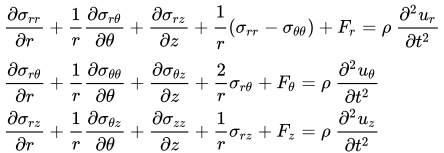
In cylindrical coordinates () the equations of motion are The strain-displacement relations are and the constitutive relations are the same as in Cartesian coordinates, except that the indices 1,2,3 now stand for ,,, respectively.




Hub AI
Linear elasticity AI simulator
(@Linear elasticity_simulator)
Linear elasticity
Linear elasticity is a mathematical model of how solid objects deform and become internally stressed by prescribed loading conditions. It is a simplification of the more general nonlinear theory of elasticity and a branch of continuum mechanics.
The fundamental assumptions of linear elasticity are infinitesimal strains — meaning, "small" deformations — and linear relationships between the components of stress and strain — hence the "linear" in its name. Linear elasticity is valid only for stress states that do not produce yielding. Its assumptions are reasonable for many engineering materials and engineering design scenarios. Linear elasticity is therefore used extensively in structural analysis and engineering design, often with the aid of finite element analysis.
Equations governing a linear elastic boundary value problem are based on three tensor partial differential equations for the balance of linear momentum and six infinitesimal strain-displacement relations. The system of differential equations is completed by a set of linear algebraic constitutive relations.
In direct tensor form that is independent of the choice of coordinate system, these governing equations are:
where is the Cauchy stress tensor, is the infinitesimal strain tensor, is the displacement vector, is the fourth-order stiffness tensor, is the body force per unit volume, is the mass density, represents the nabla operator, represents a transpose, represents the second material derivative with respect to time, and is the inner product of two second-order tensors (summation over repeated indices is implied).
Expressed in terms of components with respect to a rectangular Cartesian coordinate system, the governing equations of linear elasticity are:
An elastostatic boundary value problem for an isotropic-homogeneous media is a system of 15 independent equations and equal number of unknowns (3 equilibrium equations, 6 strain-displacement equations, and 6 constitutive equations). By specifying the boundary conditions, the boundary value problem is fully defined. To solve the system two approaches can be taken according to boundary conditions of the boundary value problem: a displacement formulation, and a stress formulation.
In cylindrical coordinates () the equations of motion are The strain-displacement relations are and the constitutive relations are the same as in Cartesian coordinates, except that the indices 1,2,3 now stand for ,,, respectively.