Hubbry Logo
Eleazar WheelockEleazar WheelockMain
Open search
Eleazar Wheelock
Community hub
Eleazar Wheelock
logo
8 pages, 0 posts
0 subscribers
Be the first to start a discussion here.
Eleazar Wheelock
Eleazar Wheelock
from Wikipedia

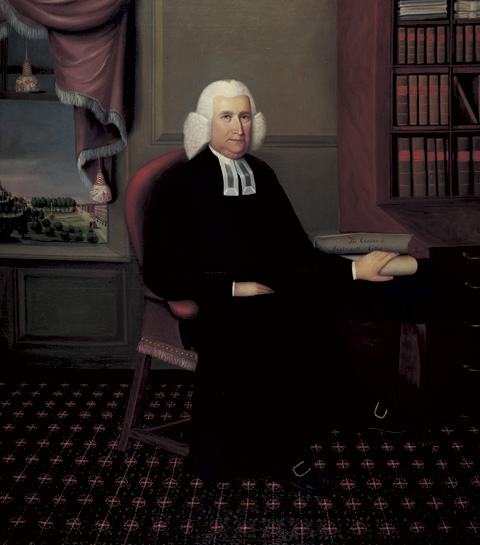
Eleazar Wheelock (April 22, 1711 – April 24, 1779) was an American Congregational minister, orator, and educator in present-day Columbia, Connecticut, for 35 years before founding Dartmouth College in New Hampshire. He had tutored Samson Occom, a Mohegan who became a Presbyterian minister and the second Native American to publish writings in English. Before founding Dartmouth, Wheelock founded and ran the Moor's Charity School in Connecticut to educate Native Americans. The college was primarily for the sons of American colonists.

Key Information

Early life and education

[edit]

Eleazar Wheelock was born in Windham, Connecticut, to Ralph Wheelock and Ruth Huntington, who had a prosperous farm of 300 acres.[1] He is the great-grandson of the first teacher of the first free school in the United States (see Dedham, Massachusetts), the Rev. Ralph Wheelock. In 1733, he graduated from Yale College, having won the first award of the Dean Berkeley Donation for distinction in classics. He continued his theological studies at Yale until he was licensed to preach in May 1734.

Marriage and family

[edit]

Two months after beginning as pastor of a church, on April 29, 1735, he married Sarah Davenport. She died in 1746. They managed a farm in addition to his pastoring, and he was an itinerant preacher during the 1730s and '40s.[1]

He married a second time to Mary Brinsmead, a widow with two children. In total he had eight children with his wives and two step-children.[1]

Career

[edit]

Wheelock was installed as the pastor of the Second Congregational Church of Lebanon Crank, Connecticut (now Columbia, Connecticut), in February 1735 and served as their minister for 34 years. Wheelock also acted as an itinerant preacher during the Great Awakening, a religious revival that had begun to sweep the Connecticut River Valley around the time of his graduation from Yale. He was one of its greatest proponents in the state, serving as the "chief intelligencer of revival news".

In addition, Wheelock was deeply concerned about Native Americans in New England, whose numbers had declined rapidly due to disease, warfare and social disruption, including continued encroachment on their lands by colonists.[1]

Wheelock "was a long-time slave owner".[2]

Christian missionary

[edit]

In 1743, Wheelock took in a student named Samson Occom, a Mohegan who knew English and had converted to Christianity in his childhood. He taught Occom for four years; the youth was a ready student, learning to read and write in Hebrew as well as deeply studying theology. After preaching for several years to the Pequot people in Montauk on eastern Long Island, Occom was ordained in Suffolk County, New York, as a Presbyterian minister. He returned to Connecticut to preach to the Mohegan and later organized Christian Indians as the Brothertown Indians.

Wheelock's success in preparing Occom for the ministry encouraged him to found a school in Columbia, Connecticut, for Native Americans. He planned to teach the boys in both secular and Christian subjects, so they could return to their native culture as missionaries. The girls would learn "housewifery" and English skills including reading and writing. Charitable contributions from New England and England supported the Moor's Charity School, which was located on Columbia's town green. Some students became homesick or even ill and died; few became missionaries.

Establishment of Dartmouth and presidency

[edit]

After sending Occom and another minister on a speaking tour of England to raise money for the charity school, Wheelock decided to enlarge it, as well as adding college classes for the education of American colonists in the classics, philosophy, and literature. He began to search for another location for the schools. Wheelock obtained a charter from King George III on December 13, 1769. Having worked and raised funds for the education of Native Americans, Occom and the British Board of Trustees headed by Lord Dartmouth opposed the addition of the college to benefit the sons of the colonists.

Wheelock kept the lord's donation and named the college after him, as Dartmouth College. He chose Hanover, New Hampshire, for the location and became the college's president. In 1771, four students were graduated in Dartmouth's first commencement, including Wheelock's son John. While some Native Americans attended Dartmouth, it primarily served the sons of American colonists.

Wheelock died during the Revolutionary War, on April 24, 1779. He is buried in Hanover. His writings include "Narrative of the Indian School at Lebanon."

Legacy and honors

[edit]
  • Wheelock, Vermont, in Caledonia County is named for him.
  • During World War II a Liberty Ship (Maritime Hull Number 0038) was named for Wheelock. This was a C-2 cargo ship outfitted to carry 550 troops. It participated in the Normandy Invasion and is frequently mentioned in the book The Far Shore by the American author Max Miller.

Notable descendants

[edit]

References

[edit]
[edit]
Revisions and contributorsEdit on WikipediaRead on Wikipedia
from Grokipedia
Eleazar Wheelock (April 22, 1711 – April 24, 1779) was an American Congregational minister, educator, and college founder who established Moor's Indian Charity School in , in 1754 to provide Christian education to Native American youth as a means of preparation. Born in , to a farming family, Wheelock graduated from in 1733 and was ordained as a minister, serving the Second Congregational Church in for over three decades while engaging in revivalist preaching during the . Wheelock's educational initiatives stemmed from his collaboration with Mohegan minister , whom he tutored and who later preached in to raise funds for the school, enabling its expansion despite challenges like student attrition and pressures. Seeking broader scope and resources amid growing enrollment of English students, Wheelock relocated the institution northward, securing a for in , in 1769, where he served as its first president until his death. The college aimed to train both Native and European men as missionaries and leaders, reflecting Wheelock's vision of as a tool for religious and civilizational advancement in the frontier. Though Wheelock's projects achieved modest success in graduating Native who contributed to tribal communities and missions, they faced for prioritizing English-style over indigenous traditions, a tension evident in Occom's later disputes with Wheelock over fund management and institutional priorities. His legacy endures through Dartmouth's evolution into a major university, underscoring his role in pioneering colonial higher education with a focus on intercultural work.

Personal Background

Early Life and Education

Eleazar Wheelock was born on April 22, 1711, in , the only surviving male child of Ralph Wheelock, a and prosperous who owned approximately 300 acres of land, and Ruth Huntington, from a locally prominent . He grew up as one of five surviving siblings in a household emphasizing and education, with his family's relative prominence traced to ancestors including a great-grandfather who held a . Despite his rural farm upbringing, Wheelock exhibited scholarly promise early, preparing him for advanced study. In 1729, at age 18, Wheelock enrolled at in , where he immersed himself in the curriculum of , theology, and philosophy, aligning with the emerging "New Light" faction that challenged traditional Calvinist orthodoxy by emphasizing personal religious experience. He graduated in 1733, earning a shared prize for excellence in , a distinction reflecting his proficiency in ancient languages and texts. Following graduation, Wheelock pursued theological studies and obtained a to preach from Yale in 1734, marking his formal entry into ministerial preparation amid the colony's Congregationalist traditions.

Marriage and Family

Wheelock married Sarah Davenport, the widow of Captain William Maltby of , on April 29, 1735. Sarah, sister of the itinerant minister James Davenport, brought at least one stepchild into the marriage, John Maltby, who died young from disease and was held dear by Wheelock. The couple had six children together, including Ralph Wheelock, who suffered from and thus could not participate in his father's efforts. Sarah died in 1746. Following Sarah's death, Wheelock remarried Mary Brinsmead, a widow with two children from her prior marriage, on November 21, 1747. They had five children: Mary (born August 28, 1748), Abigail (born December 21, 1751), John (born January 28, 1754), Eleazar Jr. (born 1756), and James. John Wheelock later succeeded his father as president of Dartmouth College, though he initially preferred military service. Abigail and Mary each married Dartmouth professors. In total, Wheelock fathered eight biological children across his two marriages while raising stepchildren, amid financial strains from supporting the large household that occasionally embittered him but did not disrupt domestic harmony.

Ministerial Career

Ordination and Pastorate in Lebanon

Wheelock received a license to preach from in 1734 following his theological studies. In February 1735, he was and installed as the sole minister of the Second Congregational Church (also known as the North Parish) in , a position he had supplied intermittently prior to formal installation. The , conducted by local authorities including representatives from the Windham Association, affirmed his commitment to Congregationalist doctrine amid the colony's established church structure. As pastor, Wheelock led weekly Sabbath services, administered sacraments such as and the Lord's Supper, and oversaw and membership, serving a rural congregation primarily composed of English families. His tenure, spanning 35 years from 1735 to 1770, emphasized orthodox Calvinist preaching focused on human depravity, divine sovereignty, and personal , drawing from Puritan traditions inherited through Yale's . Wheelock resided in a parsonage provided by the and received an annual salary supplemented by community labor, such as firewood contributions, typical of ministerial support systems. The pastorate involved routine pastoral care, including visitation of the sick, catechetical instruction for youth, and occasional fast-day sermons addressing local concerns like agricultural hardships or colonial tensions. Church records indicate steady, if modest, growth in membership under his leadership, with Wheelock performing dozens of baptisms and marriages annually in the 1740s and 1750s. In 1769, facing demands from his expanding educational initiatives, Wheelock sought and obtained ecclesiastical dismissal from the Lebanon congregation, departing for Hanover, New Hampshire, in August 1770 to assume duties at the newly chartered Dartmouth College.

Participation in the Great Awakening

Wheelock's pastorate at the Second Congregational Church in , beginning with his on December 19, 1735, coincided with the onset of the , a transatlantic religious revival emphasizing personal conversion, sin's terrors, and salvation by faith alone. As a "New Light" minister aligned with figures like Jonathan Edwards, Wheelock embraced the movement's fervor, viewing it as a divine outpouring that reinvigorated stagnant Congregationalism. His friendship with Edwards and encounters with itinerants like —whom he met in New York on May 22, 1740—further fueled his commitment to revivalism. Wheelock participated actively as an , delivering sermons across southern New England, including , , and , often preaching up to ten sermons in a single week on multiple occasions, such as documented in his June 28, 1742, letter to his wife . In 1741 alone, he composed over 365 sermons to propagate the revival, earning a as the "chief intelligencer of revival news" in and a sought-after orator whose evoked profound conviction of and fear of . His preaching stressed human depravity and the necessity of experiential faith, rejecting reliance on moral works for justification, which resonated with Awakening audiences amid widespread reports of conversions in places like Lebanon Crank. This engagement, however, sparked tensions and divisions within established churches. Wheelock's itinerancy drew criticism from "Old Light" opponents like Boston minister Charles Chauncy, who in 1743 accused him of fostering emotional excess, , and , despite Wheelock's adherence to the Saybrook Platform upholding Congregational order. A 1742 Connecticut Assembly law penalized out-of-parish preaching, leading to the withholding of his salary and, by 1743, its divestment for perceived neglect of his Lebanon flock, forcing him to supplement income through . Instances like his rejection by Separatists in Windham on , 1744, highlighted the Awakening's schismatic effects, yet Wheelock persisted in promoting unified revival within orthodox bounds.

Missionary Work and Indian Education

Founding of Moor's Indian Charity School

Eleazar Wheelock founded Moor's Indian Charity School in late 1754 in Lebanon, Connecticut, as a grammar school dedicated to the education and Christian conversion of Native American children, with the ultimate goal of training them as missionaries to evangelize their own communities. The initiative reflected Wheelock's conviction, drawn from his experiences during the Great Awakening, that Indigenous missionaries would prove more culturally resonant and cost-effective than white settlers in spreading Christianity among Native tribes. The school's name derived from Colonel Joshua Moor, a prosperous farmer from , who contributed a house and two acres of land valued at roughly £500 to house the institution. This donation enabled the school's opening by removing students from tribal environments, where Wheelock believed pagan influences hindered conversion, and immersing them in colonial Christian society. Wheelock's project built directly on his earlier mentorship of , a man whom he tutored from 1743 to 1748, fostering Occom's ordination as a Presbyterian minister and demonstrating the viability of educating Native individuals for religious leadership. The first pupils, two Delaware boys named John Pumshire and Woolley, arrived on December 18, 1754, marking the school's operational start with a focus on both secular and spiritual indoctrination. Initial operations emphasized a rigorous curriculum for boys, including Latin, Greek, biblical studies, and practical husbandry to prepare them for self-sufficiency as itinerant preachers, while girls attended academic sessions one day per week alongside training in domestic skills. Funding relied on private donations and Wheelock's promotional narratives, underscoring the school's dependence on colonial amid broader Anglo-Indian tensions.

Collaboration with Samson Occom and Fundraising

Wheelock's collaboration with , a Presbyterian minister and one of his earliest Native American pupils whom he had tutored starting in 1743, centered on expanding the resources for Moor's Indian Charity School through international appeals. After modest yields in proved insufficient for the school's growth, Wheelock devised a plan in 1764 to send Occom abroad, leveraging his protégé's proven preaching abilities and novelty as an educated Native American to solicit donations from British sympathizers of missionary causes. Occom, motivated by his own conversion experience under Wheelock's influence during the and a sense of divine calling, agreed to the endeavor despite personal hardships, including separation from his family. To execute the tour, Wheelock paired Occom with the Reverend Nathaniel Whitaker, a fellow minister, providing them with letters of introduction from supporters like the Society in for Propagating Christian Knowledge. The duo sailed from in late 1765, arriving in where they secured royal and backing, including an audience with King George III. Over the next two and a half years, until their return in 1768, Occom preached approximately 300 to 400 sermons in and , drawing crowds intrigued by his testimony of personal transformation from traditional life to and his critiques of colonial alcohol trade's impact on Native communities. Whitaker handled much of the administrative and networking duties, while Wheelock corresponded extensively from , advising on strategy and publicizing the school's successes to sustain momentum. The partnership yielded unprecedented results for a colonial educational venture, amassing roughly £11,000 to £12,000 in private contributions—an extraordinary sum equivalent to tens of thousands of dollars in contemporary terms—through individual pledges, parish collections, and notable gifts such as £200 from the king and £50 from the . These funds, documented in donation ledgers maintained during the tour, were earmarked explicitly for training Native American missionaries and teachers to evangelize indigenous populations in America. Wheelock's oversight ensured the proceeds were funneled through a board of trustees he influenced, though the effort strained Occom physically, as he suffered health declines from relentless travel and preaching amid Britain's damp climate.

Outcomes and Limitations of Native American Education Efforts

Wheelock's efforts at Moor's Indian Charity School yielded limited success in producing Native American missionaries capable of sustaining evangelistic work among their tribes. Between 1754 and 1768, the school educated approximately 50 Native students, of whom only 15 returned to their communities as missionaries, schoolmasters, or teaching assistants. By 1765, 11 students had graduated, with 3 serving as schoolmasters and 6 as assistants, though broader tribal conversions remained negligible. Notable individual achievements included , a who became a , translated hymns and the into his language, and raised £12,000 (equivalent to a major colonial college endowment) through fundraising in Britain from 1765 to 1768. Despite these outcomes, the program's effectiveness was constrained by high student mortality and adaptation failures. Of around 40 more accomplished Native students, at least 6 died prematurely, often from diseases or environmental hardships ill-suited to their physiological backgrounds, such as changes in diet and climate. Many survivors struggled with cultural dislocation, including barriers, exposure to alcohol leading to relapse into traditional lifestyles, and perceptions of "savage" behaviors by English overseers, as seen in cases like Jacob Woolley, who reverted to indigenous practices after initial progress. Parental and tribal resistance further eroded participation; for instance, some families withdrew children over demands for farm labor, and all students departed in 1768, leaving only three Native enrollees. By the early 1760s, Wheelock expressed disillusionment with Native students' capacity to function as independent teachers or missionaries, citing their tendency to revert to tribal customs despite education in farming, , and . Funding shortages exacerbated these issues, with donations increasingly diverted to English youth perceived as more reliable for roles. After relocating the school to , as Dartmouth College in 1770, Native enrollment plummeted; only three Indian students graduated in the final three decades of the , rendering the institution largely inaccessible to its intended beneficiaries. These limitations stemmed from fundamental mismatches between assimilationist goals and the resilience of tribal social structures, compounded by health vulnerabilities and external disruptions like the , which halted British funding flows.

Establishment of Dartmouth College

Rationale for Relocation to New Hampshire

Wheelock's initial vision for Moor's Indian Charity School, established in , in 1754, centered on educating Native American youth to serve as Christian missionaries in their tribal communities. However, by the mid-1760s, this approach yielded limited success: of approximately 50 students enrolled over a , only about 15 became missionaries, schoolmasters, or assistants, with many facing challenges such as cultural readjustment, illness, alcohol use, or reversion to indigenous lifestyles upon returning home. Enrollment among Native students declined sharply, dropping to just three by 1768 following the withdrawal of support from the Iroquois Confederacy, and recruitment proved difficult due to the school's remote location from tribal lands. In response, Wheelock pivoted to training English colonial youth as ministers and missionaries destined for Native territories, recognizing that this model better aligned with practical outcomes for evangelizing distant indigenous populations. Expanding the school into a degree-granting college faced obstacles in , where already held a dominant position and legal uncertainties complicated incorporating a rival institution. Wheelock's affiliation with the New Light faction of Congregationalism, associated with the Great Awakening's revivalism, drew suspicion from Boston's established orthodox clergy, limiting institutional support. Additionally, funds raised in —over £12,000 (equivalent to roughly $2.5 million today) through Samson Occom's 1765–1768 tour—necessitated a structure insulated from donor oversight, which a Connecticut-based expansion risked entangling with existing colonial authorities. New Hampshire presented strategic advantages for relocation, including generous land grants and gubernatorial backing from Royal Governor John Wentworth, who viewed the college as a means to promote settlement in the province's western frontier along the following the . Wentworth offered a in (including 3,000 acres for the institution and 300 acres for Wheelock's personal farm) and leveraged 's status as a royal colony to secure a from King George III on December 13, 1769, bypassing Connecticut's chartered college monopoly. This positioned the new in a developing region conducive to outreach toward western Native groups, with Moor's transplanting there as a preparatory academy for both Native and English students. Wheelock relocated his family and operations to in August 1770, enabling the institution's growth while sustaining its evangelical aims.

Securing the Charter and Initial Setup

Following successful fundraising in England, where Samson Occom and Nathaniel Whitaker raised over £12,000 by 1768 for expanding the Indian Charity School, Eleazar Wheelock decided by June 1768 to seek a charter in New Hampshire rather than Connecticut, where opposition from Yale-affiliated interests had stymied prior efforts. He employed strategies including leveraging local intermediaries like Ebenezer Cleaveland to gauge support and negotiate with Governor John Wentworth, while concealing plans from English trustees who opposed an American incorporation to retain control over funds. Challenges included demands from Wentworth for Anglican representation among trustees, resolved by including three New Hampshire officials alongside nine Congregationalists, and disruptions from Sir William Johnson reducing the supply of Iroquois students. The charter, modeled on Princeton's and drafted with advice from William Smith, was finalized and signed by Wentworth on December 13, 1769, designating Wheelock as founder and president, establishing a board of twelve trustees, and stating the institution's purpose as educating Native American and English youth under the name , honoring the to appease English benefactors. For initial setup, Wheelock selected , as the site, where Wentworth granted a township for the college and personal lands. In August 1770, Wheelock relocated his family, select students from Moor's School, and faculty to , where construction of the first buildings commenced amid the . Classes began that fall with approximately 30 students, including Native Americans and white youth, marking the operational start of Dartmouth as a rudimentary campus with Wheelock overseeing village layout and basic infrastructure development.

Presidency of Dartmouth

Administrative Leadership

As Dartmouth College's first president from 1769 to 1779, Eleazar Wheelock exercised centralized administrative control, serving concurrently as of , minister of the college church, and a . He also functioned as the institution's initial and , with financial records commencing in 1773 under his oversight. In the college's formative phase, Wheelock personally managed daily operations, including instruction, as he was the sole faculty member when classes began in 1770; tutors John W. Ripley, Bezaleel Woodward, and John Smith were recruited the following year to assist with the small cohort of primarily white male students drawn from . Wheelock's leadership emphasized fiscal prudence amid chronic funding shortages, as he continually solicited benefactors to stave off insolvency while insisting on retaining direct authority over donated funds rather than ceding control to external trusts. The remote Hanover location and the onset of the Revolutionary War in 1775 exacerbated recruitment difficulties for both students and faculty, leading to fluctuating enrollment—peaking modestly before wartime disruptions reduced numbers. Despite these constraints, Wheelock upheld the charter's governance structure, comprising a board of trustees with royal and provincial appointees, over which he exerted significant influence through his founding role and personal networks. Key achievements under Wheelock's tenure included stabilizing the nascent through persistent and operational adaptations, culminating in the first commencement in 1771, though limited to a handful of graduates. He designated his son John Wheelock as successor in line with the , ensuring continuity of his vision for an institution blending with missionary training. However, his hands-on approach, while enabling survival in lean early years, reflected the improvisational nature of higher education, with finances remaining precarious until external grants and land allocations provided relief.

Curriculum, Faculty, and Student Composition

The curriculum at during Eleazar Wheelock's presidency (1769–1779) emphasized classical liberal arts and theological preparation, reflecting the educational model of other . Instruction centered on ancient languages such as Latin and Greek, alongside scripture study, , logic, , , and moral philosophy, delivered through lectures, recitations from textbooks, and examinations with little emphasis on original inquiry or discussion. Wheelock, as professor of divinity, prioritized to train ministers and missionaries, aligning with the college's goals, though practical offerings were constrained by limited resources and faculty. Faculty in the early years was minimal and multifaceted, with Wheelock serving as the sole instructor in 1770, handling and administrative duties. By 1771, tutors Sylvanus Ripley, Bezaleel Woodward, and John Smith joined, expanding coverage to include (taught by Woodward, later formalized as Dartmouth's first of in 1782) and (under Smith). These tutors, often Yale graduates from Wheelock's network, doubled as administrators amid wartime disruptions and financial strains, with no full-time specialized professors until later. The student body was small and predominantly white Anglo-American males from New England families, primarily sons of Congregational ministers, farmers, and merchants seeking preparation for the clergy or law. Enrollment began with fewer than ten students in 1770, growing modestly to around 20–30 by the mid-1770s, with the first graduating class of 1771 comprising four: Levi Frisbie, Samuel Gray, Sylvanus Ripley, and John Wheelock (the founder's son). Despite the charter's emphasis on Native American education, Indian enrollment was negligible after initial transfers from Moor's Charity School, with fewer than a handful of Indigenous students persisting due to cultural assimilation pressures, illness, and dropout; by the 1770s, they formed less than 5% of the composition, shifting focus to English-descended youth.

Persistence of Indian Education Goals

Despite the relocation of Moor's Indian Charity School to Hanover, New Hampshire, in 1770, where it merged into Dartmouth College, Wheelock upheld the institution's charter mandate for the "education and instruction of Youth of the Indian Tribes in this Land." The college's emphasized classical studies, , and preparation, with the explicit aim of equipping graduates—primarily English youth—to evangelize and civilize Native Americans, reflecting Wheelock's evolving strategy after experiencing challenges with direct Native enrollment. This persistence in missionary-oriented education aligned with Wheelock's first-principles view that through and was essential for Native advancement, though he increasingly doubted the feasibility of training Indians themselves as instructors due to high attrition and cultural barriers. Only two Native American students accompanied the relocation from , underscoring the limited continuity of direct Indian education at the new site. Early enrollees included Narragansett student Daniel Simons, who attended around 1770 and is noted as one of the first Native graduates, alongside others like Caleb Watts. Wheelock actively recruited additional Native youth through correspondents and missions, but wartime disruptions from the (1775–1783) and logistical difficulties resulted in sparse attendance, with Native students comprising a negligible fraction of the roughly 100 total enrollees by 1779. These efforts yielded few completions, as many Native students faced health issues, homesickness, or reintegration pressures, mirroring patterns from the pre-relocation where approximately 50 had studied by 1768 but only 15 returned as missionaries or teachers. Wheelock's administrative correspondence reveals a pragmatic adaptation: while the Indian education ideal endured in Dartmouth's stated mission and occasional targeted admissions, the college effectively prioritized white students for advanced training to fulfill evangelistic goals indirectly. This shift was evident in the 1771 commencement, where four graduates included Wheelock's son John but no confirmed Native recipients, highlighting the gap between aspirational rhetoric and empirical outcomes. By his death in 1779, Dartmouth had graduated fewer than a handful of Native students, yet Wheelock's insistence on the college's civilizing role for tribes persisted as a core justification for its existence amid criticisms of diluted focus.

Controversies and Criticisms

Ownership and Use of Enslaved Labor

Eleazar Wheelock, a Congregational minister and founder of , owned enslaved individuals of African descent throughout much of his adult life, with records documenting at least 17 such persons between the and . These holdings were supported by deeds of purchase, account books, wills, and correspondence preserved in Dartmouth's archives, indicating transactions for at least eight enslaved people—six men and two women—acquired between 1743 and 1769, though gaps in documentation suggest the total may have exceeded 19. Wheelock's ownership was atypical in scale for clergy, where slaveholding existed but rarely reached such numbers; by 1769, his enslaved laborers outnumbered the college's hired faculty and trustees combined. The enslaved individuals performed domestic and supportive labor essential to Wheelock's household and educational institutions, including Moor's Indian Charity School and the early operations of Dartmouth College. Specific records detail purchases such as that of Fortune, a 22-year-old man acquired in 1743 for £245 (equivalent to approximately $58,000 in 2006 dollars), and Dinah, bought later to assist with family needs. Their roles encompassed household maintenance, farm work, and potentially aiding administrative tasks at the institutions, as Wheelock's growing enterprises in Lebanon, Connecticut, and later Hanover, New Hampshire, relied on such unpaid labor for operational sustainability. In one documented instance from 1776, Wheelock corresponded about payments involving both a wheel of cheese and an enslaved person, underscoring the integration of slaveholding into his routine financial considerations. Archival evidence also reveals interactions with legal authorities over enslaved individuals, including arrest warrants and a related to one person's actions, though details on treatment remain sparse beyond transactional records. Wheelock held indentures for at least one white servant alongside his Black slaves, reflecting a broader reliance on bound labor common among colonial elites, but his primary use of African-descended people aligned with prevailing practices in and where slavery persisted despite northern antislavery sentiments emerging later in the century. No primary sources indicate Wheelock manumitted any enslaved persons during his lifetime, and his will likely perpetuated holdings, consistent with patterns among slaveholders who viewed such labor as economically integral.

Assimilationist Approach to Native Americans

Eleazar Wheelock's educational efforts for Native Americans centered on an assimilationist that sought to transform Indigenous youth from what he described as a "savage" existence of and wandering into productive, Christian members of colonial society. He argued that prior schooling in Native communities had failed due to persistent familial and tribal influences that distracted students and reinforced traditional ways. To counter this, Wheelock advocated removing children at a young age from their homelands and immersing them in English cultural and religious environments, believing such separation was essential before "savagery" became ingrained. At Moor's Indian , founded in 1754 in , Wheelock implemented a designed to instill Western knowledge and skills. Boys received instruction in reading, writing, arithmetic, Latin, Greek, and classical texts such as Homer's Iliad and Cicero's orations, alongside practical training in farming and husbandry to foster settled agrarian lifestyles. Girls focused primarily on domestic arts like spinning and dairying, with limited academic exposure one day per week. Daily routines enforced strict discipline, beginning with predawn prayer and , followed by classes and labor, all aimed at cultivating obedience, piety, and utility within English societal norms. Wheelock's ultimate goal was to produce Native missionaries who could return to their communities to propagate and "," viewing educated Indigenous individuals as more effective evangelists due to linguistic and cultural affinities. He expressed this in correspondence, such as a 1756 letter to , proposing to "take of their own Children... and give them an Education Among ourselves" to create a bulwark against external threats like French influence. This approach reflected a paternalistic Calvinist that equated Native plight with universal human sinfulness, prioritizing cultural reconfiguration over preservation of Indigenous practices.

Death and Legacy

Final Years and Succession

In his final years, Wheelock grappled with deteriorating health, including chronic asthma and digestive ailments described as "hypochondriac wind," which limited his physical capacities while he continued to oversee as president, trustee, professor of divinity, and minister of its church. Financial strains intensified after British funding ceased in 1774 amid the , leaving the institution in debt and restricting access to Native American recruits due to wartime disruptions in Iroquois territories. Despite these challenges, he persisted in administrative duties and fundraising efforts, though personal resources were depleted, forcing reliance on inadequate medical remedies like prescribed wine and spirits that he could scarcely afford. Wheelock died on April 24, 1779, at age 68 in , during the Revolutionary War, and was buried there. His passing marked the end of a tenure defined by personal investment, having sunk much of his fortune into Dartmouth and Moor's Indian Charity School. Anticipating succession, Wheelock had designated his son John Wheelock as his successor in accordance with the , which empowered the founder to appoint a replacement. John, who had graduated in Dartmouth's inaugural class of 1771 at age 17, assumed the presidency at 25, initiating what became known as the "Wheelock Succession" of Dartmouth leaders. This familial transition ensured continuity in the college's early governance amid postwar uncertainties.

Enduring Impact and Historical Reassessments

Wheelock's founding of Dartmouth College in 1769 established an institution that persists as a leading liberal arts university, with its charter emphasizing education in "all parts of Learning" including theology, philosophy, and sciences, shaping American higher education's emphasis on broad intellectual development. His earlier work at Moor's Indian Charity School influenced models of missionary training, though few graduates returned successfully as Native evangelists, contributing instead to precedents for residential schooling aimed at cultural integration. Historical reassessments portray Wheelock's approach to Native American education as fundamentally assimilationist, rooted in a Calvinist view that equated indigenous customs with moral deficiency, requiring conversion to Christianity and adoption of English agrarian lifestyles to achieve "civilization." By 1765–1769, Wheelock grew disillusioned with Native students' ability to serve as missionaries, citing their reversion to tribal habits and resistance to permanent separation from communities, prompting Dartmouth's de facto shift to predominantly white enrollment despite its charter's charitable aims. This pivot ensured institutional survival amid fundraising challenges but undermined the original goal of uplifting indigenous peoples through education. Contemporary scholarship has further scrutinized Wheelock's reliance on enslaved labor, documenting his ownership of at least two individuals—Bristol and Hannah—who performed domestic and farm work supporting his educational enterprises, including Moor's School. Dartmouth's own historical projects acknowledge this complicity in slavery as integral to the college's early operations, reframing Wheelock not solely as a visionary founder but as a product of eighteenth-century norms that tolerated human bondage while pursuing religious and educational reforms. These reassessments, drawing from primary documents like Wheelock's correspondence, underscore tensions between his pious intentions and the coercive structures underpinning colonial expansion.

References

Add your contribution
Related Hubs
User Avatar
No comments yet.