


Community hub
Recent from talks
Contribute something
Nothing was collected or created yet.
Elliott Murphy
View on Wikipedia
Key Information


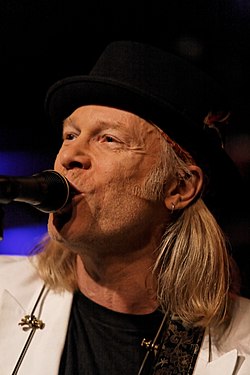
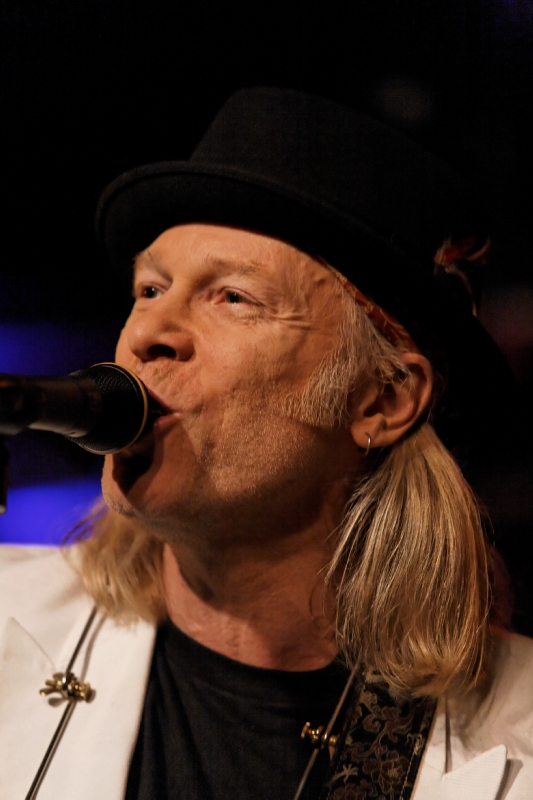
Elliott James Murphy (born March 16, 1949) is an American rock singer-songwriter, novelist, record producer, and journalist.
Biography
[edit]
Elliott Murphy was born in Rockville Centre, New York,[1] grew up in Garden City, Long Island and began playing the guitar at age twelve. His band The Rapscallions won the 1966 New York State Battle of the Bands.[2] In 1971 he travelled to Europe and appeared in the Federico Fellini film Roma[3] Returning to New York, in 1973 he secured a record contract with Polydor Records after being noticed by rock critic Paul Nelson.[4] In 1988, he returned to college studies he had given up in the 1960s, and completed his bachelor's degree at Empire State College.[5]
His debut album Aquashow (1973) was critically acclaimed[6] and favorably reviewed in Rolling Stone, Newsweek and The New Yorker. Follow up albums included Lost Generation (1975) produced by Doors Producer Paul A. Rothchild, Night Lights (1975) and Just a Story from America (1977). Special guests on Murphy's albums have included Bruce Springsteen, Mick Taylor, Billy Joel, Phil Collins, Sonny Landreth, David Johansen, Gene Parsons, The Violent Femmes, Cindy Bullens and Shawn Colvin. To date, he has released over thirty-five albums including, Affairs (1980), Murph the Surf (1982). In 1985 Jerry Harrison of Talking Heads produced the album Milwaukee. Selling the Gold (1995) featured a duet, "Everything I Do", with Bruce Springsteen. The album also has a collaboration with the Violent Femmes: all three original members Gordon Gano, Victor DeLorenzo, Brian Ritchie appear on the track "King of the Serpentine".
The albums Beauregard, Rainy Season, Soul Surfing, and La terre commune, a duo with Iain Matthews, followed. Never Say Never...The Best of 1995–2005, a CD and DVD of performances was released in 2005. The year ended with Murphy Gets Muddy, an album of 9 classic blues covers and 5 Murphy blues originals. In early 2007 the album Coming Home Again was released in Europe. Murphy's 30th studio album, Notes from the Underground, came out in 2008 and he returned to the United States. A live CD/DVD-set "Alive in Paris" was released in the fall 2009 followed by the self-titled "Elliott Murphy" (2010), "Just A Story from New York" (2011) and "It Takes A Worried Man" which was produced by his son Gaspard Murphy.[7] All Music Guide has rated over fifteen of his albums with 4 stars or more[8]
In addition to his music and song lyrics Murphy has written for Rolling Stone, Spin, Mucchio Selvaggio, Jam and various European magazines and has published Cold & Electric, a semi-autobiographical novel, in French, German and Spanish editions, as well as two short story collections (The Lion Sleeps Tonight and Where the Women Are Naked and the Men Are Rich) and in 2003 Café Notes (Hachette, France). In 2012 the complete version of Cold & Electric re-titled "Marty May" was published by Joelle Losfeld/Gallimard.[9]
On October 1, 2012, Elliott Murphy was awarded the Médaille de Vermeil de la Ville de Paris in a ceremony at the Hôtel de Ville presided by Paris Mayor Bertrand Delanoë for recognition of his career as a musician and author.[10]
On November 4, 2015 Elliott Murphy was decorated with the Chevalier Ordre des Arts et des Lettres in a ceremony at the Mairie of the 4th Arrondissement in Paris.[11]
In 2018 he was inducted into the Long Island Music Hall of Fame by Billy Joel[12]
A biography of Elliott Murphy, "Hardcore", written by Charles Pitter, was published in 2013.[13]
The Second Act of Elliott Murphy
[edit]In 2015, the documentary film, The Second Act of Elliott Murphy, by Spanish director Jorge Arenillas, detailing the transition of Murphy's career from the US to Europe was released on Mirabal Films. The film won the Audience Prize award at the 2016 Dock of the Bay film festival[14] in San Sebastian, Spain and included interviews with both Bruce Springsteen and Billy Joel.[15]
Broken Poet
[edit]In 2018, Elliott Murphy starred in the film, Broken Poet, by Spanish director Emilio Ruiz Barrachina, adapted from the Elliott Murphy short-story The Lion Sleeps Tonight. Also starring in the film are Marisa Berenson, Michael O'Keefe, Joana Preiss and a cameo appearance by Bruce Springsteen and Patti Scialfa.[16]
Discography and books
[edit]Albums and EPs
[edit]- Aquashow (1973)
- Lost Generation (1975)
- Night Lights (1976)
- Just A Story From America (1977)
- Affairs (1980)
- Murph the Surf (1982)
- Party Girls / Broken Poets (1984)
- Milwaukee (1985)
- Change Will Come (1987)
- Après le Déluge (1987)
- If Poets Were Kings (1991)
- 12 (1990) US re-edition: Unreal City (1993)
- Selling the Gold (1995)
- Beauregard (1998)
- Rainy Season (2000)
- La terre commune with Iain Matthews (2001)
- Soul Surfing (2002)
- Soul Surfing – the Next Wave EP (2002)
- Strings of the Storm (2003)
- Murphy Gets Muddy CD/DVD (2005)
- Coming Home Again (2007)
- Notes from the Underground (2008)
- Elliott Murphy (2011)
- It Takes A Worried Man (2013)
- Intime (2014)
- Aquashow Deconstructed (2015)
- Prodigal Son (2017)
- Ricochet (2019)
- The Middle Kingdom (2020)
- Wonder (2022)
- Infinity (2025)
Vintage Series
[edit]- 1 Aquashow & Just A Story From America Demos
- 2 The Night Lights Band Live
- 3 Hello Long Island 1974
- 4 The Murphys
- 5 Gramercy Park
- 6 Electric Murphyland
- 7 Double E
- 8 Live In Texas DVD
- 9 The Paris Concerts: Eldorado 1981 Like Boats Against the Current
- 10 Gold Demos
Compilation albums
[edit]- Diamonds by the Yard (1991)
- Paris/New York (1992)
- Going Through Something – the Best of 1982–1991 (1996)
- Never Say Never – the Best of 1995–2003 & Live DVD (2005)
Live albums
[edit]- Live Hot Point (1991)
- April – a Live Album (1999)
- The Last of the Rock Stars... and Me and You (2001)
- Alive in Paris (2009)
- Just A Story From New York (2011)
- Just for One Day (2011)
- Elliott Murphy is Alive! (2018)
- Live in Bilbao (2021)
Film Soundtrack albums
[edit]- Broken Poet (2020)
Misc albums
[edit]- Poetic Justice (2015)
Books
[edit]- Cold and Electric (Frío y eléctrico, Madrid, 1989, Ediciones Clips). Paris: L'Entreligne, 1989. ISBN 84-8211-057-8
- Where the Women Are Naked and the Men Are Rich (Donde Las Mujeres Estan Desnudas Y Los Hombres Son Ricos). Madrid: Celeste Ediciones, 1996. ISBN 978-84-8211-057-8
- The Lion Sleeps Tonight (El león duerme esta noche, Barcelona, 1990, Ed. Stultilfera Navis)
- Café Notes Hachette (2002) ISBN 9782012356207
- Note al caffé. Italy: FBE Edizioni, 2004. 2004. ISBN 88-89160-01-2
- Poetic Justice. Paris: Hachette Littératures, 2005. ISBN 2-012-35764-4
- Il mio nome e John Little. Italy: FBE Edizioni, 2005. 2007. ISBN 978-88-89160-32-9
- Poetic Justice. Elliott Murphy Books, 2012. ISBN 978-0615669090
- Marty May. Joelle Losefeld/Gallimard, 2013. ISBN 978-2072483455
- Forty Poems in Forty Nights. Elliott Murphy Books, 2016. ISBN 978-1530179084
- Paris Stories. Elliott Murphy Books, 2016. ISBN 978-1539817321
- Tramps. Murphyland Books, 2018. ISBN 978-1541380578
- Diamonds by the Yard. Murphyland Books, 2019. ISBN 978-1985817739
- Just a story from America - A memoir. Murphyland Books. 2019. ISBN 978-1097173877
Novels
[edit]- Poetic Justice. New York: Elliott Murphy Books, 2012. ISBN 978-0-6156-6909-0
References
[edit]- ^ "Elliott Murphy". Discogs.com. Retrieved November 21, 2017.
- ^ "The Elliott Murphy Interview". Classicbands.com. Retrieved November 21, 2017.
- ^ "Elliott Murphy". AlloCiné.fr. Retrieved November 21, 2017.
- ^ Avery, Kevin. "Read an Excerpt from Everything Is an Afterthought: The Life and Writings of Paul Nelson". November 14, 2011. American Songwriter website, November 14, 2011.
- ^ Kolbert, Elizabeth (January 3, 1988). "Getting Credit For Life's Experiences". The New York Times. New York, NY. p. 12.
- ^ Pitter, Charles (March 20, 2015). "PopMatters".
- ^ "ELLIOTT MURPHY "deconstructs" his debut album – Aquashow Deconstructed! | Blue Rose Records". Archived from the original on November 17, 2015. Retrieved November 15, 2015.
- ^ "Elliott Murphy – Album Discography". AllMusic. Retrieved November 21, 2017.
- ^ Losfeld, Editions Joelle. "Joëlle Losfeld – Marty May – Elliott Murphy – Littérature étrangère". Joellelosfeld.fr. Archived from the original on December 1, 2017. Retrieved November 21, 2017.
- ^ "Elliott Murphy décoré par la Ville de Paris – Musiques – Télérama.fr". Telerama.fr. September 27, 2012. Retrieved November 21, 2017.
- ^ "Elliott Murphy, un rocker américain adoubé à Paris – Musiques – Télérama.fr". Telerama.fr. November 5, 2015. Retrieved November 21, 2017.
- ^ "Billy Joel inducts longtime guitarist Tommy Byrnes and singer-songwriter Elliott Murphy". billyjoel.com. November 11, 2018. Retrieved July 19, 2019.
- ^ Charles, Pitter (2013). Hardcore. UK: Indiegogo. ISBN 978-1493534340.
- ^ "Dock Of The Bay 2016 list of winners – Dock Of The Bay. Music Documentary Film Festival". Dockofthebay.es. Retrieved November 21, 2017.
- ^ "'The Second Act of Elliott Murphy': Film Review". The Hollywood Reporter. November 8, 2016. Retrieved November 21, 2017.
- ^ "Elliott Murphy debuta como actor protagonista en un filme de Ruiz Barrachina". elperiodico.com. December 2, 2018. Retrieved July 19, 2019.
External links
[edit]
Elliott Murphy
View on GrokipediaEarly life
Family background and childhood
Elliott Murphy was born on March 16, 1949, in Rockville Centre, New York, into a prosperous show-business family.[4][3] His father, Elliott Murphy Sr., was an impresario and entrepreneur who produced the popular outdoor spectacle Aquashow in Queens during the 1950s and 1960s, featuring performances by jazz legends like Duke Ellington and Cab Calloway, along with swimmers, clowns, and fireworks.[6][5] His mother, Josephine, pursued acting on an amateur level while raising the family's three children, including Murphy's siblings Matthew and Michelle.[6][5] The family's affluence was evident in their large home and Cadillac in the upscale suburb of Garden City, Long Island, where Murphy spent his formative years.[6][4] Murphy's childhood was steeped in the performing arts due to his parents' involvement, fostering an early appreciation for entertainment and creativity.[5] Tragically, his father died of a heart attack in 1965 at age 48, when Murphy was just 16, leaving a profound impact on the family; his mother subsequently worked to support them.[6] Growing up in the conservative yet vibrant Long Island environment of the 1950s and 1960s, Murphy was exposed to the emerging rock 'n' roll scene through local clubs and radio, with transformative influences like Elvis Presley's appearance on The Ed Sullivan Show and The Beatles' U.S. debut sparking his passion for music.[8][9] Bob Dylan's poetic songwriting, particularly albums like his 1962 debut, further shaped his artistic sensibilities during his teenage years.[10] As a teenager, Murphy displayed early creative inclinations, receiving his first guitar around age 12 and beginning to explore songwriting alongside his growing interest in literature.[4][11] His love for writing was evident from childhood, when his first short story, "Getting Away," was published in his Garden City Junior High School literary magazine when he was 13.[12] These experiences in Garden City laid the groundwork for his dual pursuits in music and writing, amid the cultural shifts of the era.[6]Education and early musical experiences
Murphy grew up in a show-business family that nurtured his early interest in the arts. He attended Garden City High School on Long Island, where he began playing guitar at age 12 and formed his first band, The Rapscallions, during his teenage years. The group achieved local prominence by winning the 1966 New York State Battle of the Bands, a competition that showcased high school acts across the state and highlighted Murphy's emerging talent as a rhythm guitarist and songwriter.[13][14] Following high school graduation in 1967, Murphy briefly pursued higher education at Nassau Community College, attending night classes for about a year and a half while studying music theory and composition. Despite gaining valuable knowledge in music studies, he found the academic environment unfulfilling and dropped out around 1969 to commit fully to his musical aspirations, motivated in part by a desire to avoid the military draft during the Vietnam War era.[13][6] In the late 1960s, after leaving college, Murphy began performing early gigs and developing his songwriting in the vibrant New York folk-rock scene, drawing influences from artists like Bob Dylan and the Rolling Stones. He traveled frequently, often carrying his guitar, and started composing original songs inspired by personal experiences, including the loss of his father. These initial performances and writings laid the groundwork for his poetic, narrative-driven style, as he honed his craft through local appearances and informal sessions in the New York area before venturing further.[6][15]Musical career
Debut and 1970s breakthrough
Elliott Murphy's early foray into the arts included a bit part as an extra in Federico Fellini's 1972 film Roma, an experience during his 1971 travels through Europe that broadened his artistic perspective and preceded his pivot to music.[2] Returning to New York in 1973, Murphy signed a record deal with Polydor Records, marking his professional entry into the music industry.[16] His debut album, Aquashow, released in November 1973 on Polydor, showcased Murphy's poetic lyrics and rock-infused storytelling, drawing immediate critical attention for its literate songcraft.[17] The album received a prominent review in Rolling Stone by Paul Nelson, who paired it with Bruce Springsteen's The Wild, the Innocent & the E Street Shuffle and dubbed Murphy a "new Dylan" for his evocative, narrative-driven style.[6] This comparison highlighted Murphy's emergence alongside Springsteen as a key figure in the New York singer-songwriter scene, though Aquashow emphasized introspective, suburban themes with a raw, harmonica-laced energy.[18] Following Aquashow, Murphy switched to RCA Records and released Lost Generation in 1975, an album that expanded on his thematic depth with tracks addressing social disillusionment and personal ambition. The subsequent Night Lights (1976) continued this trajectory, blending rock elements with introspective ballads, while Just a Story from America (1977) on CBS Records featured notable contributions from former Rolling Stones guitarist Mick Taylor on guitar, adding a layer of blues-rock grit to songs like "Drive All Night."[19] These releases solidified Murphy's reputation for sophisticated, Dylan-esque lyricism amid the 1970s rock landscape.[20] Despite garnering critical praise in both the U.S. and Europe—evidenced by Rolling Stone's ongoing coverage and European festival appearances—Murphy's 1970s output faced commercial challenges, with modest sales failing to match the hype surrounding his debut.[6] This acclaim-without-breakthrough dynamic positioned him as a cult favorite, influencing his later artistic evolution.[21]1980s challenges and evolution
Following the critical acclaim and commercial promise of his 1970s major-label releases, Elliott Murphy encountered significant professional challenges in the United States during the early 1980s, as shifting industry priorities and disappointing domestic sales led to the termination of his contracts with labels including Polydor, RCA, and Columbia.[22] By 1977, he had lost his deal with Columbia, prompting a pivot away from the high-stakes promotional cycles of the prior decade.[22] In response, Murphy launched his own independent label, Courtesan Records, and released the six-song EP Affairs in 1980, which was positively reviewed in Rolling Stone for its raw, personal songwriting amid his career uncertainties.[23] This independent phase continued with the full-length album Murph the Surf in 1982, distributed primarily through European imprints like Disc AZ in France and CBS in other markets, reflecting limited U.S. interest but marking a strategic focus on overseas opportunities.[24] The album's blend of folk-rock elements and narrative-driven tracks, such as "Continental Kinda Girl," showcased Murphy's resilience, though it sold modestly in America due to the absence of major-label backing. By mid-decade, he released Milwaukee in 1985 on New Rose Records, produced by Talking Heads' Jerry Harrison, which shifted toward a more introspective rock style emphasizing lyrical depth and atmospheric arrangements over arena-oriented production.) Tracks like "Taking the Silence" and "Niagara Falls" highlighted this evolution, drawing on personal themes of isolation and reflection to distinguish his work in an increasingly competitive landscape. Amid these artistic adaptations, Murphy balanced his music career with personal development, completing a bachelor's degree in English at Empire State College in 1988, where he earned credits for his songwriting, guitar proficiency, and prior experience as a nightclub co-owner.[26] This period involved sporadic U.S. and international touring, often limited by financial constraints and lack of consistent support, yet it allowed him to refine his live performances.[6] Concurrently, his European presence expanded through dedicated tours, fostering a dedicated fanbase that appreciated his poetic intensity and stage energy, particularly in France where independent releases gained traction.[27] By the late 1980s, this transatlantic shift provided a vital counterpoint to U.S. setbacks, setting the stage for further international growth.[21]1990s relocation and resurgence
In the early 1990s, following a decade of independent releases and persistent touring in the United States that yielded limited commercial success, Elliott Murphy relocated to Paris, France, in the late 1980s, seeking a more receptive audience for his music.[28] This move was motivated by his growing popularity in Europe, where audiences had embraced his songwriting style during 1980s performances.[29] The relocation immediately strengthened his European support base, allowing him to focus on creative projects without the pressures of the American music industry.[30] Murphy's career resurgence in Paris began with key releases that highlighted his evolving sound. In 1991, he issued the compilation album Diamonds by the Yard, which collected standout tracks from his earlier work and introduced his catalog to new listeners. That same year, the live album Live Hot Point was released, capturing a 1989 performance at Switzerland's Hot Point Festival with guest appearances by Chris Spedding and Garland Jeffreys, showcasing Murphy's dynamic stage presence and rock influences.[31] These efforts culminated in the 1995 studio album Selling the Gold, recorded in Belgium with a ensemble of European musicians and featuring a duet with Bruce Springsteen on "Everything I Do (Leads Me Back to You)," which marked a creative high point and further solidified his transatlantic appeal.[32] The Parisian environment spurred Murphy's songwriting productivity, enabling him to produce multiple albums in quick succession during the decade, including the introspective 12 in 1990, later reissued as Unreal City.[33] Collaborations with French artists and producers, such as those on the 1992 duets album New York / Paris—which paired him with French singers like Jacques Higelin and Michèle Torr—enhanced his integration into the local scene and expanded his international profile.[34] These partnerships not only revitalized his output but also bridged his American roots with European sensibilities, fostering a loyal following across the continent.2000s to present: Recent releases and tours
In the 2000s, Elliott Murphy continued his prolific recording career with the release of Notes from the Underground in 2008, an album featuring introspective rock tracks co-written and arranged with guitarist Olivier Durand.[35][36] The record drew acclaim for its lyrical depth on themes of love and loss, solidifying Murphy's reputation as a enduring singer-songwriter.[37] By the early 2010s, family involvement became prominent in Murphy's work, as seen in It Takes a Worried Man (2013), produced by his son Gaspard Murphy at studios in Brussels and New York.[38][39] This blues-inflected album included covers like "Worried Man Blues" alongside originals such as "Angeline," highlighting Murphy's raw vocal style and thematic focus on personal resilience.[40] Gaspard's production role extended to later projects, fostering a collaborative dynamic that infused Murphy's music with fresh energy. Murphy's output remained steady through the decade, culminating in Prodigal Son (2017), again produced, mixed, and arranged by Gaspard, with contributions from longtime collaborators like Durand.[41][42] The album explored themes of return and reflection in tracks like the title song, receiving praise for its mature rock arrangements recorded in Paris.[43] Entering the 2020s, Murphy marked personal milestones with Wonder (2022), his first full studio album of originals since 2017, produced by Gaspard and featuring poetic songs on wonder and introspection.[44][45] This was followed by the single "Old-Timer" in 2024, a reflective piece inspired by his annual birthday shows, celebrating 50 years in music and his 75th birthday.[46][47] In 2025, Murphy released Infinity, his 52nd album, produced by Gaspard and featuring nine original tracks peering into future themes while grounded in personal narratives; one song, "Count My Blessings," was co-written with Olivier Durand.[48][49][7] The album's release coincided with an extensive European tour, including band shows in France (Rouen, Aix-en-Provence, Lillers, Paris), Belgium (Verviers), Spain (Madrid, Zaragoza, Donostia-San Sebastián, Santander), and Italy via cruise ship, building on his established European base from the late 1980s that has sustained his live performances.[50][51]Literary career
Debut novel and major works
Elliott Murphy entered the realm of fiction writing with his semi-autobiographical debut novel Cold & Electric, originally published in French by Éditions L'Entreligne in Paris in 1989. The work, which began as a short story serialized in Rolling Stone magazine in 1980, delves into the turbulent life of a rock musician navigating the highs and lows of fame in 1970s New York.[6] It was subsequently translated into Spanish as Frío y eléctrico by Ediciones Clips in Madrid that same year and into German, reflecting early international interest in Murphy's prose.[52] An expanded edition, retitled Marty May, appeared in French in 2012 via Éditions Joëlle Losfeld, with the English edition published in 2016. It further develops the protagonist's journey from stardom to personal downfall and artistic redemption.[53][54] Murphy's novels recurrently explore themes of identity, fame, and personal loss, often drawing from the gritty underbelly of the music world to examine resilience amid temptation and cultural decline. In Marty May, the titular guitarist grapples with a crumbling marriage, financial ruin, and the commodification of art in the 1980s music industry, ultimately seeking solace in his blues roots.[53] These motifs recur across his works, which have been translated into German and Spanish, broadening their reach in European markets.[55] Building on this foundation, Murphy expanded his literary output into a rock 'n' roll trilogy. The second installment, Tramps (2019), shifts to a 1980s New York blues bar, where protagonist Hoover, a former punk musician, confronts drug-fueled nihilism, mafia threats, and a quest for creative renewal amid societal decay.[56] The trilogy concludes with Diamonds By The Yard (2019), co-authored with his brother Matthew Murphy, which evokes the vibrant yet volatile 1970s New York music scene through the story of heiress Lexi Langdon and her record producer husband, intertwining glamour, ambition, and loss.[57] Murphy's entry into fiction was inspired by his own musical career, providing authentic narratives rooted in rock culture. His novels have garnered critical attention in Europe, where they were first published and nominated for French literary prizes, affirming his dual legacy as musician and author.[11]Short stories and nonfiction
Elliott Murphy's literary output extends beyond novels into short fiction and nonfiction, where he explores themes of urban life, personal reflection, and the intersections of music and memory. His short stories often draw from his experiences as an expatriate in Paris and his Long Island roots, blending episodic narratives with introspective elements. Murphy began writing prose before songwriting, with his first short story, "Getting Away," published in his Garden City Junior High School literary magazine at age 13.[12][58] Murphy has published several collections of short stories, establishing him as a prolific fiction writer alongside his musical career. His short story "The Lion Sleeps Tonight" (1985) marked an early foray into published short fiction, later collected in Paris Stories (2016), followed by Where the Women Are Naked and the Men Are Rich in 1996, which features tales of expatriate experiences and urban encounters.[59][60] Later works include Paris Stories (2016), comprising eleven vibrant stories centered on Parisian life and cultural observations, and Garden City Stories (2019), a set of eclectic narratives spanning decades and tied to his hometown influences.[61][62] These collections often blend fictional elements with memoir-like reflections, evolving from the concise, lyrical style of his songwriting. Murphy has contributed short stories to literary magazines in the United States and France, including the 1980 piece "Cold and Electric" in Rolling Stone, which later inspired elements of his novel Marty May.[12] By the 2020s, he had released numerous such collections, reflecting a sustained commitment to shorter prose forms.[2] In nonfiction, Murphy's work delves into personal and cultural essays, particularly those informed by his life in Paris. Café Notes (2002), published by Hachette Littératures, consists of essays on Parisian café culture, the songwriting process, and everyday expatriate observations, offering insights into his creative routines.[60] This collection highlights his ability to merge journalistic precision with autobiographical depth, a style that carries over from his earlier contributions to music magazines like Rolling Stone and Spin.[16] His 2019 memoir Just a Story from America further exemplifies this nonfiction vein, recounting his childhood, family tragedies, and rise in the music industry with candid, reflective prose.[63] In 2020, he published Tinnitus Journals – Volume 1: 21st Century 2001-2020, a collection of personal essays and reflections.[64] These works underscore Murphy's transition from lyrical brevity to expansive personal narrative, enriching his overall literary profile.[2]Other media appearances
Film roles and soundtracks
Elliott Murphy's first film appearance came in 1971 when he was cast in a non-speaking role as a street musician in Federico Fellini's Roma, filmed in Rome during the autumn of that year.[65] This uncredited extra part marked his initial foray into cinema, aligning with the early 1970s period when he was developing his musical career ahead of his debut album Aquashow in 1973.[66] Murphy later recounted being hired for a week's work on the production after busking in Roman piazzas, where Fellini spotted him and incorporated his guitar-playing into a crowd scene depicting the city's vibrant street life.[65] Throughout the 2000s and 2010s, Murphy took on supporting acting roles that often blurred the lines between his personas as musician and performer, frequently portraying rock stars or similar figures in independent films. Notable examples include appearances in Downtown 81 (2000), where he played a musician amid New York's underground art scene; La Ligne Blanche (2011), in which he embodied a charismatic rocker; and Uchronia (2016), as "Last of the Rock Stars." These roles highlighted the intersection of his acting and music, with scenes featuring live performances of his songs to underscore character emotions and narrative tension.[66] Murphy's most prominent film involvement arrived with Broken Poet (2020), where he made his lead acting debut as Jake Lion, a faded 1970s rock icon presumed dead after a suicide in Paris.[68] Directed by Emilio J. Ruiz and produced in fall 2018, the film adapts Murphy's 1985 short story "The Lion Sleeps Tonight," reimagining it as a mystery thriller involving a street busker who eerily resembles the late star.[69] Co-starring Joana Preiss, Michael O'Keefe, and Marisa Berenson, with cameos from Bruce Springsteen and Patti Scialfa, the movie integrates Murphy's original compositions directly into key scenes, such as performances of "Last of the Rock Stars" and "Lost Generation" to advance the plot and evoke themes of fame and reinvention.[69] Complementing the narrative, Murphy contributed to the soundtrack alongside his son Gaspard Murphy on score elements like "Meg's Dream" and "Busker Flamingo," resulting in a dedicated original motion picture soundtrack album released in 2020 that blends classic tracks, new themes, and instrumental pieces.[66]Documentaries and adaptations
In 2015, Spanish director Jorge Arenillas released The Second Act of Elliott Murphy, a feature-length music documentary chronicling the singer-songwriter's career trajectory from his 1970s New York origins to his relocation and artistic resurgence in Paris.[70] The film delves into Murphy's European fanbase and personal life, featuring interviews with contemporaries Bruce Springsteen and Billy Joel, who reflect on his early promise as a "new Dylan" alongside their shared scene.[71] It premiered at festivals across Europe.[72] Murphy's literary work entered visual media with the 2020 film Broken Poet, directed by Emilio J. Ruiz Barrachina and adapted from his 1985 short story "The Lion Sleeps Tonight."[73] In this narrative feature, Murphy co-wrote the screenplay and starred as an aging musician whose identity sparks a journalistic investigation into rock stardom's illusions, with cameo appearances by Springsteen and Patti Scialfa discussing their mutual history.[69] The adaptation highlights themes from Murphy's prose, blending mystery and autobiography to examine fame's aftermath.[68] Beyond these projects, Murphy has appeared in interviews within broader music documentaries on the 1970s New York rock scene, providing context on the era's singer-songwriter movement and his connections to figures like Springsteen.[74] These appearances, including endorsements in The Second Act, have amplified his visibility, contributing to renewed interest in his catalog through European festival screenings and subsequent tours.[16]Personal life
Family and residences
Elliott Murphy married Françoise Murphy in the late 1980s, and their son Gaspard Murphy was born in 1990.[6][75] Gaspard has pursued a career in music production, notably collaborating with his father on albums including It Takes a Worried Man (2011), where he served as producer and mixer, and Infinity (2025), which he produced, arranged, and mixed.[39][48][49] Since 1990, Murphy has maintained a long-term residence in Paris, France, where he lives with his wife and son, though he makes occasional visits to the United States for family connections and tours.[11][21][22] This relocation has allowed the family to sustain ties to Murphy's Long Island roots, where he was raised, while integrating into Parisian cultural life.[30][76] Gaspard's involvement in his father's recent projects highlights the family's influence on Murphy's career, blending generational perspectives in modern recordings while preserving connections to his American heritage through themes and occasional U.S.-based performances.[77][78] In 2024, Murphy celebrated his 75th birthday with family-involved events during his annual concert at New Morning in Paris on March 16, featuring performances alongside Gaspard and other collaborators.[79][80][81]Awards and honors
Elliott Murphy has received several prestigious awards recognizing his enduring contributions to music and literature, particularly in France where he has built much of his career since the 1980s. These honors reflect his transatlantic influence as a singer-songwriter and novelist.[2] In 2012, Murphy was awarded the Médaille de Vermeil de la Ville de Paris for his cultural contributions, highlighting his role in enriching Paris's artistic scene through performances and literary works.[22] Three years later, in 2015, he was named a Chevalier in the Ordre des Arts et des Lettres by the French Minister of Culture, an honor bestowed for significant achievements in the arts that promote French cultural heritage.[2] Murphy's American roots were celebrated in 2018 when he was inducted into the Long Island Music Hall of Fame, with longtime friend Billy Joel performing the induction ceremony to acknowledge his impact on the region's musical legacy.[4][82] These accolades underscore Murphy's career longevity, spanning over five decades of creative output across continents.[22]Discography
Studio albums
Elliott Murphy has released over 50 albums total since his debut in 1973, including more than 40 studio albums, marking his prolific output and stylistic evolution from energetic folk-rock infused with New York poetic influences to a more introspective singer-songwriter approach exploring personal narratives and emotional depth.[12][83][7] His breakthrough album, Aquashow (1973, Polydor), captured the raw energy of urban disillusionment through tracks blending rock and literary lyricism, establishing Murphy as a post-Dylan voice in American music.[17] This was followed by Just a Story from America (1977, RCA), a musically ambitious work recorded at Air Studios in London, featuring guest appearances by former Rolling Stones guitarist Mick Taylor on guitar and future Genesis vocalist Phil Collins on drums, with themes delving into American identity and personal reinvention.[84] In the mid-1990s, Selling the Gold (1995, Eagle Records) highlighted Murphy's collaborative spirit, recorded in Belgium with a ensemble of session musicians and including a duet with Bruce Springsteen on "Everything I Do (Leads Me Back to You)," focusing on themes of redemption and cross-generational rock solidarity.[32] Later, Notes from the Underground (2008, Last Call Records) returned to introspective roots, examining the costs of love and loss amid shadowy personal histories, praised for its cohesive songcraft and raw emotional delivery.[85] Murphy's more recent works reflect a mature, reflective phase under his own Murphyland Records label. Prodigal Son (2017) explored themes of return and reconciliation, produced with a stripped-back arrangement emphasizing acoustic introspection. Wonder (2022) continued this trajectory with contemplative tracks on wonder and resilience in later life.[86] His latest release, Infinity (2025, Murphyland Records), self-produced with his son Gaspard Murphy, delves into themes of reflection on past experiences and forward-looking aspirations, recorded in Paris as a focused collection of life's interconnected stories.[49][48]Live and compilation albums
Elliott Murphy has documented over 3,000 live performances across his five-decade career, with several live albums preserving highlights from his extensive European tours, often featuring acoustic sets and collaborations with guitarist Olivier Durand. These recordings emphasize his raw stage energy and fan-favorite reinterpretations of studio material.[87] Key live albums include Live Hot Point (1989, New Rose Records), captured during a high-energy tour across Europe that showcased Murphy's rock influences in intimate venues. Alive in Paris (2009, Last Call Records) documents a solo acoustic concert at the French capital's Sentier des Halles, blending storytelling with stripped-down arrangements of classics like "Last of the Rock Stars." More recently, Live in Bilbao (2022, Murphyland Records) features a full-band set from Spain's Kafe Antzokia, including tracks from his later works amid post-pandemic audiences. Compilations provide retrospective overviews of Murphy's output, often incorporating rare tracks and demos. Diamonds by the Yard (1992, Razor & Tie) collects B-sides and outtakes from his 1980s period, illustrating his evolution from folk-rock roots. Never Say Never: The Best of 1995-2005... and More (2005, Blue Rose Records) spans a decade of releases with remastered hits and unreleased material, underscoring his consistent European popularity.[88] The Vintage Series comprises 10 volumes released between the 2000s and 2010s on Murphyland Records, focusing on archival demos, live snippets, and alternate takes; notable entries include Aquashow & Just a Story from America Demos (2003), which revives early 1970s sessions with raw, unpolished versions of seminal songs. These volumes offer fans insight into Murphy's creative process without relying on polished studio productions. Miscellaneous releases encompass EPs and soundtracks that extend his live ethos. Poetic Justice (2015, Murphyland Records) is a limited EP of spoken-word poetry set to minimal instrumentation, drawn from live readings. The soundtrack for the documentary Broken Poet (2020, Murphyland Records) includes live performances and original scores composed for the film, reflecting Murphy's ongoing narrative style in multimedia contexts.Bibliography
Novels
Elliott Murphy's novels, primarily published in Europe, draw on themes of music, identity, and American life, often reflecting his experiences as a musician. His debut novel, originally titled Cold & Electric, appeared in French, German, and Spanish editions during the 1980s as a semi-autobiographical account of a rock guitarist's rise to fame in 1970s New York and subsequent struggles in the 1980s music industry. The complete version, retitled Marty May, was published in French by Éditions Joëlle Losfeld/Gallimard in 2012 and in English by CreateSpace Independent Publishing Platform in 2016. It follows virtuoso guitarist Marty May through the highs of stardom and the lows of a fading career, blending tragedy and elegance in a narrative compared to The Great Gatsby set against rock 'n' roll.[54][89] Murphy's second novel, Poetic Justice, was first published in French by Hachette Littératures in 2005 and in English by Elliott Murphy Books in 2012. This neo-Western explores the American frontier at the turn of the 20th century through the story of a hired killer who finds solace in poetry amid moral conflicts and personal redemption.[90] The rock trilogy continued with Tramps in 2019 from CreateSpace Independent Publishing Platform, depicting an ex-punk musician named Hoover seeking inspiration in a gritty 1980s New York blues bar, surrounded by the underbelly of the city's music scene. The trilogy concluded that same year with Diamonds by the Yard, co-authored with his brother Matthew Murphy and also published by CreateSpace, which extends the saga of aspiring artists navigating fame, loss, and resilience in the rock world. By 2025, Murphy had released these four major novels, several available in multilingual editions including French, German, and Spanish. Readers have noted the lyrical prose in works like Marty May for its poetic rhythm akin to his songwriting style. Some of his short stories serve as companions to the universes explored in these novels.[91][92][2][89]Short story collections and essays
Elliott Murphy has established himself as a prolific writer of short fiction, with collections that often draw on his experiences as an American expatriate in Paris, blending themes of identity, ambition, and cultural displacement. His stories frequently appear in literary magazines and anthologies, reflecting a body of work that spans decades and exceeds 100 individual pieces published outside his dedicated volumes.[2] Murphy's early short story collection, The Lion Sleeps Tonight (1990, Librairie Gibert Joseph/Stultifera Navis), explores narratives intersecting American dreams with the complexities of Parisian life, including tales of aspiring artists and musicians navigating fame and exile. The title story, originally published in 1985, centers on a journalist investigating the mysterious death of a rock star, capturing the allure and pitfalls of the music world.[59][69] In Where the Women Are Naked and the Men Are Rich (1996, Celeste Ediciones), Murphy delivers satirical tales critiquing expat culture, wealth disparities, and the hedonistic undercurrents of international social scenes, often set against the backdrop of affluent European locales. The collection's provocative title echoes themes from his songwriting, highlighting ironic observations on privilege and desire.[93] Murphy's nonfiction work includes Café Notes (2002, Hachette Littératures), a volume of essays reflecting on creativity, inspiration, and the rhythms of daily life observed from Paris cafés. These pieces offer introspective meditations on writing, music, and urban encounters, drawing from Murphy's long residency in the city.[94] Later short story collections include Paris Stories (2016, CreateSpace Independent Publishing Platform), featuring eleven vibrant tales inspired by his life in Paris, exploring themes of expatriation, music, and personal reflection. Garden City Stories (2019, independently published) draws on his upbringing in the Long Island village of Garden City, spanning stories from mid-20th century to the 21st, including his first published story "Getting Away." Additionally, Tinnitus Journals: Volume 1 – 21st Century 2001-2020 (2022, independently published) is a nonfiction collection of diary entries, photos, and lyrics chronicling his life as a musician living in Paris while dealing with tinnitus. By 2025, these collections—The Lion Sleeps Tonight (1990), Where the Women Are Naked and the Men Are Rich (1996), Café Notes (2002), Paris Stories (2016), Garden City Stories (2019), and Tinnitus Journals (2022)—represent his primary published volumes of shorter fiction and essays.[61][95][96][97][98]References
- https://www.[allmusic](/page/AllMusic).com/album/milwaukee-mw0000845227
- https://www.[imdb](/page/IMDb).com/name/nm1011791/