


Elliptic Curve Digital Signature Algorithm
View on Wikipedia
In cryptography, the Elliptic Curve Digital Signature Algorithm (ECDSA) offers a variant of the Digital Signature Algorithm (DSA) which uses elliptic-curve cryptography.
Key and signature sizes
[edit]As with elliptic-curve cryptography in general, the bit size of the private key believed to be needed for ECDSA is about twice the size of the security level, in bits.[1] For example, at a security level of 80 bits—meaning an attacker requires a maximum of about operations to find the private key—the size of an ECDSA private key would be 160 bits. On the other hand, the signature size is the same for both DSA and ECDSA: approximately bits, where is the exponent in the formula , that is, about 320 bits for a security level of 80 bits, which is equivalent to operations.


Signature generation algorithm
[edit]Suppose Alice wants to send a signed message to Bob. Initially, they must agree on the curve parameters . In addition to the field and equation of the curve, we need , a base point of prime order on the curve; is the additive order of the point .



| Parameter | |
|---|---|
| CURVE | the elliptic curve field and equation used |
| G | elliptic curve base point, a point on the curve that generates a subgroup of large prime order n |
| n | integer order of G, means that , where is the identity element. |
| the private key (randomly selected) | |
| the public key (calculated by elliptic curve) | |
| m | the message to send |


The order of the base point must be prime. Indeed, we assume that every nonzero element of the ring is invertible, so that must be a field. It implies that must be prime (cf. Bézout's identity).

Alice creates a key pair, consisting of a private key integer , randomly selected in the interval ; and a public key curve point . We use to denote elliptic curve point multiplication by a scalar.
![{\displaystyle [1,n-1]}](https://wikimedia.org/api/rest_v1/media/math/render/svg/6565c7499e7a49f53c1858eadce017451ff55543)


For Alice to sign a message , she follows these steps:

- Calculate . (Here HASH is a cryptographic hash function, such as SHA-2, with the output converted to an integer.)
- Let be the leftmost bits of , where is the bit length of the group order . (Note that can be greater than but not longer.[2])
- Select a cryptographically secure random integer from .
- Calculate the curve point .
- Calculate . If , go back to step 3.
- Calculate . If , go back to step 3.
- The signature is the pair . (And is also a valid signature.)










As the standard notes, it is not only required for to be secret, but it is also crucial to select different for different signatures. Otherwise, the equation in step 6 can be solved for , the private key: given two signatures and , employing the same unknown for different known messages and , an attacker can calculate and , and since (all operations in this paragraph are done modulo ) the attacker can find . Since , the attacker can now calculate the private key .





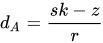
This implementation failure was used, for example, to extract the signing key used for the PlayStation 3 gaming-console.[3]
Another way ECDSA signature may leak private keys is when is generated by a faulty random number generator. Such a failure in random number generation caused users of Android Bitcoin Wallet to lose their funds in August 2013.[4]
To ensure that is unique for each message, one may bypass random number generation completely and generate deterministic signatures by deriving from both the message and the private key.[5]
Signature verification algorithm
[edit]For Bob to authenticate Alice's signature on a message , he must have a copy of her public-key curve point . Bob can verify is a valid curve point as follows:

- Check that is not equal to the identity element O, and its coordinates are otherwise valid.
- Check that lies on the curve.
- Check that .

After that, Bob follows these steps:
- Verify that r and s are integers in . If not, the signature is invalid.
- Calculate , where HASH is the same function used in the signature generation.
- Let be the leftmost bits of e.
- Calculate and .
- Calculate the curve point . If then the signature is invalid.
- The signature is valid if , invalid otherwise.





Note that an efficient implementation would compute inverse only once. Also, using Shamir's trick, a sum of two scalar multiplications can be calculated faster than two scalar multiplications done independently.[6]


Correctness of the algorithm
[edit]It is not immediately obvious why verification even functions correctly. To see why, denote as C the curve point computed in step 5 of verification,

From the definition of the public key as ,

Because elliptic curve scalar multiplication distributes over addition,

Expanding the definition of and from verification step 4,



Collecting the common term ,


Expanding the definition of s from signature step 6,

Since the inverse of an inverse is the original element, and the product of an element's inverse and the element is the identity, we are left with

From the definition of r, this is verification step 6.
This shows only that a correctly signed message will verify correctly; other properties such as incorrectly signed messages failing to verify correctly and resistance to cryptanalytic attacks are required for a secure signature algorithm.
Public key recovery
[edit]Given a message m and Alice's signature on that message, Bob can (potentially) recover Alice's public key:[7]
- Verify that r and s are integers in . If not, the signature is invalid.
- Calculate a curve point where is one of , , , etc. (provided is not too large for the field of the curve) and is a value such that the curve equation is satisfied. Note that there may be several curve points satisfying these conditions, and each different R value results in a distinct recovered key.
- Calculate , where HASH is the same function used in the signature generation.
- Let z be the leftmost bits of e.
- Calculate and .
- Calculate the curve point .
- The signature is valid if , matches Alice's public key.
- The signature is invalid if all the possible R points have been tried and none match Alice's public key.





Note that an invalid signature, or a signature from a different message, will result in the recovery of an incorrect public key. The recovery algorithm can only be used to check validity of a signature if the signer's public key (or its hash) is known beforehand.
Correctness of the recovery algorithm
[edit]Start with the definition of from recovery step 6,
From the definition from signing step 4,


Because elliptic curve scalar multiplication distributes over addition,

Expanding the definition of and from recovery step 5,

Expanding the definition of s from signature step 6,

Since the product of an element's inverse and the element is the identity, we are left with

The first and second terms cancel each other out,
From the definition of , this is Alice's public key.
This shows that a correctly signed message will recover the correct public key, provided additional information was shared to uniquely calculate curve point from signature value r.
Security
[edit]In December 2010, a group calling itself fail0verflow announced the recovery of the ECDSA private key used by Sony to sign software for the PlayStation 3 game console. However, this attack only worked because Sony did not properly implement the algorithm, because was static instead of random. As pointed out in the Signature generation algorithm section above, this makes solvable, rendering the entire algorithm useless.[8]
On March 29, 2011, two researchers published an IACR paper[9] demonstrating that it is possible to retrieve a TLS private key of a server using OpenSSL that authenticates with Elliptic Curves DSA over a binary field via a timing attack.[10] The vulnerability was fixed in OpenSSL 1.0.0e.[11]
In August 2013, it was revealed that bugs in some implementations of the Java class SecureRandom sometimes generated collisions in the value. This allowed hackers to recover private keys giving them the same control over bitcoin transactions as legitimate keys' owners had, using the same exploit that was used to reveal the PS3 signing key on some Android app implementations, which use Java and rely on ECDSA to authenticate transactions.[12]
This issue can be prevented by deterministic generation of k, as described by RFC 6979.
Concerns
[edit]Some concerns expressed about ECDSA:
- Political concerns: the trustworthiness of NIST-produced curves being questioned after revelations were made that the NSA willingly inserts backdoors into software, hardware components and published standards; well-known cryptographers[13] have expressed[14][15] doubts about how the NIST curves were designed, and voluntary tainting has already been proved in the past.[16][17] (See also the libssh curve25519 introduction.[18]) Nevertheless, a proof that the named NIST curves exploit a rare weakness is still missing.
- Technical concerns: the difficulty of properly implementing the standard, its slowness, and design flaws which reduce security in insufficiently defensive implementations.[19]
Implementations
[edit]Below is a list of cryptographic libraries that provide support for ECDSA:
See also
[edit]References
[edit]- ^ Johnson, Don; Menezes, Alfred (1999). "The Elliptic Curve Digital Signature Algorithm (ECDSA)". Certicom Research. Canada. CiteSeerX 10.1.1.38.8014.
- ^ "NIST FIPS 186-4, July 2013, pp. 19 and 26" (PDF). Archived (PDF) from the original on December 27, 2016. Retrieved March 17, 2014.
- ^ Console Hacking 2010 - PS3 Epic Fail Archived December 15, 2014, at the Wayback Machine, page 123–128
- ^ "Android Security Vulnerability". Archived from the original on April 7, 2019. Retrieved February 24, 2015.
- ^ Pornin, T. (2013). RFC 6979 - Deterministic Usage of the Digital Signature Algorithm (DSA) and Elliptic Curve Digital Signature Algorithm (ECDSA) (Technical report). doi:10.17487/RFC6979. Retrieved February 24, 2015.
- ^ "The Double-Base Number System in Elliptic Curve Cryptography" (PDF). Archived (PDF) from the original on July 26, 2011. Retrieved April 22, 2014.
- ^ Daniel R. L. Brown SECG SEC 1: Elliptic Curve Cryptography (Version 2.0) https://www.secg.org/sec1-v2.pdf
- ^ Bendel, Mike (December 29, 2010). "Hackers Describe PS3 Security As Epic Fail, Gain Unrestricted Access". Exophase.com. Archived from the original on April 7, 2019. Retrieved January 5, 2011.
- ^ "Cryptology ePrint Archive: Report 2011/232". Archived from the original on December 8, 2018. Retrieved February 24, 2015.
- ^ "Vulnerability Note VU#536044 - OpenSSL leaks ECDSA private key through a remote timing attack". www.kb.cert.org. Archived from the original on April 7, 2019. Retrieved May 24, 2011.
- ^ "ChangeLog". OpenSSL Project. Archived from the original on August 9, 2020. Retrieved April 22, 2014.
- ^ "Android bug batters Bitcoin wallets". The Register. August 12, 2013. Archived from the original on August 15, 2013. Retrieved August 27, 2017.
- ^ Schneier, Bruce (September 5, 2013). "The NSA Is Breaking Most Encryption on the Internet". Schneier on Security. Archived from the original on December 15, 2017. Retrieved January 11, 2018.
- ^ "SafeCurves: choosing safe curves for elliptic-curve cryptography". October 25, 2013. Archived from the original on April 7, 2019. Retrieved January 11, 2018.
- ^ Bernstein, Daniel J.; Lange, Tanja (May 31, 2013). "Security dangers of the NIST curves" (PDF). Archived (PDF) from the original on May 28, 2019. Retrieved January 11, 2018.
- ^ Schneier, Bruce (November 15, 2007). "The Strange Story of Dual_EC_DRBG". Schneier on Security. Archived from the original on April 23, 2019. Retrieved January 11, 2018.
- ^ Greenemeier, Larry (September 18, 2013). "NSA Efforts to Evade Encryption Technology Damaged U.S. Cryptography Standard". Scientific American. Archived from the original on December 24, 2017. Retrieved January 11, 2018.
- ^ "curve25519-sha256@libssh.org.txt\doc - projects/libssh.git". libssh shared repository. Archived from the original on March 23, 2019. Retrieved January 11, 2018.
- ^ Bernstein, Daniel J. (March 23, 2014). "How to design an elliptic-curve signature system". The cr.yp.to blog. Archived from the original on March 23, 2014. Retrieved January 11, 2018.
Further reading
[edit]- Accredited Standards Committee X9, ASC X9 Issues New Standard for Public Key Cryptography/ECDSA, Oct. 6, 2020. Source
- Accredited Standards Committee X9, American National Standard X9.62-2005, Public Key Cryptography for the Financial Services Industry, The Elliptic Curve Digital Signature Algorithm (ECDSA), November 16, 2005.
- Certicom Research, Standards for efficient cryptography, SEC 1: Elliptic Curve Cryptography, Version 2.0, May 21, 2009.
- López, J. and Dahab, R. An Overview of Elliptic Curve Cryptography, Technical Report IC-00-10, State University of Campinas, 2000.
- Daniel J. Bernstein, Pippenger's exponentiation algorithm, 2002.
- Daniel R. L. Brown, Generic Groups, Collision Resistance, and ECDSA, Designs, Codes and Cryptography, 35, 119–152, 2005. ePrint version
- Ian F. Blake, Gadiel Seroussi, and Nigel Smart, editors, Advances in Elliptic Curve Cryptography, London Mathematical Society Lecture Note Series 317, Cambridge University Press, 2005.
- Hankerson, D.; Vanstone, S.; Menezes, A. (2004). Guide to Elliptic Curve Cryptography. Springer Professional Computing. New York: Springer. doi:10.1007/b97644. ISBN 0-387-95273-X. S2CID 720546.
External links
[edit]- Digital Signature Standard; includes info on ECDSA
- The Elliptic Curve Digital Signature Algorithm (ECDSA); provides an in-depth guide on ECDSA. Wayback link

| People |
|  | |||
|---|---|---|---|---|---|
| Lists | |||||
| Technologies | |||||
| Forks |
| ||||
| History | |||||
| Movies |
| ||||
| Legal entities (not exchanges) | |||||
| Bitcoin in El Salvador | |||||

Elliptic Curve Digital Signature Algorithm
View on GrokipediaOverview
Definition and Core Principles
The Elliptic Curve Digital Signature Algorithm (ECDSA) is a digital signature scheme that adapts the principles of the Digital Signature Algorithm (DSA) to elliptic curve cryptography, enabling authentication of message origin, integrity verification, and non-repudiation through computationally efficient signatures.[2] ECDSA generates signatures using a private key and verifies them with the corresponding public key, relying on approved hash functions to process messages into fixed-length digests.[2] Proposed by Scott Vanstone in 1992, it was standardized by ANSI in 1999, IEEE and NIST in 2000, and ISO in 1998, offering superior efficiency with smaller key sizes compared to DSA for equivalent security levels due to the underlying elliptic curve discrete logarithm problem (ECDLP).[3] At its core, ECDSA operates within a structured elliptic curve group defined by domain parameters, including the finite field size $ q $, curve coefficients $ a $ and $ b $, base point $ G $ of prime order $ n $, and cofactor $ h $.[2] A key pair consists of a private key $ d $, a random integer from 1 to $ n-1 $, and the public key $ Q = d \times G $, where $ \times $ denotes scalar multiplication on the curve.[2] Signature generation produces a pair $ (r, s) $: $ r $ derives from the x-coordinate of $ k \times G $ for a random ephemeral $ k $, and $ s $ combines $ k $, the message hash, and $ d $; verification recomputes a point from $ s^{-1} $ times the hash and $ r $, checking against $ r $ using $ Q $ and $ G $.[2] The security of ECDSA fundamentally rests on the presumed intractability of the ECDLP: given $ G $, $ Q $, and the curve, computing $ d $ such that $ Q = d \times G $ is infeasible for appropriately chosen curves and parameters.[2] This provides resistance to forgery, as producing valid $ (r, s) $ without $ d $ equates to solving the ECDLP or related hard problems, with no known subexponential-time algorithms unlike classical discrete logarithms in finite fields.[3] Domain parameters must be verified for correctness to prevent attacks, and security strength aligns with the bit length of $ n $ and the hash function's output.[2]Historical Development
The Elliptic Curve Digital Signature Algorithm (ECDSA) emerged from advancements in elliptic curve cryptography (ECC), which was independently proposed in 1985 by Neal Koblitz and Victor S. Miller as a basis for public-key systems exploiting the computational difficulty of the elliptic curve discrete logarithm problem.[6][7] Koblitz outlined elliptic curve cryptosystems in a 1987 publication, building on earlier number-theoretic work, while Miller detailed their cryptographic applications in a 1985 conference paper.[7] These foundations enabled more efficient alternatives to existing schemes like RSA and DSA by requiring smaller key sizes for equivalent security levels, due to the stronger hardness assumptions of ECC groups.[6] In 1991, the National Institute of Standards and Technology (NIST) proposed the Digital Signature Algorithm (DSA) as part of the Digital Signature Standard (DSS) under FIPS 186, prompting public comments on its design.[8] ECDSA was first proposed in 1992 by Scott Vanstone, a Canadian cryptographer and co-founder of Certicom Research, as an elliptic curve analog to DSA, submitted in response to NIST's solicitation to enhance efficiency while maintaining compatibility with DSA's structure.[3][9] Vanstone's proposal adapted DSA's signing and verification processes to operate over elliptic curve groups, leveraging ECC's performance advantages for resource-constrained environments.[10] Standardization followed in the late 1990s, with ECDSA specified in ANSI X9.62 in 1998 for financial services interoperability.[11] It gained ISO approval that year and was incorporated into NIST's revised FIPS 186-2 in January 2000, alongside DSA and RSA options, enabling federal use of ECDSA with approved curves and parameters.[8][9] Subsequent validations, such as NIST's ECDSA validation system in 2004, supported broader adoption in protocols like TLS and Bitcoin transactions.[12]Mathematical Foundations
Elliptic Curves and Finite Fields
In elliptic curve cryptography, including the Elliptic Curve Digital Signature Algorithm (ECDSA), elliptic curves are defined over finite fields to yield finite point sets amenable to discrete logarithm-based security. For prime fields with a large prime, the curve takes the short Weierstrass form , where coefficients satisfy the nonsingularity condition (the discriminant).[13] This ensures the curve is smooth, without singular points that would undermine the group structure.[14] The rational points comprise all satisfying the equation, augmented by a point at infinity acting as the group identity.[13] These points form a finite abelian group under the elliptic curve addition law, derived from projective geometry: for distinct points and , the line through them intersects at a third point , and , where negation reflects over the x-axis (i.e., ). Point doubling replaces the line with the tangent at . All operations reduce modulo and use field arithmetic for slopes and coordinates, enabling efficient computation via algorithms like binary ladder methods.[14] [15] The group order follows Hasse's theorem, with trace , bounding the size near and facilitating selection of curves where the order factors include a large prime for secure subgroups.[14] In ECDSA, domain parameters specify such a curve over , a generator of prime-order subgroup of order , and cofactor (often 1), ensuring scalar multiplication resists inversion via the elliptic curve discrete logarithm problem.[13] Finite fields other than primes, like binary fields , admit generalized Weierstrass forms (e.g., ) but are less common in modern ECDSA standards due to implementation trade-offs.[13]Discrete Logarithm Problem in ECC
The elliptic curve discrete logarithm problem (ECDLP) consists of determining an integer $ k $ such that $ Q = k \cdot P $, where $ P $ and $ Q $ are points on an elliptic curve $ E $ defined over a finite field $ \mathbb{F}_q $, $ k $ is an integer between 1 and the order $ n $ of the subgroup generated by $ P $, and the operation $ \cdot $ denotes scalar multiplication in the additive group of points on $ E $.[16] This formulation adapts the classical discrete logarithm problem to the structure of elliptic curve groups, where point addition serves as the group operation.[17] No polynomial-time algorithm is known to solve the ECDLP in general for elliptic curves with carefully selected parameters, such as those over prime fields with large prime order subgroups.[18] The best generic attacks, including the Pollard rho algorithm, require approximately $ \sqrt{n} $ group operations, which for a 256-bit order $ n $ (providing around 128 bits of security) demands about $ 2^{128} $ operations, rendering it infeasible with current computational resources.[19] Curve-specific attacks exist but are ineffective against standardized curves recommended by bodies like NIST, which are designed to resist known vulnerabilities such as anomalous curves or those susceptible to MOV or Frey-Rück attacks.[20] In elliptic curve cryptography (ECC), the ECDLP underpins the security of protocols by ensuring that the private key $ d $, satisfying $ Q = d \cdot G $ for public key $ Q $ and generator $ G $, cannot be recovered from the public information.[21] For ECDSA specifically, an adversary solving the ECDLP could forge signatures by computing private keys or inverting the verification process, but the problem's hardness provides equivalent security to larger key sizes in systems like RSA or classical DSA at reduced computational cost.[22] Advances in solving the ECDLP, such as those documented in records for small curves (e.g., solving on 113-bit curves in 2009 requiring significant resources), underscore the need for larger parameters, with NIST recommending at least 224-bit curves for 112-bit security as of FIPS 186-4 published in 2013.[23]Adaptation from DSA to ECDSA
The Elliptic Curve Digital Signature Algorithm (ECDSA) adapts the Digital Signature Algorithm (DSA) by substituting the discrete logarithm problem in a subgroup of the multiplicative group of integers modulo a prime for the elliptic curve discrete logarithm problem over a finite field, thereby achieving comparable security levels with significantly smaller key and parameter sizes.[24][2] This structural preservation allows ECDSA to inherit DSA's core signing and verification mechanics while leveraging the efficiency of elliptic curve arithmetic, where point addition and scalar multiplication replace modular exponentiation.[24] In DSA, domain parameters comprise a large prime (typically 1024 to 3072 bits), a prime (160 to 256 bits) dividing , and a generator of order modulo .[24] The private key is chosen randomly from to , with the public key .[24] ECDSA replaces these with elliptic curve domain parameters: a finite field (prime of characteristic greater than 3), curve coefficients and defining , a base point of prime order , and cofactor .[24] The private key is selected from to , yielding public key via scalar multiplication.[24] Here, plays the role analogous to , ensuring operations occur in a subgroup of prime order to mitigate small-subgroup attacks.[24] Signature generation in both algorithms proceeds similarly: for a message , compute hash truncated to the bit length of the order ( or ); select ephemeral secret randomly from to the order minus one; derive from ; then compute .[24] DSA computes , using exponentiation in .[24] ECDSA instead computes point , setting to the x-coordinate of modulo .[24] Verification mirrors this: compute , , ; then derive a candidate point or value and check if its projection modulo the order equals .[24] DSA uses ; ECDSA uses the x-coordinate of modulo .[24]| Aspect | DSA | ECDSA |
|---|---|---|
| Group Operation | Modular exponentiation in | Scalar multiplication and point addition on elliptic curve |
| Computation | ||
| Security Assumption | Discrete log hardness in subgroup of order | Elliptic curve discrete log hardness in subgroup of order |
| Parameter Sizes | (L=1024+), | for curve, |
Cryptographic Primitives
Domain Parameters and Curve Selection
The domain parameters for ECDSA specify the underlying elliptic curve group and include the finite field prime , the curve coefficients and defining the Weierstrass equation , the generator point , the prime order of the subgroup generated by , and the cofactor (typically for curves with prime order subgroups).[13] These parameters must satisfy rigorous conditions, such as being a large prime exceeding for 128-bit security levels, the curve being non-singular (discriminant non-zero modulo ), and the embedding degree being sufficiently large to resist MOV attacks reducing discrete log to pairing problems.[13][26] Curve selection prioritizes standardized parameters over ad-hoc generation to ensure community-vetted security; NIST SP 800-186 recommends specific curves like P-256 (), P-384 (), and P-521 () for ECDSA, providing security levels of 128, 192, and 256 bits respectively, based on estimated resistance to Pollard rho attacks requiring approximately operations.[13] These curves use pseudorandom generation seeded by SHA-1 hash values of fixed strings for verifiability, though alternative sets like Brainpool curves (RFC 5639) employ hash-based seeds for enhanced transparency in parameter derivation.[27] Generating custom curves demands probabilistic testing for properties like prime via Miller-Rabin and resistance to anomalous curves (trace of Frobenius not zero), but such parameters are rarely used due to validation costs and lack of broad scrutiny.[13][26] Security considerations in curve selection emphasize avoidance of curves vulnerable to special attacks, such as those with small class number or low embedding degree; for instance, NIST curves have embedding degrees exceeding 10, mitigating Weil descent and pairing-based reductions.[26] While NIST parameters have faced skepticism due to opaque historical generation processes, no exploitable weaknesses have been demonstrated, and their use remains mandated in FIPS 186-5 for federal systems. Independent validations, including complete subgroup order proofs, support their integrity for practical deployments.[13]Key Generation Process
The ECDSA key generation process produces a private-public key pair given verified elliptic curve domain parameters, which include the field size q, finite field representation FR, curve coefficients a and b, base point G, order n (a prime), and cofactor h.[2] The private key d is an integer randomly selected from the interval [1, n-1] to ensure uniform distribution and sufficient entropy matching the security strength of the curve, typically using an approved deterministic random bit generator (DRBG) as specified in NIST SP 800-90A.[2] The public key Q is then computed as the scalar multiplication Q = d × G, where × denotes point multiplication on the elliptic curve.[2] Two primary methods exist for generating the private key d to mitigate bias in random number generation: the extra random bits method (Appendix A.2.1) and rejection sampling (Appendix A.2.2). In the extra random bits approach, a bit string longer than the bit length N of n (e.g., l ≥ N + 64 for reduced bias) is obtained from the DRBG, converted to an integer d, and reduced modulo n if necessary, ensuring d falls in [1, n-1] with high probability.[2] Rejection sampling generates a candidate d of exactly N bits and discards it if outside [1, n-1], repeating until valid; this method requires n to be close to a power of 2 for efficiency but guarantees uniformity.[2] Both require the DRBG to provide at least the security strength equivalent to the curve's bit length, such as 256 bits for P-256 curves.[2] Following private key generation, the public key computation involves efficient elliptic curve point multiplication algorithms, often using double-and-add techniques optimized for the curve's coordinates (e.g., Montgomery or Jacobian).[2] The resulting Q must be validated to confirm it lies on the curve and is not the point at infinity, though NIST recommends full public key validation for high-security applications to detect invalid keys that could lead to signature forgery.[2] Key pairs generated under FIPS 186-5, approved in February 2023, support curve sizes from 224 to 521 bits, with recommended parameters like NIST P-256 providing approximately 128 bits of security.[2]Signature Mechanics
Signature Generation Algorithm
The ECDSA signature generation process produces a digital signature consisting of a pair of integers for a given message, leveraging the signer's private key and elliptic curve domain parameters to ensure authenticity and integrity. The algorithm operates over an elliptic curve group generated by base point of prime order , with the private key satisfying . An approved cryptographic hash function, such as SHA-256, processes the message to yield a fixed-length digest, from which an integer is derived by taking the leftmost bits—where is the bit length of and is the hash output length—and interpreting it as an integer.[2] A per-message ephemeral secret is selected uniformly at random from the interval , or deterministically via methods like those in RFC 6979 to mitigate risks from poor randomness. The point is computed via scalar multiplication, and is obtained as the x-coordinate of modulo . If , a new is chosen and the process restarts. The second component is then calculated as , where is the modular inverse of modulo ; if , the process restarts with a fresh . The pair forms the signature, with both values in , and all intermediate values like must be securely erased post-computation to prevent key recovery.[2] In pseudocode, the core steps are:- (or equivalent truncation)
- Do:
- If , goto step 3
- Return
Signature Verification Algorithm
The ECDSA signature verification algorithm authenticates a purported signature pair on a message against the signer's public key and the elliptic curve domain parameters, which include the base point of prime order . Specified in NIST FIPS 186-5, the procedure relies on elliptic curve point arithmetic and modular inverses to recompute a candidate point whose x-coordinate must match modulo .[2] Invalid inputs or computations result in rejection, ensuring only signatures generated with the corresponding private key (where ) pass.[2] The algorithm assumes validated domain parameters and a public key that lies on the curve and satisfies (the point at infinity).[2] It begins by checking the signature components:- Confirm and are integers in the interval . If either fails this range check, reject the signature as invalid.[2]
- Compute the hash , where Hash is an approved cryptographic hash function with output length outlen bits (e.g., 256 bits for SHA-256).[2]
- Derive the integer from : Let . If outlen, set ; otherwise, take the leftmost bits of as . Interpret as a big-endian integer (per FIPS 186-5 Appendix B.2.1). This truncation ensures aligns with the security level provided by .[2]
- Compute the modular inverse using an extended Euclidean algorithm or equivalent (FIPS 186-5 Appendix B.1). Existence is guaranteed since from the range check.[2]
- Compute scalars and . These scalars probabilistically recover the ephemeral point used during signing.[2]
- Compute the point , using standardized point doubling and addition formulas over the curve's finite field. Reject if (the identity element), as this indicates an inconsistent signature.[2]
- Extract the x-coordinate of as an element of the base field, then convert it to an integer (per SP 800-186 Appendix F.1, typically by interpreting field-specific encoding as big-endian).[2] [28]
- Compute . If , accept the signature as valid; otherwise, reject it.[2]
Public Key Recovery Mechanism
In ECDSA, the public key recovery mechanism enables derivation of the signer's elliptic curve public key $ Q $ directly from the signature components $ (r, s) $, the message hash $ z $ (typically the leftmost bits of the hash of the message), and the domain parameters, obviating the need to transmit $ Q $ separately. This capability stems from rearranging the signature verification equation, which equates the point $ (u_1 G + u_2 Q) $ to the point $ R $ with x-coordinate $ r $, where $ u_1 = z s^{-1} \mod n $ and $ u_2 = r s^{-1} \mod n $. Solving for $ Q $ yields $ Q = (s R - z G) r^{-1} \mod n $, but requires identifying candidate points $ R $ on the curve satisfying $ x(R) \equiv r \pmod{n} $.[29] The recovery process begins by confirming $ 1 \leq r, s < n $. The x-coordinate candidate is taken as $ x = r $ (since $ r < n $ and typically $ n < p $ for standard curves, with rare adjustments if $ r + n < p $). Solve the curve equation $ y^2 \equiv x^3 + a x + b \pmod{p} $ for $ y $, yielding zero, one, or two solutions (by Hasse's theorem, the probability of no real points is approximately $ 1 - O(1/\sqrt{p}) $). The candidate points are $ R = (x, y) $ and $ R' = (x, -y) $, corresponding to even and odd y-coordinates, respectively.[29][30] For each viable $ R_i $, compute the scalar $ r^{-1} \mod n $ once, then derive candidate public keys as $ Q_i = r^{-1} (s R_i - z G) $, performing elliptic curve point arithmetic throughout. Each $ Q_i $ that lies on the curve and satisfies the standard ECDSA verification (i.e., $ x(u_1 G + u_2 Q_i) \equiv r \pmod{n} $) is a valid candidate; typically, exactly one matches the signer's key, while the other may spuriously verify due to the mathematics but does not correspond to the private key used. Up to two public keys are possible, with ambiguity resolved in practice by including a recovery parameter (e.g., $ v = 27 + i $ for $ i = 0,1 $, or extended to four candidates if considering $ x = r + n $) in the signature format, as standardized in SEC 1 section 4.1.6. This extension reduces transmission overhead in protocols like Bitcoin transactions, where public keys are otherwise 65 bytes uncompressed.[29][31] The mechanism's security relies on the elliptic curve discrete logarithm problem, ensuring recovery does not leak the private key $ d $, but implementers must validate points and inverses to prevent invalid curve attacks. Recovery is deterministic given the inputs and does not require additional randomness, though malformed inputs (e.g., non-quadratic residue x) may yield no candidates, which verifiers treat as invalid signatures.[29]Efficiency and Practical Attributes
Key and Signature Size Advantages
ECDSA achieves comparable security strengths to RSA and DSA using markedly smaller key sizes, which reduces storage requirements, transmission overhead, and computational demands in resource-constrained environments such as mobile devices and IoT systems.[5][32] For a security level of approximately 128 bits, ECDSA employs a 256-bit elliptic curve, whereas RSA requires a 3072-bit modulus and DSA necessitates a 3072-bit modulus with a 256-bit subgroup order.[33] This disparity arises from the elliptic curve discrete logarithm problem's higher computational resistance per bit compared to integer factorization or discrete logarithms in finite fields.[5] Private keys in ECDSA consist of a single scalar value modulo the curve order n, typically 32 bytes for curves like P-256 (secp256r1).[31] Public keys are elliptic curve points, encodable in compressed form at approximately 33 bytes (including a prefix byte indicating the y-coordinate parity) or uncompressed at 65 bytes.[34] In contrast, RSA public keys encompass the modulus n (384 bytes for 3072 bits) plus the exponent e, while DSA public keys include the generator g, modulus p (384 bytes), and verifier y = gx mod p, exceeding 768 bytes total excluding shared parameters.[5] These reductions enable faster key exchange and lower memory usage, particularly in protocols like TLS where public keys are frequently transmitted.[35] Signature sizes further highlight ECDSA's efficiency over RSA, though they align closely with DSA. An ECDSA signature comprises two integers (r, s), each up to the bit length of n, yielding 64 bytes raw for a 256-bit curve before optional DER encoding (which adds minimal overhead, typically 70-72 bytes).[31] RSA signatures match the modulus size, approximately 384 bytes for 3072-bit security, due to padding schemes like PSS.[36] DSA signatures are similarly structured as (r, s) modulo the subgroup order q (256 bits), resulting in comparable 64-byte raw sizes, but the larger DSA parameters inflate overall protocol footprints. Thus, ECDSA minimizes bandwidth in applications like blockchain transactions or certificate chains, where signature volume scales with usage.[37]| Security Level (bits) | ECDSA Curve Size (bits) | RSA Modulus (bits) | DSA Modulus/Subgroup (bits) |
|---|---|---|---|
| 112 | 224 | 2048 | 2048 / 224 |
| 128 | 256 | 3072 | 3072 / 256 |
| 192 | 384 | 7680 | 7680 / 384 |
| 256 | 521 | 15360 | 15360 / 521 |
Computational Performance Metrics
The computational performance of ECDSA is primarily determined by the cost of elliptic curve point multiplications, which dominate both signature generation and verification. Signature generation involves one full scalar multiplication to compute (where is a random nonce and is the base point), followed by a modular inverse computation in the field and basic arithmetic to derive the signature pair . Verification requires two scalar multiplications: (where and derive from the message hash, signature, and public key ), which can be optimized via simultaneous computation or fixed-base techniques for the term. These operations scale with the curve's bit length; for common curves like secp256r1 (256 bits, ~128-bit security), a single point multiplication typically requires tens to hundreds of thousands of CPU cycles on modern processors, depending on implementation and hardware accelerations like AVX instructions.[38] Benchmarks on commodity hardware illustrate ECDSA's efficiency. On an Intel Xeon Platinum 8124M (3.0 GHz, 2018-era server CPU), optimized ECDSA-P256 signing achieves latencies of approximately 22.5 μs per signature, enabling over 10,000 signatures per second per core under sustained load. Verification times are higher due to the dual multiplications but remain in the low tens of microseconds. On similar amd64 architectures (e.g., Intel Xeon E3-1220 v2 at 3.1 GHz), point multiplication rates reach ~2,800 per second for P-256 using fixed-point arithmetic, translating to signing rates of ~2,500 per second (accounting for overhead) and verification at half that rate. These figures outperform equivalent-security DSA (e.g., 256-bit modulus), which relies on slower modular exponentiations in larger finite fields, often by factors of 5–10x in signing and verification due to ECDSA's compact representations and fewer arithmetic operations per bit.[39][38]| Operation | ECDSA-P256 (μs latency, Xeon 3 GHz) | RSA-2048 equiv. (ms latency, same) | Ratio (ECDSA faster) |
|---|---|---|---|
| Signing | ~22.5 | ~1,289 | ~57x |
| Verification | ~50–100 (est. from dual mult) | ~1–10 (est.) | 10–20x |
Security Evaluation
Theoretical Security Basis
The theoretical security of the Elliptic Curve Digital Signature Algorithm (ECDSA) is founded on the intractability of the elliptic curve discrete logarithm problem (ECDLP). The ECDLP consists of finding an integer such that , where is a base point of prime order on the elliptic curve, and is the corresponding public key point; for domain parameters with of sufficient bit length, such as 256 bits in NIST's P-256 curve, no polynomial-time algorithm exists on classical computers to solve this problem efficiently.[24][3] This hardness assumption underpins the difficulty of deriving the signer's private key from the public key or forging signatures, as any such operation would require resolving the ECDLP.[42] ECDSA's security strength is quantified as the minimum of the strengths provided by the underlying elliptic curve (tied to ECDLP via the bit length of ), the hash function used in signature generation, and protections against discrete logarithm computation. For instance, curves with yield approximately 128 bits of security against ECDLP attacks, exceeding equivalent levels from RSA or classical DSA due to the ECDLP's greater resistance per bit compared to integer factorization or finite-field discrete logarithms.[24][3] NIST recommends curves where the cofactor is small (at most ) and embedding degrees are high to resist reductions like the MOV attack to finite-field pairings, ensuring the ECDLP remains the dominant hardness barrier.[24] In the random oracle model, ECDSA achieves existential unforgeability under adaptive chosen-message attacks, with reductions showing that breaking the scheme implies solving the ECDLP or distinguishing the hash function from a random oracle.[43] These proofs, while idealized, indicate that flaws in the core mechanism are unlikely absent advances against ECDLP; empirical evidence supports this, as no generic breaks have emerged despite decades of scrutiny on recommended curves.[43] However, security assumes proper nonce randomness and curve validation, as theoretical guarantees do not extend to implementation errors.[24]Proven Correctness and Reductions
The correctness of the ECDSA signature verification process is established through direct algebraic verification of the scheme's equations. Given a valid signature generated from private key , base point , message hash , and ephemeral nonce , the verification computes and , then derives the point , where is the public key, and checks if the x-coordinate of modulo equals . Substituting the generation equations yields , ensuring the x-coordinate matches due to the group scalar multiplication properties and the definition of .[44][45] Security reductions for ECDSA demonstrate that forging a valid signature is computationally equivalent to solving the elliptic curve discrete logarithm problem (ECDLP) under specific idealized models. In the generic group model, which abstracts the group operation without exploiting curve-specific structure, Daniel R. L. Brown proved in 2002 that ECDSA is secure against existential forgery under adaptive chosen-message attacks, provided the underlying hash function is collision-resistant and the ECDLP is hard; this reduction shows that an efficient forger implies an efficient ECDLP solver, with security loss proportional to the number of group operations.[46][47] However, these reductions rely on non-standard assumptions, such as the generic group model or programming access to the hash oracle and the coordinate-to-integer conversion function (x mod n). Algebraic reductions—those preserving the algebraic structure without such programming—are impossible for tight bounds, as established by meta-reduction arguments; forging ECDSA signatures cannot be reduced algebraically to ECDLP hardness unless the reduction can manipulate the conversion function, highlighting inherent non-programmability in the scheme's design.[48] No full proof exists in the standard model or even the random oracle model without additional idealized components, limiting the scheme's provable guarantees compared to alternatives like Schnorr signatures.[49][48]Empirical Attack Vectors and Mitigations
One prominent empirical attack vector on ECDSA exploits nonce reuse or predictability, where the ephemeral scalar is repeated or insufficiently random across signatures, enabling private key recovery via solving linear equations modulo the curve order . In December 2010, attackers exploited a flawed random number generator in Sony's PlayStation 3 firmware, leading to nonce reuse in ECDSA signatures and subsequent extraction of the EC3 signing key, compromising game content verification. Similar vulnerabilities have manifested in blockchain applications; for instance, in 2023, a novel "Polynonce" attack recovered private keys from Bitcoin signatures exhibiting partial nonce reuse patterns, affecting funds worth millions due to implementation flaws in wallet software. Lattice-based methods further amplify this threat by exploiting biased or partially leaked nonces; the Minerva attack recovers keys from as few as 500 signatures with simulated nonce leakage via hidden number problem reductions.[50][51] \n A foundational work in this area is the 2019 research paper "Biased Nonce Sense: Lattice Attacks against Weak ECDSA Signatures in Cryptocurrencies" by Joachim Breitner and Nadia Heninger, presented at USENIX Security 2019. The paper formalizes the Hidden Number Problem (HNP) for ECDSA nonce leakage scenarios—including partial bit knowledge, most-significant-bit (MSB) or least-significant-bit (LSB) biases, and truncated nonces—and demonstrates practical lattice-based attacks to recover private keys from signatures exhibiting nonce bias. Using lattice reduction techniques (LLL, BKZ), the attacks solve approximated nonce equations derived from the ECDSA formula: $ k_i \approx s_i^{-1} (z_i + r_i d) \mod n $, where bias makes $ k_i $ small or predictable. For secp256k1-like curves, even small biases enable key recovery with very few signatures: nonces limited to 128 bits allow recovery from just 2 signatures with ~75% success probability using a 3-dimensional lattice; for 170-bit nonces, 3 signatures yield ~95% success in a 4-dimensional lattice. The authors scanned public datasets including the Bitcoin blockchain for vulnerable signatures (notably from flawed RNGs in early wallets, with many from 2010-era transactions at Unix timestamps around 1.27–1.28 billion), TLS handshakes, and SSH sessions, identifying exploitable cases where nonces shared prefixes, suffixes, or truncation patterns. Many such vulnerabilities enabled historical key recoveries and fund thefts, though most funds from early exploits were already drained. The work builds on prior lattice attacks (Howgrave-Graham & Smart 1999, Nguyen & Shparlinski 2002) and influenced later works like Polynonce and improved lattice techniques for (EC)DSA. It emphasizes that deterministic nonce generation per RFC 6979 or full-entropy randomness is essential to prevent such attacks. Mitigations against nonce issues emphasize avoiding reliance on potentially weak randomness sources. RFC 6979 standardizes deterministic ECDSA, deriving via HMAC-DRBG from the private key and message hash, ensuring reproducibility without external RNG and preventing reuse from entropy failures; this has been adopted in libraries like OpenSSL since 2012. However, deterministic schemes remain susceptible to fault induction altering the derivation, necessitating additional verification of signatures post-computation. Secure entropy sources, such as hardware RNGs compliant with NIST SP 800-90A, and per-signature uniqueness checks via bloom filters in high-volume systems, provide complementary defenses.[25][52] Side-channel attacks, particularly differential power analysis (DPA) on scalar multiplication during signing, constitute another empirical vector, leaking bits of or the private key through timing, electromagnetic emissions, or power consumption variations. A 2015 study demonstrated key extraction from mobile ECDSA implementations using non-intrusive EM analysis on devices like iPhones, recovering keys in under 100 traces by targeting Montgomery ladder implementations. Online template attacks have extracted full scalars from single traces by profiling power models during elliptic curve point multiplication.[53][54] Countermeasures include constant-time algorithms, such as unified addition formulas and scalar blinding with random multiples, to eliminate data-dependent branches and operations; Montgomery ladders with fixed window sizes have proven effective against simple power analysis in hardened libraries. Message and point blinding randomizes intermediate values, raising the trace requirement for higher-order DPA to infeasible levels, as validated in evaluations of Curve25519-based ECDSA variants. Regular auditing via tools like ChipWhisperer ensures implementation resistance.[55][56] Fault injection attacks induce computational errors, such as via voltage glitching or laser pulses, to manipulate ECDSA's scalar multiplication or modular reductions, revealing nonce bits for lattice recovery. A 2022 attack targeted the round counter in ECDSA's double-and-add routine, recovering partial from a single fault and the private key via HNP lattices on subsequent signatures. Deterministic variants are vulnerable if faults corrupt HMAC inputs, potentially forging reusable nonces.[57][52] Mitigations involve fault detection through redundancy, such as recomputing and comparing signatures or verifying elliptic curve point coordinates against the canonical curve equation post-multiplication. Shamir's secret sharing in threshold ECDSA distributes computation to resist single-point faults, while hedged constructions in updated RFCs inject noise to invalidate faulty outputs without leaking keys. Hardware-level protections, like error-correcting codes in secure elements, further elevate attack costs.[58][59]Controversies and Implementation Risks
NSA-Generated Curve Parameters Debate
The elliptic curve parameters standardized by NIST for ECDSA, including P-256 (also known as secp256r1), were generated in 1997 by NSA cryptographer Jerry Solinas during the ANSI X9.62 standardization process, using seeds derived as SHA-1 hashes of undocumented inputs. These seeds, such asC49D360886E704936A6678E1139D26B7819F7E90 for P-256, were hashed according to IEEE 1363 guidelines to produce curve coefficients, prime fields, and base points, with iterations to ensure a suitable prime order near the field size. The opacity of the preimage inputs—speculated to involve humorous phrases like variations of "Give Jerry a raise" based on reverse-engineering attempts—prevents independent verification of randomness, prompting concerns that the NSA could have selected or manipulated parameters to embed subtle weaknesses, such as hidden algebraic structures exploitable via advanced precomputation. No such weaknesses have been empirically demonstrated despite decades of cryptanalysis.[60][61][62]
The controversy escalated with Edward Snowden's 2013 disclosures, which confirmed the NSA's insertion of a backdoor into Dual_EC_DRBG, an elliptic curve-based pseudorandom number generator standardized by NIST in SP 800-90A (2006), by choosing points P and Q on a specific curve with a undisclosed linear dependency that enables output prediction if the secret relation is known to the attacker. While Dual_EC_DRBG's vulnerability stems from its point selection rather than the underlying curve equation, the incident illustrated the NSA's influence over NIST processes and capacity for "rigging" parameters in ways undetectable without the key, paralleling fears for ECDSA curves where similar non-randomness could facilitate decryption or signature forgery under NSA-only conditions. In response, a 2023 bounty of $12,000 was offered to recover the exact seed preimages, but efforts yielded only speculative hashes without confirmation.[63][64]
Daniel J. Bernstein's SafeCurves framework critiques NIST curves for lacking "nothing-up-my-sleeve" verifiability, relying on outdated SHA-1, exhibiting rigid parameter choices that constrain side-channel-resistant implementations, and in cases like P-224, featuring twists with small cofactors vulnerable to invalid-curve attacks. These properties, while not proven insecure for the elliptic curve discrete logarithm problem central to ECDSA, could theoretically enable targeted exploits if intentionally introduced. Empirical evidence supports their robustness, as no parameter-specific breaks have occurred in widespread deployments like TLS or Bitcoin signatures, and NIST asserts compliance with rigorous testing. Nonetheless, some protocols have shifted to alternatives, such as Brainpool curves generated transparently via ANSI C code by the German BSI in 2005, or edwards curves derived from explicit constants like π digits, to prioritize auditable generation over convenience.[65][66]