


Community hub
Recent from talks
Contribute something
Nothing was collected or created yet.
Emblem of Laos
View on Wikipedia
| National Emblem of the Lao People's Democratic Republic | |
|---|---|
 | |
| Armiger | Lao People's Democratic Republic |
| Adopted | 1991 |
| Motto | ສັນຕິພາບ ເອກະລາດ ປະຊາທິປະໄຕ "Peace, Independence, Democracy" ເອກະພາບ ວັດຖະນາຖາວອນ "Unity and Prosperity" ສາທາລະນະລັດ ປະຊາທິປະໄຕ ປະຊາຊົນລາວ "Lao People's Democratic Republic" |
| Other elements | A crescent-shaped stalks of fully ripened rice at sides in between the tips of the Pagoda and the red ribbon wrapped around it on sides with the National Motto and the Name of the State. |
The National Emblem of the Lao People's Democratic Republic shows the national shrine Pha That Luang. A dam is pictured, which is a symbol of power generation at the reservoir Nam Ngum. An asphalt street and a stylized watered field is pictured. In the lower part is a section of a gear wheel. The inscription on the left reads "Peace, Independence, Democracy" (Lao script: ສັນຕິພາບ ເອກະລາດ ປະຊາທິປະໄຕ) and on the right, "Unity and Prosperity" (Lao script: ເອກະພາບ ວັດຖະນາຖາວອນ).
History
[edit]An example of socialist heraldry, the coat of arms was originally adopted in 1975. It was modified in August 1991 to deemphasize Communism as a reaction to the fall of the Soviet Union, at which time the red star and hammer and sickle were replaced with the national shrine at Pha That Luang. A description of the coat of arms is specified in the Laotian constitution:
The National Emblem of the Lao People's Democratic Republic is a circle depicting in the bottom part one-half of a cog wheel and red ribbon with inscriptions [of the words] "Lao People's Democratic Republic", and [flanked by] crescent-shaped stalks of fully ripened rice at both sides and red ribbons bearing the inscription "Peace, Independence, Democracy, Unity, Prosperity". A picture of Pha That Luang Pagoda is located between the tips of the stalks of rice. A road, a paddy field, a forest and a hydroelectric dam are depicted in the middle of the circle.
— Constitution of the Lao People's Democratic Republic, § 90 [1]
Gallery
[edit]-
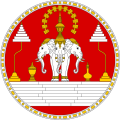 Emblem during the monarchy, 1949–1975
 -
 1975–1991
 -
 Arms of the Laos Ministry of Agriculture and Forestry

.svg)

References
[edit]- ^ Constitution of the Lao People's Democratic Republic, § 90 Official website of the Laotian embassy in Thailand.


Emblem of Laos
View on GrokipediaThe Emblem of Laos is the national coat of arms of the Lao People's Democratic Republic, comprising a circular design that encapsulates the nation's economic sectors, infrastructure, and cultural symbols within a framework of socialist heraldry.[1]
Central to the emblem is the Pha That Luang stupa, Laos's premier Buddhist relic and national symbol, positioned above representations of a hydroelectric dam at Nam Ngum, a roadway, a factory, and terraced rice fields interspersed with forest, signifying advancements in energy, transportation, industry, agriculture, and forestry.[2] At the base lies a semicircular cogwheel evoking industrial labor, flanked by a red ribbon bearing the motto in Lao script: Santiphab, Idsalanī, Pātsāthippatai ("Peace, Independence, Democracy") on the left and Èkaphāp, Phandon ("Unity, Prosperity") on the right.[1] The composition is enclosed by two curved stalks of ripe rice, denoting agricultural abundance.[2]
Introduced on December 2, 1975, upon the Pathet Lao's assumption of power and the abolition of the monarchy, the original version prominently displayed communist motifs including a hammer, sickle, and red star to underscore proletarian revolution and alliance with the Soviet bloc.[3] Revised on August 14, 1991—amid the Soviet Union's dissolution and Laos's pivot to the New Economic Mechanism for market reforms—the emblem supplanted these elements with the Pha That Luang, thereby softening ideological rigidity while preserving core socialist features like the cogwheel and ribbon inscriptions.[3][2] This adaptation reflects pragmatic adjustments to geopolitical shifts and internal policy evolution without altering the emblem's foundational emphasis on national unity and development.[2]
Design and Symbolism
Physical Description
The national emblem of the Lao People's Democratic Republic is a circular design centered on the Pha That Luang pagoda, Laos's national shrine, positioned between the tips of crescent-shaped stalks of fully ripened rice that curve along the sides.[4] Below the pagoda, the composition depicts a landscape including a road, paddy fields, forests, and a hydroelectric dam with its reservoir, symbolizing development and natural resources.[4] At the base, a semicircular cogwheel represents industry, overlaid with red ribbons bearing inscriptions: the national motto "Peace, Independence, Democracy, Unity, Prosperity" on one and the full name "Lao People's Democratic Republic" on the other.[4] The emblem employs a palette of red for the ribbons and cogwheel accents, with natural earth tones for the rice stalks, pagoda, and landscape elements against a neutral background within the circle.[4] The overall arrangement emphasizes vertical symmetry, with the pagoda as the focal point rising above the horizontal landscape and base elements, enclosed by the rice sheaves forming an organic frame.[4] This design, formalized in official specifications, maintains proportional harmony where the central motifs occupy the core space, flanked and grounded by symbolic peripherals.[4]
Symbolic Elements and Interpretations
The national emblem of Laos consists of a circular design that integrates traditional cultural motifs with symbols of socialist development, as prescribed in the constitution of the Lao People's Democratic Republic. At the center top is the stupa of Pha That Luang, Laos's most revered Buddhist monument and national symbol representing ancestral heritage, sovereignty, and Theravada Buddhism's enduring influence on Laotian identity.[5][6] This gilded stupa, located in Vientiane, embodies the fusion of religious tradition and national pride, historically restored in the 1930s under French colonial oversight and later in 1995 to reinforce cultural continuity amid political changes.[7] Flanking the stupa are crescent-shaped sheaves of ripened rice stalks, signifying agriculture as the backbone of the Lao economy and the prosperity derived from fertile lands, particularly along the Mekong River basin where rice cultivation sustains over 70% of the population.[5] At the base, a depiction of a hydroelectric dam—modeled after the Nam Ngum Dam, Laos's first major hydropower project completed in 1978—represents industrial progress, energy generation, and modernization efforts under state-led infrastructure initiatives that have expanded to produce over 15,000 megawatts by 2020.[8] Encircling the lower portion is a partial cogwheel, emblematic of proletarian industry and the mechanization of labor in alignment with Marxist-Leninist principles adapted to Laos's rural context.[5] A red ribbon at the bottom bears the national motto in Lao script: "Peace, Independence, Democracy, Unity, Prosperity," articulating the regime's ideological goals post-1975 revolution, where "democracy" refers to the people's democratic dictatorship framework rather than liberal multiparty governance.[5] The overall circular form and red elements underscore unity among the multi-ethnic population and the blood shed for independence from monarchy and foreign influence, blending pre-revolutionary Buddhist symbolism with post-revolutionary socialist iconography to legitimize the Lao People's Revolutionary Party's rule.[9] This synthesis reflects causal efforts to maintain cultural continuity while promoting state-directed economic transformation, though critics from exile communities argue it masks the suppression of monarchical and pluralistic traditions.[10]Historical Development
Adoption Following the 1975 Revolution
Following the Pathet Lao's military victory in the Laotian Civil War, the revolutionary forces entered Vientiane on December 2, 1975, compelling King Savang Vatthana to abdicate and abolishing the monarchy, thereby establishing the Lao People's Democratic Republic. On the same date, the new regime adopted a national emblem to symbolize the transition to socialism, replacing the royal seal that had depicted a white parasol over a three-headed elephant since 1949.[3][11] The emblem exemplified socialist heraldry, featuring a central landscape illustrating economic progress: a hydroelectric dam representing industrialization, adjacent roads and forests denoting infrastructure development, and irrigated paddy fields symbolizing agricultural collectivization. These elements were encircled by golden rice stalks on a partial cogwheel at the base, evoking proletarian labor and rural productivity. Above, a crossed hammer and sickle—standard icons of worker-peasant alliance—were topped by a red five-pointed star signifying communist leadership, with a rising sun in the background alluding to revolutionary dawn.[3][11] A red ribbon bore the motto in Lao script: "ສັນຕິພາບ ເອກະລາດ ປະຊາທິປະໄຕ" ("Peace, Independence, Democracy") on the left and "ເອກະພາບ ວັດຖະນາຖາວອນ" ("Unity, Prosperity") on the right, phrasing adapted from Marxist-Leninist rhetoric to align with the Pathet Lao's ideological framework while invoking national aspirations post-colonialism. The adoption underscored the regime's intent to erase monarchical symbols and propagate state-directed modernization, though implementation occurred amid purges and mass relocations that displaced over 300,000 urban residents to rural labor camps by 1976.[11][3]1991 Modifications and Post-Soviet Adjustments
In August 1991, amid the collapse of the Soviet Union, the Lao People's Democratic Republic modified its national emblem to diminish explicit communist iconography. The previous design, adopted in 1975, featured a red star atop a hammer and sickle, flanked by industrial and agricultural symbols within a wreath of rice stalks. These overtly Marxist-Leninist elements—the red star and hammer-and-sickle—were replaced with the Pha That Luang stupa at the top and a lotus flower in the center, respectively.[3][2] This adjustment, enacted on August 14, 1991, retained socialist motifs such as the water dam representing hydroelectric power, the cogwheel for industry, and the rice stalks symbolizing agriculture, encircled by the phrase "Lao People's Democratic Republic" in Lao script. The changes reflected Laos's strategic response to the loss of Soviet support and the global retreat of hardline communism, allowing the regime to maintain ideological continuity while adapting to a multipolar world order increasingly influenced by market-oriented reforms in fellow communist states like Vietnam and China.[3][8] No further substantive modifications to the emblem have occurred since 1991, underscoring its role as a stabilized symbol of the Lao People's Revolutionary Party's governance. The updated design continues to appear on official documents, seals, and state institutions, aligning with the 1991 constitution's emphasis on national unity and sovereignty without reverting to monarchical precedents.[2][3]Political Context and Adoption
Imposition by the Pathet Lao and End of the Monarchy
The Pathet Lao's seizure of power culminated on December 2, 1975, when they proclaimed the establishment of the Lao People's Democratic Republic, formally abolishing the monarchy after King Savang Vatthana abdicated under pressure. This event ended the 600-year-old rule of the Khun Lo dynasty and marked the victory of communist forces in the Laotian Civil War, which had raged since 1959 with Pathet Lao support from North Vietnam and the Soviet Union. The royal government's collapse began earlier, with Pathet Lao forces entering Vientiane in late April 1975 and disarming remaining royal units by early May.[12][13] As part of this revolutionary overhaul, the Pathet Lao imposed a new national emblem, supplanting the royal seal that had symbolized the Kingdom of Laos since its formation in 1949. The royal seal, featuring traditional Lao motifs tied to monarchical authority, was discarded to eliminate vestiges of feudalism and align state symbols with Marxist-Leninist principles. The replacement emblem, introduced alongside the republic's founding, prominently displayed a hammer and sickle beneath a red star—universal icons of proletarian unity and communism—flanked by depictions of a hydroelectric dam, rice paddies, a highway, and industrial gears, encircled by Lao script proclaiming the socialist state. This symbolic shift underscored the regime's ideological reorientation and rejection of royal heritage.[14][3] The imposition reflected the Pathet Lao's broader strategy of cultural and political purging, where monarchical emblems were systematically removed from public life, including from official documents, buildings, and military insignia. Prior to 1975, Pathet Lao forces had used provisional symbols during the insurgency, but the 1975 emblem standardized communist aesthetics across the nation, mirroring changes in the flag and anthem to consolidate the new order.[2]Alignment with Marxist-Leninist Ideology
The Emblem of Laos embodies Marxist-Leninist ideology through its depiction of the proletarian alliance between agricultural producers and industrial workers, a foundational principle in Leninist theory adapted to Laos's predominantly rural economy. The sheaves of rice encircling the central Pha That Luang stupa symbolize the peasantry's role as the revolutionary base, reflecting the emphasis in Marxist-Leninist doctrine on mobilizing rural masses for socialist transformation in agrarian societies.[10] Similarly, the cogwheel at the base represents the urban proletariat and mechanized industry, underscoring the dialectical unity of town and countryside essential to building a socialist state, as articulated in the Lao People's Revolutionary Party's adherence to Marxism-Leninism since its founding in 1955.[15] This design supplants pre-1975 monarchical symbols with icons of class-based solidarity, aligning with the Pathet Lao's victory in the Laotian Civil War on December 2, 1975, which established the Lao People's Democratic Republic under one-party rule guided by Vietnamese-influenced Marxism-Leninism. The integration of the stupa—a Buddhist relic signifying national heritage—into this framework illustrates a pragmatic ideological adaptation, blending proletarian symbolism with Theravada Buddhism to legitimize communist governance in a culturally conservative society, diverging from orthodox atheism while prioritizing party control over spiritual institutions.[15] Inscriptions encircling the emblem, reading "Peace, Independence, Democracy, Unity, Prosperity" in Lao script, invoke Leninist anti-imperialist rhetoric, where "democracy" denotes proletarian dictatorship and "independence" commemorates liberation from French colonialism and the Kingdom of Laos, though implementation has involved suppression of opposition under the party's vanguard role.[16] Modifications in 1991 removed earlier explicit communist motifs, such as a red star and hammer-and-sickle elements present in the 1975 version, amid the New Economic Mechanism's market-oriented reforms influenced by the Soviet Union's collapse. Yet these changes preserved the core ideological alignment, retaining worker-peasant motifs to affirm the Lao People's Revolutionary Party's constitutional commitment to Marxism-Leninism as of its 2021 congress reaffirmation, signaling continuity in state symbolism despite pragmatic economic shifts.[10] This evolution reflects causal realism in ideological application: symbols serve regime stability by accommodating global pressures without abandoning the party's Leninist monopoly on power.Reception and Controversies
Official Endorsement and State Propaganda
The national emblem of the Lao People's Democratic Republic receives formal endorsement through Article 111 of the country's constitution, adopted on August 13, 1991, and revised in 2003 and 2015, which specifies its design as a circle featuring a cogwheel, red ribbon inscribed with the state's name in Lao script, a water dam, rice stalks, and the Pha That Luang stupa encircled by the phrase "Lao People's Democratic Republic."[5] This constitutional provision mandates the emblem's representation of state sovereignty and socialist principles, integrating it into official seals, documents, and institutions such as the National Assembly, where it forms the base of the legislative crest surrounded by garlands and the inscription "National Assembly of the Lao PDR."[17] In practice, the emblem serves as a core element of state propaganda under the Lao People's Revolutionary Party's (LPRP) monopoly on power, appearing ubiquitously in government-controlled media, public ceremonies, and educational curricula to symbolize proletarian unity, industrial progress, and loyalty to the 1975 revolutionary regime.[18] State outlets, which constitute the entirety of Laos's media landscape as of 2017 reports, deploy the emblem alongside LPRP slogans during events like National Day on December 2—commemorating the monarchy's overthrow—to equate national identity with Marxist-Leninist governance and economic self-reliance.[19] This usage aligns with the regime's suppression of alternative symbols, where public displays of non-socialist iconography risk penalties under laws criminalizing propaganda against the state, as outlined in Article 65 of related penal provisions.[20] The emblem's propagandistic role extends to international diplomacy, where it adorns official ASEAN documentation and bilateral agreements to project a unified socialist facade, despite internal critiques of coerced patriotism; for instance, detailed specifications appear in regional standards like the 2020 ASEAN flag emblem guidelines, reinforcing its standardized deployment in state-endorsed materials.[4] In domestic contexts, mandatory inclusion on letterheads, vehicles, and border posts—enforced since the post-1975 era—functions to normalize LPRP authority, with deviations treated as disloyalty in a system where media serves explicitly as a tool for party mobilization rather than independent reporting.[18]Criticisms from Exiles, Monarchists, and Human Rights Advocates
Laotian exiles, many of whom fled the Pathet Lao takeover in 1975, and monarchist supporters reject the current national emblem as emblematic of the communist revolution that dismantled the 600-year-old Lao monarchy, leading to the arrest and presumed death of King Savang Vatthana in a re-education camp sometime between 1977 and 1984.[21] These groups often invoke the former royal seal, featuring a sacred white parasol symbolizing royal authority encircled by nine white elephants denoting provincial unity under the crown, as a legitimate alternative that preserves Laos' pre-communist Buddhist and monarchical traditions.[22] Among the diaspora, particularly Hmong communities allied with the royalist forces during the civil war, the emblem's gear, red star, and rice stalks are seen not as neutral economic motifs but as imposed Marxist-Leninist symbols that glorify the Pathet Lao's violent consolidation of power, which included purges resulting in an estimated 100,000 to 200,000 deaths from executions, forced labor, and famine in the immediate post-revolution years.[23] Monarchist figures, such as descendants of the royal family living abroad, advocate for democratic restoration while decrying state symbols that efface the kingdom's heritage, viewing the emblem's central Pha That Luang stupa—retained from earlier designs—as co-opted to lend false continuity to an illegitimate regime.[24] Human rights organizations, including those documenting the Lao People's Revolutionary Party's rule since 1975, implicitly critique such symbols through broader condemnations of the one-party state's suppression of dissent, enforced disappearances, and lack of political pluralism, which the emblem officially endorses via its constitutional mandate.[21] Advocates note that the emblem's evolution, including the 1991 removal of the hammer and sickle amid perestroika influences, failed to address underlying authoritarianism, with exiles arguing it perpetuates the narrative of "liberation" while ignoring the revolution's causal role in mass displacements and cultural erasure.[25] These criticisms underscore a persistent divide, where the emblem reinforces regime legitimacy for the government but evokes tyranny for opponents abroad.Current Usage and Legal Framework
Official Applications and Regulations
The National Emblem of the Lao People's Democratic Republic is formally defined in Article 76 of the 1991 Constitution (as amended in 2015), which describes it as a circular design featuring the Pha That Luang stupa at the center, flanked by a hydraulic dam and sheaves of rice, with a partial cogwheel and red ribbon inscribed with revolutionary slogans in Lao script at the base, encircled by ears of rice and water waves symbolizing agricultural and hydroelectric development.[26] This constitutional provision establishes the emblem's precise form and serves as the foundational legal basis for its representation in state contexts.[26] Regulations governing the emblem emphasize its protection as a core state symbol, with Article 68 of the Penal Code (amended 2017) criminalizing any destruction, denigration, or misuse that impairs the nation's honor and prestige, subjecting offenders to penalties including fines or imprisonment depending on severity. This provision aligns with broader penal restrictions on state symbols, reflecting the regime's priority on preserving ideological integrity amid limited public disclosure of administrative protocols.[27] In official applications, the emblem functions as the heraldic device for governmental entities, appearing on seals, official letterheads, and institutional badges, such as those of the National Assembly and ministries, to denote authority derived from the Lao People's Revolutionary Party-led state.[17] Its deployment is mandatory in state ceremonies, diplomatic missives, and legal instruments to symbolize national unity under Marxist-Leninist principles, though specific guidelines on reproduction standards or private sector restrictions remain outlined in non-public decrees referenced implicitly through constitutional authority.[26]International Recognition and Reproductions
The Emblem of Laos functions as the official seal of the Lao People's Democratic Republic in diplomatic exchanges, appearing on treaties, consular documents, and representations to multilateral bodies such as the United Nations, where Laos has held membership since 14 December 1955. Laotian embassies worldwide, including those in major capitals like Tokyo, incorporate the emblem on signage and official stationery to authenticate state communications, reflecting Laos's policy of broad international engagement across over 140 diplomatic missions.[28] This usage underscores implicit recognition by host nations through standard protocols under the Vienna Convention on Diplomatic Relations, to which Laos acceded in 1962. Reproductions of the emblem occur in global heraldic references, stock imagery databases, and vector graphic repositories for non-commercial and educational purposes, often in scalable SVG formats to maintain design fidelity.[29] Commercial variants appear on merchandise platforms, adapting the design for items like prints and apparel, though such uses typically adhere to fair use principles without official endorsement. In contexts involving international events, Laos has commissioned derivative logos—such as the "LaoUN70" emblem for its 70th UN anniversary in 2025, featuring stylized unity motifs alongside national elements—but these supplement rather than supplant the core national emblem.[30] Due to the emblem's ties to Laos's one-party socialist framework, its public display faces potential restrictions in jurisdictions banning communist-associated insignia, including Latvia, Lithuania, and Ukraine, where laws target symbols evoking totalitarian ideologies.References
- https://commons.wikimedia.org/wiki/File:Emblem_of_Laos.svg