Hubbry Logo
Lao IssaraLao IssaraMain
Open search
Lao Issara
Community hub
Lao Issara
logo
8 pages, 0 posts
0 subscribers
Be the first to start a discussion here.
Lao Issara
Lao Issara
from Wikipedia

Key Information

The Lao Issara (Lao: ລາວອິສຣະ lit.'Free Laos') was an anti-French nationalist movement formed on 12 October 1945 by Prince Phetsarath Ratanavongsa.[1] The short-lived movement emerged after the Japanese defeat in World War II and became the government of Laos before the return of the French. It aimed to prevent the French from restoring their control over Laos. The group disbanded in 1949.

Japanese puppet state and French resumption of power

[edit]

In 1944, France was liberated, and General Charles de Gaulle was brought into power. At the same time, Japanese Empire troops were being largely defeated in the Pacific Front and in a last-minute attempt of trying to draw support, Japan dissolved French control over its Indochinese colonies in March 1945. Large numbers of French officials in Laos were then imprisoned by the Japanese. King Sisavang Vong was also imprisoned and was forced by the Japanese, and with the urging of Prime Minister Prince Phetsarath, into declaring his Kingdom of Luang Phrabang within the French Protectorate of Laos as an independent state while accepting it into the Greater East Asia Co-Prosperity Sphere on 8 April 1945.

Prince Phetsarath remained as Prime Minister in the newly-independent nation. At the same time, remaining French officials and civilians withdrew to the mountains to regroup and join a growing Laotian insurgency against the Japanese, who occupied Vientiane in March 1945. Led by Crown Prince Savang Vatthana, Laotian insurgents challenged Japanese forces by carrying out attacks on Japanese officials and troops in Laos and many Lao died fighting with the French resistance against the Japanese occupiers.[2][3]

After Japan's surrender in August, King Sisavang Vong agreed with the French that he intended to have Laos resume its former status as a French colony against the urging of Prince Phetsarath, who sent a telegram to all Laotian provincial governors notifying them that the Japanese surrender did not affect Laos' status as independent and warning them to resist any foreign intervention. Phetsarath also proclaimed unification with the country and the southern Lao provinces of Indochina on 15 September, which led to the King dismissing him from his post as prime minister on 10 October.[4]

Prince Phetsarath and several other Lao nationalists formed Lao Issara in the power vacuum, which took control of the government and reaffirmed the country's independence on 12 October 1945.

Lao Issara cabinet ministers[5]
Position Name
Head of State Phetsarath Ratanavongsa
Prime Minister/Minister of Foreign Affairs Phaya Khammao
Minister of Public Works Souvanna Phouma
Minister of Defense and Communication Souphanouvong
Minister of Interior and Justice Somsanith Vongkotrattana
Minister of Finance Katay Don Sasorith
Minister of Education Nhouy Abhay
Minister of Economic Affairs Oune Sananikone
Minister of Justice Ouneheuane Norasing
Vice-Minister of Defense Sing Ratanasamay
Vice-Minister of Economic Affairs Keuang Pathoumsath
Vice-Minister of Foreign Affairs Tham Saygnasithsena

Weaknesses of government

[edit]

For six months, the Lao Issara government attempted to exercise its authority by establishing a defense force under the command of Phetsarath's younger half-brother Souphanouvong, with the assistance from the Viet Minh government of Ho Chi Minh and the Chinese forces.

However, two events opened the way for the French reconquest of Laos: the modus vivendi agreed between Ho Chi Minh and the French government on 6 March 1946, and the agreement of withdrawal of Chinese forces. This left the Lao Issara government alone to fend for itself, and it became militarily weaker in comparison to the French.

Besides the inability to receive foreign aid, the Lao Issara was also crippled by other internal weaknesses.

The Lao Issara was a small urban-based movement and was therefore unable to gain mass support from a tribal-oriented population. Its ideas of an independent Laos failed to appeal to the masses.

"As for the population, it was mostly silent, used to the established order and did not appear hardly concerned by this aspiration for the country's independence, and personally I think that it was mostly loyal to the ancienne administration, that is to say, the French." - Houmphanh Saignasith, the Secretary to the Minister of Economy

The Lao Issara also did not manage the finances of the country appropriately. The army itself incurred a high cost for its maintenance, and Souphanouvong refused to account for it. Within a very short period of time, the Issara government ran out of money to pay for its own running, let alone anything else. In an attempt to reign in fiscal expenditure and inflation, the Minister of Finance, Katay Don Sasorith, issued new money in early 1946, which quickly became known as "Katay's dried banana leaves" for the poor quality of the paper on which it was printed and its uselessness.[6]: p.n  The Lao Issara, bankrupt and ill-equipped, could only await the inevitable French return. At the end of April 1946, the French took Vientiane, and by May, they had entered Luang Prabang, and the Lao Issara leadership fled into exile in Thailand.

Split

[edit]

Once the reconquest was complete, the French set about reconstituting their administration in Laos. On 27 August 1946, the French formally endorsed the unity of the Kingdom of Laos as a constitutional monarchy within the French Union.

There were also French efforts made at conciliation with the nationalists. Discreet overtures toward the Lao Issara in Bangkok suggested the possibility of an amnesty. Gradually, a division of opinion appeared within the Lao Issara ranks over the practical issue of whether to co-operate with the French.

Souphanouvong had made clear his refusal to accept the new political setup in Vientiane, and was ready to embrace an alliance with the Viet Minh against the French. That repelled most of his colleagues, who began to oppose Souphanouvong's leadership in the Lao Issara.

Also, unhappiness towards Souphanouvong became obvious because of his refusal to be accountable to the Issara government for his military activities and financial expenditure. There were personal antagonisms between Souphanouvong and Katay. Both exchanged harsh criticisms at each other since both thought the other to be ineffective in their positions.[7]: p.n 

A lack of co-operation within the movement led to the Lao Issara to announce its formal dissolution on 14 October 1949.[8] On 22 October 1953, the Franco–Lao Treaty of Amity and Association transferred remaining French powers, except control of military affairs, to the Royal Lao Government, which did not include any representatives from the disbanded Lao Issara.[9]

Legacy

[edit]

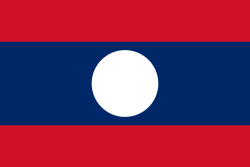
A flag resembling that of that of Thailand, initially used by Lao Issara and then by the Pathet Lao, was formally adopted on 2 December 1975, as the flag of Laos.

See also

[edit]

References

[edit]
Revisions and contributorsEdit on WikipediaRead on Wikipedia
from Grokipedia
Lao Issara, or "Free Laos," was an anti-French nationalist movement and provisional government established in on 12 October 1945 under the leadership of , emerging in the post-World War II after Japanese forces withdrew and briefly seeking full independence from colonial rule. The movement, comprising much of Laos's Western-educated elite, formed a civil administration in that promulgated the country's first and initiated steps toward a postcolonial nation-state, including anti-colonial cultural reforms and efforts to unify disparate Lao principalities. However, internal divisions arose when prioritized alignment with returning French forces, leading to Phetsarath's dismissal and the movement's collapse amid French military reoccupation by mid-1946, after which its leaders fled into exile in . Despite its short duration until around 1949, Lao Issara represented the initial organized Lao resistance to recolonization, influencing later independence struggles, though it received limited external aid including from forces under .

Historical Background

French Colonial Rule and Nationalist Stirrings

The French established colonial control over through a series of military campaigns and diplomatic impositions on Siam in the late , culminating in the Franco-Siamese treaty that transformed the Kingdom of into a . Under this arrangement, assumed responsibility for foreign affairs and defense while nominally preserving the authority of King and local princes, though French residents exercised oversight. By 1904, additional Lao principalities east of the were annexed, integrating the territory into the Union of Indochina as its least prioritized component, with administration centered in . Colonial governance emphasized via traditional elites to minimize administrative costs, but French policies prioritized resource extraction—such as timber, rubber, and —over development, resulting in scant like roads or railways and persistent underinvestment compared to or . This extractive approach, coupled with labor demands and taxation, engendered resentment, as French administrators stereotyped the Lao as inherently lazy and unmotivated, rationalizing limited reforms. Economic stagnation reinforced Laos's role as a strategic rather than a core colony, with only about 100 French civil servants managing the by the 1930s. Early resistance to French rule manifested in millenarian revolts and localized uprisings, laying groundwork for broader nationalist consciousness. Notable examples include the 1901 rebellion led by the mystic Ong Keo against taxation and forced labor, which mobilized thousands before French suppression killed over 3,000 participants, and similar unrest in the tied to ethnic and religious grievances. These movements, though fragmented and often quelled brutally, cultivated a militant tradition that persisted into the . Intellectual stirrings intensified in among a small urban elite educated in French schools or , who formed cultural societies to revive , , and history amid assimilationist pressures. Influenced by regional anti-colonial currents, figures like civil servant Katay Don Sasorith and Prince Phetsarath—viceroy under —promoted Lao identity and administrative autonomy, though constrained by French censorship and the monarchy's collaboration. By the early 1940s, French weaknesses and external pressures began eroding colonial legitimacy, priming the ground for organized .

Japanese Occupation and Independence Declaration

The Japanese presence in Laos began with the occupation of in September 1940, following an agreement with that allowed limited military basing but preserved French civil administration. This arrangement shifted dramatically on March 9, 1945, when Japanese forces executed a coup de force across Indochina, disarming French troops, arresting administrators, and assuming direct control to prevent potential Allied sabotage as Japan's war position deteriorated. In , this action dismantled French authority, interning officials and fostering an environment where Japanese commanders encouraged local autonomy to secure loyalty amid looming defeat. Under Japanese orchestration, King Sisavang Vong of declared 's independence from on April 8, 1945, framing it as liberation from colonial rule while aligning with Tokyo's ideology. This proclamation, issued from the royal capital, nominally elevated the Kingdom of to sovereignty but functioned as a entity dependent on Japanese military oversight, with limited territorial reach beyond the core principalities and no effective challenge to French legal claims. The move stimulated nascent nationalist groups, including intellectuals and elites exposed to anti-colonial ideas, though it primarily served Japanese strategic interests rather than genuine . Japan's surrender on August 15, 1945, created a post-occupation vacuum, as disorganized Japanese units lingered without orders and French forces, weakened by war, delayed reentry until late 1945. Seizing this interval, Prince Phetsarath Rattanavongsa, the king's viceroy and premier, rallied nationalists disillusioned with both Japanese manipulation and French recolonization. On October 12, 1945, the Lao Issara (Free Laos) movement formally declared 's independence in , establishing a that repudiated French and aimed to consolidate authority over , , and Champassak. This declaration, broadcast publicly, marked the first unified Lao effort toward sovereignty, drawing on the momentum from the Japanese era but rooted in indigenous resistance to colonial resumption.

Formation and Early Governance

Establishment in the Power Vacuum

Following the Japanese surrender on August 15, 1945, experienced a profound , as occupying forces rapidly disbanded without handing authority to any successor regime, while French colonial officials remained absent or disorganized after their internment during the occupation. This interregnum, lasting several weeks, allowed nascent Lao nationalist groups—previously suppressed under French rule but emboldened by wartime Japanese promises of autonomy—to coalesce amid the absence of external control. , serving as viceroy and prime minister under King , emerged as the central figure, leveraging his administrative experience and alliances with educated elites to rally support in and . On October 12, 1945, these nationalists formally established the Lao Issara (Free Laos) movement through a public ceremony in Vientiane's sports stadium, proclaiming the unification of 's principalities under a single independent authority and rejecting French suzerainty. Phetsarath assumed leadership of the , which included a drawn from anti-colonial sympathizers and incorporated remnants of Japanese-trained Lao into a nascent Lao Issara to maintain order. The group promulgated a provisional national constitution that day, emphasizing and national unity while sidelining monarchical prerogatives in favor of republican-leaning structures. This establishment capitalized on the temporary disarray, with Lao Issara forces securing key administrative centers like before French paratroopers could regroup and intervene later that month. The movement's rapid formation reflected opportunistic rather than broad popular mobilization, relying primarily on urban elites and princely networks amid limited rural penetration.

Leadership and Organizational Structure

The Lao Issara movement was spearheaded by Prince Phetsarath Rattanavongsa, who assumed de facto leadership following the declaration of independence on October 12, 1945, despite lacking a formal title in the provisional government; his influence stemmed from his prior role as viceroy under the Kingdom of and his opposition to French recolonization. The core leadership cadre, often referred to as the "Promoters" (Khana Kokan), comprised nationalist civil servants experienced in the French colonial bureaucracy, young intellectuals graduated from the Vientiane Teacher Training College, and scions of the royal family, forming a loose coalition united by anti-colonial sentiment rather than ideological rigidity. To confer legitimacy on the nascent administration amid the post-Japanese , Lao Issara authorities convened a People's Committee of 34 members in late , intended to symbolize broad representation but assembled with haste and limited popular consultation. This body oversaw rudimentary governance in , coordinating unification efforts across principalities like and Champassak, though its authority remained contested by pro-French royalists and lacked a formalized or bureaucratic hierarchy. Organizationally, the movement operated as a decentralized network of regional committees, exemplified by the Committee for the East, which managed eastern provinces and maintained ties with Vietnamese nationalists while nominally subordinating to the central ; this structure reflected improvisation rather than a robust institutional framework, vulnerable to factionalism as evidenced by later splits involving figures like Prince Souphanouvong. Phetsarath's guiding role extended to exile operations after 1946, where he directed resistance from , underscoring the movement's reliance on personal authority over codified procedures.

Policies and Achievements

Administrative Reforms and Nationalist Initiatives

The Lao Issara government pursued administrative centralization by unifying the fragmented Lao territories, including the Kingdom of , , and Champasak, into a single independent entity. In September 1945, and Champasak formally united with under the Free Laos banner, culminating in a of national independence and unity on October 12, 1945, during a ceremony in . This merger abolished the separate administrative statuses imposed under French colonial rule, establishing a provisional revolutionary government headquartered in with authority extending to key centers like . On October 12, 1945, the movement adopted 's first provisional , which created a People's Committee comprising 34 members—drawn from nationalist activists, provincial governors, and Lao Pen Lao figures—as the interim legislative and executive organ. This framework introduced rudimentary democratic procedures, such as assembly presentations of government programs, and assigned key roles including as Minister of and , alongside figures like Oun as second-in-command. A issued in late November 1945 further enforced administrative autonomy by barring officials from any contact with French authorities, while military mergers, such as the integration of partisan forces in on October 7, 1945, bolstered centralized control. Nationalist initiatives emphasized sovereignty through symbolic and coercive measures to erode colonial and monarchical legacies. An armed contingent dispatched to on November 10, 1945, compelled King to renounce his throne, declare himself a private citizen, vacate the royal palace, and surrender the sacred phrabang Buddha image as a state symbol. These actions, alongside the constitution's framework for a unified postcolonial state, represented early efforts to foster a cohesive Lao identity independent of French influence, though the government's short duration—ending with French reoccupation in early 1946—constrained implementation of broader structural changes.

Cultural and Symbolic Actions

The Lao Issara government adopted a national flag on 12 October 1945, designed by scholar Maha Sila Viravong, featuring three horizontal stripes of red, blue, and red with a central white disk; the red stripes represented the blood shed by the Lao people in their struggle for freedom, the blue middle stripe signified prosperity and unity, and the white disk symbolized justice and the unity of the ethnic Lao under the moon. This design intentionally excluded royal symbols, such as the three-headed elephant of the Kingdom of Luang Prabang, to emphasize a distinct national identity separate from monarchical emblems and colonial associations, akin to Thailand's post-1932 republican flag adjustments. Prince , as leader of the movement, advanced through symbolic promotion of Lao identity, building on his pre-1945 initiatives like advocating for standardization in 1918, which led to the first modern Lao grammar published in 1935 by Sila Viravong. He supported the founding of the Buddhist Institute in in February 1931 to cultivate a uniquely Lao Buddhist tradition, countering Thai cultural influences and reinforcing ethnic cohesion amid colonial rule. During the brief independence period, Phetsarath's 15 September 1945 proclamation of Lao sovereignty and symbolized aspirations for a greater unified Lao nation spanning the River, rejecting French-imposed boundaries. On 23 September 1945, he formally welcomed Chinese Nationalist troops into as , a gesture asserting autonomous diplomatic authority in the postwar vacuum. The movement also enlisted Buddhist monks () for and mobilization, leveraging religious networks to disseminate nationalist ideals and gain rural support against French reconquest.

Internal Weaknesses and Challenges

The Lao Issara government's administrative apparatus was provisional and underdeveloped, lacking a formal and robust centralized institutions capable of governing Laos's diverse territories effectively. Formed in the immediate post-Japanese vacuum of October 1945, it relied on committees and elite-led ministries that struggled to extend authority beyond and select urban areas, leaving vast rural expanses and ethnic minority regions under nominal or no control. Efforts to organize a national defense force from Japanese-trained levies and local militias yielded only limited results, with insufficient , armament, and cohesion to counter French military advances that began in December 1945. Popular support for the movement remained confined largely to urban elites, intellectuals, and segments of the , failing to penetrate the rural majority or tribal highlands where traditional loyalties to local lords, the , and even French colonial stability prevailed. Critics within the resistance highlighted the Lao Issara's as a core flaw, noting its disconnection from needs and inability to mobilize mass participation in a predominantly characterized by political apathy. This urban-rural divide was exacerbated by the movement's focus on symbolic nationalist gestures over practical reforms addressing or ethnic autonomies, resulting in widespread indifference among the populace that comprised over 90% rural dwellers in 1945. By early 1946, as French forces reasserted control, the absence of broad-based backing accelerated the government's collapse in proper, forcing leaders into exile.

Economic and Logistical Difficulties

The Lao Issara government, established in following the declaration of independence on October 12, 1945, inherited an empty treasury from the departing Japanese occupation authorities, leaving it without funds to pay civil servants or maintain basic operations. Efforts to generate revenue included attempts to tax exports, a key commodity in the region, but these failed due to the government's inability to control trade routes beyond the immediate area. In a bid to assert economic , the administration abolished the French Indochinese monopoly and sought to establish a domestic one, yet limited territorial authority prevented effective implementation. Desperation over financing led the Lao Issara to appeal to for a to produce , reflecting acute fiscal distress and reliance on external amid post-war economic disarray. The maintenance of irregular armed forces, numbering in the hundreds under commanders like Thao O Anourack, further strained resources, as procurement of military equipment and supplies proved challenging without stable revenues or infrastructure. Logistical hurdles compounded these issues, with main eastern roads blocked by forces, impeding movement, supply lines, and enforcement of administrative control. By early 1946, the loss of key positions such as Xiangkhoang to advancing French reinforcements exacerbated logistical vulnerabilities, isolating and undermining the government's capacity to sustain economic activities or coordinate resistance effectively. These constraints, rooted in fragmented control over Laos's rugged terrain and sparse road network, highlighted the provisional nature of the regime and contributed to its rapid erosion against superior French capabilities.

Confrontation with France

French Military Resumption and Resistance

French military forces commenced the reoccupation of in early 1946, aiming to reassert colonial authority after the Lao Issara's in October 1945. Operations started in the southern regions, with troops recapturing Muang Phine on March 14, on March 17, and Sépone shortly thereafter, supported by paratrooper drops and local partisan auxiliaries numbering over 4,000. These advances encountered sporadic resistance from Lao Issara militias, which relied on limited arms and appeals for aid from the that yielded minimal support. The pivotal confrontation occurred at on March 21, 1946, where French forces launched a fierce against entrenched Lao Issara defenders, bolstered by Vietnamese irregulars under Prince Souphanouvong. The battle devolved into urban fighting, resulting in hundreds of deaths among combatants and civilians, including executions and reprisals that targeted both Lao and Vietnamese populations. Lao Issara units inflicted some casualties but suffered approximately 700 killed, with survivors abandoning positions and leaving behind prisoners and equipment. Northern advances followed, with French columns entering and prompting the flight of Prime Minister and key ministers across the border to . By May 1946, French control was largely restored across , though isolated guerrilla actions persisted briefly before the movement shifted to exile operations. The reoccupation highlighted the Lao Issara's organizational limitations, as its forces, numbering in the low thousands and inadequately supplied, could not sustain conventional defense against professional French units.

Key Conflicts and Exile

French forces initiated their reoccupation of Laos in March 1946, beginning with the recapture of southern towns such as Muang Phine on March 14, on March 17, and on March 21. The assault on proved particularly brutal, resulting in hundreds of Lao and Vietnamese combatants and civilians killed during the fighting and subsequent executions by French troops. Lao Issara irregulars, lacking heavy weaponry and coordinated command, offered sporadic resistance but were unable to halt the French advance, which continued northward to secure by May 1946. These operations exposed the Lao Issara's military vulnerabilities, as their forces—primarily lightly armed volunteers and former Japanese collaborators—numbered fewer than 5,000 and relied on captured equipment without sustained supply lines. French commanders exploited divisions within the movement, negotiating secret surrenders with some Issara units while bypassing major engagements elsewhere, effectively dismantling organized opposition by mid-1946. King Sisavang Vong's alignment with the French, including his restoration to power, further eroded Lao Issara legitimacy in royalist strongholds like . Facing imminent collapse, Prince Phetsarath and key Lao Issara leaders crossed the Mekong River into in April 1946, establishing a in . From this base, Phetsarath continued diplomatic efforts, issuing appeals for international recognition of Lao independence and coordinating limited guerrilla activities across the border until 1949. Thai authorities tolerated the exiles amid their own anti-colonial sentiments, though French pressure eventually led to the or neutralization of many supporters. The exile period sustained nationalist momentum but highlighted internal fractures, as ideological differences among leaders prevented unified action.

Factional Split and Dissolution

Ideological Divisions Among Leaders

The ideological divisions within the Lao Issara leadership primarily revolved around differing visions for achieving and sustaining Lao independence, with tensions emerging over alliances, governance models, and attitudes toward communism. , the movement's paramount leader and a conservative , emphasized national sovereignty under a , rejecting both French recolonization and external ideological influences that threatened Lao cultural and monarchical traditions. In contrast, Prince Souphanouvong, Phetsarath's half-brother and the guerrilla army commander, advocated closer ties with the following his mid-1946 meeting with in , prioritizing revolutionary alliances to sustain armed resistance against . This strategic divergence highlighted a broader rift: Phetsarath's faction viewed Viet Minh involvement as subordinating Lao interests to Vietnamese communism, while Souphanouvong saw it as essential for military viability. These differences intensified after French forces reasserted control in 1946, forcing the Lao Issara into exile in . Phetsarath maintained an anti-communist stance, framing as a defense of Lao Buddhist monarchy against both colonial and Marxist threats, a position echoed in Issara that portrayed as incompatible with Lao cultural norms. , however, progressively aligned with leftist ideologies, leading to his removal as military commander in May 1949 amid accusations of prioritizing Vietnamese directives over Lao autonomy. The faction around him, including Viet Minh-influenced Lao elements, rejected compromise, viewing it as capitulation, whereas Phetsarath and moderates like initially resisted but later grappled with pragmatic acceptance of limited reforms. The 1949 Franco-Lao accords, granting nominal independence within the , crystallized the schism on July 20, when non-communist leaders dissolved the , with most returning to integrate into the new administration. Souphanouvong's breakaway group, formalized as the Free Laos resistance, evolved into the by August 1950, adopting Marxist-Leninist principles under Vietnamese patronage and explicitly opposing the monarchical framework favored by Phetsarath. This split not only dissolved the unified front but underscored the causal role of external communist pressures in fracturing an otherwise cohesive , as Phetsarath's until his 1959 death symbolized unyielding opposition to both French hegemony and radical ideological imports.

Dissolution of the Government-in-Exile

In the wake of the Franco-Laotian agreements signed on 19 1949, which granted Laos limited autonomy within the while retaining significant French oversight, moderate and non-communist leaders of the Lao Issara assessed the viability of continued exile resistance. These accords, negotiated in part by figures like in , prompted a strategic reevaluation, as they offered a pathway for reintegration into Lao administration under royal auspices without full independence. By late October, the in formally dissolved, with most members opting to return to via French transport to assume roles in the newly restructured . The dissolution decree, issued around 24-25 October 1949, reflected internal divisions exacerbated by the accords' concessions, as right-wing and centrist factions prioritized pragmatic participation in the French-supervised government over prolonged exile. Prince Phetsarath Rattanavongsa, the movement's paramount leader, vehemently protested the move, viewing it as a capitulation that undermined the original independence declaration of 1945; he remained in , maintaining a diminished personal following but effectively isolating himself from the mainstream nationalist effort. , diverging further, rejected the dissolution entirely and aligned with Vietnamese communists, foreshadowing the formation of the . This fragmentation effectively ended the Lao Issara as a cohesive entity, transitioning its non-exiled adherents into collaboration with French authorities and the monarchy, while sidelining hardline anti-colonialists. The exile government's logistical base in had already weakened due to shifting Thai politics and resource strains, rendering sustained operations untenable post-accords. Although Phetsarath's protests preserved a symbolic anti-French stance, the dissolution marked the absorption of Lao Issara's moderate core into the proto-independent state structure, diluting its revolutionary impetus.

Legacy and Historical Evaluation

Contributions to Lao Nationalism

The Lao Issara movement, formed on October 12, 1945, under , marked the inaugural organized effort to assert Lao sovereignty against French colonial rule following the Japanese occupation's collapse. By declaring independence and establishing a with a , it unified disparate principalities into a singular national framework for the first time, transcending prior fragmented loyalties to or regional identities. This unification effort, though brief, instilled a prototype of centralized national administration, drawing on indigenous royal authority to challenge external domination. Culturally, the Issara promoted Lao nationalism through initiatives that emphasized vernacular language, Buddhist traditions, and pre-colonial , countering French assimilation policies that had marginalized Lao identity in favor of Indochinese . Leaders introduced anti-colonial curricula and public discourse questioning French historical narratives, including the removal of colonial monuments, which galvanized urban intellectuals and fostered a nascent sense of shared ethnic and territorial consciousness. Politically, it pioneered democratic elements by drafting a and advocating , influencing subsequent Lao governance structures despite the movement's conservative-monarchist leanings. In the broader arc of Lao independence, the Issara's resistance symbolized enduring anti-colonial aspiration, providing ideological and organizational precedents for later factions, including the communist formed in 1950 from Issara remnants by figures like Prince . Though limited by urban elitism and lacking rural penetration, its defiance against French reassertion in 1946 preserved nationalist momentum in exile, preventing total erasure of independence rhetoric amid postwar realignments. This foundational role underscored as a causal driver of Lao , distinct from mere royal restoration or external proxies.

Criticisms and Long-Term Impact

The Lao Issara faced criticism for its narrow social base, drawing primarily from urban intellectuals and elites in a where the rural , comprising over 90% of the in the 1940s, remained largely illiterate and disconnected from its nationalist appeals. This elitist character limited its capacity to foster broad-based resistance against French reconquest, as the movement struggled to extend influence beyond cities like and . Internal ideological fissures further undermined cohesion, particularly over ties to the ; a pro-communist minority, including allies of Prince Souphanouvong, was expelled due to perceived excessive alignment with Vietnamese forces, fracturing unity and alienating moderate nationalists. These divisions, compounded by military setbacks—such as defeats in early 1946 that forced leaders into exile—exposed the movement's logistical vulnerabilities and inability to sustain armed opposition without reliable external support. In the long term, the Lao Issara's brief tenure (1945–1949) symbolized nascent Lao sovereignty but yielded limited enduring political structures, as its dissolution on , 1949, saw most leaders accept French-offered autonomy within the , paving the way for the Kingdom of Laos. While it introduced democratic terminology and a provisional influencing governance until the 1975 revolution, the resulting power vacuum enabled the —formed from expelled Issara communists—to dominate the independence narrative and lead to communist consolidation in 1975.

References

Add your contribution
Related Hubs
User Avatar
No comments yet.