Hubbry Logo
Air–fuel ratioAir–fuel ratioMain
Open search
Air–fuel ratio
Community hub
Air–fuel ratio
logo
7 pages, 0 posts
0 subscribers
Be the first to start a discussion here.
Air–fuel ratio
Air–fuel ratio
from Wikipedia

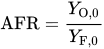
Air–fuel ratio (AFR) is the mass ratio of air to a solid, liquid, or gaseous fuel present in a combustion process. The combustion may take place in a controlled manner such as in an internal combustion engine or industrial furnace, or may result in an explosion (e.g., a dust explosion). The air–fuel ratio determines whether a mixture is combustible at all, how much energy is being released, and how much unwanted pollutants are produced in the reaction. Typically a range of air to fuel ratios exists, outside of which ignition will not occur. These are known as the lower and upper explosive limits.

In an internal combustion engine or industrial furnace, the air–fuel ratio is an important measure for anti-pollution and performance-tuning reasons. If exactly enough air is provided to completely burn all of the fuel (stoichiometric combustion), the ratio is known as the stoichiometric mixture, often abbreviated to stoich. Ratios lower than stoichiometric (where the fuel is in excess) are considered "rich". Rich mixtures are less efficient, but may produce more power and burn cooler. Ratios higher than stoichiometric (where the air is in excess) are considered "lean". Lean mixtures are more efficient but may cause higher temperatures, which can lead to the formation of nitrogen oxides. Some engines are designed with features to allow lean-burn. For precise air–fuel ratio calculations, the oxygen content of combustion air should be specified because of different air density due to different altitude or intake air temperature, possible dilution by ambient water vapor, or enrichment by oxygen additions.

Air-fuel ratio meters

[edit]

An air-fuel ratio meter monitors the air–fuel ratio of an internal combustion engine. Also called air–fuel ratio gauge, air–fuel meter, or air–fuel gauge, it reads the voltage output of an oxygen sensor, sometimes also called AFR sensor or lambda sensor.

The original narrow-band oxygen sensors became factory installed standard in the late 1970s and early 1980s. In recent years a newer and much more accurate wide-band sensor, though more expensive, has become available.

Most stand-alone narrow-band meters have 10 LEDs and some have more. Also common, narrow band meters in round housings with the standard mounting 52 and 67 mm (2+116 and 2+58 in) diameters, as other types of car 'gauges'. These usually have 10 or 20 LEDs. Analogue 'needle' style gauges are also available.

Internal combustion engines

[edit]

In theory, a stoichiometric mixture has just enough air to completely burn the available fuel. In practice, this is never quite achieved, due primarily to the very short time available in an internal combustion engine for each combustion cycle.

Most of the combustion process is completed in approximately 2 milliseconds at an engine speed of 6,000 revolutions per minute (100 revolutions per second, or 10 milliseconds per revolution of the crankshaft. For a four-stroke engine this would mean 5 milliseconds for each piston stroke, and 20 milliseconds to complete one 720 degree Otto cycle). This is the time that elapses from the spark plug firing until 90% of the fuel–air mix is combusted, typically some 80 degrees of crankshaft rotation later. Catalytic converters are designed to work best when the exhaust gases passing through them are the result of nearly perfect combustion.

A perfectly stoichiometric mixture burns very hot and can damage engine components if the engine is placed under high load at this fuel–air mixture. Due to the high temperatures at this mixture, the detonation of the fuel-air mix while approaching or shortly after maximum cylinder pressure is possible under high load (referred to as knocking or pinging), specifically a "pre-detonation" event in the context of a spark-ignition engine model. Such detonation can cause serious engine damage as the uncontrolled burning of the fuel-air mix can create very high pressures in the cylinder. As a consequence, stoichiometric mixtures are only used under light to low-moderate load conditions. For acceleration and high-load conditions, a richer mixture (lower air–fuel ratio) is used to produce cooler combustion products (thereby utilizing evaporative cooling), and so avoid overheating of the cylinder head, and thus prevent detonation.

Engine management systems

[edit]

The stoichiometric mixture for a gasoline engine is the ideal ratio of air to fuel that burns all fuel with no excess air. For gasoline fuel, the stoichiometric air–fuel mixture is about 14.7:1[1] i.e. for every one gram of fuel, 14.7 grams of air are required. For pure octane fuel, the oxidation reaction is:

25 O2 + 2 C8H18 → 16 CO2 + 18 H2O + energy

Any mixture greater than 14.7:1 is considered a lean mixture; any less than 14.7:1 is a rich mixture – given perfect (ideal) "test" fuel (gasoline consisting of solely n-heptane and iso-octane). In reality, most fuels consist of a combination of heptane, octane, a handful of other alkanes, plus additives including detergents, and possibly oxygenators such as MTBE (methyl tert-butyl ether) or ethanol/methanol. These compounds all alter the stoichiometric ratio, with most of the additives pushing the ratio downward (oxygenators bring extra oxygen to the combustion event in liquid form that is released at the time of combustions; for MTBE-laden fuel, a stoichiometric ratio can be as low as 14.1:1). Vehicles that use an oxygen sensor or other feedback loops to control fuel to air ratio (lambda control), compensate automatically for this change in the fuel's stoichiometric rate by measuring the exhaust gas composition and controlling fuel volume. Vehicles without such controls (such as most motorcycles until recently, and cars predating the mid-1980s) may have difficulties running certain fuel blends (especially winter fuels used in some areas) and may require different carburetor jets (or otherwise have the fueling ratios altered) to compensate. Vehicles that use oxygen sensors can monitor the air–fuel ratio with an air–fuel ratio meter.

Other types of engines

[edit]

In the typical air to natural gas combustion burner, a double-cross limit strategy is employed to ensure ratio control. (This method was used in World War II).[citation needed] The strategy involves adding the opposite flow feedback into the limiting control of the respective gas (air or fuel). This assures ratio control within an acceptable margin.

Other terms used

[edit]

There are other terms commonly used when discussing the mixture of air and fuel in internal combustion engines.

Mixture

[edit]

Mixture is the predominant word that appears in training texts, operation manuals, and maintenance manuals in the aviation world.

Air-fuel ratio is the ratio between the mass of air and the mass of fuel in the air-fuel mix at any given moment. The mass is the mass of all constituents that compose the air or fuel, whether they take part in the combustion or not. For example, a calculation of the mass of natural gas as fuel — which often contains carbon dioxide (CO
2
), nitrogen (N
2
), and various alkanes — includes the mass of the carbon dioxide, nitrogen and all alkanes in determining the value of mfuel.[2]

For pure octane the stoichiometric mixture is approximately 15.1:1, or λ of 1.00 exactly.

In naturally aspirated engines powered by octane, maximum power is frequently reached at AFRs ranging from 12.5 to 13.3:1 or λ of 0.850 to 0.901.[citation needed]

The air-fuel ratio of 12:1 is considered as the maximum output ratio, whereas the air-fuel ratio of 16:1 is considered as the maximum fuel economy ratio.[citation needed]

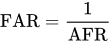
Fuel–air ratio (FAR)

[edit]

Fuel–air ratio is commonly used in the gas turbine industry as well as in government studies of internal combustion engine, and refers to the ratio of fuel to the air.[citation needed]
Air–fuel equivalence ratio (λ)

[edit]

Air–fuel equivalence ratio, λ (lambda), is the ratio of actual AFR to stoichiometry for a given mixture. λ = 1.0 is at stoichiometry, rich mixtures λ < 1.0, and lean mixtures λ > 1.0.

There is a direct relationship between λ and AFR. To calculate AFR from a given λ, multiply the measured λ by the stoichiometric AFR for that fuel. Alternatively, to recover λ from an AFR, divide AFR by the stoichiometric AFR for that fuel. This last equation is often used as the definition of λ:
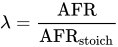
Because the composition of common fuels varies seasonally, and because many modern vehicles can handle different fuels when tuning, it makes more sense to talk about λ values rather than AFR.[3]

Most practical AFR devices actually measure the amount of residual oxygen (for lean mixes) or unburnt hydrocarbons (for rich mixtures) in the exhaust gas.

Fuel–air equivalence ratio (Φ)

[edit]

The fuel–air equivalence ratio, Φ (phi), of a system is defined as the ratio of the fuel-to-oxidizer ratio to the stoichiometric fuel-to-oxidizer ratio. Mathematically,

where m represents the mass, n represents a number of moles, subscript st stands for stoichiometric conditions.

The advantage of using equivalence ratio over fuel–oxidizer ratio is that it takes into account (and is therefore independent of) both mass and molar values for the fuel and the oxidizer. Consider, for example, a mixture of one mole of ethane (C
2
H
6
) and one mole of oxygen (O
2
). The fuel–oxidizer ratio of this mixture based on the mass of fuel and air is

and the fuel-oxidizer ratio of this mixture based on the number of moles of fuel and air is

Clearly the two values are not equal. To compare it with the equivalence ratio, we need to determine the fuel–oxidizer ratio of ethane and oxygen mixture. For this we need to consider the stoichiometric reaction of ethane and oxygen,

C2H6 + 72 O2 → 2 CO2 + 3 H2O

This gives

Thus we can determine the equivalence ratio of the given mixture as

or, equivalently, as

Another advantage of using the equivalence ratio is that ratios greater than one always mean there is more fuel in the fuel–oxidizer mixture than required for complete combustion (stoichiometric reaction), irrespective of the fuel and oxidizer being used—while ratios less than one represent a deficiency of fuel or equivalently excess oxidizer in the mixture. This is not the case if one uses fuel–oxidizer ratio, which takes different values for different mixtures.

The fuel–air equivalence ratio is related to the air–fuel equivalence ratio (defined previously) as follows:

Mixture fraction

[edit]

The relative amounts of oxygen enrichment and fuel dilution can be quantified by the mixture fraction, Z, defined as

,

where

,

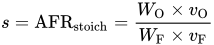
YF,0 and YO,0 represent the fuel and oxidizer mass fractions at the inlet, WF and WO are the species molecular weights, and vF and vO are the fuel and oxygen stoichiometric coefficients, respectively. The stoichiometric mixture fraction is

[4]

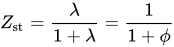
The stoichiometric mixture fraction is related to λ (lambda) and Φ (phi) by the equations

,

assuming

[5]

Percent excess combustion air

[edit]
Ideal stoichiometry

In industrial fired heaters, power plant steam generators, and large gas-fired turbines, the more common terms are percent excess combustion air and percent stoichiometric air.[6][7] For example, excess combustion air of 15 percent means that 15 percent more than the required stoichiometric air (or 115 percent of stoichiometric air) is being used.

A combustion control point can be defined by specifying the percent excess air (or oxygen) in the oxidant, or by specifying the percent oxygen in the combustion product.[8] An air–fuel ratio meter may be used to measure the percent oxygen in the combustion gas, from which the percent excess oxygen can be calculated from stoichiometry and a mass balance for fuel combustion. For example, for propane (C
3
H
8
) combustion between stoichiometric and 30 percent excess air (AFRmass between 15.58 and 20.3), the relationship between percent excess air and percent oxygen is:

See also

[edit]

References

[edit]
[edit]
Revisions and contributorsEdit on WikipediaRead on Wikipedia
from Grokipedia
The air–fuel ratio (AFR) is the of air to in a process, such as in internal combustion s or industrial furnaces, and it determines the completeness of fuel oxidation and the resulting energy release. This ratio is fundamental to engine operation, as it directly influences efficiency, power output, economy, and emissions; deviations from the optimal balance can lead to incomplete , reduced performance, or engine damage. In gasoline-powered internal combustion engines, the stoichiometric AFR—the ideal ratio for complete with no excess air or fuel—is approximately 14.7:1 by mass, meaning 14.7 parts air to 1 part , based on the of hydrocarbons with oxygen. Lambda (λ), a dimensionless , normalizes the actual AFR to the stoichiometric value (λ = actual AFR / stoichiometric AFR), where λ = 1 indicates stoichiometric conditions, λ > 1 denotes a lean (excess air), and λ < 1 signifies a rich (excess ). Lean mixtures improve fuel efficiency and reduce carbon monoxide (CO) and hydrocarbon (HC) emissions but can increase nitrogen oxide (NOx) levels and risk engine knock or overheating, while rich mixtures enhance power for high-performance applications yet produce higher CO and HC emissions alongside lower efficiency. Modern engines use sensors, such as wideband oxygen sensors, to monitor and adjust AFR in real-time via electronic control units (ECUs), enabling precise tuning for varying loads, fuels, and environmental conditions to meet regulatory standards like those for emissions control.

Fundamentals

Definition and Importance

The air–fuel ratio (AFR) is defined as the mass ratio of air to fuel present in a combustion mixture, expressed as AFR = mair / mfuel, where mair is the mass of air and mfuel is the mass of fuel. In most engineering applications, particularly for liquid fuels, AFR is calculated on a mass basis to account for density differences; however, volumetric AFR, based on volume ratios, is sometimes employed for gaseous fuels where ideal gas assumptions simplify measurements. The concept of AFR originated in early 20th-century engine design, where engineers sought to optimize the air and fuel mixture for efficient in engines used in automotive and applications. AFR plays a critical role in governing the completeness of , the magnitude of release during the process, and the avoidance of operational issues such as or incomplete fuel burning that can reduce performance and increase wear. By maintaining an appropriate AFR, engines achieve better fuel economy through more efficient conversion, output under load, and reduced emissions to comply with environmental regulations in contemporary vehicles. For typical fuels like , operational AFR values commonly range from 10:1 (rich mixtures for high power) to 20:1 (lean mixtures for economy). The stoichiometric AFR provides the ideal benchmark for complete with neither excess air nor unburned .

Stoichiometric Air-Fuel

The stoichiometric air- (AFR_s), also known as the ideal or theoretical air- , represents the precise mass of air to required for complete , where all and oxygen are fully consumed to produce (CO₂) and (H₂O) as the only products, with no unburned hydrocarbons, , or excess oxygen remaining. This ensures maximum release from the while minimizing emissions under ideal conditions. The derivation of AFR_s stems from chemical stoichiometry for a general hydrocarbon fuel represented as C_x H_y. The balanced combustion reaction is: CxHy+(x+y4)(O2+3.76N2)xCO2+y2H2O+3.76(x+y4)N2\text{C}_x \text{H}_y + \left( x + \frac{y}{4} \right) \left( \text{O}_2 + 3.76 \text{N}_2 \right) \to x \text{CO}_2 + \frac{y}{2} \text{H}_2\text{O} + 3.76 \left( x + \frac{y}{4} \right) \text{N}_2 Here, the stoichiometric oxygen coefficient is a=x+y/4a = x + y/4 moles of O₂ per mole of fuel, and air is approximated as 21% O₂ and 79% N₂ by volume (or 3.76 moles of N₂ per mole of O₂). The total moles of air per mole of fuel are 4.76a4.76 a. Using the molar mass of air (approximately 28.97 kg/kmol) and fuel (12x + y kg/kmol), the mass-based AFR_s is calculated as: AFRs=4.76(x+y4)×28.9712x+y\text{AFR}_s = \frac{4.76 \left( x + \frac{y}{4} \right) \times 28.97}{12x + y} This formula accounts for the complete oxidation of carbon to CO₂ and hydrogen to H₂O. Representative values of AFR_s vary by composition. For , which is often approximated as C₈H₁₈ (iso-octane), the stoichiometric ratio is approximately 15.1:1 by , though typical compositions yield about 14.7:1. For , approximated as C₁₂H₂₃, it is 14.5:1. , primarily (CH₄), has an AFR_s of 17.2:1. (C₂H₅OH), an oxygenated , requires 9:1 due to its inherent oxygen content reducing the external air demand. The primary factor influencing the stoichiometric ratio is fuel composition, as variations in the C_x H_y directly alter the oxygen requirement per unit of . Temperature and also affect chemistry; elevated temperatures promote dissociation of products like CO₂ and H₂O into such as CO and OH, potentially requiring minor adjustments to the ratio for achieving near-complete , while higher pressures suppress dissociation and stabilize the reaction toward stoichiometric products. In engine design, the stoichiometric serves as the foundational reference for calibrating and air intake systems to operate near AFR_s, particularly to optimize the of three-way catalytic converters, which achieve maximum conversion (HC, CO, and NOx) only when the exhaust is maintained close to this balanced condition.

Other Terms Used

In processes, air- mixtures are classified qualitatively based on their composition relative to the stoichiometric , which represents the ideal balance of air and for complete . A stoichiometric achieves exact proportions where all and oxidizer are consumed without excess. Lean mixtures contain more air than required (higher air- ), while rich mixtures have excess (lower air- ). This classification serves as a foundational reference for understanding behavior in various systems. Lean mixtures generally promote higher due to the abundance of air, which allows for more complete and lower temperatures, but they can lead to misfires if the is too diluted, resulting in incomplete or . Conversely, rich mixtures enhance power output by providing additional for cooling the and increasing flame quenching, though they contribute to higher emissions of unburned hydrocarbons and . These characteristics influence overall system performance, balancing efficiency against reliability. The term "" originated in early 20th-century design, particularly with carburetors, where it described the adjustable blend of air and vaporized fuel drawn into the intake manifold to suit varying operating conditions like idling or full . Engineers tuned these mixtures manually via jets and vents to optimize performance, laying the groundwork for modern fuel delivery systems. This historical context highlights the mixture's role as a tunable in control. Practically, mixture strength directly impacts key combustion dynamics: leaner mixtures often exhibit slower flame speeds and lower peak temperatures, promoting stability in certain low-load scenarios, while richer mixtures accelerate flame propagation and elevate temperatures, enhancing combustion completeness but risking knock or overheating. These effects underscore the need for precise mixture management to maintain stable burning across operational ranges.

Fuel–air ratio (FAR)

The fuel–air ratio (FAR), often denoted as ff or f/af/a, is defined as the mass ratio of fuel to air in a combustible mixture, mathematically expressed as FAR=mfuelmair=1AFR.\text{FAR} = \frac{m_{\text{fuel}}}{m_{\text{air}}} = \frac{1}{\text{AFR}}. This represents the inverse of the air–fuel ratio (AFR). FAR is commonly used in , particularly in and gas turbine systems, where the focus is on the mass of fuel added to a large for . It is also applied in rocket propulsion contexts for air-breathing or hybrid systems, emphasizing fuel mass relative to available oxidizer or air. For stoichiometric combustion of gasoline, the FAR is approximately 0.068, equivalent to an AFR of 14.7:1. This ratio simplifies performance analysis in fuel-lean environments typical of gas turbines and jet engines, with jet engine operation often around 0.017 to 0.03.

Air–fuel equivalence ratio (λ)

The air–fuel equivalence ratio, denoted as λ (), is a dimensionless that quantifies the composition of a combustible by comparing the actual air–fuel ratio (AFR) to the stoichiometric air–fuel ratio (AFR_s) required for complete . It is mathematically defined as λ = AFR / AFR_s, where AFR is the of air to in the actual . At , λ = 1, indicating an ideal balance where all and oxygen are consumed without excess; values greater than 1 denote a lean with surplus air, while values less than 1 signify a rich with excess . This normalization arises from the need to standardize deviations across varying types, as AFR_s differs by composition (e.g., approximately 14.7 for and 14.5 for diesel). For instance, a λ of 0.85 implies an approximately 18% rich condition ((1/λ - 1) × 100%), meaning the content exceeds stoichiometric needs by about 18%, which can lead to incomplete and higher emissions but provides cooling benefits in high-load scenarios. The parameter's derivation emphasizes relative excess air or , enabling consistent and diagnostics independent of absolute AFR values. The use of λ gained prominence in the alongside the advent of electronic engine controls, particularly with Bosch's introduction of the in 1976, which facilitated real-time mixture adjustments to meet emerging emissions regulations. In modern automotive diagnostics, λ is integral to systems, where it monitors exhaust oxygen levels to ensure compliance with emission standards by maintaining mixtures near during closed-loop operation. Typical operating ranges for λ are 0.7–1.2 in spark-ignition (SI) engines to balance power, efficiency, and emissions, while diesel engines employ wider spans, often exceeding 5 under lean, low-load conditions for reduced and improved fuel economy.

Fuel–air equivalence ratio (Φ)

The fuel–air equivalence ratio, denoted as Φ (phi), is defined as the ratio of the actual fuel-to-air mass ratio to the stoichiometric fuel-to-air mass ratio: Φ=(mf/ma)actual(mf/ma)stoich=FARFARs=AFRsAFR,\Phi = \frac{(m_\mathrm{f}/m_\mathrm{a})_\mathrm{actual}}{(m_\mathrm{f}/m_\mathrm{a})_\mathrm{stoich}} = \frac{\mathrm{FAR}}{\mathrm{FAR_s}} = \frac{\mathrm{AFR_s}}{\mathrm{AFR}}, where mfm_\mathrm{f} and mam_\mathrm{a} are the masses of fuel and air, respectively, FAR is the fuel–air ratio, and AFR is the air–fuel ratio, with the subscript "s" denoting stoichiometric conditions. This dimensionless parameter normalizes the mixture composition relative to complete combustion, emphasizing the fuel perspective. At stoichiometric conditions, Φ = 1, indicating exact proportions for complete without excess fuel or air; Φ > 1 corresponds to fuel-rich mixtures with excess fuel, while Φ < 1 denotes fuel-lean mixtures with excess air. As the reciprocal of the air–fuel equivalence ratio λ, Φ = 1 / λ provides an inverted view suited to analyses where fuel distribution is the primary scalar. For instance, if λ = 0.85 (a lean condition from the air perspective), then Φ ≈ 1.18, signifying approximately 18% excess fuel relative to stoichiometry, calculated as (Φ - 1) × 100%. This ratio is commonly employed in computational fluid dynamics (CFD) simulations and chemical kinetics modeling, particularly for fuel-focused approaches in complex flow fields where tracking fuel mass fractions is central. In such simulations, Φ facilitates the parameterization of reaction rates and species transport in non-uniform mixtures, enabling predictions of flame structure and stability without explicit air tracking. High values of Φ in local rich zones are associated with elevated soot and carbon monoxide (CO) formation, as insufficient oxygen limits oxidation to CO₂ and promotes incomplete combustion products. For example, soot volume fraction peaks around Φ ≈ 1.85 in certain diffusion flames, while CO emissions rise in rich regions due to reduced post-flame oxidation. The use of Φ gained prominence in 1980s aerospace research for analyzing non-premixed flames, where it supported early CFD models of jet engine combustors and scramjet flows by quantifying local fuel excess in turbulent diffusion regimes.

Mixture fraction

The mixture fraction, denoted as ff, serves as a conserved scalar in turbulent combustion modeling, representing the local mass fraction of material originating from the fuel stream in a mixture of fuel and oxidizer. This scalar is invariant under chemical reactions, allowing it to track the progress of mixing independently of combustion kinetics. For simple hydrocarbon fuels and oxidizers like oxygen or air, it is defined as f=YFYO/r+YOx,/rYF,+YOx,/r,f = \frac{Y_F - Y_O / r + Y_{Ox,\infty} / r}{Y_{F,\infty} + Y_{Ox,\infty} / r}, where YFY_F and YOY_O are the local mass fractions of fuel and oxidizer, rr is the stoichiometric fuel–oxidizer ratio, and the subscript \infty indicates values in the inlet fuel and oxidizer streams, respectively. At the pure fuel inlet, f=1f = 1, while at the pure oxidizer inlet, f=0f = 0. In turbulent non-premixed combustion modeling, the mixture fraction plays a central role by parameterizing the thermochemical state of the flow, enabling the solution of a single transport equation for ff instead of multiple species equations. This simplification is particularly valuable in , where fuel and oxidizer mix without prior premixing, and combustion occurs at stoichiometric surfaces defined by a specific value of fstf_{st}. Flamelet models and often tabulate species concentrations, temperature, and other properties as functions of ff and its variance, capturing turbulence-chemistry interactions efficiently. The mixture fraction approach finds widespread application in computational fluid dynamics (CFD) simulations of practical devices such as gas turbine combustors and industrial furnaces, where it facilitates predictions of temperature fields, species distributions, and heat release rates in complex turbulent flows. For instance, in gas turbine modeling, it helps optimize fuel injection strategies to minimize emissions by resolving non-uniform mixing. Similarly, in furnace simulations, it aids in evaluating combustion efficiency under varying fuel compositions. A notable variant is Bilger's mixture fraction, which normalizes the scalar based on atomic mass fractions of elements like carbon, hydrogen, and oxygen to ensure conservation in the presence of differential diffusion and for fuels with complex compositions beyond simple hydrocarbons. This formulation, Z=(ββox)/(βfβox)Z = (\beta - \beta_{ox}) / (\beta_f - \beta_{ox}), where β\beta combines normalized element fractions, improves accuracy in multi-element systems by reducing sensitivity to molecular transport differences. Despite its advantages, the mixture fraction method assumes single-step, infinitely fast chemistry in basic implementations, which limits its fidelity for detailed kinetic effects or partial premixing scenarios. It is thus most appropriate for non-premixed turbulent flames and less suitable for premixed combustion regimes where equivalence ratios vary globally rather than through diffusion.

Percent excess combustion air

The percent excess combustion air, often simply called percent excess air, quantifies the additional air supplied beyond the stoichiometric requirement for complete fuel combustion. It is defined as the ratio of the difference between actual air supplied and stoichiometric air to the stoichiometric air, multiplied by 100%: % excess air=actual airstoichiometric airstoichiometric air×100%\% \text{ excess air} = \frac{\text{actual air} - \text{stoichiometric air}}{\text{stoichiometric air}} \times 100\% This metric can also be derived from the (AFR), where AFRs_s denotes the stoichiometric value: % excess air=AFRAFRsAFRs×100%\% \text{ excess air} = \frac{\text{AFR} - \text{AFR}_s}{\text{AFR}_s} \times 100\% Furthermore, it directly relates to the air–fuel equivalence ratio λ\lambda, a scalar measure of air relative to stoichiometric needs, via: % excess air=(λ1)×100%\% \text{ excess air} = (\lambda - 1) \times 100\% For instance, when λ=1.2\lambda = 1.2, the percent excess air equals 20%, indicating 20% more air than needed for stoichiometry. In boiler and furnace operations, percent excess air plays a key role in optimizing efficiency by trading off heat retention against combustion reliability. Minimal excess air limits exhaust heat losses from unused air mass, enhancing thermal efficiency, while sufficient excess ensures thorough fuel oxidation to avoid unburned residues. Industrial burners typically operate at 10–50% excess air, with lower values (e.g., 10–20%) common for gaseous fuels and higher for solids or liquids to promote mixing. Practically, percent excess air is measured through flue gas analysis, where exhaust oxygen concentration serves as a proxy: elevated O2_2 levels (e.g., 3–5% for optimal conditions) reflect higher excess, allowing adjustments for efficiency. The concept of percent excess air emerged as a standard tool in 19th-century steam engine optimization, enabling precise air control in boilers to boost fuel economy amid Industrial Revolution demands.

Measurement

Air-Fuel Ratio Meters

Air–fuel ratio meters, commonly known as lambda sensors or oxygen sensors, are devices that measure the composition of exhaust gases to infer the air–fuel ratio (AFR) in internal combustion engines. These sensors primarily detect the oxygen partial pressure in the exhaust, providing feedback for maintaining optimal combustion efficiency and emission control. Narrowband lambda sensors operate as binary switches, producing a voltage output that sharply transitions at the stoichiometric equivalence ratio (λ = 1, corresponding to an AFR of approximately 14.7:1 for gasoline), indicating whether the mixture is rich (high voltage, ~0.9 V) or lean (low voltage, ~0.1 V). This type is suitable for basic stoichiometric control but lacks precision for lean or rich mixtures outside a narrow range. In contrast, wideband lambda sensors deliver a linear output proportional to the AFR across a broad range (λ from 0.7 to infinity), enabling accurate measurement for both fuel economy and performance tuning. They achieve this through a dual-cell design incorporating a Nernst sensing cell and an oxygen pump cell, where a controlled current pumps oxygen ions to maintain a reference λ = 1 at the sensing electrode, with the pump current (Ip) directly correlating to the exhaust oxygen level. The core operation of these sensors relies on zirconia-based electrochemical cells, where yttria-stabilized zirconia (YSZ) acts as a solid electrolyte that conducts oxygen ions at high temperatures (>350°C), generating a Nernstian voltage based on the difference in oxygen partial pressures between the exhaust and a reference atmosphere. Typical response times for modern sensors are around 100 ms, allowing real-time feedback during engine transients. The equivalence ratio λ serves as the standard output metric, where λ < 1 indicates a rich mixture and λ > 1 a lean one. Advancements since the early 2000s have focused on planar designs, which integrate thin-film zirconia layers on a substrate for reduced size, lower manufacturing costs, and faster heating to compared to earlier thimble-style sensors. These planar sensors, often heated for rapid activation during cold starts, have enabled widespread adoption in automotive applications for improved durability and integration. Calibration of AFR meters involves exposing the sensor to known gas mixtures, such as those simulating stoichiometric conditions, to verify and adjust the output voltage or current against reference standards. Modern wideband units achieve an accuracy of ±1% in AFR measurement, ensuring reliable performance over their operational lifespan.

Calculation and Estimation Methods

The air-fuel ratio (AFR) can be directly calculated using measured mass flow rates of air and fuel, typically obtained from intake airflow sensors and fuel injector pulse widths calibrated against fuel density and injector flow characteristics. The fundamental equation is AFR = \dot{m}_a / \dot{m}_f, where \dot{m}_a is the air mass flow rate (often derived from volumetric flow rate multiplied by air density under prevailing conditions) and \dot{m}_f is the fuel mass flow rate. This method relies on engine dynamometer data or in-situ measurements during operation, providing a straightforward stoichiometric or actual AFR value without exhaust sampling. Exhaust gas analysis offers an indirect estimation of AFR by analyzing concentrations of (CO), (CO₂), oxygen (O₂), and hydrocarbons (HC) using a five-gas analyzer. This approach leverages to infer the equivalence ratio λ (where λ = 1 corresponds to stoichiometric AFR), with the standard Brettschneider equation providing the calculation based on the balance of oxygen to carbon and hydrogen in the exhaust gases. Such methods are particularly effective for steady-state conditions in or post- evaluations, normalizing against the known stoichiometric AFR for the type. Model-based estimation employs computational algorithms within engine control units (ECUs) to predict AFR from inputs like manifold absolute pressure (), engine speed (RPM), and throttle position, bypassing direct sensing. Techniques such as extended Kalman filters fuse these dynamic variables with a mean-value model to track cylinder air charge and fuel delivery, while neural networks can adaptively learn nonlinear mappings from training data on similar operating regimes. These estimators enable real-time inference for transient conditions, integrating with broader dynamics models. These methods typically achieve accuracies within ±5% of measured values under controlled conditions, though errors can increase to ±10% during transients due to unmodeled disturbances like variations or drift. Limitations include dependency on precise and reduced reliability in variable-fuel scenarios, making them suitable for sensorless tuning in performance engines or retrofitting historical vehicles lacking modern . In contemporary applications, such estimation techniques support hybrid engine simulations by providing virtual AFR feedback for design optimization and enable (OBD) to maintain compliance during failures through fallback models.

Applications

Internal Combustion Engines

In spark-ignition (SI) engines, the air–fuel ratio (AFR) is typically optimized around the stoichiometric value of 14.7:1 by mass for , which ensures complete and compatibility with three-way catalytic converters that require operation within a narrow window near this ratio for effective pollutant reduction. This stoichiometric operation predominates during steady-state conditions such as cruising, where the equivalence ratio λ equals 1.0, balancing fuel economy and power output while minimizing unburned hydrocarbons and . In contrast, modes in direct-injection SI engines extend λ to 1.2–1.6, enhancing by reducing pumping losses and , particularly at part loads, though this requires advanced stratification to maintain stable ignition. Compression-ignition (diesel) engines operate with an overall lean AFR, typically corresponding to λ values of 1.5–4, far exceeding the stoichiometric of approximately 14.5:1 for conventional , which allows for density without throttling while inherently limiting peak temperatures. During transients such as , local rich pockets (λ < 1) can form due to delayed fuel vaporization and air utilization, necessitating careful injection timing to control smoke formation without compromising overall leanness. Fuel-specific tuning adjusts these regimes; for example, E10 gasoline in SI engines has a slightly lower stoichiometric AFR of about 14.1:1 compared to pure gasoline, requiring recalibration to maintain λ = 1.0 and avoid lean misfires under the same air mass flow. Pure diesel, with its , supports broader lean operation without such adjustments. Transient effects further influence AFR optimization in both engine types. In SI engines, enrichment to λ < 0.9 occurs during acceleration to cool the charge and suppress knock, a phenomenon driven by auto-ignition of the end-gas mixture, while idling reverts to stoichiometric conditions for stable combustion and catalyst readiness. Diesel engines exhibit analogous transient enrichment in rich pockets to manage torque demands, though their baseline leanness mitigates widespread knock risks. The evolution of AFR control in internal combustion engines transitioned from fixed ratios in carbureted systems—prevalent before the 1980s, which offered limited adaptability to load or fuel variations—to electronic fuel injection (EFI) enabling precise, variable AFR modulation across operating regimes for improved efficiency and responsiveness.

Other Types of Engines

In gas turbine engines, lean premixed combustion operates at air-fuel equivalence ratios λ of 1.5 to 2, which reduces NOx emissions by maintaining lower flame temperatures compared to diffusion flames. Variable geometry features, such as adjustable swirlers or dilution ports, enable precise control of airflow distribution to maintain optimal local air-fuel ratios across varying operating conditions. Rocket engines employ an oxidizer-to-fuel ratio analogous to the , with bipropellant systems using separate fuel and oxidizer streams for controlled combustion, unlike monopropellant systems that decompose a single substance. For /LOX bipropellant engines like the , the typical oxidizer-to-fuel mass ratio is 2.34:1, which is fuel-rich relative to the stoichiometric ratio of 2.56:1, allowing the excess fuel to provide regenerative cooling for the combustion chamber walls. Wankel rotary engines operate with air-fuel ratios similar to spark-ignition piston engines but exhibit wider tolerance ranges, particularly for lean mixtures, due to peripheral or side port timing that enhances air swirl and fuel stratification for more stable combustion. Stirling engines utilize external combustion where fuel is burned in a separate heater head with a fixed high air-fuel ratio, typically featuring excess air to ensure complete combustion, minimize emissions, and maximize thermal efficiency transfer to the working fluid. In high-speed flow environments of gas turbines and rocket engines, maintaining uniform air-fuel ratios is challenging due to turbulent mixing and shear layers, necessitating staging techniques—such as axial or radial fuel injection points—to prevent localized hotspots that could cause thermal stress or elevated emissions. In aerospace contexts, the fuel-air ratio is often emphasized over air-fuel ratio for analyzing combustion efficiency in such systems.

Control Systems

Engine Management Systems

Engine management systems (EMS) utilize the electronic control unit (ECU) to integrate (AFR) sensors with throttle position sensors and fuel injectors, enabling closed-loop control that dynamically adjusts fuel delivery based on real-time exhaust feedback. This integration allows the ECU to maintain optimal combustion conditions by modulating injector pulse widths in response to AFR deviations, ensuring efficient operation across varying engine loads and speeds. In modern gasoline engines, such systems employ proportional-integral-derivative (PID) algorithms within the closed-loop framework to trim the fuel mixture toward the stoichiometric ratio (λ=1), minimizing excursions that could affect drivability. Operational modes in EMS alternate between open-loop and closed-loop configurations to balance startup reliability and steady-state precision. During cold starts, the system operates in open-loop mode using predefined fuel maps that deliver a richer AFR (typically λ<1) to promote stable ignition and rapid warm-up, as oxygen sensors are not yet operational. Once the engine reaches operating temperature—usually after 30-60 seconds—the ECU transitions to closed-loop mode, where AFR sensors provide continuous feedback for fine adjustments via fuel trims. Short-term fuel trims (STFT) offer immediate corrections up to ±25% based on instantaneous oxygen sensor data, while long-term fuel trims (LTFT) accumulate these adjustments over multiple cycles to account for persistent biases. Adaptive learning mechanisms within the EMS further refine control by compensating for component degradation, such as fuel injector aging or variations in fuel quality. These algorithms update base fuel maps by integrating LTFT data, allowing the ECU to "learn" and adapt to changes like reduced injector flow rates over time, thereby preserving AFR accuracy without manual recalibration. Post-2010 advancements have incorporated model predictive control (MPC) in hybrid powertrains, where the ECU forecasts AFR trajectories alongside torque demands to optimize fuel injection and electric motor assist, enhancing overall efficiency in transient conditions. For diagnostics, on-board systems compliant with OBD-II standards monitor AFR deviations through fuel trim values; sustained excursions exceeding 25%—indicating potential sensor or injector faults—trigger the malfunction indicator lamp (MIL) after two consecutive drive cycles to alert the driver of emissions-related issues. Wideband AFR meters provide the precise λ feedback essential for these advanced control loops in contemporary EMS.

Effects on Performance and Emissions

The air-fuel ratio (AFR) significantly influences engine performance in internal combustion engines, with deviations from the stoichiometric value affecting power output and stability. Rich mixtures, characterized by an equivalence ratio λ < 1, deliver the highest power output due to the increased fuel content that enables faster flame propagation and higher pressures, though this comes at the cost of reduced thermal efficiency from incomplete . In contrast, lean mixtures (λ > 1) enhance fuel economy by promoting more complete oxidation, but they can lead to power loss, instability, and risks of engine knock beyond λ ≈ 1.5, where misfires become prevalent and indicated (IMEP) declines sharply. Emissions profiles vary markedly with AFR, driven by combustion temperature and oxygen availability. Lean operation reduces carbon monoxide (CO) and hydrocarbon (HC) emissions—achieving up to 85% CO reduction at λ = 1.2—by ensuring excess oxygen for complete fuel burnout, but it elevates nitrogen oxides (NOx) due to higher peak flame temperatures. Conversely, rich mixtures suppress NOx formation through lower combustion temperatures but increase CO, HC, and particulate matter (PM) emissions from incomplete combustion, with PM rising notably above λ = 1.4 in lean conditions as well. At stoichiometric conditions (λ = 1), emissions of CO and HC are minimized, while NOx peaks slightly richer at λ ≈ 1.1 before declining. Thermal efficiency exhibits trade-offs tied to AFR, peaking in slightly lean regimes at λ = 1.1–1.2, where indicated specific consumption (ISFC) decreases by up to 30% at low loads compared to stoichiometric operation, owing to reduced pumping losses and better utilization. However, excessive lean mixtures lead to losses from unburned in the exhaust and elevated rejection. Regulatory frameworks like Euro 6 and ULEV standards enforce near-stoichiometric AFR control to optimize three-way catalysts (TWCs), which achieve over 99% reductions in CO, HC, and only within a narrow λ window around 1, penalizing deviations that impair catalyst and elevate tailpipe pollutants. Mitigation strategies address these challenges, particularly for lean-burn NOx control. Stratified charge combustion enables ultra-lean operation (λ up to 2.0) by creating locally rich zones near the for stable ignition while maintaining overall lean mixtures, paired with lean NOx traps (LNTs) that store during lean phases and reduce it during periodic rich purges. Emerging hydrogen-fueled engines benefit from wider AFR tolerance (e.g., effective operation at λ = 2), yielding negligible CO emissions but requiring management due to high flame speeds, thus expanding viable lean regimes beyond traditional fuels.

References

Add your contribution
Related Hubs
User Avatar
No comments yet.