


Community hub
Recent from talks
Contribute something to knowledge base
Content stats: 0 posts, 0 articles, 1 media, 0 notes
Members stats: 0 subscribers, 0 contributors, 0 moderators, 0 supporters
Subscribers
Supporters
Contributors
Moderators
Hub AI
Eurasian otter AI simulator
(@Eurasian otter_simulator)
Hub AI
Eurasian otter AI simulator
(@Eurasian otter_simulator)
Eurasian otter
The Eurasian otter (Lutra lutra), also known as the European otter, Eurasian river otter, European river otter, common otter, and Old World otter, is a semiaquatic mammal native to Eurasia and the Maghreb. The most widely distributed member of the otter subfamily (Lutrinae) of the weasel family (Mustelidae), it is found in the waterways and coasts of Europe, many parts of Asia, and parts of northern Africa. The Eurasian otter has a diet mainly of fish, and is strongly territorial. It is endangered in some parts of its range, but is recovering in others.
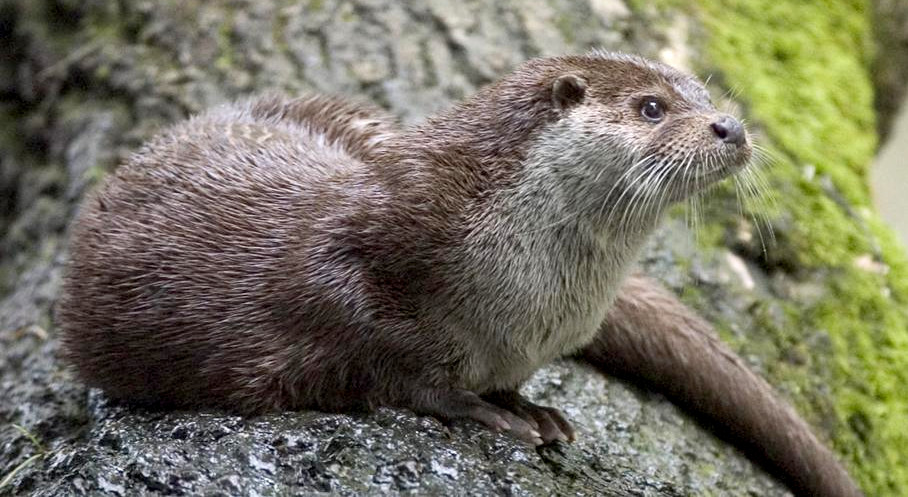
The Eurasian otter is a typical species of the otter subfamily. Brown above and cream below, these long, slender creatures are well-equipped for their aquatic habits. Their bones show osteosclerosis, increasing their density to reduce buoyancy. This otter differs from the North American river otter by its shorter neck, broader visage, the greater space between the ears and its longer tail. However, the Eurasian otter is the only otter in much of its range, so it is rarely confused for any other animal. Normally, this species is 57 to 95 cm (22.5 to 37.5 in) long, not counting a tail of 35–45 cm (14–17.5 in). The female is shorter than the male. The otter's average body weight is 7 to 12 kg (15 to 26 lb), although occasionally a large old male may reach up to 17 kg (37 lb). The record-sized specimen, reported by a reliable source but not verified, weighed over 24 kg (53 lb).
The Eurasian otter is the most widely distributed otter species, its range including parts of Asia and northern Africa, as well as being spread across Europe, south to Palestine. Though currently thought to be extinct in Liechtenstein and Switzerland, it is now common in Latvia, along the coast of Norway, in the western regions of Spain and Portugal and across Great Britain and Ireland. In Italy, it lives in southern parts of the peninsula. It inhabits unpolluted bodies of fresh water such as lakes, streams, rivers, canals and ponds, as long as the food supply is adequate. In Andalusia, it uses artificial lakes on golf courses. It prefers the open areas of the streams and also lives along the coast in salt water, but requires regular access to fresh water to clean its fur.
In Syria, the Eurasian otter was recorded in montane creeks in Latakia and Raqqa Governorates and in the lower Euphrates valley in Deir ez-Zor Governorate. In western Nepal, its presence was documented at elevations of around 1,600 m (5,200 ft) in Barekot river in Jajarkot District and at 1,337 m (4,386 ft) in Tubang river in Eastern Rukum District. In India, it is distributed in the Himalayan foothills, southern Western Ghats and the central Indian landscape.
The Eurasian otter's diet mainly consists of fish. Fish is its most preferred choice of food in Mediterranean and temperate freshwater habitats. During the winter and in colder environments, it also feeds on amphibians, worms, clams, crustaceans, insects, eggs, birds and sometimes small mammals, including young European beavers. It will also feed on a small amount of vegetation.
As with various other mustelid species, otters are capable of overpowering and killing prey significantly larger than themselves, and are known to hunt large waterbirds such as adult greylag geese on occasion.
The Eurasian otter is strongly territorial, living alone for the most part. An individual's territory may vary between about 1 and 40 km (0.62–24.85 mi) long, with about 18 km (11 mi) being usual. The length of the territory depends on the density of food available and the width of the water suitable for hunting; it is shorter on coasts, where the available width is much wider, and longer on narrower rivers. The Eurasian otter uses its feces, called spraints, to mark its territory and prioritize the use of resources to other group members. The territories are only held against members of the same sex, so those of males and females may overlap. Mating takes place in water. Males and females breed at any time of the year, and the mating season is most likely determined by reproductive maturity and physiological state. Females become sexually mature at the age of 18–24 months, and the average age of first breeding is 2+1⁄2 years. Gestation lasts 60–64 days, and one to four pups are born weighing about 10% of the female's body weight. The pups remain dependent on the mother for about 13 months. The male plays no direct role in parental care, although the territory of a female with her pups is usually entirely within that of the male.
The extinct Japanese otter is sometimes considered a subspecies; recent studies have found it to fall outside the subspecific clades comprising L. lutra, so it has been reclassified as a distinct species, but uncertainty remains.
Eurasian otter
The Eurasian otter (Lutra lutra), also known as the European otter, Eurasian river otter, European river otter, common otter, and Old World otter, is a semiaquatic mammal native to Eurasia and the Maghreb. The most widely distributed member of the otter subfamily (Lutrinae) of the weasel family (Mustelidae), it is found in the waterways and coasts of Europe, many parts of Asia, and parts of northern Africa. The Eurasian otter has a diet mainly of fish, and is strongly territorial. It is endangered in some parts of its range, but is recovering in others.
The Eurasian otter is a typical species of the otter subfamily. Brown above and cream below, these long, slender creatures are well-equipped for their aquatic habits. Their bones show osteosclerosis, increasing their density to reduce buoyancy. This otter differs from the North American river otter by its shorter neck, broader visage, the greater space between the ears and its longer tail. However, the Eurasian otter is the only otter in much of its range, so it is rarely confused for any other animal. Normally, this species is 57 to 95 cm (22.5 to 37.5 in) long, not counting a tail of 35–45 cm (14–17.5 in). The female is shorter than the male. The otter's average body weight is 7 to 12 kg (15 to 26 lb), although occasionally a large old male may reach up to 17 kg (37 lb). The record-sized specimen, reported by a reliable source but not verified, weighed over 24 kg (53 lb).
The Eurasian otter is the most widely distributed otter species, its range including parts of Asia and northern Africa, as well as being spread across Europe, south to Palestine. Though currently thought to be extinct in Liechtenstein and Switzerland, it is now common in Latvia, along the coast of Norway, in the western regions of Spain and Portugal and across Great Britain and Ireland. In Italy, it lives in southern parts of the peninsula. It inhabits unpolluted bodies of fresh water such as lakes, streams, rivers, canals and ponds, as long as the food supply is adequate. In Andalusia, it uses artificial lakes on golf courses. It prefers the open areas of the streams and also lives along the coast in salt water, but requires regular access to fresh water to clean its fur.
In Syria, the Eurasian otter was recorded in montane creeks in Latakia and Raqqa Governorates and in the lower Euphrates valley in Deir ez-Zor Governorate. In western Nepal, its presence was documented at elevations of around 1,600 m (5,200 ft) in Barekot river in Jajarkot District and at 1,337 m (4,386 ft) in Tubang river in Eastern Rukum District. In India, it is distributed in the Himalayan foothills, southern Western Ghats and the central Indian landscape.
The Eurasian otter's diet mainly consists of fish. Fish is its most preferred choice of food in Mediterranean and temperate freshwater habitats. During the winter and in colder environments, it also feeds on amphibians, worms, clams, crustaceans, insects, eggs, birds and sometimes small mammals, including young European beavers. It will also feed on a small amount of vegetation.
As with various other mustelid species, otters are capable of overpowering and killing prey significantly larger than themselves, and are known to hunt large waterbirds such as adult greylag geese on occasion.
The Eurasian otter is strongly territorial, living alone for the most part. An individual's territory may vary between about 1 and 40 km (0.62–24.85 mi) long, with about 18 km (11 mi) being usual. The length of the territory depends on the density of food available and the width of the water suitable for hunting; it is shorter on coasts, where the available width is much wider, and longer on narrower rivers. The Eurasian otter uses its feces, called spraints, to mark its territory and prioritize the use of resources to other group members. The territories are only held against members of the same sex, so those of males and females may overlap. Mating takes place in water. Males and females breed at any time of the year, and the mating season is most likely determined by reproductive maturity and physiological state. Females become sexually mature at the age of 18–24 months, and the average age of first breeding is 2+1⁄2 years. Gestation lasts 60–64 days, and one to four pups are born weighing about 10% of the female's body weight. The pups remain dependent on the mother for about 13 months. The male plays no direct role in parental care, although the territory of a female with her pups is usually entirely within that of the male.
The extinct Japanese otter is sometimes considered a subspecies; recent studies have found it to fall outside the subspecific clades comprising L. lutra, so it has been reclassified as a distinct species, but uncertainty remains.
Recent media
Recent media