


Community hub
Recent from talks
Contribute something
Nothing was collected or created yet.
Euthenia
View on Wikipedia
'Euthenia (Ancient Greek: Eὐθηνια) was the Greek name for a personification of abundance. As the Greek equivalent of either of the Roman goddesses Annona or Abundantia, she appeared on the coinage of Roman Imperial Egypt. She was associated with Nilus, the Greek god of the Nile, and was syncretized with the Egyptian goddess Isis. There are no ancient literary sources for the goddess. She is known all most entirely from her iconography.
Role
[edit]Euthenia was, from the reign of the Roman emperors Augustus through Commodus, the Greek name used for a deified personification of abundance, particularly the abundance of wheat associated with the flooding of the Nile.[2] The Ancient Greek common noun euthenia ("prosperity, plenty, abundance")[3] like the Latin annona,[4] was used to refer to the grain-supply, and the deified personification Euthenia, was used on Roman coins in the Greek East as the Greek equivalent of either of the Roman divine personifications Annona or Abundantia.[5] Here her role seems to have been to associate the abundance of the food supply with Roman rule of Egypt.[6] The management of the food supply in Egypt, and it's magistrate, was called the euthenia and the eutheniarchos, respectively.[7]
She had no mythology or cult of her own.[8] She was considered to be a consort of Nilus, the Greek river god associated with the Nile.[9] Because of the identification of the Egyptian god Osiris with Nilus, Euthenia became syncretized with Osiris's consort Isis.[10]
Sources
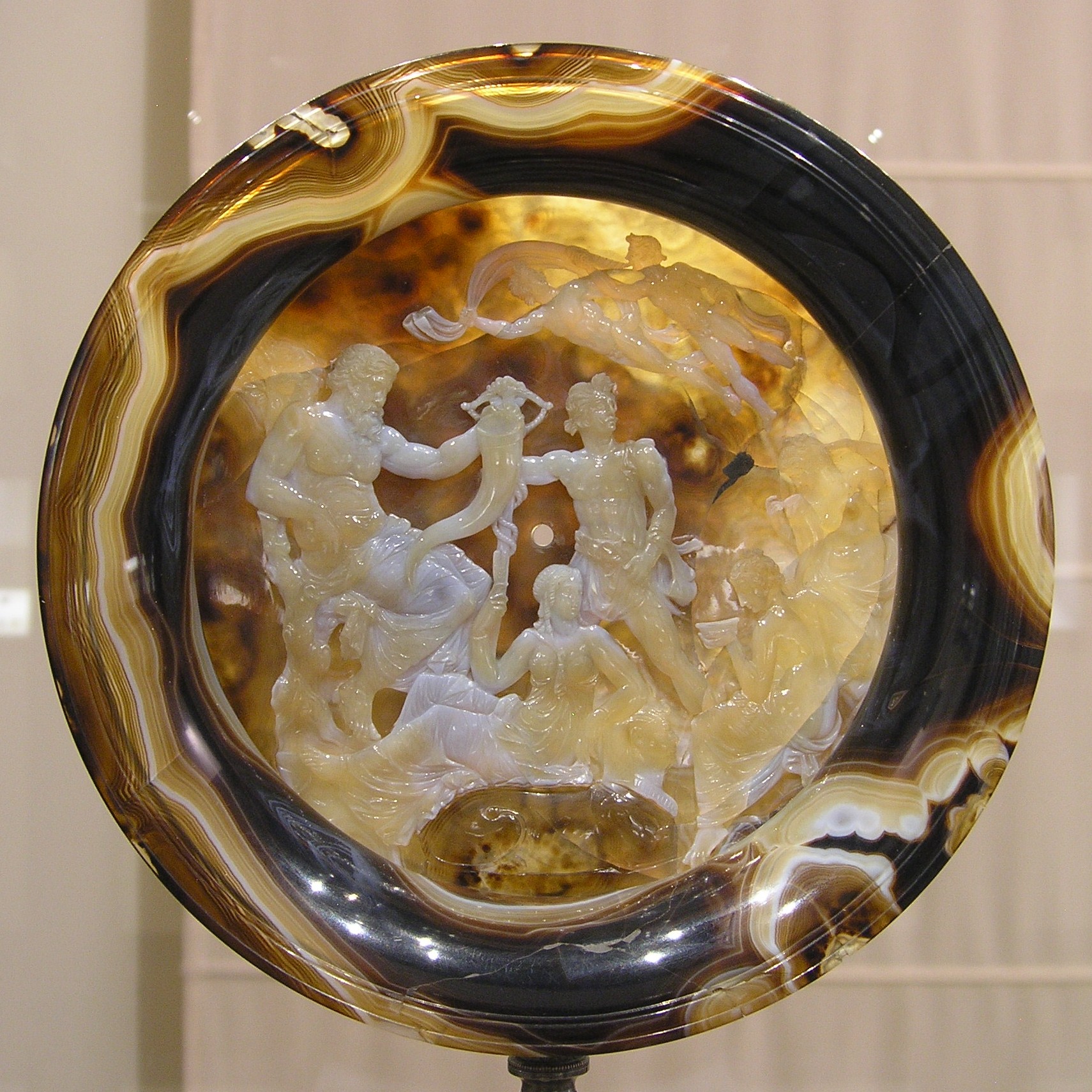
[edit]All early sources for Euthenia are iconographic. Perhaps the oldest of these is found on the Tazza Farnese (mid-second century to first century BC?), where the syncretized Isis-Euthenia is depicted reclining on a sphinx holding up two ears of wheat in her right hand.[11] Otherwise the oldest sources for Euthenia are found on the Roman Imperial coinage of Augustus in Alexandria Egypt, from the last decade of the first century BC.[12] Euthenia is also named in a votive dedicatory inscription from Anazarbus in Cilicia dated to the first or second century AD.[13]
The only literary source which mentions Euthenia as a personification dates from the fifteenth century AD. A source from the end of the sixth century AD describes the sighting of two gigantic apparitions rising up out of the Nile river, the Nile god itself, and an accompanying unnamed female (Euthenia?).[14]
Iconography
[edit]


Representations of Euthenia only occur in Greco-Roman Egypt, and appear primarily on coins, where she can be identified by inscription.[17] She can also be recognized through her association with the god Nilus, where she is always depicted in a subsidiary role. Her attributes are borrowed from other better-known divinities. These include her most characteristic attributes Demeter's ears of wheat (some times mixed with poppies), and Abundantia and Annona's cornucopia, or more rarely Nilus's nilometer, and Isis's sistrum and Isiac knot.
She is usually shown crowned with ears of wheat, and is often depicted reclining or sitting on a Sphinx,[18] or with Nilus, where she can be seen reclining on the ground at his feet, or crowning him, or kneeling before him.[19]
Euthenia was depicted on Alexandrian coinage beginning in the last decade of the first century BC during the reign of Roman emperor Augustus and continued at irregular intervals through the reign of Commodus. In her earliest depictions, on the coins of Augustus, Euthenia appears as a draped female bust in profile, wearing a crown of wheat and holding ears of wheat, and identified by the inscription "ΕΥΘΗΝΙΑ".[20] On coins from Antoninus to Aurelian, twin busts of Euthenia and Nilus appear.[21] On coins of Domitian, Antoninus, Marcus Aurelius and Commodus, she can be seen standing, holding wheat and a cornucopia like Abundantia.[22]
In addition to coins, depictions of Euthenia are also found on several other objects. Perhaps the oldest of these is the Tazza Farnese, where the central female figure shown reclining on a male sphinx has been identified by some scholars as Euthenia.[23] This figure holds two ears of wheat in her raised right hand. She wears "Libyan" corkscrew curls, a diadem headband, and an Isiac knot leaving her breasts bare. She sits at the feet of a seated Nilus on the left, with a third figure standing behind her.[24]
A first or second century wall hanging (see above), thought to be from Akhmim, depicts a reclining Euthenia holding a bowl in her right hand (her left hand no longer visible). As in the Tazza Farnese, she wears an Isiac knot with exposed breasts, as she reclines on a sphinx. In the background is a garden with birds in flight or at rest. Her hair is intertwined with flowers and fruit, with a leafy crown and an Egyptian uraeus ("rearing cobra"), with two ears of wheat on either side, on top, and a halo behind. She wears gold bracelets and earrings.[25]
A second century statue (Alexandria Graeco-Roman Museum 24124) depicts a Euthenia reclining on her left side, holding a cup in her left hand which rests on the head of a sphinx, wearing the characteristic corkscrew curls and Isiac knot. Here she is surrounded by eight putti, the well-known symbols of a cubit of height of the annual Nile inundation.[26]
Notes
[edit]- ^ Tallet, p. 968; Fischer 2024, pp. 49–50, Figure 3.5.
- ^ Jentel, pp. 120–121; LSJ, s.v. εὐθηνία; RE, s.v. Euthenia.
- ^ The Cambridge Greek Lexicon, s.v. εὐθενία (variant reading εὐθενεια); LSJ, s.v. εὐθηνία.
- ^ The Pocket Oxford Latin Dictionary, s.v. annona.
- ^ Erdkamp, s.v. Annona (grain); Jentel, p. 120; LSJ, s.v. εὐθηνία.
- ^ Kákosy, p. 291, which calls her "a manifestation of the political ideology of the Principate".
- ^ Erdkamp, s.v. Annona (grain).
- ^ Jentel, p. 124.
- ^ Jentel, p. 120
- ^ Kákosy, p. 292.
- ^ Jentel, p. 121: LIMC Euthenia 1; LIMC IV.2, p. 63.
- ^ Kákosy, p. 291.
- ^ Jentel, p. 120; RE, s.v. Eustheneia; IK Anazarbos 265.
- ^ Jentel, p. 120. For the divine apparitions see Theophylact Simocatta, 7.16 (pp. 201–202).
- ^ Jentel, p. 123: LIMC Euthenia 50; LIMC IV.2, p. 67.
- ^ Fischer 2024, pp. 47–55; Fischer 2017, pp. 36–37; Jentel, p. 121: LIMC Euthenia 1; LIMC IV.2, p. 63.
- ^ For a detailed discussion of Euthenia's iconography see Jentel, pp. 120–124. This discussion follows Jentel, p. 124: "COMMENTAIRE".
- ^ Jentel, pp. 121–122: LIMC Euthenia 1–14 (reclining), 19–27 (sitting).
- ^ Jentel, pp. 121–123: LIMC Euthenia 15, 16* (reclining), 43, 44*, (crowning), 46* (kneeling).
- ^ Jentel, p. 123: LIMC Euthenia 48; LIMC IV.2, p. 66.
- ^ Jentel, pp. 123–124: LIMC Euthenia 50; LIMC IV.2, p. 67.
- ^ Jentel, p. 123: LIMC Euthenia 35–37.
- ^ Like many things concerning the Tazza Farnese, this identification is controversial. The first modern interpretation of the cup, in 1790 by Ennius Quirinus Visconti, identified the figure as the Egyptian fertility and agricultural goddess Isis, an identification that was accepted until 1900, when Adolf Furtwängler was the first to identify the figure as Euthenia, an identification that was rejected in 1958 by Charbonneaux, pp. 88–89, based upon the late date of the comparisons offered by Furtwängler (see Dwyer, pp. 256, 258 n. 19; Fischer 2017, p. 36 n. 35). However several modern scholars accept Furtwängler's identification, these include Jentel 1988, Dwyer 1992 (calling her "Isis-Euthenia"), Fischer 2017, pp, 36–37 (calling her "Euthenia/Abudantia"), and Fischer 2024, pp. 47–55 (calling her "Isis-Euthenia").
- ^ Fischer 2024, pp. 47–55; Fischer 2017, pp. 36–37; Jentel, p. 121: LIMC Euthenia 1; LIMC IV.2, p. 63. See also Queyrel, pp. 197–198.
- ^ Tallet, p. 968; Fischer 2024, pp. 49–50, Figure 3.5; Metropolitan Museum of Art, "Hanging Showing Euthenia in a Garden".
- ^ Kákosy, pp. 291–292; Jentel, p. 121: LIMC Euthenia 9; Bibliotheca Alexandrina Antiquities Museum, Temporary collections: Statue of Euthenia; LIMC IV.2, p. 63 (Euthenia 9).
References
[edit]- The Cambridge Greek Lexicon, edited by J. Diggle et al, Cambridge University Press, 2021 ISBN 978-0-521-82680-8.
- Charbonneaux, Jean, "Sur la signification et la date de la Tasse Farnèse", in Monuments et mémoires de la Fondation Eugène Piot, 50, 1958, pp. 85-103.
- Dwyer, Eugene J., "The Temporal Allegory of the Tazza Farnese", in American Journal of Archaeology, 96 (2), 1992, pp. 255–282. doi:10.2307/505925. JSTOR 505925.
- Erdkamp, s.v. Annona (grain), published online 07 March 2016, in the Oxford Classical Dictionary, edited by Tim Whitmarsh, digital ed, New York, Oxford University Press. ISBN 978-0-19-938113-5.
- Fischer, Julia C. (2017), Breaking with Convention in Italian Art, Cambridge Scholars Publishing, 2017. ISBN 9781527500549.
- Fischer, Julia C. (2024), Power and Propaganda in the Large Imperial Cameos of the Early Roman Empire, Taylor & Francis, 2024. ISBN 9781040016282. Google Books.
- Jentel, s.v. Euthenia, in Lexicon Iconographicum Mythologiae Classicae (LIMC) IV.1 EROS-HERAKLES, Artemis Verlag, Zürich and Munich. 1988. ISBN 3-7608-8751-1. Internet Archive.
- Kákosy, László, "The Nile, Euthenia, and the Nymphs", in The Journal of Egyptian Archaeology, 68, 1962, pp. 290–298. doi:10.2307/3821647. ISSN 0307-5133. JSTOR 3821647.
- Liddell, Henry George, Robert Scott, A Greek-English Lexicon, revised and augmented throughout by Sir Henry Stuart Jones with the assistance of Roderick McKenzie, Clarendon Press Oxford, 1940. Online version at the Perseus Digital Library.
- Lexicon Iconographicum Mythologiae Classicae (LIMC) IV.2 EROS-HERAKLES, Artemis Verlag, Zürich and Munich. 1988. ISBN 3-7608-8751-1. Internet Archive.
- Pauly, August, Georg Wissowa, Wilhelm Kroll, Kurt Witte, Karl Mittelhaus, Konrat Ziegler, Hans Gärtner (eds), Paulys Real-Encyclopaedie der classischen Altertumswissenschaft. Stuttgart: J. B. Metzler, 1893-1980.
- The Pocket Oxford Latin Dictionary, edited by James Morwood, Oxford University Press, 1994. ISBN 0-19-864227-X.
- Queyrel, François, "The Portraits of the Ptolemies", in Handbook of Greek Sculpture, Olga Palagia, (ed.), De Gruyter, 2019. ISBN 978-1-61451-540-1.
- Tallet, Gaëlle, La splendeur des dieux :Quatre études iconographiques sur l'hellénisme égyptien; Religions in the Graeco-Roman world 193; Leiden, Boston: Brill, 2021. ISBN 9789004428911.
- Theophylact Simocatta, The History of Theophylact Simocatta, translation and "Introduction" by Michael Whitby and Mary Whitby, Oxford, 1986. Internet Archive.
| International | |
|---|---|
| National | |
| Other | |
