Hubbry Logo
AmphoraAmphoraMain
Open search
Amphora
Community hub
Amphora
logo
8 pages, 0 posts
0 subscribers
Be the first to start a discussion here.
Amphora
Amphora
from Wikipedia

Key Information

Silver amphora-rhyton with zoomorphic handles, c. 500 BC, Vassil Bojkov Collection (Sofia, Bulgaria)

An amphora (/ˈæmfərə/; Ancient Greek: ἀμφορεύς, romanizedamphoreús; English pl.amphorae or amphoras) is a type of container[1] with a pointed bottom and characteristic shape and size which fit tightly (and therefore safely) against each other in storage rooms and packages, tied together with rope and delivered by land or sea. The size and shape have been determined from at least as early as the Neolithic Period. Amphorae were used in vast numbers for the transport and storage of various products, both liquid and dry, but mostly for wine. They are most often ceramic, but examples in metals and other materials have been found. Versions of the amphorae were one of many shapes used in Ancient Greek vase painting.

The amphora complements a vase, the pithos, which makes available capacities between one-half and two and one-half tons. In contrast, the amphora holds under a half-ton, typically less than 50 kilograms (110 lb). The bodies of the two types have similar shapes. Where the pithos may have multiple small loops or lugs for fastening a rope harness, the amphora has two expansive handles joining the shoulder of the body and a long neck. The necks of pithoi are wide for scooping or bucket access. The necks of amphorae are narrow for pouring by a person holding it by the bottom and a handle. Some variants exist. The handles might not be present. The size may require two or three handlers to lift. For the most part, however, an amphora was tableware, or sat close to the table, was intended to be seen, and was finely decorated as such by master painters.[clarification needed]

Stoppers of perishable materials, which have rarely survived, were used to seal the contents. Two principal types of amphorae existed: the neck amphora, in which the neck and body meet at a sharp angle; and the one-piece amphora, in which the neck and body form a continuous curve upwards. Neck amphorae were commonly used in the early history of ancient Greece, but were gradually replaced by the one-piece type from around the 7th century BC onward.

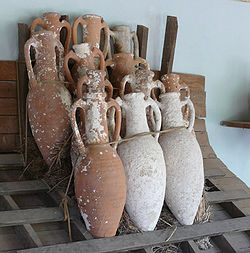
Most were produced with a pointed base to allow upright storage by embedding in soft ground, such as sand. The base facilitated transport by ship, where the amphorae were packed upright or on their sides in as many as five staggered layers.[citation needed]. If upright, the bases probably were held by some sort of rack, and ropes passed through their handles to prevent shifting or toppling during rough seas[citation needed]. Heather and reeds might be used as packing around the vases. Racks could be used in kitchens and shops. The base also concentrated deposits from liquids with suspended solid particles, such as olive oil and wines.

Amphorae are of great use to maritime archaeologists, as they often indicate the age of a shipwreck and the geographic origin of the cargo. They are occasionally so well preserved that the original content is still present, providing information on foodstuffs and mercantile systems. Amphorae were too cheap and plentiful to return to their origin-point and so, when empty, they were broken up at their destination. At a breakage site in Rome, Testaccio, close to the Tiber, the fragments, later wetted with calcium hydroxide (calce viva), remained to create a hill now named Monte Testaccio, 45 m (148 ft) high and more than 1 kilometre in circumference.

Etymology

[edit]

Amphora is a Greco-Roman word developed in ancient Greek during the Bronze Age. The Romans acquired it during the Hellenization that occurred in the Roman Republic. Cato is the first known literary person to use it. The Romans turned the Greek form into a standard - a declension noun, amphora, pl. amphorae.[2] The word and the vase were almost certainly introduced to Italy through the Greek settlements there, which traded extensively in Greek pottery.

Even though the Etruscans imported, manufactured, and exported amphorae extensively in their wine industry, and other Greek vase names were Etruscanized, no Etruscan form of the word exists. There was perhaps an as yet unidentified native Etruscan word for the vase that pre-empted the adoption of amphora.

The Latin word derived from the Greek amphoreus (ἀμφορεύς),[3] a shortened form of amphiphoreus (ἀμφιφορεύς), a compound word combining amphi- ("on both sides", "twain")[4] and phoreus ("carrier"), from pherein ("to carry"),[5] referring to the vessel's two carrying handles on opposite sides.[6] The amphora appears as 𐀀𐀠𐀡𐀩𐀸, a-pi-po-re-we, in the Linear B Bronze Age records of Knossos, 𐀀𐀡𐀩𐀸, a-po-re-we, at Mycenae, and the fragmentary ]-re-we at Pylos, designated by Ideogram 209 𐃨, Bennett's AMPHORA, which has a number of scribal variants. The two spellings are transcriptions of amphiphorēwes (plural) and amphorēwe (dual) in Mycenaean Greek from which it may be seen that the short form prevailed on the mainland. Homer uses the long form for metrical reasons, and Herodotus has the short form. Ventris and Chadwick's translation is "carried on both sides."[7]

Weights and measures

[edit]
Dressel 1B type amphora
Key : 1: rim; 2: neck; 3: handle; 4: shoulder;
5: belly or body; 6: foot

Amphorae varied greatly in height. The largest stands as tall as 1.5 metres (4.9 feet) high, while some were less than 30 centimetres (12 inches) high - the smallest were called amphoriskoi (literally "little amphorae"). Most were around 45 centimetres (18 inches) high.

There was a significant degree of standardisation in some variants; the wine amphora held a standard measure of about 39 litres (41 US qt), giving rise to the amphora quadrantal as a unit of measure in the Roman Empire. In all, approximately 66 distinct types of amphora have been identified.

Further, the term also stands for an ancient Roman unit of measurement for liquids. The volume of a Roman amphora (amphora quadrantal) was about one cubic pes (foot), equivalent to 26.2 liters (5.8 imp gal; 6.9 U.S. gal).[8]

Production

[edit]

Roman amphorae were wheel-thrown terracotta containers. During the production process the body was made first and then left to dry partially.[9] Then coils of clay were added to form the neck, the rim, and the handles.[9] Once the amphora was complete, the maker then treated the interior with resin that would prevent permeation of stored liquids.[10] The reconstruction of these stages of production is based primarily on the study of modern amphora production in some areas of the eastern Mediterranean.[9]

Amphorae often were marked with a variety of stamps, sgraffito, and inscriptions.[11] They provided information on the production, content, and subsequent marketing. A stamp usually was applied to the amphora at a partially dry stage. It indicates the name of the figlina (workshop) and/or the name of the owner of the workshop. Painted stamps, tituli picti, recorded the weight of the container and the contents, and were applied after the amphora was filled. Today, stamps are used to allow historians to track the flow of trade goods and recreate ancient trade networks.[11]

Classification

[edit]

The first systematic classification of Roman amphorae types was undertaken by the German scholar Heinrich Dressel. Following the exceptional amphora deposit uncovered in Rome in Castro Pretorio at the end of the 1800s, he collected almost 200 inscriptions from amphorae and included them in the Corpus Inscriptionum Latinarum. In his studies of the amphora deposit he was the first to elaborate a classification of types, the so-called "Dressel table",[12] which still is used today for many types.

Subsequent studies on Roman amphorae have produced more detailed classifications, which usually are named after the scholar who studied them. For the neo-Phoenician types see the work by Maña published in 1951,[13] and the revised classification by Van der Werff in 1977–1978.[14] The Gallic amphorae have been studied by Laubenheimer in a study published in 1989,[15] whereas the Cretan amphorae have been analyzed by Marangou-Lerat.[16] Beltràn studied the Spanish types in 1970.[17] Adriatic types have been studied by Lamboglia in 1955.[18] For a general analysis of the Western Mediterranean types see Panella,[19] and Peacock and Williams.[9]

History

[edit]

Prehistoric origins

[edit]
Amphora found in Banpo (China), made by the Yangshao culture; 5000–3000 BC; Guimet Museum (Paris)

Ceramics of shapes and uses falling within the range of amphorae, with or without handles, are of prehistoric heritage across Eurasia, from the Caucasus to China. Amphorae dated to approximately 4800 BC have been found in Banpo, a Neolithic site of the Yangshao culture in China. Amphorae first appeared on the Phoenician coast at approximately 3500 BC.

In the Bronze and Iron Ages amphorae spread around the ancient Mediterranean world, being used by the ancient Greeks and Romans as the principal means for transporting and storing grapes, olive oil, wine, oil, olives, grain, fish, and other agricultural products.[20] They were produced on an industrial scale until approximately the 7th century AD. Wooden and skin containers seem to have supplanted amphorae thereafter.

They influenced Chinese ceramics and other East Asian ceramic cultures, especially as a fancy shape for high-quality decorative ceramics, and continued to be produced there long after they had ceased to be used further west.

Ancient Greece: fancy shapes for painting

[edit]
Large late Geometric Attic amphora; 725–700 BC; Louvre (Paris, France)

Besides coarse amphorae used for storage and transport, the vast majority, high-quality painted amphorae were produced in Ancient Greece in significant numbers for a variety of social and ceremonial purposes. Their design differs vastly from the more functional versions; they are typified by wide mouth and a ring base, with a glazed surface and decorated with figures or geometric shapes. They normally have a firm base on which they can stand. Panathenaic amphorae were used as prizes in the Panathenaic Festivals held between the 6th century BC to the 2nd century BC, filled with olive oil from a sacred grove. Surviving examples bear the inscription "I am one of the prizes from Athens", and usually depict the particular event they were awarded for.

Painted amphorae were also used for funerary purposes, often in special types such as the loutrophoros. Especially in earlier periods, outsize vases were used as grave markers, while some amphorae were used as containers for the ashes of the dead. By the Roman period vase-painting had largely died out, and utilitarian amphorae were normally the only type produced.

Greek amphora types

[edit]

Various different types of amphorae were popular at different times:

Neck amphora (c. 6th–5th century BC)
[edit]

On a neck amphora, the handles are attached to the neck, which is separated from the belly by an angular carination. There are two main types of neck amphorae:

There are also some rarer special types of neck amphora, distinguished by specific features, for example:

  • the Pointed amphora, with a notably pointed toe, sometimes ending in a knob-like protrusion
  • the Loutrophoros, used for storing water during ritual ceremonies, such as marriages and funerals.
Belly amphora (c. 640–450 BC)
[edit]

In contrast to the neck amphora, a belly amphora does not have a distinguished neck; instead, the belly reaches the mouth in a continuous curve. After the mid-5th century BC, this type was rarely produced. The pelike is a special type of belly amphora, with the belly placed lower, so that the widest point of the vessel is near its bottom. The pelike was introduced around the end of the 6th century BC.

Panathenaic prize amphora
[edit]

Another special type is the Panathenaic prize amphora, with black-figure decoration, produced exclusively as prize vessels for the Panathenaia and retaining the black-figure technique for centuries after the introduction of red-figure vase painting. Some examples bear the inscription "ΤΩΝ ΑΘΗΝΗΘΕΝ ΑΘΛΩΝ" meaning "[I am one] of the prizes from [the goddess] Athena". They contained the prize of oil from the sacred olive tree of the goddess Athena for the winners of the athletic contests held to honour the goddess, and were evidently kept thereafter, and perhaps used to store wine, before being buried with the prize-winner. They depicted goddess Athena on one side (as seen on the second image on this page) and the athletic event on the other side, e.g. a scene of wrestling or running contest etc.

Ancient Rome

[edit]
Miniature Roman Holy Land 1st–3rd century AD lead pilgrim's votive amphora "Ampulla"

By the Roman period utilitarian amphorae were normally the only type produced.

The first type of Roman amphora, Dressel 1, appears in central Italy in the late 2nd century BC.[21] This type had thick walls and a characteristic red fabric. It was very heavy, although also strong. Around the middle of the 1st century BC the so-called Dressel 2-4 starts to become widely used.[22] This type of amphora presented some advantages in being lighter and with thinner walls. It has been calculated that while a ship could accommodate approximately 4500 Dressel 1, it was possible to fit 6000 Dressel 2–4 in the same space.[23] Dressel 2-4 were often produced in the same workshops used for the production of Dressel 1 which quickly ceased to be used.[22]

At the same time in Cuma (southern Italy) the production of the cadii cumani type starts (Dressel 21–22). These containers were mainly used for the transportation of fruit and were used until the middle imperial times. At the same time, in central Italy, the so-called Spello amphorae, small containers, were produced for the transportation of wine. On the Adriatic coast the older types were replaced by the Lamboglia 2 type, a wine amphora commonly produced between the end of the 2nd and the 1st century BC. This type develops later into the Dressel 6A which becomes dominant during Augustan times.[23]

In the Gallic provinces the first examples of Roman amphorae were local imitations of pre-existent types such as Dressel 1, Dressel 2–4, Pascual 1, and Haltern 70. The more typical Gallic production begins within the ceramic ateliers in Marseille during late Augustan times. The type Oberaden 74 was produced to such an extent that it influenced the production of some Italic types.[22] Spanish amphorae became particularly popular thanks to a flourishing production phase in late Republican times. The Hispania Baetica and Hispania Tarraconensis regions (south-western and eastern Spain) were the main production areas between the 2nd and the 1st century BC due to the distribution of land to military veterans and the founding of new colonies. Spanish amphorae were widespread in the Mediterranean area during early imperial times. The most common types were all produced in Baetica and among these there were the Dressel 20, a typical olive oil container, the Dressel 7–13, for garum (fish sauce), and the Haltern 70, for defrutum (fruit sauce). In the Tarraconensis region the Pascual 1 was the most common type, a wine amphora shaped on the Dressel 1, and imitations of Dressel 2–4.

North-African production was based on an ancient tradition which may be traced back to the Phoenician colony of Carthage.[24] Phoenician amphorae had characteristic small handles attached directly onto the upper body. This feature becomes the distinctive mark of late-Republican/early imperial productions, which are then called neo-Phoenician. The types produced in Tripolitania and Northern Tunisia are the Maña C1 and C2, later renamed Van der Werff 1, 2, and 3.[25] In the Aegean area the types from the island of Rhodes were quite popular starting from the 3rd century BC due to local wine production which flourished over a long period. These types developed into the Camulodunum 184, an amphora used for the transportation of Rhodian wine all over the empire. Imitations of the Dressel 2-4 were produced on the island of Cos for the transportation of wine from the 4th century BC until middle imperial times.[26] Cretan containers also were popular for the transportation of wine and can be found around the Mediterranean from Augustan times until the 3rd century AD.[27] During the late empire period, north-African types dominated amphora production. The so-called African I and II types were widely used from the 2nd until the late 4th century AD. Other types from the eastern Mediterranean (Gaza), such as the so-called Late Roman 4, became very popular between the 4th and the 7th century AD, while Italic productions ceased.

The largest known wreck of an amphorae cargo ship, carrying 6,000 pots, was discovered off the coast of Kefalonia, an Ionian island off the coast of Greece.[28]

Modern use

[edit]

Some modern winemakers and brewers use amphorae to provide a different palate and taste to their products from those that are available with other aging methods.[29]

See also

[edit]

Citations

[edit]
  1. ^ Twede, D. (2002), "Commercial Amphoras: The Earliest Consumer Packages?", Journal of Macromarketing, 22 (1): 98–108, doi:10.1177/027467022001009, S2CID 154514559, retrieved 19 June 2019
  2. ^ amphora. Charlton T. Lewis and Charles Short. A Latin Dictionary on Perseus Project.
  3. ^ ἀμφορεύς. Liddell, Henry George; Scott, Robert; A Greek–English Lexicon at the Perseus Project.
  4. ^ ἀμφί in Liddell and Scott.
  5. ^ φορεύς, φέρειν in Liddell and Scott.
  6. ^ Göransson, Kristian (2007). The transport amphorae from Euesperides: The maritime trade of a Cyrenaican city 400-250 BC. Acta Archaeologica Lundensia, Series in 4o No. 25. Stockholm: Lund. p. 9.
  7. ^ Ventris, Michael; Chadwick, John (1973). Documents in Mycenaean Greek (2nd ed.). Cambridge: University Press. pp. 324, 328, 494, 532.
  8. ^ Smith, Sir William; Charles Anthon (1851) A new classical dictionary of Greek and Roman biography, mythology, and geography partly based upon the Dictionary of Greek and Roman biography and mythology New York: Harper & Bros. Tables, pp. 1024–1030
  9. ^ a b c d Peacock, D. P. S.; Williams, D. F. (1986). Amphorae and the Roman economy: an introductory guide. Longman archaeology series. London; New York: Longman. p. 45.
  10. ^ Chassouant, Louise; Celant, Alessandra; Delpino, Chiara; Rita, Federico Di; Vieillescazes, Cathy; Mathe, Carole; Magri, Donatella (29 June 2022). "Archaeobotanical and chemical investigations on wine amphorae from San Felice Circeo (Italy) shed light on grape beverages at the Roman time". PLOS ONE. 17 (6) e0267129. Bibcode:2022PLoSO..1767129C. doi:10.1371/journal.pone.0267129. ISSN 1932-6203. PMC 9242518. PMID 35767534.
  11. ^ a b The Ancient Greek Economy: Markets, Households and City-States. Edward Monroe Harris, David M. Lewis, Mark Woolmer. Cambridge. 2015. ISBN 978-1-139-56553-0. OCLC 941031010.{{cite book}}: CS1 maint: location missing publisher (link) CS1 maint: others (link)
  12. ^ Dressel 1879, Di un grande deposito di anfore rinvenuto nel nuovo quartiere del Castro Pretorio, in BullCom, VII, 36–112, 143–196.
  13. ^ Maña, Sobre tipologia de ánforas pùnicas, in VI Congreso Arqueologico del Sudeste Español, Alcoy, 1950, Cartagena, 1951, 203–210
  14. ^ Amphores de tradition punique à Uzita, in BaBesch 52-53, 171-200
  15. ^ Laubenheimer, Les amphores gauloises sous l'empire: recherches nouvelles sur leur production et chronologie, in Amphores romaines et histoire économiqué: dis ans de recherche. Actes du Colloque de Sienne (22-24 mai 1986), Rome, 105-138
  16. ^ Marangou-Lerat, Le vin et les amphores de Crète de l'epoque classique à l'epoque impériale, in Etudes Cretoises, 30, Paris, 1995
  17. ^ Beltràn, Las anforas Romanas en Espana, Zaragoza
  18. ^ "Sulla cronologia delle anfore romane di età repubblicana" in Rivista Studi Liguri 21, 252–60
  19. ^ Panella 2001, pp. 177–275: Le anfore di età imperiale del Mediterraneo occidentale, in Céramiques hellénistiques et romaines III
  20. ^ Adkins, L.; Adkins, R. A. (1994). Handbook to life in Ancient Rome. New York, N.Y.: Facts on File. p. 196. ISBN 978-0-8160-2755-2.
  21. ^ Panella 2001, p. 177.
  22. ^ a b c Panella 2001, p. 194.
  23. ^ a b Bruno 2005, p. 369.
  24. ^ Panella 2001, p. 207.
  25. ^ Van der Werff 1977-78.
  26. ^ Bruno 2005, p. 374.
  27. ^ Bruno 2005, p. 375.
  28. ^ Buckley, Julia (16 December 2019). "Biggest ever Roman shipwreck found in the eastern Med". CNN Travel. Retrieved 17 December 2019.
  29. ^ "Back to the future". Cantillon.be/br/. Brasserie Cantillon. Archived from the original on 6 November 2014. Retrieved 6 November 2014.

General references

[edit]
[edit]
Revisions and contributorsEdit on WikipediaRead on Wikipedia
from Grokipedia
An amphora (plural: amphorae) is a two-handled vessel originating in the , characterized by a narrow , wide belly, and small foot or ring base, primarily used for the storage and transportation of liquids such as wine and , as well as like grains and olives. The term derives from words amphi ("on both sides") and phorein ("to carry"), reflecting its design for handling on either side. These vessels varied in size, typically holding between 20 and 50 liters, and served as a standard unit of measure in ancient trade. Amphorae first appeared in the , with early examples from Canaanite and Minoan cultures used for maritime trade of commodities like oil and wine across the as early as the Middle Bronze Age (c. 2000–1550 BCE). In , production emerged and flourished during the Geometric period (c. 900–700 BCE), coinciding with the composition of Homeric epics, when large-scale amphorae were crafted for both practical and ceremonial purposes. Greek amphorae proliferated through the Archaic and Classical periods (c. 800–323 BCE), facilitating widespread commerce in the Aegean and regions, often stamped on their handles with makers' marks, magistrates' names, or origins to regulate trade. The form persisted into the Roman era (c. 1st century BCE–5th century CE), where it became integral to the empire's economy, with specialized types like Dressel 20 amphorae mass-produced in for olive export across the Mediterranean. Production continued in Byzantine contexts, adapting to local needs until . Several distinct types of amphorae emerged based on region, period, and function, including the neck-handled amphora of , with handles attached to the neck for easier pouring, and the belly-handled or Nolan amphora, popular in for its broader form. Panathenaic amphorae, awarded as prizes in ' athletic festivals from c. 566 BCE, featured standardized black-figure decoration depicting and were often repurposed as grave markers. Roman variants, such as the cylindrical amphorae from or the flat-based Keay 52 type from (e.g., or ), were optimized for stacking in ship holds during long-distance voyages. Beyond storage, amphorae held ritual significance, serving as containers for funeral offerings, child burials, or with shards used as ballots (ostraka) in democratic processes such as . Culturally, amphorae were often elaborately decorated with painted scenes in styles like black-figure or red-figure pottery, illustrating myths, daily life, or athletic events, which provide key insights into ancient aesthetics and narratives. High-quality examples, such as those from Athenian workshops, were traded not just for contents but as luxury items, influencing art across the Mediterranean. Archaeologically, vast deposits of amphorae shards—known as amphorae wastelands—have enabled scholars to map trade routes and economic patterns from the 8th century BCE onward. Today, these vessels are prized in museums for their historical and artistic value, exemplifying the ingenuity of ancient ceramic technology.

Terminology

Etymology

The term "amphora" originates from the word ἀμφορεύς (amphoreús), denoting a two-handled or vessel designed to be carried on both sides. This derives from the compound amphiphoreus, combining the prefix ἀμφί (amphí), meaning "on both sides," with φορεύς (phoreús), meaning "bearer" or "carrier," directly alluding to the characteristic pair of vertical handles positioned on opposite sides of the vessel's body. The word entered Latin as amphora during the Hellenistic influence on the , where it retained its core meaning while becoming standardized in Roman agricultural and trade contexts. In , the term appears as early as the 5th century BCE in ' Histories, where it describes large jars used for storage and transport, such as those filled with wine during festivals. By the 2nd century BCE, Roman author employed "amphora" extensively in his De Agricultura, referencing the vessels in recipes for wine preservation and farm inventories, marking one of the earliest detailed literary uses in Latin texts. In ancient nomenclature, "amphora" was distinguished from related Greek terms for other jars; for instance, the referred to much larger, often immovable storage pithoi used for bulk goods like or in households and palaces, lacking the portability and handles of amphorae. Similarly, the was a specialized water-carrying vessel with three handles—one for pouring and two for lifting—contrasting with the amphora's dual-handled design optimized for transport rather than daily liquid fetching. The Latin amphora persisted through the and was adopted into modern European languages, entering around the early to describe similar two-handled jars, with cognates in French (amphore), Italian (anfora), and Spanish (ánfora). Beyond referring to the vessel, the term "amphora" also denoted a unit of liquid measure in and Roman contexts, typically around 39 liters for amphorae and 26 liters for the Roman amphora quadrantal.

Classification

Amphorae are systematically classified according to their morphology, which encompasses variations in , handle configuration, and design, allowing archaeologists to identify production origins, functions, and chronological contexts. s typically include ovoid forms with elongated, egg-like profiles; globular types featuring rounded, bulbous bodies; and biconical variants with a pronounced waist-like . Handles are generally two vertical elements attached to the and or upper body, categorized as handles (flat and strap-like) or bilobate handles (with two distinct lobes for added strength). styles range from narrow and cylindrical, suited for secure transport of liquids like wine, to wide-mouthed openings that facilitate access for viscous contents such as or . Key typological frameworks have been established for Greek and Roman amphorae, providing standardized nomenclature based on these morphological traits. For Greek examples, Virginia Grace's seminal classifications, developed through analysis of stamped handles and shapes from Athenian Agora excavations, distinguish early transport vessels such as Corinthian Type A, an ovoid form with a narrow neck and pointed base primarily used for wine storage and trade in the Archaic period. Later Hellenistic types, like those from Rhodes or Knidos, feature more standardized globular bodies with ribbon handles. In Roman contexts, Heinrich Dressel's typology from the late 19th century, outlined in the Corpus Inscriptionum Latinarum, categorizes over 60 types by form and inscriptions; notable among them is Dressel 20, a large globular amphora with bilobate handles and a short, thick neck, mass-produced in Baetica (modern Spain) for olive oil export across the Mediterranean during the Imperial era. Regional variations reflect local adaptations to resources and trade needs, further refining these classifications. Mediterranean amphorae, such as those from and , often emphasize globular or ovoid shapes optimized for sea voyages, while Black Sea variants from Sinope or tend toward taller, more cylindrical forms with prominent ribbon handles to accommodate fish products in cooler climates. Punic amphorae from exhibit distinctive cylindrical bodies with heavy, bilobate handles and wide necks, evolving from Phoenician prototypes for wine and transport. Iberian types, like the ovoid Pascual 1 from the eastern coast, contrast with the later Haltern 70's elongated neck and narrow mouth, tailored for in the western Mediterranean. These schemes are also organized chronologically, aligning with broad historical phases such as Archaic (pre-500 BCE), Classical-Hellenistic (500–30 BCE), and Roman Imperial (30 BCE–400 CE), without implying specific production events.

Physical Characteristics

Dimensions and Capacity

Amphorae varied significantly in size depending on their regional origin and intended use, but transport varieties generally featured heights between 45 and 120 centimeters, with maximum body diameters of approximately 30 to 50 centimeters. examples, such as those from the Geometric period, tended to be taller, often exceeding 70 centimeters, while many Roman types were shorter, typically 60 to 80 centimeters in height to facilitate handling. These dimensions allowed for efficient packing while maintaining structural integrity under load. The capacity of most transport amphorae ranged from 26 to 40 liters, a range that supported standardized commercial exchange across the Mediterranean. In the Roman context, the quadrantal served as a key unit of measure, equivalent to about 26 liters, reflecting deliberate efforts to align vessel volumes with imperial weight and volume systems for taxation and . Full amphorae weighed 20 to 50 kilograms, varying with contents and vessel thickness, which influenced portability and stacking density. Structural features like the toe-shaped base and double handles were critical to functionality. The pointed or spiked base enabled secure stacking in ship holds through intercalation, where bases nestled into the spaces between upper-layer bodies, reducing shifting and breakage during voyages while lowering the center of gravity for stability when upright in racks. The two robust handles, attached to the neck and shoulder, facilitated lifting by individuals or teams, often using ropes or poles, and contributed to overall balance during transport. These designs balanced capacity needs with practical demands of maritime logistics, promoting some degree of standardization across production centers.

Materials and Production

Amphorae were primarily crafted from clay sourced locally to minimize transportation costs and leverage regional geological characteristics. In , potters often utilized red-firing clays from deposits in , , and the islands, which provided the necessary plasticity and fired to a characteristic reddish hue suitable for durable storage vessels. Roman amphorae, by contrast, employed coarser clays from Italian volcanic soils or provincial quarries in and , yielding robust, thick-walled containers optimized for mass transport. While clay dominated production, rare variants included stone-carved amphorae from or metal versions in for elite use, though these were exceptional and not representative of standard trade goods. The manufacturing began with clay preparation, involving to remove impurities and achieve uniformity, followed by shaping on a . The elongated body was typically wheel-thrown in sections—starting with the base and building upward in coils or rings to manage the vessel's height—while handles were formed separately using techniques and attached before final . Once leather-hard, the amphora underwent bisque firing in updraft kilns at temperatures between 800 and 1000°C, a that vitrified the clay for impermeability and strength; Greek kilns often employed a three-phase cycle of oxidation, reduction, and re-oxidation to control color and density. Surface treatments varied, including the application of coatings for or incised stamps denoting origin and capacity, with occasional painted details on Greek examples. Workshops were organized in specialized districts to facilitate efficient output, such as the quarter in for Greek production or the industrial zones near Ostia for Roman operations, where teams of potters, apprentices, and laborers enabled to meet demands. was maintained through potter's marks, capacity stamps, and post-firing inspections, ensuring vessels met commercial standards despite common defects like firing cracks from uneven temperatures or warping during drying. Regional variations reflected local traditions and resources: Greek amphorae occasionally featured black-figure glazing—a slip technique fired to produce glossy black silhouettes on red clay bodies—contrasting with the predominantly plain, unglazed coarse wares of Roman production, which prioritized functionality over . These differences arose from distinct clay compositions and firing practices, with Greek methods allowing for decorative finesse while Roman approaches emphasized volume and durability, though both grappled with production flaws like blistering or incomplete .

Historical Development

Prehistoric Origins

The earliest precursors to amphorae emerged around 3000 BCE in the and Aegean regions, evolving from simple storage jars utilized by early farming societies for the preservation of agricultural products such as grain and . These and Early vessels represented an adaptation to settled agriculture, with archaeological evidence from sites like Tepe in the indicating the use of large jars for liquid storage as early as 5400 BCE, though the distinctive two-handled forms associated with later amphorae began to appear closer to 3000 BCE in the . In the , Canaanite amphorae emerged around 2000 BCE, used for maritime trade of oil and wine across the . In the Aegean, this development coincided with the transition to more complex societies, where storage needs drove innovations in vessel design for both domestic and emerging exchange purposes. Key archaeological sites in Minoan Crete, such as and , provide evidence of large pithoi—immense, hand-built storage jars up to 2 meters tall—as primary precursors to amphorae, primarily used for bulk containment of foodstuffs within households and early palatial structures from the Early Minoan period (ca. 3000–2000 BCE). These pithoi, often featuring rope-like coil construction and occasional relief decoration, facilitated the storage of and grains, reflecting the island's reliance on intensive . Similarly, excavations on the Cycladic island of Ayia Irini on Keos have uncovered two-handled storage jars from Early Cycladic II contexts (ca. 2800–2300 BCE), with thick-walled forms and strap handles indicating early experimentation with portable designs suitable for inter-island movement. A functional shift occurred during this period, as these vessels transitioned from purely household use to proto-trade containers, particularly with the introduction of collared jars in the Early Bronze II Aegean, which served as the first specialized containers for high-value commodities like wine. This evolution was influenced by expanding agricultural surpluses and nascent maritime networks, allowing for the bulk transport of liquids across the Aegean and into the . Material production also advanced, moving from hand-built techniques to wheel-thrown methods by Early Minoan II in (ca. 2600 BCE), which enabled greater standardization and efficiency in crafting handled jars, laying the groundwork for the more refined amphorae of later periods.

Development in Ancient Greece

The production of amphorae in ancient Greece reached its peak between the 8th and 4th centuries BCE, evolving from simple Geometric forms to more refined and decorated vessels during the Archaic (c. 700–480 BCE) and Classical (c. 480–323 BCE) periods. Early examples from the 8th century BCE featured basic geometric patterns and were primarily functional storage jars, but by the 7th century BCE, workshops began incorporating figurative scenes, marking a shift toward artistic expression alongside utility. A notable development was the use of Panathenaic amphorae as prizes in the Athenian Panathenaic Games, starting around 566 BCE; these black-figure vessels, filled with olive oil, were awarded to victors in athletic events and featured standardized iconography of Athena on one side and the specific contest on the other. Key innovations included advancements in painting techniques and vessel forms tailored to contents. The black-figure technique, dominant from the late 7th to mid-5th century BCE, involved incising details into silhouettes fired black against a red clay background, allowing for complex narrative scenes on amphorae surfaces. Around 530 BCE, the red-figure technique emerged as an innovation, reversing the colors by painting outlines and details in black slip, leaving figures in the natural red clay for more naturalistic rendering; this was particularly suited to neck amphorae, which had a distinct offset between body and neck for easier pouring of oils. In contrast, belly amphorae, with a continuous curve from neck to base, were optimized for wine storage due to their stability when stacked. These form distinctions reflected practical adaptations, with neck types often exported for oil trade and belly types used locally for wine. Major production centers included workshops in , which dominated from the 6th century BCE onward, Corinthian facilities known for early exports, and East Greek sites like those in and producing regional variants from the 8th to 5th centuries BCE. amphorae were widely exported to Greek colonies in the Black Sea, , and , facilitating trade networks, while Corinthian types circulated in the western Mediterranean before predominance. East Greek workshops innovated with heavier, more robust forms suited to , often featuring stamped handles for identification, and their products reached and southern by the 6th century BCE. Distinct types emerged, such as the Nolan amphora, a compact neck variant (typically under 30 cm tall) with an elongated neck and ribbed handles, popular in red-figure from c. 475–465 BCE and widely distributed to , where many were recovered from tombs near . The Tyrrhenian amphora, an ovoid black-figure neck type produced briefly from c. 570–545 BCE in , featured frieze decorations and was primarily exported to (modern ), with over 200 examples found in Etruscan contexts. amphorae, named for their "SOS"-like neck markings, were mass-produced in during the 6th century BCE for oil transport; archaeological evidence shows their distribution concentrated in central Greece and the , with standardized volumes indicating organized production peaking mid-century before declining.

Development in Ancient Rome

The development of amphorae in ancient Rome began with imports from the Greek world during the 3rd century BCE, as Roman trade expanded into the Mediterranean, initially relying on foreign designs for transporting wine and other liquids. By the late 2nd century BCE, local Italian production emerged with the introduction of the Dressel 1 type, a tall cylindrical form optimized for wine transport, marking the start of widespread Roman adaptation and mass manufacturing that continued to dominate through the 1st to 4th centuries CE. This period saw kilns proliferate in provinces like Gaul and Hispania, where southern Gallic workshops produced variants such as Gauloise 4 from the 1st century CE onward, and Baetican sites in Spain specialized in olive oil containers like Dressel 20 starting in the late 1st century BCE. Roman amphorae shifted toward utilitarian designs, prioritizing durability and efficiency over aesthetic decoration, in contrast to earlier Greek influences that emphasized painted motifs. Key typological changes included the evolution from early forms like Dressel 1 and 2-4 (wine amphorae with angular shoulders and solid footings, produced from the 2nd century BCE to CE) to later ovoid shapes such as Dressel 20 (for , with bifid handles and a capacity of around 70 liters, dominant from the 1st to 3rd centuries CE) and Dressel 28-30 (fish sauce variants from and in the 2nd-4th centuries CE). A notable adaptation was the widespread use of tituli picti, painted inscriptions in red or black ink on the shoulders or necks, detailing contents (e.g., wine type or oil quality), origins (e.g., estate names), dates, and shippers, which facilitated commerce and quality control across the empire. Production reached an immense scale under the , with state-organized and workshops functioning as quasi-imperial factories, particularly in Baetica, supplying the system that distributed foodstuffs to 's population and legions along frontier trade routes. For instance, the Dressel 20 type alone accounted for millions of vessels annually, with approximately 50 million estimated at the dump in , reflecting organized export networks that integrated provincial economies into imperial supply chains. Amphorae served as key economic indicators, their distributions revealing trade volumes, regional specializations (e.g., to the Rhine legions, Spanish oil to Britain), and fluctuations in commodity flows, as quantified through archaeological assemblages and stamped handles tracing producers. By the post-4th century CE, amphorae production declined sharply, coinciding with the empire's fragmentation and a shift to wooden barrels for liquid transport, which were lighter and more versatile for overland routes. evidence supports this transition, showing a peak in amphora cargoes during the 1st-2nd centuries CE (e.g., over 1,000 Mediterranean wrecks with Roman amphorae) followed by a marked drop after the , with fewer intact ceramic containers and increased reliance on perishable barrels that rarely preserve in the .

Uses and Significance

Ancient Uses in Trade and Storage

Amphorae served as essential vessels for transporting and storing key commodities in ancient Mediterranean economies, primarily liquids such as wine, , and (), with residue analysis from archaeological sites confirming these uses through the detection of biomarkers like for wine and hydroxy fatty acids for olive oil. Organic residue studies on Roman amphorae have further identified via profiles and residues, particularly from wrecks in the western Mediterranean, underscoring their role in the trade of preserved fish products. While less common for , amphorae were occasionally adapted for storage, especially in Greek contexts where pointed bases allowed for stable piling in ships or warehouses. In trade networks, amphorae facilitated extensive maritime commerce across the Mediterranean, with shipwrecks providing direct evidence of their scale; for instance, the Madrague de Giens wreck off , dated to around 70–45 BCE, carried approximately 6,000–10,000 Dressel 1B amphorae filled with , stacked in multiple layers to optimize space in the vessel's hold. This standardization of amphora shapes and capacities—typically 20–30 liters—enabled efficient loading and unloading, supporting routes from production centers in and to ports in , , and the . Such uniformity also aided in assessing tariffs, as customs officials used amphora counts to impose duties. For storage, amphorae were employed in diverse settings, from state-managed warehouses known as horrea to private households and even burials, where their durable form allowed reuse after transport. In Roman horrea, such as those in the emporium near Ostia, amphorae were arranged in racks or stacked vertically with pointed bases embedded in sand or wood frames to prevent rolling and maximize capacity, preserving contents like oil and wine for months without spoilage. Household storage involved similar stacking in cool, shaded areas, often with stoppers of cork or clay to seal against air and pests, while in funerary contexts, empty amphorae were repurposed as grave markers or containers in regions like and . These practices highlight amphorae's versatility in maintaining supply chains for perishable goods. Economically, amphorae functioned as de facto units of measure in , with the Roman amphora equivalent to about 26 liters serving as a standard for quantifying liquids in contracts, inventories, and taxation records, thereby streamlining across the . Marks stamped on handles, including producers' names and capacities, facilitated and fiscal oversight, as seen in lead seals and tituli picti that denoted contents for collection at ports. This integration into economic systems amplified amphorae's impact, enabling the bulk movement of staples that underpinned urban provisioning and imperial expansion.

Cultural and Artistic Role

Amphorae held profound symbolic value in ancient cultures, often serving as in Etruscan tombs where they depicted banquets and mythological scenes, reflecting beliefs in the and commemorative practices. For instance, black-figure amphorae imported to featured narratives of heroic feats, such as Herakles' labors, which resonated with Etruscan viewers through shared mythic traditions and underscored the vessels' role in funerary rituals. These artistic depictions not only honored the deceased but also conveyed cultural exchanges between Greek and Etruscan societies, with amphorae placed alongside other luxury items to signify status in the tomb. In , amphorae were integral to ritual contexts, particularly symposia where they stored and served wine, often adorned with painted scenes of and his retinue to invoke the god's presence during communal gatherings. Such vessels participated in religious offerings to , as seen in festivals like the , which included marriage rites and libations from amphorae symbolizing renewal and divine favor. The painted narratives on these amphorae, depicting mythological episodes like ' voyages, enhanced their ceremonial function by narrating stories of ecstasy and transformation central to Dionysiac worship. Decorated amphorae signified social prestige among the elite, with finely painted examples from workshops like that of reserved for affluent patrons or awarded as prizes in events such as the . ' masterpieces, such as the amphora showing Achilles and Ajax at play, exemplified this through intricate black-figure techniques that portrayed heroic camaraderie, appealing to aristocratic audiences and influencing subsequent pottery traditions. Ownership of such vessels marked participation in high-society rituals, reinforcing hierarchies where only the wealthy could commission or acquire works blending artistry with mythic prestige. Archaeological evidence from amphora iconography provides insights into gender dynamics, with depictions of women in domestic or ritual roles on Attic vases revealing societal expectations of femininity tied to household and religious duties. Scenes of or heroines, as on ' works, further illuminated cultural myths that explored inverted gender norms, portraying women warriors as exotic threats to Greek masculinity and order. These motifs, drawn from epics like the Aithiopis, offered symbolic commentary on identity and otherness without direct economic connotations, enriching understandings of ancient worldview through preserved and finds.

Modern Applications

In contemporary contexts, replicas of ancient amphorae are prominently featured in museum collections to aid education and preservation efforts. For instance, the houses examples such as an early black-figure style amphora that serves as an replica of a Peloponnesian type, allowing visitors to engage with historical forms without risking damage to originals. These reproductions are also integral to , where researchers recreate production techniques to understand ancient methods. A study on Punic amphorae from southern Iberia during the employed physical s and 3D digital modeling of potter's wheels to simulate throwing processes, revealing that fast wheels enabled efficient of standardized vessels for trade. Amphorae-inspired vessels have seen commercial revival, particularly in , where they offer an alternative to barrels. In Georgia, qvevri—large clay amphorae buried underground for and aging—continue a over 8,000 years old, producing natural wines with minimal intervention; modern producers emphasize their , as the vessels are reusable for centuries and reduce reliance on wood resources. This practice has gained global traction, with winemakers in regions like and adopting similar amphorae for aging, resulting in wines noted for their fruity profiles and light . Additionally, smaller amphora replicas serve as popular tourism souvenirs in , often crafted from polyresin or ceramics and sold in sites like ' Plaka district to commemorate visits to ancient heritage areas. Amphorae play a key role in modern archaeological research, especially as tools for analyzing ancient economies and diets. In underwater archaeology, they are among the most common artifacts recovered from shipwrecks, providing evidence of maritime trade routes; a recent excavation off Turkey's coast uncovered a sealed 1,100-year-old amphora containing olive residues, highlighting their preservation in marine environments and aiding reconstructions of medieval provisioning. Residue analysis on amphorae interiors further informs paleodiet studies, with techniques like gas chromatography-mass spectrometry identifying lipids and biomarkers from absorbed contents, such as wine or oil, to trace dietary habits and commodity exchanges in ancient Mediterranean societies. Complementing these, digital modeling employs finite element analysis to simulate amphorae performance, assessing structural integrity under transport stresses; research on Roman-era types demonstrated that variations in shape and thickness optimized load-bearing for long-distance shipping. Cultural revivals of amphorae emphasize sustainability and artistic expression in contemporary settings. Modern artists draw on amphora forms for installations, such as a 2024 collaboration where artists like and created ceramic amphorae to support initiatives, symbolizing ancient storage vessels in the context of global resource challenges. In festivals, particularly in Georgia's wine regions, qvevri-based events showcase eco-friendly , promoting clay vessels over disposable alternatives to highlight low-carbon production and preservation.

References

Add your contribution
Related Hubs
User Avatar
No comments yet.