


Community hub
Recent from talks
Contribute something
Nothing was collected or created yet.
FAP 2026
View on Wikipedia | This article may require cleanup to meet Wikipedia's quality standards. The specific problem is: poor grammar & style. (April 2022) |
| FAP 2026 | |
|---|---|
 | |
| Overview | |
| Type | Medium tactical truck |
| Manufacturer | Fabrika automobila Priboj |
| Production | 1978–1994 |
| Designer | Military Technical Institute |
| Body and chassis | |
| Class | 6×6 Utility, Transport Truck |
| Body style | COE |
| Powertrain | |
| Engine | Mercedes-Benz OM 402 |
| Transmission | FAP MS-120, 16-speed, synchromesh |
| Battery | 2 × 12 V, 143 Ah |
| Dimensions | |
| Wheelbase | 3,450 mm (135.8 in) |
| Length | 7,720 mm (303.9 in) |
| Width | 2,490 mm (98.0 in) |
| Height | 3,100 mm (122.0 in) |
| Curb weight | 11,570 kg (25,507 lb) |
| Chronology | |
| Predecessor | FAP 2220 |
| Successor | FAP 2228 |

FAP 2026 is a general purpose off-road lorry made by Serbian vehicle manufacturer Fabrika automobila Priboj (FAP). The six-wheel drive lorry is designed for transport of personnel, weapons and material up to 6 t (5.9 long tons; 6.6 short tons) of total weight, as for traction of weapons and trailer up to 7.2 t (7.1 long tons; 7.9 short tons) of weight for the needs of the Yugoslav People's Army.
Development
[edit]During 1965 the Department for Traffic of Federal Secretariat of People's Defense has formed work group with task to analyzes the unarmored vehicles of Yugoslav People's Army. The result of the work group was the study of non-combat vehicles and trailers in use with Yugoslav People's Army. The inferences of study were adopted by the Main Military Technical Council in 1966. The study has concluded that there are 129 different vehicle marks in 320 types in service. A decision was made to reduce number of different vehicle marks in service by development of five vehicle classes: 0,75 tons 4x4 off-road vehicle, 1,5 tons 4x4 off-road truck, 3 tons 6x6 off-road truck, 6 tons 6x6 off-road truck and 9 tons 8x8 heavy off-road truck.[1]
During the 1970s the plan for 1.5 t (1.5 long tons; 1.7 short tons) 4x4 and 3 t (3.0 long tons; 3.3 short tons) 6x6 off-road trucks was realized by TAM, while the 6x6 heavy truck was developed by the FAP. The first 6 t (5.9 long tons; 6.6 short tons) 6x6 military truck model developed by FAP was FAP 2220, mainly produced for transportation of the sections of PM M71 pontoon bridge and prototype series of M-77 Oganj self-propelled multiple rocket launcher. The new model, designated FAP 2026 BS/AV was developed during the late 1970s and introduced to service in 1978. It was based on the Mercedes-Benz NG with a OM 402 8-cylinder, 4-stroke, water cooled diesel engine, due to the fact that FAP has produced trucks under Mercedes-Benz licence.[2]
The FAP 2026 was mass-produced for the needs of the Yugoslav People's Army from 1978 until the 1994. Several small series were produced during the 1990s after the dissolution of Yugoslavia.
The FAP 2228 model was further development based on FAP 2026.
Variant
[edit]The standard variant is FAP 2026 BS/AV, with short cab and standard cargo bed. Used for transport of personnel (20 + 2 troops with equipment), materials and as tractor for artillery and anti-aircraft weapons.[3]
- FAP 2026 BDS/AVG is used with PM M71 Floating Bridge as trucks for towing of tugboats, it has longer cab with cargo bed.
- FAP 2026 BDS/A is variant with longer cab used as platform for different upgrades, as trucks for transportation of the PM M71 Floating Bridge sections, M-77 Oganj self-propelled multiple rocket launcher, mounting of M-85 Žirafa mobile radar and fire truck.[4]
The standard FAP 2026 BS/AV was used also as platform for well drill (BMB) and SORA 122 mm (4.8 in) self-propelled howitzer.
-
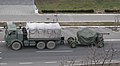 FAP 2026 BS/AV towing Bofors L/70 40 mm anti-aircraft gun
 -
 FAP 2026 BDS/AVG towing RPP M68 tugboat out from river
 -
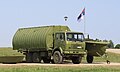 FAP 2026 BDS/A with PM M71 sections
 -
 M-77 Oganj multiple rocket launcher mounted on FAP 2026 BDS/A
 -
 M-85 Žirafa (Giraffe) mobile radar
 -
 FAP 2026 BDS/A fire truck


Technical data
[edit]Engine
[edit]- Engine type Mercedes-Benz OM 402, naturally aspirated V8 diesel
- Bore/Stroke (mm) 102/130
- Displacement (cm3) 6,370
- Output power (kW/HP) 205/279
- At speeds (rpm) 2,200
- Max. torque (Nm) 1,100
- At speeds (rpm) 1,200-1,600
- Gearbox
- Type 16MS-120, 16-speed, synchromesh
- Rated inlet torque 1200 Nm
- Transmission ratio: 13.68; 11.64; 9.4; 8.0; 6.73; 5.73; 4.79; 4.07; 3.36; 2.89; 2.31; 1.96; 1.65; 1.41; 1.18; 1.0
- Reverse 11.06; 9.41
- PTO PP 80 / 3C
- PTO application for winch drive
- Timing gear
- Type - mechanic, differential with three axles and two gear ratios:
- Gear ratio
- On-road (direct) 1 : 1
- Off-road (reduced) 1 : 1.6
- Propeller shafts
- Type - tubular, open, with universal joints (needle bearings in the joints) with protected telescopic connection, *without retaining bearings.
- Drive axles
- Type - Banjo, with fully unloaded axle shafts.
- Front axle is steering.
- Total transmission ratio 9.4
Cab
[edit]- Type short tipping
- Construction metal, tipping
- Number of seats 2
- Driver's seat single parts
- Cab insulation made on the internal side with special insulation of the bonnet on the lower side
- Ventilation wing window on doors and roof opening
- Heating by hot air from engine, through heater and fan
- Wipers electric
Winch
[edit]- Type with warm reducer and hydraulic power transfer
- Rope total length 86 m (282 ft), ø 16 mm (0.63 in)
- Towing force on the first drum winding 100.000 N +/- 10%
Wheels and tires
[edit]- No. of wheels 6+1 spare (2 in front, 4 at rear)
- Type of wheel 2-part with flat rim
- Rim size 11.25 - 21
- Tire type 15.00 - 21, special construction with pressure regulation dependent on terrain
Equipment
[edit]- The vehicle is equipped with a set of tools, accessories, and spare parts.
Electric equipment
[edit]- Rated voltage 24 V Two batteries, capacity 143 Ah
- Generator alternator with full radio interference, waterproof, rated power 28 V, 85 A, positioned on the engine right side
- Alternator regulator with full radio interference, 28V
- Electric starter waterproof, 24V, of 4.8 kW (6.4 hp).
Operators
[edit]


References
[edit]
- ^ FAP 2832 - part about Study of non-combat vehicles and trailers in use with Yugoslav People's Army (Serbia)
- ^ History of FAP (Serbian)
- ^ Yugoslav People's Army manual for FAP 2026 (Serbo-Croatian)
- ^ (Serbo-Croatian)
- ^ FFB Komerc - Specijalna Vozila - FAP 2026 BS/AV (Serbian)
- ^ "x.com". X (formerly Twitter). Retrieved 7 June 2024.


FAP 2026
View on GrokipediaHistory
Development
This effort aligned with broader national goals to modernize heavy-duty transport amid Cold War tensions, focusing on rugged 6x6 configurations capable of operating in diverse terrains. Key design influences for the FAP 2026 stemmed from a 1970 licensing agreement with Daimler-Benz, enabling production of Mercedes-Benz NG-series trucks adapted for military use.[3] The integration of the reliable OM 402 V8 diesel engine, rated at 260 horsepower, was prioritized to ensure durability in demanding applications, drawing directly from Mercedes-Benz's proven technology for off-road reliability.[3] Engineering milestones included prototyping in the early 1970s, where engineers at Fabrika automobila Priboj refined the 6x6 drivetrain for superior cross-country performance and adopted a cab-over-engine design to improve maneuverability and reduce overall length.[4] The FAP 2026 succeeded the FAP 2220. Extensive trials followed, culminating in the official introduction of the FAP 2026 in 1978.[3]Production
The production of the FAP 2026 commenced in 1978 at the Fabrika automobila Priboj (FAP) facility in Priboj, Serbia (then part of Yugoslavia), marking the start of full-scale manufacturing following the vehicle's development phase.[3] This assembly was enabled by a licensing agreement with Daimler-Benz, initially signed in 1970 for lighter truck models and extended in 1976 to encompass vehicles weighing 12 to 26 tonnes, allowing FAP to produce Mercedes-Benz-derived designs with locally sourced components such as chassis and axles.[3] The FAP 2026 was primarily manufactured for military applications, serving as a multi-purpose off-road truck for the Yugoslav People's Army in logistics and transport roles across challenging terrains.[5] After the dissolution of Yugoslavia in the early 1990s, FAP continued small-series production of the FAP 2026 into the early 2000s, focusing on needs of successor states like Serbia while facing disruptions in international supply chains.[3] The economic impacts of the breakup, including sanctions and fragmented markets, shifted reliance toward domestic Serbian government contracts for military vehicles, which helped maintain the Priboj plant's output despite overall reduced capacity in the late 1990s and early 2000s.[3] By the 2010s, annual truck production at FAP had declined significantly, with only dozens of units built yearly, underscoring the model's niche military focus amid broader privatization efforts starting in 2002.[3] Production persists in limited quantities as of 2025, supporting ongoing Serbian Armed Forces requirements, including as the chassis for the TSMB 203mm self-propelled mortar system unveiled at the Partner 2025 defense expo in September 2025.[6]Design and variants
Base design
The FAP 2026 is a general-purpose 6×6 off-road truck with a cab-over-engine layout, produced by Fabrika automobila Priboj for military applications.[7] Developed in collaboration with the Military Technical Institute in Belgrade, it serves as a medium tactical vehicle for logistics support in the Yugoslav People's Army, prioritizing durability across diverse terrains including rough off-road conditions. The design draws from a licensed Mercedes-Benz NG series truck, incorporating adaptations for enhanced military utility such as robust off-road performance.[8] The base model features a ladder-frame chassis with reinforced beams and electropneumatically controlled manual locking differentials on the axles and inter-axles, enabling superior traction and stability during operations.[7] This construction supports a payload capacity of 6 tonnes for general cargo and personnel transport, while also accommodating towing duties.[7] The standard configuration includes a short cab and cargo bed optimized for versatility in transporting up to 20 troops plus 2 crew members alongside equipment and supplies.[9] Key dimensions of the base design measure 7,720 mm in length, 2,490 mm in width, and 3,100 mm in height, with a ground clearance of 380 mm to facilitate navigation over uneven surfaces.[10] These attributes contribute to its role as a reliable workhorse for tactical logistics, balancing load-carrying capability with maneuverability in challenging environments.[7]Variants
The FAP 2026 series includes several specialized variants derived from the core 6×6 chassis, each tailored for distinct military and engineering roles while maintaining off-road capability. The FAP 2026 BS/AV represents the standard cargo configuration, featuring a short cab and open cargo bed optimized for the transport of personnel and general supplies in rugged terrain. This variant serves as the foundational model for many adaptations, with its chassis frequently modified for mounting equipment such as the SORA 122 mm self-propelled howitzer.[11] The FAP 2026 BDS/AVG is an extended cab version equipped with a reinforced hitch, specifically designed for towing components of the PM M71 floating bridge system, including tugboats and pontoon sections, to facilitate rapid bridge deployment in riverine operations.[12] The FAP 2026 BDS/A employs a longer cab for enhanced crew accommodation and is adapted for heavy-duty applications, including as a prime mover for artillery pieces like the M-77 Oganj multiple rocket launcher, as well as fire trucks, well-drilling rigs. This variant's reinforced structure supports the integration of specialized superstructures for these roles.[13] Additional derivatives include a tractor unit configuration for hauling semi-trailers, expanding logistical versatility.Technical specifications
Engine and powertrain
The FAP 2026 is powered by a Mercedes-Benz OM 402A V8 diesel engine with a displacement of 12,800 cm³, generating 205 kW (279 hp) at 2,200 rpm and maximum torque of 1,050 Nm between 1,200 and 1,600 rpm.[14][15][16][17] The engine employs direct injection for efficient fuel delivery and includes air pre-heating to facilitate cold starts in low-temperature conditions. Fuel is stored in two tanks with a combined capacity of 400 liters, supporting extended operational range in demanding environments.[16] The powertrain features the FAP MS-120, a 16-speed synchronized manual gearbox paired with a two-speed transfer case that enables a low-range reduction gear for enhanced off-road traction and torque multiplication.[18] Key performance metrics include a governed top speed of 85 km/h on paved roads and reduced speeds of 6–8 km/h in off-road conditions, reflecting the vehicle's emphasis on low-speed control and stability over rough terrain. Off-road fuel consumption typically ranges from 40–50 L/100 km, influenced by load, terrain, and transfer case engagement.Chassis, cab, and dimensions
The chassis of the FAP 2026 consists of a high-tensile steel ladder frame reinforced with cross-members, enabling it to handle a gross vehicle weight rating of 21,000 kg. The curb weight is 11,500 kg. This robust structure provides the foundational support for the vehicle's off-road capabilities and payload demands in military applications.[13][19] The cab employs an all-steel forward-control configuration, accommodating 2–3 crew members in a compact layout optimized for maneuverability. Optional cab extensions are available to adapt the design for variant-specific requirements, such as additional personnel or equipment integration. Key features include a foldable windshield for enhanced visibility in varied terrains and a removable canvas top for weather protection and quick reconfiguration.[19] Overall dimensions feature a wheelbase of 3,850 mm combined with a 1,400 mm rear overhang, contributing to a curb weight of 11,500 kg. These proportions balance stability and agility, with approach and departure angles measuring 42° and 48°, respectively, facilitating navigation over rough and inclined surfaces.[19] For protection, the cab panels offer basic ballistic resistance suitable for light combat environments, while the vehicle's fording depth reaches 1.2 m without preparatory modifications, supporting amphibious operations in shallow water crossings.[13]Suspension, wheels, and tires
The FAP 2026 employs a robust suspension system optimized for off-road operations, featuring leaf springs across its axles complemented by hydraulic shock absorbers, particularly reinforced on the rear wheels to manage heavy loads and recoil forces in artillery variants. This setup utilizes rigid axles with semi-elliptical leaf springs on the rear, while the front axle incorporates independent leaf springs for improved steering and stability over uneven terrain.[20] The design integrates with the vehicle's ladder-frame chassis to provide durability under demanding conditions, such as towing trailers up to 7.2 tons off-road.[21] The wheel configuration consists of six driven wheels in a 6x6 arrangement, plus one spare wheel, enabling all-wheel drive for enhanced traction in challenging environments. Each wheel is equipped with hub reduction gearing, which delivers increased low-speed torque essential for overcoming obstacles and maintaining momentum on soft or steep surfaces.[22] The two-part wheels feature flat rims sized at 11.25-21, supporting the vehicle's high ground clearance and load-bearing capacity.[21] Tires on the FAP 2026 are typically 15.00-21 bias-ply or radial types, designed as run-flat for puncture resistance during extended operations. A key feature is the central tire pressure regulation system, which allows adjustment to optimize traction and ride comfort across varied terrains, from highways to mud or sand.[20] This system contributes to the truck's off-road prowess, enabling it to climb gradients up to 60%, handle side slopes of 30%, and surmount vertical obstacles of 1.65 meters, as verified in military testing for Yugoslav-era vehicles.[21] Overall, these components ensure reliable mobility, with cross-country speeds reaching approximately 61 km/h under load.[21]Equipment and winch
The FAP 2026 features a range of standard auxiliary equipment designed to support logistics, maintenance, and recovery operations in demanding off-road conditions. This includes integrated toolboxes for storing essential repair tools and accessories, a rear-mounted spare tire carrier for quick access during field repairs, and robust towing hooks positioned at both the front and rear bumpers to facilitate vehicle recovery and interconnection with other units. Optional configurations provide added versatility, such as a removable canvas cover to protect cargo from environmental elements and foldable troop seats along the cargo bed sides to accommodate up to 20 personnel in addition to the standard three-man cab crew.[21] A prominent recovery component is the front-mounted winch, which is hydraulically driven via a power take-off (PTO) connected directly to the transmission for reliable operation without relying on auxiliary engines. It offers an 8-ton pulling capacity with a 60-meter steel cable, enabling the truck to self-recover from obstacles or assist immobilized vehicles in rough terrain, such as mud, sand, or steep inclines. The winch is integrated into the front chassis frame for balanced weight distribution and durability, with controls accessible from the cab for safe, operator-monitored deployment.[21] Further enhancing towing and protection are additional mechanical fittings, including a rear pintle hitch rated for trailer loads up to 7.2 tons, wire-mesh guards around the headlights and taillights to prevent damage from branches or debris, and heavy-duty mud flaps to minimize spray and underbody fouling during operations on unpaved surfaces. Select engineering variants incorporate specialized attachments like folding bridge-laying ramps, which allow the truck to deploy temporary crossing structures over ditches or streams.[21] To streamline upkeep, the FAP 2026 incorporates a centralized lubrication system that distributes grease to key chassis fittings, such as pivot points and suspension bushings, via a single access point, reducing downtime and maintenance effort in remote deployments.[7]Electrical system
The FAP 2026 employs a 24 V electrical system to power its starting, lighting, and auxiliary functions, ensuring reliability in demanding off-road and military conditions. The system is supported by two 12 V batteries connected in series, offering a total capacity of 360 Ah for sustained operation. A waterproof 4.8 kW starter motor provides robust cranking power for the engine, capable of functioning in wet environments typical of tactical deployments.[23] Charging is handled by a 2.5 kW alternator with an integrated voltage regulator, which maintains stable output and prevents voltage fluctuations during vehicle operation. The alternator, mounted on the right side of the engine and driven by its rotation, supplies power to the batteries and electrical loads while incorporating waterproofing and radio frequency interference suppression for electromagnetic compatibility.[24][25] Electrical circuits are protected by dedicated fuses to isolate faults and prevent system-wide failures. The lighting array consists of sealed-beam headlights for primary illumination and blackout lights designed for concealed operations, minimizing visibility during nighttime maneuvers. The instrument panel includes electrically driven gauges for fuel level, engine coolant temperature, and oil pressure, providing critical operational data to the driver. Accessory wiring supports hydraulic controls for the winch and provisions for an optional radio, with grounding straps integrated to mitigate electromagnetic pulse effects and enhance overall system resilience in hostile electronic environments.[24]Operational use
Current operators
The FAP 2026 remains in active service primarily with the Serbian Armed Forces, functioning as a rugged 6x6 off-road truck for personnel and material transport, as well as a chassis for integrated weapon systems such as artillery and air defense platforms.[26] Modernization efforts since the 2010s have focused on upgrading the FAP 2026's chassis and powertrain for enhanced off-road performance and compatibility with digital systems, including its use in the upgraded PASARS short-range air defense system and the M-77 Oganj multiple rocket launcher. At the Partner 2025 defense exhibition in September 2025, Serbia showcased systems like the TSMB 203mm self-propelled mortar carrier mounted on the FAP 2026 chassis, highlighting its ongoing role.[27][28][26] The FAP Corporation in Priboj continues to support the Serbian Armed Forces' FAP 2026 fleet amid broader defense modernization initiatives.[8] Derived from Yugoslav-era designs, the FAP 2026 has seen adoption by several successor states, though Serbia maintains the most extensive active employment in military logistics.[29]Former operators
The FAP 2026 served as the primary logistics vehicle for the Yugoslav People's Army (JNA) from its introduction in 1978 until the JNA's dissolution in May 1992. Designed for off-road transport of personnel, weapons, and materials in harsh conditions, it supported Cold War-era military exercises and operational deployments across diverse terrains.[30] Following the breakup of the Socialist Federal Republic of Yugoslavia in 1991–1992, JNA assets including FAP 2026 trucks were redistributed to the armed forces of the successor states, such as Serbia and Montenegro (forming the initial core of the Yugoslav Army), Croatia, Slovenia, Bosnia and Herzegovina, and North Macedonia. This division occurred amid the conflicts of the Yugoslav Wars, with equipment often seized or negotiated during the transition from federal to national militaries.[31][32] In the Federal Republic of Yugoslavia during the 1990s, international sanctions severely restricted access to spare parts and maintenance, leading to the decommissioning and partial scrapping of aging military vehicles like the FAP 2026 to repurpose materials or due to operational obsolescence. By the late 1990s, the vehicle was being phased out in favor of newer models such as the FAP 2228 for ongoing logistics needs.[33]References
- https://commons.wikimedia.org/wiki/File:FAP_2026_BDS_AVG_1.jpg