



Community hub
Community hub
Recent from talks
Knowledge base stats:
Talk channels stats:
Members stats:
FN Five-seven
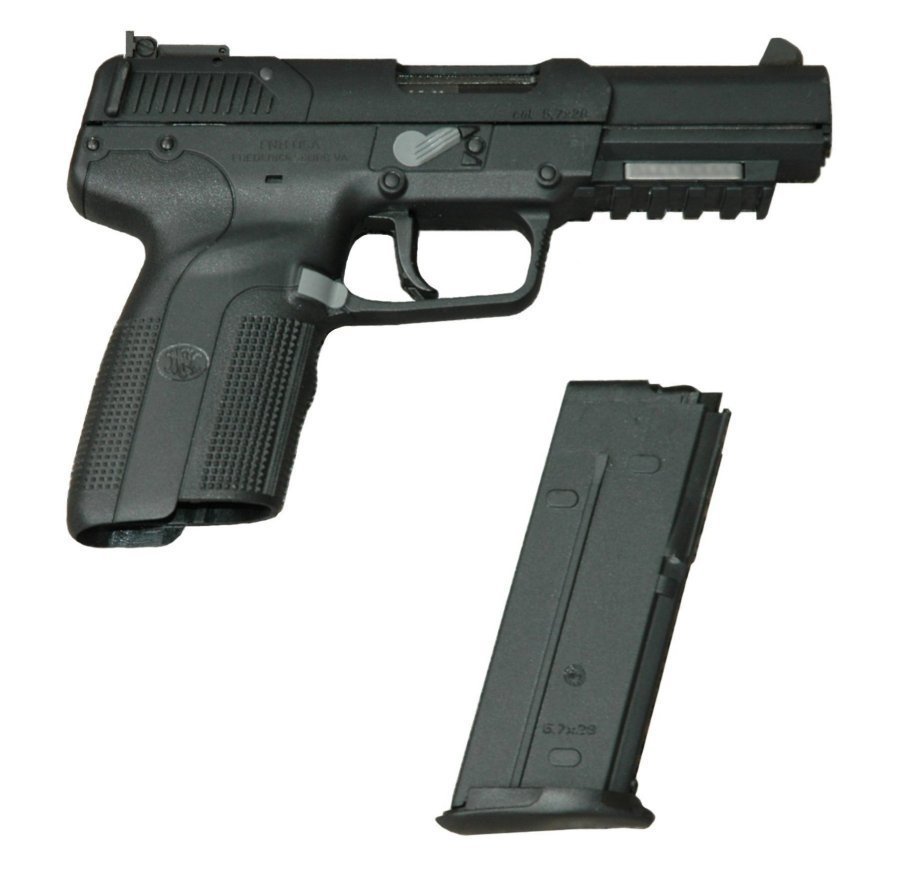
The FN Five-seven (stylized as Five-seveN) is a semi-automatic pistol designed and manufactured by FN Herstal in Belgium. The pistol is named for the 5.7×28mm cartridge's bullet diameter, and the trademark's capitalization style is intended to emphasize the manufacturer's initials—FN.
The Five-seven pistol was developed in conjunction with the FN P90 personal defense weapon and the FN 5.7×28mm cartridge. The P90 was introduced in 1990, and the Five-seven was introduced in 1998 as a pistol using the same 5.7×28mm ammunition. Developed as a companion pistol to the P90, the Five-seven shares many of its design features: it is a lightweight polymer-based weapon with a relatively large magazine capacity, ambidextrous controls, low recoil, and the ability to penetrate body armor when using certain cartridge types.
Sales of the Five-seven were originally restricted by FN to military and law enforcement customers, but since 2004, the pistol has also been offered to civilian shooters for uses such as personal protection and target shooting. Although offered only with sporting ammunition, the Five-seven's introduction to civilian shooters was met with vocal opposition from gun control organizations such as the Brady Campaign, and the pistol has been subject to ongoing controversy in the United States.
The Five-seven is currently in service with military and police forces in over 40 nations, including Canada, France, Greece, India, Poland, Spain, and the United States. In the United States, the Five-seven is in use with numerous law enforcement agencies, including the U.S. Secret Service. In the years since the pistol's introduction to the United States' civilian market, it has become increasingly popular with civilian shooters.
The Five-seven pistol and its 5.7×28mm ammunition were developed by FN Herstal in response to NATO requests for a replacement for the 9×19mm Parabellum cartridge and associated pistols and submachine guns. NATO called for two types of weapons chambered for a new cartridge—one a shoulder-fired weapon, and the other a handheld weapon. According to NATO, these new weapons, termed personal defense weapons (PDWs), were to provide "personal protection in last-resort situations when the user is directly endangered by the enemy [...]." In 1989, NATO published document D/296, outlining a number of preliminary specifications for these weapons:
FN Herstal was the first small arms manufacturer to respond to NATO's requirement; FN started by developing a shoulder-fired personal defense weapon, the FN P90, along with a small caliber, high velocity 5.7×28mm cartridge type. The original 5.7×28mm cartridge, called the SS90, went into production with the P90 in 1990. This cartridge type was discontinued in 1993, and replaced with the 5.7×28mm SS190, which used a heavier and slightly shorter projectile weighing 2.0 g (31 grains). The reduced length of the SS190 projectile allowed it to be used more conveniently in the Five-seven, which was under development at that time.
In 1993, Jean-Louis Gathoye of FN filed a United States patent application for a delayed blowback operating system intended for the Five-seven pistol, and U.S. Patent 5,347,912 ("Elements for decelerating the recoil of the moving parts of a firearm") was received the following year. In 1995, FN officially announced development of the Five-seven pistol, and a prototype of the pistol was publicly displayed the following year. With some improvements, a double-action only model of the pistol went into production in 1998, and a single-action model called the Five-seven Tactical was then introduced shortly afterward. The Five-seven first entered service in May 2000, when the Cypriot National Guard (Greek: Εθνική Φρουρά) purchased 250 pistols for their special forces group.
In 2002 and 2003, NATO conducted a series of tests with the intention of standardizing a PDW cartridge as a replacement for the 9×19mm Parabellum cartridge. The tests compared the relative merits of the FN 5.7×28mm cartridge and the HK 4.6×30mm cartridge, which was created by German small arms manufacturer Heckler & Koch as a competitor to the 5.7×28mm. The results of the NATO tests were analyzed by a group formed of experts from Canada, France, the United Kingdom, and the United States, and the group's conclusion was that the 5.7×28mm was "undoubtedly" the more efficient cartridge.
Hub AI
FN Five-seven AI simulator
(@FN Five-seven_simulator)
FN Five-seven
The FN Five-seven (stylized as Five-seveN) is a semi-automatic pistol designed and manufactured by FN Herstal in Belgium. The pistol is named for the 5.7×28mm cartridge's bullet diameter, and the trademark's capitalization style is intended to emphasize the manufacturer's initials—FN.
The Five-seven pistol was developed in conjunction with the FN P90 personal defense weapon and the FN 5.7×28mm cartridge. The P90 was introduced in 1990, and the Five-seven was introduced in 1998 as a pistol using the same 5.7×28mm ammunition. Developed as a companion pistol to the P90, the Five-seven shares many of its design features: it is a lightweight polymer-based weapon with a relatively large magazine capacity, ambidextrous controls, low recoil, and the ability to penetrate body armor when using certain cartridge types.
Sales of the Five-seven were originally restricted by FN to military and law enforcement customers, but since 2004, the pistol has also been offered to civilian shooters for uses such as personal protection and target shooting. Although offered only with sporting ammunition, the Five-seven's introduction to civilian shooters was met with vocal opposition from gun control organizations such as the Brady Campaign, and the pistol has been subject to ongoing controversy in the United States.
The Five-seven is currently in service with military and police forces in over 40 nations, including Canada, France, Greece, India, Poland, Spain, and the United States. In the United States, the Five-seven is in use with numerous law enforcement agencies, including the U.S. Secret Service. In the years since the pistol's introduction to the United States' civilian market, it has become increasingly popular with civilian shooters.
The Five-seven pistol and its 5.7×28mm ammunition were developed by FN Herstal in response to NATO requests for a replacement for the 9×19mm Parabellum cartridge and associated pistols and submachine guns. NATO called for two types of weapons chambered for a new cartridge—one a shoulder-fired weapon, and the other a handheld weapon. According to NATO, these new weapons, termed personal defense weapons (PDWs), were to provide "personal protection in last-resort situations when the user is directly endangered by the enemy [...]." In 1989, NATO published document D/296, outlining a number of preliminary specifications for these weapons:
FN Herstal was the first small arms manufacturer to respond to NATO's requirement; FN started by developing a shoulder-fired personal defense weapon, the FN P90, along with a small caliber, high velocity 5.7×28mm cartridge type. The original 5.7×28mm cartridge, called the SS90, went into production with the P90 in 1990. This cartridge type was discontinued in 1993, and replaced with the 5.7×28mm SS190, which used a heavier and slightly shorter projectile weighing 2.0 g (31 grains). The reduced length of the SS190 projectile allowed it to be used more conveniently in the Five-seven, which was under development at that time.
In 1993, Jean-Louis Gathoye of FN filed a United States patent application for a delayed blowback operating system intended for the Five-seven pistol, and U.S. Patent 5,347,912 ("Elements for decelerating the recoil of the moving parts of a firearm") was received the following year. In 1995, FN officially announced development of the Five-seven pistol, and a prototype of the pistol was publicly displayed the following year. With some improvements, a double-action only model of the pistol went into production in 1998, and a single-action model called the Five-seven Tactical was then introduced shortly afterward. The Five-seven first entered service in May 2000, when the Cypriot National Guard (Greek: Εθνική Φρουρά) purchased 250 pistols for their special forces group.
In 2002 and 2003, NATO conducted a series of tests with the intention of standardizing a PDW cartridge as a replacement for the 9×19mm Parabellum cartridge. The tests compared the relative merits of the FN 5.7×28mm cartridge and the HK 4.6×30mm cartridge, which was created by German small arms manufacturer Heckler & Koch as a competitor to the 5.7×28mm. The results of the NATO tests were analyzed by a group formed of experts from Canada, France, the United Kingdom, and the United States, and the group's conclusion was that the 5.7×28mm was "undoubtedly" the more efficient cartridge.