
.jpg/250px-Skeet_masculin_aux_Jeux_olympiques_de_2024_-_Éric_Delaunay_(2).jpg)


.jpg/1333px-Skeet_masculin_aux_Jeux_olympiques_de_2024_-_Éric_Delaunay_(2).jpg)
Community hub
Recent from talks
Contribute something
Nothing was collected or created yet.
Shooting sports
View on Wikipedia

Key Information

.jpg)
Shooting sports is a group of competitive and recreational sporting activities involving proficiency tests of accuracy, precision and speed in shooting — the art of using ranged weapons, mainly small arms (firearms and airguns, in forms such as handguns,[1] rifles[2] and shotguns[3]) and bows/crossbows.[4][5]
Shooting sports can be categorized by equipment, shooting distances, targets, time limits and degrees of athleticism involved. Shooting sports may involve both team and individual competition, and team performance is usually assessed by summing the scores of the individual team members. Due to the noise[6] of shooting and the high (and often lethal) impact energy of the projectiles, shooting sports are typically conducted at either designated permanent shooting ranges[7] or temporary shooting fields in the area away from settlements.
History
[edit]Great Britain
[edit]The National Rifle Association (NRA) was founded in 1859 to raise the funds for an annual national rifle meeting "for the encouragement of Volunteer Rifle Corps and the promotion of Rifle-shooting throughout Great Britain".[8]
United States
[edit]Target shooting was a favorite sport in colonial America, with the New England Puritans regularly testing their shooting skills for recreation and at militia training days. The Scotch Irish settlers on the frontier favored shooting matches sponsored by Tavern keepers. Turkey shoots were popular after harvest time. Contestants would pay an entry fee, and everyone who killed a tethered turkey at 110 yards for muskets or 165 yards for rifles could keep the bird. German gunsmiths in Pennsylvania began to manufacture Flintlock rifles in the 1720s, which became especially popular among hunters because of its long-range accuracy. It could be accurate to 200 yards. Along about 1820, percussion caps, and the locks that ignited them, became available, and nearly all new firearms began to be constructed using this ignition system. Many flintlock firearms were also subsequently converted to the percussion system, which was a relatively simple procedure that could be accomplished by local gunsmiths. Although percussion ignition did not add to the accuracy of the firearm, the time between when the firearm firing mechanism (or "lock") started the sequence that lead to the ignition of the propellant in the barrel, was shortened drastically. This made getting smaller shot groups on the target more attainable as the possibility of the firearm moving off the aiming point after the shooter pressed the trigger was lessened. This shortened ignition time, which is referred to as "lock time" was (and still is) a very important factor in target shooting. The closed design of the percussion system materially improved reliability of the firearm, especially in rainy or damp conditions.[relevant?] The faster "lock time" also made hitting fast-moving aerial targets with a cloud of tiny lead pellets ("shot") fired from a smooth-bore firearm a real possibility. Practicing for game hunting by shooting at artificial aerial targets launched from spring-powered launching devices ("traps") became highly popular and led to the development of the modern Trap, Skeet, and Sporting Clays shooting sports.
In 1831 a sportsman club in Cincinnati Ohio held a competitive shoot at pigeons and quail released from ground traps. German ethnic communities set up athletic clubs and shooting clubs, especially in the Midwestern states In the 1850–1917. period[9] Breach loading shotguns introduced in the 1860s, and the knowledge of rifles by Civil War soldiers, made trap shooting popular. However, there was human humanitarian opposition to killing live birds—and the passenger pigeon was dying out—so glass or clay targets were used instead.[10][11]
Concerned over poor marksmanship during the American Civil War, veteran Union officers Col. William C. Church and Gen. George Wingate formed the National Rifle Association of America in 1871 for the purpose of promoting and encouraging rifle shooting on a "scientific" basis.[12] In 1872, with financial help from New York state, a site on Long Island, the Creed Farm, was purchased for the purpose of building a rifle range. Named Creedmoor, the range opened in 1872, and became the site of the first National Matches until New York politics forced the NRAoA to move the matches to Sea Girt, New Jersey. The popularity of the National Matches soon forced the event to be moved to its present, much larger location: Camp Perry. In 1903, the U.S. Congress created the National Board for the Promotion of Rifle Practice (NBPRP), an advisory board to the Secretary of the Army, with a nearly identical charter to the NRAoA. The NBPRP (now known as the Civilian Marksmanship Program) also participates in the National Matches at Camp Perry.[13][14][15]

In 1903, the NRA of America began to establish rifle clubs at all major colleges, universities, and military academies. By 1906, youth programs were in full swing with more than 200 boys competing in the National Matches. Today, more than one million youth participate in shooting sports events and affiliated programs through groups such as 4-H, the Boy Scouts of America, the American Legion, U.S. Jaycees, NCAA, The USA High School Clay Target League, the Scholastic Clay Target Program, National Guard Bureau, ROTC, and JROTC.
Olympics
[edit]French pistol champion and founder of the modern Olympics, Pierre de Coubertin, participated in many of these early competitions. This fact certainly contributed to the inclusion of five shooting events in the 1896 Olympics. Over the years, the events have been changed a number of times in order to keep up with technology and social standards. The targets that formerly resembled humans or animals in their shape and size have are now a circular shape in order to avoid associating the sport with any form of violence. At the same time, some events have been dropped and new ones have been added. The 2004 Olympics featured three shooting disciplines (rifle, pistol, and shotgun) where athletes competed for 51 medals in 10 men's and 7 women's events—slightly fewer than the previous Olympic schedule.[16]
In the Olympic Games, the shooting sport has always enjoyed the distinction of awarding the first medals of the Games. Internationally, the International Shooting Sport Federation (ISSF) has oversight of all Olympic shooting events worldwide, while National Governing Bodies (NGBs) administer the sport within each country.
Competition disciplines
[edit]Shooting at the Summer Olympics includes fifteen medal events, covering seven disciplines. Medal events are evenly distributed between rifle, pistol and shotgun with five events each. Three Mixed Pairs events were introduced to ensure gender equity between men's and women's events. They replaced 50m Prone Rifle, 50m Free Pistol and Double Trap which were all men-only events.[17]
- Rifle
- 50 meter rifle three positions (individual - men and women)
- 10 meter air rifle (individual - men and women)
- 10 meter air rifle (mixed pairs)
- Pistol
- 25 meter rapid fire pistol (individual - men)
- 25 meter sport pistol (individual - women)
- 10 meter air pistol (individual - men and women)
- 10 meter air pistol (mixed pairs)
- Shotgun
- Trap (men and women)
- Skeet (individual - men and women)
- Skeet (mixed pairs)
Gun shooting sports
[edit]
Gun shooting sports are shot with either firearms or air guns, which can be handguns, rifles or shotguns.
Handguns are handheld small arms designed to be shot off-hand without needing a shoulder stock. The two main subtypes of handguns are pistols and revolvers. They are much more convenient to carry in general, but usually have a shorter effective range and less accuracy compared to long guns such as rifles. In shooting sports, revolvers and semi-automatic pistols are the most commonly used.
A rifle is a long gun with a rifled barrel, and requires the use of both hands to hold and brace against the shoulder via a stock in order to shoot steadily. They generally have a longer range and greater accuracy than handguns, and are popular for hunting. In shooting sports, bolt-action or semi-automatic rifles are the most commonly used.
A shotgun is similar to a rifle but often smoothbore and larger in caliber, and typically fires either a shell containing many smaller scattering sub-projectiles called shots, or a single large projectile called a slug. In shooting sports, shotguns are more often over/under-type break action or semi-automatic shotguns, and the majority of shotgun events are included in clay pigeon shooting.
Bullseye shooting
[edit]
Bullseye shooting is a category of pistol and rifle shooting disciplines where the objective is to achieve as many points as possible by hitting a round shooting target as close to the middle as possible with slow precision fire. These disciplines place a large emphasis on precision and accuracy through sight picture, breath and trigger control.[citation needed] Fixed and relatively long time limits give the competitors time to concentrate for a perfect shot. An example of bullseye shooting is the ISSF pistol and rifle disciplines, but there are also many other national and international disciplines which can be classified as bullseye shooting. The shooting distances are typically given in round numbers, such as 10, 25, 50, 100, 200 or 300 meters depending on firearm type and discipline. Competitions are usually shot from permanent shooting ranges and with the same target arrangement and distance from match to match. Usually the competitors each have their own shooting target and shoot beside each other simultaneously. Because of the relatively simple match format, beginners are often recommended bullseye shooting in order to learn the fundamentals of marksmanship.[citation needed] Bullseye shooting is part of the Summer Olympic Games, and a considerable amount of training is needed to become proficient.
Bullseye shooting with handguns
[edit]- There are six ISSF shooting events with pistols. These include three Olympic events, plus three events not included in the Olympic program but contested at World Championships. Their roots date back to the first modern Olympic Games in 1896, consisting of both precision slow-fire and rapid-fire target shooting from distances of 10, 25, and 50 meters. The specialised pistols offer anatomic grips, with competitors shooting one-handed. In the UK (except for Northern Ireland), it is no longer possible to practice for some of the Olympic events following the Firearms (Amendment) (No. 2) Act 1997, legislation brought in after the Dunblane Massacre.[citation needed]
- The CISM Rapid Fire match is similar to the ISSF 25 meter rapid fire pistol event.
- NRA Precision Pistol is a bullseye shooting event where up to 3 handguns of differing calibers are used. Its history is almost as old as ISSF events. Shooters must fire the pistol one-handed at 6- and 8-inch bullseye targets placed 25 and 50 yards downrange respectively.
- Precision Pistol Competition (PPC), was originally a police shooting program started in 1960 by the National Rifle Association of America.[18]
-
 The Men's ISSF 10 meter air pistol final in the 2012 Summer Olympics
 -
 Boris Kokorev from Russia during the ISSF 50 meter pistol 2007 World Cup in Munich
 -
 Women's 10 meter air pistol at the 2012 Summer Olympics
.jpg)


Bullseye shooting with rifles
[edit]- The six rifle ISSF shooting events (including two Olympic events: 10 meter air rifle and 50 meter rifle three positions) consist of slow-fire target shooting from distances of 10 or 50 or 300 metres (33 or 164 or 984 ft).[19]
- Fullbore target rifle involves prone shooting with single-shot rifles at distances of 300yds to 1200yds. It is particularly popular in Britain and within the Commonwealth of Nations (mostly former constituents of the British Empire).
- Gallery rifle shooting is popular in the UK, using carbine rifles chambered in pistol calibres. Gallery Rifle was introduced as a substitute for many pistol shooting disciplines following the 1997 handgun ban.
- High Power Rifle (also known as "Across the Course" or 'traditional' High power) in the United States is a format that shoots 3-position (standing, kneeling, or sitting, and prone) at 200, 300, and 600 yards. The term "Across the Course" is used because the match format requires the competitors to shoot at different distances to complete the course of fire.
- Military Service Rifle shooting is a shooting discipline that involves the use of rifles that are used by military forces and law-enforcement agencies, both past and present use. Ex-military rifles, sniper rifles (both past and present) and civilian versions of current use service rifles are commonly used in the Military Service Rifle shooting competitions. It is popular in the United States and culminates each year with the National Matches being held at Camp Perry, Ohio. Some countries have outlawed civilian shooting at human-silhouette targets; silhouette targets are not used in the National Match Course of Fire. Bullseye targets are used. High Power Rifle competition often is held at the same events as Service Rifle, such as the U.S. national championships each year at Camp Perry. High Power competitors generally are civilians using whatever rifles they prefer within the rules, whereas Service Rifle entrants are limited to current or previous U.S. armed forces weapons. Under NRA of America rules only certain matches allow optical sights, normally those conducted at ranges over 600 yards.
- Project Appleseed is a rifle marksmanship program by The Revolutionary War Veterans Association that teaches both rifle marksmanship and oral history regarding the American Revolutionary War. It shoots 3-position (standing, sitting, and prone) at 25 meters at reduced scale targets, simulating shooting at 100, 200, 300, and 400 yards. The techniques taught easily apply to transitioning to High Power Rifle.
- Full bore and small bore rifle shooting in the United Kingdom.
- Three position airgun competitions, popular in the United States.
- Four position small bore is a popular sport in the U.S, which adds Sitting to the Three positions used internationally.
-
 A junior shooter in Switzerland target shoots with a SIG 550. A brass catcher is fitted to avoid disturbing other shooters with the ejection.
 -
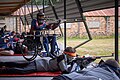 Competitors shoot in an ISSF 50 metre prone competition in Wales. A para-athlete shoots from a chair.
 -
 Two shooters during an ISSF 300 meter rifle three positions (prone, kneeling and standing)


Field shooting
[edit]Field-Shooting or Terrain-Shooting [20][21] refer to a set of pistol and rifle shooting disciplines that usually are shot from temporary shooting ranges in outdoor terrain at varying (and sometimes unknown) distances, rather than at permanent shooting ranges at fixed distances.
Field shooting with handguns
[edit]- Nordic Handgun Field-Shooting competitions are shot with pistol and revolver in different classes depending on equipment,[22] with classes up from small-bore .22 LR to large-bore .500 S&W Magnum.[23] Matches are held outdoor throughout the year with varied shooting targets and distances, and are arranged by the Norwegian Shooting Association (NSF), the Danish Gymnastics and Sports Associations (DGI Shooting) and the Swedish Pistol Shooting Association (SPSF).
- Swiss field shooting with handguns is a discipline under the Swiss Shooting Sport Federation arranged under a common Swiss ruleset, and has been part of the annual field shooting championship since 1919 alongside field shooting with rifles, which have been arranged since 1899.

Field shooting with rifles
[edit]- Nordic Rifle Field-Shooting[24] are shot with either small-bore .22 LR cartridge at 100 meters, or intermediate (such as .223 Remington or 6mm BR) or battle rifle cartridges (such as the 6.5×55mm, .308 Winchester or the .30-06 Springfield) at distances from 100 to 650 meters. With 200 and 300 meters being ordinary shooting distance in Nordic Bullseye Rifle-Shooting, those targets placed well beyond 300 meters in Rifle Field-Shooting means that the competition format also can be classified as a long range shooting discipline. Matches are usually held in the winter season with varied targets, and are arranged by the National Rifle Association of Norway (DFS), the Danish Gymnastics and Sports Associations (DGI Shooting) and the Swedish Shooting Sport Association (SvSF).
- Swiss field shooting with rifles is a discipline under the Swiss Shooting Sport Federation arranged under a common Swiss ruleset. The annual Swiss Field Shooting Championship has been held since 1899. From 1919, Swiss field shooting with handguns has also been av part of the Swiss Field Shooting Championship.
- Precision rifle competitions, like the Precision Rifle Series (PRS), is both a field and long range shooting discipline where rifles with intermediate or battle rifle cartridges are shot in the terrain at varying distances from about 10 to 1000 meters.
- Field Target is an outdoor air gun discipline originating in the United Kingdom, but gaining popularity worldwide. Hunter field target is a variation of field target.
-
 Nordic Rifle Field Shooting in Sweden during the winter in 2012
 -
 The Norwegian Rifle Field Shooting Championship at the 2007 Landsskytterstevnet
 -
 Field-like shooting competition in USA using a National Match M1
 -
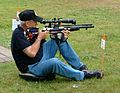 Field target shooting in Germany


Rapid fire
[edit]Rapid fire with handguns
[edit]- The ISSF 25 meter pistol and ISSF 25 meter rapid fire pistol events are contested at the Olympic Games.
- The Bianchi Cup, a fusion of IPSC (without the "run and gun" element) and bullseye shooting (except shot with two hands and going prone whenever rules allow it) where accuracy under tight time limits in four simulated scenarios, known as the "Event(s)", is the basis of this competition. Shooters must start with gun in the holster on every strings of fire and distances range from 10 to 50 yards.
- Fast draw, also known as quick draw, a form of pistol action shooting from North America, based on the romanticized art of the gunslingers in the American Old West, using traditional single action revolvers. But unlike Cowboy action shooting, Fast Draw is done with special blanks or wax bullets. While some competitions are strictly against the clock, with the fastest time winning, many are set up as head-to-head single or double elimination matches.
-
 Female athlete competes in 25 meter pistol event.
 -
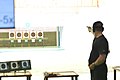 Keith Sanderson from USA during the ISSF 25 meter rapid fire pistol event at the 2016 Rio Olympic Games in Rio de Janeiro
 -
 John Pride at the 2008 Bianchi Cup

.jpg)

Rapid fire with rifles
[edit]- The CISM Rapid Fire match is a sped-up version of the ISSF 300 m Standard Rifle event.
- Felthurtigskyting (literally Field Rapid Shooting) and Stangskyting are a type of variable rapid-fire rifle competitions popular in Scandinavia.
-
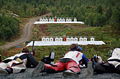 Stang-Shooting at the 2007 Landsskytterstevnet in Norway. The nearest targets are placed at 155 meters, the farthest at 221 meters.
 -
 Field-Rapid-Shooting at the 2007 Landsskytterstevnet in Norway


Clay target
[edit]Clay pigeon shooting are shotgun disciplines shot at flying clay pigeon targets.
- The three Shotgun ISSF/ Olympic shooting events are all are based on quick reaction to clay targets thrown by machines called "Traps".
- Skeet: Targets are either thrown in singles or doubles from two throwers called "traps" placed 40 meters apart.[25]
- Trap and Double Trap: Either one (trap) or two targets (double trap) are thrown from 15 meters in front of the shooter.[25]
- The Fédération Internationale de Tir aux Armes Sportives de Chasse (FITASC) Compak Sporting is a type of shotgun sport shooting similar to sporting clays, trap and skeet.
- Other shotgun sports with (at least partial) international recognition include Sporting Clays, Down-The-Line/ATA and Five stand.
-
 Trap shooting in USA
 -
 Skeet shooting in USA
 -
 Clay targets being placed in an automatic throwing machine
 -
 Trap shooting at the 2015 World Police and Fire Games in USA
 -
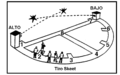 Sketch of a Skeet shooting range


.jpg)

Running target
[edit]Running target shooting refers to a number of disciplines involving a shooting target—sometimes called a boar, moose, or deer—that is made to move as if it is a running animal. Events of this type include:
- ISSF 10 meter running target
- ISSF 10 meter running target mixed
- ISSF 50 meter running target
- ISSF 50 meter running target mixed
- 100 meter running moose, popular in Scandinavia both as a sport and hunting exercise. Competitions in Sweden are held at 80 meters.[26]
- 100 meter running deer, also somewhat[tone] popular in Scandinavia and Great Britain[27]
Moving target
[edit]Shooting at the 1908 Summer Olympics – Men's moving target small-bore rifle
Disappearing target
[edit]Shooting at the 1908 Summer Olympics – Men's disappearing target small-bore rifle
Practical shooting
[edit]Practical shooting, also known as action shooting or dynamic shooting, is a generic term applicable to shooting sports where speed is of equal importance as precision. Many of the disciplines involve movement, and when using handguns they are often drawn from a holster.
- The International Practical Shooting Confederation (IPSC) is the oldest and largest sanctioning body within practical shooting. IPSC is sometimes considered the "Formula One" of shooting sports, and is shot with handguns, rifles and shotguns. While the United States Practical Shooting Association (USPSA) is the U.S. regional affiliate of IPSC, many of USPSA's rules differ slightly from those used internationally. IPSC was developed by former police and civilian marksmen and later used as a basis for modern military and police exercises. It is a variation where the shooter often moves during shooting, and hits scored and shooting time are equally important. Stage procedure is generally not dictated (freestyle) and the shooter is allowed to determine the order and manner in which he or she engages the targets.
- International Defensive Pistol Association (IDPA) is an action shooting sport that uses semi-automatic handguns and revolvers with a strong emphasis on concealed shooting. Many aspects of stage engagement are dictated to competitors and penalties are given to competitors whom the safety officer determines attempted to gain a competitive advantage or engaged in a forbidden action with a "guilty mind" - that he knowingly failed to do right.
- Multigun are practical shooting events where each of the stages generally require the competitor to use and transition between a combination of rifles, handguns, and/ or shotguns[28] or other types of firearms. 3-Gun has a lot in common with ordinary IPSC/USPSA matches, having courses of fire where the shooter must move through different stages and engage targets in a variety of different positions.
- Steel Challenge is a speed shooting championship solely about shooting steel targets as fast as possible, and is governed by the Steel Challenge Shooting Association (SCSA). There are eight standardized courses of fire, and a special "stop plate" must be shot last to stop the timer.
- International Confederation of Revolver Enthusiasts (ICORE) is an international community that promotes action shooting competitions with revolvers. Founded in 1991, the sport has elements from the Bianchi Cup, IPSC, and the Steel Challenge.[29]
- IPSC Action Air follows the same principle of IPSC, using airsoft instead of real firearms. The ranges, paper targets and poppers are scaled down to suit airsoft, and the sport enjoys popularity in countries such as Taiwan, Hong Kong, and Japan where civilian ownership of real firearms are either illegal or extremely difficult to obtain.
- Bowling pin shooting (primarily shot with handguns) has the competitors race against one another to knock standard bowling pins from a table in the shortest elapsed time.
-
 An Open division practical pistol shooter during a stage
 -
 A Norwegian practical rifle shooter at the 2017 IPSC Rifle World Shoot in Russia
 -
 Three times practical revolver world champion Ricardo López Tugendhat from Ecuador


Long range
[edit]Long range shooting is shooting held at such distances that sight adjustment based from judging atmospherical conditions become critical.
- Fullbore target shooting is concerned with shooting at targets at ranges of 300–1200 yards. The sport is internationally governed by ICFRA, and is popular in the UK, US, Germany and Commonwealth countries. Similar disciplines called bullseye and field shooting are popular in Scandinavia, although fired at shorter distances.
- "Target Rifle" (also known as Palma rifle) is an ICFRA fullbore competition format that dates from 1876, featuring long-range rifle shooting out to 1,000 yards. The first Palma match was contested by teams from the U.S., Australia, Canada, Scotland and Ireland (with muzzle loaded rifles at that time). The matches continued to the late 1920s, and the Palma trophy was eventually lost in Washington DC around the outbreak of WW2. The match was revived in the modern era in 1966 in Canada, and continues between teams from around the world. Regulations stipulate bolt-action rifles chambered in 7.62mm NATO caliber (Winchester .308) and firing Match Grade ammunition using a 155 grain bullet using micrometer aperture (iron) sights, or a 5.56mm NATO (.223 Remington) with a max bullet weight of 90 grains, and iron sights. Due to developments in modern bullet technology, an 85.5 grain bullet out of a .223 can out shoot a .308, with the right load.[30] The last two International Long-range Target Rifle Matches were held in Australia in 2011 and the U.S. in 2015, were won by Great Britain.[31]
- F-Class is another ICFRA fullbore competition format shot with Fullbore Target Rifles at ranges up to 1000 yards, the rifles being fitted with telescopic sights and the use of fore-end and butt rests being permitted. This is a fast-growing variant of Fullbore Target Rifle. The 'F' honours George Farquharson, the Canadian inventor of F-Class.
- Precision Rifle Competitions, a relatively new long range competition format which seeks to find a balance between speed and precision, often involving movement and shooting from unusual positions with a time limit, at both known and unknown distances.
- National Rifle League (NRL) is a 501(c)(3) non-profit organization dedicated to the growth and education of precision rifle shooting in the United States. Their match format allows any caliber between .224 to .308 and not to exceed 3,200 feet per second (980 m/s), involving at least 50 shooters with each firing minimum 140 rounds in at least 12 individual stages, over the course of at least two days. Since its debut in 2017, currently 11 clubs from eight states are involved in the league.[32]
- National Rifle League 22 (NRL22) is a sub-league under the National Rifle League dedicated to .22 Long Rifle rimfire rifles. It was established to address the fact that most localities do not have access to 1000 yard ranges, but nearly all localities have 100-yard ranges and most shooters own .22 rifles. Their championship match consist of minimum 170 rounds fired in at least 15 individual stages. Currently 68 clubs from 31 states in the US participate in NRL22 matches, with addition to two overseas clubs from UK and Australia.[33]
- T-Class Shooting Sport Competitions. Practical sniping with precision rifle systems is a shooting sport, which gains tremendous popularity worldwide over a short period of time. It concentrates on shooting onto static or dynamic targets of various distances (known and unknown), from different positions, under artificially created, but realistic stressful circumstances. It proves to be extremely interesting both for implementation and observation, due to its demanding level of difficulty. The International T-Class Confederation (ITCC) is a non-profit organization, which is founded in 2014 for the purpose of promotion of the T-Class shooting sport internationally, with headquarters residing in Bulgaria. It offers a Set of Rules for designing and managing T-Class Competitions.
-
 Fullbore target rifle ("Palma") shooting in Canada in 2011
 -
 An ICFRA F-Class rifle equipped with a scope and bipod


Benchrest
[edit]Benchrest shooting is concerned with shooting small groups with the rifleman sitting on a chair (bench) and the rifle supported from a table. Of all shooting disciplines, this is the most demanding equipment-wise.[according to whom?] Depending on equipment class, international benchrest competitions are governed by either the World Benchrest Shooting Federation or World Rimfire and Air Rifle Benchrest Federation.
-
 An Anschütz 1903 rifle in caliber .22 LR used for benchrest shooting at 50 meters
 -
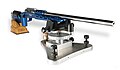 A BCM Europearms single shot benchrest rifle


Metallic silhouette
[edit]Metallic silhouette competitors shoot at animal-shaped steel silhouettes (chickens, pigs, turkeys and rams) that must be knocked down to score. Banks of 5 targets are placed at up to 500 meters, with distance and size of target determined by firearm class. Classes include Handguns, Small Bore Rifle (Hunter, Silhouette), High Power Rifle (Hunter, Silhouette), air rifle and black powder rifle. Handguns used in the Unlimited Categories are rifle-like in appearance; Thompson Contender, Remington XP-100, and other pistols are chambered in rifle calibers with the power, aerodynamic efficiency, and external ballistics required for precise shooting at 200 meters. There are silhouette categories appropriate for virtually all types of adjustable sight pistols and rifles, only excluding high-velocity armor-piercing rounds that would damage targets. Targets for open sighted guns are placed between 25 and 200 meters, and are designed to provide a usable size of the hit zone of about 1.5 milliradians (or 5 minutes of arc).
-
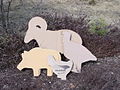 Cut cardboard targets of the same shape and sizes which are used for IHMSA metal targets in metallic silhouette shooting
 -
 Chicken, pig, turkey, and ram. The different targets are placed at different distances, and in this image the targets are scaled to how they would appear to the shooter in angular sizes (mil or moa).


Western
[edit]- Cowboy action shooting (CAS) is almost identical to USPSA and IDPA stage design but with Western cowboy-themed props. Competitors shoot with historical long guns and revolvers, and are required to use a themed alias and authentic dress.
- Cowboy mounted shooting, also called Western Mounted Shooting or simply Mounted Shooting, is a competitive equestrian sport involving the riding of a horse to negotiate a shooting pattern. Rule sets vary between shooting sport organizations, it can be based on the historical reenactment of historic shooting events held at Wild West shows in the late 19th century. Modern events use blank ammunition instead of live rounds, certified to break a target balloon within twenty feet.[34]
-
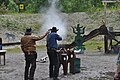 A Cowboy action shooter firing a lever action rifle at steel targets. The Range Officer to the left is holding a shooting timer to measure the time.
 -
 Scenery in a Western scenario
 -
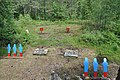 The shooter uses different firearms during a stage. In this stage revolvers were used at the close range blue targets and a lever action at the red targets furthest away.
 -
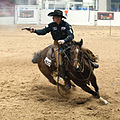 Cowboy mounted shooting at the 2012 AQHA Mounted Shooting World Championship


Muzzleloading
[edit]Muzzleloading are concerned with shooting replica (or antique) guns.
-
 Competitor shooting at 1000 yards (914.4 meters) laying on back
 -
 Competitor from Team Norway shooting at 1000 yards (914.4 meters)
 -
 Replica Rigby rifle used at the 2015 MLAIC Muzzleloading Long Range Championship
 -
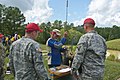 A member of Team USA loading his blackpowder rifle


Para shooting
[edit]Paralympic shooting, also known as "shooting Para sport", is an adaptation of shooting sports for competitors with disabilities. Paralympic shooting first appeared in the Summer Paralympics at the 1976 Toronto Games. Para shooting is internationally governed by the International Paralympic Committee. To help establish fair competition, a shooting classification called Para-shooting classification is in place for the Paralympic Games.[35]
The events mirror to some extent the shooting events at the Olympic Games. Air Pistol is typically shot from a seated position with the pistol unsupported. The amount of back-support permitted is determined by the athlete's level of disability. The Air Rifle events include Rifle "Standing", which is shot seated like Air Pistol, with variable levels of back support. "Prone" Rifle uses the basic prone shooting position utilising a sling for the supporting arm, but is shot rested on a table with the athlete seated either in a chair or wheelchair.
-
 Para shooting with a rifle sitting in a wheelchair
 -

-
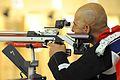
-
 Para "Prone" modifies the basic prone shooting position to be shot from a table.


Competitions using factory and service firearms
[edit]Shooting competitions for factory and service firearms, usually called Service Rifle, Service Pistol, Production, Factory or Stock, describe a set of disciplines or equipment classes where the types of permitted firearms are subject to type approval and few aftermarket modifications are permitted. Thus the terms refer to permitted equipment and modifications rather than the type of shooting format itself. The names Service Rifle and Service Pistol stem from that the equipment permitted for these types of competitions traditionally were based on standard issue firearms used by one or several armed forces and civilian versions of these, while the terms Production, Factory and Stock often are applied to more modern disciplines with similar restrictions on equipment classes. Factory and service classes are often restrictive in nature, and the types of firearms permitted are usually rugged, versatile and affordable. In comparison, more expensive custom competition equipment are popular in more permissive equipment classes. Both types of equipment classes can be found within many disciplines, such as bullseye, field, practical and long range shooting.
-
 Service rifle shooting in Slovenia with the Zastava M48 rifle
 -


Plinking
[edit]Plinking refers to informal target shooting done for pleasure or practice typically at non-standard targets such as tin cans, logs, cartons, fruits, or any other homemade or naturally occurring objects like rocks (however, it is unsafe to shoot at rocks) or tree branches. The primary appeals of plinking as a sport are the broad variety of easily available locations, minimal costs, freedom in practice styles, and more relaxing and less restrictive shooting experience.
The flexibility of target choice is also why plinking is popular. A small, three-dimensional target in an outdoors setting is much more akin to a real-world hunting and varminting scenario, presenting a better simulated opportunity to practice shooting skills. A plinking target will also often react much more positively to a hit than a paper target used in formal competitions, either audibly with a sharp impact sound (hence the name "plink") or visually by bouncing, splattering or falling over. Steel targets used for formal action and long range shooting competitions are also popular for plinking due to the ease of setting up and confirming good hits.
-
 A woman plinking with a Hi-Point pistol in .40 S&W in Alaska
 -
 Plinking with a Ruger 10/22 rifle in Burro Canyon, Arizona, US
 -
 Plinking on a Saturday in Burro Canyon, Arizona, US. On this range firearms must be kept unloaded in the rack, except when on the firing line.


Athletic shooting sports
[edit]Athletic shooting sports are hybrid events of normally stationary shooting sport competitions and the sport of athletics or other physically demanding non-shooting sports. Many were borne from military exercises and emphasize physical endurance.
- IBU Biathlon is a Winter Olympic sport combining cross-country skiing (normally freestyle skate skiing) and shooting with .22 LR rifles.[13] In Scandinavia the discipline is simply known as "Ski Shooting" (Swedish: skidskytte, Danish: skiskydning, Norwegian: skiskyting).
- Bike biathlon or velo biathlon (Russian Велобиатлон) combines cycling (road or mountain bike) and shooting (handgun[36] or rifle[37]).
- ISSF Target Sprint combines medium-range run (3 × 400 m) and airgun shooting.
- Modern pentathlon is a Summer Olympic sport includes a combined event called Laser-run that consists of 4 laps of 800 metres combined with 4 rounds of timed shooting with a laser air pistol as one of its original five parts.[38]
- Nordic Ski Field Shooting (Norwegian: skifeltskyting, Swedish: skidfältskytte) is a Nordic discipline organised by the National Rifle Association of Norway and the Swedish Shooting Sport Association which is based on the origins of modern biathlon. It is normally held using classic (in-track) skiing, but competitions can also be held in a freestyle skate skiing format. Furthermore, shooting is done with fullbore calibers and usually in the field from temporary shooting ranges. The discipline is considered as a near precursor to modern biathlon.
- Nordic shooting with cross-country running (Norwegian: skogsløp, Swedish: springfältskytte) is a Nordic discipline arranged by the National Rifle Association of Norway and the Swedish Shooting Sport Association which combines running with shooting. It is considered the summer edition of Ski Field Shooting. Running distances are usually between 2 and 3 kilometers with 2 to 3 shooting series.
- Military patrol was a team winter sport in which athletes competed in cross-country skiing, ski mountaineering and rifle shooting. It was usually contested between countries or military units.
- Moose biathlon (Finnish Hirvenhiihto) is a variation of biathlon comprising cross-country skiing, range estimation and rifle shooting at paper targets of moose. Moose shooting with cross-country running (Finnish Hirvenjuoksu) is a summer variant where the skiing part is replaced with running.
- Orienteering shooting (Finnish ampumasuunnistus) combines shooting with orienteering, and competitions are organised in Denmark by DMSA, in Sweden by the civilian Swedish Multisport Association[39] and in Finland by the FRSF.
- Pistol shooting with cross-country running (maastokilpailu), organized in Finland by the FRSF.
- Pistol skiing (Norwegian pistollangren, Swedish pistolskidskytte, Finnish pistooliammuntahiihto) is biathlon with pistols and revolvers, and is organised in Norway by NROF, in Sweden by SPSA and in Finland by the FRSF.
- Summer biathlon, with skiing replaced by either running or rollerskis, is popular in Germany.
- Ski Archery is a variation of biathlon combining archery marksmanship with cross country skiing.
- Underwater target shooting is a combined underwater and shooting sport that tests a competitors' ability to accurately use a speargun via a set of individual and team events conducted in a swimming pool using free diving or Apnoea technique.
-
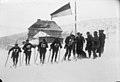 German military patrol in Giant Mountains in 1932
 -
 Standing phase at the 2018 Biathlon World Cup in Oberhof
 -
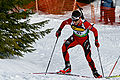
-
 Bike biathlon competition using handguns


Bow shooting sports
[edit]Archery
[edit]Modern competitive archery involves shooting arrows at a target for accuracy from a set distance or distances. A person who participates in archery is typically called an archer or a bowman, and a person who is fond of or an expert at archery is sometimes called a toxophilite. The most popular competitions worldwide are called target archery. Another form, particularly popular in Europe and America, is field archery, which generally is shot at targets set at various distances in a wooded setting. 3D archery, which differs from field archery in that the targets are animal models, is also quite popular in the same regions. There are also several other lesser-known and historical forms, as well as archery novelty games. The tournament rules vary from organization to organization. World Archery Federation rules are often considered normative, but large non-WA-affiliated archery organizations do exist with different rules. Competitive archery in the United States is governed by USA Archery and National Field Archery Association (NFAA), which also certifies instructors. Run archery is a shooting discipline connecting archery with running.
-
 Target shooting with a recurve bow
 -
 Archery competition in Mönchengladbach, West Germany, June 1983
.jpg)

Crossbow
[edit]The International Crossbow Shooting Union (Internationale Armbrustschützen Union or IAU) was founded in Landshut, Germany on June 24, 1956, as the world governing body for crossbow target shooting. The IAU supervises World, Continental and International crossbow shooting championships in 3 disciplines; 30 m Match-crossbow, 10 m Match-crossbow and Field-crossbow shooting. IAU World Championships take place every two years with Continental Championships on intervening years. Other International and IAU-Cup events take place annually.[13] World Crossbow Shooting Association (WCSA) organises competitions in 7 disciplines: Target, Target match play, Forest, Forest match play, 3D, Bench & prone target and Indoor target.[40]
-
 Anna Sushko of Russia, 2006 Junior World Champion, holding an ICU 10 m Match Crossbow
 -
 A competitor at the 30 meter event at the 2008 ICU Match-Crossbow World Championships in Sulgen, Switzerland


Dart shooting sports
[edit]Sport blowgun
[edit]There are several competition styles of sport blowgun practised around the world. A standardization of competition style is based upon fukiya, and governed by the International Fukiyado Association. It is a 10-metre target shooting, using a standardized barrel caliber and length, and a standardized dart length and weight as outlined by IFA. There are two more styles, both based upon the Cherokee Annual Gathering Blowgun Competition. The Field Style competition is similar to the winter Biathlon, where the shooter runs from a starting line to a target lane, shoots and retrieves the darts, and continues to the next station. The course length varies from 400 to 800 m with from 9 to 16 targets at various heights and shooting distances. The final style is the Long Distance target shoot. The target is a circle of 24 cm diameter, and the firing line is 20 m away. Three darts are fired by each shooter, at least one of which must stick in the target. All successful shooters move to the next round, moving back 2 m each time.
Confrontational shooting sports
[edit]Confrontational shooting sports is a set of relatively new team sports using non-lethal ranged weapons that are safe enough to shoot at other people. Previously such games were not possible due to safety concerns since bows and guns are generally too lethal and dangerous for human targets, but the development of newer airgun and infrared technologies allowed for the development of safe confrontational disciplines. While initially only for sport and recreations, professional sport competitions are now held. These types of games are also used for tactical gunfight training by military and law enforcement agencies to some extent.[41]
Olympic dueling
[edit]Olympic dueling is an archaic individual sport that sought to safely emulate the deadly practice of pistol duelling, akin to fencing emulating sword fighting. It involved the use of specially built primer-fired pistols to propel wax bullets.[42] Two versions of the sport were demonstration events at the 1906 Olympics and 1908 Olympics. It was also a popular sport in France.[43]
-
 A duel at the 1908 Olympics
 -
 Portrait shots of Olympic duelists, showing their safety equipment and modified guns


Paintball
[edit]Paintball is a competitive sport in which players from opposing teams eliminate opponents out of play by hitting them with round, breakable, dye-filled oil and gelatin pellets ("paintballs"), shot from HPA/CO2-powered air guns called paintball markers. It can be played on indoor or outdoor fields scattered with natural or artificial terrain, which players use for tactical cover. Paintball game types vary, but can include capture the flag, elimination, ammunition limits, defending or attacking a particular point or area, or capturing objects of interest hidden in the playing area. Depending on the variant played, games can last from seconds to hours, or even days in scenario play. The game was developed in the 1980s and is now regularly played at a formal sporting level with organized competition involving major tournaments, professional teams and players.
- National Xball League is the United States' professional paintball circuit. The league consists of a Professional Division, consisting of the best players the sport has to offer, that extends down to the beginner ranks of "Division 5" for those newer to the tournament atmosphere. The league hosts five national events across the country in places such as Las Vegas, Dallas, Nashville, Cleveland, Chicago, Atlantic City and Orlando throughout the year, starting in March and ending their season in early November. The league's largest event each year is the season finale known as the World Cup, with the 2016 World Cup hosted 3,554 players from 35 countries.
- National Collegiate Paintball Association is an all-volunteer, non-profit organization created by United States college players. The goal of the NCPA is to promote the positive aspects of the sport in an intercollegiate manner. The NCPA consists of two distinct classes which competes separately — Class AA is an open-class division where any college may enter and compete in regional and national tournaments. Class A is a closed-class division where only certain colleges may compete after securing a bid in the previous season, and represents the best talent of college paintball and includes universities such as Drexel University, University of Maryland, Illinois State University, Purdue University, University of Connecticut, Penn State University and 10 other teams across three conferences all fighting for a national title. The association's 2007 playoff tournament was aired on Fox Sports Net's digital cable college sports network, Fox College Sports.


Airsoft
[edit]Airsoft is a competitive sport similar in concept to paintball, in which participants from opposing teams eliminate opponents by hitting each other with solid round plastic pellets launched from low-powered smoothbore air guns called airsoft guns. It is different from paintball in that airsoft pellets do not visibly mark the targets like paintballs, and thus the sport relies heavily on an honor system where a hit player has the ethical duty to call himself out of play, regardless of whether anyone else sees it happen. Most airsoft guns are also magazine-fed (unlike the commonly top-mounting pellet loader of paintball markers) with mounting platforms compatible with real firearm accessories, and tend to more closely resemble real guns in appearance, making them more popular for military simulation and historical reenactments. The greater toughness of airsoft pellets also allows the use of better powerplants and apparatus such as hop-up device for improved external ballistics, making the gameplay more accurately resemble real gunfights. They are also much cheaper for casual players to participate than paintball.
Airsoft gameplay varies in style and composition just like paintball and is played in both indoor and outdoor courses. Situations on the field frequently involve the use of real-life military tactics to achieve objectives, and it is not uncommon for participants to emulate the uniforms and equipment of real military and police organizations for a sense of realism. Games are normally supervised (and sometimes umpired) by trained on-site administrators, and players' airsoft guns are usually checked through a chronograph to enforce power output restrictions.
There are currently no formal national or international governing bodies for the airsoft sport. Competitive tournaments are usually organized by private clubs or among enthusiasts and professional/semi-professional teams (often referred to as "clans"), with rules and restrictions varying from event to event.
-
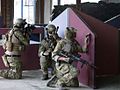 Three airsoft team members defending an area during an indoor CQB game
 -
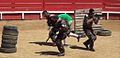 From an outdoor airsoft game
 -
 Three airsoft team members during a field game


Laser tag
[edit]Laser tag (despite the name, laser is actually not used due to safety concerns) is a tag game played with infrared light guns and sensors worn on the body of the players. Since its birth in 1979, laser tag has evolved in both indoor and outdoor games, each with gameplay styles such as annihilation, capture the flag, domination, VIP protection, (usually sci-fi) role playing, etc. When compared to paintball and airsoft, laser tag is painless and very safe because it involves no projectile impacts, and indoor games may be considered less physically demanding because most indoor venues prohibit running or roughhousing.
- Zone Laser Tag World Championships were international tournaments among professional/semi-professional teams from North American, Europe and Australia, hosted every few years since 2003.
- Bi-lateral international championships have included USA vs. Australia and Australia vs. South Africa.
- National tournaments in various countries including Australia, US, Sweden, Finland, UK, etc.
- Private club-level events such as TagCon (annual in UK and US), Tagfest (annual in US), Dropzone (annual in UK), LaserStorm (annual in Australia), etc.
More sophisticated forms of laser tag, such as MILES, are used (in conjunction with blanks) by militaries to allow for non-lethal combat training.
-
 An indoor laser tag competition at Long Beach, California in 2011
 -
 Soldiers equipped with laser tag training equipment
.jpg)

Archery Tag
[edit]Archery Tag is a form of combat archery sport where participants shoot one another using a bow with arrows with large foam tips. The game's rules closely resemble dodgeball. The game begins with a number of arrows in the center of the arena. At the whistle, players race to collect them, before firing them at one another across the playing field. A player is eliminated if struck by an arrow, and a player can bring an eliminated teammate back into play by catching an arrow. To avoid injury, participants wear protective facemasks and use bows with less than 30 pounds (14 kg) draw weight. It was invented in 2011 by John Jackson of Ashley, Indiana, and experienced a boost in popularity from the Hunger Games books and film series, which feature a bow-wielding protagonist Katniss Everdeen. Jackson staged Archery Tag games at local premieres of the films. By 2014, Jackson had licensed the game to 170 locations, mostly in the United States, but also in Russia, Peru and Saudi Arabia.
Battle gaming variants of Archery Tag also exist, such as Dagorhir, Amtgard, Belegarth and Darkon, where archers are pitted among melee players welding foam weapons to simulate medieval battles.
-
 A game of archery tag in Toronto

Esports
[edit]Esports is the competitive playing of video games, often referring to play at the professional level. While the term esports includes many types of video games unrelated to shooting sports, a major subset of esports are the shooters, namely first-person shooters and third-person shooters. Matches of these games can take a variety of forms but traditionally take formats similar to paintball, involving teams of players whose objective is to eliminate the opposing team in simulated combat, often while also focusing other key objectives. Major games of these styles currently in professional play include (among others) Counter-Strike: Global Offensive, Overwatch, Team Fortress 2, Valorant, and PlayerUnknown's Battlegrounds. Organized play is done both online or in-person. While there has been serious interest to include esports in the Olympics and similar events, the inclusion of shooters has been less welcomed due to their often violent visual content.
-

-
 A live professional CS:GO match in 2016
.jpg)

See also
[edit]References
[edit]- ^ "Handgun Sports • NSSF | National Shooting Sports Foundation". Archived from the original on April 4, 2019. Retrieved November 3, 2017.
- ^ "Rifle Sports • NSSF | National Shooting Sports Foundation". Archived from the original on April 4, 2019. Retrieved November 3, 2017.
- ^ "Shotgun Sports • NSSF | National Shooting Sports Foundation". Archived from the original on October 14, 2018. Retrieved November 3, 2017.
- ^ "Archery 101 by Archery 360". February 22, 2023. Archived from the original on November 3, 2017. Retrieved November 3, 2017.
- ^ "Archery | World Archery". August 16, 2023. Archived from the original on September 2, 2017. Retrieved November 3, 2017.
- ^ Kardous, C. A.; Willson, R. D.; Hayden, C. S.; Szlapa, P.; Murphy, W. J.; Reeves, E. R. (2003). "Noise exposure assessment and abatement strategies at an indoor firing range". Applied Occupational and Environmental Hygiene. 18 (8): 629–36. doi:10.1080/10473220301409. PMID 12851012.
- ^ "Noise levels at shooting range - timesofmalta.com". June 19, 2015. Archived from the original on July 28, 2024. Retrieved November 3, 2017.
- ^ Minshall, David (2005). "Wimbledon & the Volunteers". ResearchPress.co.uk. Archived from the original on April 23, 2012.
- ^ Richard L. Hummel, and Gary S. Foster, "Germanic/American shooting societies: continuity and change of schuetzenvereins." International Journal of the History of Sport 15.2 (1998): 186-193.
- ^ "Pottery Pigeons" Timeline (March/April 1994) 11#2 pp. 22-27 identifies George Ligowsky of Cincinnati as an inventor of clay pigeons.
- ^ Steven A. Riess, ed. Sports in America from Colonial Times to the Twenty-First Century: An Encyclopedia (Sharpe, 2011), 3:828.
- ^ Russell Gilmore, "'The New Courage': Rifles And Soldier Individualism, 1876-1918." Journal of Military History 40.3 (1976): 97+
- ^ a b c "Shooting Equipment and history - Olympic Sport History". www.olympic.org. May 15, 2018. Archived from the original on August 18, 2016. Retrieved August 12, 2016.
- ^ Marlin, Marlin, Jeffrey A. "The National Guard, the National Board for the Promotion of Rifle Practice, and the National Rifle Association: Public Institutions and the Rise of a Lobby for Private Gun Ownership." (Dissertation, Georgia State University, 2013). online Archived November 1, 2019, at the Wayback Machine
- ^ James B. Trefethen, Americans and their guns: The National Rifle Association story through nearly a century (1967)
- ^ Australia, Sporting Shooter's Association of. "| Sporting Shooters' Association of Australia (SSAA)". ssaa.org.au. Archived from the original on August 8, 2016. Retrieved August 12, 2016.
- ^ "Double trap, rifle prone and 50m pistol dropped from Olympics". The Times of India. timesofindia.indiatimes.com. February 24, 2017. Archived from the original on April 12, 2023. Retrieved June 1, 2020.
- ^ "NRA Law Enforcement Division: Police Pistol Combat Competition". ppc.nra.org. National Rifle Association of America. 2015. Archived from the original on July 28, 2024. Retrieved April 17, 2015.
- ^ Scott McDonald (April 15, 2016). "Your Comprehensive Guide To The 15 Olympic Shooting Events". Team USA. Archived from the original on April 19, 2016. Retrieved November 16, 2022.
- ^ "Danish: Aalborg Skyttekreds af 1862 - Terrænskydning". Archived from the original on September 23, 2017. Retrieved October 6, 2017.
- ^ "Norwegian: feltskyting – Store norske leksikon". November 17, 2016. Archived from the original on September 23, 2017. Retrieved October 6, 2017.
- ^ "Swedish: Svenska Pskytteförbundet-Om pistolskytte-Fältskjutning". June 2017. Archived from the original on October 13, 2017. Retrieved October 6, 2017.
- ^ "Norwegian: Litt om feltskyting – Haugesund Pistolklubb (English: A little about field shooting - Haugesund Pistol Club)". Archived from the original on July 28, 2024. Retrieved October 6, 2017.
- ^ "Swedish: Fältskytte gevär förklarat | Sandvikens Skyttegille". Archived from the original on April 17, 2017. Retrieved October 6, 2017.
- ^ a b "Topend Sports | About Shooting Sports". Archived from the original on July 28, 2024. Retrieved October 6, 2017.
- ^ ""jagareforbundet.se"". Archived from the original on July 28, 2024. Retrieved June 8, 2018.
- ^ "Wayback Machine" (PDF). www.njff.no. Archived from the original (PDF) on September 24, 2020. Retrieved August 11, 2025.
- ^ DeJesus, Ivey (January 8, 2015). "A pistol, rifle and shotgun sport part of the lineup at NRA's Great American Outdoor Show". PA Media Group. Archived from the original on April 17, 2015. Retrieved April 16, 2015.
- ^ "ICORE History and Information". Archived from the original on June 27, 2015. Retrieved July 30, 2015.
- ^ "Palma USA". Archived from the original on April 1, 2017. Retrieved March 31, 2017.
- ^ "PALMA TEAM TROPHY" (PDF). Archived (PDF) from the original on March 26, 2014.
- ^ "Participating Clubs/Matches". National Rifle League. Archived from the original on June 24, 2018. Retrieved June 24, 2018.
- ^ "Clubs". NRL 22. Archived from the original on June 24, 2018. Retrieved June 24, 2018.
- ^ Taffin, John (September 28, 2005). Single Action Sixguns. Iola, Wisconsin: Krause Publications. pp. 299–300. ISBN 978-1-4402-2694-6.[permanent dead link]
- ^ "Shooting Para Sport Classification Rules and Regulations". International Paralympic Committee. Archived from the original on February 7, 2022. Retrieved November 21, 2022.
- ^ "Biathlon goes for spin in Bike-n-Shoot event – The Denver Post". April 23, 2007. Archived from the original on September 20, 2019. Retrieved September 16, 2019.
- ^ "Velo Biathlon Combines Cycling and Rifles | Complex". Complex Networks. Archived from the original on September 20, 2019. Retrieved September 16, 2019.
- ^ "UIPM Laser Run". Union Internationale de Pentathlon Moderne (UIPM). July 15, 2016. Archived from the original on July 28, 2024. Retrieved August 4, 2021.
- ^ "Orienteringsskyting – enda en orienteringsgren? – Knut Edvard Helland". Archived from the original on July 22, 2023. Retrieved December 12, 2018.
- ^ stephen sommers (January 3, 2014). "World Crossbow Shooting Association Inc". Worldcrossbow.com. Archived from the original on March 20, 2022. Retrieved March 4, 2022.
- ^ "Police and US Military Using Airsoft Guns for Training Missions". Police1. December 12, 2012. Archived from the original on September 27, 2022. Retrieved June 27, 2022.
- ^ "Forgotten Weapons - "Lepage Wax-Bullet Dueling Pistols" (YouTube)". YouTube. January 3, 2018. Archived from the original on August 21, 2019. Retrieved July 8, 2019.
- ^ "Duel With Wax Bullets" (PDF). The New York Times. February 26, 1909. Archived (PDF) from the original on June 28, 2021. Retrieved December 24, 2014.
Further reading
[edit]- Adcock, Ken (2021). Pistol Shooting Sports: A Beginner’s Guide to Practical Shooting Competition. Pistol Shooting Sports, LLC. ISBN 9781735053134.
- Axford, Ray. Archery Anatomy: An introduction to techniques for improved performance (Souvenir Press, 2017).
- Björklund, Glenn. "Shooting efficiency for winners of World Cup and World Championship races in men's and women's biathlon: where is the cut-off?" International Journal of Performance Analysis in Sport 18.4 (2018): 545-553.
- Chen, Yin-Ting, and Derick Mordus. "Shooting sports (archery, air rifle, trapshooting)." in Adaptive Sports Medicine (Springer, Cham, 2018) pp. 313–322.
- George, Judith Jenkins. "Women's Riflery Teams: A Collegiate Anomaly of the Post World War I Period." Sport History Review 23.1 (1992): 32-45.
- Goldschmied, Nadav, and Jason Kowalczyk. "Gender performance in the NCAA rifle championships: where is the gap?" Sex Roles 74.7 (2016): 310-322. online
- Ihalainen, Simo, et al. "Relation of elite rifle shooters' technique-test measures to competition performance." International journal of sports physiology and performance 11.5 (2016): 671-677.
- Ihalainen, Simo, et al. "Which technical factors explain competition performance in air rifle shooting?" International Journal of Sports Science & Coaching 13.1 (2018): 78-85.
- Reeves, W. P. "The Adoption of Military Rifle Shooting as an Intercollegiate Sport." American Physical Education Review 23.3 (1918): 157-159.
- Spancken, Sina, Hannah Steingrebe, and Thorsten Stein. "Factors that influence performance in Olympic air-rifle and small-bore shooting: A systematic review" PLOS ONE 16.3 (2021): e0247353 online.
- Wadge, Richard. Archery in Medieval England: Who Were the Bowmen of Crecy? (The History Press, 2012).
- Wallace, Lacey N. "College Student Involvement in Hunting and Shooting Sports: What Drives Participation?" Recreational Sports Journal 44.2 (2020): 126-138.
External links
[edit]

| Mandatory sports |
|
|---|---|
| Discretionary sports | |
| |

| International | |
|---|---|
| National | |
| Other | |

Shooting sports
View on GrokipediaHistory
Ancient and Medieval Origins
Projectile weapons, including spears and early arrows, emerged as critical tools for hunting and warfare during the Paleolithic era, with archaeological evidence indicating their use by modern humans as early as 54,000 years ago in sites like Grotte Mandrin in France, where small stone points consistent with arrowheads were found alongside Homo sapiens remains.[11] These implements required precise aiming and force application, foundational skills honed through repeated practice for survival, as ballistic analyses of replicated Paleolithic javelins and atlatl darts demonstrate kinetic energies sufficient for penetrating large game at distances exceeding 20 meters.[12] In tribal societies, such proficiency likely extended to informal contests testing accuracy, as ethnographic parallels among later hunter-gatherers show games and challenges using bows to build agility and communal bonds, though direct prehistoric evidence remains indirect via tool wear patterns suggesting targeted practice.[13] In medieval Europe, marksmanship evolved into structured civic obligations, exemplified by the English Assize of Arms of 1252 under King Henry III, which mandated that all able-bodied men aged 15 to 60 possess a bow, arrows, and other arms, with regular practice enforced to bolster national defense amid threats like French invasions.[14] This decree built on earlier Norman policies, prioritizing archery as a collective duty over individual leisure, with local officials required to oversee equipment and training.[15] By the 14th century, archery and crossbow guilds proliferated in Flanders and northern France, organizing competitive shoots that combined military preparation with social hierarchy, where participants vied for prizes in accuracy trials at fixed targets, fostering discipline amid urban growth and princely levies.[16] These guilds, documented in municipal records from Ghent and Bruges, emphasized empirical skill refinement through repetitive drills, mirroring first-principles of trajectory control and release consistency.[17] Parallel traditions appear in non-European contexts, underscoring the universal demands of precision in projectile use. In Japan, kyujutsu—the precursor to modern kyudo—traced to at least the 12th century among samurai, integrating bow training for mounted warfare and ceremonial rites, with texts like the Taiheiki describing rigorous accuracy drills as paths to mental focus and ethical conduct.[18] Indigenous North American groups, such as the Cherokee, maintained bow-and-arrow proficiency for hunting via generational teaching and contests like cornstalk shoots, where archers targeted bundled stalks at varying distances to simulate prey pursuit, embedding marksmanship in cultural narratives of provision and defense.[19] These practices, devoid of industrialization, highlight causal links between repeated targeted projection and adaptive success, prefiguring formalized sports without anachronistic overlays.[20]Early Modern Development in Europe
In Germany, the early modern period saw the evolution of Schützenvereine—shooting societies rooted in late medieval civic militias—into formalized recreational competitions using black powder firearms. Emerging in autonomous towns during the 15th and 16th centuries, these groups initially focused on crossbow proficiency for defense but shifted to matchlocks and wheellocks as gunpowder technology proliferated, with circular targets replacing popinjay effigies by the mid-1500s. Annual Schützenfeste featured precision shooting at distances up to 200 meters, often crowning a "king" marksman, blending military readiness with festive marksmanship trials that emphasized accuracy over volley fire.[21][22] Parallel developments occurred in Britain, where 18th-century informal matches among landowners and officers simulated field hunting with flintlock smoothbores, spurred by improved firearm production tied to colonial arms trade and wartime demands. By the 1780s, records describe organized "country shoots" testing wing-shooting skills against live or mechanical targets, reflecting a transition from subsistence hunting to competitive recreation amid rising civilian access to imported powder and locks. These events prioritized practical proficiency, causal to broader militia training amid post-Napoleonic demobilization and perceived skill erosion from reduced drill.[23] The 19th century formalized European shooting through institutions like the UK's National Rifle Association, founded on November 10, 1859, by military officers and nobles responding to Crimean War critiques of British infantry marksmanship—where hit rates lagged behind Prussian standards due to outdated smoothbore tactics. Prompted by invasion fears and volunteer corps expansion, the NRA established annual Imperial Meetings with rifled muzzle-loaders at standardized ranges (200–1,000 yards), enforcing prone/kneeling positions and scoring via bullseye impacts, thus institutionalizing recreation as a counter to military decline.[24][25]Adoption and Growth in the United States
![Washington DC Girls' Rifle Team.jpg][float-right]The National Rifle Association of America (NRA) was established on November 17, 1871, by Union Army veterans Colonel William C. Church and General George Wingate in response to observed deficiencies in marksmanship during the Civil War, with the explicit aim of promoting and encouraging rifle shooting among civilians and military personnel to enhance national preparedness. [26] [27] This founding reflected a causal link between frontier self-reliance—where proficient shooting supported hunting, protection, and expansion—and organized training to address empirical shortcomings in soldier accuracy, as Northern troops had struggled against better-trained Confederate sharpshooters. [26] The NRA's early efforts included sanctioning matches and ranges, fostering rifle clubs that proliferated in the post-war era, directly tying civilian practice to improved defense capabilities amid ongoing territorial growth. [28] A pivotal event in this adoption was the inaugural International Rifle Match at Creedmoor, New York, on September 26, 1874, pitting an American team against seasoned Irish competitors at distances of 800, 900, and 1,000 yards using muzzleloading rifles; although the Irish prevailed with superior scores, the contest exposed gaps in U.S. equipment and technique while validating the viability of long-range precision under competitive conditions. [29] [30] Subsequent matches in 1875 and beyond saw American teams adopt breechloading rifles like the Remington and Sharps, achieving victories that refined techniques and established empirical benchmarks for sub-minute angular dispersion at extreme ranges, countering any notion of disorganized proliferation by demonstrating structured, international-caliber advancement. [31] These events, hosted by the NRA, elevated shooting from a survival skill to a formalized sport, with records showing aggregate scores improving through iterative refinement of sights, ammunition, and prone positioning. [30] Into the early 20th century, growth accelerated via institutional youth initiatives; in 1903, NRA Secretary Albert S. Jones advocated for school-based rifle clubs, leading to the creation of the NRA Junior Rifle Corps to instill safe marksmanship fundamentals among adolescents, explicitly linking civilian training to military readiness as evidenced by correlations between program participants and improved enlistee proficiency. [32] [27] By 1910, thousands of juniors were enrolled, with empirical data from NRA-sanctioned meets showing consistent score elevations attributable to standardized drills, underscoring how such programs institutionalized shooting as a disciplined pursuit rather than mere recreation. [32] This era's expansion, supported by federal interest in reservist skills, solidified the U.S. as a center for competitive marksmanship, where causal factors like accessible ranges and veteran-led instruction drove participation without reliance on unchecked armament. [33]
Olympic Inclusion and 20th-Century Standardization
Shooting sports debuted at the inaugural modern Olympic Games in Athens in 1896, comprising five men's events: three pistol disciplines (25-meter military revolver, 25-meter rapid fire pistol, and free pistol) and two rifle events (200-meter military rifle and 300-meter free rifle).[34][35] These competitions emphasized military-style marksmanship, reflecting the era's focus on practical firearm proficiency, with events held at a dedicated range in Kallithea.[36] The program expanded at the 1900 Paris Olympics to include shotgun disciplines, such as trap shooting, which initially used live pigeons as targets before transitioning to clay disks in later editions.[6][37] The International Shooting Sport Federation (ISSF) was established on July 17, 1907, in Zurich, Switzerland, by representatives from seven national federations to unify rules for rifle and pistol events amid growing international participation.[3][38] World War I led to the ISSF's temporary dissolution in 1916, with reformation in 1921 as the Union Internationale de Tir, enabling standardized competitions that resumed Olympic integration post-war.[39] The interwar period saw refinements in event formats, but World War II again suspended activities until 1947, after which the ISSF oversaw post-1945 expansions, including the formalization of events like the 50-meter free pistol and small-bore rifle three positions.[4] These developments prioritized precision scoring, equipment specifications, and range protocols to ensure comparability across nations.[39] Gender integration began at the 1968 Mexico City Olympics, where women competed in mixed-gender events for the first time, initially in disciplines like small-bore rifle.[40] During the Cold War era, Eastern Bloc nations, led by the Soviet Union, achieved dominance through systematic, state-funded training regimens emphasizing volume practice and biomechanical analysis, as evidenced by the USSR's multiple golds from 1952 (e.g., Anatoly Bogdanov in 300-meter free rifle three positions) through 1988, often topping shooting medal counts in Games like Helsinki and Moscow.[41] This period solidified ISSF rules as the global standard, with Olympic programs stabilizing around 10-15 events by the late 20th century, balancing rifle, pistol, and shotgun formats while excluding atypical historical variants like live-bird shooting.[4]Post-2000 Globalization and Recent Milestones
The International Shooting Sport Federation (ISSF) expanded its World Cup series post-2000 to include venues across Asia, Europe, and the Americas, increasing participation from over 100 nations by the 2010s and promoting standardized events globally.[1] This globalization correlated with Asia's rise in competitive success, as China amassed 24 Olympic shooting medals between 2004 and 2020, reflecting heavy state investment in training facilities and athlete development. India's targeted programs, including national academies established after Abhinav Bindra's 2008 gold, produced three bronze medals in shooting at the 2024 Paris Olympics—Manu Bhaker in women's 10m air pistol and mixed team, plus Swapnil Kusale in 50m rifle three positions—demonstrating empirical gains from infrastructure spending exceeding $100 million annually in recent years.[42] Youth initiatives in the United States bolstered participation, with the Civilian Marksmanship Program (CMP) hosting its 2024 Junior Three-Position Air Rifle Championships for athletes from JROTC, 4-H, Scouts, and clubs, drawing over 1,000 competitors in sporter and precision classes to foster early marksmanship skills via safe, air-powered disciplines.[43] Scouting America updated its National Range and Target Activities Manual in 2024, effective September 1, restricting shooting to certified public or council facilities (except limited Cub Scout exceptions) and expanding pistol access for Scouts BSA, Venturing, and Sea Scouts aged 14+, prioritizing empirical safety data to reduce risks in youth programs.[44] Industry metrics from the National Shooting Sports Foundation (NSSF) show U.S. sport shooting participation reaching 52.2 million adults in 2023, with 17% newcomers by 2022, sustained into 2024 amid range innovations like automated safety systems and modular designs reported in the 2025 Range Survey.[45] Globally, the sports shotgun market grew at a 5.6% CAGR from 2025 projections, with South American expansion in clay target events driven by rising recreational demand in countries like Argentina and Brazil.[46] Recent milestones include USA Shooting's 68 international medals in 2024 and ISSF's 2025 calendar featuring new Asian hosts like Ningbo, China, underscoring ongoing competitive depth.[47][48]Core Principles and Skills
Marksmanship Fundamentals
The core marksmanship fundamentals—stance stability, sight alignment, breath control, and trigger control—stem from biomechanical principles that minimize human-induced perturbations to the firearm's muzzle direction, thereby reducing angular deviations in the projectile's initial velocity vector along its ballistic path. These elements address the primary sources of shooter error, which dominate accuracy at typical competition distances of 10 to 300 meters, where gravitational drop and environmental factors like wind exert secondary influences compared to muzzle misalignment on the order of 0.1 to 1 milliradian, equivalent to 1 to 10 cm dispersion at 100 meters.[49] Proper application ensures the line of bore aligns with the line of sight, leveraging optical parallax minimization and rigid body mechanics to constrain physiological tremors and muscular flinch, which can otherwise introduce torque vectors exceeding mechanical tolerances in precision barrels.[50] Stance and hold position establish a stable biomechanical platform by aligning the shooter's center of mass with the firearm's recoil impulse, distributing forces through skeletal structure rather than isolated musculature to dampen post-shot recovery time and residual sway. In prone or supported positions, this reduces vertical and lateral wobble to sub-0.5 arcminute levels under controlled conditions, as the interface with the ground or rest absorbs kinetic energy transfer per Newton's third law, preventing amplification of minor instabilities into measurable shot-to-shot variance. Empirical assessments confirm that unstable holds correlate with expanded group sizes, with skilled shooters achieving intrinsic accuracy limits of approximately 0.5 inches at 100 yards absent equipment flaws, underscoring human factors as the binding constraint over ballistic coefficients.[50][51] Sight alignment requires superimposing the front sight element within the rear aperture or notch, centered on the target, to nullify parallax errors that arise from off-axis viewing angles, ensuring the projectile's point of aim coincides with point of impact within the sight radius's mechanical precision, typically 1-2 inches at 25 yards for iron sights. This optical-geometric alignment exploits the inverse square law of light convergence but prioritizes shooter consistency, as deviations from perfect centering introduce systematic offsets proportional to distance.[52] Breath control interrupts respiratory-induced diaphragmatic motion, which generates torso displacements of 1-3 cm per cycle, by timing the shot during a natural respiratory pause after partial exhalation, thereby stabilizing the sighting platform against cyclical perturbations that could shift aim by 0.5-1 milliradian. Studies indicate that uncontrolled breathing contributes to 20-30% of observed muzzle movement in unsynchronized firing, with disciplined pauses enabling tighter temporal windows for trigger actuation without compromising oxygen saturation in short sequences.[53][54] Trigger control entails a deliberate, linear rearward pressure applied at a rate of 1-2 pounds per second for standard triggers, isolating the firing mechanism from lateral or rotational disturbances that induce barrel whip or sight flinch, rooted in the causal chain where premature muscular anticipation disrupts the zero-torque equilibrium. This minimizes "trigger jerk," a common error amplifying dispersion by 2-5 times in novice cohorts, as validated by pattern analysis in training data where smooth squeezes correlate with reduced vertical stringing in five-shot groups.[52][55] Recoil management integrates these fundamentals by preconditioning the shooter-firearm system to vectorize impulse along the bore axis, with empirical tests showing that elevated recoil energies degrade hit probabilities by 10-25% in sequential shots due to anticipatory flinch, whereas technique-refined absorption maintains sub-1 MOA (minute of angle) grouping at 100 yards across calibers from .22 LR to .308 Winchester. These principles apply universally to firearm and bow disciplines, emphasizing operator skill over hardware refinements, as mechanical accuracy alone cannot compensate for uncorrected human variances in trajectory initialization.[56][57][55]Training and Proficiency Development
Training in shooting sports emphasizes deliberate, structured progression from basic mechanics to elite-level execution, leveraging cognitive and motor skill integration. Dry-fire drills, conducted without live ammunition, enable shooters to isolate and refine core elements such as sight alignment, trigger control, and stance stability, fostering muscle memory and consistency that transfer to live-fire scenarios.[58][59] This approach minimizes costs and safety risks associated with frequent live rounds while allowing unlimited repetition, with studies confirming its efficacy in enhancing foundational accuracy. Progressive distance training complements this by initiating practice at short ranges—typically 3 to 10 meters for pistol events—to ingrain precision before advancing to full competition distances like 25 or 50 meters, ensuring skills scale without foundational gaps.[60] Experienced shooters demonstrate superior executive functions, including enhanced inhibitory control and selective attention, as evidenced by performance on cognitive tasks like the Flanker test, where experts outperform novices in conflict resolution under pressure—skills causally linked to sustained focus during marksmanship.[61] Coaching paradigms draw from deliberate practice frameworks, requiring an estimated 10,000 hours of focused, feedback-driven repetition for ISSF athletes to reach elite status, far exceeding unstructured volume in building adaptive proficiency.[62] Mental visualization techniques, simulating shot sequences and environmental stressors, accelerate skill acquisition by reinforcing neural pathways akin to physical rehearsal, with empirical data showing improved accuracy under threat compared to physical practice alone.[63][64] Proficiency metrics rely on standardized scoring systems, such as the ISSF's ring-based targets where the central 10-ring yields maximum points (e.g., 10.0 to 10.9 per shot in finals), aggregating to totals like 600 for 60-shot rifle qualifications.[65] Progression classifications advance from novice (e.g., sub-80% qualification scores) through intermediate tiers to master levels, defined by consistent high-ring hits (often 95%+ aggregates) and competitive placement, providing objective benchmarks for skill advancement across disciplines.[62]Safety and Empirical Risk Assessment
Accident and Injury Statistics
In the United States, unintentional firearm-related fatalities account for less than 0.5% of all unintentional fatalities, with rates at approximately 0.2 per 100,000 population as of recent National Safety Council data integrated by the National Shooting Sports Foundation (NSSF).[66] These figures encompass incidents during recreational activities including shooting sports and hunting, where annual firearm accidents have declined by over 85% since peaking at 3,200 in 1930.[67] Hunting with firearms, a primary context for shooting sports participation, exhibits an injury rate of 0.05%, equivalent to roughly 1 injury per 2,000 participants annually, based on 2011 NSSF analysis of National Safety Council data.[68] More recent estimates indicate that approximately 0.03% of the roughly 14 million U.S. hunters in 2022 experienced injury or fatality from hunting accidents.[69] Unintentional firearm fatalities specifically fell 17% from 2014 to 2015, continuing a multi-decade downward trend driven by safety education.[70] In Olympic-style shooting events, injury prevalence remains low, with systematic reviews reporting rates below 5% across summer disciplines during training and competition.[71] International Shooting Sport Federation (ISSF) data from youth and junior athletes confirms overall injury prevalence under 6.6% in competitions and 5.5% in training sessions.[72] These figures primarily involve overuse injuries such as shoulder or back strain rather than acute accidents, with no severe cases exceeding 0.05% in recent Games surveillance.[73]| Activity Context | Injury/Fatality Rate | Source Year | Citation |
|---|---|---|---|
| U.S. Firearm Accidents (Unintentional Fatalities Share) | <0.5% of all unintentional | Recent (NSC/NSSF) | [66] |
| Hunting with Firearms | 0.05% (1 per 2,000 participants) | 2011 | [68] |
| Olympic Shooting (Prevalence) | <5% (training/competition) | 2021 Review | [71] |