



Community hub
FN Five-seven
View on Wikipedia
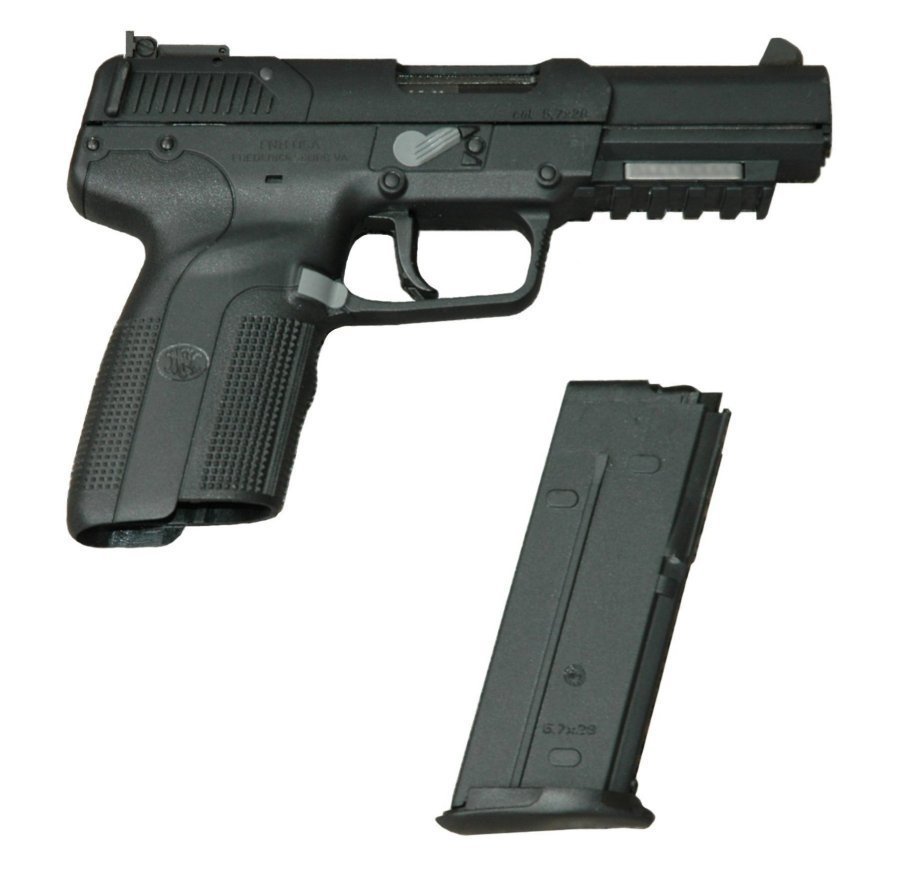
The FN Five-seven (stylized as Five-seveN) is a semi-automatic pistol designed and manufactured by FN Herstal in Belgium.[8] The pistol is named for the 5.7×28mm cartridge's bullet diameter, and the trademark's capitalization style is intended to emphasize the manufacturer's initials—FN.[14]
Key Information


The Five-seven pistol was developed in conjunction with the FN P90 personal defense weapon and the FN 5.7×28mm cartridge.[15] The P90 was introduced in 1990, and the Five-seven was introduced in 1998 as a pistol using the same 5.7×28mm ammunition.[7] Developed as a companion pistol to the P90, the Five-seven shares many of its design features: it is a lightweight polymer-based weapon with a relatively large magazine capacity, ambidextrous controls, low recoil, and the ability to penetrate body armor when using certain cartridge types.[16]
Sales of the Five-seven were originally restricted by FN to military and law enforcement customers, but since 2004, the pistol has also been offered to civilian shooters for uses such as personal protection and target shooting.[17][18] Although offered only with sporting ammunition, the Five-seven's introduction to civilian shooters was met with vocal opposition from gun control organizations such as the Brady Campaign, and the pistol has been subject to ongoing controversy in the United States.[19][20]
The Five-seven is currently in service with military and police forces in over 40 nations, including Canada, France, Greece, India, Poland, Spain, and the United States.[21] In the United States, the Five-seven is in use with numerous law enforcement agencies, including the U.S. Secret Service.[14][22] In the years since the pistol's introduction to the United States' civilian market, it has become increasingly popular with civilian shooters.[23]
History
[edit]Development
[edit]
The Five-seven pistol and its 5.7×28mm ammunition were developed by FN Herstal in response to NATO requests for a replacement for the 9×19mm Parabellum cartridge and associated pistols and submachine guns.[1] NATO called for two types of weapons chambered for a new cartridge—one a shoulder-fired weapon, and the other a handheld weapon.[1] According to NATO, these new weapons, termed personal defense weapons (PDWs), were to provide "personal protection in last-resort situations when the user is directly endangered by the enemy [...]."[1] In 1989, NATO published document D/296, outlining a number of preliminary specifications for these weapons:
- The new cartridge was to have greater range, accuracy, and terminal performance than the 9×19mm cartridge.[1] Additionally, it was to be capable of penetrating certain types of body armor.[1]
- The shoulder-fired personal defense weapon was to weigh less than 3 kg (6.6 lb), with a magazine capacity of at least 20 rounds.[1]
- The handheld personal defense weapon (pistol) was to weigh less than 1 kg (2.2 lb), although a weight of 700 g (1.5 lb) was deemed desirable; it was to have a magazine capacity of no fewer than 20 rounds.[1]
- Both weapons were to be sufficiently compact to be carried hands-free on the user's person at all times, whether in the cab of a vehicle or the cockpit of an aircraft, and were to perform effectively in all environments and weather conditions.[1]
FN Herstal was the first small arms manufacturer to respond to NATO's requirement; FN started by developing a shoulder-fired personal defense weapon, the FN P90, along with a small caliber, high velocity 5.7×28mm cartridge type.[1] The original 5.7×28mm cartridge, called the SS90, went into production with the P90 in 1990.[24] This cartridge type was discontinued in 1993, and replaced with the 5.7×28mm SS190, which used a heavier and slightly shorter projectile weighing 2.0 g (31 grains).[6][24] The reduced length of the SS190 projectile allowed it to be used more conveniently in the Five-seven, which was under development at that time.[6]
In 1993, Jean-Louis Gathoye of FN filed a United States patent application for a delayed blowback operating system intended for the Five-seven pistol, and U.S. Patent 5,347,912 ("Elements for decelerating the recoil of the moving parts of a firearm") was received the following year.[6][25] In 1995, FN officially announced development of the Five-seven pistol, and a prototype of the pistol was publicly displayed the following year.[26] With some improvements, a double-action only model of the pistol went into production in 1998, and a single-action model called the Five-seven Tactical was then introduced shortly afterward.[7][27] The Five-seven first entered service in May 2000, when the Cypriot National Guard (Greek: Εθνική Φρουρά) purchased 250 pistols for their special forces group.[1]

NATO evaluation
[edit]In 2002 and 2003, NATO conducted a series of tests with the intention of standardizing a PDW cartridge as a replacement for the 9×19mm Parabellum cartridge.[29] The tests compared the relative merits of the FN 5.7×28mm cartridge and the HK 4.6×30mm cartridge, which was created by German small arms manufacturer Heckler & Koch as a competitor to the 5.7×28mm.[29] The results of the NATO tests were analyzed by a group formed of experts from Canada, France, the United Kingdom, and the United States, and the group's conclusion was that the 5.7×28mm was "undoubtedly" the more efficient cartridge.[29]
At the time, the German delegation and others rejected the NATO recommendation that 5.7×28mm should be standardized, delaying the standardization until its eventual completion in February 2021.[30][1][29] Despite this delay, both the 4.6×30mm and 5.7×28mm cartridges (and the associated weapons) have been independently adopted by various NATO countries, according to preference; the Five-seven pistol is currently in service with military and police forces in over 40 nations throughout the world (see FN Five-seven § Users).[1][21]
Present
[edit]At first, sales of the Five-seven pistol were restricted by FN to military and law enforcement customers,[17] but in 2004 the new Five-seven IOM model was introduced and offered to civilian shooters for use with 5.7×28mm sporting ammunition.[11] The IOM model incorporated several modifications to the weapon's design, such as the addition of an M1913 accessory rail, a magazine safety mechanism, and fully adjustable sights.[11]
Further development of the Five-seven pistol led to the introduction of the Five-seven USG model, which was approved by the ATF as a sporting firearm in 2004.[31] The USG model incorporates a conventionally shaped square trigger guard, a reversible magazine release, and other minor changes.[18]
The Five-seven MK2 was introduced in 2013, replacing the USG model.[18] The MK2 model has cocking serrations on the front of the slide, all black controls, and slightly different iron sights.[18]
The Five-seven MK3 MRD was introduced at Eurosatory in 2022, introducing the possibility to mount a Mini Red Dot on top of the slide, a threaded barrel, making it possible to use a silencer, a new texture pattern on the grip and deeper slide serrations.[32]
Design
[edit]The Five-seven is a semi-automatic delayed blowback pistol chambered for FN's 5.7×28mm ammunition.[8] The pistol has a concealed hammer.[8] Polymer materials are used extensively in the pistol's design, and even the steel slide is encased in a polymer shell.[11][28] This provides reduced weight and greater resistance to corrosion.[12][33] The slide's polymer shell gives the pistol the appearance of being constructed entirely of polymers, but the slide interior, barrel, trigger, springs, pins, and similar parts are all steel.[11][28] However, the pistol is unusually lightweight, weighing only 744 g (1.6 lb) with a loaded 20-round magazine.[12][24]
The Five-seven is a full-size pistol, having an overall length of 208 mm (8.2 in), a height of 137 mm (5.4 in), and a max width of 36 mm (1.4 in).[8][9] It has the same grip angle as the distinguished Browning Hi-Power and M1911 pistols.[34] Despite the considerable length of the pistol's 5.7×28mm ammunition, the grip is not particularly unwieldy—the distance from the trigger to the back of the grip measures 69.85 mm (2.750 in), which is identical to a U.S. Military issue M9 pistol chambered in 9×19mm Parabellum.[14][24] The Five-seven barrel is cold hammer-forged and chrome-lined, with a total length of 122 mm (4.8 in) and a rifled length of 94 mm (3.7 in).[8][18] The barrel has eight rifling grooves with a right-hand twist rate of 1:231 mm (1:9.1 in), and it weighs 113 g (0.249 lb).[8][11] The small caliber gives the barrel a length in calibers of more than 20, 58% more than a comparable 9x19 barrel. It has a stated service life of 20,000 rounds[28] and the Five-seven is noted for being very accurate.[9][20][23]
Current models of the Five-seven are single-action, having a short and light trigger pull of 20 to 30 N (4.4 to 6.6 lbF).[8] They have a Picatinny rail for mounting accessories, and a magazine safety mechanism that prevents the pistol from firing without a magazine inserted.[8] The grip texture on current pistols is extensively checkered for a superior hold, and each side of the slide has a series of narrow ridges at the rear to aid grasping.[18][23] The trigger and trigger guard surfaces also have grooves to reduce finger slip, and the trigger guard is elongated to ease firing while wearing gloves.[24] The Five-seven is currently offered in two different frame finishes (standard black or flat dark earth), and two different iron sight systems (adjustable sights or low profile fixed sights).[18][35]
Ammunition
[edit]
Particularly significant to the design of the Five-seven pistol is the small caliber, high velocity bottlenecked cartridge it uses.[24] The 5.7×28mm cartridge was created by FN Herstal in response to NATO requests for a replacement for the 9×19mm Parabellum cartridge, which is commonly used in pistols and submachine guns.[29] The 5.7×28mm cartridge weighs 6.0 g (93 grains)—significantly lighter than the average 9×19mm Parabellum cartridge (M882 NATO total cartridge weight of 12 grams (180 grains))[36]—making extra ammunition less burdensome, or allowing more ammunition to be carried for the same weight.[12][37][38] Since the 5.7×28mm cartridge also has a relatively small diameter, an unusually high number of cartridges can be contained in a magazine.[39] The cartridge has a loud report and produces considerable muzzle flash, but it has roughly 30 percent less recoil than the 9×19mm cartridge, improving controllability.[20][24][38] Due to its high velocity, the 5.7×28mm also exhibits an exceptionally flat trajectory.[33]
One of the design intents for the standard 5.7×28mm cartridge type, the SS190, was that it would have the ability to penetrate Kevlar protective vests—such as the NATO CRISAT vest—that will stop conventional pistol bullets.[38] Fired from the Five-seven, the 5.7×28mm SS190 has a muzzle velocity of roughly 650 m/s (2,130 ft/s) and is capable of penetrating the CRISAT vest at a range of 100 m (110 yd), or 48 layers of Kevlar material (roughly equivalent to two stacked Level II Kevlar vest panels) at a range of 50 m (55 yd).[27][37] It is also capable of penetrating a PASGT vest at a range of 300 m (330 yd) or a PASGT helmet at a range of 240 m (260 yd).[27] FN states an effective range of 50 m (55 yd) and a maximum range of 1,510 m (1,650 yd) for the 5.7×28mm cartridge when fired from the Five-seven pistol.[11]
In testing conducted by Passaic County, New Jersey Sheriff's Department, the 5.7×28mm SS190 penetrated to a depth of 27 cm (11 in) in bare ballistic gelatin, and a depth of 23 cm (9.1 in) in gelatin protected with a Kevlar vest.[28] In testing, the SS190 and similar 5.7×28mm projectiles consistently turn base over point ("tumble") as they pass through ballistic gelatin and other media, using the 21.6-mm (.85 in) projectile length[11] to create a larger wound cavity.[12][16][28] However, some are skeptical of the bullet's terminal performance, and it is a subject of debate among civilian shooters in the United States.[16]
The 5.7×28mm projectile potentially poses less risk of collateral damage than conventional pistol bullets, because the projectile design limits overpenetration, as well as risk of ricochet.[28][34][40] The lightweight projectile also poses less risk of collateral damage in the event of a miss, because it loses much of its kinetic energy after traveling only 400 m (440 yd), whereas a conventional pistol bullet such as the 9×19mm retains significant energy beyond 800 m (870 yd).[33] This range exceeds the engagement distances expected for the 5.7×28mm cartridge's intended applications, so the cartridge's limited energy at long range is not considered to be disadvantageous.[33] Since the 5.7×28mm SS190 projectile does not rely on fragmentation or the expansion of a hollow-point bullet, the cartridge and pistol are considered suitable for military use under the Hague Convention of 1899, which prohibits the use of expanding bullets in warfare.[16]
| Cartridge type | SS190[10] | SS195LF[10] | SS197SR[10] | EA Protector[16] | EA Varmintor[41] | EA S4[41] |
|---|---|---|---|---|---|---|
| Projectile weight | 2.0 g (31 gr) | 1.8 g (28 gr) | 2.6 g (40 gr) | 2.6 g (40 gr) | 2.3 g (35 gr) | 1.8 g (28 gr) |
| Muzzle velocity | 650 m/s (2,100 ft/s) | 625 m/s (2,050 ft/s) | 520 m/s (1,700 ft/s) | 610 m/s (2,000 ft/s) | 640 m/s (2,100 ft/s) | 770 m/s (2,500 ft/s) |
| Muzzle energy | 424 J (313 ft⋅lb) | 350 J (260 ft⋅lb) | 350 J (260 ft⋅lb) | 480 J (350 ft⋅lb) | 480 J (350 ft⋅lb) | 535 J (395 ft⋅lb) |
Feeding
[edit]
The Five-seven pistol feeds from detachable box magazines, but it is unconventional in that it feeds cartridges into the chamber without the use of a barrel feed ramp, having a beveled chamber only—the pistol's feeding is inherently reliable because of its use of bottlenecked cartridges.[14] The pistol is supplied with 20-round magazines as standard, or 10-round magazines for jurisdictions with a high-capacity magazine ban.[8] The Five-seven will also accept an aftermarket extended 30-round magazine, which protrudes an additional 38 mm (1.5 in) from the base of the pistol.[39] With an additional cartridge in the chamber, the Five-seven pistol has a total capacity of 11, 21, or 31 rounds depending on which magazine type is used.[8] Magazine pouches for the Five-seven magazine are available from various manufacturers.[citation needed]
The Five-seven's magazine can be disassembled for cleaning or lubrication by removing the polymer floorplate.[8] The magazine body is constructed of polymer, with steel inserts at the feed lips.[14] Unlike a conventional pistol magazine, it is a double-stack staggered-feed magazine, with a follower that has the same appearance as that of an M16 rifle's magazine, and which is loaded in the same manner: by pushing cartridges straight down into the magazine, rather than pushing them down and back.[42] This setup makes it very easy to load individual cartridges into the magazine.[14] The magazine floorplate has a slight finger spur, and four holes in the left side of the magazine body allow a convenient estimate of the amount of remaining ammunition.[8][11]
Controls
[edit]All controls (excluding the trigger) on the Five-seven USG and earlier models are grey polymer, in contrast to the black polymer frame and slide cover.[23] Similarly, all of the controls on the Five-seven FDE and Five-seven ODG models are black polymer, in contrast to the flat dark earth and olive drab polymer frames.[18] A takedown lever is located at the front on the left side of the weapon's frame, and a slide release is located at the rear on the left side of the frame; these controls are protected from accidental movements by slight projections in the frame contour.[8][11] A chamber indicator, in the form of a pin inside a tiny hole, is provided on the left side of the slide.[8] When a round has been chambered, this pin will protrude 1.6 mm (0.063 in), which is sufficient to provide both visible and tactile indication of the chamber's status.[14][23]
Current models of the Five-seven have an ambidextrous manual safety device, which is located in an unconventional position: one control is found on each side of the frame above the trigger guard, where it is reachable with the trigger finger or support hand thumb.[8][23] A red dot is visible here when the safety is deactivated and the pistol is ready to fire; when the safety is moved to the raised position, it is activated and the red dot is no longer visible.[8] The pistol's push-button magazine release, located on the left side of the frame where the trigger guard intersects with the grip, is square-shaped and reversible for left-handed shooters.[8]
The Five-seven can be disassembled quickly and easily, by using the left hand to retract and hold the slide 5 mm (0.20 in) rearwards, while simultaneously using the left-hand thumb to push and hold the takedown lever rearwards.[8][24] When the slide is released, it moves forward freely and the complete slide assembly can be disengaged from the frame, whereupon the barrel (and captured recoil spring) can be removed from the slide.[8] This level of disassembly is sufficient to perform thorough cleaning of the pistol, and FNH USA recommends no further disassembly except by an authorized armorer, FN Herstal, or FNH USA.[8] Reassembly of the pistol is done in the reverse order, except no use of the disassembly lever is necessary.[8]
Sights and accessories
[edit]
The Five-seven has a sight radius of 178 mm (7.0 in); the pistol is currently offered with either adjustable sights or fixed sights.[8][11] The "three-dot" type adjustable sights consist of a 2.9-mm (0.12 in) square notch rear and a 3.6-mm (0.14 in) blade front, which has a height of 9.2 mm (0.36 in).[11] The sights are targeted at 91.4 m (100.0 yd), but can be adjusted for either windage or elevation.[23] The "three-dot" type C-More fixed sights, which are offered as a low profile alternative to the adjustable sights, can only be adjusted for windage.[39][43] The fixed sights are targeted at 7.6 m (25 ft) using SS195LF ammunition, and are available with or without tritium-illuminated inserts ("night sights") to aid use of the pistol in dim lighting.[8][43]
The Five-seven is supplied with a lockable hard case, a locking device and keys, a magazine release reversal tool, a sight adjustment tool (not included with the fixed sights model), a cleaning kit, an owner's manual, and three 20-round magazines (or three 10-round magazines, where restricted by law).[8]
The Five-seven can be used in conjunction with a wide range of firearm accessories; holsters are offered by various manufacturers, and the pistol's MIL-STD-1913 (Picatinny) accessory rail will accept tactical lights or laser aiming devices.[8][44] With the use of an extended, threaded barrel, the pistol can also be fitted with various sound suppressors developed by Advanced Armament Corporation, Gemtech, Silencerco, and other manufacturers. The Gemtech SFN-57, which was developed in 1998 specifically for use with the Five-seven, is a matte black aluminum suppressor with a length of 147 mm (5.8 in), a diameter of 32 mm (1.3 in), and a weight of 147 g (0.324 lb).[22][45] Israeli manufacturer FAB Defense offers a complete PDW conversion kit for the Five-seven, designated the KPOS G2 FN 5.7, that allows the pistol to be reconfigured into a shoulder-fired personal defense weapon, and CornerShot offers a weapon system compatible with the Five-seven that allows the shooter to aim and fire around corners without being exposed.[46][47]
Variants
[edit]- Five-seven
- The original Five-seven was introduced in 1998,[7] and it is now discontinued. It had no manual safety device and it was double-action only, with a heavy trigger pull of 4.5 to 6.5 daN (10 to 14 lbF); its double-action only trigger was harshly criticized.[7][20][48] The original Five-seven had a pebbled grip pattern, a smoothly contoured accessory rail, low profile fixed sights and a large circular-shaped trigger guard designed to facilitate gloved use.[11][48] It did not have a slide release and the slide was not serrated as on newer models, but a portion at the rear of the slide was instead slightly concave to aid grasping.[11][48] The pistol also had slightly different markings, with an FN logo placed on the left side of the frame above the trigger guard.[11]
- Five-seven Tactical
- The Five-seven Tactical was introduced shortly after the original double-action only model, as a single-action alternative.[24][48] It had a short and light trigger pull of 2 to 3 daN (4.4 to 6.6 lbF), as on current models.[48] It also had the addition of an ambidextrous manual safety device (located on each side of the frame, as on current models), and a slide release.[48] Aside from these modifications, the Tactical model was identical to the original double-action only Five-seven.[48] It was discontinued following the introduction of the IOM model.[citation needed]
- Five-seven IOM
- The Five-seven IOM (Individual Officer Model)[23] was the first model of the Five-seven pistol to be offered to civilian shooters, debuting in 2004.[11] It is now discontinued in favor of the USG model. The IOM was similar in its basic design to the Tactical version, but differed in that it had a MIL-STD-1913 (Picatinny) accessory rail, a serrated slide and trigger guard, and fully adjustable sights.[11] It also had a magazine safety mechanism incorporated into the design, to prevent the pistol from being fired without a magazine inserted.[11]

- Five-seven USG
- The Five-seven USG (United States Government)[23] model was approved by the ATF as a sporting firearm in 2004,[31] replacing the IOM model. The USG retained the changes that were incorporated in the IOM, but it had further modifications, including a conventionally shaped square trigger guard, a tightly checkered grip pattern, and a larger, reversible magazine release.[8][18] It was originally offered with adjustable sights, but starting in 2009 it was also offered with low profile fixed sights.[35] The USG model had a black frame finish with grey controls as standard, but it was also offered in limited quantities with black controls.[49] Since 2013, the USG model is no longer listed by FNH USA.[18]
- Five-seven FDE
- The Five-seven FDE (Flat Dark Earth)[18] model was built to the same specifications as the Five-seven USG, but it had a brown frame finish and black controls, as opposed to the standard black frame finish and grey controls of the Five-seven USG.[18] Like the USG model, the FDE was offered with either adjustable sights or low profile fixed sights.[18] Since 2013, the original FDE model is no longer listed by FNH USA, although a flat dark earth version of the new MK2 is available.[18]
- Five-seven ODG
- The Five-seven ODG (Olive Drab Green)[16] model was built to the same specifications as the Five-seven USG model, but it had an olive drab frame finish and black controls, as opposed to the standard black frame finish and grey controls of the Five-seven USG.[16] Like the USG model, the ODG model was offered with either adjustable sights or low profile fixed sights.[16] Since 2012, the ODG model is no longer listed by FNH USA.[18]
- Five-seven MK2
- The Five-seven MK2 model was introduced in 2013, and is now the standard version of the Five-seven offered by FN Herstal.[50] This new model has cocking serrations on the front of the slide, and has a one-piece metal slide (under the polymer cover), whereas the previous models have a two-piece welded metal slide.[51] It is available only with adjustable sights.[51][52] The rear sight on the adjustable-sight version has also been changed, with beefed-up construction and white straight-edge sight references compared to the present three-dot target-style sights; these have been described as "combat adjustable sights".[52]
- The MK2 has a black frame and slide, with flat black controls in place of the grey controls of the IOM and USG models. It is also available with a flat dark earth frame color. It is slightly wider than previous models and will not fit most custom holsters made for earlier versions of the Five-seven.[citation needed]
Current model
[edit]- Five-seven MK3 MRD
- The Five-seven MK3 MRD model was introduced in 2022, the main difference is the new FN patented interface that accepts the most commonly used red dot sights, and multisurfaced textures. Optically it has a new slide and a more textured grip, compared to the MK2. It is available in black and flat dark earth.
Controversies
[edit]The Five-seven pistol and 5.7×28mm ammunition were originally restricted by FN to military and law enforcement customers, but in 2004 the new Five-seven IOM model was introduced, and offered to civilian shooters for use with 5.7×28mm SS192 ammunition.[11][17] FNH USA has marketed the Five-seven to civilian shooters as a pistol suitable for personal protection, target shooting, and similar uses, but the Five-seven's introduction to civilian shooters was strongly opposed by U.S. gun control organizations such as the Brady Campaign; by the end of 2004, sales of the Five-seven pistol had increased dramatically.[18][19][53]
In early 2005, the pistol was subject to controversy in the United States after the Brady Campaign stated that commercially available 5.7×28mm SS192 ammunition penetrated a Level IIA Kevlar vest in testing.[19][54] The National Rifle Association of America (NRA) shortly countered the Brady Campaign's claim by stating that the gun control group may not have adhered to standard testing procedures, and that FN offers armor-piercing varieties of the 5.7×28mm cartridge only to military and law enforcement customers.[54][55] Varieties offered to civilians are classified by the U.S. Bureau of Alcohol, Tobacco, Firearms and Explosives (ATF) as not armor-piercing, and it was stated that the SS192 and SS196 cartridge variations were unable to penetrate various types of Kevlar vests in tests conducted by FNH USA.[56]
The Five-seveN has been loved and hated in the years since its introduction. It is one of the most controversial handguns of our time, and was so even before the Fort Hood atrocity.
Michael D. Barnes, then-president of the Brady Campaign, responded to the NRA's statements on the Five-seven by challenging NRA Executive Vice President Wayne LaPierre to be shot with the pistol while wearing a Kevlar vest.[57] The NRA again responded to the Brady Campaign's statements, saying that "Barnes demonstrated his group's complete and utter disregard for gun safety and its flaming zeal to further restrict the rights of law-abiding gun owners."[57] In the same year, two pieces of legislation were introduced in the United States Congress, specifically targeting the Five-seven pistol and 5.7×28mm ammunition for a federal ban: the H.R. 1136: PLEA Act was introduced in the House of Representatives by Rep. Eliot Engel (D-NY), and the S. 527: PLEA Act was introduced in the Senate by Sen. Frank Lautenberg (D-NJ); neither bill proceeded to a vote by the House or Senate.[58][59]
In March 2007, legislation was again introduced in the United States Congress by Rep. Engel, under the new designation H.R. 1784: PLEA Act.[60] Once again, the bill failed to proceed to a vote.[60] In the following years, the Five-seven was subject to further controversy due to reports of the pistol's use by drug cartels in the Mexican drug war.[4][61][62] In the United States, the Five-seven has been used once to shoot and kill a police officer, causing the line of duty death of Wisconsin State Patrol Trooper Trevor Casper. Various news sources such as The Boston Globe and La Jornada also report incidents in which the pistol was used to shoot and kill police officers or civilians in Mexico.[61][63][64] According to the ATF, the Five-seven is one of the weapons favored by drug cartels in the Mexican Drug War, and a smuggled Five-seven pistol can sell for up to 66,000 pesos (US$5,000) in Mexico.[4][62] From Mexico, the pistols have been smuggled into other South American countries;[65] in a July 2010 drive-by shooting in Envigado, Colombia, two cartel gunmen armed with Five-seven pistols opened fire on a group of bystanders outside a nightclub, leaving 9 people dead and 10 wounded.[66][67]
In November 2009, the Five-seven again became subject to controversy in the United States, following the shooting at Fort Hood military base, in Texas.[20][53][63] A U.S. Army psychiatrist, Major Nidal Hasan, opened fire on fellow soldiers with a Five-seven pistol, killing 13 people and wounding 29 in the worst shooting ever to take place on an American military base.[20][53][63] Shortly after the shooting, FNH USA responded with a fact sheet dismissing allegations about the nature of the pistol, stating that it is only offered to civilians with sporting ammunition.[40] Later in the month, a number of gun control organizations such as the Brady Campaign wrote a collaborative letter to U.S. President Barack Obama, citing the weapon's use by the Fort Hood shooter and Mexican drug cartels, and calling on him to ban importation of the Five-seven pistol and 5.7×28mm ammunition.[68] In July 2010, legislation was introduced in the United States Congress by Rep. Engel, for a third time, under the new designation H.R. 6030: PLEA Act.[69] Like its previous incarnations, the H.R. 6030 bill failed to proceed to a vote by either the House of Representatives or Senate.[69]
Users
[edit]
The first military organization to adopt the Five-seven was the Cypriot National Guard (Greek: Εθνική Φρουρά), which purchased 250 pistols in May 2000 for its special forces group.[1] By 2009, the Five-seven was in service with military and police forces in over 40 nations throughout the world.[citation needed]
In the United States, the Five-seven (as of 2010) is used by over 300 law enforcement agencies, including the U.S. Secret Service.[22][70] Military and law enforcement organizations using the Five-seven include:
| Country | Organization | Model | Quantity | Date | Reference |
|---|---|---|---|---|---|
 Belgium Belgium
|
Composante Air (Belgian Air Force) pilots | − | − | − | [71][72] |
| Composante Terre (Belgian Army), replacing the Browning Hi-Power pistol | Mk2 | − | 2013– | [73][74] | |
| Directorate of Special Units (DSU) group of the Federale Politie/Police Fédérale | − | − | − | [75] | |
| Special Forces Group (SFG) | − | − | − | [2][72][76] | |
| Liège metropolitan police force | − | − | − | [75][77] | |
 Canada Canada
|
Service de police de la Ville de Montréal (SPVM) in Montreal, Quebec | − | − | − | [78] |
 Cyprus Cyprus
|
Εθνική Φρουρά (Cypriot National Guard) special forces | Five-seven | 250 | 2000– | [1][22][71] |
 France France
|
Direction Générale de la Sécurité Extérieure (DGSE) intelligence agency | − | − | − | [79] |
| GIGN counter-terrorist unit of the Gendarmerie Nationale | − | − | − | [80][81] | |
| Recherche Assistance Intervention Dissuasion (RAID) unit of the Police Nationale | − | − | − | [82] | |
 Georgia Georgia
|
Georgian army | − | − | − | [83] |
| Ministry of Internal Affairs | − | − | − | [83][84] | |
 Greece Greece
|
Ειδική Κατασταλτική Αντιτρομοκρατική Μονάδα (EKAM) unit of the Hellenic Police | − | − | − | [85] |
 Guatemala Guatemala
|
Dirección General de Inteligencia Civil (DIGICI) intelligence agency | USG | − | 2008– | [86] |
 India India
|
Special Protection Group (SPG) assigned to the prime minister and other officials | USG | − | 2008– | [87] |
 Indonesia Indonesia
|
Komando Pasukan Katak (Kopaska) tactical diver group of the Indonesian Navy | − | − | − | [88] |
| Komando Pasukan Khusus (Kopassus) special forces group of the Indonesian Army | − | − | − | [88] | |
 Italy Italy
|
Col Moschin 9º Reggimento d'Assalto Paracadutisti (9th Parachute Assault Regiment) special forces of the Italian Army | USG | − | − | [89] |
 Libya Libya
|
Military of Libya (used by Muammar Gaddafi's military forces in the 2011 Libyan civil war, and some of these examples were captured and used in the war by Libyan rebel forces) | USG | 367 | 2008– | [5][90][91] |
 Mexico Mexico
|
Ejército Méxicano (Mexican Army) | − | − | − | [64][71] |
| Estado Mayor Presidencial (EMP; Presidential Guard) | − | − | − | [92] | |
| Fuerzas Especiales (FES; Special Forces) of the Mexican Navy | − | − | − | [92] | |
 Nepal Nepal
|
Nepalese Armed Forces | − | − | − | [71] |
 Peru Peru
|
Grupo de Fuerzas Especiales (GRUFE) of the Peruvian Armed Forces | USG | − | 2009– | [93] |
 Poland Poland
|
Centralne Biuro Śledcze (CBŚ; Central Bureau of Investigation) | − | − | − | [74] |
| Grupa Reagowania Operacyjno-Manewrowego (GROM) special forces (used primarily for dignitary protection) | USG | − | 2007– | [94][95] | |
 Saudi Arabia Saudi Arabia
|
Armed Forces of Saudi Arabia | USG | 12,000 | 2007– | [96] |
 Singapore Singapore
|
Singapore Armed Forces Commando Formation (CDO FN) | Five-seven Tactical | 500 | − | [97] |
 Spain Spain
|
Fuerzas Armadas Españolas (Spanish Armed Forces) | − | − | − | [71] |
| Pozuelo de Alarcón (Madrid) municipal police force | − | − | − | [98] | |
 Suriname Suriname
|
Security forces | − | − | − | [99] |
 Thailand Thailand
|
กองทัพบกไทย (Royal Thai Army) | − | − | − | [100] |
 United States United States
|
United States Secret Service | − | − | − | [22][96] |
| Duluth, Georgia police department | − | − | − | [101] | |
| Passaic County, New Jersey sheriff's department SWAT | − | − | 2002– | [28] | |
| Landis, North Carolina police department | USG & Mk2 | 5 | 2011– | [102] |
See also
[edit]- FK BRNO Field Pistol – Modern Czech pistol chambered for bottlenecked, high velocity 7.5 FK ammunition.
- Fort mod. 28 – semi-automatic pistol chambered for the 5.7×28mm cartridge
- Heckler & Koch UCP – Competing 4.6×30mm PDW-caliber pistol project briefly developed by Heckler & Koch in Germany.
- PSA 5.7 Rock – Semi-automatic pistol chambered for the 5.7×28mm cartridge
- Ruger-57 – Semi-automatic pistol chambered for the 5.7×28mm cartridge
- Smith & Wesson M&P 5.7 – Semi-automatic pistol chambered for the 5.7×28mm cartridge
References
[edit]- ^ a b c d e f g h i j k l m n o Gourley, S.; Kemp, I (November 26, 2003). "The Duellists". Jane's Defence Weekly (ISSN 0265-3818), Volume 40 Issue 21, pp 26–28.
- ^ a b "Special Forces: Tout Sauf des Rambo". La Libre Belgique (in French). March 25, 2006. Archived from the original on February 22, 2012. Retrieved February 6, 2010.
- ^ "Indonesian troops kill seven rebels, seize weapons in Aceh". Antara. November 23, 2003. Archived from the original on November 11, 2013. Retrieved November 19, 2011.
- ^ a b c Harris, Byron (March 16, 2009). "Texas is arming Mexican drug cartels". Dallas Morning News. Archived from the original on August 15, 2010. Retrieved April 27, 2010.
- ^ a b "Des armes wallonnes utilisées pour mater les manifestants en Libye?". La Libre Belgique (in French). February 21, 2011. Archived from the original on May 11, 2012. Retrieved October 17, 2011.
- ^ a b c d Watters, Daniel E. "The 5.56 × 45mm Timeline: 1990–1994". The Gun Zone. Archived from the original on January 4, 2010. Retrieved January 31, 2010.
- ^ a b c d e f Hogg, Ian (2002). Jane's Guns Recognition Guide. Jane's Recognition Guides. Glasgow: Jane's Information Group and Collins Press. ISBN 978-0-00-712760-3.
- ^ a b c d e f g h i j k l m n o p q r s t u v w x y z aa ab ac ad ae af ag ah ai "FNH USA Five-seveN Autoloading Pistol Owner's Manual" (PDF). FNH USA. 2009. Archived (PDF) from the original on July 25, 2018. Retrieved August 31, 2012.
- ^ a b c d Detty, Mike (January 2008). "FNH USA PS90 Carbine" (PDF). Police Magazine. Archived from the original on April 25, 2012. Retrieved October 18, 2009.
- ^ a b c d e f "FNH USA 2008 Product Catalog – 5.7×28mm Ammunition" (PDF). FNH USA. 2008. Archived from the original on July 11, 2011. Retrieved January 30, 2010.
- ^ a b c d e f g h i j k l m n o p q r s t u Sterett, Larry S. (2005). "FN 5.7mm Five-seveN Pistol Makes Civilian Model Debut". Gun Week. Archived from the original on October 29, 2012. Retrieved October 19, 2009.
- ^ a b c d e Detty, Mike (October 2008). "FNH 5.7×28mm Dynamic Duo". Special Weapons For Military & Police. Archived from the original on July 17, 2010. Retrieved November 21, 2009.
- ^ "ProMag FN Five Seven IOM & USG 5.7x28mm 55-Round Drum Magazine". gunmagwarehouse.com. Retrieved November 10, 2023.
- ^ a b c d e f g Wood, J.B. (26 June 2009). "FNH USA Five-seveN Pistol 5.7×28mm". Tactical Life. Archived from the original on February 17, 2012. Retrieved October 18, 2009.
- ^ Francotte, Auguste; Claude, Gaier; Robert, Karlshausen, eds. (January 2008). Ars Mechanica – The Ultimate FN Book. Vottem: Herstal Group. ISBN 978-2-87415-877-3.
- ^ a b c d e f g h Bahde, Dave (November 2009). "FNH Five-seveN ODG 5.7×28mm". Combat Handguns. Archived from the original on July 17, 2010. Retrieved November 28, 2009.
- ^ a b c "Five-seveN Pistol". FN Manufacturing LLC. 2001. Archived from the original on October 3, 2001. Retrieved April 20, 2010.
- ^ a b c d e f g h i j k l m n o p "The Five-seveN". FNH USA. 2012. Archived from the original on September 8, 2012. Retrieved August 31, 2012.
- ^ a b c "Police Officers at Risk from Cop-Killer Gun". Brady Campaign. February 17, 2005. Archived from the original on October 23, 2010. Retrieved October 19, 2009.
- ^ a b c d e f g h Massad Ayoob (April 16, 2010). "Defensive Handguns – The FN Five-seveN". On Target. Archived from the original on October 2, 2011. Retrieved January 28, 2010.
- ^ a b Tirans, Ivars (2009). "Baltic Defence Research and Technology 2009 Conference Proceedings". Military Review: Scientific Journal for Security and Defence (ISSN 1407-1746), Nr. 3/4 (132/133), p 103.
- ^ a b c d e Jones, Richard D.; Ness, Leland S., eds. (January 27, 2009). Jane's Infantry Weapons 2009/2010 (35th ed.). Coulsdon: Jane's Information Group. ISBN 978-0-7106-2869-5.
- ^ a b c d e f g h i j Grevillius, Nils (September 11, 2006). "One Hot Number". Guns & Ammo. Vol. 50, no. 10. pp. 48–53.
- ^ a b c d e f g h i Marchington, James (2004). The Encyclopedia of Handheld Weapons. Miami: Lewis International, Inc. ISBN 978-1-930983-14-4.
- ^ "U.S. Patent 5,347,912 (Elements for decelerating the recoil of the moving parts of a firearm)". United States Patent and Trademark Office. Archived from the original on February 2, 2017. Retrieved July 15, 2010.
- ^ Watters, Daniel E. "The 5.56 × 45mm Timeline: 1995–1999". The Gun Zone. Archived from the original on January 4, 2010. Retrieved January 31, 2010.
- ^ a b c "Five-seveN Tactical Pistol". FN Manufacturing LLC. 2000. Archived from the original on September 19, 2000. Retrieved April 22, 2010.
- ^ a b c d e f g h Humphries, Michael O. (May 2008). "Radical Tactical Firepower" (PDF). Tactical Weapons. Archived from the original on July 11, 2011. Retrieved February 4, 2010.
- ^ a b c d e Oliver, David (2007). "In the Line of Fire". Global Defence Review. Archived from the original on October 16, 2006. Retrieved October 19, 2009.
- ^ Sagi, Guy J. "NATO Standardizes FN's 5.7x28 mm Cartridge". American Rifleman. National Rifle Association of America. Retrieved 16 January 2023.
- ^ a b "Responses to Frequently Asked Questions about 5.7×28mm Ammunition and Firearms Systems". FNH USA. 2006. Archived from the original on April 11, 2006. Retrieved February 1, 2010.
- ^ "New FN Five-seveN Mk3 MRD semi-automatic pistol". GUNSweek.com. June 9, 2022. Retrieved June 14, 2022.
- ^ a b c d Kevin, Dockery (2007). Future Weapons. New York: Berkley Trade. ISBN 978-0-425-21750-4.
- ^ a b Cutshaw, Charlie (May 2006). "FN Herstal's Five-seveN Pistol". Hendon Publishing Company. Archived from the original on December 8, 2007. Retrieved April 12, 2011.
- ^ a b "FNH USA Introduces FN Five-SeveN Standard with Fixed Three Dot Combat Sights". FNH USA. July 7, 2009. Archived from the original on December 23, 2010. Retrieved October 18, 2009.
- ^ "The Rise of the 9mm Luger - Shooting Times". Shooting Times. 2013-04-30. Archived from the original on 2017-01-06. Retrieved 2017-01-06.
- ^ a b "FNH USA, Inc. 5.7×28mm Weapon System". FNH USA. 2002. Archived from the original on December 25, 2002. Retrieved February 1, 2010.
- ^ a b c Fortier, David (2008). "Military Ammo Today". Handguns Magazine. Archived from the original on 2010-01-22. Retrieved October 19, 2009.
- ^ a b c Amselle, Jorge (November 2011). "FN FIVE-SEVEN 5.7×28mm". Special Weapons For Military & Police. Archived from the original on December 24, 2011. Retrieved November 9, 2011.
- ^ a b "Five-seveN Facts" (PDF). FNH USA. November 9, 2009. Archived from the original on July 11, 2011. Retrieved September 18, 2010.
- ^ a b Quinn, Jeff (August 15, 2009). "FN Five-seveN USG 5.7×28mm Semi-Auto Pistol". Gunblast. Archived from the original on March 14, 2011. Retrieved March 17, 2011.
- ^ Wagner, Scott (August 19, 2008). "FN's 5.7 Civilian-Legal Dynamic Duo Gives You the Tactical Edge". Gun Digest. Archived from the original on 2010-04-29. Retrieved August 1, 2010.
- ^ a b "C-More Systems Five-seveN USG 3-Dot Sight". FNH USA. 2009. Archived from the original on October 31, 2011. Retrieved December 24, 2009.
- ^ "FN Herstal Holsters". The Gun Source. 2011. Archived from the original on July 13, 2010. Retrieved January 1, 2011.
- ^ "GEMTECH SFN-57". Gemtech. 2009. Archived from the original on November 18, 2010. Retrieved September 18, 2010.
- ^ "KPOS G2 FN 5.7 – PDW Conversion Kit For The FN 5.7". FAB Defense. 2012. Archived from the original on July 25, 2014. Retrieved September 23, 2012.
- ^ Lewis, Jack (September 26, 2007). The Gun Digest Book of Assault Weapons (7th ed.). Krause Publications. ISBN 9780896894983.
- ^ a b c d e f g "The Five-seveN Pistols, 5.7×28mm". FN Herstal. 2002. Archived from the original on 2002-02-14. Retrieved October 15, 2011.
- ^ "AcuSport to Sell Exclusive All-Black FNH Five-seveN Personal Defense Pistol". FNH USA. April 23, 2010. Archived from the original on March 14, 2011. Retrieved May 4, 2010.
- ^ "FN Five-seveN® MK2". FN Herstal. 2013. Archived from the original on February 28, 2014. Retrieved September 28, 2013.
- ^ a b "Five-seveN redesign". fnforum.net. Archived from the original on 2013-10-02. Retrieved 2013-01-23.
- ^ a b "Five-seveN redesign". fnforum.net. Archived from the original on 2013-03-14. Retrieved 2013-01-23.
- ^ a b c Ward, Mike (November 7, 2009). "Pistol linked to attack called powerful, concealable – 5.7mm handgun called 'an assault rifle that fits in your pocket.'". Austin American-Statesman. Gannett. Archived from the original on April 27, 2011. Retrieved November 27, 2010.
- ^ a b "Lautenberg, Schumer Join Brady Campaign In Lying About the FN Five-seveN Pistol". National Rifle Association of America. March 9, 2005. Archived from the original on March 25, 2012. Retrieved May 12, 2010.
- ^ "FNH USA Products – 5.7x28mm Ammunition". FNH USA. 2012. Archived from the original on September 4, 2012. Retrieved August 31, 2012.
- ^ "FN 5.7 (Fabrique Nationale) Pistol is a Semiautomatic Pistol in 5.7 × 28 mm Caliber". Bureau of Alcohol, Tobacco, Firearms and Explosives. January 20, 2005. Archived from the original on December 25, 2009. Retrieved October 3, 2009.
- ^ a b "Brady's Barnes Sinks To The Gutter". National Rifle Association of America. March 6, 2005. Archived from the original on December 3, 2010. Retrieved November 27, 2010.
- ^ "H.R. 1136: PLEA Act". GovTrack. 2010. Archived from the original on October 14, 2006. Retrieved January 16, 2011.
- ^ "S. 527: PLEA Act". GovTrack. 2010. Retrieved January 16, 2011.
- ^ a b "H.R. 1784: PLEA Act". GovTrack. 2010. Archived from the original on March 6, 2012. Retrieved January 16, 2011.
- ^ a b Grillo, Ioan (August 19, 2007). "'Cop-killer' guns from US seen crossing into Mexico". The Boston Globe. Archived from the original on January 13, 2010. Retrieved April 27, 2010.
- ^ a b Castillo, Victor (January 13, 2009). "Operation Rio Bravo to curb weapons smuggling". Valley Central News. Archived from the original on July 17, 2011. Retrieved April 27, 2010.
- ^ a b c "Fort Hood Killer Reportedly Chose "Cop Killer" Handgun". Brady Campaign. November 6, 2009. Archived from the original on September 18, 2010. Retrieved November 9, 2009.
- ^ a b Cruz Flores, Alejandro (April 3, 2007). "La PGR evalúa desde el viernes crimen de Mireya López Portillo". La Jornada (in Spanish). Archived from the original on June 4, 2011. Retrieved February 6, 2010.
- ^ Restrepo, Elvira María (October 2010). "The Changing Remnants of the Colombian Paramilitary and their Impact in the Region" (PDF). 2010 Congress of the Latin American Studies Association. Archived (PDF) from the original on April 26, 2012. Retrieved December 7, 2011.
- ^ "Autoridades anunciaron que reforzarán seguridad en Envigado". El País (in Spanish). July 2, 2010. Archived from the original on April 5, 2012. Retrieved October 11, 2011.
- ^ "Policía y gobierno expresan preocupación por racha de homicidios en Antioquia". Caracol Radio (in Spanish). July 2, 2010. Archived from the original on June 13, 2013. Retrieved October 11, 2011.
- ^ "Gun Violence Prevention Organizations Call on President Obama to Use Executive Authority to Ban Import of Armor-Piercing Pistol Used in Fort Hood Attack". Violence Policy Center. November 19, 2009. Archived from the original on June 11, 2011. Retrieved November 28, 2009.
- ^ a b "H.R. 6030: PLEA Act". GovTrack. 2010. Retrieved January 16, 2011.
- ^ "FNH USA 2010 Product Catalog – Military and Law Enforcement" (PDF). FNH USA. 2010. Archived from the original on July 11, 2011. Retrieved October 27, 2010.
- ^ a b c d e Valpolini, Paolo (June 2009). "There are Two Types of Men in this World..." (PDF). Armada International. Archived from the original (PDF) on 2016-03-13. Retrieved February 13, 2010.
- ^ a b Koller, Martin (2009). "Belgické Království: Obranný Průmysl" (PDF) (in Czech). Armed Forces of the Czech Republic. Archived (PDF) from the original on July 11, 2009. Retrieved February 13, 2010.
- ^ "Composante Terre – Armement Léger: Five-seveN" (in French). Belgian Armed Forces. Archived from the original on October 13, 2012. Retrieved February 13, 2010.
- ^ a b "RIS 2013: FN Five-seveN Mk 2" (in Polish). Raport. April 28, 2013. Archived from the original on May 28, 2013. Retrieved September 28, 2013.
- ^ a b "Belgisch 'Copkiller' Maakt Kogelvrije Vest Zinloos". Het Nieuwsblad (in Dutch). January 29, 2005. Archived from the original on May 27, 2005. Retrieved October 17, 2009.
- ^ "Armas Ligeras para Unidades Militares y Policiales". Revista ARMAS (in Spanish). Archived from the original on August 1, 2010. Retrieved February 9, 2010.
- ^ "Belgische Senaat: Gebruik van het Pistool Five-SeveN – Gebruik door de Federale Politie" (in Dutch). Belgian Senate. February 9, 2005. Archived from the original on June 16, 2011. Retrieved October 1, 2009.
- ^ Selves, Bertrand. "La Police Quebecoise D'Investigation" (PDF) (in French). OFQJ: Office Franco-Québécois pour la Jeunesse. Archived from the original (PDF) on November 16, 2008. Retrieved September 16, 2009.
- ^ "Algunos Teletipos de Armas desde Francia". Revista ARMAS (in Spanish). Archived from the original on September 12, 2009. Retrieved December 25, 2009.
- ^ Kemp, Ian (December 2008). "Individual Weapons – Combat Pistols: Poised for a Shift". Asian Military Review. Archived from the original (PDF) on May 26, 2024. Retrieved October 1, 2009.
- ^ Thompson, Leroy (June 2010). "France's GIGN Anti-Terror Unit". Special Weapons For Military & Police. Archived from the original on July 26, 2010. Retrieved July 21, 2010.
- ^ "Le RAID: Arme de Poing" (in French). Archived from the original on February 18, 2009. Retrieved February 13, 2010.
- ^ a b "Account Suspended". geo-army.ge. Archived from the original on 2015-09-20. Retrieved 2015-08-25.
- ^ "Account Suspended". geo-army.ge. Archived from the original on 2014-05-29.
- ^ "Greece Ministry of Public Order Press Office: Special Anti-Terrorist Unit" (PDF). Hellenic Police. July 2004. Archived from the original (PDF) on 2009-11-08. Retrieved September 27, 2009.
- ^ Sas, Luis Ángel (2008). "Digici Comprará Medio Centenar de Armas y 10 mil Municiones". El Periodico (in Spanish). Archived from the original on September 28, 2011. Retrieved February 6, 2010.
- ^ Unnithan, Sandeep (August 22, 2008). "If Looks Could Kill". India Today. Archived from the original on February 12, 2010. Retrieved April 4, 2009.
- ^ a b "Kopassus & Kopaska – Specijalne Postrojbe Republike Indonezije". Ministarstvo obrane Republike Hrvatske (in Croatian). Archived from the original on August 22, 2010. Retrieved September 24, 2009.
- ^ "Col Moschin 9º Reggimento d'Assalto Paracadutisti" (in Italian). RAIDS Italia Magazine (ISSN 1721-3460), 2007.
- ^ "FN Libye: un Rapport Accablant du délégué Wallonie-Bruxelles". La Libre Belgique (in French). December 16, 2009. Archived from the original on February 28, 2011. Retrieved January 5, 2010.
- ^ Al-Rubaye, Ahmad (October 3, 2011). "Libyan National Transitional Council (NTC) fighters flash the V-for-victory sign". AFP / Getty Images. Retrieved October 17, 2011.
- ^ a b "Exige la ALDF al Gobierno Federal Investigar a Fondo Decomiso de Armas". La Jornada (in Spanish). February 21, 2008. Archived from the original on August 11, 2010. Retrieved February 6, 2010.
- ^ Taibo, Javier (2009). "Así fue SITDEF 2009" (in Spanish). Defensa. Archived from the original on August 10, 2010. Retrieved February 9, 2010.
- ^ "GROM ma już 21 lat" (in Polish). Raport. June 14, 2011. Archived from the original on August 21, 2011. Retrieved October 24, 2011.
- ^ Meter, Sebastian. "GROM Utility and Equipment" (in Polish). Gdansk House Publishing. Archived from the original on February 8, 2012. Retrieved August 2, 2009.
- ^ a b Mortier, Karel (August 6, 2007). "Opnieuw Belgische wapens naar Saoedi-Arabië!?". Linkse Socialistische Partij. Archived from the original on July 22, 2011. Retrieved December 23, 2010.
- ^ "Singapurske Specijalne Postrojbe". Ministarstvo obrane Republike Hrvatske (in Croatian). Archived from the original on October 15, 2009. Retrieved October 25, 2009.
- ^ Gutiérrez, Antonio (April 2011). "FN Five-seveN 5.7x28mm – La pistola del futuro que se quedó anclada en el pasado" (PDF). Armas.es (in Spanish). Archived from the original (PDF) on October 27, 2011. Retrieved October 24, 2011.
- ^ Madhuban, Reita (October 2, 2005). "Five Seven Pistool in Omloop". Dagblad Suriname (in Dutch). Archived from the original on November 12, 2009. Retrieved January 2, 2010.
- ^ Popenker, Maxim; Williams, Anthony G. (May 1, 2007). Modern Combat Pistols: The Development of Semi-automatic Pistols for Military and Police Service Since 1945. Swindon: Crowood. ISBN 978-1-86126-894-5.
- ^ Warren, Beth (August 28, 2002). "Two Bullets Struck Duluth Police Officer, At Least One Was 'Friendly Fire'". Atlanta Journal-Constitution. Archived from the original on September 3, 2002. Retrieved September 19, 2009.
- ^ Hosey, Roger. "Assistant Chief Benfield congratulates Officer File — in Landis, North Carolina". Landis Police Department Facebook. Landis Police Department. Retrieved 1 November 2017.
External links
[edit]

- Official website
- Official website – FNH USA
- Owner's Manual
- FNH Firearms Blog
- "FNH USA Five-seven Pistol 5.7×28mm" Archived 2012-02-17 at the Wayback Machine – Tactical-Life
- Video
| Lever delayed |  | |
|---|---|---|
| Roller delayed | ||
| Gas delayed | ||
| Hesitation locked | ||
| Flywheel delayed | ||
| Radial delayed | ||
| Screw/Turnbolt delayed | ||
| Toggle delayed | ||
| Vector delayed | ||

FN Five-seven
View on GrokipediaHistory
Development origins
The FN Five-seveN pistol originated as a companion firearm to the FN P90 personal defense weapon, both developed by FN Herstal to utilize the innovative 5.7×28mm cartridge. In the late 1980s, NATO issued a solicitation for a new ammunition type to supplant the 9×19mm Parabellum, prioritizing enhanced penetration against soft body armor while maintaining low recoil and high velocity for use by vehicle crews and support personnel.[4][11] FN Herstal responded by engineering the 5.7×28mm round from first principles, focusing on a small-caliber, high-velocity projectile with a polymer-tipped bullet design to achieve these goals without excessive weight or bulk.[3] The pistol's conception followed the P90's initial prototyping in the early 1990s, with FN aiming to extend the cartridge's advantages to a full-sized handgun platform suitable for sidearm roles. Engineers, including cartridge designers Jean-Paul Denis and Marc Neuforge, emphasized lightweight polymer construction—resulting in an unloaded weight of approximately 744 grams (1.64 pounds)—and a standard 20-round double-stack magazine to enable sustained fire with minimal fatigue.[3][12] The delayed-blowback operating system was selected for its simplicity and reliability with the cartridge's high chamber pressures, incorporating a fixed barrel and a mass-locked bolt to mitigate recoil impulses.[3] Early prototypes of the Five-seveN underwent internal testing at FN Herstal facilities from the mid-1990s onward, refining ergonomics such as the ambidextrous controls and slim grip profile to suit gloved hands and extended use. These efforts prioritized controllability and rapid follow-up shots, aligning with the post-Cold War shift toward compact, high-capacity firearms for non-frontline troops. The design culminated in the pistol's public debut in 1998, though development roots trace to the cartridge's 1990 formalization.[13][14]NATO trials and initial adoption
In 2002 and 2003, NATO conducted formal trials under its personal defense weapon (PDW) program to evaluate the 5.7×28mm cartridge against the competing 4.6×30mm developed by Heckler & Koch, with testing focused on penetration, terminal ballistics, and barrier performance using protocols including IWBA ballistic gel and CRISAT armor targets (1.6 mm titanium backed by 20 layers of Kevlar).[15] The FN SS190 variant of the 5.7×28mm achieved superior results, penetrating CRISAT targets more effectively than the 4.6×30mm, with empirical data showing 27% greater effectiveness against unprotected targets and 11% against armored ones at 100 m per the NAAG Quick Reaction Team report; average penetration in gel reached 15-23 inches, indicating reliable incapacitation potential without excessive overpenetration.[15] [8] These trials validated the cartridge's design advantages, including enhanced barrier defeat (e.g., minimal degradation through light domestic obstacles) and tumbling behavior for larger wound cavities (up to 14.9 cubic inches), which prioritized causal effectiveness in urban engagements over traditional 9×19mm Parabellum limitations in soft armor penetration.[15] Although no immediate NATO-wide standardization followed, the results influenced early adopters by demonstrating reduced overpenetration risks—gel tests showed consistent 14-16 inch depths suitable for close-quarters scenarios—while outperforming competitors in armor defeat without rifle-level velocity hazards.[15] [16] Initial military adoption preceded full standardization, with the U.S. Secret Service selecting the Five-seven after evaluations from approximately 2000 to 2004, citing its high-velocity round's ability to penetrate Level IIIA body armor while minimizing civilian risks in protective details.[16] Belgian special operations forces, as the manufacturer's home nation, integrated the pistol alongside the P90 PDW in the early 2000s for similar penetration advantages in counter-terrorism roles.[13] These selections emphasized empirical test data over caliber familiarity, favoring the 5.7×28mm's balance of armor defeat and controlled terminal effects.[17]Production evolution and recent upgrades
The FN Five-seveN entered civilian production with the IOM (Individual Officer Model) variant in 2004, incorporating a Picatinny-style accessory rail and fully adjustable sights to meet commercial market demands while using sporting variants of the 5.7×28mm cartridge.[4] This release marked a shift from exclusive military and law enforcement supply, enabling broader adoption amid rising interest in the caliber's low recoil and high capacity.[4] In 2013, FN introduced the MK2 model, replacing earlier variants like the USG with refinements including front slide serrations for improved manipulation, blacked-out controls replacing prior gray finishes, and enhanced Picatinny rail compatibility, responding to user feedback on handling without altering the delayed blowback operating system.[18] These updates standardized the platform for sustained production, aligning with ongoing demand from professional users and civilians drawn to the pistol's flat trajectory and magazine capacity.[18] The MK3 MRD variant debuted in June 2022 at Eurosatory, featuring a factory-milled slide for direct mounting of micro red dot optics, redesigned grip stippling and trigger guard texturing for superior control, and wider slide serrations, all informed by end-user data to enhance ergonomics and usability.[10] Subsequent refinements through 2023-2025 included Flat Dark Earth (FDE) finish options and minor barrel threading compatibility, maintaining the core mechanically delayed blowback mechanism while boosting modularity for modern tactical applications.[19] Production has scaled with the caliber's popularity, incorporating these iterative enhancements to address real-world performance needs without compromising reliability.[20] ![FN Five-seveN in Flat Dark Earth finish, showcasing recent ergonomic updates][float-right]Design Features
Operating mechanism and feeding system
The FN Five-seveN employs a delayed blowback operating system with a fixed barrel, distinguishing it from short-recoil designs common in many service pistols.[19] In this configuration, the slide's rearward movement is mechanically delayed by the geometry of the 5.7×28mm cartridge case, which features a rebated rim and progressive taper that creates initial resistance against the slide until chamber pressure subsides sufficiently for safe extraction. This cartridge-assisted delay mechanism compensates for the round's elevated chamber pressures, rated at a SAAMI maximum average of 48,500 psi, preventing premature case opening that could lead to ruptures or failures to eject.[21] The fixed barrel enhances simplicity and reliability by eliminating tilting or unlocking components, relying instead on the recoil spring and slide mass buffered by the cartridge's design to manage bolt velocity.[22] Feeding occurs via a double-action-only trigger mechanism integrated with a detachable, translucent polymer box magazine of 20-round capacity, allowing visual round counts without removal.[2] The DAO trigger delivers a consistent pull weight ranging from 4.4 to 7.87 pounds, prioritizing safety in high-stress scenarios by eliminating single-action cocking while maintaining a smooth, predictable break for rapid follow-up shots.[2] Empirical reliability assessments confirm the system's robustness, with independent testing firing over 500 rounds of factory ammunition without cleaning, lubrication, or recorded malfunctions, attributable to the low residue from the cartridge's design and the pistol's sealed internals.[18] The polymer frame construction contributes to an unloaded weight of 21 ounces (without magazine), minimizing overall mass and leveraging the 5.7×28mm's low recoil impulse—stemming from its lightweight, high-velocity projectile—to facilitate sustained high rates of fire with negligible muzzle flip.[2] This physics-based advantage arises from the cartridge's momentum transfer, where the bullet's mass and velocity yield reduced rearward energy compared to equal-caliber handgun rounds, enabling the lightweight slide and frame to cycle efficiently without excessive torque or shooter fatigue.[18]Ammunition specifications
The 5.7×28mm is a rimless, bottlenecked centerfire cartridge developed by FN Herstal, featuring a brass case 28 mm in length and a .224-inch (5.7 mm) bullet diameter.[21] Its design prioritizes high muzzle velocity for enhanced penetration against soft body armor, achieved through lightweight projectiles ranging from 27 to 40 grains propelled to speeds exceeding 2,000 feet per second (fps) from the Five-seveN pistol's barrel.[23] This configuration yields muzzle energies of approximately 300–400 foot-pounds, enabling a flat trajectory suitable for engagements up to 200 meters while maintaining controllability in a pistol platform.[24] Military and law enforcement variants, such as the SS190, employ a 31-grain projectile with a steel penetrator core encased in aluminum and copper jacket, achieving a muzzle velocity of about 2,130 fps from the Five-seveN.[25] These rounds are engineered for armor-defeating capability without the bulk or recoil of rifle cartridges, though their sale is restricted to authorized users.[23] Civilian alternatives include the SS197SR, a 40-grain polymer-tipped V-Max bullet with a lead core for sporting and varmint applications, loaded to SAAMI specifications of 1,750 fps from a 5-inch barrel.[26][27]| Variant | Bullet Weight (grains) | Construction | Muzzle Velocity (fps, from Five-seveN or equiv.) | Intended Use |
|---|---|---|---|---|
| SS190 | 31 | Steel penetrator, aluminum core, FMJ | ~2,130 | Military/LE armor-piercing[25][23] |
| SS197SR | 40 | Lead core, polymer-tipped V-Max | ~1,750 | Civilian sporting/varmint[26][27] |
| SS195LF/SS198LF | 27 | Jacketed aluminum core hollow point | ~2,000+ | Training, lead-free civilian[28] |