Hubbry Logo
Factor theoremFactor theoremMain
Open search
Factor theorem
Community hub
Factor theorem
logo
7 pages, 0 posts
0 subscribers
Be the first to start a discussion here.
Factor theorem
Factor theorem
from Wikipedia

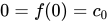
In algebra, the factor theorem connects polynomial factors with polynomial roots. Specifically, if is a (univariate) polynomial, then is a factor of if and only if (that is, is a root of the polynomial). The theorem is a special case of the polynomial remainder theorem.[1][2]

The theorem results from basic properties of addition and multiplication. It follows that the theorem holds also when the coefficients and the element belong to any commutative ring, and not just a field.

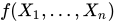
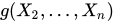
In particular, since multivariate polynomials can be viewed as univariate in one of their variables, the following generalization holds : If and are multivariate polynomials and is independent of , then is a factor of if and only if is the zero polynomial.
Factorization of polynomials

[edit]

Two problems where the factor theorem is commonly applied are those of factoring a polynomial and finding the roots of a polynomial equation; it is a direct consequence of the theorem that these problems are essentially equivalent.

The factor theorem is also used to remove known zeros from a polynomial while leaving all unknown zeros intact, thus producing a lower degree polynomial whose zeros may be easier to find. Abstractly, the method is as follows:[3]

  1. Deduce the candidate of zero of the polynomial from its leading coefficient and constant term . (See Rational root theorem.)
  2. Use the factor theorem to conclude that is a factor of .
  3. Compute the polynomial , for example using polynomial long division or synthetic division.
  4. Conclude that any root of is a root of . Since the polynomial degree of is one less than that of , it is "simpler" to find the remaining zeros by studying .

Continuing the process until the polynomial is factored completely, which all its factors is irreducible on or .

Example

[edit]

Find the factors of

Solution: Let be the above polynomial

Constant term = 2
Coefficient of

All possible factors of 2 are and . Substituting , we get:

So, , i.e, is a factor of . On dividing by , we get

Quotient =

Hence,

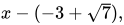
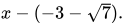
Out of these, the quadratic factor can be further factored using the quadratic formula, which gives as roots of the quadratic Thus the three irreducible factors of the original polynomial are and

Proofs

[edit]

Several proofs of the theorem are presented here.

If is a factor of it is immediate that So, only the converse will be proved in the following.

Proof 1

[edit]

This proof begins by verifying the statement for . That is, it will show that for any polynomial for which , there exists a polynomial such that . To that end, write explicitly as . Now observe that , so . Thus, . This case is now proven.

What remains is to prove the theorem for general by reducing to the case. To that end, observe that is a polynomial with a root at . By what has been shown above, it follows that for some polynomial . Finally, .

Proof 2

[edit]

First, observe that whenever and belong to any commutative ring (the same one) then the identity is true. This is shown by multiplying out the brackets.

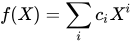
Let where is any commutative ring. Write for a sequence of coefficients . Assume for some . Observe then that . Observe that each summand has as a factor by the factorisation of expressions of the form that was discussed above. Thus, conclude that is a factor of .

Proof 3

[edit]

The theorem may be proved using Euclidean division of polynomials: Perform a Euclidean division of by to obtain where . Since , it follows that is constant. Finally, observe that . So .


The Euclidean division above is possible in every commutative ring since is a monic polynomial, and, therefore, the polynomial long division algorithm does not involve any division of coefficients.

Corollary of other theorems

[edit]

It is also a corollary of the polynomial remainder theorem, but conversely can be used to show it.

When the polynomials are multivariate but the coefficients form an algebraically closed field, the Nullstellensatz is a significant and deep generalisation.

References

[edit]
Revisions and contributorsEdit on WikipediaRead on Wikipedia
from Grokipedia
The Factor Theorem is a fundamental theorem in algebra that links the roots of a polynomial function to its factors, stating that for a polynomial f(x)f(x), a linear factor (xc)(x - c) divides f(x)f(x) evenly if and only if cc is a root of the polynomial, meaning f(c)=0f(c) = 0. This theorem provides a practical criterion for identifying factors without performing full polynomial division, enabling efficient factorization of polynomials over the real or complex numbers. Formally, the theorem asserts two equivalent conditions: if f(c)=0f(c) = 0, then f(x)=(xc)[q(x)](/page/Polynomial)f(x) = (x - c) \cdot [q(x)](/page/Polynomial) for some q(x)q(x); conversely, if (xc)(x - c) is a factor of f(x)f(x), then f(c)=0f(c) = 0. This bidirectional relationship holds for polynomials with coefficients in any field, such as the rationals or reals, and is a direct consequence of the Remainder Theorem, which states that the remainder of f(x)f(x) divided by (xc)(x - c) is exactly f(c)f(c). When the remainder is zero, the division is exact, confirming the factor. In practice, the Factor Theorem is applied using to test potential roots and factor higher-degree polynomials iteratively, often in conjunction with the to identify possible rational roots. This theorem underpins solving polynomial equations, graphing polynomial functions by identifying intercepts, and more advanced topics like polynomial rings in .

Fundamentals

Formal Statement

The Factor Theorem asserts that, for a univariate polynomial f(x)f(x) with coefficients in a field FF (such as the real numbers R\mathbb{R} or complex numbers C\mathbb{C}), the linear factor (xr)(x - r) divides f(x)f(x) if and only if rFr \in F is a of f(x)f(x), meaning f(r)=0f(r) = 0. This equivalence holds because polynomials over a field form a , enabling division with remainder. In general form, if f(x)Ff(x) \in F has degree nn and f(r)=0f(r) = 0, then f(x)f(x) factors as f(x)=(xr)q(x)f(x) = (x - r) q(x), where q(x)Fq(x) \in F is a unique of degree n1n-1. The theorem applies to univariate polynomials over an , with fields ensuring the division algorithm's validity and unique factorization up to units. For multiple roots, if rr has multiplicity k>1k > 1, the factorization extends to f(x)=(xr)kq(x)f(x) = (x - r)^k q(x), where q(r)0q(r) \neq 0 and degq(x)=nk\deg q(x) = n - k, though the basic theorem addresses single factors.

Historical Context

The factor theorem, which states that a polynomial f(x)f(x) has (xa)(x - a) as a factor if and only if f(a)=0f(a) = 0, originated in the work of René Descartes in his 1637 treatise La Géométrie. In this foundational text on , Descartes explicitly articulated the theorem as part of his systematic treatment of equations, using literal coefficients rather than numerical ones, and proved it via induction by assuming the existence of roots for polynomials of lower degrees. This marked a significant advancement in algebraic theory, enabling the based on their roots and laying the groundwork for later developments in . In the , the theorem gained further prominence through efforts to solve equations, building on Descartes' ideas. Leonhard Euler contributed to theory by exploring solutions to equations like using complex numbers, implicitly relying on principles akin to the factor theorem in his attempt at proving the (). Joseph-Louis advanced this in 1770 by initiating a systematic program to determine the solvability of by radicals, analyzing cubic and quartic equations where the factor theorem facilitated root extraction and permutation studies. The theorem's importance was underscored by Carl Friedrich , who in 1799 provided the first rigorous proof of the —establishing that every non-constant has a root in the complex numbers—proving it in multiple ways and linking it to cyclotomic polynomials in his (1801). These works solidified the theorem's role in the context of the , which Descartes had assumed but not proven. The saw the factor theorem's formalization within emerging , particularly through field theory. , in his 1830s manuscripts, developed concepts of field extensions and Galois groups to address solvability, where the theorem served as a basic tool for factoring over fields and understanding root structures. This tied into the broader rise of around the , with influences from Gauss's work on congruences, leading to its inclusion in texts on by the late 1800s. Dedekind and others further integrated it into rigorous treatments of rings and ideals. By the early , the factor theorem had become a standard component of high school and undergraduate curricula, reflecting its centrality in and as established in foundational texts like those by Weber and Hilbert. Its enduring influence stems from these historical integrations into proofs and abstract structures, making it indispensable in modern .

Connections to Other Theorems

Relation to Remainder Theorem

The remainder theorem provides a foundational result in polynomial algebra, stating that if a polynomial f(x)f(x) is divided by the linear factor (xc)(x - c), where cc is a constant, then the remainder of the division is exactly f(c)f(c). This theorem arises from the general polynomial division algorithm, which expresses any polynomial f(x)f(x) in the form f(x)=(xc)q(x)+r,f(x) = (x - c) q(x) + r, where q(x)q(x) is the quotient polynomial and rr is the constant remainder. Substituting x=cx = c into this equation yields f(c)=rf(c) = r, confirming the remainder's value. The factor theorem emerges directly as a special case of the remainder theorem when the remainder is zero. Specifically, if f(r)=0f(r) = 0 for some constant rr, then the remainder term rr in the division equation vanishes, simplifying to f(x)=(xr)q(x),f(x) = (x - r) q(x), indicating that (xr)(x - r) divides f(x)f(x) exactly without any leftover constant. This zero-remainder condition implies that rr is a of f(x)f(x), and thus (xr)(x - r) is a factor of the . This relationship underscores the factor theorem's utility as an efficient tool for polynomial : by first evaluating f(r)f(r) to check if it equals zero—a quick computation via the remainder theorem—one can confirm whether (xr)(x - r) is a factor before performing full division. This linkage streamlines testing and processes in , bridging general division outcomes to precise factor identification. The provides a method to identify possible rational roots of a with coefficients. For a f(x)=anxn++a1x+a0f(x) = a_n x^n + \cdots + a_1 x + a_0, where ana_n and a0a_0 are integers, any rational root, expressed in lowest terms as pq\frac{p}{q}, has pp as a factor of the constant term a0a_0 and qq as a factor of the leading coefficient ana_n. The Factor Theorem complements this by offering a direct test for these candidates: evaluate the at each possible rational r=pqr = \frac{p}{q}; if f(r)=0f(r) = 0, then (xr)(x - r) is a factor of f(x)f(x). This evaluation leverages the Factor Theorem's core assertion that a corresponds to a linear factor, allowing systematic verification of the Rational Root Theorem's suggestions without full division initially. Once a rational is confirmed, synthetic or can factor out (xr)(x - r), yielding a lower-degree to which the process is applied iteratively until the is fully factored over or reduced to an irreducible quadratic or higher-degree factor. This iterative approach exploits the Factor Theorem repeatedly to achieve complete rational when possible. However, the linkage is limited to rational roots, as the theorems operate over the rationals and cannot detect irrational or complex roots directly; for polynomials of degree greater than two, even if rational roots are found, remaining factors may be irreducible over the rationals, requiring other methods like the quadratic formula or advanced factorization techniques.

Applications

Polynomial Factorization Example

To illustrate the application of the factor theorem in factorization, consider the cubic f(x)=x36x2+11x6f(x) = x^3 - 6x^2 + 11x - 6. By the factor theorem, if cc is a of f(x)f(x), then (xc)(x - c) is a factor. To identify possible rational roots, the suggests testing the factors of the constant term (-6) over the factors of the leading coefficient (1), yielding candidates ±1,±2,±3,±6\pm 1, \pm 2, \pm 3, \pm 6. Evaluating f(1)=136(1)2+11(1)6=16+116=0f(1) = 1^3 - 6(1)^2 + 11(1) - 6 = 1 - 6 + 11 - 6 = 0 confirms that x=1x = 1 is a , so (x1)(x - 1) is a factor. To find the , can be employed with 1 and coefficients 1, -6, 11, -6: 1161161561560\begin{array}{r|r} 1 & 1 & -6 & 11 & -6 \\ & & 1 & -5 & 6 \\ \hline & 1 & -5 & 6 & 0 \\ \end{array} The resulting is x25x+6x^2 - 5x + 6, with 0, verifying the f(x)=(x1)(x25x+6)f(x) = (x - 1)(x^2 - 5x + 6). The quadratic x25x+6x^2 - 5x + 6 factors further as (x2)(x3)(x - 2)(x - 3), since its roots are found by solving x25x+6=0x^2 - 5x + 6 = 0 (discriminant 2524=125 - 24 = 1, roots x=5±12x = \frac{5 \pm 1}{2}, yielding 3 and 2). Thus, the complete factorization is f(x)=(x1)(x2)(x3)f(x) = (x - 1)(x - 2)(x - 3), and setting f(x)=0f(x) = 0 gives roots 1, 2, and 3. For verification, expand the factored form: first, (x2)(x3)=x25x+6(x - 2)(x - 3) = x^2 - 5x + 6; then, (x1)(x25x+6)=x35x2+6xx2+5x6=x36x2+11x6(x - 1)(x^2 - 5x + 6) = x^3 - 5x^2 + 6x - x^2 + 5x - 6 = x^3 - 6x^2 + 11x - 6, matching the original polynomial.

Solving Polynomial Equations

The factor theorem provides a systematic approach to solving equations by identifying and factoring iteratively, reducing the polynomial's degree until it is fully resolved. Consider the x3+2x25x6=0x^3 + 2x^2 - 5x - 6 = 0. Possible rational , as suggested by the , include ±1,±2,±3,±6\pm1, \pm2, \pm3, \pm6; testing x=2x=2 yields p(2)=8+8106=0p(2) = 8 + 8 - 10 - 6 = 0, confirming it as a root and thus (x2)(x-2) as a factor. Using to factor out (x2)(x-2): 212562431410\begin{array}{r|r} 2 & 1 & 2 & -5 & -6 \\ & & 2 & 4 & 3 \\ \hline & 1 & 4 & -1 & 0 \\ \end{array} The quotient is x2+4x+3=0x^2 + 4x + 3 = 0, which factors further as (x+1)(x+3)=0(x+1)(x+3) = 0, giving roots x=1x = -1 and x=3x = -3. Thus, the complete factorization is (x2)(x+1)(x+3)=0(x-2)(x+1)(x+3) = 0, with solutions x=2,1,3x = 2, -1, -3. Verification by substitution confirms the roots: p(1)=1+2+56=0p(-1) = -1 + 2 + 5 - 6 = 0, p(3)=27+18+156=0p(-3) = -27 + 18 + 15 - 6 = 0. This iterative application of the factor theorem reduces higher-degree polynomials step-by-step, enabling complete solutions that would otherwise require more complex methods.

Proofs

Proof Using Polynomial Division

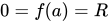
The factor theorem can be proved using the division algorithm, which states that for any f(x)f(x) and linear divisor xrx - r, there exist unique polynomials q(x)q(x) and a constant remainder RR such that f(x)=(xr)q(x)+Rf(x) = (x - r) q(x) + R. This division is possible because the polynomials form a under the degree function, allowing unique factorization into quotient and remainder with deg(R)<1\deg(R) < 1, hence constant. To derive the theorem, evaluate the division equation at x=rx = r: substituting yields f(r)=(rr)q(r)+R=Rf(r) = (r - r) q(r) + R = R. Thus, the RR equals f(r)f(r). If f(r)=0f(r) = 0, then R=0R = 0, implying f(x)=(xr)q(x)f(x) = (x - r) q(x), so xrx - r divides f(x)f(x) evenly. For the converse, suppose xrx - r divides f(x)f(x), meaning f(x)=(xr)q(x)f(x) = (x - r) q(x) for some q(x)q(x). Substituting x=rx = r gives f(r)=(rr)q(r)=0f(r) = (r - r) q(r) = 0. This establishes the if-and-only-if relationship: f(r)=0f(r) = 0 xrx - r is a factor of f(x)f(x). This proof holds in the over any field, such as the real numbers R\mathbb{R} or complex numbers C\mathbb{C}, where the division algorithm applies due to the field properties ensuring unique quotients and remainders.

Proof via Remainder Theorem

The remainder theorem states that for a f(x)f(x) over a field and any rr in that field, the division of f(x)f(x) by xrx - r yields f(x)=(xr)q(x)+f(r)f(x) = (x - r) q(x) + f(r), where q(x)q(x) is the quotient and f(r)f(r) is the constant remainder. If f(r)=0f(r) = 0, then the remainder is zero, simplifying the equation to f(x)=(xr)q(x)f(x) = (x - r) q(x), which directly implies that xrx - r is a factor of f(x)f(x). To establish the converse, assume f(x)=(xr)q(x)f(x) = (x - r) q(x) for some polynomial q(x)q(x). Substituting x=rx = r gives f(r)=(rr)q(r)=0q(r)=0f(r) = (r - r) q(r) = 0 \cdot q(r) = 0, confirming that rr is a root of f(x)f(x). This bidirectional equivalence forms the factor theorem. The uniqueness of q(x)q(x) and the remainder follows from the division algorithm for polynomials, which guarantees a unique quotient and remainder when dividing by a monic linear polynomial, with the remainder having degree less than 1 (i.e., a constant). The result holds in full generality for polynomials over any field, as the division algorithm applies in such polynomial rings.

Corollary Perspective

The Factor Theorem emerges as a direct consequence of the , which asserts that every non-constant polynomial with complex coefficients factors completely into linear factors over the complex numbers ℂ. In this framework, the statement that if f(r) = 0 for some r ∈ ℂ, then (x - r) divides f(x), follows logically from the guaranteed existence of roots and the iterative factorization process inherent to the theorem's proof./02:_Polynomial_and_Rational_Functions/2.06:_Zeros_of_Polynomial_Functions) More broadly, in the of rings, the core assertion of the Factor Theorem—that a implies divisibility by the corresponding linear —derives from the unique factorization property of these rings. Over a field k, the ring k is a (UFD), where non-constant polynomials decompose uniquely into irreducible factors, and linear polynomials (x - r) for r ∈ k are precisely the irreducibles of degree one; the condition ensures that such a linear factor appears in the of f(x). This perspective underscores how the theorem encapsulates the divisibility behavior within UFDs, providing a foundational link between and without relying on explicit division algorithms. An alternative algebraic viewpoint positions the Factor Theorem as a specialized instance of applied within integral domains, particularly where linear polynomials serve as irreducible elements governing divisibility. In rings over integral domains, guarantees that if an irreducible divides a product, it divides one of the factors; here, the linear irreducible (x - r) divides f(x) precisely when the evaluation at r vanishes, reflecting the lemma's role in establishing root-based divisibility in such domains. This connection highlights the theorem's roots in general . The implications of this corollary perspective extend to broader classes of polynomial rings, such as ℤ and k for fields k, both of which are UFDs inheriting unique factorization from their base rings. This ties the Factor Theorem to the structural properties of these domains, enabling consistent factorization behaviors across algebraic settings while emphasizing its derivation from fundamental ring-theoretic principles rather than computations.

References

Add your contribution
Related Hubs
User Avatar
No comments yet.