Hubbry Logo
Fan ChungFan ChungMain
Open search
Fan Chung
Community hub
Fan Chung
logo
8 pages, 0 posts
0 subscribers
Be the first to start a discussion here.
Fan Chung
Fan Chung
from Wikipedia

Fan-Rong King Chung Graham (Chinese: 金芳蓉; pinyin: Jīn Fāngróng; born October 9, 1949), known professionally as Fan Chung, is a Taiwanese-American mathematician who works mainly in the areas of spectral graph theory, extremal graph theory and random graphs, in particular in generalizing the Erdős–Rényi model for graphs with general degree distribution (including power-law graphs in the study of large information networks).

Key Information

Since 1998, Chung has been the Paul Erdős Professor in Combinatorics at the University of California, San Diego (UCSD). She received her doctorate from the University of Pennsylvania in 1974, under the direction of Herbert Wilf. After working at Bell Laboratories and Bellcore for nineteen years, she joined the faculty of the University of Pennsylvania as the first female tenured professor in mathematics. She serves on the editorial boards of more than a dozen international journals. Since 2003 she has been the editor-in-chief of Internet Mathematics. She has been invited to give lectures at many conferences, including the International Congress of Mathematicians in 1994 and a plenary lecture on the mathematics of PageRank at the 2008 Annual meeting of the American Mathematical Society. She was selected to be a Noether Lecturer in 2009. In 2024, she was elected to the United States National Academy of Sciences.[1]

Biography

[edit]
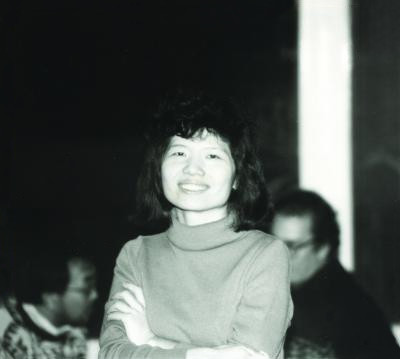
Fan Chung, her husband Ronald Graham, and Paul Erdős, Japan, 1986

Fan Chung was born on October 9, 1949, in Kaohsiung, Taiwan. Under the influence of her father, an engineer, she became interested in mathematics, especially in the area of combinatorics in high school in Kaohsiung. After high school, Chung entered the National Taiwan University (NTU) to start her career in mathematics formally. While Chung was an undergraduate, she was surrounded by many female mathematicians, and this helped encourage her to pursue and study mathematics.

After graduating from NTU with a B.S. in mathematics, Chung went on to the University of Pennsylvania to pursue a career in mathematics. There she obtained the highest score in the qualifying exam by a wide margin, catching the attention of Herbert Wilf, who would eventually become her doctoral advisor. Wilf suggested Ramsey theory as a subject Chung could work on. During a single week studying material Chung had come up with new proofs for established results in the field. Wilf said: "My eyes were bulging. I was very excited. I asked her to go to the blackboard and show me. What she wrote was incredible! In just one week, from a cold start, she had a major result in Ramsey theory. I told her she had just done two-thirds of a doctoral dissertation."[2]

Chung earned a M.S. in 1972 and a Ph.D. in 1974. By this time, she was married and had already given birth to her first child. After receiving her Ph.D., she began working for the Mathematical Foundations of Computing Department at Bell Laboratories in Murray Hill, New Jersey. The position at Bell Laboratories was an opportunity to work with other excellent mathematicians, but also it contributed to her mathematical world powerfully. She has published many impressive mathematical papers, and published many joint papers with Ronald Graham.

Bell Laboratories

[edit]

In 1974, Fan Chung graduated from the University of Pennsylvania and became a member of Technical Staff working for the Mathematical Foundations of Computing Department at Bell Laboratories in Murray Hill, New Jersey. She worked under Henry Pollak. During this time, Chung collaborated with many leading mathematicians who worked for Bell Laboratories.

In 1975, Chung published her first joint paper with Graham, On multicolor Ramsey numbers for complete bipartite graphs,[3] which was published in the Journal of Combinatorial Theory (Series B).

In 1983 the Bell Telephone Company was split up. Since Pollak joined and became head of a research unit within a new company, he asked Chung to become Research Manager. She supervised many mathematicians in the unit.

Usually with positions in management you obtain more influence and you certainly have more power to make decisions. But I do not want people to respect me because of that power. I'd rather win their admiration because of the mathematics I'm doing.

— Fan Chung, in Donald J. Albers, Making Connections: A Profile of Fan Chung, Math Horizons, September 1995, 14–18[4]

In 1990, she was one of the first to receive a Bellcore university fellowship, a sabbatical she spent at Harvard university.

Later career

[edit]

After twenty years of work at Bell Laboratories and Bellcore, Chung decided to go back to the University of Pennsylvania to become a professor of mathematics. In 1998, she was named Distinguished Professor of Mathematics at the University of California, San Diego.[5]

Beyond her contributions to graph theory, Chung has used her knowledge to connect different fields of science. As she wrote in "Graph Theory in the Information Age",

“In the past decade, graph theory has gone through a remarkable shift and a profound transformation. The change is in large part due to the humongous amount of information that we are confronted with. A main way to sort through massive data sets is to build and examine the network formed by interrelations. For example, Google’s successful Web search algorithms are based on the WWW graph, which contains all Web pages as vertices and hyperlinks as edges. There are all sorts of information networks, such as biological networks built from biological databases and social networks formed by email, phone calls, instant messaging, etc., as well as various types of physical networks. Of particular interest to mathematicians is the collaboration graph, which is based on the data from Mathematical Reviews. In the collaboration graph, every mathematician is a vertex, and two mathematicians who wrote a joint paper are connected.”[6]

Chung's life was profiled in the 2017 documentary film Girls who fell in love with Math.[7]

In 2012, she became a fellow of the American Mathematical Society.[8]

Chung was an American Mathematical Society (AMS) Council member at large.[9]

Personal life

[edit]

Chung has two children; the first child was born during her graduate studies from her first marriage.[10][2]

Fan Chung's first marriage ended in divorce in 1982. However, when she worked at Bell Laboratories, she met Ronald Graham. During that time, they became close friends and published many joint papers in graph theory, eventually marrying in 1983. She was married to him until his death in 2020.[11]

In Paul Hoffman's book The Man Who Loved Only Numbers, regarding her marriage with Graham, Chung said:

Many mathematicians would hate to marry someone in the profession. They fear their relationship would be too competitive. In our case, not only are we both mathematicians, we both do work in the same areas. So we can understand and appreciate what the other is working on, and we can work on things together and sometimes make good progress.[12]

Both Chung and Graham were close friends of the mathematician Paul Erdős, and have both published papers with him – 13 in her case;[13] thus, both have Erdős numbers of one. In 1998, Graham and Chung co-wrote the book Erdős on Graphs.[5]

Research

[edit]

Chung has published more than 200 research papers and three books:

  • Erdős on Graphs: His Legacy of Unsolved Problems (with Ron Graham), A K Peters, Ltd., 1998, ISBN 1-56881-079-2[14]
  • Spectral Graph Theory (CBMS Regional Conference Series in Mathematics, No. 92), American Mathematical Society, 1997, ISBN 0-8218-0315-8
  • Complex Graphs and Networks (CBMS Regional Conference Series in Mathematics, No. 107) (with Linyuan Lu), American Mathematical Society, 2006, ISBN 0-8218-3657-9

Spectral graph theory

[edit]

Among Fan Chung's publications, her contributions to spectral graph theory are important to this area of graph theory. From the first publications about undirected graphs to recent publications about directed graphs, Fan Chung creates the solid base in the spectral graph theory to the future graph theorist.

Spectral graph theory, as one of the most important theories in graph theory, combines the algebra and graph perfectly. Historically, algebraic methods treat many types of graphs efficiently. Her work initiated a geometric approach to spectral graph theory with connections to differential geometry. According to the biography Fan Rong K Chung Graham, "Spectral graph theory studies how the spectrum of the Laplacian of a graph is related to its combinatorial properties.".

In 1997, the American Mathematical Society published Chung's book Spectral graph theory. This book became a standard textbook at many universities and is key to studying spectral graph theory for many mathematics students who are interested in this area. Fan Chung's study in spectral graph theory brings this “algebraic connectivity” of graphs into a new and higher level.[5]

Network science

[edit]

Chung's work in random graph models shed new light on the field of network science. Many real-world large information networks (such as Internet Graphs, Call Graphs, and collaboration graphs) have been observed to be well approximated by a power law distribution. Chung's work in the Chung-Lu model, pioneered the theory of treating random graphs with arbitrary degree distributions, including the power law graphs. Her work provides a solid framework for quantitative and rigorous analysis for modeling and analyzing large complex networks. It also often serves as a popular benchmark for comparing new graph models in network science.

In 2006, the American Mathematical Society and the Conference Board of the Mathematical Sciences co-published Fan Chung and Linyuan Lu's book Complex Graphs and Networks.[15] The book gave a well-structured exposition for using combinatorial, probabilistic, spectral methods as well as other new and improved tools to analyze real-world large information networks.

Quasi-random graphs

[edit]

Fan Chung, together with Ronald Graham and Richard Wilson, introduced a strong notion of equivalence among graph properties through the control of error bounds and developed the theory of quasi-random graphs. In a series of research papers (with several coauthors), she showed that a large family of graph properties is equivalent in the sense that if a graph satisfies any one of the properties, it must satisfy all of them. The set of equivalent quasi-random properties includes a surprisingly diverse collection of properties, and therefore provides efficient methods for validating graph properties. Many (but not all) random graph properties are quasi-random. The notion of quasi-randomness has been extended to many other combinatorial structures, such as sequences, tournaments, hypergraphs and graph limits. In general, the theory of quasi-randomness gives a rigorous approach to 'random-like' or 'pseudorandom' alternatives.

Extremal graph theory

[edit]

A basic question in extremal graph theory is to find unavoidable patterns and structures in graphs with given density or distribution. A complementary problem is to find a smallest graph which contains every member of a given family of graphs as subgraphs. In a series of works with Paul Erdős, Chung determined the sizes and structures of unavoidable graphs and hypergraphs. With several coauthors, she also derived many elegant and surprising results on universal graphs. Her fundamental contributions in these areas of extremal graph theory have many applications in parallel computations.

Awards and honors

[edit]

References

[edit]

Sources

[edit]
  • Notable Women in Mathematics, a Biographical Dictionary, edited by Charlene Morrow and Teri Perl, Greenwood Press, 1998, pp. 29–34.
[edit]
Revisions and contributorsEdit on WikipediaRead on Wikipedia
from Grokipedia
Fan Chung Graham (born October 9, 1949), professionally known as Fan Chung, is a Taiwanese-American mathematician renowned for her foundational contributions to , , and . She is a Distinguished Professor Emerita of Mathematics and at the (UCSD), where she holds the Paul Professorship in , and has been recognized for pioneering work on quasi-random graphs, random graphs with general degree distributions, and algorithms for network analysis. Born in , , Chung earned her bachelor's degree from in 1970 and her Ph.D. in from the in 1974, with a thesis on lower bounds for multicolored Ramsey numbers that established enduring results in . After receiving her PhD, she joined Bell Laboratories (1974–1983), contributing to , followed by positions at Bell Communications Research (Bellcore) (1984–1994), where she directed research groups in and algorithms and was named a in 1991. From 1995 to 1998, she was a professor of and at the . In 1998, she joined UCSD as the Akamai Professor in Internet Mathematics, later becoming the Professor in in 2010, advancing through her seminal 1997 book Spectral Graph Theory, which introduced key techniques for analyzing graph eigenvalues and their applications to random walks, expanders, and network structures. Chung's research spans over 270 publications and includes influential collaborations, notably with on problems and her husband, mathematician Ron Graham, coauthoring Erdős on Graphs: His Legacy of Unsolved Problems (1998), a comprehensive collection of open questions in the field. Other major works include Complex Graphs and Networks (, with Linyuan Lu), which explores and their real-world applications in social and biological networks. Her innovations, such as the Chung-Lu random graph model, have impacted fields like , topology, and by providing probabilistic tools for modeling large-scale systems. Among her numerous honors, Chung received the 1990 Allendoerfer Award from the for expository excellence, delivered an invited address at the 1994 in , and was elected a of the American Academy of Arts and Sciences in 1998. She became a of the in 2013, a SIAM Fellow in 2015, a of the American Association for the Advancement of Science in 2002, and was elected to in 2016. In 2017, she was awarded an honorary doctorate from the , and in 2024, she received UCSD's Revelle Medal for exceptional service and contributions to the university. As of Internet Mathematics, she has shaped research at the intersection of and digital networks, mentoring generations of scholars in and .

Biography

Early Life and Education

Fan Rong K. Chung, known professionally as , was born on October 9, 1949, in , . Her father, an engineer, played a significant role in fostering her interest in from a young age, famously telling her that "in math all you need is pencil and paper." Growing up in , Chung attended local high school, where she developed a passion for the subject, particularly , drawn to its accessible yet challenging problems that allowed quick entry but demanded deep insight. She pursued her undergraduate studies at in , earning a B.S. in in 1970. During this time, Chung was influenced by a supportive community of peers, including fellow women mathematicians, emphasizing the value of alongside formal instruction. Eager to advance her education abroad, she moved to the shortly after graduation. Chung continued her graduate studies at the , where she received an M.S. in in 1972 and a Ph.D. in 1974. Her doctoral dissertation, titled "Ramsey Numbers in Multi-Colors and Combinatorial Designs," was supervised by Herbert Wilf, focusing on in . This early research marked the beginning of her prolific contributions to the field, with her first paper published in 1973.

Career Milestones

After earning her Ph.D. in mathematics from the University of Pennsylvania in 1974 under the supervision of Herbert Wilf, Fan Chung joined the Mathematical Foundations of Computing Department at Bell Laboratories in Murray Hill, New Jersey, as a Member of the Technical Staff. During her two decades in industry, she advanced through several leadership roles at Bell Labs and its successor Bell Communications Research (Bellcore), including Research Manager of the Discrete Mathematics Research Group from 1984 to 1986 and Division Manager of Mathematics, Information Sciences, and Operations Research from 1986 to 1990. By 1990, she had been appointed a Bellcore Fellow, becoming the highest-ranked woman executive in the organization, where she managed interdisciplinary teams focused on communication networks, algorithm analysis, and applied mathematics. In parallel with her industrial career, Chung maintained active academic engagements. She served as a Visiting in the Computer Science Department at during the fall of 1989 and held a fellowship at in 1990, followed by another visiting professorship there in 1991, during which she delivered an AMS-MAA invited lecture. A pivotal milestone came in 1994 when she presented an invited address at the in , highlighting her growing influence in combinatorial ; that year, she also joined the Institute for Advanced Study in Princeton as a Member. Transitioning back to academia full-time, Chung was appointed Professor of and Professor of at the in 1995, where she held the Class of 1965 Endowed Professorship until 1998. In 1998, she moved to the (UCSD), becoming a of Mathematics and , a position from which she retired in 2024, becoming Emerita. In 2016, she partially retired from her appointment in & Engineering, continuing in Mathematics until her full retirement. At UCSD, she was named the Akamai Professor in Internet Mathematics from 1998 to 2010 and served as the Professor in from 2010 to 2024, roles that underscore her expertise in and applications. Throughout her career, Chung has authored over 200 research papers and authored influential texts, such as her book Spectral Graph Theory (1997), solidifying her impact on .

Personal Life

Fan Chung was born in 1949 in , , to an father and a high school teacher mother, in a family that was unusual for the time because her mother worked full-time outside the home and was highly respected by her students. Her father, also an , actively encouraged her early interest in , telling her that it "gives you power" to understand the world. She grew up in during the and alongside one brother, who later became a . Chung has been married twice. Her first marriage, to a college acquaintance, lasted approximately nine years and produced two children: a daughter born in 1974 while Chung was pursuing her Ph.D. at the , and a son born around 1977 during her time at Bell Laboratories. In 1983, she married mathematician , whom she met at Penn and with whom she collaborated extensively, co-authoring over 100 papers until his death in 2020. Graham was a supportive partner, particularly during Chung's at Harvard. Throughout her career, Chung has balanced professional demands with family responsibilities, often managing multiple roles simultaneously as a woman in —a challenge she likened to wine needing time "to reach the right density." She reported no significant gender-based in pay or promotions at institutions like , the , or the , and relied on live-in help to support her family. Today, Chung resides in , where she was a for nearly three decades (1998–2024), and shares her home with her dog, Muffin, whom she describes as her "constant companion."

Research Contributions

Spectral Graph Theory

Fan Chung's contributions to spectral graph theory have profoundly influenced the field by bridging algebraic techniques with combinatorial properties of graphs, particularly through the study of eigenvalues associated with the graph Laplacian. In her seminal monograph Spectral Graph Theory (1997), Chung provides a comprehensive framework for analyzing graphs via the spectrum of the normalized Laplacian matrix L=D1/2LD1/2\mathcal{L} = D^{-1/2} L D^{-1/2}, where L=DAL = D - A is the standard Laplacian, DD is the degree matrix, and AA is the adjacency matrix. This normalization extends spectral methods to irregular graphs, enabling the second smallest eigenvalue λ1\lambda_1 (the algebraic connectivity or Fiedler value) to quantify expansion and connectivity in a degree-weighted manner. The book establishes key bounds, such as λ11D\vol(G)\lambda_1 \geq \frac{1}{D \cdot \vol(G)} for connected graphs with diameter DD and volume \vol(G)\vol(G), linking spectral gaps to graph diameters and isoperimetric constants. A central theme in Chung's work is the application of gaps to expander graphs, where λ1\lambda_1 measures the graph's expansion properties, ensuring efficient mixing and robustness in networks. She derives discrete analogues of the Cheeger inequality, bounding the Cheeger constant h(G)h(G) by λ1/2h(G)2λ1\lambda_1 / 2 \leq h(G) \leq \sqrt{2 \lambda_1}
Add your contribution
Related Hubs
User Avatar
No comments yet.