Hubbry Logo
Fastech 360Fastech 360Main
Open search
Fastech 360
Community hub
Fastech 360
logo
8 pages, 0 posts
0 subscribers
Be the first to start a discussion here.
Fastech 360
Fastech 360
from Wikipedia

Fastech 360 is the name given to a pair of former experimental high-speed EMU trainsets developed by East Japan Railway Company (JR East) to test technology for the next-generation Shinkansen rolling stock. The name is a portmanteau of Fast, Technology, and 360 km/h (360 km/h or 225 mph), the target operational speed for production trains based on the new technologies. Speeds of up to 405 km/h (250 mph) were targeted during performance testing.[1] Results of testing using these trains was incorporated into the E5 series and E6 series trains, entering revenue service from 2011, eventually operating at 320 km/h (200 mph).

There were 2 trains:

  • Class E954 Fastech 360S: 8-car set for use on shinkansen tracks only
  • Class E955 Fastech 360Z: 6-car set for use on both shinkansen and Mini-shinkansen lines

Fastech 360 trains were equipped with emergency air braking plates like that of an aircraft, similar in appearance to the ears of a cat. This trait earned them a nickname of Nekomimi Shinkansen (猫耳新幹線), which literally means "cat-eared Shinkansen". This technology was not incorporated in the subsequent E5 series or E6 series trains.[citation needed]

Class E954 Fastech 360S

[edit]
Class E954 "Fastech 360S"
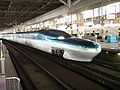
The Fastech 360S train (stream-line end) at Omiya Station in May 2008
In service2005–2009
ManufacturerHitachi, Kawasaki Heavy Industries
Constructed2005
Scrapped2009
Number built8 vehicles
Number in serviceNone
Number preservedNone
Number scrapped8 vehicles
Formation8 cars
Fleet numbersS9
OperatorsJR East
DepotsSendai
Lines servedTohoku Shinkansen, Joetsu Shinkansen
Specifications
Car body constructionAluminium alloy
Maximum speed360 km/h (225 mph) (nominal)
Electric system(s)25 kV AC, 60 Hz Overhead catenary
Current collectionPantograph
Track gauge1,435 mm (4 ft 8+12 in) standard gauge

This 8-car set (S9) was delivered on 26 June 2005. Cars 1 to 3 were built by Hitachi, and cars 4 to 8 were built by Kawasaki Heavy Industries.[2]

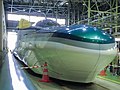
Car E954-1 has a stream-line profile, reminiscent of the 500 series, and E954-8 has an arrow-line profile more reminiscent of the JR East E2 series and E4 series designs.[3]

The train was withdrawn in September 2009 and scrapped.[4]

Formation

[edit]
  1. E954-1 (T1c)
  2. E954-2 (M1) (with pantograph)
  3. E954-3 (M2) (with toilet)
  4. E954-4 (M2)
  5. E954-5 (M1s)
  6. E954-6 (M2)
  7. E954-7 (M1) (with pantograph)
  8. E954-8 (T2c)

Class E955 Fastech 360Z

[edit]
Class E955 "Fastech 360Z"
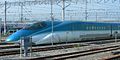
The Fastech 360Z set S10 at Sendai Shinkansen Depot in July 2008
In service2006–2008
ManufacturerHitachi, Kawasaki Heavy Industries
Constructed2006
Scrapped2008
Number built6 vehicles
Number in serviceNone
Number preservedNone
Number scrapped6 vehicles
Formation6 cars
Fleet numbersS10
OperatorsJR East
Lines servedTohoku Shinkansen, Akita Shinkansen
Specifications
Car body constructionAluminium alloy
Maximum speed360 km/h (225 mph) (nominal)
130 km/h (80 mph) (Akita Shinkansen)
Electric system(s)25/20 kV AC, 50 Hz Overhead catenary
Current collectionPantograph
Track gauge1,435 mm (4 ft 8+12 in) standard gauge

This 6-car set (S10) was delivered on 6 April 2006. Cars 1 and 4 to 6 were built by Kawasaki Heavy Industries, and cars 2 and 3 were built by Hitachi.[5] The train was withdrawn in December 2008 and scrapped.[2]

Formation

[edit]
  1. E955-1 (M2c)
  2. E955-2 (M1s)
  3. E955-3 (M1) (with pantograph and toilet)
  4. E955-4 (M1)
  5. E955-5 (M1) (with pantograph)
  6. E955-6 (M2c)

References

[edit]
[edit]
Revisions and contributorsEdit on WikipediaRead on Wikipedia
from Grokipedia
Fastech 360 is the collective name for a pair of experimental high-speed (EMU) trainsets developed by the (JR East) to advance technology, targeting commercial operations at 360 km/h while prioritizing improvements in speed, , reliability, environmental impact, and passenger comfort. The project comprised two distinct variants: the Fastech 360S (Class E954), an eight-car formation with standard clearances designed exclusively for high-speed testing on dedicated standard-gauge tracks, and the Fastech 360Z (Class E955), a six-car formation engineered for compatibility with both standard lines and narrower routes on converted conventional lines. The name "Fastech" is derived from "FASt TECHnology," with "360" denoting the maximum target speed in kilometers per hour, and the suffixes "S" and "Z" indicating Shinkansen-specific and zairaisen (conventional line) applications, respectively. Both trainsets featured innovative technologies, including compact high-output motors, advanced s for stable current collection at high speeds, for smoother rides, and a 2-degree tilting mechanism to navigate curves more efficiently. Aerodynamic enhancements, such as streamlined and arrow-shaped nose designs on the Fastech 360S, along with deployable air "fins" resembling cat ears for emergency stopping without excessive noise or wear, were central to reducing external noise levels to match those of existing E2 series trains at 360 km/h. The Fastech 360Z incorporated a narrower body width of 2,904 mm to fit infrastructure, double-skin aluminum construction for weight reduction, and retractable shields for clearance on conventional lines. Testing commenced in June 2005 for the Fastech 360S on the Tohoku between and Kitakami, reaching peak speeds of 398 km/h during nighttime performance trials, while the Fastech 360Z began dynamic tests in March 2006. Although 360 km/h operations proved challenging due to and vibration issues, the extensive trials through 2009 validated key innovations that informed the E5 series , whose pre-production models were optimized versions of the Fastech 360S carriages for 320 km/h service.

Overview

Description and Purpose

The Fastech 360 refers to a pair of experimental (EMU) trainsets developed by the (JR East) to test next-generation technologies for high-speed operations. These trainsets were designed to advance Shinkansen capabilities by addressing key challenges in achieving sustained high speeds on existing infrastructure. The primary purpose of the Fastech 360 project was to validate the feasibility of commercial operations at 360 km/h on the Tohoku line, with a particular emphasis on improving to minimize pressure waves in tunnels, enhancing power collection systems for stable contact, and reducing noise levels to meet environmental standards. This initiative aimed to enable significant reductions in travel times, such as shortening the to route, while ensuring safety, reliability, and passenger comfort. The project included performance tests targeting speeds up to 405 km/h to gather data beyond the operational goal. The two key variants were the E954 series, known as Fastech 360S, an 8-car formation focused on stability for standard tracks; and the E955 series, known as Fastech 360Z, a 6-car formation with reduced body width for compatibility with routes converted from conventional lines.

Development Background

The Fastech 360 project originated in April 2002 when (JR East) launched the High-speed Project through its Center, with the primary goal of developing technologies to enable 360 km/h operations on the Tohoku Shinkansen line and extend services northward beyond existing limits. This initiative was driven by growing demand for reduced travel times on routes connecting to northern destinations like and , aiming to enhance competitiveness against domestic following the successful implementation of 300 km/h upgrades on lines such as the Tokaido and Joetsu . The project emphasized comprehensive research into train performance, environmental impacts, and passenger comfort to support future commercial high-speed expansions. Building on the evolution of earlier Shinkansen experimental trains, such as the Series 1000 prototypes that pioneered in the , the Fastech 360 focused on integrated systems for sustained 360 km/h running, including advanced and power collection suited to the Tohoku line's infrastructure. In February 2004, JR East formally announced the development of two test trainsets—the eight-car E954 series for standard tracks and the six-car E955 series for potential through-services on conventional lines—targeting maximum test speeds of 400 km/h. Construction of the trainsets was contracted to and , Ltd., with assembly occurring at their facilities in and Kasado, respectively, under JR East's oversight to ensure alignment with research objectives. The first set, designated E954 and branded Fastech 360S, was completed and unveiled at JR East's Sendai Works in June 2005, initiating dynamic testing on the Tohoku to validate technologies for , stability, and energy efficiency. Throughout the project, JR East's Research and Development Center played a central role in coordinating validations, drawing on prior high-speed experiments to address challenges specific to northern route extensions.

Design Innovations

Aerodynamics

The Fastech 360 experimental trains addressed critical aerodynamic challenges inherent to operations at 360 km/h, such as micro-pressure waves generated during tunnel entries, elevated aerodynamic drag contributing to higher energy consumption, and yawing motions exacerbated by crosswinds that could compromise stability. These issues were particularly pronounced on Japan's extensive tunnel network and in regions prone to gusty winds, necessitating innovations to ensure passenger comfort, safety, and environmental compliance. Key innovations included optimized nose shapes developed through (CFD) simulations to minimize pressure wave formation. The E954 series (Fastech 360S) featured extended 16-meter noses in two variants—a streamlined shape on the leading car and an arrow-shaped design on the trailing car—for comparative evaluation of wave suppression and drag reduction. Complementing this, the car body cross-sectional profile was refined, with the E954 maintaining a standard width of 3.38 meters while incorporating smooth contours, covered areas, and minimized protrusions to lower overall air resistance. The E955 series (Fastech 360Z), designed for compatibility with narrower conventional lines, further reduced body width to 2.904 meters, achieving a smaller frontal area that enhanced entry performance and reduced drag without sacrificing interior space. To counteract yawing and crosswind effects, the trains integrated active control systems, including fully active lateral secondary suspensions with electromagnetic actuators on the leading cars. These systems dynamically adjusted to maintain stability. Aerodynamic noise reduction was prioritized through features like pantograph fairings, 30-degree angled noise insulation plates, underbody streamlining, and sound-absorbing panels on car sides—the first such application on a Shinkansen. These measures limited wayside noise to below 75 dB(A) at 300 km/h, aligning with regulatory standards; passing noise at 330 km/h was equivalent to conventional trains at 275 km/h, with pantograph contributions reduced by over 2 dB compared to the E2 series via low-drag single-arm collectors.

Pantograph Technology

The technology in the Fastech 360 project addressed significant challenges in maintaining reliable between the train's and the overhead at speeds exceeding 360 km/h. At such velocities, aerodynamic uplift, vibrations from track irregularities, and dynamic interactions can cause fluctuations, leading to arcing, wear, and potential power interruptions. The E954 series (Fastech 360S) incorporated innovative single-arm pantographs equipped with multi-segment sliders to enhance current collection stability and reduce wear during high-speed operations. These pantographs were mounted as a single unit per trainset for reduced aerodynamic drag and noise. The design also featured air-spring elements in the overall suspension system to mitigate vibrations affecting contact quality, though primary focus was on the pantograph's mechanical improvements for longevity. Aerodynamic integration was a key aspect, with streamlined fairings and retractable shields around the s to minimize air resistance and generation, which can constitute a notable portion of total drag at high speeds. A dedicated insulation panel further contributed to lowering acoustic emissions during operation. These features allowed for brief automatic adjustments in height to optimize contact under varying conditions. Performance testing demonstrated that the system maintained stable contact up to 405 km/h, with reduced arcing incidents compared to prior designs through improved sliding mechanisms and materials. The pantographs were optimized for the standard power supply of 25 kV AC at 50/60 Hz, integrating seamlessly with systems to recover energy during deceleration and enhance overall efficiency.

Fastech 360S (E954 Series)

Configuration and Formation

The Fastech 360S (E954 series) was built as an 8-car experimental trainset and delivered in June 2005 by and , with cars 1–3 constructed by and cars 4–8 by . The formation consisted of eight cars in a Tc-M-M-M-M-M-M-Tc layout, including two end cars with driving cabs (E954-1 designated T1c with stream-line nose, E954-8 as T2c with arrow-line nose), and six powered intermediate cars (M) each equipped with 1,150 kW asynchronous AC motors, two of which carried pantographs (E954-2 and E954-7). Key dimensions included an overall length of approximately 200 m (based on 25 m per ), a body width of 3.38 m, and a of 3.65 m, designed for standard clearances to optimize aerodynamics and performance on dedicated high-speed tracks. The total weight was reduced through an advanced aluminum alloy body structure. The interior was configured for testing, with extensive sensors for monitoring performance, no passenger facilities, and balanced weight distribution for stability at high speeds. The trainset featured a silver livery with red accents and was designated as set S9, operated from Depot.

Testing Program

The Fastech 360S (E954 series) experimental trainset began dynamic testing in June 2005 on the Tohoku , primarily between and Kitakami, with later trials on the Joetsu to evaluate performance in varied conditions. These tests aimed to develop technologies for next-generation , focusing on 360 km/h operations while assessing compatibility with existing infrastructure. Primary objectives included validating aerodynamic stability, noise levels, and innovations such as compact high-output motors, advanced pantographs with multi-split sliders, active electromagnetic suspension, and a 2-degree body tilting mechanism. Tests also examined earthquake safety features, including improved braking and air resistance devices. Key achievements included reaching a peak speed of 405 km/h during performance trials in 2005–2007, primarily at night and twice weekly, with typical speeds between 275 km/h and 365 km/h. The program demonstrated a 25% reduction in tunnel pressure waves and effective crosswind stability up to 30 m/s via active yaw control. Testing involved extended runs up to 500 km, high-speed passing maneuvers (closing speeds near 720 km/h), and like sensors and cameras for data on stability, noise, and efficiency. The program ran from 2005 to 2009, concluding with withdrawal in September 2009; the set was scrapped later that year, with technologies influencing the E5 series .

Fastech 360Z (E955 Series)

Configuration and Formation

The Fastech 360Z (E955 series) was built as a 6-car experimental trainset in 2006 by Hitachi and Kawasaki Heavy Industries, with two cars constructed by Hitachi and four by Kawasaki Heavy Industries. The formation followed a Mc1-M2-F3-M4-F5-Mc6 layout, comprising four powered cars (two end cars Mc with driving cabs and two intermediate motor cars M) equipped with asynchronous AC motors (including three-phase squirrel-cage induction motors rated at 370 kW and synchronous motors rated at 355 kW per motor, for a total train output of 7,250 kW), and two trailer cars (F). Key dimensions included an overall length of 151.5 m, a reduced body width of 2.904 m, and a height of 3.65 m, optimized for aerodynamic performance on both standard and mini-Shinkansen lines; the total weight was 480 tons, achieved through an advanced aluminum alloy body structure. This reduced profile supported aerodynamic benefits by minimizing cross-sectional area and drag. The interior layout prioritized testing, featuring extensive sensor arrays for performance monitoring and data acquisition, with no standard passenger facilities and a focus on balanced weight distribution to improve high-speed stability. The trainset was visually identified by its silver accented with red stripes and bore the designation SaHa E955-1 on the lead car.

Testing Program

The Fastech 360Z (E955 Series) experimental trainset was unveiled in March 2006 and began dynamic testing in March 2006 on the Tohoku line, with a particular emphasis on northern sections such as the Kitakami–Morioka route to assess performance in varied terrain and weather conditions. These tests were conducted to support the development of future capable of through-service on both standard and lines, leveraging the trainset's reduced cross-sectional profile for compatibility. The primary objectives of the testing program centered on evaluating aerodynamic stability and noise generation at operational speeds of 360 km/h, while validating the effectiveness of the active yaw in mitigating effects. This included simulations of strong gusts to ensure safe passage in exposed areas, building on the trainset's innovations for enhanced environmental compatibility and passenger comfort during high-speed travel. Data collection focused on real-world validation of these features, distinct from prior pantograph-centric trials on the E954 variant. Key achievements from the program included reaching a peak test speed of 398 km/h in during nighttime runs, demonstrating the trainset's potential beyond the target operational limit. Aerodynamic refinements resulted in a 25% reduction in tunnel pressure waves compared to previous designs, significantly lowering micro-pressure wave impacts and associated sonic booms. Additionally, stability was improved to withstand gusts up to 30 m/s without compromising control, thanks to the integrated active yaw dampers. Testing methodologies involved extended route runs of up to 500 km along the Tohoku Shinkansen, incorporating high-speed cameras for motion analysis and pressure sensors mounted on the train and trackside infrastructure to monitor aerodynamic interactions. These runs simulated commercial operations, including passing maneuvers at closing speeds approaching 720 km/h, to gather comprehensive data on stability, noise, and energy efficiency. The overall testing program concluded in 2008, with findings contributing to subsequent Shinkansen development. The E955 set was subsequently scrapped in 2009, its components recycled for use in new , and no elements were retained for preservation or display.

Legacy and Influence

Technological Advancements

The Fastech 360 experimental trains introduced integrated systems that combined aerodynamic profiling with advanced designs, enabling the creation of hybrid stability models to optimize train-catenary interactions at speeds 360 km/h. These models incorporated data from simulations and on-track testing to minimize uplift forces and ensure consistent power collection, laying the groundwork for more reliable high-speed operations in subsequent Shinkansen designs. Advancements in noise and vibration mitigation were central to the project, with systems reducing lateral carbody vibrations by up to 50% at 1-2 Hz frequencies during tests at 300 km/h and above. This was complemented by low-noise single-arm pantographs equipped with sound insulation plates and aerodynamic fairings, which lowered overall passing noise at 330 km/h to levels equivalent to commercial trains operating at 275 km/h, as measured 25 meters from the track. Such developments, including smoothed carbody features like circumferential , addressed ride discomfort and environmental impact at elevated speeds. Energy efficiency improvements stemmed from refined systems and algorithms, which supported smoother acceleration profiles and higher recovery rates in distributed traction setups. Testing validated these optimizations for reduced power consumption during high-speed runs, aligning with broader goals of minimizing operational energy use through efficient . Safety enhancements included real-time monitoring of catenary-pantograph interactions via improved contact systems, such as multi-split sliders. These innovations influenced protocols by providing data on degradation, enhancing overall system reliability for sustained 360 km/h operations. The technological outputs of Fastech 360, centered on wheeled applications, demonstrated scalability for advanced rail systems, with concepts in stability and efficiency adaptable to hybrid high-speed environments beyond conventional tracks.

Impact on Shinkansen Evolution

The aerodynamic designs developed during Fastech 360 testing, including an elongated 16-meter shape to mitigate tunnel micro-pressure waves and aerodynamic noise shields around the , were adapted and incorporated into the E5 series trains, which feature a 15-meter nose. These features enabled the E5 sets, which debuted in March 2011 on the , to achieve operational speeds of up to 320 km/h while maintaining passenger comfort and reducing environmental noise. The single-arm configuration, refined from Fastech prototypes to minimize aerodynamic drag and sound emissions through integrated insulators, further optimized the E5's performance, allowing it to replace slower E2 and series trains on high-speed services. Additionally, the Fastech 360S carriages were optimized and reused to form the E5 series pre-production trainset (set U51), which underwent further testing starting in 2010. Fastech 360's extensive running tests from 2005 to 2009 revealed significant challenges in achieving 360 km/h operations, particularly related to elevated noise levels and micro-pressure waves in , which necessitated advanced noise barriers and infrastructure upgrades not feasible under cost and environmental constraints. As a result, JR East capped commercial speeds at 320 km/h on the Tohoku line, balancing higher velocities with sustainable wayside noise mitigation measures such as extended soundproof walls and refined . This decision, informed by Fastech data on environmental performance, ensured compliance with Japanese regulations while enabling the line's extension to Shin-Aomori in 2010 without excessive ecological disruption. The Fastech 360 program influenced long-term evolution by providing foundational data for efficiency improvements in subsequent JR East models. Its testing outcomes also underscored the practical limits of conventional wheel-on-rail , contributing to strategic planning for next-generation systems like the Chuo maglev project, which targets speeds beyond 500 km/h to overcome noise and infrastructure barriers identified in Fastech trials. Economically, the E5 Hayabusa's adoption of these technologies reduced to Shin-Aomori travel times from approximately 3 hours 20 minutes to 2 hours 59 minutes by , enhancing connectivity and supporting ridership growth on the Tohoku line. As of 2025, no Fastech 360 units remain in active service, having been retired after 2009, but their legacy persists in JR East's ongoing R&D efforts toward 400 km/h targets via prototypes like the .

References

Add your contribution
Related Hubs
User Avatar
No comments yet.