Hubbry Logo
Fath MuhammadFath MuhammadMain
Open search
Fath Muhammad
Community hub
Fath Muhammad
logo
8 pages, 0 posts
0 subscribers
Be the first to start a discussion here.
Fath Muhammad
Fath Muhammad
from Wikipedia

Fateh Muhammad or Nadim Sahib (6 May 1684 – 9 September 1729) was an official of the Mughal Empire in Mysore region, and was the father of Mysore Sultanate founder Hyder Ali, who was his fifth child from his third wife, and the paternal grandfather of the Mysore Sultanate Ruler Tipu Sultan.[1][2]

Key Information

He was born on 6 May 1684 at Doddallapur in the Bijapur Sultanate, 2 years before the Mughal Empire took control of the region during the reign of Aurangzeb. His father Ali Muhammad, a descendant of Sufi mystic Muhammad Bahlole, had come to Gulbarga and married daughter of custodian of shrine of Banda Nawaz.[3] He was killed in action at the age of 45 years, 4 months, and 3 days in a battle between Tahir Muhammad Khan, who was the Subahdar of Sira, and Jaher Khan of Chittor on 9 September 1729. He was buried at Kolar alongside his parents.

At an early age, he served as a commander of 50 men in the Rocket artillery of the army of the Nawab of Carnatic. It is believed that he served alongside Zulfiqar Ali Khan, the first Nawab of the Carnatic during the Siege of Jinji. This was maintained under the command of the Mughal Emperor Aurangzeb with the purpose of capturing or killing the renegade Maratha ruler Rajaram.[4] then later in 1700s he became a valuable Military Commander. Fath Muhammad eventually entered the service of the Wodeyar Rajas of the Kingdom of Mysore, where he rose to become a powerful military commander. The Wodeyars awarded him Budikote as a jagir (land grant), where he then served as Naik (Lord).[5]

See also

[edit]

References

[edit]

Sources

[edit]
  • Narasimha, Roddam; Srinivasan, Jagannathan; Biswas, S. K (2003). The Dynamics of Technology: Creation and Diffusion of Skills and Knowledge. New Delhi: Sage Publications. ISBN 978-0-7619-9670-5. OCLC 231988745.
  • Tour, Maistre de la; Mohammed, Gholam (1855). The History of Hyder Shah, Alias Hyder Ali Khan Bahadur. London: W. Thacker. OCLC 65664006.
  • Wilks, Mark (1869). Historical Sketches of the South of India, in an Attempt to Trace the history of Mysoor (Second ed.). Madras: Higginbotham. OCLC 460735564.
  • Bowring, Lewin (1899). Haidar Alí and Tipú Sultán, and the Struggle with the Musalmán Powers of the South. Oxford: Clarendon Press. OCLC 11827326.
Revisions and contributorsEdit on WikipediaRead on Wikipedia
from Grokipedia
Fateh Muhammad (c. 1684–1729), also known as Nadim Sahib, was a military commander of Qizilbash origin who served under Mughal governors and the Wodeyar dynasty in the Mysore region of southern India. As the father of Hyder Ali—born to his third wife in 1720—Fateh Muhammad's lineage directly contributed to the founding of the short-lived but influential Mysore Sultanate, with his son rising from humble military ranks to de facto ruler and his grandson Tipu Sultan continuing the dynasty's resistance against British expansion. Early in his career, he migrated from Punjab to the Deccan, eventually settling in Kolar as a jagirdar and naik (commander), where he managed local defenses amid regional power struggles between Mughal appointees and local chieftains. Killed in battle in 1729, he was buried in Kolar alongside his parents, leaving a legacy tied to the martial traditions that propelled his descendants to prominence in 18th-century South Indian warfare.

Early Life

Birth and Family Background

Fath Muhammad, also known as Fateh Muhammad or Nadim , was born on 6 May 1684 in Doddaballapur, approximately 50 kilometers north of Bengaluru in the Deccan region, then part of the Sultanate amid expanding Mughal influence under . The area, encompassing nearby locales like Kolar, featured a mix of local Hindu kingdoms and Muslim military elites serving regional powers, providing the context for his family's involvement in soldiering. His family background reflected the modest military strata common among Deccan , with ancestors migrating southward within and engaging in service under sultans like those of the Qutb Shahi or Adil Shahi dynasties before Mughal consolidation. His father, Ali Muhammad, had held positions in northern Deccan forces, dying around 1697 and buried in Kolar, indicating established regional ties rather than confirmed noble or foreign noble ancestry often romanticized in later narratives. As a figure in , Fath Muhammad's ethnic roots likely stemmed from local converts or intermarried migrant groups from the Persianate military class, though primary records emphasize practical service over unverified genealogical claims of Persian or descent.

Entry into Military Service

Fath Muhammad began his military career at an early age as a commander of 50 men in the rocket artillery of the Nawab of Carnatic's army. This specialized unit, utilizing bamboo-based rockets primarily for signaling and limited bombardment, operated within the nawab's forces, which held semi-autonomous authority in the Carnatic region as a Mughal subahdarate. His assignment to such a technical role amid the era's rudimentary but innovative South Indian warfare indicated early recognition of his competence, as rocket troops required skill in handling volatile munitions amid frequent regional conflicts. The of Carnatic's military, though nominally loyal to the Mughal emperor, exemplified the decentralized power dynamics of the early 18th-century Deccan, where local rulers increasingly pursued independent agendas following the empire's exhaustion from prolonged campaigns. Fath Muhammad's entry thus aligned with opportunistic service under provincial authorities rather than direct imperial commands, a common pathway for capable officers in a landscape marked by Mughal administrative fragmentation after Aurangzeb's death in 1707. This initial command provided foundational experience in tactics and coordination, setting the stage for his subsequent advancements without reliance on hereditary privilege.

Military Career

Service under Regional Powers

Fath Muhammad, originating from a family of Pathan migrants, entered the service of Saadatullah Khan, the Mughal-appointed ruler of the Carnatic, shortly after his father's death in 1697. Saadatullah Khan, who assumed the nawabship in 1710, initially appointed him as a jamadar commanding 50 horsemen, reflecting the fragmented political landscape of where Mughal viceroys relied on capable local and migrant officers to assert control amid encroaching Maratha incursions and internal rivalries. His rapid promotions stemmed from proven effectiveness in combat operations, particularly in cavalry engagements that helped repel Maratha raids into the Carnatic during the 1710s and , a period when central Mughal authority had weakened, forcing regional powers to prioritize military over strict hierarchical fidelity. By the mid-1710s, Fath Muhammad's command expanded to include approximately 600 infantry, 500 , and 50 specialists, units critical for the nawab's defensive strategies against decentralized threats in a where survival hinged on tactical adaptability rather than unwavering allegiance to distant imperial centers. This phase underscored the causal dynamics of 18th-century South Indian warfare, where officers like Fath Muhammad advanced through empirical demonstrations of logistical and battlefield prowess in polycentric environments, maintaining the facade of Mughal while navigating alliances driven by immediate power balances; historical accounts emphasize his role in bolstering the Carnatic's resilience without attributing undue ideological motivations, consistent with patterns observed in other Pathan mercenaries of the era.

Commands in Mysore

Fath Muhammad entered the service of the Wodeyar Rajas of the Kingdom of Mysore in the early 18th century, where he was granted the military title of naik, denoting command over a modest infantry unit typically numbering 10 to 20 soldiers in the South Indian context of the era. This appointment aligned with the kingdom's efforts to bolster defenses amid regional instability following Mughal decline, though specific engagements under his direct leadership remain undocumented in primary accounts. Internal dissensions among Mysore's hereditary chiefs and ministers, characteristic of the Wodeyar court's fragmented authority in the 1710s and , led Fath Muhammad to depart the service prematurely. His brief tenure nonetheless positioned him within networks of Deccan professionals, facilitating transitions to adjacent postings and establishing precedents for familial involvement in regional armies. This continuity stemmed from practical inheritance of contacts and skills rather than formal entitlements, as evidenced by the subsequent careers of his descendants in comparable roles. Following his exit from , Fath Muhammad assumed the role of (garrison commander) of in the neighboring Mughal province of Sira around 1720, overseeing local fortifications and troop deployments against and rival claimants in the contested Carnatic-Mysore frontier. In this capacity, he directed forces comprising roughly 400 and 200 for patrol and defensive operations, contributing to stability in territories integral to Mysore's eventual expansion under later rulers. Such commands underscored the fluid military labor market of the period, where competence in skirmish suppression outweighed rigid allegiance to a single sovereign.

Family and Personal Life

Marriages and Children

Fath Muhammad, as a Muslim officer in 18th-century southern , practiced , contracting multiple marriages consistent with the norms of elite Muslim families, where such unions often served to consolidate social and professional networks. He had at least three wives, though details on the first two remain sparse in historical records. Hyder Ali, the future ruler of , was Fath Muhammad's fifth child overall and second son by his third wife; he was born circa 1720 in Budikote (present-day , ). No verifiable records specify the names or number of children from Fath Muhammad's earlier marriages, reflecting the limited documentation of non-prominent offspring in military lineages of the era.

Death and Legacy

Death and Burial

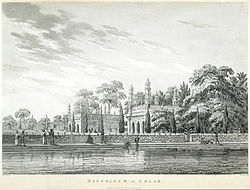
Fath Muhammad died on September 9, 1729, at age 45, killed in a battle between the of Sira and Jaher Khan of Chittor while serving as a military commander. His death occurred in the context of regional conflicts in the area under Mughal oversight. He was buried in Kolar, alongside his parents, in a that reflects modest military honors rather than royal pomp. The site, documented in an colored by J. Wells after A. Allan, stands on a main road without adjacent river access as sometimes depicted. Today, it remains a historical known locally as a mazaar, preserving his physical commemoration without elaborate modern embellishments.

Anecdotes and Historical Significance

One enduring anecdote from portrays Fath Muhammad as a paragon of bravery, recounting how he single-handedly killed a that attacked him while traveling, thereby earning local acclaim and favor. This tale, transmitted orally and popularized in regional narratives, symbolizes martial valor but lacks substantiation in verifiable contemporary documents, distinguishing it from empirical annals that emphasize his routine command duties rather than singular heroic feats. Fath Muhammad's historical significance derives principally from his paternity of , whose ascent from subordinate officer to ruler of in 1761 established a dynasty that challenged British expansion in southern until Tipu Sultan's defeat in 1799. As a commander of modest forces—initially 50 men in under the of Carnatic before transferring to service—his career exemplifies the opportunistic mobility of Naib officers during the Mughal Empire's fragmentation post-Aurangzeb, yet records reveal no major independent conquests or strategic innovations attributable to him alone. Proponents of dynastic lore credit him as the foundational military progenitor enabling 's innovations in rocketry and , positing a causal chain from his Kolar postings to 's militarization; critics, however, contend he was a peripheral figure whose early death in 1729 curtailed any outsized agency, with 's successes stemming more from personal acumen amid Wodeyar patronage and regional power vacuums than inherited prowess. This duality underscores how posthumous often inflates progenitors' roles in ascendant lineages, contrasting with data-limited assessments that prioritize 's autonomous agency over unproven paternal precedents.

References

Add your contribution
Related Hubs
User Avatar
No comments yet.