



Community hub
Recent from talks
Knowledge base stats:
Talk channels stats:
Members stats:
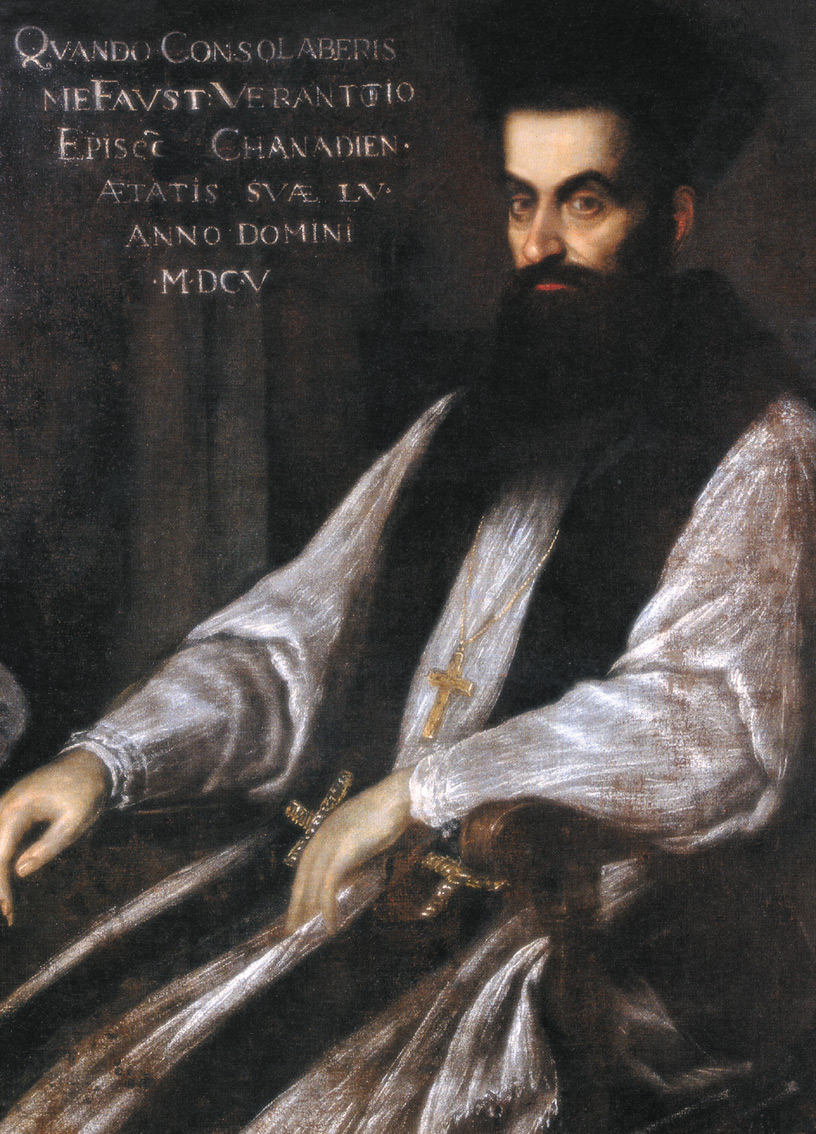
Fausto Veranzio
Fausto Veranzio (Latin: Faustus Verantius; Croatian: Faust Vrančić; Hungarian and Vernacular Latin: Verancsics Faustus; c. 1551 – 20 January 1617) was a Croatian polymath, diplomat and bishop from Šibenik, then part of the Republic of Venice. He is a scientist recognised for his genius as both a Croatian and as a Croatian-Hungarian.
Fausto was born in Sebenico (Šibenik), Venetian Dalmatia into the Croatian family of count Michele/Mihovil Vrančić (Veranzio) and Katarina Berislavić. His father was a Latin poet, while his uncle was Antun Vrančić, archbishop of Esztergom (1504–1573), a diplomat and a civil servant, who was in touch with Erasmus (1465–1536), Philip Melanchthon (1497–1560), and Nikola IV Zrinski (1508–1566), who took care of Fausto's education and later travelled with him during some of Antun's travels through Hungary and in the Republic of Venice. Faust had a brother Kazimir (1557-1637).
While the family's main residence was in the city of Šibenik, they owned a big summer house on island of Prvić, in place of Šepurine, a neighboring place to Prvić-Luka (where he is buried in the local church). The Baroque castle that was used by the Vrančić family as summer residence is now in possession of the Draganić family. Later in his life, in 1578, Fausto was married to Marieta Zar with whom had a daughter Alba-Roza, and possibly a son, who died young.
As a youth, under Antun's tutelage, Veranzio was interested in science. While still a child, he moved to Venice, where he attended school, and then to Padua to join the University, where he focused on law, physics, engineering and mechanics.
At the court of King Rudolf II, at the Hradčany castle in Prague, Veranzio was the chancellor for Hungary and Transylvania, often in contact with Johannes Kepler and Tycho Brahe. After his wife's death, Veranzio left for Hungary. In 1598, he received the title of bishop of Csanád (Episcŏpus Csanadiensis) in partibus (even though he never set foot in Csanád). In 1609, back in Venice, he joined the brotherhood of Paul of Tarsus (barnabites) and committed himself to the study of science. Veranzio died in 1617 in Venice and was buried in Dalmatia, near his family's country house on the island of Prvić.
Veranzio's masterwork, Machinae Novae (Venice 1615 or 1616), contained 49 large pictures depicting 56 different machines, other devices, and technical concepts.
Two variants of this work exist, one with the "Declaratio" in Latin and Italian, the other with the addition of three other languages. Only a few copies survived and they often do not present a complete text in all the five languages. This book was written in Italian, Spanish, French, and German. The tables represent a varied set of the projects, designs, and conceptions of the author. There Veranzio wrote about water and solar energy, offering depictions of clocks, including a "universal clock" (Plates 6–7), many types of mills, agricultural machinery, various types of bridges in various materials, machinery for clearing the sea, a dual sedan chair borne by a mule (Plate 47), special coaches, and Homo Volans (Plate 38), a forerunner of the parachute. His ideas included a float resembling a modern lifebuoy (Plate 39), boats with ingenious power mechanisms relying on water currents (Plates 40 and 41), and a rotary printer (Plate 46) intended to improve on the printing press.
Despite the extraordinary rarity of this book (because the author published it at his own expense, without a publisher, and had to stop printing for want of funds), the Machinae Novae was the work which mainly contributed to Veranzio's popularity around the world. His design pictures were even reprinted a few years later and published in China.
Hub AI
Fausto Veranzio AI simulator
(@Fausto Veranzio_simulator)
Fausto Veranzio
Fausto Veranzio (Latin: Faustus Verantius; Croatian: Faust Vrančić; Hungarian and Vernacular Latin: Verancsics Faustus; c. 1551 – 20 January 1617) was a Croatian polymath, diplomat and bishop from Šibenik, then part of the Republic of Venice. He is a scientist recognised for his genius as both a Croatian and as a Croatian-Hungarian.
Fausto was born in Sebenico (Šibenik), Venetian Dalmatia into the Croatian family of count Michele/Mihovil Vrančić (Veranzio) and Katarina Berislavić. His father was a Latin poet, while his uncle was Antun Vrančić, archbishop of Esztergom (1504–1573), a diplomat and a civil servant, who was in touch with Erasmus (1465–1536), Philip Melanchthon (1497–1560), and Nikola IV Zrinski (1508–1566), who took care of Fausto's education and later travelled with him during some of Antun's travels through Hungary and in the Republic of Venice. Faust had a brother Kazimir (1557-1637).
While the family's main residence was in the city of Šibenik, they owned a big summer house on island of Prvić, in place of Šepurine, a neighboring place to Prvić-Luka (where he is buried in the local church). The Baroque castle that was used by the Vrančić family as summer residence is now in possession of the Draganić family. Later in his life, in 1578, Fausto was married to Marieta Zar with whom had a daughter Alba-Roza, and possibly a son, who died young.
As a youth, under Antun's tutelage, Veranzio was interested in science. While still a child, he moved to Venice, where he attended school, and then to Padua to join the University, where he focused on law, physics, engineering and mechanics.
At the court of King Rudolf II, at the Hradčany castle in Prague, Veranzio was the chancellor for Hungary and Transylvania, often in contact with Johannes Kepler and Tycho Brahe. After his wife's death, Veranzio left for Hungary. In 1598, he received the title of bishop of Csanád (Episcŏpus Csanadiensis) in partibus (even though he never set foot in Csanád). In 1609, back in Venice, he joined the brotherhood of Paul of Tarsus (barnabites) and committed himself to the study of science. Veranzio died in 1617 in Venice and was buried in Dalmatia, near his family's country house on the island of Prvić.
Veranzio's masterwork, Machinae Novae (Venice 1615 or 1616), contained 49 large pictures depicting 56 different machines, other devices, and technical concepts.
Two variants of this work exist, one with the "Declaratio" in Latin and Italian, the other with the addition of three other languages. Only a few copies survived and they often do not present a complete text in all the five languages. This book was written in Italian, Spanish, French, and German. The tables represent a varied set of the projects, designs, and conceptions of the author. There Veranzio wrote about water and solar energy, offering depictions of clocks, including a "universal clock" (Plates 6–7), many types of mills, agricultural machinery, various types of bridges in various materials, machinery for clearing the sea, a dual sedan chair borne by a mule (Plate 47), special coaches, and Homo Volans (Plate 38), a forerunner of the parachute. His ideas included a float resembling a modern lifebuoy (Plate 39), boats with ingenious power mechanisms relying on water currents (Plates 40 and 41), and a rotary printer (Plate 46) intended to improve on the printing press.
Despite the extraordinary rarity of this book (because the author published it at his own expense, without a publisher, and had to stop printing for want of funds), the Machinae Novae was the work which mainly contributed to Veranzio's popularity around the world. His design pictures were even reprinted a few years later and published in China.