


Community hub
Recent from talks
Contribute something
Nothing was collected or created yet.
Ferdinand Jodl
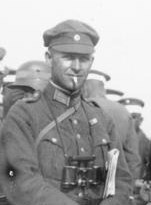
View on WikipediaFerdinand Alfred Friedrich Jodl (28 November 1896 – 9 June 1956) was a German general during World War II who commanded the Mountain Corps Norway during the Petsamo–Kirkenes Offensive. He was the younger brother of Alfred Jodl, Chief of the Operations Staff of the OKW. He was the nephew of philosopher and psychologist Friedrich Jodl at the University of Vienna.[1]
Key Information


Life and career
[edit]
Ferdinand Jodl entered the Imperial German Army in August 1914 as an ensign, serving as a Leutnant in a Bavarian Field Artillery Regiment from 1915 until the end of World War I. He remained in the army after 1918, becoming a general staff officer. In this capacity he served with XII Corps in the early part of World War II, then moving to XXXXIX Mountain Corps. From 1942 he served in Finland and North Norway, first as chief of staff of the 20th Mountain Army, then as commander of the XIX Mountain Corps,[2] receiving the Knight's Cross of the Iron Cross for his command of this corps in January 1945.[3] He ended the war as commander of German forces in North Norway, grouped under the name Army Detachment Narvik, having attained the rank of General of Mountain Troops.[2]
Ferdinand Jodl died in Essen on 9 June 1956, aged 59 and was buried on Frauenchiemsee in Bavaria.[4]
Awards and decorations
[edit]- Knight's Cross of the Iron Cross on 13 January 1945 as General der Gebirgstruppe and commander of XIX. Gebirgskorps[3]
References
[edit]Citations
[edit]- ^ Jodl, Alfred (1946). "A Short Historical Consideration of German War Guilt". In Office of United States Chief of Counsel For Prosecution of Axis Criminality (ed.). Nazi Conspiracy and Aggression, Volume VIII (PDF). Washington: U.S. Government Printing Office. p. 663.
- ^ a b Lucas 1980, p. 214.
- ^ a b Fellgiebel 2000, p. 201.
- ^ See: Jodl family grave, Frauenchiemsee.
Bibliography
[edit]- Fellgiebel, Walther-Peer (2000) [1986]. Die Träger des Ritterkreuzes des Eisernen Kreuzes 1939–1945 — Die Inhaber der höchsten Auszeichnung des Zweiten Weltkrieges aller Wehrmachtteile [The Bearers of the Knight's Cross of the Iron Cross 1939–1945 — The Owners of the Highest Award of the Second World War of all Wehrmacht Branches] (in German). Friedberg, Germany: Podzun-Pallas. ISBN 978-3-7909-0284-6.
- Lucas, James (1980). Alpine Elite: German Mountain Troops of World War II. Jane's Publishing. ISBN 0531037134.
| International | |
|---|---|
| National | |
| People | |


Ferdinand Jodl
View on GrokipediaFerdinand Alfred Friedrich Jodl (23 November 1896 – 9 June 1956) was a German Wehrmacht officer who rose to the rank of General der Gebirgstruppe and commanded formations in northern Europe during World War II.[1]
Born out of wedlock as Ferdinand Baumgärtler in Landau, Bavaria, to Therese Baumgärtler and artillery officer Johannes Jodl—who later married and legitimized their children—he adopted the Jodl surname and pursued a military career, becoming the younger brother of Alfred Jodl, Chief of the Operations Staff of the Oberkommando der Wehrmacht.[2][3] His early service included staff roles in the XII Corps during the invasion of France and the Low Countries.[1]
Jodl's wartime assignments focused on the Eastern Front and Scandinavia, serving as Chief of Staff for the II Mountain Corps, Army Lapland, and the 20th Mountain Army before taking command of the XIX Mountain Corps in September 1944 and Army Detachment Narvik in December 1944, where his forces conducted rearguard actions against the Soviet Petsamo-Kirkenes Offensive.[1][4] Captured at war's end, he remained a prisoner until July 1947 without facing war crimes prosecution, unlike his brother.[1] He died in Bavaria at age 59.[1]
Early Life
Birth and Family Background
Ferdinand Alfred Friedrich Jodl was born on 28 November 1896 in Landau, Bavaria, within the German Empire.[2][5] He was the younger son of Johannes Jodl, a captain (Hauptmann) in the Bavarian artillery, and Theresia Baumgärtler.[3][6] The family maintained a tradition of military service, reflected in the father's career in the Bavarian Army, though details of their socioeconomic status remain limited beyond this professional context.[3] Jodl's older brother, Alfred Josef Ferdinand Jodl, born in 1890, shared the same parents and later rose to prominence as a general in the Wehrmacht's high command during World War II.[3][6] The brothers' early family environment, centered in Bavaria, emphasized discipline and military values, though no primary records detail specific childhood influences or relocations immediately following Ferdinand's birth.[2]Initial Education and Influences
Ferdinand Jodl underwent initial military education through the Bavarian cadet system, completing his Kadettenausbildung prior to enlisting in the Imperial German Army.[7] Born into a family with a strong military tradition—his father, Johannes Jodl, was a retired lieutenant colonel in the artillery—this background likely directed Jodl toward a career in the officer corps from an early age.[2] The structured discipline and tactical focus of cadet training emphasized artillery proficiency and leadership, aligning with the professional standards of the pre-war Bavarian Army.[7] Jodl's influences were predominantly familial and institutional, shaped by his father's service in the artillery and the broader Prussian-Bavarian military culture that prioritized hierarchical obedience and technical expertise in gunnery.[2] His older brother Alfred, who had graduated from the Munich Cadet School in 1910 and pursued a similar path, may have reinforced these orientations, though Ferdinand's training occurred amid escalating European tensions leading to World War I.[8] No evidence indicates significant non-military intellectual pursuits in his formative years; instead, the cadet curriculum's emphasis on practical warfare preparation dominated his early development.[7]Military Career Before World War II
World War I Enlistment and Service
Ferdinand Jodl enlisted in the Bavarian Army on 15 August 1914, shortly after the outbreak of World War I, as a Fähnrich (officer cadet) assigned to the 4th Bavarian Field Artillery Regiment.[2][9] He underwent initial training, including a detachment to the Fähnrich course at Jüterbog from 16 October to 25 November 1914, before returning to regimental duties.[9] From 7 March 1915, Jodl served as battery officer in the 3rd Battery of the 4th Bavarian Field Artillery Regiment, a role he held until 5 November 1917, primarily supporting infantry operations on the Western Front through artillery fire support.[9] During this period, he received a brief detachment to the 16th Assault Battalion from 18 June to 29 June 1917, exposing him to stormtrooper tactics amid the evolving nature of trench warfare.[9] Following a transfer to the II Replacement Battalion of his regiment from November 1917 to January 1918, he resumed battery officer duties, advancing to temporary battery leader from 6 August to 15 August 1918.[9] Jodl was promoted to Leutnant on 15 November 1915, reflecting his competence in artillery command amid the regiment's engagements.[2] Toward the war's end, from 23 September 1918, he served as temporary ordnance officer on the regimental staff, continuing in that capacity until the armistice on 11 November 1918 and briefly beyond into 1919.[9] For his service, Jodl received the Iron Cross, Second Class on 20 October 1915, the Bavarian Military Merit Order, Fourth Class with Swords on 6 March 1916, and the Iron Cross, First Class on 2 June 1918, indicating recognition for bravery and leadership in sustained frontline artillery operations.[2][9] These decorations were typical for officers demonstrating effectiveness in the grueling conditions of prolonged positional warfare, though specific actions tied to each award remain undocumented in available records.[2]Interwar Assignments in the Reichswehr
After the conclusion of World War I, Ferdinand Jodl continued his military service in the Reichswehr, initially assigned to the Reichswehr-Artillerie-Regiment 21.[2] On 31 August 1920, he transferred to the 7th (Bavarian) Artillery Regiment, part of the 7th Division (Bavarian) headquartered in Munich.[2] Jodl received promotion to Oberleutnant on 1 April 1925, reflecting the deliberate pace of advancement in the Treaty of Versailles-constrained Reichswehr, capped at 100,000 personnel with prohibitions on heavy armaments and general staff activities.[2] His assignments remained focused on artillery operations and training within the Bavarian regiment, emphasizing tactical development under international restrictions. On 1 February 1931, he advanced to Hauptmann.[2] By summer 1934, Jodl assumed the role of battery commander in the 7th (Bavarian) Artillery Regiment, overseeing a unit of approximately 150-200 men equipped with light field guns compliant with Versailles limitations.[7] This position aligned with the early phases of German rearmament, as the Reichswehr expanded beyond treaty bounds starting 1 October 1934, setting the stage for Jodl's subsequent specialization in mountain artillery units.[7]World War II Service
Staff Roles in Early Campaigns
In 1938, Ferdinand Jodl assumed the role of Chief of Operations (Ia) for the XII Army Corps, commanded by General der Infanterie Walther von Reichenau (later succeeded by others), positioning him as a key staff officer responsible for operational planning and coordination at the corps level.[1] [10] This assignment placed him directly involved in the preparations and execution of Germany's initial offensive operations at the outset of World War II. As Oberstleutnant since January 1, 1939, Jodl contributed to the corps' integration into Army Group South under Gerd von Rundstedt for the invasion of Poland, which commenced on September 1, 1939, with XII Corps advancing from Silesia toward the Polish heartland as part of the 8th Army's sector.[2] His staff duties encompassed logistical assessments, troop movements, and tactical synchronization, supporting the rapid encirclement maneuvers that led to the fall of Warsaw by September 27, 1939, though specific personal contributions beyond standard staff functions remain undocumented in primary records.[1] Following the Polish campaign, Jodl continued in his Ia role through early 1940, aiding XII Corps' repositioning for the Western offensive. On May 10, 1940, as part of Army Group A under Gerd von Rundstedt, the corps—now under General der Kavallerie Erich Hoepner—participated in the critical Ardennes thrust, with Jodl overseeing operational directives that facilitated the corps' breakthrough across the Meuse River near Sedan on May 13, 1940, enabling Panzer Group Kleist's exploitation toward the Channel.[1] This phase highlighted the effectiveness of corps-level staff coordination in exploiting blitzkrieg tactics, contributing to the encirclement of Allied forces at Dunkirk by late May. On June 1, 1940, amid the ongoing campaign, Jodl transitioned to Chief of Staff (Ib) for XII Corps, a promotion reflecting his prior performance and assuming broader responsibilities for administrative and supply oversight until October 25, 1940.[1] These roles underscored his expertise in high-tempo staff work during the Wehrmacht's successful early conquests, though later assignments shifted him toward mountain warfare specialization.[10]Deployment to Norway and Mountain Warfare
In January 1942, Ferdinand Jodl, then a colonel, was assigned as Chief of Staff to the Army of Lapland (later redesignated as the 20th Mountain Army under General Eduard Dietl), operating in the northern Finnish Lapland region adjacent to North Norway.[11] [1] This deployment marked his entry into high-level staff duties in the Arctic theater, where German forces conducted mountain and winter warfare against Soviet incursions along the frontier.[1] The 20th Mountain Army, comprising elite Gebirgstruppe (mountain troops) units such as the 6th Mountain Division, emphasized specialized tactics including ski-mounted infantry, pack mules for supply in rugged terrain, and fortified positions in fjords and tundra to counter Soviet probes and maintain the nickel-rich Petsamo (Pechenga) area's defenses.[12] Jodl served as Chief of Staff of the 20th Mountain Army from 22 June 1942 until 1 March 1944, coordinating operations amid harsh subzero temperatures, perpetual winter darkness, and logistical challenges posed by the mountainous and forested landscape.[1] His role involved planning defensive maneuvers and supply lines across the Finland-Norway border, where mountain warfare demanded acclimatization to extreme cold—often below -40°C—and navigation through impassable bogs and steep escarpments, with troops relying on lightweight artillery and close air support from Luftwaffe units.[13] These efforts stabilized the front until the Finnish armistice with the Soviet Union in September 1944, forcing a German withdrawal southward into Norway.[12] Promoted to Generalleutnant on 1 September 1943 and subsequently to General der Gebirgstruppe on 1 September 1944, Jodl assumed acting command of the XIX Mountain Corps (also known as Gebirgskorps Norwegen) on 21 April 1944, taking full command by 1 September.[1] [14] The corps, including the 2nd and 6th Mountain Divisions, defended the Petsamo-Kirkenes sector during the Soviet offensive launched on 15 October 1944, employing delaying tactics such as rearguard actions along rivers like the Titovka and West Litsa, where troops used mountain ridges for defensive leverage and conducted fighting withdrawals over 400 kilometers of arctic terrain to evade encirclement.[12] [13] Jodl's leadership emphasized corps-level flexibility in mountain environments, preserving combat effectiveness despite ammunition shortages and Soviet numerical superiority of approximately 3:1 in infantry.[13] By 1 December 1944, Jodl transitioned to acting command of Army Detachment Narvik in North Norway, overseeing the final phases of the German retreat and scorched-earth measures to deny infrastructure to advancing Soviet and Norwegian forces, while maintaining order among units in the fjord-dotted coastal mountains until the capitulation on 8 May 1945.[1] This command highlighted the Gebirgstruppe's doctrine of mobility in vertical terrain, with Jodl directing demolitions of rail lines and ports like Narvik to impede pursuit, though the detachment inflicted significant casualties on Soviet troops through ambushes in narrow passes.[13] His service underscored the Wehrmacht's adaptation of alpine warfare principles to subarctic conditions, prioritizing endurance training and decentralized command to mitigate the isolating effects of fog-shrouded peaks and frozen waterways.[1]Command of Mountain Corps Norway
Ferdinand Jodl assumed acting command of the XIX Mountain Corps, also designated Mountain Corps Norway (Gebirgskorps Norwegen), on 21 April 1944, with the unit subordinated to the 20th Mountain Army responsible for the Arctic front in northern Finland and Norway.[1] The corps comprised elite mountain infantry divisions adapted for harsh winter terrain, including the 2nd and 6th Mountain Divisions alongside coastal defense elements, totaling approximately 56,000 personnel as of July and September 1944.[13] Jodl, promoted to General der Gebirgstruppe on 1 September 1944, directed defensive preparations along fortified lines northwest of Murmansk, anticipating Soviet pressure following Finland's armistice with the USSR on 19 September 1944.[1] [2] The corps' primary challenge arose during the Soviet Petsamo-Kirkenes Offensive, initiated by the 14th Army on 7 October 1944 with a 97,000-round artillery barrage targeting German positions covering Petsamo, Luostari, and the Murmansk axis.[13] Jodl's forces, outnumbered roughly five-to-one by Soviet attackers incorporating naval infantry for amphibious assaults, held initial strongpoints but suffered rapid breakthroughs by 9 October due to enveloping maneuvers and air superiority disrupting German wire communications.[2] [13] On 8 October, Jodl secured authorization from 20th Mountain Army commander Colonel-General Lothar Rendulic to withdraw the battered 6th Mountain Division to the Titovka River line, executing the maneuver nocturnally over 14 days to salvage supplies amid encirclement threats.[13] A planned corps-level counterattack on 10 October was deferred to 11 October owing to unit dispersal from flanking penetrations.[13] By 13 October, with Soviet forces infiltrating the Tarnet Road and threatening total envelopment, Jodl requested and obtained permission to retreat westward into Norway, deploying combat elements of the 6th Mountain Division against Soviet engineer detachments to secure the route.[13] This enabled 15,000 to 18,000 troops to disengage, though the corps incurred 5,300 to 6,000 casualties; Soviet advances captured Petsamo on 15 October and Kirkenes on 25 October, pursuing to the Tana Fjord (halted 30 October) and Ivalo (halted 2 November).[13] Jodl's conduct in these outnumbered defensive battles earned him the Knight's Cross of the Iron Cross with Oak Leaves on 26 October 1944.[2] Post-withdrawal, the corps regrouped in northern Norway for static defense against further Soviet incursions, transitioning under Army Detachment Narvik by 1 December 1944 while retaining its mountain warfare focus.[1] Jodl maintained oversight until the German surrender in the theater on 8 May 1945, after which remaining forces capitulated without major engagements.[13] The command period underscored the corps' resilience in extreme Arctic conditions but highlighted vulnerabilities to Soviet massed artillery and maneuver in the post-Finnish armistice phase.[13]Post-War Period
Immediate Aftermath of Defeat
In the final days of the European war, Ferdinand Jodl served as acting General Officer Commanding Army Detachment Narvik, overseeing German forces in northern Norway amid the broader collapse of the Wehrmacht. On 8 May 1945, following the unconditional surrender of all German armed forces proclaimed by Karl Dönitz, subordinate commands in Norway—including Jodl's detachment—received orders to cease hostilities and capitulate to Allied and Norwegian representatives. Jodl directed his units, part of the 20th Mountain Army's remnants, to lay down arms, contributing to the orderly surrender of approximately 350,000 German personnel across Norway, one of the largest intact formations to capitulate without combat at war's end.[1][15] Jodl formally ended his active service and surrendered personally on 9 May 1945, after which he was detained by Allied forces as a prisoner of war. This internment reflected standard procedures for high-ranking Wehrmacht officers in occupied territories, with Jodl held in custody pending denazification and potential war crimes investigations. Unlike his brother Alfred Jodl, who signed the Reims surrender and faced immediate arrest leading to trial, Ferdinand encountered no prompt indictment for atrocities, though his command's prior scorched-earth withdrawals from Finland in 1944 had drawn scrutiny. He remained in POW status through the initial occupation phase, during which Norwegian authorities managed the demobilization and repatriation of German troops amid concerns over sabotage and resistance holdouts.[1]Later Life and Death
Following his capture by British forces on May 8, 1945, amid the unconditional surrender of German forces in Norway, Ferdinand Jodl spent over two years as a prisoner of war.[1] He was released on July 2, 1947, after which he returned to civilian life in West Germany without facing prosecution at the Nuremberg trials, unlike his brother Alfred.[1] [7] Jodl died on June 9, 1956, in Essen, North Rhine-Westphalia, at age 59.[2] [4] He was interred at the Friedhof Frauenchiemsee on Herrenchiemsee island in Bavaria.[4]Awards and Recognition
Key German Military Decorations
Ferdinand Jodl received the Iron Cross, Second Class, during his service in World War I with the Bavarian artillery.[16] He was subsequently awarded the Iron Cross, First Class, on 2 June 1918 for gallantry in action.[2] In recognition of his World War I service, Jodl was granted the Honour Cross of the World War 1914/1918 on 12 January 1935.[16] During the early phase of World War II, he earned the Clasp to the Iron Cross, First Class, on an unspecified date in 1939, affirming renewed combat merit building on his prior decoration.[2] He also received the West Wall Medal for participation in the construction and defense of the Siegfried Line.[2] Jodl's most prominent World War II decoration was the Knight's Cross of the Iron Cross, awarded on 13 January 1945 while serving as General of Mountain Troops and commanding the XIX Mountain Corps.[17] [18] This honor recognized his leadership in defensive operations around Petsamo, where his outnumbered forces held against superior Soviet assaults amid harsh Arctic conditions.[2]Promotions and Ranks Achieved
Ferdinand Jodl advanced through the ranks of the Reichswehr and later the Wehrmacht, reflecting steady progression in staff and command roles during the interwar period and World War II.[2][1] His promotions accelerated amid the expansion of German forces and wartime demands, culminating in the specialist rank of General der Gebirgstruppe, equivalent to a lieutenant general in the mountain troops branch.[1][19] The table below details his key promotions from the early 1930s onward, drawn from personnel records:| Date | Rank |
|---|---|
| 1 February 1931 | Hauptmann |
| 1 January 1936 | Major |
| 1 January 1939 | Oberstleutnant |
| 1 November 1940 | Oberst |
| 1 February 1942 | Generalleutnant (Major General) |
| 1 September 1943 | Generalleutnant (Lieutenant General) |
| 1 September 1944 | General der Gebirgstruppe |