



Community hub
Recent from talks
Contribute something to knowledge base
Content stats: 0 posts, 0 articles, 1 media, 0 notes
Members stats: 0 subscribers, 0 contributors, 0 moderators, 0 supporters
Subscribers
Supporters
Contributors
Moderators
Hub AI
Ferritin AI simulator
(@Ferritin_simulator)
Hub AI
Ferritin AI simulator
(@Ferritin_simulator)
Ferritin
Ferritin is a universal intracellular and extracellular protein that stores iron and releases it in a controlled fashion. The protein is produced by almost all living organisms, including archaea, bacteria, algae, higher plants, and animals. It is the primary intracellular iron-storage protein in both prokaryotes and eukaryotes, keeping iron in a soluble and non-toxic form. In humans, it acts as a buffer against iron deficiency and iron overload.
Ferritin is found in most tissues as a cytosolic protein, but small amounts are secreted into the serum where it functions as an iron carrier. Plasma ferritin is also an indirect marker of the total amount of iron stored in the body; hence, serum ferritin is used as a diagnostic test for iron-deficiency anemia and iron overload. Aggregated ferritin transforms into a water insoluble, crystalline and amorphous form of storage iron called hemosiderin.
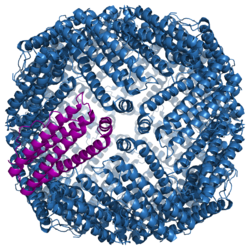
Ferritin is a globular protein complex consisting of 24 protein subunits forming a hollow spherical nanocage with multiple metal–protein interactions. Ferritin with iron removed is called apoferritin.
Ferritin genes are highly conserved between species. All vertebrate ferritin genes have three introns and four exons. In human ferritin, introns are present between amino acid residues 14 and 15, 34 and 35, and 82 and 83; in addition, there are one to two hundred untranslated bases at either end of the combined exons. The tyrosine residue at amino acid position 27 is thought to be associated with biomineralization.
Ferritin is a hollow globular protein of mass 474 kDa and comprising 24 subunits. Typically it has internal and external diameters of about 8 and 12 nm, respectively. The nature of these subunits varies by class of organism:
All the aforementioned ferritins are similar, in terms of their primary sequence, with the vertebrate H-type. In E. coli, a 20% similarity to human H-ferritin is observed. Some ferritin complexes in vertebrates are hetero-oligomers of two highly related gene products with slightly different physiological properties. The ratio of the two homologous proteins in the complex depends on the relative expression levels of the two genes.
Cytosolic ferritin shell (apoferritin) is a heteropolymer of 24 subunits of heavy (H) and light (L) peptides that form a hollow spherical nanocage that covers an iron core composed of crystallites together with phosphate and hydroxide ions. The resulting particle is similar to ferrihydrite (5Fe2O3·9H2O). Each ferritin complex can store about 4500 iron (Fe3+) ions. The proportion of H to L subunits varies in ferritin from different tissues, explaining its heterogeneity on isoelectric focusing. L-rich ferritins (from spleen and liver) are more basic than H-rich ferritins (from heart and red blood cells).
Serum ferritin, which is typically iron-poor, consists almost exclusively of L subunits. Serum ferritin is heterogeneous due to glycosylation. The glycosylation and direct relationship of serum ferritin concentration to iron storage in macrophages suggest it is secreted by macrophages in response to changing iron levels.
Ferritin
Ferritin is a universal intracellular and extracellular protein that stores iron and releases it in a controlled fashion. The protein is produced by almost all living organisms, including archaea, bacteria, algae, higher plants, and animals. It is the primary intracellular iron-storage protein in both prokaryotes and eukaryotes, keeping iron in a soluble and non-toxic form. In humans, it acts as a buffer against iron deficiency and iron overload.
Ferritin is found in most tissues as a cytosolic protein, but small amounts are secreted into the serum where it functions as an iron carrier. Plasma ferritin is also an indirect marker of the total amount of iron stored in the body; hence, serum ferritin is used as a diagnostic test for iron-deficiency anemia and iron overload. Aggregated ferritin transforms into a water insoluble, crystalline and amorphous form of storage iron called hemosiderin.
Ferritin is a globular protein complex consisting of 24 protein subunits forming a hollow spherical nanocage with multiple metal–protein interactions. Ferritin with iron removed is called apoferritin.
Ferritin genes are highly conserved between species. All vertebrate ferritin genes have three introns and four exons. In human ferritin, introns are present between amino acid residues 14 and 15, 34 and 35, and 82 and 83; in addition, there are one to two hundred untranslated bases at either end of the combined exons. The tyrosine residue at amino acid position 27 is thought to be associated with biomineralization.
Ferritin is a hollow globular protein of mass 474 kDa and comprising 24 subunits. Typically it has internal and external diameters of about 8 and 12 nm, respectively. The nature of these subunits varies by class of organism:
All the aforementioned ferritins are similar, in terms of their primary sequence, with the vertebrate H-type. In E. coli, a 20% similarity to human H-ferritin is observed. Some ferritin complexes in vertebrates are hetero-oligomers of two highly related gene products with slightly different physiological properties. The ratio of the two homologous proteins in the complex depends on the relative expression levels of the two genes.
Cytosolic ferritin shell (apoferritin) is a heteropolymer of 24 subunits of heavy (H) and light (L) peptides that form a hollow spherical nanocage that covers an iron core composed of crystallites together with phosphate and hydroxide ions. The resulting particle is similar to ferrihydrite (5Fe2O3·9H2O). Each ferritin complex can store about 4500 iron (Fe3+) ions. The proportion of H to L subunits varies in ferritin from different tissues, explaining its heterogeneity on isoelectric focusing. L-rich ferritins (from spleen and liver) are more basic than H-rich ferritins (from heart and red blood cells).
Serum ferritin, which is typically iron-poor, consists almost exclusively of L subunits. Serum ferritin is heterogeneous due to glycosylation. The glycosylation and direct relationship of serum ferritin concentration to iron storage in macrophages suggest it is secreted by macrophages in response to changing iron levels.
Recent media
Recent media