Hubbry Logo
Finitely generated moduleFinitely generated moduleMain
Open search
Finitely generated module
Community hub
Finitely generated module
logo
7 pages, 0 posts
0 subscribers
Be the first to start a discussion here.
Finitely generated module
from Wikipedia

In mathematics, a finitely generated module is a module that has a finite generating set. A finitely generated module over a ring R may also be called a finite R-module, finite over R,[1] or a module of finite type.

Related concepts include finitely cogenerated modules, finitely presented modules, finitely related modules and coherent modules all of which are defined below. Over a Noetherian ring the concepts of finitely generated, finitely presented and coherent modules coincide.

A finitely generated module over a field is simply a finite-dimensional vector space, and a finitely generated module over the integers is simply a finitely generated abelian group.

Definition

[edit]

The left R-module M is finitely generated if there exist a1, a2, ..., an in M such that for any x in M, there exist r1, r2, ..., rn in R with x = r1a1 + r2a2 + ... + rnan.

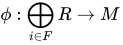
The set {a1, a2, ..., an} is referred to as a generating set of M in this case. A finite generating set need not be a basis, since it need not be linearly independent over R. What is true is: M is finitely generated if and only if there is a surjective R-linear map:

for some n; in other words, M is a quotient of a free module of finite rank.

If a set S generates a module that is finitely generated, then there is a finite generating set that is included in S, since only finitely many elements in S are needed to express the generators in any finite generating set, and these finitely many elements form a generating set. However, it may occur that S does not contain any finite generating set of minimal cardinality. For example the set of the prime numbers is a generating set of viewed as -module, and a generating set formed from prime numbers has at least two elements, while the singleton{1} is also a generating set.

In the case where the module M is a vector space over a field R, and the generating set is linearly independent, n is well-defined and is referred to as the dimension of M (well-defined means that any linearly independent generating set has n elements: this is the dimension theorem for vector spaces).

Any module is the union of the directed set of its finitely generated submodules.

A module M is finitely generated if and only if any increasing chain Mi of submodules with union M stabilizes: i.e., there is some i such that Mi = M. This fact with Zorn's lemma implies that every nonzero finitely generated module admits maximal submodules. If any increasing chain of submodules stabilizes (i.e., any submodule is finitely generated), then the module M is called a Noetherian module.

Examples

[edit]
  • If a module is generated by one element, it is called a cyclic module.
  • Let R be an integral domain with K its field of fractions. Then every finitely generated R-submodule I of K is a fractional ideal: that is, there is some nonzero r in R such that rI is contained in R. Indeed, one can take r to be the product of the denominators of the generators of I. If R is Noetherian, then every fractional ideal arises in this way.
  • Finitely generated modules over the ring of integers Z coincide with the finitely generated abelian groups. These are completely classified by the structure theorem, taking Z as the principal ideal domain.
  • Finitely generated (say left) modules over a division ring are precisely finite dimensional vector spaces (over the division ring).

Some facts

[edit]

Every homomorphic image of a finitely generated module is finitely generated. In general, submodules of finitely generated modules need not be finitely generated. As an example, consider the ring R = Z[X1, X2, ...] of all polynomials in countably many variables. R itself is a finitely generated R-module (with {1} as generating set). Consider the submodule K consisting of all those polynomials with zero constant term. Since every polynomial contains only finitely many terms whose coefficients are non-zero, the R-module K is not finitely generated.

In general, a module is said to be Noetherian if every submodule is finitely generated. A finitely generated module over a Noetherian ring is a Noetherian module (and indeed this property characterizes Noetherian rings): A module over a Noetherian ring is finitely generated if and only if it is a Noetherian module. This resembles, but is not exactly Hilbert's basis theorem, which states that the polynomial ring R[X] over a Noetherian ring R is Noetherian. Both facts imply that a finitely generated commutative algebra over a Noetherian ring is again a Noetherian ring.

More generally, an algebra (e.g., ring) that is a finitely generated module is a finitely generated algebra. Conversely, if a finitely generated algebra is integral (over the coefficient ring), then it is finitely generated module. (See integral element for more.)

Let 0 → M′ → MM′′ → 0 be an exact sequence of modules. Then M is finitely generated if M′, M′′ are finitely generated. There are some partial converses to this. If M is finitely generated and M′′ is finitely presented (which is stronger than finitely generated; see below), then M′ is finitely generated. Also, M is Noetherian (resp. Artinian) if and only if M′, M′′ are Noetherian (resp. Artinian).

Let B be a ring and A its subring such that B is a faithfully flat right A-module. Then a left A-module F is finitely generated (resp. finitely presented) if and only if the B-module BA F is finitely generated (resp. finitely presented).[2]

Finitely generated modules over a commutative ring

[edit]

For finitely generated modules over a commutative ring R, Nakayama's lemma is fundamental. Sometimes, the lemma allows one to prove finite dimensional vector spaces phenomena for finitely generated modules. For example, if f : MM is a surjective R-endomorphism of a finitely generated module M, then f is also injective, and hence is an automorphism of M.[3] This says simply that M is a Hopfian module. Similarly, an Artinian module M is coHopfian: any injective endomorphism f is also a surjective endomorphism.[4] The Forster–Swan theorem gives an upper bound for the minimal number of generators of a finitely generated module M over a commutative Noetherian ring.

Any R-module is an inductive limit of finitely generated R-submodules. This is useful for weakening an assumption to the finite case (e.g., the characterization of flatness with the Tor functor).

An example of a link between finite generation and integral elements can be found in commutative algebras. To say that a commutative algebra A is a finitely generated ring over R means that there exists a set of elements G = {x1, ..., xn} of A such that the smallest subring of A containing G and R is A itself. Because the ring product may be used to combine elements, more than just R-linear combinations of elements of G are generated. For example, a polynomial ring R[x] is finitely generated by {1, x} as a ring, but not as a module. If A is a commutative algebra (with unity) over R, then the following two statements are equivalent:[5]

  • A is a finitely generated R module.
  • A is both a finitely generated ring over R and an integral extension of R.

Generic rank

[edit]

Let M be a finitely generated module over an integral domain A with the field of fractions K. Then the dimension is called the generic rank of M over A. This number is the same as the number of maximal A-linearly independent vectors in M or equivalently the rank of a maximal free submodule of M (cf. Rank of an abelian group). Since , is a torsion module. When A is Noetherian, by generic freeness, there is an element f (depending on M) such that is a free -module. Then the rank of this free module is the generic rank of M.

Now suppose the integral domain A is an -graded algebra over a field k generated by finitely many homogeneous elements of degrees . Suppose M is graded as well and let be the Poincaré series of M. By the Hilbert–Serre theorem, there is a polynomial F such that . Then is the generic rank of M.[6]

A finitely generated module over a principal ideal domain is torsion-free if and only if it is free. This is a consequence of the structure theorem for finitely generated modules over a principal ideal domain, the basic form of which says a finitely generated module over a PID is a direct sum of a torsion module and a free module. But it can also be shown directly as follows: let M be a torsion-free finitely generated module over a PID A and F a maximal free submodule. Let f be in A such that . Then is free since it is a submodule of a free module and A is a PID. But now is an isomorphism since M is torsion-free.

By the same argument as above, a finitely generated module over a Dedekind domain A (or more generally a semi-hereditary ring) is torsion-free if and only if it is projective; consequently, a finitely generated module over A is a direct sum of a torsion module and a projective module. A finitely generated projective module over a Noetherian integral domain has constant rank and so the generic rank of a finitely generated module over A is the rank of its projective part.

Equivalent definitions and finitely cogenerated modules

[edit]

The following conditions are equivalent to M being finitely generated (f.g.):

  • For any family of submodules {Ni | iI} in M, if , then for some finite subset F of I.
  • For any chain of submodules {Ni | iI} in M, if , then Ni = M for some i in I.
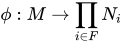
  • If is an epimorphism, then the restriction is an epimorphism for some finite subset F of I.

From these conditions it is easy to see that being finitely generated is a property preserved by Morita equivalence. The conditions are also convenient to define a dual notion of a finitely cogenerated module M. The following conditions are equivalent to a module being finitely cogenerated (f.cog.):

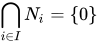
  • For any family of submodules {Ni | iI} in M, if , then for some finite subset F of I.
  • For any chain of submodules {Ni | iI} in M, if , then Ni = {0} for some i in I.
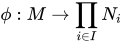
  • If is a monomorphism, where each is an R module, then is a monomorphism for some finite subset F of I.

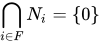
Both f.g. modules and f.cog. modules have interesting relationships to Noetherian and Artinian modules, and the Jacobson radical J(M) and socle soc(M) of a module. The following facts illustrate the duality between the two conditions. For a module M:

  • M is Noetherian if and only if every submodule N of M is f.g.
  • M is Artinian if and only if every quotient module M/N is f.cog.
  • M is f.g. if and only if J(M) is a superfluous submodule of M, and M/J(M) is f.g.
  • M is f.cog. if and only if soc(M) is an essential submodule of M, and soc(M) is f.g.
  • If M is a semisimple module (such as soc(N) for any module N), it is f.g. if and only if f.cog.
  • If M is f.g. and nonzero, then M has a maximal submodule and any quotient module M/N is f.g.
  • If M is f.cog. and nonzero, then M has a minimal submodule, and any submodule N of M is f.cog.
  • If N and M/N are f.g. then so is M. The same is true if "f.g." is replaced with "f.cog."

Finitely cogenerated modules must have finite uniform dimension. This is easily seen by applying the characterization using the finitely generated essential socle. Somewhat asymmetrically, finitely generated modules do not necessarily have finite uniform dimension. For example, an infinite direct product of nonzero rings is a finitely generated (cyclic!) module over itself, however it clearly contains an infinite direct sum of nonzero submodules. Finitely generated modules do not necessarily have finite co-uniform dimension either: any ring R with unity such that R/J(R) is not a semisimple ring is a counterexample.

Finitely presented, finitely related, and coherent modules

[edit]

Another formulation is this: a finitely generated module M is one for which there is an epimorphism mapping Rk onto M :

f : RkM.

Suppose now there is an epimorphism,

φ : FM.

for a module M and free module F.

  • If the kernel of φ is finitely generated, then M is called a finitely related module. Since M is isomorphic to F/ker(φ), this basically expresses that M is obtained by taking a free module and introducing finitely many relations within F (the generators of ker(φ)).
  • If the kernel of φ is finitely generated and F has finite rank (i.e. F = Rk), then M is said to be a finitely presented module. Here, M is specified using finitely many generators (the images of the k generators of F = Rk) and finitely many relations (the generators of ker(φ)). See also: free presentation. Finitely presented modules can be characterized by an abstract property within the category of R-modules: they are precisely the compact objects in this category.
  • A coherent module M is a finitely generated module whose finitely generated submodules are finitely presented.

Over any ring R, coherent modules are finitely presented, and finitely presented modules are both finitely generated and finitely related. For a Noetherian ring R, finitely generated, finitely presented, and coherent are equivalent conditions on a module.

Some crossover occurs for projective or flat modules. A finitely generated projective module is finitely presented, and a finitely related flat module is projective.

It is true also that the following conditions are equivalent for a ring R:

  1. R is a right coherent ring.
  2. The module RR is a coherent module.
  3. Every finitely presented right R module is coherent.

Although coherence seems like a more cumbersome condition than finitely generated or finitely presented, it is nicer than them since the category of coherent modules is an abelian category, while, in general, neither finitely generated nor finitely presented modules form an abelian category.

See also

[edit]

References

[edit]

Textbooks

[edit]
  • Atiyah, M. F.; Macdonald, I. G. (1969), Introduction to commutative algebra, Addison-Wesley Publishing Co., Reading, Mass.-London-Don Mills, Ont., pp. ix+128, MR 0242802
  • Bourbaki, Nicolas (1998), Commutative algebra. Chapters 1--7 Translated from the French. Reprint of the 1989 English translation, Elements of Mathematics, Berlin: Springer-Verlag, ISBN 3-540-64239-0
  • Kaplansky, Irving (1970), Commutative rings, Boston, Mass.: Allyn and Bacon Inc., pp. x+180, MR 0254021
  • Lam, T. Y. (1999), Lectures on modules and rings, Graduate Texts in Mathematics No. 189, Springer-Verlag, ISBN 978-0-387-98428-5
  • Lang, Serge (1997), Algebra (3rd ed.), Addison-Wesley, ISBN 978-0-201-55540-0
  • Matsumura, Hideyuki (1989), Commutative ring theory, Cambridge Studies in Advanced Mathematics, vol. 8, Translated from the Japanese by M. Reid (2 ed.), Cambridge: Cambridge University Press, pp. xiv+320, ISBN 0-521-36764-6, MR 1011461
  • Springer, Tonny A. (1977), Invariant theory, Lecture Notes in Mathematics, vol. 585, Springer, doi:10.1007/BFb0095644, ISBN 978-3-540-08242-2.
Revisions and contributorsEdit on WikipediaRead on Wikipedia
from Grokipedia
In module theory, a finitely generated module over a ring R is an R-module M that can be generated as an R-module by a finite set of elements, meaning every element of M can be expressed as an R-linear combination of these generators. Equivalently, there exists a positive integer n and a surjective R-module homomorphism from the free module R^n onto M. This concept generalizes finite-dimensional vector spaces, where the ring R plays the role of the field, and it forms a foundational notion in and . A stronger condition is that of being finitely presented, which requires not only that M is finitely generated but also that the kernel of the surjection R^n \to M (the module of relations among the generators) is finitely generated as an R-module. This is captured by the existence of an exact sequence R^m \to R^n \to M \to 0 for some integers m and n. Finitely presented modules are preserved under certain operations, such as in short exact sequences: if M_1 and M_3 are finitely presented in 0 \to M_1 \to M_2 \to M_3 \to 0, then so is M_2. Finitely generated modules exhibit particularly rich structure over special classes of rings. Over a R (where every ideal is finitely generated), every submodule of a finitely generated R-module is itself finitely generated, ensuring a form of "finiteness" throughout the module lattice. For principal ideal domains (PIDs) like the integers ℤ or polynomial rings k over a field k, the structure theorem classifies finitely generated modules up to isomorphism: they decompose as a direct sum of a free module of finite rank and a torsion submodule, where the torsion part admits unique decompositions into cyclic modules via invariant factors or elementary divisors. In particular, torsion-free finitely generated modules over PIDs are free. These modules are central to applications in algebraic geometry, representation theory, and number theory, as they model finite phenomena in infinite structures and facilitate computations like syzygies and resolutions.

Basic Concepts

Definition

In abstract algebra, a module MM over a ring RR is called finitely generated if there exists a finite subset {g1,,gn}M\{g_1, \dots, g_n\} \subseteq M such that every element of MM can be expressed as a finite RR-linear combination i=1nrigi\sum_{i=1}^n r_i g_i with riRr_i \in R. Equivalently, MM is finitely generated if there is a surjective RR-module homomorphism RnMR^{\oplus n} \to M for some positive integer nn. The submodule generated by a SMS \subseteq M, denoted S\langle S \rangle, is the smallest submodule of MM containing SS, consisting of all finite RR-linear combinations of elements from SS. Thus, MM is finitely generated if it equals g1,,gn\langle g_1, \dots, g_n \rangle for some {g1,,gn}\{g_1, \dots, g_n\}. The terminology "generated by" refers to this process, where SS generates MM if S=M\langle S \rangle = M. A generating set for MM is any subset whose generated submodule is MM; it is minimal if no proper subset generates MM. The size of a minimal generating set, when it exists, provides about the "dimension" of MM over RR, though it may vary in general rings. The concept of finitely generated modules was introduced by in her foundational work on ideal theory, where she studied rings satisfying the condition that every ideal is finitely generated as a module over the ring. Free modules form a special case of finitely generated modules in which the generators are linearly independent over RR.

Examples

A fundamental class of examples arises when considering abelian groups as modules over the Z\mathbb{Z}. Every is naturally a Z\mathbb{Z}-module, and the finitely generated ones include all finite abelian groups, which decompose as direct sums of s of the form Z/nZ\mathbb{Z}/n\mathbb{Z} for positive integers nn. For instance, the Z/nZ\mathbb{Z}/n\mathbb{Z} is generated by a single element, namely the residue class of 1 modulo nn. Over a field kk, vector spaces provide straightforward examples of finitely generated modules. Any finite-dimensional vector space over kk is a finitely generated kk-module, where a basis of nn vectors serves as a generating set, making the module free of rank nn and isomorphic to knk^n. This highlights how modules over fields simplify to the familiar structure of vector spaces, with the dimension equaling the minimal number of generators. Modules over polynomial rings illustrate more varied behavior. For a field kk, the quotient ring k/(f(x))k/(f(x)), where f(x)f(x) is a of finite degree, is a finitely generated kk-module, generated by the residue class of 1. Such modules are torsion, with the annihilator ideal generated by f(x)f(x), and they model cyclic actions, such as those arising from linear transformations on vector spaces via the rational canonical form. Free modules of finite rank offer canonical examples across rings. For any ring RR, the module RnR^n (or equivalently, the space of n×1n \times 1 column vectors over RR, or row vectors) is free and finitely generated by the standard basis vectors e1,,ene_1, \dots, e_n. More generally, the module of m×nm \times n matrices over RR is isomorphic to RmnR^{mn} as an RR-module and thus finitely generated. Not all finitely generated modules are free, as seen in the Z\mathbb{Z}-module Z/6Z\mathbb{Z}/6\mathbb{Z}, which is generated by a single element but torsion, hence not free since it has nonzero elements annihilated by 6. This contrasts with free modules, where no nonzero element has a nonzero annihilator. To appreciate the finite generation condition, consider the rational numbers Q\mathbb{Q} as a Z\mathbb{Z}-module, which is not finitely generated. Any finite set of rationals has a common denominator, so the submodule they generate consists of fractions with bounded denominators, failing to span all of Q\mathbb{Q}, which requires infinitely many generators like {1/pkp prime,k1}\{1/p^k \mid p \text{ prime}, k \geq 1\}.

General Properties

Basic Properties

A finitely generated module over an arbitrary ring possesses several fundamental closure properties that facilitate its study in and . Specifically, if MM is a finitely generated RR-module and NMN \subseteq M is a submodule, then the module M/NM/N is also finitely generated, as it is generated by the images of the finite set of generators of MM. In contrast, submodules of finitely generated modules are not necessarily finitely generated over arbitrary rings; a counterexample arises with the polynomial ring R=k[x1,x2,]R = k[x_1, x_2, \dots] in countably infinitely many variables over a field kk, where RR itself is finitely generated (by 11) but the ideal (x1,x2,)(x_1, x_2, \dots) is not. The image of a finitely generated module under any RR-module homomorphism is also finitely generated. If f:MNf: M \to N is a with MM finitely generated, then imfM/kerf\operatorname{im} f \cong M / \ker f, and since quotients preserve finite generation, imf\operatorname{im} f inherits this property. Finite direct sums of finitely generated modules are finitely generated. If M1,,MkM_1, \dots, M_k are finitely generated RR-modules, then M1MkM_1 \oplus \cdots \oplus M_k is generated by the union of the finite generating sets of each MiM_i. Regarding tensor products, the tensor product of two finitely generated modules over RR is finitely generated, but the tensor product of a finitely generated module with an arbitrary module need not be. For instance, over R=ZR = \mathbb{Z}, the module Z\mathbb{Z} is finitely generated, but ZZQQ\mathbb{Z} \otimes_{\mathbb{Z}} \mathbb{Q} \cong \mathbb{Q}, and Q\mathbb{Q} is not finitely generated as a Z\mathbb{Z}-module since it requires infinitely many elements like 1/n1/n for nNn \in \mathbb{N} to generate the denominators. Finally, a finitely generated module over a field kk is a finite-dimensional over kk. Since kk is a , any finitely generated kk-module is free of finite rank, equivalent to having finite .

Equivalent Characterizations

A module MM over a ring RR admits several equivalent characterizations as a finitely generated module. One standard reformulation is that MM is finitely generated if and only if there exists a positive nn such that MM is isomorphic to a of the free RR-module RnR^n. This perspective emphasizes the finite "type" of the module, aligning with the notion in where a quasicoherent sheaf on an affine scheme Spec(R)\operatorname{Spec}(R) is of finite type precisely when the corresponding RR-module is finitely generated. The dual concept to finite generation is that of a finitely cogenerated module, defined dually via the intersection property on submodules: MM is finitely cogenerated if every family of submodules of MM whose intersection is zero admits a finite subfamily whose intersection is also zero. Equivalently, MM embeds as a submodule into a finite direct power of an injective cogenerator in the category of RR-modules. In general, finite generation and finite cogeneration are distinct notions—a module may satisfy one without the other—though they coincide for modules of finite length over artinian rings, where such modules are both finitely generated and artinian (hence finitely cogenerated). Over a RR, finite generation admits a further equivalent in terms of finite : MM is finitely generated if and only if it is finitely presented, meaning there exists a surjection RnMR^n \twoheadrightarrow M whose kernel is also finitely generated as an RR-module. The forward implication holds because submodules of finitely generated modules over Noetherian rings are themselves finitely generated; the converse is true over any ring.

Modules over Special Rings

Over Principal Ideal Domains

Over a principal ideal domain RR, every finitely generated RR-module MM admits a complete via the structure theorem, which decomposes MM into a of cyclic modules. Specifically, there exist nonnegative integers rr and kk, along with nonzero elements d1,,dkRd_1, \dots, d_k \in R such that d1d2dkd_1 \mid d_2 \mid \cdots \mid d_k and MRrR/(d1)R/(dk).M \cong R^r \oplus R/(d_1) \oplus \cdots \oplus R/(d_k). This decomposition into invariant factors is unique up to units in RR, meaning the did_i are determined up to multiplication by units. An alternative presentation, known as the elementary divisor form, decomposes the torsion part into primary cyclic components. Here, MM is isomorphic to RrpR/(pep,1)R/(pep,mp)R^r \oplus \bigoplus_p R/(p^{e_{p,1}}) \oplus \cdots \oplus R/(p^{e_{p,m_p}}), where the sum is over prime elements pp of RR (up to units), and for each pp, the exponents satisfy 1ep,1ep,mp1 \leq e_{p,1} \leq \cdots \leq e_{p,m_p}. This form is also unique, with the exponents for each prime uniquely determined. The proof relies on the fact that finitely generated modules over a PID are finitely presented, allowing a presentation RnM0R^n \twoheadrightarrow M \twoheadrightarrow 0 with relation matrix AMm×n(R)A \in M_{m \times n}(R). Using the Euclidean algorithm and PID properties, AA can be transformed via elementary row and column operations (corresponding to change of bases) into Smith normal form: PAQ=diag(d1,,dt,0,,0)P A Q = \operatorname{diag}(d_1, \dots, d_t, 0, \dots, 0), where P,QP, Q are invertible over RR, tmin(m,n)t \leq \min(m,n), and d1dtd_1 \mid \cdots \mid d_t. This diagonal form directly yields the invariant factor decomposition of MM, with the free rank r=ntr = n - t and torsion invariants did_i. A key application is the separation of MM into its torsion-free part RrR^r, which is free of rank rr (the minimal number of generators modulo torsion), and its torsion submodule T(M)i=1kR/(di)T(M) \cong \bigoplus_{i=1}^k R/(d_i), consisting of elements annihilated by nonzero elements of RR. The rank rr equals dimK(MRK)\dim_{K} (M \otimes_R K), where KK is the fraction field of RR. A prominent example arises when R=ZR = \mathbb{Z}, the ring of integers, classifying all finitely generated abelian groups. Finite abelian groups correspond to the torsion case (r=0r=0), decomposing uniquely as Z/d1ZZ/dkZ\mathbb{Z}/d_1\mathbb{Z} \oplus \cdots \oplus \mathbb{Z}/d_k\mathbb{Z} with d1dk>1d_1 \mid \cdots \mid d_k > 1, or equivalently into primary cyclic summands like Z/pe1ZZ/pemZ\mathbb{Z}/p^{e_1}\mathbb{Z} \oplus \cdots \oplus \mathbb{Z}/p^{e_m}\mathbb{Z} for primes pp.

Over Commutative Rings

When the underlying ring RR is commutative, finitely generated modules exhibit additional and satisfy specialized theorems that leverage the commutativity to provide deeper insights into their , support, and resolutions. These properties often rely on the interaction between ideals and modules, particularly in or Noetherian settings, enabling tools like localization and completion to analyze module behavior at prime ideals. A fundamental result in this context is , which addresses the generation of modules over local commutative rings. Specifically, let (R,m)(R, \mathfrak{m}) be a local commutative ring with m\mathfrak{m}, and let MM be a finitely generated RR-module. If mM=M\mathfrak{m}M = M, then M=0M = 0. More generally, for any ideal Irad(R)I \subseteq \mathrm{rad}(R) (the Jacobson radical of RR) and finitely generated MM, if IM=MIM = M, then M=0M = 0; dually, if M/IM=0M/IM = 0, then M=0M = 0. This lemma has key corollaries, such as the fact that a set of generators of MM modulo mM\mathfrak{m}M lifts to a generating set for MM itself, ensuring that minimal generating sets can be studied via Nakayama's criterion. Another corollary implies that surjective homomorphisms between finitely generated modules over local rings remain surjective after modding out by the , facilitating the study of module ranks and freeness. In commutative settings, the support of a finitely generated module MM over RR, defined as Supp(M)={pSpec(R)Mp0}\mathrm{Supp}(M) = \{\mathfrak{p} \in \mathrm{Spec}(R) \mid M_\mathfrak{p} \neq 0\}, coincides with the closed set V(AnnR(M))V(\mathrm{Ann}_R(M)) in the , where AnnR(M)\mathrm{Ann}_R(M) is the annihilator ideal of MM. When RR is Noetherian, the associated primes of MM, denoted AssR(M)={pSpec(R)p=AnnR(M/N) for some NM}\mathrm{Ass}_R(M) = \{\mathfrak{p} \in \mathrm{Spec}(R) \mid \mathfrak{p} = \mathrm{Ann}_R(M/N) \text{ for some } N \subset M\}, form a finite nonempty set if M0M \neq 0, and the support is the closure of this set. This finiteness implies that finitely generated modules over Noetherian commutative rings admit finite chains of prime ideals containing their annihilators, and in cases where MM has finite length (e.g., when supported at a single ), these chains correspond to of bounded length. Over s, provides a bound on the complexity of resolutions for finitely generated modules. Let kk be a field and R=k[x1,,xn]R = k[x_1, \dots, x_n] a in nn variables. Then every finitely generated RR-module MM admits a free resolution of length at most nn, meaning there exists an 0FnF1F0M00 \to F_n \to \cdots \to F_1 \to F_0 \to M \to 0 where each FiF_i is a free RR-module. This finite projectivity depth highlights the regular nature of s and underpins computational methods in , such as Gröbner bases for syzygy computations. For Noetherian commutative rings, finitely generated modules inherit the Noetherian property: if RR is Noetherian, then any finitely generated RR-module MM is Noetherian, meaning every submodule of MM is finitely generated. This follows from the fact that submodules of finitely generated modules over Noetherian rings remain finitely generated, ensuring ascending conditions on submodules. Dually, over Artinian commutative rings (which are necessarily Noetherian and of finite as modules over themselves), every finitely generated module is Artinian, satisfying descending conditions on submodules. In this Artinian case, such modules have finite , providing a symmetric counterpart to the Noetherian structure and enabling decomposition into semisimple components.

Advanced Notions

Generic Rank

For a finitely generated module MM over an RR with KK, the generic rank of MM, denoted rank(M)\operatorname{rank}(M), is defined as the of the [K](/page/K)[K](/page/K)- MRKM \otimes_R K. This invariant captures the "linear" of MM after extending scalars to the fraction field, effectively ignoring torsion elements since the torsion submodule of MM becomes zero upon tensoring with [K](/page/K)[K](/page/K).[](https://people.brandeis.edu/~jbellaic/number theory/refresher.pdf) The generic rank is an additive invariant: if M=NPM = N \oplus P, then rank(M)=rank(N)+rank(P)\operatorname{rank}(M) = \operatorname{rank}(N) + \operatorname{rank}(P). It relates directly to the torsion-free rank of MM, which is the rank of the quotient M/tors(M)M / \operatorname{tors}(M), where tors(M)\operatorname{tors}(M) denotes the submodule of torsion elements; indeed, MRK(M/tors(M))RKM \otimes_R K \cong (M / \operatorname{tors}(M)) \otimes_R K. Over the spectrum of RR, this rank is constant at the generic point corresponding to the zero ideal, providing a uniform measure across the "general" behavior of the module.[](https://people.brandeis.edu/~jbellaic/number theory/refresher.pdf) When RR is a (PID), the structure theorem for finitely generated modules asserts that MRrTM \cong R^r \oplus T, where r0r \geq 0 is the free rank and TT is a torsion module; in this case, the generic rank equals rr. For example, over R=ZR = \mathbb{Z}, any MM decomposes as ZrT\mathbb{Z}^r \oplus T with TT finite, and rank(M)=r\operatorname{rank}(M) = r. In , the generic rank of a finitely generated module over the coordinate ring of an integral variety corresponds to the rank of the associated at the , determining the generic of coherent sheaves. This connection underpins the study of s on schemes, where locally free modules of constant rank model algebraic s.

Finitely Presented Modules

A module MM over a ring RR is finitely presented if there exists a finite rank free resolution, meaning an F1F0M0F_1 \to F_0 \to M \to 0 where F0F_0 and F1F_1 are free RR-modules of finite rank. This presentation arises from choosing a finite generating set for MM and then accounting for the finite set of relations among those generators. Finitely presented modules are necessarily finitely generated, as the surjection from the finite F0F_0 onto MM implies MM admits a finite generating set. However, the converse does not hold in general. For instance, consider the R=k[x1,x2,]R = k[x_1, x_2, \dots] in countably infinitely many variables over a field kk; the ideal I=(x1,x2,)I = (x_1, x_2, \dots) is not finitely generated, so the module M=R/IkM = R/I \cong k is finitely generated (by the image of 1) but not finitely presented, since any presentation would require the relation module to be finitely generated, which II is not. Key properties of finitely presented modules include stability under extensions: in a short exact sequence 0M1M2M300 \to M_1 \to M_2 \to M_3 \to 0 of RR-modules, if M1M_1 and M3M_3 are finitely presented, then so is M2M_2. Moreover, over a Noetherian ring RR, every finitely generated module is finitely presented, because submodules of finitely generated modules (including relation modules) are themselves finitely generated. Examples of finitely presented modules include all projective modules of finite rank, as such a module PP admits a presentation 00FP00 \to 0 \to F \to P \to 0 with FF finite free, or more generally, any quotient of a finite free module by a finitely generated submodule. For instance, cyclic modules R/IR/I where II is a finitely generated ideal are finitely presented. Finitely presented modules are precisely the finitely related modules, meaning those for which there exists a finite generating set whose relations form a finitely generated submodule of the on those generators. A finitely related module over a ring RR is one that admits a FM0F \twoheadrightarrow M \to 0, where FF is a RR-module (possibly of infinite rank) and the kernel of the surjection is finitely generated as an RR-submodule. This notion generalizes finitely presented modules, as the latter are precisely the finitely related modules that are also finitely generated. Coherent rings provide a setting where properties of finitely generated ideals align with finite presentations. A ring RR is coherent if every finitely generated ideal of RR is finitely presented as an RR-module. Equivalently, RR is coherent if it is coherent as a module over itself, meaning RR is finitely generated (trivially) and every finitely generated submodule (i.e., ideal) is finitely presented. Noetherian rings are coherent, since finitely generated ideals are finitely generated submodules of free modules of finite rank, hence finitely presented. A module MM over any ring RR is coherent if it is finitely generated and every finitely generated submodule of MM is finitely presented. Coherent modules are always finitely presented, as a surjection from a finitely generated onto MM has a kernel that is finitely generated (arising from finite syzygies ensured by the coherence condition on submodules). Over a coherent ring RR, the notions of coherent and finitely presented modules coincide: every finitely presented module is coherent (true over any ring), and conversely, every coherent module is finitely presented. Examples of coherent rings include the ring of integers Z\mathbb{Z}, which is Noetherian and thus coherent, and polynomial rings k[x1,,xn]k[x_1, \dots, x_n] over a field kk in finitely many variables, which are also Noetherian. Prüfer domains form another class of coherent rings, generalizing Dedekind domains to the non-Noetherian setting while preserving coherence of finitely generated ideals. Over Prüfer domains, finitely generated torsion-free modules exhibit coherent-like behavior, such as being flat, which ties into the ring's coherent structure for module presentations.

Finitely Cogenerated Modules

A module MM over a ring RR is finitely cogenerated if there exists a finite family of RR-modules {U1,,Un}\{ U_1, \dots, U_n \} that cogenerates MM, meaning every nonzero submodule of MM admits a nonzero into at least one UiU_i. Equivalently, MM is finitely cogenerated if for every family of submodules {Nλ}\{ N_\lambda \} of MM with λNλ=0\bigcap_\lambda N_\lambda = 0, there exists a finite subfamily {Nλ1,,Nλk}\{ N_{\lambda_1}, \dots, N_{\lambda_k} \} such that i=1kNλi=0\bigcap_{i=1}^k N_{\lambda_i} = 0. This condition implies that the socle of MM, denoted Soc(M)\operatorname{Soc}(M), is finitely generated as an RR-module and essential in MM, i.e., every nonzero submodule of MM intersects Soc(M)\operatorname{Soc}(M) nontrivially. In the context of duality, finitely cogenerated modules serve as the dual notion to finitely generated modules. Over an , a module is finitely cogenerated if and only if its dual (under the Hom functor with respect to an injective cogenerator) is finitely generated. More precisely, if UU is an injective cogenerator for the category of RR-modules, then the functor HomR(,U)\operatorname{Hom}_R(-, U) establishes a duality between finitely cogenerated modules and finitely generated modules in the torsion class σ[U]\sigma[U]. Finitely cogenerated modules exhibit several key properties related to their submodule structure. They are Artinian, meaning they satisfy the descending chain condition on submodules, and this property extends to their factor modules. The class of finitely cogenerated modules is closed under the formation of submodules, finite direct sums, and extensions. Regarding essential submodules, if SocR(U)ER(U)\operatorname{Soc}_R(U) \subseteq E_R(U) for an essential extension, then UU cogenerates its factor modules in a finite manner. Additionally, such modules have finite dimension, equal to the number of non-isomorphic simple modules in their torsion class. Examples of finitely cogenerated modules include those of finite length, as their socle is semisimple and essential, generated by finitely many simples. Injective hulls of simple modules, such as the Prüfer pp-group Z(p)\mathbb{Z}(p^\infty) over Z\mathbb{Z}, are finitely cogenerated since they are indecomposable injectives with cyclic socle. Over local rings, the injective hull of the residue field is another standard example, being uniserial with nonzero socle. A fundamental theorem establishing the equivalence with finitely generated modules is provided by Matlis duality: over a commutative that is complete in its , the Matlis dual HomR(,E)\operatorname{Hom}_R(-, E), where EE is the injective hull of the , induces a contravariant equivalence between the category of finitely generated modules and the category of finitely cogenerated (Artinian) modules. This duality preserves exactness and reflects the structural symmetries between generation and cogeneration in these settings.

References

Add your contribution
Related Hubs
User Avatar
No comments yet.