Hubbry Logo
Laguna Hills MallLaguna Hills MallMain
Open search
Laguna Hills Mall
Community hub
Laguna Hills Mall
logo
8 pages, 0 posts
0 subscribers
Be the first to start a discussion here.
Laguna Hills Mall
Laguna Hills Mall
from Wikipedia

Laguna Hills Mall was a shopping mall in Laguna Hills, California, United States, in southern Orange County that is being redeveloped into a lifestyle center by the owners as Village at Laguna Hills. The enclosed mall closed on December 31, 2018, and was completely demolished in 2023. The exterior stores remain open. A hotel, entertainment venues, apartments, office spaces and a community park will replace the mall.[1][2]

Key Information

History

[edit]

1973 launch

[edit]

The mall opened in phases starting in Spring 1973 with a 214,000-square-foot (19,900 m2) Sears as the first anchor open, followed by a 50,000 sq ft (4,600 m2) two-level Buffums on September 5, 1973. The Broadway followed, opening in August 1975, and J.C. Penney in 1976. Up to that point, the mall had cost an estimated $50 million to build[3] and contained 393,000 sq ft (36,500 m2) of retail space in Phase I with 55 stores and 832,000 sq ft (77,300 m2) of retail space with 83 stores in Phase II.[4][5]

1990s

[edit]

In May 1991, Buffums closed due to the chain being liquidated and three years later, the store's second level was converted into an upstairs food court. The food court, which operated from 1994 to 2011,[6] was the only part of the general mall on the second level. The Broadway converted into Macy's in May 1996.[7]

2010s

[edit]

In May 2013, Merlone Geier Partners purchased the property from Simon Property Group.[8] A year later, Merlone Geier purchased the Sears anchor store. Sears (the mall's original anchor store) closed in July 2014.[9] Renovations started in 2016.[10][11][12]

Re-branding

[edit]
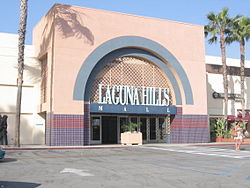
Former Laguna Cafes food court entrance at Laguna Hills Mall.

The Laguna Hills Mall is scheduled to be renamed "Five Lagunas". According to Laguna Hills' city documents, the renovations include pedestrian plazas, new retail sections, a 988-unit apartment complex, a multi-screen movie theater, new signage, and a 1,500-space parking structure.[11][12]

Macy's closed in March 2018 as part of a plan to close 11 stores nationwide, which halted construction on its end of the mall and left JCPenney as the only remaining anchor.[13]

JCPenney closed in October 2018 which left the mall with no anchors.[14]

The mall closed on December 31, 2018. The exterior stores remained open.[2]

Plans for Five Lagunas

[edit]

At a November 2019 City Council meeting, Merlone-Geier unveiled two major changes to the previous plans proposed since 2016: adding housing and reduction of retail space. Previously, the proposal called for 880,000 square feet (82,000 m2) of retail space and 988 residential units. Another reduction was made in office space to make room for the seasonal events. The revised proposal included a new 110,000-square-foot (10,000 m2) cinema, 225,000 sq ft (20,900 m2) to 300,000 sq ft (28,000 m2) of retail, a 125-room hotel, 390,000 sq ft (36,000 m2) to 520,000 sq ft (48,000 m2) of office space, two three-story parking structures, and a potential of 1,200 to 1,500 more apartments.[15]

References

[edit]
[edit]
Revisions and contributorsEdit on WikipediaRead on Wikipedia
from Grokipedia
The Laguna Hills Mall was a major regional in , encompassing 68 acres with approximately 869,000 square feet of retail space, including an enclosed mall and exterior stores. It opened in 1973 as a key destination for shopping and entertainment in southern Orange County, originally anchored by four department stores: The Broadway, Buffum's, JCPenney, and . Developed by The Hahn Company and the Rossmoor Corporation, the mall became a social hub for the growing suburban community. Ownership changed hands multiple times, with acquiring it in 1997 before selling to Merlone Geier Partners in 2013 for $110 million. By the late 2010s, amid a national decline in enclosed malls, anchor tenants departed— in 2014, followed by and JCPenney in 2018—leading to the permanent closure of the interior on December 31, 2018, while some exterior retailers remained operational. The site's redevelopment into the Village at Laguna Hills, a mixed-use , followed demolition completed in 2023, with plans approved in 2022 for up to 1,450 residential units, hotels, offices, new retail, and public spaces across five neighborhoods. As of November 2025, pre-construction activities are advancing, with negotiations for project modifications under review and approvals anticipated by early 2026, transforming the former mall site into a vibrant community-oriented development.

History

Opening and Early Development (1973–1980s)

The Laguna Hills Mall was developed as a between the Rossmoor Corporation and the Ernest W. Hahn organization on a 68-acre site in , with construction beginning in April 1971. This project aimed to create a regional shopping destination amid the rapid growth of southern Orange County's master-planned communities during the early . The mall's design emphasized an enclosed, air-conditioned environment to serve the expanding suburban population in the area. The mall opened in phases starting in spring 1973, with the initial phase featuring as the first anchor store, which debuted in April of that year, alongside approximately 45 specialty shops. followed as the second anchor on September 5, 1973, marking the completion of Phase I and establishing the mall as an early retail hub. The second phase opened in April 1975, adding The Broadway department store in August 1975 and J.C. Penney in 1975, along with about 30 additional specialty shops, bringing the total retail space to approximately 867,000 square feet upon full completion. Early ownership transitioned when Ross Cortese of the Rossmoor Corporation sold his interest to Ernest Hahn, Inc., by , consolidating control under the Hahn organization, a prominent national developer. Throughout the and , the mall served as a vital community shopping hub for southern Orange County, functioning as the region's first enclosed mall and supporting local by attracting residents from nearby inland cities.

Expansions and Operations (1990s–2000s)

In May 1991, , one of the mall's original anchor stores since its 1973 opening, closed as part of the chain's liquidation of its 16 locations amid the regional and declining profits. The closure left a significant two-story vacancy at the Laguna Hills Mall, prompting subsequent repurposing efforts to maintain occupancy and attract shoppers. By 1994, the mall underwent a multimillion-dollar renovation that transformed the former Buffums space, with the second level converted into an upstairs food court to enhance dining options and draw more foot traffic. The first floor was subdivided for inline retailers, including multiple shops from The Limited chain such as Victoria's Secret, alongside a record store and a large bookstore on the upper level adjacent to the new food court. This expansion aligned with broader updates to common areas, positioning the mall for growth during the mid-1990s retail recovery. In May 1996, The Broadway department store, another key anchor, was rebranded as following Federated Department Stores' acquisition of the chain, standardizing the retail mix and bolstering the mall's appeal to mid-range shoppers. Ownership transitioned in October 1997 when Simon DeBartolo Group acquired the 866,000-square-foot property as part of a $1.2 billion portfolio deal involving 12 centers, marking a shift to larger-scale that emphasized productivity and regional dominance. During the economic boom, the Laguna Hills Mall reached its operational peak with approximately 120 tenants, serving as a vital regional retail hub for southern Orange County by drawing shoppers from a broad area including and families amid suburban expansion. Under Simon's stewardship into the , the center maintained high occupancy rates above 95% and generated strong sales of $420 per square foot in , contributing significantly to local economic activity through job creation and taxable retail revenue in a growing .

Decline and Closure (2010s–2018)

The Laguna Hills Mall began experiencing significant operational challenges in the early 2010s, marked by declining foot traffic that prompted the closure of its in January 2011. Owned by at the time, the mall shuttered the upper-level eateries, including Chinese Express, , and , as part of efforts to reconfigure the space amid reduced visitor numbers. This move reflected broader struggles in maintaining vibrancy, contrasting with the mall's peak expansions during the when it had thrived as a regional shopping destination. In May 2013, Merlone Geier Partners acquired the property from for $110 million, with initial plans for an exterior and interior makeover to revitalize the struggling center. The new ownership rebranded it as Five Lagunas and announced intentions to add luxury elements like a high-end grocery market and theater. However, these efforts faced headwinds when Sears closed its store in mid-July 2014, as part of a lease buyout that allowed for potential of the space. By early 2016, work commenced, including plans for a pedestrian promenade, , and redesigned interiors approved by the in March, but the initiatives ultimately failed to stem the tide of tenant losses. The decline accelerated in 2018 with the successive closures of the remaining major anchors: shuttered in late March amid a wave of company-wide store rationalizations due to slumping sales, followed by J.C. Penney in . These exits left all pads vacant, exacerbating the mall's emptiness and contributing to its overall downturn. The interior portion of the mall closed permanently on December 31, 2018, though a handful of exterior stores operated briefly into 2019 before winding down. This closure aligned with a national trend, as more than 500 U.S. malls had shuttered since their peak in the , driven by growth and shifting consumer preferences. Locally, Laguna Hills Mall faced stiff competition from upscale nearby centers like The Shops at Mission Viejo, which drew shoppers with stronger tenant mixes and modern amenities.

Design and Layout

Architecture and Structure

The Laguna Hills Mall was constructed as a fully enclosed, single-level regional shopping center, exemplifying mid-20th-century suburban mall . The structure featured an inward-focused layout with central corridors that facilitated pedestrian flow between retail spaces, surrounded by expansive surface lots in a pattern to accommodate high volumes of visitors. At completion in 1973, the mall encompassed a total gross leasable area of 867,000 square feet, serving as a key commercial hub in southern Orange County. The site's design emphasized automotive accessibility, with the mall positioned immediately adjacent to Interstate 5 for regional connectivity and buffered by large parking fields that supported thousands of vehicles daily. This auto-oriented configuration reflected the era's reliance on car-centric suburban development, prioritizing convenience for shoppers arriving from surrounding communities. In 1994, structural adaptations included the addition of a on the upper level, enhancing the mall's interior functionality without altering the core single-level enclosure. The saw primarily this renovation following the closure of Buffum's, with no major expansions adding significant retail space.

Facilities and Amenities

The mall's single-level layout was supplemented by partial second-floor elements, accessible via elevators and escalators, while restrooms were conveniently located throughout the interior corridors to serve shoppers efficiently. Extensive parking facilities encompassed surface lots and structures, including options for added . A was introduced as a key amenity in , offering a centralized dining hub on the second level.

Retail Tenants

Anchor Stores

The anchor stores at Laguna Hills Mall consisted of four major department stores that anchored the from its , providing extensive retail space and serving as primary attractions for regional shoppers by offering diverse merchandise categories such as apparel, home goods, and appliances. These anchors occupied a significant portion of the mall's total leasable area, collectively drawing foot traffic and supporting the viability of surrounding inline tenants through their established brands and large footprints. Sears opened as the mall's first anchor in spring 1973, spanning approximately 208,000 square feet across two levels and establishing the center's initial retail presence. As a full-line , it featured departments for clothing, tools, and automotive services, contributing substantially to the mall's early success by attracting families from southern Orange County. The store operated until its closure in July 2014 amid broader company challenges. Buffums, an upscale chain known for high-end fashion and specialty goods, opened on September 5, 1973, with about 50,000 square feet on two levels. It catered to affluent shoppers with curated selections of and luxury items, enhancing the mall's reputation as a destination for quality retail. Buffums closed in May 1991 as part of the chain's liquidation after 87 years of operation. The Broadway, a mid-tier , joined as an anchor in 1975, occupying roughly 160,000 square feet and broadening the mall's appeal with mid-range apparel, cosmetics, and household essentials. In May 1996, following the acquisition of by Federated Department Stores, the location converted to , which continued operations with similar offerings until its closure in late March 2018. J.C. Penney opened in , encompassing about 169,000 square feet and focusing on affordable family-oriented merchandise including clothing, jewelry, and home furnishings. The store played a key role in maintaining the mall's everyday shopping draw for local residents. It remained operational until October 2018. The departure of these anchors in the preceded the mall's overall closure on December 31, 2018.

Inline Retail and Dining

The Laguna Hills Mall housed a vibrant collection of inline retail tenants, peaking at nearly 100 specialty stores that lined its corridors and provided a mix of everyday and niche offerings. retailers formed a core part of this ecosystem, with chains like Gap and drawing in families and casual shoppers for affordable apparel and accessories. Electronics outlets, such as , catered to consumers seeking gadgets, batteries, and tech accessories until the chain's broader decline. Specialty shops added variety, including jewelers like Goldman Jewelers and Plumb Gold, which offered custom pieces, repairs, and estate sales for local residents. Service-oriented tenants rounded out the inline spaces, featuring salons for hair and nail care as well as spas like Total Woman Gym & Spa, which provided fitness and wellness services in a convenient setting. Dining options emphasized quick-service fare, primarily through an upstairs that once supported up to eight vendors but dwindled over time. By 2010, surviving outlets included for pizza, for casual snacks, Chinese Express for stir-fries, and Pinoy Pam’s Best for , reflecting a shift toward diverse ethnic . Additional inline eateries like Subway for sandwiches, Rubio’s Fresh Grill for coastal-style tacos, and Ruby’s for classic American meals extended dining choices beyond the court. Exterior fast-casual spots, such as adjacent to the property, complemented these with burger-focused meals popular among mall visitors. The tenant mix evolved notably from the and early , when family-oriented and mid-tier stores dominated, to a more budget-conscious profile in the amid economic pressures and retail shifts. Discount anchors and value-driven inline shops, including Ross and Michael's, increasingly filled vacancies, adapting to changing consumer preferences while maintaining accessibility for South Orange County households.

Cultural and Community Role

Local Significance

The Laguna Hills Mall, opened in 1973, emerged as a pioneering suburban retail center in South Orange County, capitalizing on the region's rapid transformation from rural ranchlands to burgeoning residential communities during the post-World War II boom. When it opened, the mall had no real competition in South County, anchoring commercial development and serving the growing population of families relocating to the Saddleback Valley, providing convenient access to retail amid expanding freeway infrastructure like Interstate 5. Economically, the mall was a vital engine for Laguna Hills and surrounding communities, generating millions in that funded local services and . At its peak, it supported thousands of jobs through its anchor stores and inline retailers, with a 1992 expansion alone projected to add 600 positions, underscoring its role in bolstering employment and stimulating ancillary businesses like restaurants and service providers. This influx also enhanced property values and tax bases, contributing to the economic vitality of Laguna Hills, whose population grew from 13,676 in 1970 to 46,731 in 1990. Socially, the mall functioned as a central gathering place for multiple generations in South Orange County, particularly evolving into a beloved hangout for during the and , where arcades, food courts, and stores fostered casual socializing and rites of passage. Drawing families and young people from across the region, it mirrored the era's mall culture as depicted in films like , offering a safe, air-conditioned oasis amid suburban sprawl. Today, the mall evokes strong in local culture, with residents reminiscing about personal milestones such as first jobs at stores like or Piercing Pagoda, awkward teenage dates in the bustling corridors, and family outings that marked community life. "There's a lot of nostalgia for what the mall used to be," noted Laguna Hills Janine Heft, capturing its enduring place in as a symbol of youthful freedom and local identity.

Events and Gatherings

The Laguna Hills Mall hosted a variety of annual holiday events that drew families from southern Orange County, particularly in its central atrium spaces. Santa photo sessions were a longstanding tradition, with arriving each holiday season to pose for pictures and distribute treats to children; for instance, in November 2010, Santa was available for visits on weekends from 10 a.m. to 6 p.m., continuing a pattern seen in subsequent years such as 2012 and 2013. Breakfast events complemented these, like the 2012 gathering that included crafts, a , and meals for young attendees. Choir appearances added festive flair, as evidenced by the 1989 holiday schedule featuring the Laguna Hills High School Choir performance in front of Lens Crafters. Easter egg hunts occurred seasonally in the mall's common areas. Anchor stores like spearheaded promotional sales to boost foot traffic and community engagement. Charity drives were also common through these retailers, with participating in annual fundraising efforts tied to sales events, aligned with broader corporate initiatives for causes like children's health. These activities often coincided with peak shopping periods, emphasizing the mall's role as a local hub for seasonal promotions. Community gatherings further animated the mall, including back-to-school fairs that provided resources and activities for families in late summer, as part of ongoing efforts to support local education needs. Live music performances enriched the atmosphere, with events like the Laguna Hills High School Choir holiday show drawing crowds for seasonal entertainment. In the , the mall's , added during renovations, became a high-attendance venue for casual events and social meetups, serving as a regional draw amid the era's booming suburban growth and attracting broad crowds from South County for dining and informal gatherings before its 2011 closure.

Redevelopment

Planning and Rebranding

In 2016, Merlone Geier Partners, the mall's owner, announced a rebranding of the Laguna Hills Mall to "Five Lagunas" as part of a major renovation initiative aimed at modernizing the aging retail center. The project sought to create an "urban village" experience with enhanced outdoor spaces and mixed-use elements to revitalize the site. The original development plan, approved by the City of Laguna Hills in 2016, proposed a comprehensive transformation including 988 apartment units, a 110,000-square-foot cinema, 225,000 to 300,000 square feet of retail space, a 125-room , approximately 45,000 square feet of , structured parking, and a 2.5-acre public park. This vision was intended to integrate residential, commercial, and recreational features while preserving some existing structures. Following the mall's closure on December 31, 2018, planning efforts intensified to adapt the proposal amid shifting market conditions. In November 2019, Merlone Geier submitted a revised plan that reduced retail and office components while increasing residential density to approximately 1,500 units across five apartment buildings, alongside 390,000 to 520,000 square feet of commercial space, a , and areas. This adjustment prioritized to address regional affordability needs and California's growing emphasis on residential development in urban infill sites. The revision also rebranded the project as "The Village at Laguna Hills" to reflect its evolving community-oriented focus. Throughout 2019 and 2020, the City of Laguna Hills facilitated approvals and reviews, including environmental assessments under the (CEQA) via addendums to the 2009 Program Environmental Impact Report. Community input was actively sought through public workshops, advisory group meetings—such as those by the Future of Laguna Hills Advisory Group (FLAG)—and comment periods, addressing concerns over traffic, density, and open space. These processes ensured before advancing to formal entitlements in subsequent years.

Demolition and Construction (2018–2025)

The interior of the Laguna Hills Mall permanently closed on December 31, 2018, marking the end of operations for its enclosed retail spaces. A number of exterior-facing stores and restaurants, such as , BJ's Restaurant & Brewhouse, and King's Fish House, continued operating during the initial transition period, providing continuity for local shoppers while planning advanced. These remaining tenants were gradually relocated or closed in the years leading up to , with the last anchor structures vacated to facilitate site clearance. Demolition of the mall's core structures commenced in the fall of 2022, targeting the aging enclosed portions and anchor buildings including J.C. Penney and . By February 2023, the majority of the demolition was complete, with the building fully razed by April of that year, transforming the 68-acre site into a largely vacant dirt lot. This phase cleared the way for the mixed-use Village at Laguna Hills development, which evolved from the original Five Lagunas concept proposed in early 2019. Following site clearance, construction was delayed due to shifting economic and market conditions. As of November 2025, no building construction has commenced, with an Ad Hoc Committee formed in April 2025 to facilitate negotiations on major project modifications requested in January 2025. Proposed changes include reducing residential units from 1,500 to 1,456 (adding townhomes and single-family homes), increasing to two hotels with 225 rooms total, removing office space and a theater, adding a specialty grocer, and reducing retail to 150,000 square feet, while retaining 200 affordable units for seniors and veterans. In September 2025, the city approved 180 apartments for seniors as part of this affordable housing component. Approvals for modifications are targeted for completion in the fourth quarter of 2025 or first quarter of 2026, with construction expected to begin 6–12 months thereafter (mid-2026 to early 2027). Full occupancy for initial phases is now projected for 2028 or later, aligning with the site's long-term vision as a walkable urban village spanning over a decade of build-out.

References

Add your contribution
Related Hubs
User Avatar
No comments yet.