Hubbry Logo
Flag of AcadianaFlag of AcadianaMain
Open search
Flag of Acadiana
Community hub
Flag of Acadiana
logo
8 pages, 0 posts
0 subscribers
Be the first to start a discussion here.
Flag of Acadiana
Flag of Acadiana
from Wikipedia

Acadiana
Flag of Acadiana
Other namesAcadiana flag, Cajun flag
UseOther Small vexillological symbol or pictogram in black and white showing the different uses of the flag Small vexillological symbol or pictogram in black and white showing the different uses of the flag Flag can be hung vertically by hoisting on a normal pole, then turning the pole 90°
Proportion2∶3
AdoptedJuly 5, 1974 (51 years ago) (1974-07-05)
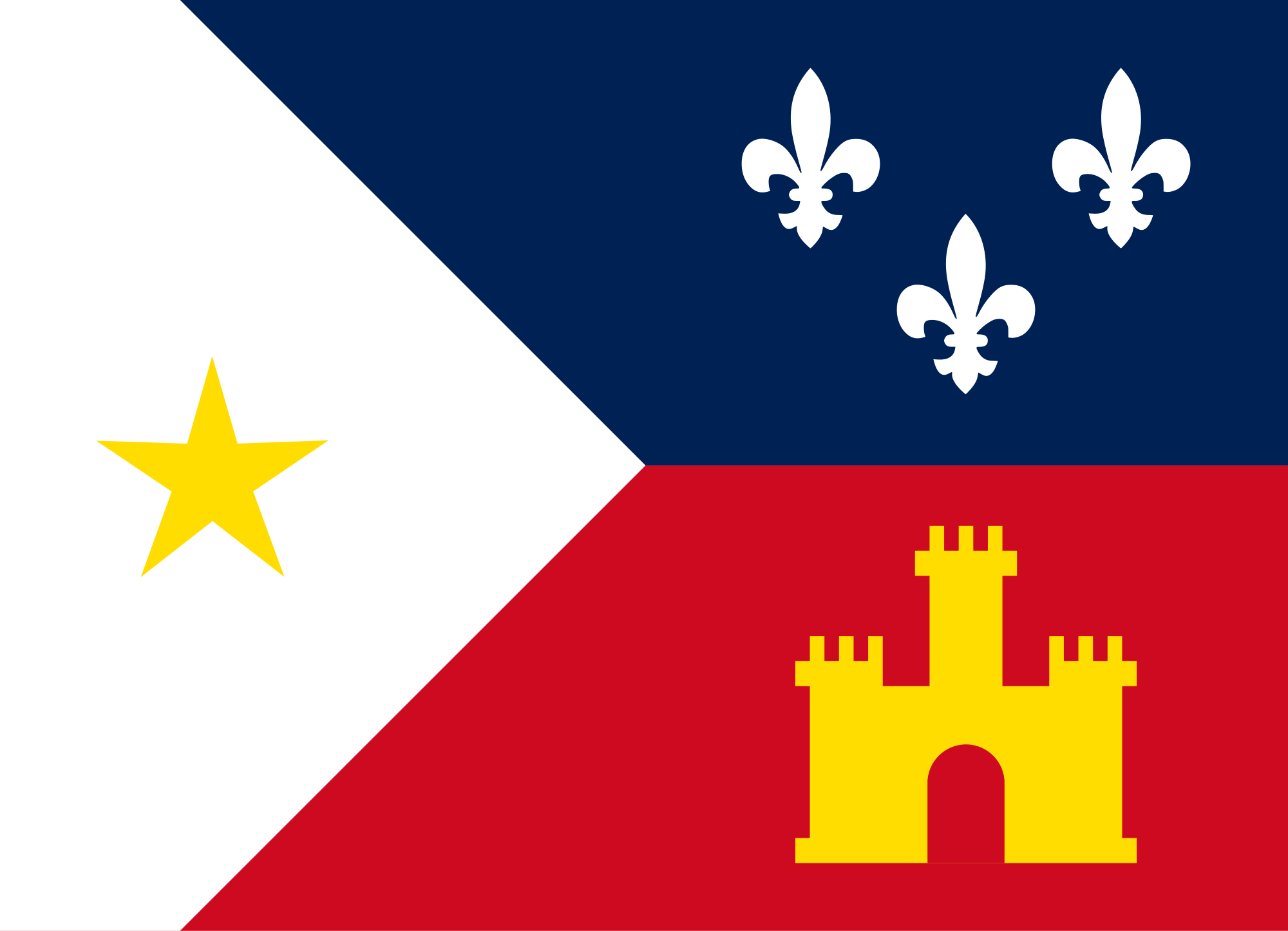
DesignTwo equal horizontal bands of blue (top) and red (bottom) bearing three white fleurs de lis and a gold castle, respectively, and a white isosceles triangle at the hoist, within which is a gold five-pointed star.
Designed byDr. Thomas J. Arceneaux

The flag of Acadiana (drapeau de l'Acadiane) represents the Acadian (Cajun) ethnic region of southern Louisiana. It consists of two equal horizontal bands of blue (top) and red (bottom) bearing three white fleurs de lis and a gold castle, respectively, and a white isosceles triangle at the hoist, within which is a gold five-pointed star. It was designed in 1965 and officially adopted July 5, 1974. The flag is referred to as the Acadiana flag or Cajun flag.

History

[edit]

The flag was designed in 1965 by Dr. Thomas J. Arceneaux of the University of Southwestern Louisiana (present day University of Louisiana at Lafayette),[1] who derived it from the Southwestern Louisiana Institute seal. He was an early proponent of the Louisiana French Renaissance Movement, a movement designed to renew interest and pride in the French-Acadian heritage, language, and culture of Louisiana.[2] On July 5, 1974, the State Legislature passed House Concurrent Resolution No. 143 adopting Dr. Arceneaux's design as the official flag of Acadiana.[3]

Symbolism

[edit]

The various symbols on the flag were each chosen to represent a special aspect of Cajun culture and history. The golden star surrounded by a field of white serves as a symbol of Acadian exiles in America and alludes to their Roman Catholic heritage. The golden star in particular refers to the Virgin Mary. The fleurs de lis set against a background of blue represent the French ancestry of the Cajuns. The golden castle set upon a field of red represents Spanish colonial rule of Louisiana, the rule during which the exiled Acadians arrived.[4]

Proposed replacements

[edit]

While Acadiana derives its name from its Acadian/Cajun population, it is also a legally defined region of 22 parishes which contain large non-Cajun populations.[5] In most Acadiana parishes, African Americans make up between 20 and 40 percent of the population; one parish, St. John the Baptist Parish, is majority African American.[6]

Some residents have expressed concerns that the flag, by highlighting French and Spanish heritage, excludes the region's large Black population. In 2018, University of Louisiana professor Rick Swanson proposed two potential replacement Acadiana flags. One recolors the white triangle yellow and the gold star green to represent the West African origins of most local African Americans. The second reorients the three fields into vertical stripes.[7]

Swanson's proposal generated fierce pushback. He responded that the flag was meant to represent the region, not the Cajun ethnic group: "We’re unique in the sense that we have a very strong regional identity, but we don’t have a flag that was designed specifically for the purpose of representing all of the heritages that contribute to that unique regional identity."[8]

See also

[edit]

References

[edit]
[edit]
Revisions and contributorsEdit on WikipediaRead on Wikipedia
from Grokipedia
The Flag of Acadiana is the official emblem of the region in southern , encompassing the cultural heartland of Cajun descendants from Acadian exiles, designed in 1965 by Thomas J. Arceneaux, dean of the College of Agriculture at the University of Southwest Louisiana, to commemorate the 200th anniversary of Acadian settlement in the area. Adopted by the on July 5, 1974, as the regional flag, it synthesizes symbols of Acadian heritage, French origins, Spanish colonial governance, and religious devotion central to Cajun identity. The flag's design divides into three sections: a hoist-side field bearing three silver fleurs-de-lis representing the French ancestry of the under the Bourbon ; a red fly-side field with a gold castle from the arms of Castile, denoting the Spanish era during which arrived in after their expulsion from ; and a white overlaying the division, centered with a single gold star symbolizing Our Lady of the Assumption, the patroness of the . These elements encapsulate the multicultural influences shaping Acadiana's distinct identity, distinct from the broader Acadian flag used in Maritime . Since its adoption, the flag has served as a potent symbol of regional , flown at official events, incorporated into local , and recognized in cultural preservation efforts across the 22-parish area, underscoring the resilience of Cajun traditions amid historical displacements and assimilative pressures.

Design

Composition and Elements

The Flag of Acadiana consists of three equal horizontal bands: the upper band is azure (blue) charged with three argent (silver) fleurs-de-lis arranged horizontally; the central band is argent () bearing a central or (golden) five-pointed mullet (star); and the lower band is gules (red) charged with an or (golden) tower from the ancient arms of Castile. The fleurs-de-lis symbolize the French heritage of the , derived from the royal arms of . The golden star represents devotion to Our Lady of the Assumption, the patroness of the , and also signifies their participation in the . The golden tower on the red field denotes the Spanish colonial period during which most Acadians settled in Louisiana after their expulsion from British-controlled Acadia in 1755. The flag's colors—blue, white, red, and gold—draw from French, Spanish, and traditions without specified proportions beyond the equal band widths.

Colors and Symbolism Overview

The Flag of Acadiana incorporates a palette of , , white, gold, and silver, each color tied to specific historical and cultural significances in the region's Acadian heritage. evokes the French colonial origins, signifies Spanish governance, white denotes purity and religious devotion, while gold and silver highlight royal and sacred motifs. Central to the design, three silver fleurs-de-lis arranged on a blue field symbolize the ' French ancestry, drawing from the emblem of French monarchs that marked their expulsion from in 1755 and subsequent resettlement. This element underscores the enduring ties to , predating British conquests in . A golden castle on a red field represents Spain's 18th-century control over following the 1763 Treaty of Paris, during which many arrived and integrated into the territory's society. The castle, akin to Castilian , commemorates this era of colonial administration and land grants to exiles. The golden eight-pointed star on a white field honors Our Lady of the Assumption, patroness of the since a 1634 during early settlement hardships, symbolizing faith, exile, and the community's Roman Catholic identity amid . This Marian emblem also alludes to the ' role in American settlement, blending spiritual resilience with regional pride.

History

Creation and Designer

The Flag of Acadiana was designed by Thomas J. Arceneaux, then dean of the College of Agriculture at the University of Southwestern Louisiana (now the University of Louisiana at Lafayette). Arceneaux, a longtime advocate for English-French bilingual education in Louisiana, created the flag by synthesizing elements from historical Acadian symbols, including the fleur-de-lis and a gold Castelnaudary-style castle representing the region's French colonial fortresses. Arceneaux developed the design in 1965 to commemorate the 200th anniversary of the Acadian exile and arrival in , drawing on the region's heritage following the expulsion of from by the British in the 1750s. The flag was first unveiled on , 1965, during events marking this bicentennial, with Arceneaux present alongside local Acadian cultural figures. This creation reflected a deliberate effort to encapsulate Acadian identity through vexillological elements rooted in French and colonial , rather than contemporary political motifs.

Adoption and Early Recognition

The Flag of Acadiana, designed in 1965 by Thomas J. Arceneaux to commemorate the bicentennial of Acadian settlement in , was initially introduced at the University of Southwest Louisiana (now the ), where Arceneaux served as dean of the College of Agriculture. It quickly gained traction as a symbol of regional ethnic pride among Cajun communities, appearing on local government vehicles such as Lafayette's garbage trucks and being incorporated into the city's seal prior to broader adoption. This early usage reflected growing cultural awareness of Acadian heritage amid mid-20th-century efforts to revive and traditions in south , including Arceneaux's involvement in the founding of the Council for the Development of French in Louisiana (CODOFIL). In 1971, the formally recognized as a distinct cultural encompassing 22 parishes, providing legislative acknowledgment of the area's unique Acadian-influenced identity and laying groundwork for symbolic representations like the flag. This recognition aligned with broader state initiatives to preserve Cajun culture, though the flag itself saw informal proliferation through community events, educational institutions, and local displays before official status. Official adoption occurred on July 5, 1974, when the passed House Concurrent Resolution No. 143, designating Arceneaux's design as the emblematic flag of Acadiana to represent its French, Spanish, and Acadian elements in public and cultural contexts. The resolution ensured its display in state facilities and reinforced its role in fostering regional unity, marking a pivotal step from local symbol to legislatively endorsed banner without prior competing designs achieving similar statewide endorsement.

Subsequent Developments

The Flag of Acadiana has remained unaltered in design since its official adoption by the on July 5, 1974, via House Concurrent Resolution No. 143, continuing to represent the cultural heritage of the 22-parish region without subsequent legislative modifications. Following adoption, the flag gained prominence during the Cajun cultural revival of the 1970s, becoming a symbol flown by local governments, educational institutions such as the —where its designer served as dean—and community organizations across south . It has been integrated into regional events commemorating Acadian history, including anniversaries of the Acadian and arrival in , maintaining its status as the official emblem of into the .

Symbolism

Acadian and Religious Elements

The three silver fleurs-de-lis arranged vertically on the blue field symbolize the French origins of the , descendants of settlers from regions such as , Aunis, and who established colonies in (present-day Maritime Canada) in the early before their mass expulsion by British forces between 1755 and 1764. This emblem evokes the Acadian homeland and the cultural continuity preserved by exiles who resettled in , evolving into the Cajun population. The central gold star on the white field represents Acadian exiles scattered across the Americas, particularly those who found refuge in after the Great Expulsion, and embodies their collective identity as a diasporic people guided by faith. Known as the Stella Maris or Assumption Star, it specifically honors Our Lady of the Assumption, patroness of the since a 1635 vow by early settlers invoking her protection, which they attributed to their survival during hardships. This star's religious connotation underscores the Acadians' devout Roman Catholicism, a faith that provided spiritual resilience amid persecution and displacement; annual Assumption celebrations remain a cornerstone of Cajun religious life in . The fleurs-de-lis, while primarily denoting French royal and national heritage, also carry Marian associations in Catholic as symbols of purity and the Virgin Mary, reinforcing the flag's integration of Acadian ethnic pride with theological devotion.

Colonial Heritage Representations

The fleurs-de-lis on the blue field of the Flag of Acadiana symbolize the French colonial origins of the people, who trace their ancestry to settlers in the French colony of (present-day Maritime ) established in the early . These three silver fleurs-de-lis evoke the Bourbon dynasty's emblem, underscoring the enduring French cultural and linguistic ties maintained by despite the British expulsion of Acadians during the Great Upheaval of 1755–1764. The gold castle, or tower of Castile, on the red field represents Spain's colonial administration of Louisiana, where Acadian exiles resettled beginning in 1765 following the Treaty of Paris (1763), which transferred the territory from France to Spain. This element acknowledges the Spanish governor Alexandre O'Reilly's policies that facilitated Acadian immigration and land grants in the Attakapas and Opelousas districts between 1765 and 1785, integrating the refugees into the colony's economy through agriculture and militia service. Designer Thomas J. Arceneaux incorporated these symbols to reflect the dual colonial influences shaping 's formation: French foundational identity from and Spanish territorial governance in , distinguishing the flag from purely Acadian designs by emphasizing post-exile adaptation. The white cross dividing the fields further signifies the convergence of these heritages under Catholic tradition, as Spain's rule preserved French Catholic practices against Anglo-Protestant pressures.

Usage

Official and Institutional Adoption

The Louisiana Legislature recognized Acadiana as a distinct cultural region comprising 22 parishes in 1971 through Act 119, establishing the framework for regional symbolism including the flag. On July 5, 1974, House Concurrent Resolution No. 100 formally adopted the flag designed by Thomas J. Arceneaux as the official emblem of , affirming its representation of Acadian, French, and Spanish heritage elements within the state. The , where Arceneaux served as dean of the College of Agriculture, has institutionally embraced the flag since its creation in 1965, displaying it prominently on campus and in official materials to symbolize regional identity tied to Acadian arrival commemorations. Local parishes within , such as Lafayette and surrounding areas, incorporate the flag in governmental proceedings and public facilities, though it holds no statewide official status equivalent to Louisiana's pelican flag; its use remains regionally authoritative under the 1974 resolution without subsequent revocation or alteration.

Cultural and Commercial Applications

The Flag of Acadiana features prominently in cultural festivals and events celebrating Cajun and Acadian heritage, such as the Festivals Acadiens et Créoles in Lafayette Parish, where a flag-raising ceremony initiated the 50th anniversary celebrations on October 11, 2024, alongside live music and traditional performances. It is displayed at public gatherings across the 22-parish region to evoke ethnic pride and historical resilience, often alongside other Acadian symbols during parades and heritage commemorations. In commercial contexts, the flag is widely produced as merchandise, including 3-by-5-foot versions with fade-resistant dyes, canvas headers, and grommets, sold by retailers for personal and decorative use to signify regional affiliation. businesses incorporate it into branding and promotional materials, such as apparel icons and flags, to align with Cajun identity and attract culturally aware consumers. The flag's visibility supports initiatives by publicizing Acadiana's French-Acadian colonial legacy and narrative, as noted by its in promoting heritage awareness to draw visitors to southern Louisiana's cultural sites and events. This application underscores its role in economic activities tied to regional festivals, which generated over 1.2 million attendees across events in recent years, bolstering local commerce through themed merchandise and hospitality.

Controversies

Inclusivity and Representation Debates

In 2018, professor Rick Swanson proposed redesigning the Flag of to incorporate symbols representing non-Acadian ethnic groups, such as a green star denoting West African heritage, arguing that the existing design—featuring fleurs-de-lis for French colonial ties, a gold castle for Spanish rule, and a gold star for the Acadian patroness Our Lady of the Assumption—marginalizes , Native Americans, and other demographics integral to the region's history. Swanson's initial modified version retained core elements but added a yellow triangle and green star, while a subsequent iteration used vertical stripes to blend Cajun, Creole, and broader settler symbols, aiming for a "cultural " that mirrors the U.S. flag's evolution toward inclusivity. He contended that the flag's Acadian focus ignores contributions from enslaved Africans, who comprised significant portions of early populations (e.g., 56% in parts of what became parishes by ), and overlooks the diverse genealogies shaping local Creole culture and languages like Kouri-Vini. The proposal elicited strong opposition, with critics labeling it an act of cultural erasure that prioritizes modern demographic pluralism over the flag's historical role in commemorating the 1765 Acadian arrival and Cajun resilience, as designed by botanist Thomas J. Arceneaux in and officially adopted by the Louisiana Legislature in 1974 via House Concurrent Resolution No. 143. Defenders argued that Acadiana's naming, coined around in reference to Acadian exiles and formalized for 22 parishes in 1971, inherently ties regional identity to French-Acadian roots, and altering symbols like the gold star—linked to Acadian Catholic devotion and Revolutionary War service under —undermines ethnic specificity without empirical justification for exclusion, given ' foundational demographic and cultural dominance. The backlash, described as a "hornet's nest," highlighted broader tensions, with some viewing inclusivity advocates as engaging in ideological revisionism that conflates heritage preservation with , rather than addressing verifiable historical underrepresentation through separate regional symbols. Similar efforts persisted, including a 2020 proposal by Cory Stewart to recolor or add Pan-African elements, which also met resistance, and a 2022 attempt to edit historical references from online descriptions, but no redesign has been implemented, preserving the flag as a marker of Acadian heritage amid ongoing debates over whether "inclusivity" demands diluting origin-specific in favor of multicultural abstraction. Proponents of change, often from academic circles, emphasize the region's pre-Acadian indigenous and African presences, yet critics counter that such arguments overlook causal historical sequences—Acadian settlement establishing the area's francophone core—while risking the politicization of symbols traditionally tied to faith, exile, and local autonomy.

Specific Proposals for Alternatives

In 2018, Rick Swanson, a political science professor at the , proposed two alternative designs for a regional flag of to enhance inclusivity beyond its Acadian and Cajun associations. The first design modified the existing flag by replacing the white triangle and gold star—symbolizing Acadian exile—with a yellow triangle and green star to incorporate West African heritage, while retaining the white on blue for French Acadian elements and the red field with a Spanish castle for colonial influences. This iteration sought to acknowledge the diverse ethnic makeup of , including African American, European, Latin American, Asian, Middle Eastern, and Native American populations, which constitute a significant portion of the region's 22-parish area as defined by law since 1971. Following feedback that the initial design too closely mirrored the Cajun flag, Swanson introduced a second variant featuring the same symbols and colors arranged in three vertical stripes to create greater distinction and avoid direct resemblance. He emphasized that the proposals were not intended to supplant the established Acadiana flag—adopted by the Louisiana Legislature in 1974—but to foster a separate emblem representing the broader "cultural gumbo" of the region, including historically marginalized groups like African Americans and immigrants from Lebanese, German, Irish, Italian, and Southeast Asian backgrounds. Swanson's motivation stemmed from presentations dating back to 2017, highlighting the need to correct narratives that overlooked non-Acadian contributions to Acadiana's history and demographics. The proposals elicited significant backlash from Cajun communities and cultural advocates, who viewed them as an erosion of the flag's core Acadian identity, tied to the 1965 design by Thomas J. Arceneaux commemorating Acadian settlement. Critics argued that altering symbols risked diluting a heritage recognized statewide, with visceral reactions underscoring the flag's entrenched role in regional pride rather than yielding to formal adoption or redesign processes. clarified the intent as sparking dialogue on representation, inviting public input without legislative mandate, though no subsequent official changes materialized. No other formalized proposals for flag alternatives have gained comparable traction in legislative or institutional discussions as of 2025.

Significance

Role in Regional Identity

The Flag of Acadiana serves as a primary emblem of Cajun ethnic pride and cultural continuity in southern , encapsulating the Acadian people's historical resilience following their 1755 expulsion from during Le Grand Dérangement. Designed in 1965 by agronomist Thomas J. Arceneaux to mark the bicentennial of Acadian settlement in , it visually integrates symbols of Acadian faith (the gold star representing the Virgin Mary as patroness), French colonial roots (), and Spanish territorial influences (Castile castle), thereby fostering a unified narrative of , adaptation, and hybrid heritage distinct from broader American or identities. Its adoption on July 5, 1974, coincided with a Cajun cultural renaissance, amplifying its function in regional identity formation amid efforts to preserve Cajun and traditions against mid-20th-century assimilation pressures. Flown at events like Acadian Day (established ) and festivals such as Lafayette's Festivals Acadiens et Créoles, the flag reinforces communal bonds, with displays on homes, vehicles, and public institutions signaling affiliation to Acadiana's 22-parish region, where over 800,000 residents trace Acadian descent. In educational and civic contexts, such as at the —where Arceneaux served—the flag underscores pedagogical efforts to transmit Acadian history, contributing to intergenerational awareness and countering historical marginalization by highlighting causal links between 18th-century exile and contemporary bayou-based livelihoods in , farming, and oil industries. This role extends to and media, where it promotes authentic Cajun distinctiveness, though debates over its exclusivity persist in multicultural .

Criticisms and Defenses of Preservation

Criticisms of preserving the Flag of center on its perceived exclusivity to Acadian and Cajun heritage, excluding other ethnic groups integral to the region's history. In 2018, political science professor Rick Swanson proposed redesigning the to incorporate elements from the Creole , arguing that the existing design—featuring three fleurs-de-lis, a Castilian castle, and a gold star—primarily symbolizes Acadian exile and settlement while neglecting contributions from Creoles, , Native Americans, and other settlers in the 22-parish region defined by the state. Swanson contended that using the for broader regional representation perpetuates a narrow , potentially marginalizing non-Cajun populations and hindering unified civic identity. Similar views have been echoed in local discussions, where critics assert the 's Acadian focus misaligns with 's diverse demographics, including significant Black and Creole communities, and advocate for alternatives that blend symbols like the Creole with Acadian motifs to foster inclusivity. Defenses of preservation emphasize the flag's role as a precise emblem of Acadian resilience and foundational history, arguing that altering it would dilute the unique cultural identity that defines the region. Designed in 1965 by Thomas J. Arceneaux to mark the bicentennial of Acadian arrival in Louisiana, the flag incorporates the gold star for Our Lady of the Assumption (patroness of Acadians), fleurs-de-lis for French roots, and the castle for Spanish colonial ties, directly tying to the 1755 Great Expulsion and subsequent settlement in Louisiana. Proponents, including cultural historians, maintain that Acadiana's name derives explicitly from "Acadian," making the flag's focus on this heritage logically consistent rather than exclusionary; they view redesign efforts as an ahistorical push to prioritize modern multiculturalism over empirical ethnic origins, potentially erasing symbols of survival amid British deportation and frontier adaptation. Local advocates have framed preservation as essential to combating broader cultural erosion in Louisiana, linking it to defenses of monuments and traditions against revisionist pressures that overlook the flag's role in promoting Acadian language, music, and folklore since its adoption. These arguments hold that separate symbols, such as the Creole flag, already exist for other groups, allowing the Acadiana flag to retain its specificity without imposing a homogenized regional banner.
Add your contribution
Related Hubs
User Avatar
No comments yet.