
Recent from talks
Flat feet
Knowledge base stats:
Talk channels stats:
Members stats:
Flat feet
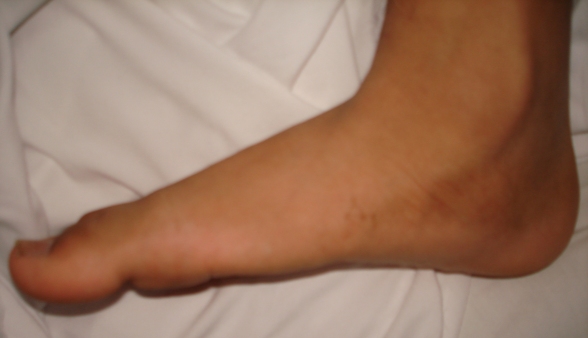
Flat feet, also called pes planus or fallen arches, is a postural deformity in which the arches of the foot collapse, with the entire sole of the foot coming into complete or near-complete contact with the ground. Sometimes children are born with flat feet (congenital). There is a functional relationship between the structure of the arch of the foot and the biomechanics of the lower leg. The arch provides an elastic, springy connection between the forefoot and the hind foot so that a majority of the forces incurred during weight bearing on the foot can be dissipated before the force reaches the long bones of the leg and thigh.
In pes planus, the head of the talus bone is displaced medially and distal from the navicular bone. As a result, the plantar calcaneonavicular ligament (spring ligament) and the tendon of the tibialis posterior muscle are stretched to the extent that the individual with pes planus loses the medial longitudinal arch (MLA). If the MLA is absent or nonfunctional in both the seated and standing positions, the individual has "rigid" flatfoot. If the MLA is present and functional while the individual is sitting or standing up on their toes, but this arch disappears when assuming a foot-flat stance, the individual has "supple" flatfoot. This latter condition is often treated with arch supports.
Studies have shown flat feet are a common occurrence in children and adolescents. The human arch develops in infancy and early childhood as part of normal muscle, tendon, ligament and bone growth. Flat arches in children usually become high arches as the child progresses through adolescence and into adulthood. Children with flat feet are at a higher risk of developing knee, hip, and back pain. A 2007 randomized controlled trial found no evidence for the efficacy of treatment of flat feet in children either from expensive prescribed orthotics (i.e. shoe inserts) or less expensive over-the-counter orthotics. As a symptom itself, flat feet usually accompany genetic musculoskeletal conditions such as dyspraxia, ligamentous laxity or hypermobility.
Since children are unlikely to suspect or identify flat feet on their own, it is important for adult caregivers to check on this themselves. Besides visual inspection of feet and of the treadwear pattern on shoe soles, caregivers should notice when a child's gait is abnormal, or the child seems to be in pain from walking. Children who complain about calf muscle pains, arch pain, or any other pains around the foot area may be developing or have developed flat feet. A systematic review and meta-analysis study by Xu, et.al., found that urban sedentary boys, aged 6–9, were frequently diagnosed with flatfeet. The researchers also explored and listed additional risk factors that played a role in diagnosing flatfeet.
Training of the feet, utilizing foot gymnastics and going barefoot on varying terrain, can facilitate the formation of arches during childhood, with a developed arch occurring for most by the age of four to six years. Ligament laxity is also among the factors known to be associated with flat feet. One medical study in India with a large sample size of children who had grown up wearing shoes and others going barefoot found that the longitudinal arches of the bare-footers were generally strongest and highest as a group, and that flat feet were less common in children who had grown up wearing sandals or slippers than among those who had worn closed-toe shoes. Focusing on the influence of footwear on the prevalence of pes planus, the cross-sectional study performed on children noted that wearing shoes throughout early childhood can be detrimental to the development of a normal or a high medial longitudinal arch. The vulnerability for flat foot among shoe-wearing children increases if the child has an associated ligament laxity condition. The results of the study suggest that children be encouraged to play barefooted on various surfaces of terrain and that slippers and sandals are less harmful compared to closed-toe shoes. It appeared that closed-toe shoes greatly inhibited the development of the arch of the foot more so than slippers or sandals. This conclusion may be a result of the notion that intrinsic muscle activity of the arch is required to prevent slippers and sandals from falling off the child's foot. In children with few symptoms orthotics is not recommended.
Flat feet can also develop as an adult ("adult acquired flatfoot") due to injury, illness, unusual or prolonged stress to the foot, faulty biomechanics, or as part of the normal aging process. This is most common in women over 40 years of age. Known risk factors include obesity, hypertension and diabetes. Flat feet can also occur in pregnant women as a result of temporary changes due to increased elastin (elasticity) during pregnancy; if developed by adulthood, flat feet generally remain flat permanently.
If a youth or adult appears flatfooted while standing in a full weight bearing position, but an arch appears when the person plantarflexes, or pulls the toes back with the rest of the foot flat on the floor, this condition is called flexible flatfoot. This is not a true collapsed arch, as the medial longitudinal arch is still present and the windlass mechanism still operates; this presentation is actually due to excessive pronation of the foot (rolling inwards), although the term 'flat foot' is still applicable as it is a somewhat generic term. Muscular training of the feet is helpful and will often result in increased arch height regardless of age.[citation needed]
Research has shown that tendon specimens from people who have adult-acquired flat feet show evidence of increased activity of proteolytic enzymes. These enzymes can break down the constituents of the involved tendons and cause the foot arch to fall. In the future, these enzymes may become targets for new drug therapies.
Hub AI
Flat feet AI simulator
(@Flat feet_simulator)
Flat feet
Flat feet, also called pes planus or fallen arches, is a postural deformity in which the arches of the foot collapse, with the entire sole of the foot coming into complete or near-complete contact with the ground. Sometimes children are born with flat feet (congenital). There is a functional relationship between the structure of the arch of the foot and the biomechanics of the lower leg. The arch provides an elastic, springy connection between the forefoot and the hind foot so that a majority of the forces incurred during weight bearing on the foot can be dissipated before the force reaches the long bones of the leg and thigh.
In pes planus, the head of the talus bone is displaced medially and distal from the navicular bone. As a result, the plantar calcaneonavicular ligament (spring ligament) and the tendon of the tibialis posterior muscle are stretched to the extent that the individual with pes planus loses the medial longitudinal arch (MLA). If the MLA is absent or nonfunctional in both the seated and standing positions, the individual has "rigid" flatfoot. If the MLA is present and functional while the individual is sitting or standing up on their toes, but this arch disappears when assuming a foot-flat stance, the individual has "supple" flatfoot. This latter condition is often treated with arch supports.
Studies have shown flat feet are a common occurrence in children and adolescents. The human arch develops in infancy and early childhood as part of normal muscle, tendon, ligament and bone growth. Flat arches in children usually become high arches as the child progresses through adolescence and into adulthood. Children with flat feet are at a higher risk of developing knee, hip, and back pain. A 2007 randomized controlled trial found no evidence for the efficacy of treatment of flat feet in children either from expensive prescribed orthotics (i.e. shoe inserts) or less expensive over-the-counter orthotics. As a symptom itself, flat feet usually accompany genetic musculoskeletal conditions such as dyspraxia, ligamentous laxity or hypermobility.
Since children are unlikely to suspect or identify flat feet on their own, it is important for adult caregivers to check on this themselves. Besides visual inspection of feet and of the treadwear pattern on shoe soles, caregivers should notice when a child's gait is abnormal, or the child seems to be in pain from walking. Children who complain about calf muscle pains, arch pain, or any other pains around the foot area may be developing or have developed flat feet. A systematic review and meta-analysis study by Xu, et.al., found that urban sedentary boys, aged 6–9, were frequently diagnosed with flatfeet. The researchers also explored and listed additional risk factors that played a role in diagnosing flatfeet.
Training of the feet, utilizing foot gymnastics and going barefoot on varying terrain, can facilitate the formation of arches during childhood, with a developed arch occurring for most by the age of four to six years. Ligament laxity is also among the factors known to be associated with flat feet. One medical study in India with a large sample size of children who had grown up wearing shoes and others going barefoot found that the longitudinal arches of the bare-footers were generally strongest and highest as a group, and that flat feet were less common in children who had grown up wearing sandals or slippers than among those who had worn closed-toe shoes. Focusing on the influence of footwear on the prevalence of pes planus, the cross-sectional study performed on children noted that wearing shoes throughout early childhood can be detrimental to the development of a normal or a high medial longitudinal arch. The vulnerability for flat foot among shoe-wearing children increases if the child has an associated ligament laxity condition. The results of the study suggest that children be encouraged to play barefooted on various surfaces of terrain and that slippers and sandals are less harmful compared to closed-toe shoes. It appeared that closed-toe shoes greatly inhibited the development of the arch of the foot more so than slippers or sandals. This conclusion may be a result of the notion that intrinsic muscle activity of the arch is required to prevent slippers and sandals from falling off the child's foot. In children with few symptoms orthotics is not recommended.
Flat feet can also develop as an adult ("adult acquired flatfoot") due to injury, illness, unusual or prolonged stress to the foot, faulty biomechanics, or as part of the normal aging process. This is most common in women over 40 years of age. Known risk factors include obesity, hypertension and diabetes. Flat feet can also occur in pregnant women as a result of temporary changes due to increased elastin (elasticity) during pregnancy; if developed by adulthood, flat feet generally remain flat permanently.
If a youth or adult appears flatfooted while standing in a full weight bearing position, but an arch appears when the person plantarflexes, or pulls the toes back with the rest of the foot flat on the floor, this condition is called flexible flatfoot. This is not a true collapsed arch, as the medial longitudinal arch is still present and the windlass mechanism still operates; this presentation is actually due to excessive pronation of the foot (rolling inwards), although the term 'flat foot' is still applicable as it is a somewhat generic term. Muscular training of the feet is helpful and will often result in increased arch height regardless of age.[citation needed]
Research has shown that tendon specimens from people who have adult-acquired flat feet show evidence of increased activity of proteolytic enzymes. These enzymes can break down the constituents of the involved tendons and cause the foot arch to fall. In the future, these enzymes may become targets for new drug therapies.
Recent media