Hubbry Logo
FolgersFolgersMain
Open search
Folgers
Community hub
Folgers
logo
8 pages, 0 posts
0 subscribers
Be the first to start a discussion here.
Folgers
Folgers
from Wikipedia

Folgers
Product typeCoffee
OwnerThe J.M. Smucker Company
CountryUnited States
Introduced1850; 175 years ago (1850)
Related brands
MarketsNorth America
Previous ownersProcter & Gamble (1963–2008)
Tagline"The Best Part of Wakin' Up is Folgers in Your Cup"[1]
Websitewww.folgerscoffee.com
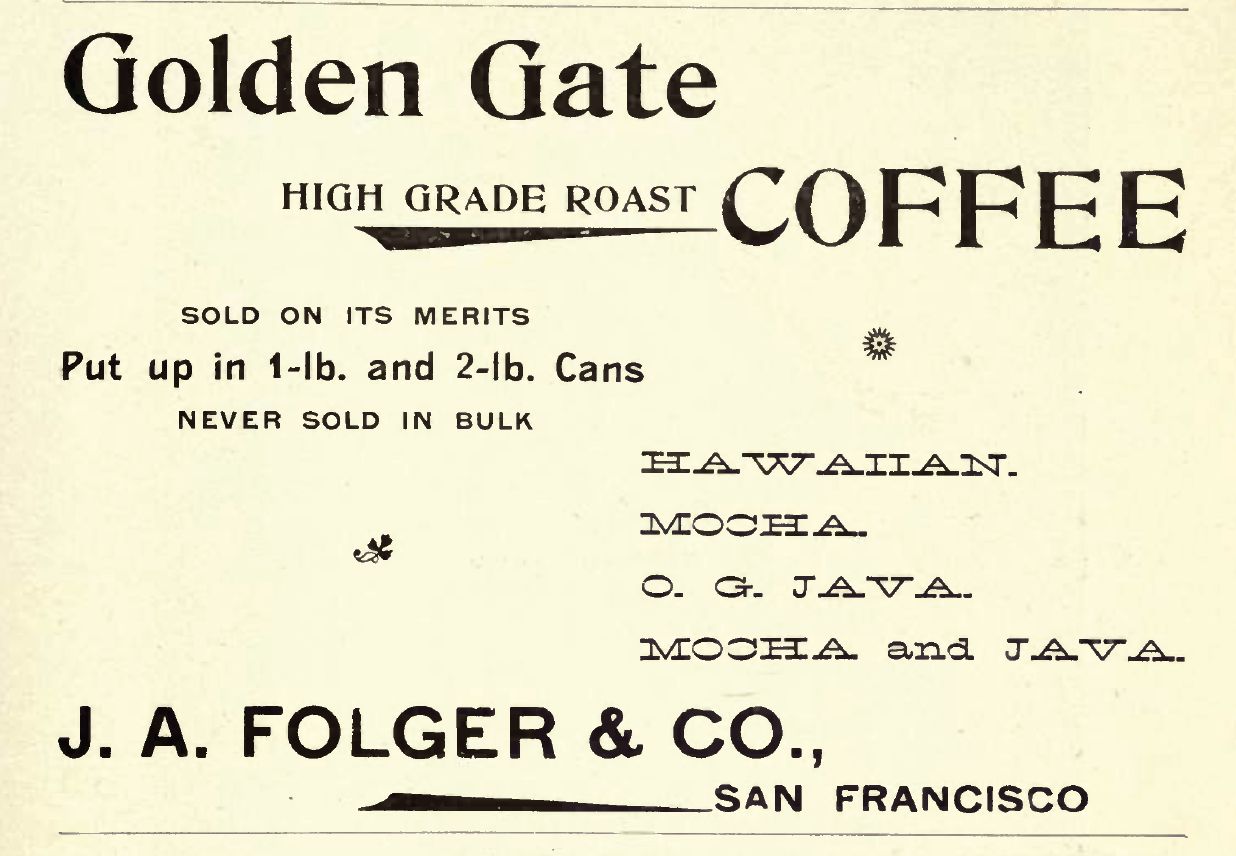
1898 Advertisement for J. A. Folger & Company coffee[2]
Folger's Golden Gate Coffee advertisement, early 20th century

Folgers is an American brand of coffee produced and sold in the United States, with additional distribution in Asia, Canada and Mexico. It forms part of the food and beverage division of the J.M. Smucker Company. Folgers roasts its coffee in New Orleans.[3]

History

[edit]

"J.A. Folger & Co. were established in 1850 as Wm. H. Bovee & Co"[4]

The precursor of the Folger Coffee Company was founded in 1850 in San Francisco, California, as the Pioneer Steam Coffee and Spice Mills. Prior to that Californians had to purchase green coffee beans and roast and grind them on their own. The mill’s founding owner, William H. Bovee, saw the opportunity to produce roasted and ground coffee ready for brewing.[5] Bovee hired newly arrived 15 year old carpenter J. A. Folger to help build his mill. Folger had come from Nantucket Island with his two older brothers during the California Gold Rush. In the 1850s, kerosene became a cheaper alternative to whale oil, Nantucket's dominant business. Many Nantucket ships were re-purposed to instead bring coffee from South America to San Francisco.[6] After working at Bovee's mill for nearly a year, Folger had saved enough money to buy part of the company, and went to mine for gold. He agreed to carry samples of coffee and spices, taking orders from grocery stores along the way. Upon his return to San Francisco in 1865, Folger became a full partner at Pioneer Steam Coffee and Spice Mills. In 1872, he bought out the other partners and renamed the company J.A. Folger & Co.

In 1861, James Folger married. He and his wife had four children, and two of the children worked for the family business. In 1889, Folger died, and his oldest son, James A. Folger II, became president of J.A. Folger & Co at the age of 26.

In the 1900s, the company began to grow dramatically due primarily to a salesman named Frank P. Atha. Atha sold coffee in the California area, but proposed to James Folger II that he open and manage a Folgers Coffee plant in Texas. The company grew exponentially after Atha opened the Texas plant.

Under the mid-20th century leadership of Peter Folger, the brand became one of the principal coffee concerns in North America. In 1960, the construction of a Folger Coffee Company plant in New Orleans was started due to new shipping routes from Central America.[1] Procter & Gamble acquired Folger's in 1963[1] and removed the apostrophe from its name.[7][a] During P&G's ownership, Folgers became the number one coffee brand in America.

On August 9, 1969, company heiress Abigail Folger was stabbed to death in Los Angeles as part of the Manson Family's Tate–LaBianca murders.[8]

P&G announced in January 2008 that Folgers would be spun off into a separate Cincinnati-based company[9] but reversed itself that June and announced Folgers would be acquired by the end of 2008 by The J.M. Smucker Company.[10][11] Utilizing a rare financial technique called a Reverse Morris Trust, Smucker purchased Folgers in November 2008 and made it a subsidiary, whose products lead the $10 billion USD at-home retail coffee category.[12]

Folgers also produces and sells non-instant coffee products.[13]

Brands

[edit]

Folgers established brand colors, included on their logo, were traditionally a moderately dark red background with white lettering. The white or grey lettering is still used, with a green background signifying decaf and a black background signifying their Noir dark roast.[14]

Folgers products available in the United States include:

  • Ground coffee in cans
    • 100% Colombian (medium roast)
    • Black Silk (dark roast), also available in decaf
    • Brazilian blend (medium roast)
    • Breakfast blend (mild roast)
    • Classic roast (medium roast), also in decaf and half caff
    • Coffeehouse blend (medium-dark roast)
    • Country roast (medium-dark roast)
    • French roast (medium-dark roast)
    • Gourmet Supreme (medium-dark roast)
    • House blend (medium roast)
    • Special roast (medium roast)
  • Folgers Noir, a line of dark roast coffees
  • Simply Smooth, a mild roast coffee intended to be gentler on the stomach,[15] also in decaf
  • Simply Gourmet, a line of naturally flavored coffees
  • Folgers Flavors, French vanilla and hazelnut flavored coffees, also available as decaf hazelnut
  • Folgers Crystals, instant coffee available in regular and decaf
  • Coffee Singles, single-serve packets
  • Cappuccino instant mixes
  • K-cup pods in a variety of roasts and flavors
  • 1850, a premium brand launched in 2018

In Canada, Folgers is primarily available as Classic Roast and Mountain Roast.

In the United Kingdom, Folgers Instant Crystals are available.

Advertising

[edit]
Instant Folgers coffee ad from the 1960s

Folgers is promoted with the slogan "The best part of waking up is Folgers in your cup!" It is well associated with a jingle featured in almost every advertisement since 1984, with lyrics by Susan Spiegel Solovay and Bill Vernick, and music by Leslie Pearl. Over the years it has been rearranged and performed by many famous musicians, such as Richie Havens, Randy Travis, Bonnie Tyler, Paul Stanley, Aretha Franklin, and Rockapella.

From 1965 to 1986, Folgers was known for television ads involving "Mrs. Olson", a Swedish neighbor played by Virginia Christine who invariably recommended a cup of Folgers coffee for the characters in the commercial.[16]

Folgers promoted their instant coffee in the 1970s and early 1980s ads which took the viewer inside various 'high-end' restaurants while a voice-over (by Bryan Clark) whispered to the viewer that they've secretly switched the coffee used at the restaurant with Folgers, and watched the restaurants' patrons to see if they could tell whether or not they noticed the difference.

One Folgers television ad from 1985, "Peter Comes Home For Christmas," became particularly associated with the Christmas holidays. A college student returns home, apparently on Christmas Day. His younger sister is the first one to greet Peter, helping him make the Folgers. The smell of freshly brewed coffee awakening his parents and alerting them to their son's arrival. The Cunningham & Walsh[b][17] spot aired yearly until 1998, then in edited form in 2004 and 2005.[18]

In the mid-1980s Folgers became a NASCAR sponsor. After a trial season with the Joe Ruttman-driven and Larry McClure-owned Chevrolet in 1985, Folgers expanded its sponsorships.[19][20][21]

In 2006, the advertising agency Saatchi & Saatchi created a viral advertisement, popularly known as "Happy Mornings", in which a large group of cheerful singers and dancers appear at sunrise as the sun itself to wake people up.[22]

In 2009, Saatchi & Saatchi created a holiday ad, "Coming Home", wherein a man reunites with his teenage sister at their parents' home after volunteering in West Africa. The ad quickly went viral, and has been criticized for perceived sexual tensions between the siblings.[23]

In 2014, the brand celebrated the 30th anniversary of the famous jingle.[24]

Building

[edit]
The Folger Coffee Company Building at 101 Howard Street, San Francisco

The brick, five-story Folger Coffee Company Building at 101 Howard in San Francisco, California is the former headquarters of Folgers. It is listed on the United States National Register of Historic Places.[25] The building still has a sign saying "The Folgers Coffee Company" on one corner.

On August 2, 2011, the Folger Building was purchased by the University of San Francisco, marking a return to the university's roots in downtown San Francisco.[26]

[edit]

In the 1998 film The Big Lebowski, after one of the protagonists dies, their ashes are transported to the Pacific Ocean in a Folgers coffee can because the cheapest urn is deemed too expensive.[27][28] The film has become a cult classic, and at least one person has dressed up as a can of Folgers during a fan event.[29]

In the 1991 Seinfeld episode "The Library", Jerry is challenged by Lt. Bookman (played by Philip Baker Hall) on why there is no instant coffee available for guests to his apartment: "You buy a jar of Folger's Crystals, you put it in the cupboard, you forget about it. Then later on when you need it, it's there. It lasts forever. It's freeze-dried. Freeze-dried crystals."

The November 16, 1991 episode of Saturday Night Live had a sketch that parodied the 'high end restaurant' commercials from the 1970s and 1980s, showing a customer (Chris Farley) violently losing his temper upon being informed that he was given another company's coffee blend instead of the restaurant's usual blend.[30]

Notes and references

[edit]

Further reading

[edit]
[edit]
Revisions and contributorsEdit on WikipediaRead on Wikipedia
from Grokipedia
Folgers is an American coffee brand specializing in ground and related products, founded in 1850 in , , as the Pioneer Steam Coffee and Spice Mills, and currently the largest seller of ground in the United States. The brand is owned by , which acquired it in 2008 from , under whose ownership Folgers became the top-selling coffee brand in America during the mid-20th century. The company's origins trace back to 14-year-old James A. Folger, who joined the Pioneer Steam Coffee and Spice Mills in 1850 and became a full partner by , eventually buying out the other partners and renaming the business & Co. following the economic recovery after the in 1865. Key early milestones include the introduction of rigorous "cup-testing" quality standards in 1880, survival of the with the company providing free to recovery efforts, and expansion into eastern U.S. markets around 1900. Throughout the , Folgers innovated with products like vacuum-sealed tins for freshness in the and promotions for in 1949, while building major production facilities, including the world's largest plant in New Orleans in 1960. Under Procter & Gamble's ownership starting in , Folgers launched its iconic advertising campaign and slogan "The Best Part of Wakin' Up Is Folgers in Your Cup®" in 1984, which became one of the most recognizable in American history. Since the 2008 acquisition by J.M. Smucker, the brand has continued to lead the U.S. at-home retail category, introducing modern campaigns like "#DamnRightItsFolgers" in 2022 and celebrating its 175th anniversary in 2025 with special-edition products, while maintaining a focus on quality blends such as its Black Silk roast.

History

Founding and Early Development

The Pioneer Steam Coffee and Spice Mills was established in May 1850 by William H. Bovee in , , amid the , which created a surging demand for essential goods like among miners and settlers. Bovee's venture was among the earliest in the region to mechanize coffee processing, starting with hand-powered machinery before transitioning to steam power, allowing for efficient roasting and grinding of beans to meet the needs of the burgeoning West Coast population. That same year, 14-year-old James Athearn Folger arrived in from , , seeking opportunity after a fire devastated his family's tea business; he was promptly hired by Bovee as an apprentice and general laborer at the mill. Folger's dedication and business acumen led to his rapid advancement: by 1859, he had become a full partner in the firm, and in 1865, following economic challenges including post-Civil War , he reorganized the company by settling its debts and acquiring majority control. In 1872, Folger bought out the remaining partners and renamed the business J.A. Folger & Co., marking the formal foundation of what would become a leading coffee enterprise. Under Folger's leadership, the company emphasized importing premium green beans primarily from (then the Kingdom of Hawaii) and Asian sources like , leveraging San Francisco's position as a major Pacific port to receive shipments via swift clipper ships. Beans were then roasted and ground on-site using advanced steam-powered mills, ensuring freshness for distribution across West Coast markets, including mining camps and urban grocers. The initial product lineup centered on whole bean and pre-ground , packaged in barrels and sold under brands like Pioneer , catering directly to the practical demands of Gold Rush consumers who valued reliable, high-quality provisions over imported luxuries. The company survived the , providing free coffee to recovery efforts.

Expansion Under Family Ownership

Following the death of founder James A. Folger in 1882, his sons—James A. Folger II, William H. Folger, and Charles Folger—assumed leadership of & Co., with James II, at age 26, stepping in as president to guide the company's continued operations and growth. Under their , the family emphasized quality and scalability, implementing early quality controls such as cup-testing to ensure consistent flavor profiles. This period marked a shift from regional production in to broader , building on the company's gold rush-era foundations. A pivotal innovation came in the with the introduction of vacuum-packed cans, which preserved the coffee's freshness by preventing exposure to air and extending shelf life for distant distribution. This advancement, coupled with branded packaging featuring distinctive labels, helped differentiate Folgers in competitive markets and supported reliable ground coffee as an affordable staple. Key expansions accelerated under salesman Frank P. Atha, who in the early 1900s expanded operations into to better serve Southern markets, leveraging the region's growing demand. By the , Folgers achieved nationwide distribution, facilitated by efficient rail networks that transported roasted coffee across the , transforming it from a West Coast roaster to a coast-to-coast presence. In the post-World War II era, , grandson of the founder and a Marine Major during the war, took a leading role as chairman and president, driving further growth through rigorous roasting standards that maintained uniformity in blend quality. His emphasis on operational consistency and market expansion positioned Folgers as one of the top U.S. sellers by the , with the brand capturing significant share through its focus on accessible, dependable ground for everyday consumers.

Corporate Acquisitions and Modern Era

In 1963, Procter & Gamble acquired the Folgers Coffee Company, marking the end of family ownership and initiating a period of aggressive national expansion. Under P&G's stewardship, Folgers transitioned from a primarily West Coast brand to a nationwide leader through enhanced distribution networks and substantial investments in research and development, including innovations in roasting and packaging to improve shelf life and flavor consistency. This corporate phase lasted until 2008, when sold Folgers to in a Reverse Morris Trust transaction valued at $3.3 billion. The deal, structured as an all-stock merger, allowed for tax efficiency and integrated Folgers into Smucker's diversified portfolio of food products, such as jams and pet foods, while assuming approximately $350 million in associated debt. Post-acquisition, Smucker maintained Folgers' operational independence but leveraged synergies in and marketing to bolster its position in the coffee category. Following the 2008 acquisition, Folgers experienced sustained growth under Smucker, including expansion into international markets such as , , and parts of , where distribution adapted to local preferences for ground and instant formats. Amid a broader industry shift, with traditional ground coffee sales facing relative decline due to rising demand for convenience, Folgers adapted by introducing single-serve pod options compatible with brewers, capturing a segment of the growing at-home pod market without abandoning its core ground coffee heritage. In recent years, Folgers has solidified its dominance as the top U.S. brand by volume, holding over 20% in the ground coffee category as of 2025. A notable milestone came in , when Folgers Black Silk dark roast prevailed in a blind taste test against French Roast, with 63% of 379 participants preferring its flavor profile; this result fueled a renewed emphasis on taste superiority to counter premium competitors. Under stable Smucker ownership, Folgers continues to prioritize sustainability initiatives, such as supporting smallholder farmers, while navigating evolving consumer trends toward premium and convenient brews. In 2025, Folgers celebrated its 175th anniversary with special-edition products honoring its origins.

Products and Brands

Core Coffee Varieties

Folgers Classic Roast represents the brand's flagship offering, a medium roast coffee characterized by its balanced, rich, and smooth flavor profile that has been a staple since its early development as the core product line. This variety is crafted from a blend of Arabica and Robusta beans, delivering a consistent taste suitable for everyday consumption among a broad range of coffee drinkers seeking reliability and familiarity. It is available in the original formulation as well as a 100% Colombian variant, the latter emphasizing a medium roast made exclusively from high-quality Arabica beans sourced from Colombia for a more refined, lively expression. Black Silk stands out as a key dark roast in Folgers' lineup, featuring a bold yet smooth taste with intense notes and a silky finish that appeals to consumers desiring a stronger, more premium-style alternative within the ground coffee category. This variety is positioned to provide depth and satisfaction, drawing from carefully roasted beans to achieve its distinctive profile without excessive bitterness. Among other staple offerings, Folgers 100% Colombian delivers a medium roast with full-bodied, smooth qualities derived from Arabica beans grown in Colombia, targeting those who prefer a vibrant, region-specific character in their daily brew. Decaffeinated options, such as Classic Decaf, mirror the rich flavor of their caffeinated counterparts while removing nearly all caffeine, catering to health-conscious users who want the brand's signature taste at any time. Folgers employs color coding on packaging to aid quick identification, with red lids for regular caffeinated blends, green for decaffeinated varieties, and black for dark roasts like Black Silk. Overall, the brand primarily sources Arabica beans from Latin American regions, particularly Colombia, to support the quality and consistency of these core varieties, though blends like Classic incorporate Robusta for added body.

Formats and Packaging

Folgers offers its ground primarily in recyclable tubs, with the standard family-size holding 30.5 ounces, introduced in the early 2000s as a convenient alternative to traditional metal cans. These tubs feature an interlocking AromaSeal lid to preserve flavor and aroma. is packaged in jars ranging from 3 to 16 ounces, allowing for easy dissolution in hot water or milk. Whole bean varieties are available in similar tubs or resealable bags, catering to consumers who prefer grinding at home. In response to the rise of single-serve brewing systems, Folgers introduced K-Cup pods in the 2010s, compatible with machines and other major pod brewers. These pods come in counts of 10 to 96 per box, offering the same roast profiles in a convenient, portion-controlled format for quick preparation. The brand's packaging evolved significantly with the shift from metal cans, used since the late , to tubs in 2003, aimed at improving portability and reducing production costs while maintaining an airtight seal. In 2024, Folgers faced criticism for adding a non-recyclable outer wrapping to some existing containers, which consumers viewed as unnecessary without enhancing functionality or . Folgers products are distributed mainly through grocery store channels in shelf-stable packaging designed for long-term storage, with airtight features ensuring freshness for up to two years unopened. This approach emphasizes accessibility for everyday household use across various core roast varieties.

Innovations and Specialty Lines

In 2018, Folgers introduced the 1850 line as a premium offering of whole bean and ground coffees, utilizing time-honored roasting techniques developed over the brand's 170-year history. This series features blends such as Expedition Blend and Black Gold, made from 100% Arabica beans that are fire-roasted and steel-cut for a bolder, smoother flavor profile compared to standard roasts. To appeal to diverse tastes, Folgers expanded its flavored coffee options in the , including varieties like , , and , available in both ground and K-Cup pod formats. These artificially flavored products deliver smooth, aromatic notes, with the K-Cup versions introduced starting in to support single-serve brewing systems. Folgers has also innovated in the instant coffee category with its Classic Roast Instant, produced through a freeze-drying process that preserves flavor clarity and aroma by removing moisture from brewed extract at low temperatures. Complementing this, Folgers Singles packets provide convenient, single-serve portions designed for on-the-go preparation, where users simply add hot water or to the packet for quick brewing without equipment. In 2025, to celebrate its 175th anniversary, Folgers released limited-edition metal cans of Classic Roast ground featuring a San Francisco-inspired design honoring the brand's origins. The same year, the brand launched French Vanilla and Buttery Artificially Flavored Instant mixes in single-serve packets, allowing preparation with hot or cold water or milk for a creamy, sweet coffee beverage.

Marketing and Advertising

Iconic Slogans and Jingles

Folgers' most enduring advertising element is the slogan and "The Best Part of Wakin' Up is Folgers in Your Cup," introduced in 1984 as part of a campaign by the N.W. Ayer. The music was composed by Leslie Pearl, known for her earlier hit "If the Love Fits Wear It," while the lyrics were crafted by Bill Vernick and Susan Spiegel Solovay to create a simple, memorable tune emphasizing the comforting ritual of morning . This debuted in the emotional "Peter Comes Home for " television spot, marking a shift from character-driven ads to audio-focused branding that highlighted Folgers' fresh aroma and ease of preparation. The jingle quickly became a cultural staple, evolving through various musical styles and celebrity interpretations to maintain relevance across decades. In the , lent her soulful voice to a version in a 1996 commercial, infusing the tune with gospel-inspired warmth to appeal to diverse audiences. artist performed an iteration in the mid-1990s, adapting the melody for a twangy, heartfelt delivery that resonated with rural consumers. group also recorded a harmonious take, further showcasing the jingle's versatility in over 30 television spots that reinforced Folgers' position as a essential. Prior to this iconic , Folgers' advertising under ownership from emphasized the brand's superior aroma and convenience through the character Mrs. Olson, portrayed by actress . Slogans like "Folgers in your cup" were central to these campaigns, promoting the vacuum-sealed packaging introduced in the that preserved freshness and made brewing quick and reliable for busy households. This focus on sensory appeal and everyday utility laid the groundwork for the 1984 jingle, which built directly on the "in your cup" phrasing to evoke warmth and familiarity. The jingle's cultural staying power is evident in its widespread recognition and commercial longevity, generating ongoing royalties—such as $11,746 in the year leading up to a auction where rights sold for $90,500—and solidifying Folgers' brand recall through repeated exposure in media and parodies.

Major Advertising Campaigns

One of the most enduring advertising series for Folgers was the "Mrs. Olson" campaign, which ran from 1965 to 1986 and featured actress as a wise Swedish neighbor who gently advised harried housewives and newlyweds on the virtues of Folgers to improve their morning routines and marital harmony. In these spots, Mrs. Olson would intervene in domestic scenes where poor coffee led to tension, recommending Folgers' mountain-grown blend as the solution to ensure husbands lingered for a second cup, thereby emphasizing the brand's role in fostering family contentment. The character appeared in hundreds of television commercials over more than two decades, becoming a that significantly boosted Folgers' brand recognition and market leadership in the U.S. industry. Building on this foundation, Folgers' advertisements in the and increasingly highlighted family-oriented themes, portraying as central to shared morning rituals, holiday gatherings, and everyday bonding moments within the home. These print and TV spots often depicted multigenerational families starting their day with Folgers, underscoring themes of warmth, tradition, and emotional connection to reinforce the product's position as a household essential. By the , the campaigns evolved to reflect more diverse family structures, incorporating representations of modern, multicultural households to maintain relevance amid shifting societal norms while continuing to focus on inclusive morning experiences. A notable example of this emotional was the 2009 "Coming Home" television commercial, a holiday-themed spot created by that depicted a reuniting with his , culminating in a warm Folgers brew shared at the kitchen table. Intended as a heartfelt update to earlier reunion ads, the commercial went viral online, amassing millions of views and sparking widespread discussion for its poignant narrative of homecoming and familial joy. In the 2020s, Folgers shifted toward digital platforms with campaigns targeting busy lifestyles, promoting quick-brew options like for on-the-go consumers through short-form videos and interactive content on and . These efforts, including a 2023 initiative partnering with for rapid delivery, aimed to appeal to younger demographics by highlighting Folgers' convenience and affordability in fast-paced routines.

Sponsorships and Recent Promotions

In the 1980s, Folgers sponsored teams, prominently featuring its branding on race cars such as the Folgers Chevrolet driven by for in 1986 and 1987. This partnership included associate sponsorship from country singer from 1985 to 1991, with the brand appearing on vehicles driven by drivers including , Richmond, and . The sponsorship targeted audiences in the , where held strong popularity, aligning with Folgers' efforts to connect with regional consumers through high-visibility exposure. Launched in , Folgers' "Can Do" promotion embodied the brand's resilient image by inviting consumers to nominate and vote on community projects, with the company providing up to $1,000 in funding for 10 selected initiatives supporting families and local causes. The online initiative encouraged participation through Folgers' website and , fostering a sense of empowerment and tying directly to the brand's longstanding "Can Do" to highlight everyday perseverance. In 2024, Folgers promoted its Black Silk dark roast through a campaign centered on a blind taste test where it outperformed Starbucks French Roast, with 63% of 379 preferring participants favoring Black Silk for its bold flavor and silky-smooth finish. The effort included advertisements claiming superiority in boldness, distributed across digital platforms, television, and in-store retail displays to emphasize accessible premium taste. This positioned Black Silk as a value-driven alternative in the competitive dark roast segment. In 2025, to mark its 175th anniversary, Folgers launched promotional campaigns featuring limited-edition Classic Roast cans with San Francisco-inspired designs, promoted via and the brand's to honor its origins and engage consumers with nostalgic content. Amid a June pricing dispute with Canadian retailer Loblaw, which led to the removal of Folgers products from its shelves over "unjustified" cost increases, the brand shifted toward value-focused messaging in other markets to underscore affordability and quality amid rising coffee costs.

Operations and Facilities

Ownership and Corporate Structure

Folgers has been owned by The J.M. Smucker Company since the 2008 acquisition from Procter & Gamble, operating as a wholly owned subsidiary. Within Smucker's organizational structure, Folgers falls under the U.S. Retail Coffee strategic business unit, which encompasses the company's core coffee portfolio and reports to the chief operating officer. This segment integrates Folgers with complementary brands, including the licensed Dunkin' packaged line and the owned , allowing shared leadership, marketing resources, and efficiencies across mainstream and growing ethnic coffee categories. In 2025, the U.S. Retail Coffee segment generated net sales of $2.81 billion, reflecting a 4% increase from the prior year driven by pricing adjustments amid rising commodity costs, with Folgers serving as the flagship contributor to this performance. Governance for Folgers aligns with Smucker's overall corporate structure, headquartered in , where strategic decisions for the coffee portfolio are centralized. Brand management for Folgers is integrated into Smucker's operations in , focusing on consumer insights and promotional strategies. As the leading brand in the U.S. retail ground category, Folgers maintains a dominant market position while contending with competition from single-serve pod systems like and premium ready-to-drink options from .

Manufacturing and Supply Chain

Folgers' primary manufacturing operations are centered in New Orleans, Louisiana, where the company operates two facilities that together form the largest plant in the United States. These sites handle the bulk of roasting, grinding, and initial packaging for Folgers products, with a $69 million investment in 2010 to expand capacity following the closures of plants in (2010), and (2012). This consolidation has streamlined production, allowing for greater efficiency in processing green beans into ground and whole bean varieties. The supply chain for Folgers relies on sourcing 100% beans from key global producers, including , , and . J.M. Smucker Co., Folgers' parent company, purchases around 500 million pounds of green each year, primarily from and , to meet production demands. For its Colombian-sourced products, such as Folgers , the company partners with cooperatives like the Federación Nacional de Cafeteros de Colombia, which supports over 500,000 smallholder farmers. These partnerships provide training and resources to farmers while ensuring a steady flow of high-quality beans suited for Folgers' medium to dark roast profiles. Production processes at the New Orleans facilities employ automated roasting systems that apply precise heat profiles to develop light to dark roasts, followed by consistent grinding for various coarseness levels and vacuum-sealing in AromaSeal containers to preserve freshness and flavor. This end-to-end automation ensures uniformity across batches, with master cuppers overseeing to maintain Folgers' signature robust taste. The annual output from these operations supports widespread distribution through J.M. Smucker's extensive network to major U.S. grocery retailers. In 2025, Folgers adapted to disruptions caused by climate events, such as severe droughts and erratic rainfall in and , which reduced yields and drove up green coffee costs. The company responded by implementing price adjustments on select products, including a fourth increase since June 2024 effective August 2025 to offset 10% U.S. tariffs on imports, while absorbing portions of tariff-related expenses to minimize consumer impact, alongside diversifying sourcing routes within its network to mitigate shortages. These measures helped maintain availability amid broader industry volatility.

Historic Sites and Buildings

The Folger Coffee Company Building, situated at 101 Howard Street in San Francisco's Financial District, stands as a key preserved site in the company's history. Constructed in 1905 by architect Henry Schulze in the Renaissance Revival style, this five-story red brick structure served as the headquarters, processing plant, and warehouse for & Co., supporting the firm's expansion in roasting and distributing during the early . The building's steel frame and wooden pilings provided resilience, allowing it to suffer only minor damage from the and subsequent fire, one of the few downtown structures to survive intact. It remained in use by the company until the mid-20th century, when operations shifted eastward, culminating in a major relocation to New Orleans in 1963 to capitalize on regional coffee markets and logistics. Recognized for its architectural merit and role in San Francisco's coffee industry, the building was listed on the in 1996 (NRHP #96000679), highlighting its contributions to commerce and innovation in coffee importation and processing. Original interior features, including executive offices and elements of the roasting facilities, have been maintained, offering insights into the operational layout of a pioneering coffee enterprise. In 2011, , Folgers' parent since 2008, sold the property to the for $37 million, repurposing it as a academic hub while ensuring its preservation through . Earlier origins trace to the company's precursor, the Pioneer Steam Coffee and Spice Mills, established in 1850 at a site on Powell Street between Broadway and Pacific Avenues, which catered to Gold Rush miners with ground coffee and spices. This original location was destroyed in the widespread devastation of the 1906 earthquake and fire, which razed much of the North Beach and surrounding commercial districts. No physical remnants survive, but its legacy underscores Folgers' roots in San Francisco's post- economy. Preservation efforts emphasize educational access to these sites, with City Guides conducting walking tours of historic coffee roasting districts that feature the Folger Building and narrate the Gold Rush-era coffee trade's influence on the city's development. These programs, offered by a nonprofit founded in 1978, connect visitors to the industrial heritage without interior access to the now-academic structure, focusing instead on exterior architecture and broader contextual exhibits at local museums. In , where Folgers established its first eastern plant around 1901 in to serve southern markets, early facilities integrated into later Smucker operations lack dedicated historic markers but contribute to regional industrial narratives through archival records.

Sustainability and Responsibility

Farmer Support and Ethical Sourcing

Folgers has implemented the Best Part Promise initiative to support smallholder coffee farmers by providing in sustainable and climate-resilient farming practices, aiming to enhance yields and long-term profitability. This program focuses on addressing challenges in key coffee-growing regions, including the and , through targeted educational efforts that help farmers adopt techniques to improve and economic stability. Key partnerships underpin these efforts, such as the collaboration with TechnoServe on the Plus Café project in , which empowers over 2,000 smallholder farmers with resources for better crop management and . Additionally, Folgers participates in the MOCCA public-private partnership, funded by the USDA, to uplift and cocoa farmers' livelihoods in by promoting and . The company also works with Enveritas, a , to tackle issues and in the sector, with a goal of ending global coffee poverty by 2030. For its 1850 coffee brand, Folgers ensures ethical sourcing through 100% certification as of early 2025, verifying adherence to standards for , worker rights, and farm management. Under J.M. Smucker's broader Responsible Sourcing Program, Folgers maintains a commitment to certified green , with historical targets including 10% of retail from verified sustainable sources, while providing ongoing training to smallholder farmers to sustain the . These initiatives have delivered measurable impacts, with the Plus Café project supporting over 30,500 people as of 2025. To enhance transparency, Folgers employs technology in partnership with Farmer Connect and for single-origin coffees under the 1850 brand, allowing traceability from farm to consumer and supporting direct benefits to producers.

Environmental Initiatives

Folgers, under , pursues sustainability goals aimed at minimizing environmental impacts across its processes. The company targets a 28% reduction in absolute Scope 1 and Scope 2 greenhouse gas emissions by 2030 from a 2019 baseline, aligning with broader efforts to transition toward sources. In 2023, Smucker achieved 99.21% renewable energy usage across its operations through wind farm partnerships, such as the Sunflower Wind Farm in and Plum Creek Wind Farm in , contributing to Folgers' manufacturing footprint. Additionally, water intensity reduction efforts include a 5% decrease target by 2025 from 2019 levels; as of the end of 2024, a 4.40% reduction was achieved, with total withdrawals at 2,211 megaliters in 2023. Packaging initiatives focus on enhancing recyclability to address consumer and environmental concerns. In response to criticism over non-recyclable plastic wraps on coffee containers highlighted in 2024, Folgers introduced updated for its branded products, featuring a minimum of 80% and designed for full recyclability, eliminating approximately 30,000 pounds of non-recyclable materials annually. Smucker-wide commitments include achieving 100% recyclable, compostable, or reusable by 2025, with 80% of -based already sourced from recycled or certified materials as of 2023. These changes support principles while maintaining product freshness. To promote , Folgers participates in conservation programs through strategic partnerships, emphasizing shade-grown and practices in coffee-growing regions. A notable effort is a 25-year project in covering 125 hectares, aimed at restoring habitats and enhancing ecosystem resilience for cultivation; as of 2025, over 100,000 trees have been planted. Collaborations with organizations like World Coffee Research and Enveritas further track and improve environmental outcomes in supply chains, including biodiversity metrics alongside farmer training that has benefited over 17,000 smallholders and boosted yields by 20%. These initiatives prioritize ecological protection without overlapping into direct farmer support programs.

Cultural Impact

Representations in Media

Folgers has appeared in several notable films and television shows, often portraying the brand as a staple of everyday American routines. In the 1998 film , the protagonist known as the purchases a can of Folgers from a , highlighting its role as an accessible, no-frills choice amid the character's laid-back lifestyle. The brand is further referenced when Walter Sobchak scatters the ashes of their friend Donny from an empty Folgers can during a , cementing its association with casual, unpretentious Americana in cult cinema. On television, Folgers features in the Seinfeld episode "The Library" (Season 3, Episode 22, aired April 16, 1992), where detective Lt. Bookman confronts about an overdue book and probes his coffee habits. In a humorous exchange, Bookman remarks, "You buy a jar of Folger's Crystals, you put it in the cupboard, you forget about it," using the product as an example of something easily overlooked, tying into a lighthearted debate on preferences. This mention underscores Folgers' familiarity as a household essential in 1990s sitcom humor. Saturday Night Live parodied Folgers in a 1991 sketch titled "Hidden Camera Decaf Crystals," featuring as a man who reacts explosively upon discovering his regular Folgers has been switched to decaf by his wife and colleague. The bit mocks the brand's classic "morning switch" advertisements, exaggerating the emotional attachment to Folgers' robust flavor for comedic effect. Throughout the 2000s, Folgers appeared in various product placements on television, particularly in family-oriented programming that emphasized morning rituals and domestic normalcy, reinforcing its image as a reliable start to the day. These depictions often showed the brand in kitchen scenes of sitcoms and dramas, portraying it positively as an unassuming yet comforting element of daily life, akin to its role in simulated ad breaks within shows.

Controversies and Public Events

During the , Folgers faced public backlash through a Bay Area-led boycott organized by activists protesting the company's purchase of coffee beans from amid that country's , with critics arguing that sales indirectly funded government forces; the campaign, which targeted Folgers as a major importer of Salvadoran beans (accounting for about 60% of the country's harvest at the time), pressured the brand to diversify sourcing but highlighted ethical concerns in its . A tragic connection to Folgers emerged in 1969 when Folger, great-granddaughter of company founder and heiress to the family fortune, was murdered at age 25 by members of the Family during the infamous Tate-LaBianca killings in ; media coverage of the event briefly spotlighted her ties to the coffee empire, noting her father Peter Folger's role as company chairman and her own privileged background rooted in the brand's legacy. In 2024, Folgers encountered consumer complaints on regarding the addition of non-recyclable wrapping to its tubs, which critics viewed as unnecessary over-packaging that increased environmental without improving product protection or aesthetics; these grievances echoed an ongoing 2023 petition urging the company to revert to metal cans or adopt more sustainable alternatives, amassing support from environmentally conscious users concerned about . In June 2025, major Canadian retailer Loblaw Cos. Ltd. delisted all products from its stores, including banners under Loblaw, after rejecting what it called "unjustified" price increases proposed by parent company J.M. Smucker Co. following two hikes the prior year; the move, aimed at shielding consumers from passed-on costs amid broader grocery inflation, disrupted Folgers' availability at one of Canada's largest chains as of June 2025 and drew attention to tensions in supplier-retailer negotiations.

References

Add your contribution
Related Hubs
User Avatar
No comments yet.