
Recent from talks
Foot-and-mouth disease
Knowledge base stats:
Talk channels stats:
Members stats:
Foot-and-mouth disease
Foot-and-mouth disease (FMD) or hoof-and-mouth disease (HMD) is an infectious and sometimes fatal viral disease that primarily affects even-toed ungulates, including domestic and wild bovids. The virus causes a high fever lasting two to six days, followed by blisters inside the mouth and near the hoof that may rupture and cause lameness.
FMD has very severe implications for animal farming, since it is highly infectious and can be spread by infected animals comparatively easily through contact with contaminated farming equipment, vehicles, clothing, and feed, and by domestic and wild predators. Its containment demands considerable efforts in vaccination, strict monitoring, trade restrictions, quarantines, and the culling of both infected and healthy (uninfected) animals.
Susceptible animals include cattle, water buffalo, sheep, goats, pigs, antelope, deer, and bison. It has also been known to infect hedgehogs and elephants; llamas and alpacas may develop mild symptoms, but are resistant to the disease and do not pass it on to others of the same species. In laboratory experiments, mice, rats, and chickens have been artificially infected, but they are not believed to contract the disease under natural conditions. Cattle, Asian and African buffalo, sheep, and goats can become carriers following an acute infection, meaning they are still infected with a small amount of virus but appear healthy. Animals can be carriers for up to 1–2 years and are considered very unlikely to infect other animals, although laboratory evidence suggests that transmission from carriers is possible.
Humans are only extremely rarely infected by foot-and-mouth disease virus (FMDV). However, humans, particularly young children, can be affected by hand, foot, and mouth disease (HFMD), which is also a viral infection caused by multiple viruses belonging to the Picornaviridae family, but it is distinct from FMD.
The virus responsible for FMD is an aphthovirus, foot-and-mouth disease virus. Infection occurs when the virus particle is taken into a cell of the host. The cell is then forced to manufacture thousands of copies of the virus, and eventually bursts, releasing the new particles in the blood. The virus is genetically highly variable, which limits the effectiveness of vaccination. The disease was first documented in 1870.
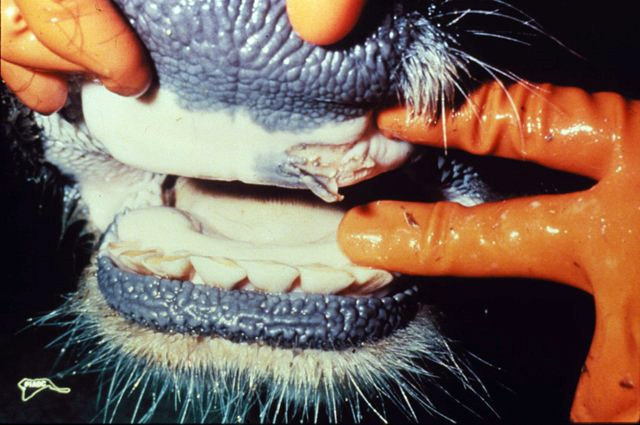
The incubation period for FMD virus has a range between one and 12 days. The disease is characterized by high fever that declines rapidly after two to three days, blisters inside the mouth that lead to excessive secretion of stringy or foamy saliva and to drooling, and blisters on the feet that may rupture and cause lameness. Adult animals may suffer weight loss from which they do not recover for several months, as well as swelling in the testicles of mature males, and cows' milk production can decline significantly. Though most animals eventually recover from FMD, the disease can lead to myocarditis (inflammation of the heart muscle) and death, especially in newborn animals. Some infected ruminants remain asymptomatic carriers, but they nonetheless carry the virus and may be able to transmit it to others. Pigs cannot serve as asymptomatic carriers.
Subclinical (asymptomatic) infections can be classified as neoteric or persistent based on when they occur and whether the animal is infectious. Neoteric subclinical infections are acute infections, meaning they occur soon after an animal is exposed to the FMD virus (about 1 to 2 days) and last about 8 to 14 days. Acute infections are characterized by a high degree of replicating virus in the pharynx. In a neoteric subclinical infection, the virus remains in the pharynx and does not spread into the blood as it would in a clinical infection. Although animals with neoteric subclinical infections do not appear to have disease, they shed substantial amounts of virus in nasal secretions and saliva, so they are able to transmit the FMD virus to other animals. Neoteric subclinical infections often occur in vaccinated animals but can occur in unvaccinated animals as well.
Persistent subclinical infection (also referred to as a carrier state) occurs when an animal recovers from an acute infection but continues to have a small amount of replicating virus present in the pharynx. Cattle, buffalo, sheep, and goats can all become carriers, but pigs cannot. Animals can become carriers following acute infections with or without symptoms. Both vaccinated and unvaccinated animals can become carriers. Transmission of the FMD virus from carriers to susceptible animals is considered very unlikely under natural conditions and has not been conclusively demonstrated in field studies.
Hub AI
Foot-and-mouth disease AI simulator
(@Foot-and-mouth disease_simulator)
Foot-and-mouth disease
Foot-and-mouth disease (FMD) or hoof-and-mouth disease (HMD) is an infectious and sometimes fatal viral disease that primarily affects even-toed ungulates, including domestic and wild bovids. The virus causes a high fever lasting two to six days, followed by blisters inside the mouth and near the hoof that may rupture and cause lameness.
FMD has very severe implications for animal farming, since it is highly infectious and can be spread by infected animals comparatively easily through contact with contaminated farming equipment, vehicles, clothing, and feed, and by domestic and wild predators. Its containment demands considerable efforts in vaccination, strict monitoring, trade restrictions, quarantines, and the culling of both infected and healthy (uninfected) animals.
Susceptible animals include cattle, water buffalo, sheep, goats, pigs, antelope, deer, and bison. It has also been known to infect hedgehogs and elephants; llamas and alpacas may develop mild symptoms, but are resistant to the disease and do not pass it on to others of the same species. In laboratory experiments, mice, rats, and chickens have been artificially infected, but they are not believed to contract the disease under natural conditions. Cattle, Asian and African buffalo, sheep, and goats can become carriers following an acute infection, meaning they are still infected with a small amount of virus but appear healthy. Animals can be carriers for up to 1–2 years and are considered very unlikely to infect other animals, although laboratory evidence suggests that transmission from carriers is possible.
Humans are only extremely rarely infected by foot-and-mouth disease virus (FMDV). However, humans, particularly young children, can be affected by hand, foot, and mouth disease (HFMD), which is also a viral infection caused by multiple viruses belonging to the Picornaviridae family, but it is distinct from FMD.
The virus responsible for FMD is an aphthovirus, foot-and-mouth disease virus. Infection occurs when the virus particle is taken into a cell of the host. The cell is then forced to manufacture thousands of copies of the virus, and eventually bursts, releasing the new particles in the blood. The virus is genetically highly variable, which limits the effectiveness of vaccination. The disease was first documented in 1870.
The incubation period for FMD virus has a range between one and 12 days. The disease is characterized by high fever that declines rapidly after two to three days, blisters inside the mouth that lead to excessive secretion of stringy or foamy saliva and to drooling, and blisters on the feet that may rupture and cause lameness. Adult animals may suffer weight loss from which they do not recover for several months, as well as swelling in the testicles of mature males, and cows' milk production can decline significantly. Though most animals eventually recover from FMD, the disease can lead to myocarditis (inflammation of the heart muscle) and death, especially in newborn animals. Some infected ruminants remain asymptomatic carriers, but they nonetheless carry the virus and may be able to transmit it to others. Pigs cannot serve as asymptomatic carriers.
Subclinical (asymptomatic) infections can be classified as neoteric or persistent based on when they occur and whether the animal is infectious. Neoteric subclinical infections are acute infections, meaning they occur soon after an animal is exposed to the FMD virus (about 1 to 2 days) and last about 8 to 14 days. Acute infections are characterized by a high degree of replicating virus in the pharynx. In a neoteric subclinical infection, the virus remains in the pharynx and does not spread into the blood as it would in a clinical infection. Although animals with neoteric subclinical infections do not appear to have disease, they shed substantial amounts of virus in nasal secretions and saliva, so they are able to transmit the FMD virus to other animals. Neoteric subclinical infections often occur in vaccinated animals but can occur in unvaccinated animals as well.
Persistent subclinical infection (also referred to as a carrier state) occurs when an animal recovers from an acute infection but continues to have a small amount of replicating virus present in the pharynx. Cattle, buffalo, sheep, and goats can all become carriers, but pigs cannot. Animals can become carriers following acute infections with or without symptoms. Both vaccinated and unvaccinated animals can become carriers. Transmission of the FMD virus from carriers to susceptible animals is considered very unlikely under natural conditions and has not been conclusively demonstrated in field studies.
Recent media