Hubbry Logo
search
logo
2112392

Ford CD2 platform

logo
Community Hub0 Subscribers
Read side by side
from Wikipedia
CD2
Overview
ManufacturerFord Motor Company
Production2001–2012
Body and chassis
ClassCompact SUV
VehiclesFord Escape
Mazda Tribute
Mercury Mariner
RelatedMazda GF
Chronology
SuccessorFord CD3 platform

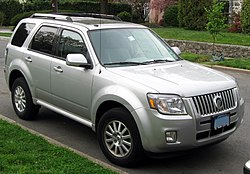
The Ford CD2 platform (for "C/D-class" and called U204 internally) is an automobile platform for crossover SUVs. It is the basis for the Mazda Tribute, Ford Escape, and Mercury Mariner, and was jointly developed by Mazda and Ford.[1] The design is based on Mazda's GF platform, used by the Mazda Capella/626.[2]

CD2 is a front wheel drive platform with an all wheel drive option. Tributes and Escapes are manufactured at Mazda's Hofu Plant and Ford's Kansas City Assembly in Claycomo, Missouri. A Mercury Mariner version was briefly produced at the Ohio Assembly in Avon Lake, Ohio, but this line was halted in mid-2005 to allow the plant to convert to Ford Econoline production. The Mariner was subsequently produced at the Kansas City Assembly plant.

The CD2 vehicles were updated for the 2008 model year with a new exterior and interior, but the chassis and powertrain are mainly carried over. The 2008 models debuted in early 2007. A shortened 2007 production run caused Mazda to halt construction of the 2007 model year Tribute for North America. For the 2009 model year, the vehicles received new powertrain options designed to increase power and fuel economy over the previous models.

from the Mazda GF platform

References

[edit]

See also

[edit]
Revisions and contributorsEdit on WikipediaRead on Wikipedia
from Grokipedia
The Ford CD2 platform, internally designated as U204, is a front-wheel-drive unibody automobile architecture jointly developed by Ford Motor Company and Mazda for compact crossover sport utility vehicles (SUVs).[1][2] It served as the foundation for the first-generation Ford Escape (2001–2007) and Mazda Tribute (2001–2006), as well as the second-generation Ford Escape (2008–2012), Mazda Tribute (2008–2011), and Mercury Mariner (2005–2011).[3][4] Development of the platform began in November 1996 under the U204 project code, with Ford and Mazda engineers collaborating closely—Mazda leading much of the design and engineering from its Hiroshima facility in Japan—after initial plans for separate vehicles were consolidated due to Ford's controlling interest in Mazda.[5][2] The resulting structure emphasized car-like handling, efficiency, and packaging over traditional body-on-frame SUV designs, featuring a 103.1-inch wheelbase, overall length of 173 inches, and independent rear suspension for improved ride quality and space utilization (133.9 cubic feet of interior volume).[1][2] It supported both front-wheel-drive and all-wheel-drive systems, with the latter using a rotary blade coupling (on Mazda variants) or Ford's Control Trac II for on-demand power distribution, enabling towing capacities up to 3,500 pounds when equipped with the optional V6 engine and tow package.[1] Key powertrains included a base 2.0-liter Zetec inline-four engine producing 130 horsepower, paired with a five-speed manual transmission, and an optional 3.0-liter Duratec V6 delivering 200 horsepower with a four-speed automatic; fuel economy ranged from 23 mpg city/28 mpg highway for the four-cylinder front-wheel-drive models to 20 mpg city/24 mpg highway for the V6 all-wheel-drive versions.[1][2] Safety features incorporated dual front airbags, optional side airbags, side intrusion beams, and child seat tethers, while production occurred primarily at Ford's Kansas City Assembly Plant in Claycomo, Missouri, with an annual capacity of around 250,000 units, supplemented by Mazda's Hofu Plant in Japan for right-hand-drive models.[5][4] The platform's debut helped Ford and Mazda capture the burgeoning compact SUV market, with the Escape starting at $18,160 and the Tribute positioned as a sportier alternative.[1] A hybrid variant was introduced for the 2005 model year on the Escape, pairing a 2.3-liter Atkinson-cycle four-cylinder with electric motors for up to 40 mpg in city driving and Super Ultra Low Emissions Vehicle (SULEV) compliance.[2]

Development and history

Origins and collaboration with Mazda

The Ford CD2 platform emerged from a strategic partnership between Ford Motor Company and Mazda in the late 1990s, facilitated by Ford's 33.4% controlling stake in Mazda, which it had increased in 1996 to support the Japanese automaker amid financial challenges. This collaboration leveraged shared engineering resources to develop a new vehicle architecture, marking one of the first major joint production efforts following Ford's deepened involvement. Mazda took a leading role in the platform's design, drawing on its expertise in compact vehicle dynamics, while Ford provided input on scalability for North American markets.[6][7][8] Internally designated as the U204 project and classified as a C/D-class platform, the CD2 was tailored for compact to mid-size crossover SUVs, emphasizing front-wheel-drive architecture with an optional all-wheel-drive system. It was derived from Mazda's GF platform, which underpinned the Mazda 626 (1997–2002), but adapted specifically for SUV applications through modifications such as increased ground clearance, reinforced structural elements for off-road capability, and a unibody construction that enhanced rigidity without the weight penalties of traditional body-on-frame designs. Although Ford clarified that the final platform was not a direct derivative of the 626, the GF's foundational elements influenced the CD2's overall layout and componentry.[9][10][11][8] Development of the platform began in November 1996, involving intensive prototype testing that prioritized unibody integration to achieve superior fuel efficiency compared to conventional body-on-frame SUVs, while maintaining durability for light off-road use. This timeline aligned with the broader industry shift toward crossover vehicles, culminating in production vehicles debuting in 2000 for the 2001 model year. Key design objectives centered on delivering a balance of car-like handling—through fully independent suspension—and SUV utility, such as versatile cargo space, all at an affordable price point to appeal to urban families transitioning from sedans. The platform also pioneered hybrid technology in the SUV segment, with the Escape Hybrid introduced in 2005 as the first mass-produced hybrid SUV in North America, combining a gasoline engine with electric propulsion for improved efficiency.[8][12]

Evolution across generations

The Ford CD2 platform, derived from the Mazda GF platform, underwent evolutionary updates across its two generations from 2001 to 2012, focusing on refinements to safety, powertrains, and efficiency to remain competitive in the North American compact crossover market. These changes responded to rivals such as the Toyota RAV4 and Honda CR-V by prioritizing enhanced safety features and fuel economy without necessitating a complete platform overhaul.[8] The first generation, spanning 2001 to 2007, launched with a basic all-wheel-drive system that provided traction for urban driving and mild off-road conditions. A mid-cycle refresh for the 2005 model year introduced updated exterior styling, including a bolder front fascia and honeycomb grille, alongside interior tweaks like a revised gauge cluster. This refresh also marked the debut of a hybrid powertrain option, making the Ford Escape the first production hybrid SUV available in North America and offering up to 34 mpg in city driving for front-wheel-drive models.[13][14][15] Additionally, the base engine shifted from the 2.0-liter Zetec inline-four to the 2.3-liter Duratec inline-four, delivering 153 horsepower—a 20 percent power increase over the prior unit—for improved performance without sacrificing efficiency.[16][17] The second generation, produced from 2008 to 2012, retained the underlying CD2 chassis but featured a comprehensive redesign of the body, interior, and front-end aesthetics to adopt a more rugged, truck-inspired look aligned with Ford's Explorer lineup. Electronic stability control, branded as AdvanceTrac with Roll Stability Control, became standard on all models, enhancing vehicle control and rollover prevention to meet rising safety expectations in the segment.[18][19] Aerodynamic refinements, such as updated bumpers and spoilers, contributed to a modest fuel economy gain of approximately 5 percent for non-hybrid variants compared to the prior generation, supporting Ford's emphasis on efficiency.[20] The 3.0-liter V6 engine remained available through 2012 but was discontinued for the 2013 model year as part of a broader shift toward smaller, more efficient engines.[21] Over its lifespan, the CD2 platform was exclusively applied to North American crossovers, including badge-engineered variants like the Mazda Tribute and Mercury Mariner, with no major adaptations for other global markets.[22]

Design and features

Chassis and suspension

The Ford CD2 platform utilizes unibody construction, distinguishing it from traditional body-on-frame SUVs and enabling improved handling and ride quality compared to truck-based competitors. This design integrates the body and chassis into a single structure, reducing weight and enhancing structural rigidity for better maneuverability in urban and light off-road scenarios. Curb weights for vehicles on this platform typically range from 3,133 pounds for front-wheel-drive models to around 3,457 pounds for all-wheel-drive variants, depending on engine and equipment configurations.[2][23] The front suspension consists of independent MacPherson struts paired with coil springs, providing responsive steering and absorption of road imperfections. At the rear, an independent multi-link system with trailing arms is employed, particularly in all-wheel-drive models, to maintain stability and wheel control during cornering and load shifts. This setup contributes to the platform's balanced dynamics, with a turning radius of approximately 35.4 feet in early implementations and ground clearance measuring 7.8 to 8.4 inches across configurations, optimizing it for everyday driving while offering modest capability over uneven surfaces.[8][24][25] Front-wheel drive is standard on CD2-based vehicles, with an optional intelligent all-wheel-drive system that incorporates a viscous coupling unit to dynamically distribute torque—up to 100% to the rear wheels under slip conditions—without a traditional center differential, promoting efficiency and traction as needed. Integral safety elements of the chassis include reinforced side-impact door beams and front/rear crumple zones designed to deform progressively in collisions, absorbing energy to protect occupants; these features helped early models achieve 5-star NHTSA ratings in frontal crash tests. Overall NHTSA ratings varied by year and drivetrain, with later second-generation examples earning 4 stars overall due to evolving test standards.[26][25][27]

Body and dimensions

The Ford CD2 platform underpins compact crossover SUVs with a consistent wheelbase of 103.1 inches (2,620 mm), providing a balanced foundation for maneuverability in urban environments.[28][29] Overall vehicle length measures 173.0 to 174.9 inches (4,394 to 4,445 mm) across generations, while width spans 70.1 to 71.1 inches (1,781 to 1,806 mm), and height ranges from 67.6 to 68.0 inches (1,717 to 1,727 mm), depending on drivetrain configuration and model year.[30][29][31] These dimensions position the CD2-based vehicles in the compact SUV segment, offering a footprint smaller than full-size platforms like Ford's D-class while maintaining sufficient presence for family use. Interior packaging accommodates five passengers in a two-row configuration, with front headroom of 40.4 inches and rear headroom of 39.2 inches, ensuring comfortable upright seating for adults.[30][29] Cargo capacity behind the rear seats totals 29.3 cubic feet (829 L), expanding to 66.3 cubic feet (1,877 L) with the 60/40-split folding second-row seats lowered, which facilitates versatile loading for gear or groceries without compromising passenger space.[32] Rear hip room measures 53.4 inches in the first generation, contributing to a spacious feel despite the platform's compact exterior.[30] Body styles on the CD2 platform consisted of five-door SUV variants throughout production, with consistent configurations across the first generation (2001–2007) and second generation (2008–2012). The liftgate design features a top-hinged setup, with optional power operation introduced in later models for enhanced convenience. The platform's modular architecture, developed in collaboration with Mazda, enables shared body components between Ford Escape, Mazda Tribute, and Mercury Mariner models, optimizing production efficiency while allowing brand-specific styling cues.[33][34] Aerodynamically, CD2 vehicles achieve a drag coefficient ranging from 0.39 to 0.40, aided by rounded contours and underbody shielding to reduce wind resistance at highway speeds.[35] Body panels incorporate galvanized steel for improved corrosion resistance, particularly in high-humidity regions, enhancing long-term durability.[36] The platform's wide stance and efficient packaging deliver class-leading rear hip room relative to its compact footprint, prioritizing occupant comfort over expansive cargo in larger rivals, though overall interior volume remains constrained compared to midsize platforms.[30][37]

Powertrains

Gasoline engines

The first-generation Ford CD2 platform vehicles, produced from 2001 to 2007, offered two inline-four engines and an optional V6, all naturally aspirated gasoline units designed for balanced performance and efficiency in compact SUVs like the Escape and Tribute.[38] The base 2.0-liter Zetec inline-four, available from 2001 to 2004, featured a DOHC design producing 127 horsepower at 5,400 rpm and 135 lb-ft of torque at 4,500 rpm.[39] In 2005, Ford replaced it with the 2.3-liter Duratec inline-four, which delivered 153 horsepower at 5,800 rpm and 152 lb-ft of torque at 4,250 rpm through 2007, offering improved refinement over the Zetec. The optional 3.0-liter Duratec V6, available throughout the generation, provided 201 horsepower at 5,900 rpm and 196 lb-ft of torque at 4,700 rpm from 2001 to 2004, then 200 horsepower at 6,000 rpm and 193 lb-ft of torque at 4,850 rpm from 2005 to 2007, prioritizing smoother power delivery for heavier loads.[38][40][41] For the second generation (2008–2012), engine options evolved with updates for better efficiency and power, while maintaining the Duratec family naming. The carryover 2.3-liter Duratec inline-four in 2008 produced 153 horsepower and 152 lb-ft of torque, but was phased out after that year in favor of the 2.5-liter Duratec inline-four starting in 2009, which output 171 horsepower at 6,000 rpm and 171 lb-ft of torque at 4,500 rpm through 2012.[37] The 3.0-liter Duratec V6 continued at 200 horsepower at 6,000 rpm and 193 lb-ft of torque at 4,850 rpm in 2008, then received a significant upgrade in 2009 to 240 horsepower at 6,550 rpm and 223 lb-ft of torque at 4,300 rpm through 2012, thanks to revised DOHC heads and intake tuning.[42][43]
EngineDisplacementPowerTorqueYears
Zetec I42.0 L127 hp @ 5,400 rpm135 lb-ft @ 4,500 rpm2001–2004
Duratec I42.3 L153 hp @ 5,800 rpm152 lb-ft @ 4,250 rpm2005–2007 (first gen); 2008 (second gen)
Duratec I42.5 L171 hp @ 6,000 rpm171 lb-ft @ 4,500 rpm2009–2012
Duratec V63.0 L201 hp @ 5,900 rpm196 lb-ft @ 4,700 rpm2001–2004
Duratec V63.0 L200 hp @ 6,000 rpm193 lb-ft @ 4,850 rpm2005–2008
Duratec V63.0 L240 hp @ 6,550 rpm223 lb-ft @ 4,300 rpm2009–2012
Transmissions paired with these engines varied by model year and powertrain: early inline-fours used a five-speed manual, while most configurations, including the V6 and later automatics, employed a four-speed automatic through 2010; from 2011, a six-speed automatic became standard across gasoline variants for improved shift quality and efficiency.[42] Fuel economy for inline-four models typically ranged from 20–23 mpg city and 26–29 mpg highway per EPA ratings, with the V6 achieving around 18–20 mpg combined, reflecting the trade-off for added power.[44][45] The Duratec engines featured DOHC architecture with variable valve timing on later iterations, enhancing low-end torque and mid-range responsiveness while aiding emissions compliance. By 2005, gasoline-powered CD2 vehicles met Ultra Low Emission Vehicle (ULEV) standards, incorporating advanced catalytic converters and electronic fuel injection to reduce hydrocarbons and NOx outputs.

Hybrid system

The Ford CD2 platform's hybrid variants debuted with the 2005 model year for the Ford Escape and Mercury Mariner, becoming the first production hybrid SUVs available in North America. This parallel hybrid powertrain, which allows the gasoline engine and electric motor to operate independently or together, was co-developed by Ford using licensed technology from Toyota's Hybrid Synergy Drive system, originally featured in the Prius; the licensing agreement, announced in March 2004, covered approximately 20 Toyota patents related to hybrid controls and emissions.[46] The system integrates a nickel-metal hydride (NiMH) battery pack rated at 300 volts nominal and 5.5 ampere-hours, providing energy storage for electric assistance and regenerative functions.[47] In the first-generation hybrids (2005–2007), the setup pairs a 2.3-liter Duratec inline-four gasoline engine producing 133 horsepower with a 70-kilowatt (94-horsepower) permanent magnet AC synchronous electric motor integrated into the transaxle, yielding a combined system output of 155 horsepower.[14] A continuously variable transmission (CVT) delivers power to the front wheels, with front-wheel drive as standard. The 2008 model year retained this 2.3-liter configuration with 155 horsepower total output. The second-generation update starting in 2009 refined the configuration by adopting a 2.5-liter Atkinson-cycle inline-four engine rated at 153 horsepower—optimized for efficiency through late intake valve closing—paired with the same 70-kilowatt electric motor for a total system output of 177 horsepower through 2012, while retaining the CVT as standard.[48][49] The hybrid system's operation emphasizes seamless integration between power sources, featuring regenerative braking that captures kinetic energy during deceleration to recharge the NiMH battery via the electric motor acting as a generator.[50] It supports limited electric-only driving up to approximately 25 miles per hour for low-speed maneuvers, such as parking or urban creeping, before the gasoline engine engages for higher demands. All-wheel drive was an available option, unique among early hybrids, achieved through a separate rear electric motor that provides on-demand torque without a traditional driveshaft, enabling regenerative braking at all four wheels.[51] Fuel efficiency for the 2005 Escape Hybrid was rated at 33 miles per gallon city and 30 highway by the EPA for front-wheel-drive models, offering a total driving range of approximately 500 miles on its 16-gallon fuel tank.[52] The 2009 refresh improved this to 34 city and 31 highway mpg for front-wheel-drive models, thanks to the more efficient Atkinson-cycle engine and software optimizations. Among its distinctive features, the CD2 hybrid was the first to offer optional all-wheel drive in a hybrid SUV configuration, enhancing versatility for varied terrains. The battery pack is mounted under the rear cargo floor, minimally impacting storage by reducing available space behind the seats by about 2 cubic feet compared to non-hybrid models, while still providing 29 cubic feet with seats up and up to 66 cubic feet folded.[53]

Applications

First-generation vehicles (2001–2007)

The first-generation Ford CD2 platform debuted with the Ford Escape, which was introduced in August 2000 as a 2001 model-year vehicle. Available in both two-door and four-door body styles, the Escape offered XLS and XLT trim levels, providing buyers with options for basic utility or added comfort features like upgraded audio and alloy wheels. It quickly became a sales leader in the emerging compact SUV category, moving 42,635 units in its partial launch year of 2000 alone.[54] The Mazda Tribute launched simultaneously with the Escape in 2000 for the 2001 model year, sharing the CD2 platform but featuring a more upscale interior with available leather seating and a premium feel, alongside sportier suspension tuning for enhanced handling. This first-generation Tribute, produced through 2007, emphasized Mazda's design flair while maintaining compatibility with Ford's powertrain lineup.[55][56] In 2005, Mercury introduced the Mariner as an upscale variant of the Escape, targeting luxury-oriented buyers with the Premier trim that included standard leather upholstery and heated front seats. The Mariner shared the Escape's hybrid powertrain option from its debut, offering improved fuel efficiency in a more refined package.[57][58] These vehicles pioneered the compact crossover segment by blending car-like ride quality with SUV versatility, reshaping consumer preferences away from traditional body-on-frame trucks toward more agile alternatives. The 2005 introduction of the Escape Hybrid further enhanced Ford's environmental image as the first gas-electric SUV available from a U.S. automaker, appealing to eco-conscious buyers amid rising fuel costs. Across the Escape, Tribute, and Mariner, first-generation models achieved approximately 1.5 million total sales through 2007, solidifying the CD2 platform's commercial success.[59][60][61] Distinctive features across the lineup included standard roof rails for added cargo versatility and a maximum towing capacity of 3,500 pounds when equipped with the optional V6 engine, making these crossovers suitable for light trailering needs. This generation laid the groundwork for the platform's evolution into subsequent redesigns with refined styling and technology.[45][62]

Second-generation vehicles (2008–2012)

The second-generation Ford CD2 platform vehicles received a mid-cycle refresh for the 2008 model year, introducing bolder exterior styling and enhanced interior quality to address evolving consumer preferences for compact crossovers. The Ford Escape led the lineup with a redesigned front grille inspired by larger Ford SUVs like the Explorer, larger headlights, and improved materials such as soft-touch surfaces and upgraded seating in higher trims. Available in XLS, XLT, and Limited configurations, the Escape offered front- or all-wheel drive, with the hybrid variant carrying over from the previous generation and remaining available through the 2012 model year.[63][64] The Mazda Tribute underwent a similar facelift for 2008, featuring minor exterior updates like a revised grille and taillights alongside a more upscale cabin with better sound insulation and optional leather upholstery. However, shifting dynamics in the Ford-Mazda alliance, including Ford's gradual divestment of its stake in Mazda amid financial pressures and strategic realignments, led to the Tribute's discontinuation after the 2011 model year.[65][66] Parallel to the Escape, the Mercury Mariner received coordinated styling revisions for 2008, including a more premium chrome-accented grille and refined interior trim, with the hybrid powertrain offered from 2008 through 2010. As part of Ford's broader portfolio streamlining during the economic downturn, the Mercury division was phased out, resulting in the Mariner's production ending with the 2011 model year.[67][68] Technological enhancements distinguished this generation, with the introduction of Microsoft SYNC infotainment system in 2009 enabling hands-free calling, voice-activated audio controls, and USB integration on select trims. Optional navigation systems and advanced safety features, such as blind-spot monitoring, became available on XLT and Limited models to improve driver assistance. Sales for the second-generation Escape reached a peak of 280,274 units in 2012 in the U.S., reflecting strong demand for its versatile packaging and hybrid option, with cumulative production across the Escape, Tribute, and Mariner approaching 1.2 million units globally. While praised for reliability and value early on, the models faced criticism by 2012 for feeling dated compared to newer competitors, with outdated chassis dynamics and styling that lagged behind segment leaders. The 3.0-liter V6 engine continued to be paired with a four-speed automatic transmission.[69][70][61][69]

Production and discontinuation

Manufacturing locations

The Ford CD2 platform vehicles, including the Ford Escape, Mercury Mariner, and Mazda Tribute, were primarily assembled at the Kansas City Assembly Plant in Claycomo, Missouri, United States, serving as the main production hub for North American models from 2001 to 2012. This facility handled all U.S. production for the Escape and Mariner throughout their runs, as well as the Tribute until 2011, leveraging shared assembly lines for the jointly developed platform.[71][48] Production of the first-generation Escape and Mariner also occurred at the Ohio Assembly Plant in Avon Lake, Ohio, from 2001 to 2005. The Claycomo plant, operational since 1951 and spanning 4.7 million square feet, supported high-volume output with a capacity exceeding 300,000 units annually during peak CD2 production years, facilitated by joint venture elements between Ford and Mazda that included shared tooling and components for efficiency. Production incorporated lean manufacturing practices to optimize workflows and reduce waste across the assembly process. At its height for the Escape line, the facility employed around 3,700 hourly workers dedicated to these vehicles.[72][73][74] Key supply chain elements centered on North American suppliers, with Duratec gasoline engines sourced from the Cleveland Engine Plant in Brook Park, Ohio. For hybrid variants, nickel-metal hydride batteries were supplied by Sanyo Electric, while Visteon provided powertrain and electronic components from facilities in Michigan before its partial reintegration with Ford.[75][76][77] While focused on North American markets, CD2 vehicles saw limited exports to Mexico and Canada, with no large-scale overseas assembly for U.S.-spec models; however, the Mazda Tribute underwent localized production in Taiwan at the Ford Lio Ho plant and in the Philippines at Ford Philippines for regional distribution.[78]

End of production

The production of vehicles based on the Ford CD2 platform concluded with the end of the 2011 model year for the Mazda Tribute and Mercury Mariner, while the Ford Escape continued through the 2012 model year before transitioning to a new architecture.[34][79][80] Several factors contributed to the platform's retirement, including its aging design that struggled to keep pace with evolving consumer demands for improved fuel efficiency amid rising gasoline prices in the late 2000s and early 2010s. Stricter Corporate Average Fuel Economy (CAFE) standards, which required automakers to achieve higher fleet-wide efficiency targets for model years 2012–2016, further pressured the CD2's carried-over powertrains and chassis. Additionally, intensified competition from unibody compact SUVs like the Subaru Forester, which offered better handling and efficiency, eroded market share for CD2-based models.[81][80][82] Across all models from 2001 to 2012, the CD2 platform underpinned approximately 2.7 million units produced globally, with hybrid variants accounting for roughly 100,000 units, marking Ford's early push into electrified SUVs.[83][8] The CD2's legacy lies in its role as a foundational unibody SUV platform that influenced subsequent Ford designs, paving the way for the global C platform introduced with the 2013 Escape, which enabled modular architecture for shared components across models like the Focus and Kuga. This shift supported broader electrification and efficiency goals in later platforms, including the C2 architecture used from 2018 onward for vehicles such as the current Escape and Bronco Sport.[80][84] In the aftermarket, CD2-based vehicles maintain a strong presence in the used market due to their affordability and versatility, with reliability ratings averaging 4 out of 5 from RepairPal assessments across the era. Hybrid models, as the first production hybrid SUVs in North America, have garnered a dedicated enthusiast following for their pioneering role in sustainable mobility.[85][8]

References

User Avatar
No comments yet.