Hubbry Logo
Forgotten WorldsForgotten WorldsMain
Open search
Forgotten Worlds
Community hub
Forgotten Worlds
logo
7 pages, 0 posts
0 subscribers
Be the first to start a discussion here.
Forgotten Worlds
Forgotten Worlds
from Wikipedia

Forgotten Worlds
Arcade flyer
DeveloperCapcom
PublishersCapcom
Sega (Genesis, Master System)
U.S. Gold (home computers)
NEC Avenue (TG-16)
DesignersAkira Yasuda
Akira Nishitani
Noritaka Funamizu
Yoshiki Okamoto
ArtistAkira Yasuda
ComposerTamayo Kawamoto
PlatformsArcade, Sega Genesis, Amiga, Commodore 64, Atari ST, ZX Spectrum, Amstrad CPC, Master System, TurboGrafx-16
Release
May 13, 1988
  • Arcade
    DOS
    Genesis
    ZX Spectrum
    Amiga
    Amstrad CPC
    Atari ST
    C64
    Master System
    Turbo-CD
    • JP: March 27, 1992
    • US: November 1992[8]
GenreScrolling shooter
ModesSingle-player, multiplayer
Arcade systemCP System

Forgotten Worlds[a], originally titled Lost Worlds[b], is a 1988 horizontally scrolling shooter video game developed and published by Capcom for arcades. It is notable for being the first title released by Capcom for their CP System arcade game hardware.[9]

Plot

[edit]

Set in the 29th century, an evil god known as Bios has destroyed most of the Earth, turning it into a desolate wasteland known as the Dust World. Two nameless supersoldiers are created by the people to defeat Bios and the eight evil gods who serve him.[10]

Gameplay

[edit]

Forgotten Worlds can be played by up to two players simultaneously. The player controls a flying muscle-bound soldier armed with a rifle with unlimited ammo. The Player 1 character is equipped with a long-range automatic rifle, while Player 2 has a short-range wide shot. The controls in the original coin-op version consist of an eight-way joystick for moving the character in the air while flying and a unique rotatable button known as the "roll switch".[10] Rotating the switch left or right allows the player to adjust their character's aim in one of sixteen directions, while pressing it causes the player character to shoot his gun. This allows for the player to move their character anywhere while keeping their aim in one direction. Pressing the switch rapidly will cause the character to perform a "megacrush" attack which will destroy all on-screen enemies, but at the expense of a portion of their vitality gauge.

The player character is accompanied by a satellite module orbiting near him that will provide backup firepower every time the player fires their gun. Like the main character, the satellite can also be rotated with the roll switch. Rotating the character while firing will only rotate the aim of the satellite, while rotating the character without firing will not only rotate the satellite's aim, it will also move its relative position around the player.

The player can obtain blue-colored coins known as Zenny from defeating enemies throughout the game. Zenny is used as currency to obtain new power-up items from shops located at certain points in each stage. When the player enters an item shop, they are given a choice of the items available and a limited time to make any purchase they wish. These items consist primarily of new weapons for the satellite module, but also include a health kit to restore lost vitality, armor that allows the player to sustain additional damage, and even tips on how to defeat the boss awaiting at the end of the current stage.

Forgotten Worlds consists of nine stages each with its own boss. The player will lose if their vitality gauge runs out, but will be given a chance to continue.

Development

[edit]

The game took two years to develop, with a production budget between $5,000,000 (equivalent to $14,000,000 in 2025) and £5.5 million or $10,000,000 (equivalent to $27,000,000 in 2025).[11][12] The game used four megabytes of sprite data.[11] The game started off as a regular side-scrolling shooter, but Yoshiki Okamoto wanted a more imaginative game.[13] During development, Capcom tried to make the game easier to play, having received criticism about how hard it was to dodge enemy projectiles in previous games. As this was the first game to use the CPS-1, Capcom tried to fully maximize its software capabilities.[14] The game did not generate enough income upon its release due to large numbers of shooter games in the market and there were increased expenses due to a shortage of chips needed for the CPS-1 boards.[13]

Home versions

[edit]

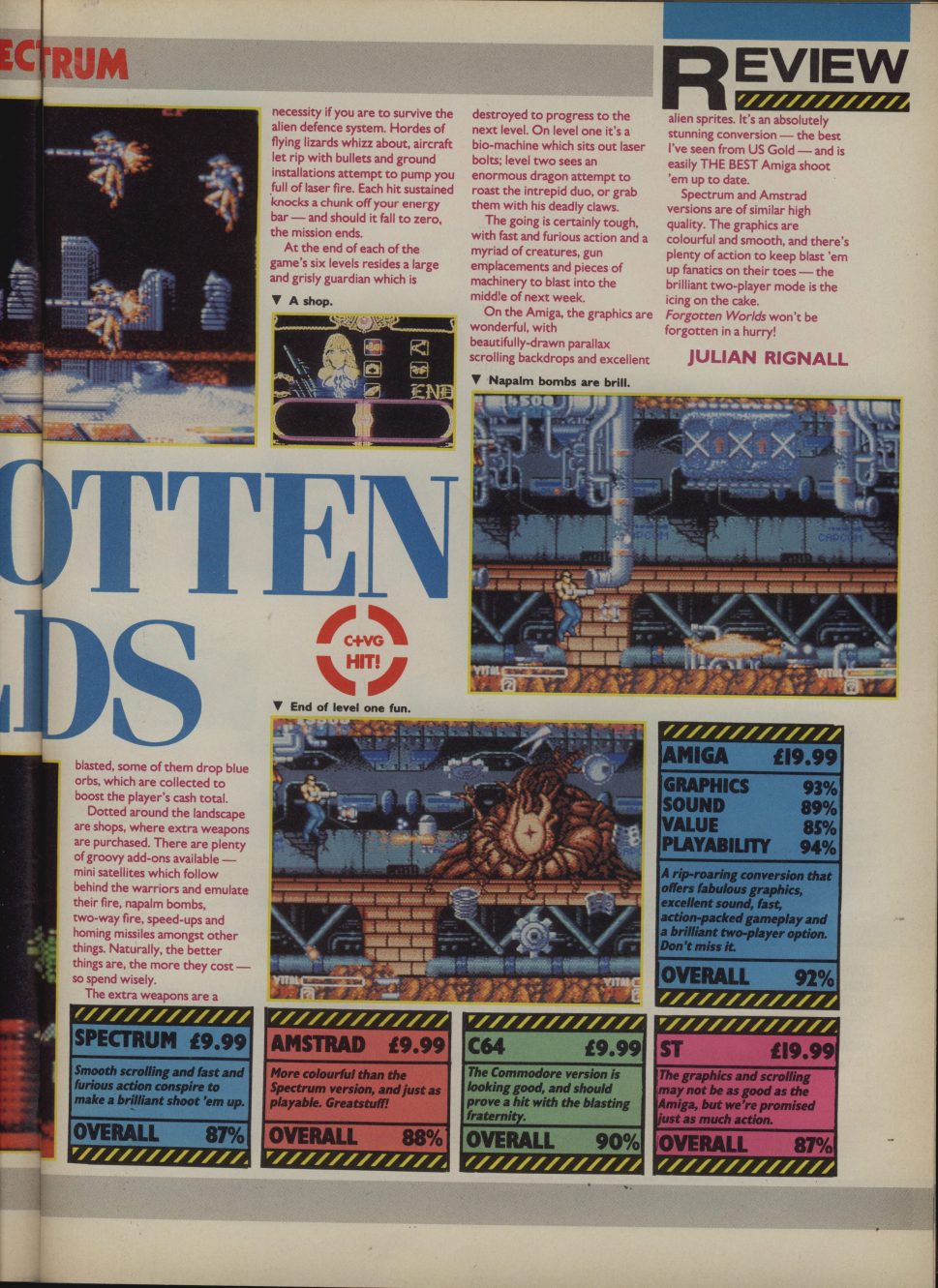
Forgotten Worlds was first ported to various home computers in Europe by U.S. Gold in 1989. Versions were produced for the Amiga, Atari ST, Commodore 64, ZX Spectrum, Amstrad CPC, and IBM-compatible PC. These versions of the game were developed by Arc Developments.[4] The development team had four months to make the conversions. Every graphical frame was digitised directly from the arcade version's screen using a DigiView Gold device and stored the data on an Amiga 500 computer. The God of War was hand sketched, redrawn on the computer and colored with Deluxe Paint, although the mirroring function saved time. Even the shop scene was hand sketched from scratch.[15]

All the home computer version required a joystick controller in order to be played and could not be played with the keyboard only (with the exception of the IBM PC, ZX Spectrum, and Amstrad CPC versions). The player rotated the character in these versions by holding the fire button while pushing the joystick left or right.[16] In the Spectrum sales charts, it was number two, behind Robocop, which was number one every month for most of the year.[17]

The Sega Mega Drive/Genesis version, produced by Sega, was released in Japan on November 18, 1989, followed by North America a month later, with a subsequent release in the PAL region the following year. The Mega Drive version simulated the controls of the arcade version by using A and C buttons to rotate the character in either direction and the B button for shooting. Unlike in the arcade version, both players are equipped with long-ranged automatic rifles. This version has only seven of the arcade's nine stages and provides an auto-fire feature that can be toggled on or off on the game's settings. In 2008, the Mega Drive version was released on the Wii Virtual Console in North America on November 17 and in Europe on November 28.[18]

The Master System version was also released by Sega in Europe and Brazil. This version is 1-player only and due to the presence of only two buttons on the Master System's standard controller, the buttons are used solely to rotate the character, who shoots automatically. The megacrush attack is performed in this version by pressing both buttons simultaneously.

The PC Engine version (published by NEC Avenue) was released in Japan on March 27, 1992 as a Super CD-ROM² title which supported a specialized 3-button controller that NEC released only in Japan. The North American version for the TurboGrafx-16 CD was released by Turbo Technologies Inc. With the 3-button controller, the player can control their character as they would in the Mega Drive version, with two buttons to rotate the character and one to shoot. With the standard TurboGrafx-16 controller, the Run button is used in the place of the third button to rotate the character to the left. The TG16 CD port is one-player only, but allows the player to select between either of the two unknown soldiers at the start of the game (with their respective abilities from the arcade version retained).

A version for the Capcom Power System Changer was planned and previewed but never released.[19]

An emulation of the original arcade version is included in the 2005 compilation Capcom Classics Collection Vol.1 for the PlayStation 2 and Xbox, 2006's Capcom Classics Collection: Remixed for the PlayStation Portable, and also for the Nintendo Switch as part of Capcom Arcade Stadium, as well as the PlayStation 4, Xbox One, and Microsoft Windows via Steam. The PS2 and Xbox versions allow the player to use their respective controllers' right analog sticks to control the player character's aim. In 2008 the Mega Drive version was ported to the Wii as part of the Virtual Console.[20]

Reception

[edit]

In Japan, Game Machine listed Forgotten Worlds on their September 1, 1988 issue as being the second most-successful table arcade unit of the month, outperforming titles like Sky Soldiers and Ninja Spirit.[41] In the United Kingdom, U.S. Gold predicted the home computer port could outsell their previous best-selling Capcom release Bionic Commando, which had sold 70,000 copies in the UK as of early 1989.[12]

The game was met with highly positive reviews from critics. Upon release, the arcade game received positive reviews from Computer and Video Games, The Games Machine, Your Sinclair,[23] and Commodore User.[29] Critics compared the arcade game favorably to earlier shooters including Capcom's Side Arms (1986), Konami's Nemesis (Gradius) and Sega's Space Harrier.[23]

The Games Machine gave the Amiga version a score of 94%, praising the title's graphics and faithfulness to the arcade version.

Accolades

[edit]

At the 1988 Gamest Awards in Japan, the arcade game received the "Best Graphics" award.[35]

The home computer conversions received the "CVG Hit!" award from Computer + Video Games. The ZX Spectrum version received the "Crash Smash!" from Crash and the "SU Classic" award from Sinclair User.

Retrospective

[edit]

Notes

[edit]

References

[edit]
[edit]
Revisions and contributorsEdit on WikipediaRead on Wikipedia
from Grokipedia
Forgotten Worlds is a horizontally scrolling developed and published by in 1988. Set in a post-apocalyptic 29th-century devastated by the alien god Lord Bios, the game follows two nameless soldiers equipped with jetpacks as they battle waves of monstrous invaders across nine stages to restore humanity. Originally titled Lost Worlds in , it was Capcom's first title for its arcade hardware and introduced innovative 360-degree aiming mechanics using a rotary control, alongside an in-game economy where players collect currency to purchase weapons and upgrades. Gameplay emphasizes fast-paced action in a science-fiction and fantasy hybrid world, with players controlling flying warriors who can aim in sixteen directions while auto-firing weapons like the Vulcan Cannon or Thunder Laser. Enemies drop "Zenny" coins upon defeat, which are spent at shops between stages on power-ups, armor, and special items, including a screen-clearing Mega attack charged by holding a button. The game supports one- or two-player mode, though ports often vary in fidelity; for instance, the version omits two stages and alters controls, while the PC Engine Super CD-ROM² port features enhanced audio with but lacks co-op. Boss encounters draw from mythological inspirations, such as a techno-organic version of the Egyptian god , adding thematic depth to the shooter formula. Developed by a team including notable Capcom figures like Yoshiki Okamoto and , Forgotten Worlds evolved from concepts similar to Contra into a unique entry in Capcom's "jetpack" shooter series alongside and Side Arms. It was ported to numerous home platforms starting in 1989, including the , ST, Commodore 64, Sega Master System, and Sega Mega Drive/Genesis, with modern re-releases available via on platforms like , , and PlayStation 4. These emulated versions preserve the original arcade experience with improved controls and multilingual support, ensuring accessibility for contemporary players.

Synopsis

Plot

Set in the 29th century, Forgotten Worlds takes place on a post-apocalyptic transformed into a desolate wasteland known as Dust World following the catastrophic invasion by the tyrannical god , who has unleashed eight subordinate to eradicate human civilization.) , portrayed as an alien and self-proclaimed Celestial Emperor, has systematically destroyed cities and defenses, leaving behind ruined freeways, toppled , and barren landscapes as remnants of humanity's former glory.) In response to this apocalypse, humanity awakens two genetically engineered supersoldiers from to serve as its ultimate defenders against the divine onslaught.) These protagonists, often depicted as muscular, flying warriors—one blonde with shades and the other mohawked—are equipped with jetpacks and jet guns as their primary weapons, enabling them to traverse the ravaged world in pursuit of vengeance.) The narrative progresses across nine stages, chronicling the supersoldiers' journey through increasingly perilous regions of Dust World as they dismantle Bios's forces, including confrontations with bosses embodying the eight evil gods, such as the War God and . The storyline builds to a climactic assault on Bios's stronghold, the , where the protagonists engage in a against the god of destruction itself to reclaim from eternal subjugation.

Gameplay

Forgotten Worlds is a horizontal scrolling shooter in which players control supersoldiers equipped with jetpacks, navigating through enemy-infested environments while engaging in combat. The game supports two-player simultaneous cooperative mode, allowing both participants to progress through the stages together, with each player controlling a distinct character that influences their starting weapon capabilities. Movement is handled via an 8-way , enabling free horizontal and vertical traversal across the screen, while shooting is directed by a unique rotary "roll switch" control that allows 360-degree aiming; rotating the knob adjusts the firing direction of the character's satellite-mounted gun in real time, and pushing it down activates a rapid-fire burst or a screen-clearing mega crush when double-pressed. The core weapon system revolves around a default jet gun that can be upgraded at inter-stage shops using Zenny currency collected from defeated enemies. These shops, hosted by a character named Sylphie, offer a variety of power-ups, including precision beams for armor-piercing attacks, the rapid-fire vulcan cannon for sustained barrages, and wide spread shots for broader coverage against enemy waves. Upgrades are purchased in escalating power levels, with higher-cost options providing greater damage output and range, and players can also acquire enhancements for improved firing rates or armor to bolster defenses. The game consists of nine stages, each featuring waves of enemies, mid-boss encounters, massive end-stage bosses, and environmental hazards like collapsing structures or projectile barrages that demand precise maneuvering. Progression involves destroying foes to accumulate points for scoring, which is primarily based on the number of enemies eliminated and Zenny gathered, with bonuses for quick stage completion. Players start with a health bar that depletes gradually from enemy contact or projectiles, allowing multiple hits before death; one life is provided per credit, but continues are available to resume from the current stage, and difficulty scales progressively with more aggressive enemy patterns and tougher bosses in later levels.

Development

Production history

The development of Forgotten Worlds was undertaken by 's internal arcade division in the late 1980s, culminating in its release as the company's first title on the new Capcom Play System-1 (CPS-1) hardware in July 1988. Originally conceived as a two-player in the vein of Contra, , and Heavy Barrel, the project evolved into a unique entry incorporating elements from prior Capcom shooters like Side Arms, with asset reuse from Side Arms and due to development constraints. Key personnel included prominent designers Akira "Akiman" Yasuda and Akira Nishitani, alongside planner Noritaka Funamizu and director Yoshiki Okamoto, who contributed to the game's innovative structure and visual style. Originally titled Lost Worlds for its Japanese arcade release, the game was renamed Forgotten Worlds for international markets to better appeal to global audiences. The production process presented several challenges, including delays from an insufficient number of unique enemy designs, which prompted the team to reuse sprites and elements from prior titles like Side Arms and 1943 to maintain visual variety without extending timelines further. Additionally, the CPS-1 board's expansive design, featuring over 10 ROM chips, proved cumbersome for prototyping and debugging, complicating efforts to balance graphical ambition with reliable playability. The development of the underlying CPS-1 hardware itself incurred significant costs, estimated at $5 million, underscoring the era's investment in advanced arcade technology.

Technical innovations

Forgotten Worlds marked the debut of Capcom's (CPS-1) arcade hardware, a modular board set that powered the company's arcade titles through the early . The system featured a CPU running at 10 MHz for main processing, paired with a at 3.579 MHz for sound duties, enabling complex and multimedia effects previously challenging on earlier arcade platforms. This hardware supported a 12-bit color palette of 4096 hues, with up to 512 colors displayable on screen via a palette system allocating 16 colors per tile or sprite across multiple layers, allowing for vibrant, detailed environments that stood out in 1988 arcades. A key input innovation was the use of dual control mechanisms: a standard 8-way for character movement and a rotary spinner—known as a "rolling switch" in —for 360-degree aiming and control, providing analog-like precision beyond typical digital D-pads or joysticks of the era. Pressing the rotary control fired weapons in the aimed direction, while a secondary handled deployment, creating fluid, intuitive combat in a side-scrolling shooter. This setup, mounted on a specialized control panel, enhanced tactical depth by decoupling movement from firing orientation. Visually, the CP System's three independent scrolling layers facilitated , simulating depth with foreground, midground, and background elements moving at varying speeds to craft immersive alien worlds. Sprite handling supported up to 256 sprites per scanline in sizes from 16x16 to 256x256 pixels, each with 16 colors (15 unique plus transparency), enabling large, animated bosses and dynamic enemy swarms without flicker during smooth horizontal and vertical progression. Audio advancements included the Z80-driven FM synthesis chip for melodic tracks and the OKI MSM6295 for 4-bit ADPCM voice samples, delivering digitized speech like enemy taunts and shop interactions—rare for arcade shooters at the time and adding flair. The game's shop system introduced an in-game where players collected "Zenny" from defeated foes to purchase weapon upgrades, armor, and items between stages, blending shooter action with RPG-like progression and foreshadowing hybrid genres that integrated into fast-paced combat.

Release

Arcade version

_Forgotten Worlds was initially released in arcades in in July 1988 under the title Lost Worlds (ロストワールド), with the international launch following in 1988. Developed and published by for worldwide distribution, it debuted on the company's new Capcom Play System (CPS-1) hardware, marking an early showcase for the platform. The game was housed in standard upright arcade cabinets, each equipped with a distinctive control layout to support its cooperative gameplay. Players used an eight-way to maneuver their character through the side-scrolling environments, while a rotary knob allowed independent control of the weapon's aiming direction, enabling 360-degree firing without restricting movement. This dual-input design, combined with a fire button on the rotary, provided precise control over the aerial combat mechanics, where the core loop involved flying soldiers battling alien forces while collecting power-ups. Commercially, the arcade version performed strongly, solidifying its place in Capcom's successful portfolio that year alongside titles like Street Fighter. Regional variations were minimal, primarily involving the title change for the Japanese market and differences in voice samples; for instance, the Japanese Lost Worlds included additional audio clips for characters like the fairy Sylphie, which were omitted or altered in international localizations due to production constraints.

Home ports

The home ports of Forgotten Worlds began appearing in 1989, adapting the 1988 arcade original to various 8-bit and 16-bit home computers and consoles, with publishers varying by platform and region. handled the European releases for the , Atari ST, Commodore 64, , , and IBM PC (DOS) versions that year, while published the /Mega Drive port in in November 1989, followed by North American and PAL releases in 1990. These early ports prioritized accessibility on limited hardware, often simplifying the arcade's unique control scheme—which featured an eight-way for movement and a rotatable button for independent aiming and firing—into approximations using standard controllers or keyboards. On home computers like the and ST, players used keyboard controls or input for aiming, while console versions such as the Genesis relied on movement combined with button holds to rotate the character's aim, reducing precision compared to the arcade's dual-input system. The DOS version supported EGA but suffered from grainy visuals and choppy performance due to hardware constraints. Graphical and gameplay fidelity varied significantly across platforms, with 16-bit systems like the , ST, and Genesis offering closer approximations to the arcade's detailed sprites and multi-layered backgrounds, though animations were simplified and some parallax scrolling effects were omitted on the ST. Eight-bit ports on the Commodore 64, , and featured notable downgrades, including reduced color palettes, smaller sprites, and slower frame rates to fit memory limits, while maintaining the core horizontal-scrolling structure but shortening levels or removing minor details. Co-operative multiplayer, a hallmark of the arcade, was retained on higher-end systems like the Genesis but omitted in ports such as the DOS and 8-bit computer versions to streamline single-player focus. Later adaptations extended to the in 1991 (published by for European and Brazilian markets) and the /PC Engine Super ² in on March 27, 1992 (published by Avenue). The version, developed by Sanritsu, mirrored the 8-bit computer ports with further graphical simplifications and no co-op mode, emphasizing solo play on the console's hardware. In contrast, the PC Engine release leveraged capabilities for enhanced audio tracks, including a more expansive , while preserving all levels and improving sprite fidelity over 8-bit counterparts, though it still cut two-player functionality in favor of selectable solo characters.

Re-releases

_Forgotten Worlds was included in the , a compilation released in 2005 for and , which emulated the original arcade version and mapped the rotary aiming controls to the right for improved accessibility on home consoles. In 2021, the game received a digital re-release as for , initially launching on before expanding to , , and PC via . This version supports both Japanese and options and introduces modern features such as save states, gameplay rewind, adjustable difficulty and speed settings, and online leaderboards. The emulation adapts the original rotary controls using s for aiming or shoulder buttons for discrete rotation, enhancing playability on contemporary hardware. As of 2025, Forgotten Worlds remains available digitally through on , , , and , with no new physical releases announced since 2021.

Reception and legacy

Contemporary reception

Upon its 1988 arcade release, Forgotten Worlds received praise for its stunning and fast-paced action, with reviewers highlighting the detailed and colorful foreground elements, massive end-of-level bosses like the Dust Dragon and Samurai Warlord, and overall over-the-top presentation that surpassed many contemporaries. The game's innovative control scheme, using a for aiming combined with a for movement, was noted for enabling fluid 360-degree shooting, though it came with a steep that frustrated some players. However, critics also pointed out its lack of originality as a variation on Capcom's earlier Side Arms, alongside its extreme difficulty, which made it expensive to play due to frequent deaths from relentless enemy swarms and high-speed chaos. The title achieved solid adoption in arcades, reflecting Capcom's growing prominence in the genre during the late 1980s. Home computer ports, released primarily in 1989 by , garnered high acclaim on 16-bit systems like the and ST, where they were lauded for faithfully capturing the arcade's visual spectacle, smooth scrolling, and co-operative multiplayer mode. The version, in particular, earned scores of 97% from for its "addictive" gameplay and "stunning" graphics, and 90% from Commodore User, which called it a rival to top arcade conversions like . These ports averaged around 94% in contemporary reviews, emphasizing the innovation in rotational aiming and two-player co-op as standout features that enhanced replayability. Common praises included the empowering weapon upgrade system using in-game currency, though the game's short length—typically completable in under an hour by skilled players—was occasionally noted as a drawback. In contrast, 8-bit conversions for platforms like the Commodore 64 received more mixed responses, with scores around 88% from Commodore User but criticisms centered on occasional slowdowns during intense sprite-heavy sequences that disrupted the pacing. Reviewers appreciated the effort to replicate the arcade's core mechanics and co-op play but highlighted how hardware limitations led to less fluid action compared to 16-bit versions. Overall, the home ports bolstered Capcom's early presence on European computer markets, contributing to the company's expansion beyond arcades into console and home computing ecosystems during the early . The steep difficulty curve remained a consistent theme across platforms, often praised for challenge but criticized for alienating casual players, while the aiming innovation was widely lauded for adding depth to the formula.

Accolades

At the 2nd Gamest Grand Prize awards for , held in , Forgotten Worlds (known as Lost Worlds domestically) secured second place in the overall grand prize category and was nominated for best shooter with a second-place finish in that subcategory. The game also won first place for Best Graphics, recognizing its innovative use of the hardware for detailed, scalable sprites and backgrounds. Additional placements included third for Best Ending. The title's debut on Capcom's new arcade board marked a significant technical milestone, earning developer recognition as the company's first production utilizing this influential hardware platform, which later powered hits like . It was featured in Japanese arcade popularity polls and year-end selections by Gamest, highlighting its innovative and visual design. In the West, Forgotten Worlds received no major formal awards beyond positive mentions in magazine top lists, such as those in , but its graphical achievements were frequently praised in contemporary coverage.

Retrospective reviews

In the 2010s and 2020s, retrospective analyses have praised Forgotten Worlds for its innovative blend of shoot 'em up mechanics and RPG-like elements, positioning it as one of Capcom's standout titles from the late 1980s arcade era. Hardcore Gaming 101 highlighted its stunning visuals, such as the ruined freeways and Incan-styled shops, along with varied boss designs, describing it as a key entry in Capcom's "jetpack" trilogy alongside Section Z and Side Arms. The game's health bar system and currency-based shop for weapon upgrades were noted for adding strategic depth uncommon in contemporary shooters, contributing to its enduring appeal among retro enthusiasts. The title's legacy includes its influence on the genre through the shop system, which allows players to purchase power-ups using collected Zenny, fostering a sense of progression and replayability that echoed in later titles with mechanics. Its free-aiming controls, originally via a rotary knob for 360-degree shooting, inspired adaptations in subsequent action games that emphasized directional flexibility over fixed patterns. Among shmup fans, Forgotten Worlds holds cult status for its unconventional human protagonists and co-op gameplay, often celebrated in retro gaming communities for blending sci-fi and fantasy elements in a mesmerizing level design. Recent coverage, including playthroughs and analyses from 2021 to 2023, has emphasized the game's timeless difficulty as a challenging yet fair test of skill, with no major remakes but frequent inclusion in anniversary collections. The 2021 re-release in received positive user feedback on platforms like , earning around 69% positive reviews from players who appreciated the emulation's fidelity and added features like rewind and adjustable speed. Modern takes on re-releases often contrast early criticisms of the arcade's specialized controls with contemporary adaptations, such as using shoulder buttons or right analog sticks for aiming, which make the rotational shooting more accessible on standard controllers without diluting the original intensity.

References

Add your contribution
Related Hubs
User Avatar
No comments yet.