Hubbry Logo
Free teknoFree teknoMain
Open search
Free tekno
Community hub
Free tekno
logo
7 pages, 0 posts
0 subscribers
Be the first to start a discussion here.
Free tekno
Free tekno
from Wikipedia

Free tekno, also known as tekno, freetekno and hardtek, is the music predominantly played at free parties in Europe. The spelling tekno is deliberately used to differentiate the musical style from techno. The music is fast and it can vary between 150 and 185 bpm and is characterised by a pounding repetitive kick drum.[1] Nevertheless, bass drum distortion by clipping is used less often as in the related genre of mainstyle hardcore. Nowadays, some tekno producers also use drum sets that rather sound trancey, since many members of the tekno subculture as well as the psytrance subculture frequently attend the same raves and the two scenes are closely connected.

History

[edit]
Freetekno party

Tekno evolved in tandem with the teknival movement in the early 1990s since many of the teknival organisers and DJs were also making music. At first the music took off from acid house and then drew on influences such as hardcore, jungle, early hardcore and techno, with the producers taking the sound in a darker direction. Spiral Tribe was the first to start making and widely disseminating this genre, taking it to France and Eastern Europe after the Criminal Justice act was implemented in the UK. An emphasis is placed on samples from TV shows, films and popular culture which are placed at strategic moments in the tracks. The music was produced with whatever was available: drum machines, synthesisers and keyboards as well as computer programs such as audio/MIDI sequencers and Trackers, sometimes even hitting a random table with a pen. Starting from year 2001 there has been a trend using laptop and laptops for live performances, because the capabilities of both the hardware and software were improving very quickly. Many artists, however, still use hardware for live performance and create a unique track at every freeparty. The sounds are lot simpler making them sound more oldschool and easier to dance to. The main genre that is still played with hardware, is tribe, a relatively underground subgenre of tekno.

With the evolution of the genre it has come to be known by a number of names, including spiral tekno, hardtek, tribetek, tribe and lately evolved in many other subgenres like pumping tek, hardfloor and Frenchcore which is a sort of mixture between mainstream hardcore and hardtekno, with funny and pumping samples taken from different media sources.

Artists within this genre usually follow a very different ideology when compared to more modern and mainstream producers:

  • Artists often use many pseudonyms, as they are not interested in mainstream success or recognition
  • Most are not interested in profit
  • They also support the free distribution of their works, as they do not see it as their own material, but as something that belongs to the fans and the community

This is described as "returning to the roots".

Subgenres

[edit]

Jungletek and raggatek are genres derived directly from hardtek. These genres are often mixed to create fast energetic 190 bpm dance floor music. Kicked off around 2008 in the UK, Mandidextrous & Vandal were among the first producers of these genres. It breathed new life into the underground rave scene not only in the UK but also picking up a strong following in Italy, Spain and Austria to mention a few. Influences for this music also came from the techno scene in Europe where some of the first underground music lovers increase the bpm and added variations in structure, thus becoming tekno. Techno in the UK in the early 1990s was based on a bpm of 130–140. By the 2000s, tekno had gained more speed and hardtek was starting to dominate UK raves, especially in the South and London. Trance also progressed from sweeping delicate melodies to what's now known as hard trance. Hard trance is a faster and bouncier music than its predecessor. In late 2010s, there was a progression of drum and bass (DnB) into neurofunk, which was grittier and had harsher bass and synth sounds.

Raggatek is predominantly influenced by reggae and ragga, incorporating also elements from jungle, DnB, dancehall and techno. Well-known MCs such as YT and Top Cat are a massive influence on the world of raggatek. Producers loving this type of sound wanted to bring it to the dance floors of the underground. Upping the bpm to between 180 – 200 and adding breaks. The big sounding ragga style vocals are often present in raggatek songs.

Jungletek works on exactly the same formula as raggatek, replacing the ragga elements with those from jungle and DnB. It is less known for the vocal arrangements and more for its bass lines. Jungletek takes the basics of the bass line from well-known jungle and DnB tracks and recreates them in a hardtek format. Original productions also use the simple format of kick-bass with amen breaks. European raggatek and jungletek are often recognizable by their energetic eletro sounds in the bass lines and synth melodies.

Other subgenres include, acid tekno. Tracks usually include a simple hard hitting kick and acid lines as melodies. These acid lines appeared in the 1980s with acid house music. This particular and unique sound is produced with a synthesizer like the tb-303 by Roland. This subgenre eventually gave birth to acidcore, which is faster and has distorted kicks.

Another subgenre that is played a lot at free parties is tribe tek. A simple kick bassline with simple rhythmic patterns on top of the kicks. This genre can be traced back all the way to the first parties where it was played on hardware, like synthesizers. This genre got its name from the Spiral Tribe collective that organized some of the first free parties in the UK and France. This genre can again be declined in to tribecore, which uses a faster rythme and harder hitting kicks than original tribe tek.

Unconnected Genres

[edit]

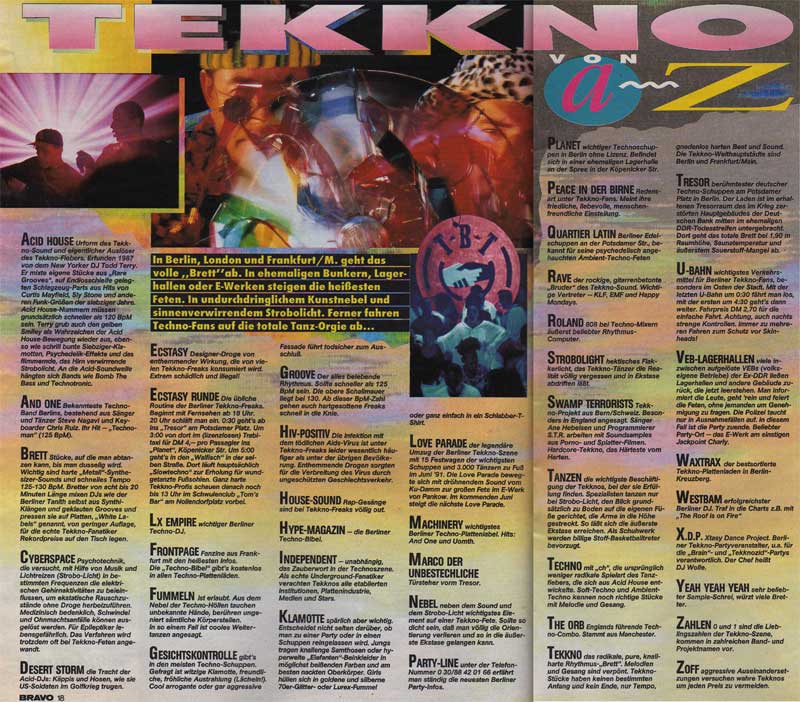
Tekk/Tekke is mainly produced in Germany and often remixes quotes or audio clips and represents a commercial part of electronic music. Therefore the Tekno and Tekkno scenes are not connected. As dance music, tekkno was unusually rhythm-oriented for the time.[2] Therefore, this term also became synonymous with particularly hard dance music.[2] At times, the number of the letter "k" was used to advertise the supposed hardness of the sound at parties and compilations (Tekno, Tekkno, Tekkkno...). A similar variant appeared shortly afterwards with the emergence of the Freetekno[de] scene. The overall sound of Tekk can be descripted as "dumb" or "asozial/assi", due to its heavy and monotone kicks with repeating vocals. Famous artists are: Die Gebrüder Brett, Zahni, Nogge, Crotekk, Minupren and Craig Mortalis.


Notes

[edit]
[edit]
Revisions and contributorsEdit on WikipediaRead on Wikipedia
from Grokipedia

Free tekno, also known as freetekno or hardtek, is an underground electronic dance music subgenre featuring fast tempos typically between 150 and 190 beats per minute, repetitive and distorted kick drums, and minimalistic, industrial sonic elements designed for high-energy immersion. Emerging in the early 1990s from Europe's post-rave free party circuits, particularly in France, the United Kingdom, and Italy, it developed as a harder, accelerated variant of hardcore techno, prioritizing raw production over polished studio aesthetics. The genre is inextricably linked to a DIY cultural movement of autonomous collectives organizing non-commercial events like teknivals—multi-day gatherings with mobile sound systems in rural or derelict urban settings—advocating for unrestricted access to partying as an expression of personal and communal liberty against institutional control and market forces.

Definition and Overview

Core Characteristics and Distinctions

Free tekno constitutes a high-energy subgenre of electronic dance music, distinguished by its rapid tempos generally exceeding 170 beats per minute (BPM) and a relentless, repetitive pounding kick drum that forms the sonic foundation. This raw, abrasive sound often incorporates heavy bass lines and experimental elements derived from analog synthesizers and loops, prioritizing intensity over melodic complexity. Unlike mainstream techno, which typically operates at 120-140 BPM with softer, more structured rhythms and melodic progressions, free tekno emphasizes aggression and minimalism to sustain prolonged, immersive dance experiences. Central to free tekno is its inextricable link to sound system culture and underground free parties, where mobile collectives deploy powerful, custom-built audio rigs to host non-commercial events in remote or abandoned locations. These gatherings embody a DIY ethos, with participants handling production, setup, and operation autonomously, fostering a communal atmosphere grounded in mutual aid and self-policing rather than professionalized infrastructure. The genre's distinctions from commercial electronic scenes lie in its deliberate rejection of mechanisms, such as ticket sales, sponsorships, and polished studio production, in favor of anti-authoritarian principles that prioritize and spontaneity. This separation manifests in free tekno's raw aesthetic—often or with basic equipment—and its role in events that challenge institutional controls, contrasting sharply with the regulated, profit-oriented club environments associated with mainstream variants. The intentional "tekno" further underscores this divergence, signaling a break from techno's established nomenclature and commercial connotations.

Historical Development

Origins in Early 1990s Free Party Scene

Free tekno emerged in the early 1990s free party scene as a harder, faster variant of , developed by nomadic sound systems in response to escalating crackdowns on raves after the 1988 . , formed in late 1990 in by members including Mark Harrison and Simone Feeney, pioneered this sound by organizing illegal warehouse parties and free festivals, blending influences from , Dutch , jack tracks, and emerging French hardcore into proto-tekno characterized by rapid tempos and aggressive rhythms optimized for outdoor playback. The , held from May 22 to 29, 1992, in , , served as a pivotal catalyst, drawing an estimated 20,000 to 50,000 attendees including travelers, punks, and electronic music enthusiasts who formed DIY collectives around sound systems like , DiY, and Bedlam. There, proto-tekno tracks—featuring fast "nosebleed" alongside and other genres—were broadcast from multiple rigs, fostering communal experimentation amid the event's week-long duration. This gathering prompted arrests of thirteen members on public order charges and directly spurred the and Public Order Act 1994, enacted in November, which prohibited unlicensed events with music defined by "repetitive beats" and gatherings of 20 or more vehicles, fining organizers up to £5,000 or imprisoning them for up to three months. The legislation accelerated the shift toward more resilient, mobile practices, embedding free tekno's DIY ethos in opposition to regulatory suppression.

Expansion Across Europe in the Mid-1990s

Following the repression of free parties in the United Kingdom under the Criminal Justice and Public Order Act 1994, sound systems such as Spiral Tribe migrated to continental Europe, particularly France, where they established bases and organized the inaugural teknivals. Spiral Tribe, a UK-based collective formed in 1990, relocated to Paris in the summer of 1993 amid escalating police crackdowns, collaborating with local operators to announce and host the first teknival that year, which catalyzed the formation of a nomadic free tekno circuit. This shift marked the onset of cross-border expansion, with Spiral Tribe members staging free parties across France and into other nations starting in the summer of 1994, adapting to rural and semi-rural sites for multi-day events. In , the influx of tribes spurred the rapid proliferation of teknivals, large-scale nomadic gatherings featuring multiple sound systems that emphasized communal sound production and evasion of authorities. By , events like those in the Czech Republic-hosted Free Republic of Kolaj drew international participants, while French teknivals in subsequent years, such as the 1997 Rouen gathering documented in recordings, exemplified the scale and migratory nature of these parties. These events fostered self-organized , including shared generators and water supplies, underscoring a commitment to autonomy amid growing attendance. The movement extended into and through emergent local collectives influenced by the French model, forming loose intertribal networks that exchanged equipment and personnel. In , integrated with existing autonomous social centers (centri sociali), repurposed squats hosting underground raves resistant to commercialization, though direct UK migrations were less pronounced than in France. saw adoption via schranz, a raw, high-BPM hard techno variant pioneered by figures like in the mid-1990s, which aligned with ethos through its emphasis on intense, unpolished sounds in and outdoor settings. These networks prioritized DIY principles, with tribes pooling resources like PA systems for events that rejected ticketed entry and corporate involvement, sustaining the scene's core.

Evolution and Challenges from 2000s Onward

In the early 2000s, intensified across curtailed the scale of free tekno gatherings, with enacting the Mariani Law (Loi n° 2002-307 du 4 mars 2002 relative à la sécurité publique), which mandated prior declarations for events exceeding 250 participants, authorized equipment seizures, and imposed fines up to €3,750 for non-compliance. This built on prior inter-ministerial directives from that hardened repression against unauthorized raves, prompting a shift from sprawling nomadic teknivals—often spanning days and drawing thousands—to smaller, more discreet urban free parties that evaded large-scale policing. EU-wide coordination, including cross-border intelligence sharing, further diminished itinerant events, as authorities targeted sound systems and convoys preemptively. The scene endured in , where less stringent regulations allowed persistence of teknival-style events into the 2000s and , with collectives like those in the hosting annual gatherings that attracted international participants despite occasional clashes with police. Groups such as Heretik System continued organizing free parties through much of the decade, influencing mainland European networks and maintaining the nomadic ethos in regions with weaker enforcement. By the , adaptations included integration of affordable workstations for production, enabling bedroom-based track creation aligned with the DIY principle, though core analog sound system culture persisted. In the 2020s, online platforms facilitated revival efforts amid pandemic restrictions and ongoing scrutiny, with groups coordinating hybrid events and hosting archival mixes and live streams to sustain community ties. These digital shifts coexisted with challenges like internal in some collectives, where sponsorships eroded , yet underground scenes upheld the non-commercial, self-organized model, showing tempered radicalism focused on cultural continuity rather than confrontation. Persistence emphasized resilience, with events adapting to urban margins and virtual formats while resisting full institutional co-optation.

Musical Elements

Rhythm, Tempo, and Core Sounds

Free tekno employs a 4/4 with tempos generally ranging from 170 to 200 beats per minute, producing a rapid, unrelenting pulse optimized for sustained dancing in large-scale outdoor environments. This high velocity emphasizes raw kinetic force over nuanced phrasing, where the elevated BPM facilitates a visceral bodily response, channeling repetitive percussion into a hypnotic drive that sustains participant engagement for extended durations. The rhythmic foundation centers on distorted, punchy kick drums engineered for deep low-end penetration and compressive power, often fused with a fundamental bass note to amplify system-shaking impact on potent PA setups. Offbeat snares or claps punctuate the pattern, injecting propulsion without overwhelming the kick's dominance, while sparse hi-hats contribute minimal shuffle to reinforce forward momentum. This stripped-back percussion prioritizes endurance and collective entrainment, leveraging sheer velocity and distortion to induce via somatic rather than harmonic development. Signature timbres include acid basslines mimicking the TB-303's resonant, sliding tones—achieved through filter sweeps and envelope modulation—for looping, immersive textures that echo origins but adapt to tekno's intensity. Hoover synths, featuring supersaw-like wailing leads with detuned oscillators, layer in eerie, sustained motifs inherited from hardcore, fostering auditory hypnosis amid minimal vocal chops or samples restricted to fragmented, echoed phrases for rhythmic reinforcement. These elements collectively favor sonic aggression and loop-based , ensuring tracks maintain peak pressure suited to nomadic sound system culture.

Production Techniques and Influences

Free tekno production emphasizes do-it-yourself (DIY) approaches, utilizing accessible hardware and software to create raw, high-energy tracks suited to nomadic environments. Early practitioners relied on emulations or affordable clones of classic gear, such as the TB-303 bass synthesizer for squelching acid lines and the TR-909 for punchy, distorted kicks and snares, which provided the foundational elements of distorted basslines and relentless rhythms at tempos often exceeding 160 BPM. These tools enabled unpolished focused on aggressive low-end frequencies, with techniques like heavy , filtering, and resampling to generate gritty textures that prioritize impact over studio polish. By the mid-2000s, production shifted toward digital tools like and VST plugins, allowing for faster iteration and integration of sampled elements, while maintaining the genre's of and immediacy; tracks were often assembled live or with basic sequencing to capture spontaneous energy. Distribution mirrored this DIY spirit, with early releases on cassettes dubbed in small runs for party handouts and later free digital shares via networks like early file-sharing platforms or sound system collectives, bypassing commercial labels. Influences stem from UK breakbeat hardcore's rapid tempos and break rhythms, Belgian new beat's slowed, distorted EBM-derived pulses, and industrial noise's abrasive textures, which collectively shaped free tekno's causal evolution toward bass-heavy profiles optimized for penetration through large outdoor sound systems rated at 50-100 kW. This design imperative—favoring sub-bass resonance over high-fidelity mixing—arose from the practical need to project sound across open fields, where empirical testing on massive rigs refined low-frequency emphasis to ensure audibility amid . Producers like those in collectives adapted these borrowings to forge a sound resilient to the chaotic acoustics of teknivals, prioritizing causal efficacy in live playback over aesthetic refinement.

Subgenres and Variations

Primary Subgenres

Hardtek represents a foundational subgenre within free tekno, defined by punchy, mid-tempo rhythms typically ranging from 160 to 180 BPM, emphasizing groovy, rolling basslines and distorted kicks designed for sustained dancefloor energy. This style prioritizes a balance of aggression and accessibility, often incorporating layered percussion that supports extended sets in nomadic sound system environments. Tribecore, an evolution emphasizing tribal percussion elements, operates at higher tempos of 180 to 200 BPM or more, featuring clicky, percussive kicks and polyrhythmic patterns that evoke endurance-oriented grooves suitable for marathon free parties. These distinctions arise from practical adaptations in regional sound systems, where faster, repetitive tribal structures facilitate prolonged collective immersion without rapid fatigue. Acidcore and mentalcore push extremes, with tempos exceeding 200 BPM, screeching acid synth lines derived from emulations, and heavily distorted, frenetic elements that prioritize intensity over melodic structure. In free tekno contexts, these subgenres cater to peak-time escalation, reflecting sound system preferences for sonic overload in high-energy, late-night scenarios. Hardfloor introduces a bouncier, more techno-inflected , often at 175 BPM and above, with emphasized off-beat accents and punchy sequences that differentiate it from the rawer variants through a focus on dancefloor propulsion. Schranz, while overlapping with harder influences, manifests in free tekno as a raw, industrial-edged variant at 140 to 155 BPM, characterized by minimalist, machine-like percussion and relentless drive, often tied to German sound system aesthetics favoring stark, unpolished aggression. These and sonic divergences empirically stem from regional collective experiments, optimizing for specific event durations and audience dynamics rather than stylistic fiat.

Regional and Hybrid Developments

In , free tekno evolved into mentaltek during the , incorporating chaotic, psychedelic elements influenced by culture, with production emphasizing distorted kicks, prolonged decays, and layered hi-hat rhythms that evoke disorienting intensity. This regional style diverged from core European tekno by prioritizing mental immersion over straightforward propulsion, often tied to Italy's underground party networks amid legal pressures. Eastern European scenes, particularly in and neighboring countries, produced hybrids blending free tekno's hard-edged rhythms with psytrance's dark, mysterious soundscapes, integrating full-on basslines, hypnotic builds, and traditional regional motifs into tekno frameworks around the 2010s. These fusions arose in cross-subcultural releases where tekno labels incorporated psytrance tracks, yielding variants like psycore that combined tribe tekno's raw drive with psychedelic layering for extended, immersive sets. Such integrations reflected local sound system adaptations in post-Soviet contexts, where psytrance's prevalence intersected with migrating collectives. By the 2020s, digital platforms facilitated free tekno hybrids with and , accelerating tempos beyond 200 BPM and infusing 's distorted, punchy kicks from Dutch influences into tekno's warehouse energy. These crossovers, evident in mixes merging acidcore destruction and hardcore elements, emerged from online sharing among European producers, expanding tekno's aggression without diluting its roots. Regional differences in hardware—such as varying access to analog units—further shaped these evolutions, tying sonic traits to practical event logistics rather than doctrinal rigidity.

Cultural and Social Dimensions

Sound Systems, Collectives, and Events

Free tekno gatherings are organized around mobile sound systems managed by collectives referred to as tribes, which pool financial and material resources to deploy high-powered audio rigs. These rigs typically feature speaker stacks, generators, and mixing equipment mounted on trucks or trailers for rapid setup in remote locations, with power outputs often reaching 60 kW or more to achieve the desired volume and bass impact. Collectives such as , formed in the UK after 1988, exemplify this model by maintaining dedicated vehicles like the Studio 23 trailer for transporting and operating their systems across . Teknivals and free parties constitute the primary event formats, functioning as multi-day autonomous camps with multiple simultaneous stages provided by collaborating sound systems. Participants establish temporary settlements equipped with basic infrastructure, including shared generators and water supplies, while operations emphasize self-policing through informal community oversight to maintain order and resolve disputes. Resource distribution often occurs via economies, where attendees exchange , tools, and services rather than using , supporting the collective's logistical needs such as and repairs. In the peak period, events like the 1992 Castlemorton gathering drew thousands of attendees, with subsequent such as Spiral Tribe's inaugural 1993 Paris event and the 1995 teknival attracting 10,000 or more participants across multiple systems. Early examples, including Bologna's Livello 57 parties, sustained scales of 10,000 to 15,000, though contemporary gatherings have trended smaller due to increased operational constraints. Other notable collectives, such as France's Heretik System and Italy's Mutoid Waste Company, contributed rigs and expertise to these networked events, fostering a tradition of inter-tribe cooperation for staging and breakdown.

Ideology, Lifestyle, and Community Dynamics

The free tekno movement espouses an anarchist-inspired ideology centered on self-organization, rejection of hierarchical authority, and opposition to commercialization within electronic music culture. Drawing from DIY principles and anti-establishment values, participants emphasize free access to events and music as a form of resistance against profit-driven mainstream club scenes, viewing hedonistic participation in raves as a pathway to authentic experiential freedom and collective activism. This ethos, encapsulated in Spiral Tribe's mantra of "free party, free people, free future," promotes temporary autonomous zones where creativity flourishes without state or corporate interference, though it lacks a unified political program beyond protest against repression. Influences from punk, squatter, and new age traveler scenes underscore a broader countercultural rejection of neoliberal norms, prioritizing chaos and imagination over structured governance. Lifestyle in free tekno revolves around nomadic and communal practices, with collectives often residing in repurposed vehicles such as ex-Soviet trucks or squats, facilitating mobility across for teknivals and free parties. Shared labor in sound system maintenance and event logistics fosters mutual aid, while attire like baggy clothing, , and piercings signals affiliation with this itinerant . Hedonistic elements, including widespread use of substances such as , , and marijuana, enable psychonautic exploration and escapist immersion in music, romanticized as liberation from societal constraints but empirically linked to cycles of dependency and health strain in intensive party environments. Over time, the centrality of nomadism has diminished, reflecting adaptations to legal pressures and personal challenges. Community dynamics exhibit strong collaborative bonds through loose sound system tribes that organize open-access events, yet internal contradictions persist, including factionalism over and debates on compensating labor in ostensibly anti-capitalist setups. Infiltration by authorities, such as undercover police in groups like the Advance Party, has eroded trust and contributed to implosions. Empirical observations highlight high burnout rates from relentless travel and event demands, underscoring causal tensions between the movement's professed ideals of enduring communal and the practical realities of exhaustion, interpersonal conflicts, and limited systemic impact beyond ephemeral resistance.

Reception, Impact, and Global Spread

Influence on Broader Electronic Music

Free tekno's raw, high-BPM soundscapes, often exceeding 160 beats per minute with distorted percussion and minimal melodic elements, directly contributed to the evolution of hard techno and schranz subgenres by emphasizing aggressive, organic energy over polished production. In , schranz producers in the early drew from free tekno's hardcore influences, adopting heavier, faster rhythms that prioritized percussive intensity, as seen in the shift toward darker, less melodic structures in tracks from labels like Token or Ground Zero Noise. This cross-pollination is evident in the incorporation of free tekno's DIY-recorded aesthetics into schranz's industrial edge, sustaining a benchmark for underground hardness amid rising commercial techno trends. The genre's persistence reinforced a countercultural ethos in electronic music, countering the mainstream EDM's emphasis on accessibility and spectacle with uncompromised DIY principles, as exemplified by Spiral Tribe's nomadic sound systems in the 1990s that prioritized communal, non-commercial events. This influence extended to festival circuits, where free tekno's model—large-scale, self-organized gatherings with multiple sound systems—embedded sustainable underground practices in niche European events, fostering ongoing hybrid scenes that blend raw energy with experimental sounds. includes the continued operation of teknivals since the mid-1990s, which have outlasted many commercial festival formats by maintaining low-barrier entry and artist autonomy. However, free tekno's rejection of mainstream adaptations, such as melodic hooks or reduced tempos for broader appeal, has constrained its permeation into dominant electronic genres like , where early 2000s nods to its energy remained niche rather than transformative. Critics note that this purist stance, while preserving authenticity, limited evolutionary breakthroughs, as the genre's focus on ideological resistance over sonic innovation resulted in relative isolation from global EDM circuits by the .

Adaptations Outside Europe

Free tekno's diffusion beyond has been constrained, manifesting in small-scale sound system activities in and isolated underground gatherings in , often initiated by European expatriates or immigrant networks carrying the nomadic DIY ethos. In , free tekno sound systems emerged as part of a broader mobile audio culture, drawing indirect inspiration from Jamaican origins while prioritizing high-BPM electronic sounds over roots; these setups convene in urban fringes or warehouses but lack the multi-day endurance seen in or the due to localized permit requirements and noise ordinances. North American adaptations face steeper structural hurdles, including pervasive private land ownership that curtails spontaneous —unlike Europe's more accessible abandoned industrial sites or —and rigorous enforcement against unauthorized assemblies. The U.S. Reducing Americans' Vulnerability to Ecstasy (RAVE) Act of 2003, by holding event promoters civilly liable for attendees' drug possession or distribution, effectively deterred large unsanctioned raves, pushing any tekno-aligned free parties into clandestine, low-attendance formats like one-off incursions rather than sustained collectives. Similar dynamics in amplify risks, with hosting marginally more activity via francophone ties but still no equivalents to Spiral Tribe-scale migrations. By the 2020s, online platforms facilitated virtual extensions, such as collectives uploading live sets and groups coordinating informal shares among diaspora enthusiasts, yet these rarely translate to physical convergence owing to entrenched fears and a cultural preference for privatized recreation over collective land occupation. Verifiable instances remain episodic—e.g., occasional Chicago-area tekno gatherings advertised via social channels—but fall short of magnitudes, underscoring how legal and proprietary barriers perpetuate marginalization.

Controversies and Criticisms

The Criminal Justice and Public Order Act 1994 in the United Kingdom introduced specific provisions under Section 63 to address unauthorized raves, empowering police to direct attendees to leave gatherings of 100 or more people (or 20 or more vehicles) featuring "music predominantly characterised by the emission, production or amplification of repeated beats" held without landowner consent, with non-compliance constituting a criminal offense punishable by up to three months imprisonment or fines. Enacted following high-profile incidents like the 1992 , which attracted 20,000 to 40,000 participants and generated widespread complaints of , noise disturbing local residents into the early morning, extensive litter, and unauthorized land use, the act facilitated proactive interventions to prevent public disorder and safety risks from unregulated crowds lacking formal security or medical provisions. Implementation resulted in numerous police operations, equipment confiscations, and arrests; for example, the 1992 Love Decade event in alone yielded 836 arrests amid clashes, contributing to a pattern where authorities seized sound systems valued in the tens of thousands of pounds to deter repeat offenses tied to and . These measures empirically curtailed large-scale illegal parties on public or private land, prompting a migration toward licensed indoor venues with oversight, though sporadic evictions persisted as enforcers targeted persistent violations of noise ordinances and zoning laws. In , the free tekno scene intensified after UK collectives like relocated in the early 1990s to evade domestic crackdowns, organizing teknivals that often exceeded thousands of attendees on rural sites without permits, leading to 2001 legislative amendments that escalated penalties for rave organizers to up to three years in and €45,000 fines for events over 1,000 participants lacking authorization. Such regulations responded to documented disruptions including from , road blockages, and acoustic pollution measurable in decibels far above residential limits, with police raids frequently seizing generators and speakers to enforce compliance. EU-wide patterns mirrored these tensions, as seen in the 2005 CzechTek festival near , where Czech deployed armored vehicles and to evict approximately 7,000 participants from an unpermitted site adjacent to a motorway, resulting in over 200 arrests for illegal assembly and claims. These interventions, grounded in national public order statutes, highlighted causal links between unannounced occupations and heightened risks of accidents, substance-related emergencies, and fiscal burdens on local authorities for cleanup, cumulatively driving thousands of enforcement actions across member states since the 1990s.

Social, Health, and Environmental Issues

Drug use at free tekno events, characterized by open-air teknivals and nomadic gatherings, frequently involves substances such as ecstasy (MDMA), , hallucinogens, and cannabinoids, with participants reporting motivations tied to the subculture's emphasis on and communal experience. Studies on nights indicate that open-air events attract heavier drug consumers, correlating with acute health risks including from cocaine or amphetamines, cramps, and elevated body temperatures exceeding 37.5°C. Long-term effects encompass psychological issues like depressed mood, sleep disturbances, and anxiety attacks, exacerbated by the unregulated, multi-day nature of these parties. exposure, often underreported, has risen in contexts including free parties, contributing to overdoses and dissociative effects, though specific overdose statistics for free tekno remain limited due to the scene's underground status. Social risks at these events include heightened to assaults, facilitated by impairment and crowded, remote settings lacking . Reports from broader scenes highlight sexual assaults linked to substances like GHB, with similar dynamics inferred for free tekno's informal environments. Poor prevails in open-air teknivals, where makeshift facilities or none at all lead to contamination and risks, compounded by attendee and substance use over extended durations. Environmentally, free tekno gatherings contribute to site degradation through accumulated and traffic from nomadic convoys, leaving behind that burdens local authorities for cleanup. In the UK during the late 1980s and early 1990s, free parties resulted in substantial rubbish disposal costs borne by taxpayers via poll taxes, illustrating a pattern of post-event neglect despite the scene's DIY . This contrasts with occasional claims of ecological alignment in free tekno communities, as the transient, unregulated format often prioritizes mobility over site restoration, leading to and from discarded materials. Such practices foster criticisms of irresponsibility, shifting remediation expenses to public resources while undermining assertions of inherent .

Internal Debates on Authenticity and

Within the free tekno scene, authenticity debates often center on accusations of compromising the anti-commercial ethos through participation in paid gigs or affiliations with record labels, which some view as betrayals of the DIY principle central to sound system collectives since the . For example, collectives like DiY Sound System, active in bridging free parties and club culture, encountered internal tensions from the psychological toll of nomadic lifestyles and drug-related issues, prompting shifts toward semi-commercial viability that drew purist backlash for diluting radical autonomy. These conflicts underscore a broader rift between ideological purists, who prioritize gratis events and self-sufficiency, and pragmatists arguing that selective sustains equipment and operations without full co-optation. In the , production purity has fueled divisions, with adherents to analog hardware—such as TR-series emulations or custom synth rigs—insisting it yields the raw, unpredictable tones essential to tekno's gritty aesthetic, while digital workflows face scorn for prioritizing over tactile authenticity. Techno producers, including those in tekno-adjacent circles, debate this in forums and interviews, citing analog's warmth from circuit imperfections as irreplaceable for evoking immediacy, though digital tools enable broader experimentation amid resource constraints. This tension reflects causal pressures: analog's cost and maintenance burdens strain marginal collectives, yet deviations risk alienating core listeners who associate digital sterility with mainstream dilution. Sustainability challenges manifest in participant aging and stalled , as empirical surveys of over 200 ravers reveal that while many in their 30s and 40s persist through adapted roles like organizing rather than all-night raving, the physically demanding, legally precarious prompts exits, with younger generations deterred by amplified risks and distractions like smartphones and formalized alternatives. A 2016 study documented this transition, noting free party representations emphasize youth yet sustain older involvement via and community bonds, but without institutional frameworks, burnout and enforcement erode numbers—evident in regional declines where events dwindle from peaks of thousands to sporadic gatherings. These patterns expose the anarchic model's long-term limits: absent scalable structures for or resources, radicalism wanes as causal realities of aging bodies and societal integration prevail, favoring hybrid models with minimal for endurance over pure .

References

Add your contribution
Related Hubs
User Avatar
No comments yet.