



Community hub
Recent from talks
Knowledge base stats:
Talk channels stats:
Members stats:
Fuegians
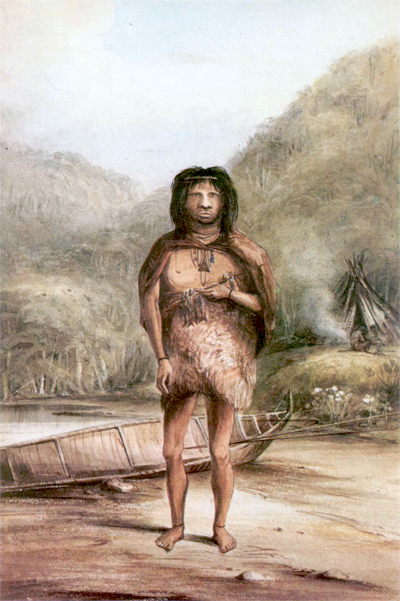
Fuegians are the indigenous inhabitants of Tierra del Fuego, at the southern tip of South America. The name has been credited to Captain James Weddell, who supposedly created the term in 1822.
The indigenous Fuegians belonged to several different ethnic groups including the:
All of these ethnic groups except the Selkʼnam lived exclusively in coastal areas and have their own languages. The Yahgan and the Kawésqar traveled by birchbark canoes around the islands of the archipelago, while the coast dwelling Haush did not. The Selkʼnam lived in the interior of Isla Grande de Tierra del Fuego and were exclusively terrestrial hunter gatherers who hunted terrestrial game such as guanacos, foxes, tuco-tucos and upland nesting birds as well as littoral fish and shellfish. The Fuegian peoples spoke several distinct languages: both the Kawésqar language and the Yahgan language are considered language isolates, while the Selkʼnam and Haush spoke Chon languages like the Tehuelche on the mainland.
The name "Tierra del Fuego" may refer to the fact that both Selkʼnam and Yahgan had their fires burn in front of their huts (or in the hut). In Magellan's time Fuegians were more numerous, and the light and smoke of their fires presented an impressive sight if seen from a ship or another island. Yahgan also used fire to send messages by smoke signals, for instance if a whale drifted ashore. The large amount of meat required notification of many people, so that it would not decay. They might also have used smoke signals on other occasions, but it is possible that Magellan saw the smokes or lights of natural phenomena.
Alongside the Pericúes of Baja California, the Fuegians and Patagonians show the strongest evidence of partial descent from the Paleoamerican lineage, a proposed early wave of migration to the Americas derived from an Australo-Melanesian population, as opposed to the main Amerind peopling of the Americas of Siberian (admixed Ancient North Eurasian and Paleo-East Asian) descent. Further credibility is lent to this idea by research suggesting the existence of an ethnically distinct population elsewhere in South America. According to archaeologist Ricardo E. Latcham the sea-faring nomads of Patagonia (Chono, Kawésqar, Yahgan) may be remnants from more widespread indigenous groups that were pushed south by "successive invasions" from more northern nations.
However these previous claims were refuted by multiple genetic and anthropologic studies, such as one study published in Nature in 2018 which concluded that all Native Americans descended from a single founding population which initially split from East Asians c. 36,000 BC, with geneflow between Ancestral Native Americans and Siberians persisting until c. 25,000 BC, before becoming isolated in the Americas at c. 22,000 BC. Northern and Southern Native American subpopulations split from each other at c. 17,500 BC. There is also some evidence for a back-migration from the Americas into Siberia after c. 11,500 BC. Another study published in Nature in 2021, which analysed a large amount of ancient genomes, similarly concluded that all Native Americans descended from the movement of people from Northeast Asia into the Americas. These Ancestral Americans, once south of the continental ice sheets, spread and expanded rapidly, and branched into multiple groups, which later gave rise to the major subgroups of Native American populations. The study also dismissed the existence of an hypothetical distinct non-Native American population (suggested to have been related to Indigenous Australians and Papuans), sometimes called "Paleoamerican". The authors explained that these previous claims were based on a misinterpreted genetic echo, which was revealed to represent early East-Eurasian geneflow (close but distinct to the 40,000 BC old Tianyuan lineage) into Aboriginal Australians and Papuans.
When Chileans and Argentines of European descent studied, invaded and settled on the islands in the mid-19th century, they brought with them diseases such as measles and smallpox for which the Fuegians had no immunity. The Fuegian population was devastated by the diseases, and their numbers were reduced from several thousand in the 19th century to hundreds in the 20th century. In 1876 a serious smallpox epidemic decimated the Fuegians. Between 1881 and 1883 the Yahgan population dropped from perhaps 3,000 to only 1,000 due to measles and smallpox.
As early as 1878 Europeans in Punta Arenas seeking additional sheep pastures negotiated to acquire large tracts of land on Isla Grande de Tierra del Fuego from the Chilean government just prior to Argentina's and Chile's sovereignty there.
Hub AI
Fuegians AI simulator
(@Fuegians_simulator)
Fuegians
Fuegians are the indigenous inhabitants of Tierra del Fuego, at the southern tip of South America. The name has been credited to Captain James Weddell, who supposedly created the term in 1822.
The indigenous Fuegians belonged to several different ethnic groups including the:
All of these ethnic groups except the Selkʼnam lived exclusively in coastal areas and have their own languages. The Yahgan and the Kawésqar traveled by birchbark canoes around the islands of the archipelago, while the coast dwelling Haush did not. The Selkʼnam lived in the interior of Isla Grande de Tierra del Fuego and were exclusively terrestrial hunter gatherers who hunted terrestrial game such as guanacos, foxes, tuco-tucos and upland nesting birds as well as littoral fish and shellfish. The Fuegian peoples spoke several distinct languages: both the Kawésqar language and the Yahgan language are considered language isolates, while the Selkʼnam and Haush spoke Chon languages like the Tehuelche on the mainland.
The name "Tierra del Fuego" may refer to the fact that both Selkʼnam and Yahgan had their fires burn in front of their huts (or in the hut). In Magellan's time Fuegians were more numerous, and the light and smoke of their fires presented an impressive sight if seen from a ship or another island. Yahgan also used fire to send messages by smoke signals, for instance if a whale drifted ashore. The large amount of meat required notification of many people, so that it would not decay. They might also have used smoke signals on other occasions, but it is possible that Magellan saw the smokes or lights of natural phenomena.
Alongside the Pericúes of Baja California, the Fuegians and Patagonians show the strongest evidence of partial descent from the Paleoamerican lineage, a proposed early wave of migration to the Americas derived from an Australo-Melanesian population, as opposed to the main Amerind peopling of the Americas of Siberian (admixed Ancient North Eurasian and Paleo-East Asian) descent. Further credibility is lent to this idea by research suggesting the existence of an ethnically distinct population elsewhere in South America. According to archaeologist Ricardo E. Latcham the sea-faring nomads of Patagonia (Chono, Kawésqar, Yahgan) may be remnants from more widespread indigenous groups that were pushed south by "successive invasions" from more northern nations.
However these previous claims were refuted by multiple genetic and anthropologic studies, such as one study published in Nature in 2018 which concluded that all Native Americans descended from a single founding population which initially split from East Asians c. 36,000 BC, with geneflow between Ancestral Native Americans and Siberians persisting until c. 25,000 BC, before becoming isolated in the Americas at c. 22,000 BC. Northern and Southern Native American subpopulations split from each other at c. 17,500 BC. There is also some evidence for a back-migration from the Americas into Siberia after c. 11,500 BC. Another study published in Nature in 2021, which analysed a large amount of ancient genomes, similarly concluded that all Native Americans descended from the movement of people from Northeast Asia into the Americas. These Ancestral Americans, once south of the continental ice sheets, spread and expanded rapidly, and branched into multiple groups, which later gave rise to the major subgroups of Native American populations. The study also dismissed the existence of an hypothetical distinct non-Native American population (suggested to have been related to Indigenous Australians and Papuans), sometimes called "Paleoamerican". The authors explained that these previous claims were based on a misinterpreted genetic echo, which was revealed to represent early East-Eurasian geneflow (close but distinct to the 40,000 BC old Tianyuan lineage) into Aboriginal Australians and Papuans.
When Chileans and Argentines of European descent studied, invaded and settled on the islands in the mid-19th century, they brought with them diseases such as measles and smallpox for which the Fuegians had no immunity. The Fuegian population was devastated by the diseases, and their numbers were reduced from several thousand in the 19th century to hundreds in the 20th century. In 1876 a serious smallpox epidemic decimated the Fuegians. Between 1881 and 1883 the Yahgan population dropped from perhaps 3,000 to only 1,000 due to measles and smallpox.
As early as 1878 Europeans in Punta Arenas seeking additional sheep pastures negotiated to acquire large tracts of land on Isla Grande de Tierra del Fuego from the Chilean government just prior to Argentina's and Chile's sovereignty there.