



Community hub
Functional linguistics
View on Wikipedia| Part of a series on |
| Linguistics |
|---|
 Portal Portal |

Functional linguistics is an approach to the study of language characterized by taking systematically into account the speaker's and the hearer's side, and the communicative needs of the speaker and of the given language community.[1]: 5–6 [2] Linguistic functionalism spawned in the 1920s to 1930s from Ferdinand de Saussure's systematic structuralist approach to language (1916).
Functionalism sees functionality of language and its elements to be the key to understanding linguistic processes and structures. Functional theories of language propose that since language is fundamentally a tool, it is reasonable to assume that its structures are best analyzed and understood with reference to the functions they carry out. These include the tasks of conveying meaning and contextual information.
Functional theories of grammar belong to structural[3] and, broadly, humanistic linguistics, considering language as being created by the community, and linguistics as relating to systems theory.[1][4] Functional theories take into account the context where linguistic elements are used and study the way they are instrumentally useful or functional in the given environment. This means that pragmatics is given an explanatory role, along with semantics. The formal relations between linguistic elements are assumed to be functionally-motivated. Functionalism is sometimes contrasted with formalism,[5] but this does not exclude functional theories from creating grammatical descriptions that are generative in the sense of formulating rules that distinguish grammatical or well-formed elements from ungrammatical elements.[3]
Simon Dik characterizes the functional approach as follows:
In the functional paradigm a language is in the first place conceptualized as an instrument of social interaction among human beings, used with the intention of establishing communicative relationships. Within this paradigm one attempts to reveal the instrumentality of language with respect to what people do and achieve with it in social interaction. A natural language, in other words, is seen as an integrated part of the communicative competence of the natural language user. (2, p. 3)
Functional theories of grammar can be divided on the basis of geographical origin or base (though it simplifies many aspects): European functionalist theories include Functional (discourse) grammar and Systemic functional grammar (among others), while American functionalist theories include Role and reference grammar and West Coast functionalism.[5] Since the 1970s, studies by American functional linguists in languages other than English from Asia, Africa, Australia and the Americas (like Mandarin Chinese and Japanese), led to insights about the interaction of form and function, and the discovery of functional motivations for grammatical phenomena, which apply also to the English language.[6]
History
[edit]1920s to 1970s: early developments
[edit]The establishment of functional linguistics follows from a shift from structural to functional explanation in 1920s sociology. Prague, at the crossroads of western European structuralism and Russian formalism, became an important centre for functional linguistics.[1]
The shift was related to the organic analogy exploited by Émile Durkheim[7] and Ferdinand de Saussure. Saussure had argued in his Course in General Linguistics that the 'organism' of language should be studied anatomically, and not in respect with its environment, to avoid the false conclusions made by August Schleicher and other social Darwinists.[8] The post-Saussurean functionalist movement sought ways to account for the 'adaptation' of language to its environment while still remaining strictly anti-Darwinian.[9]
Russian émigrés Roman Jakobson and Nikolai Trubetzkoy disseminated insights of Russian grammarians in Prague, but also the evolutionary theory of Lev Berg, arguing for teleology of language change. As Berg's theory failed to gain popularity outside the Soviet Union, the organic aspect of functionalism diminished, and Jakobson adopted a standard model of functional explanation from Ernst Nagel's philosophy of science. It is, then, the same mode of explanation as in biology and social sciences;[1] but it became emphasised that the word 'adaptation' is not to be understood in linguistics in the same meaning as in biology.[10]
Work on functionalist linguistics by the Prague school resumed in the 1950s after a hiatus caused by World War II and Stalinism. In North America, Joseph Greenberg published his 1963 seminal paper on language universals that not only revived the field of linguistic typology, but also the approach of seeking functional explanations for typological patterns.[11] Greenberg's approach has been highly influential for the movement of North American functionalism that formed from the early 1970s, which has since been characterized by a profound interest in typology.[11] Greenberg's paper was influenced by the Prague School and in particular it was written in response to Jakobson's call for an 'implicational typology'.[11] While North American functionalism was initially influenced by the functionalism of the Prague school, such influence has been later discontinued.[11]
1980s onward: name controversy
[edit]The term 'functionalism' or 'functional linguistics' became controversial in the 1980s with the rise of a new wave of evolutionary linguistics. Johanna Nichols argued that the meaning of 'functionalism' had changed, and the terms formalism and functionalism should be taken as referring to generative grammar, and the emergent linguistics of Paul Hopper and Sandra Thompson, respectively; and that the term structuralism should be reserved for frameworks derived from the Prague linguistic circle.[12] William Croft argued subsequently that it is a fact to be agreed by all linguists that form does not follow from function. He proposed that functionalism should be understood as autonomous linguistics, opposing the idea that language arises functionally from the need to express meaning:
"The notion of autonomy emerges from an undeniable fact of all languages, 'the curious lack of accord ... between form and function'"[13]
Croft explains that, until the 1970s, functionalism related to semantics and pragmatics, or the 'semiotic function'. But around 1980s the notion of function changed from semiotics to "external function",[13] proposing a neo-Darwinian view of language change as based on natural selection.[14] Croft proposes that 'structuralism' and 'formalism' should both be taken as referring to generative grammar; and 'functionalism' to usage-based and cognitive linguistics; while neither André Martinet, Systemic functional linguistics nor Functional discourse grammar properly represents any of the three concepts.[15][16]
The situation was further complicated by the arrival of evolutionary psychological thinking in linguistics, with Steven Pinker, Ray Jackendoff and others hypothesising that the human language faculty, or universal grammar, could have developed through normal evolutionary processes, thus defending an adaptational explanation of the origin and evolution of the language faculty. This brought about a functionalism versus formalism debate, with Frederick Newmeyer arguing that the evolutionary psychological approach to linguistics should also be considered functionalist.[17]
The terms functionalism and functional linguistics nonetheless continue to be used by the Prague linguistic circle and its derivatives, including SILF, Danish functional school, Systemic functional linguistics and Functional discourse grammar; and the American framework Role and reference grammar which sees itself as the midway between formal and functional linguistics.[18]
Functional analysis
[edit]Since the earliest work of the Prague School, language was conceived as a functional system, where term system references back to De Saussure structuralist approach.[1] The term function seems to have been introduced by Vilém Mathesius, possibly influenced from works in sociology.[1][2] Functional analysis is the examination of how linguistic elements function on different layers of linguistic structure, and how the levels interact with each other. Functions exist on all levels of grammar, even in phonology, where the phoneme has the function of distinguishing between lexical material.
- Syntactic functions: (e.g. Subject and Object), defining different perspectives in the presentation of a linguistic expression.
- Semantic functions: (Agent, Patient, Recipient, etc.), describing the role of participants in states of affairs or actions expressed.
- Pragmatic functions: (Theme and Rheme, Topic and Focus, Predicate), defining the informational status of constituents, determined by the pragmatic context of the verbal interaction.
Functional explanation
[edit]In the functional mode of explanation, a linguistic structure is explained with an appeal to its function.[19] Functional linguistics takes as its starting point the notion that communication is the primary purpose of language. Therefore, general phonological, morphosyntactic and semantic phenomena are thought of as being motivated by the needs of people to communicate successfully with each other. Thus, the perspective is taken that the organisation of language reflects its use value.[1]
Many prominent functionalist approaches, like Role and reference grammar and Functional discourse grammar, are also typologically oriented, that is they aim their analysis cross-linguistically, rather than only to a single language like English (as is typical of formalist/generativism approaches).[20][21]
Economy
[edit]The concept of economy is metaphorically transferred from a social or economical context to a linguistic level. It is considered as a regulating force in language maintenance. Controlling the impact of language change or internal and external conflicts of the system, the economy principle means that systemic coherence is maintained without increasing energy cost. This is why all human languages, no matter how different they are, have high functional value as based on a compromise between the competing motivations of speaker-easiness (simplicity or inertia) versus hearer-easiness (clarity or energeia).[22]
The principle of economy was elaborated by the French structural–functional linguist André Martinet. Martinet's concept is similar to Zipf's principle of least effort; although the idea had been discussed by various linguists in the late 19th and early 20th century.[22] The functionalist concept of economy is not to be confused with economy in generative grammar.
Information structure
[edit]Some key adaptations of functional explanation are found in the study of information structure. Based on earlier linguists' work, Prague Circle linguists Vilém Mathesius, Jan Firbas and others elaborated the concept of theme–rheme relations (topic and comment) to study pragmatic concepts such as sentence focus, and givenness of information, to successfully explain word-order variation.[23] The method has been used widely in linguistics to uncover word-order patterns in the languages of the world. Its importance, however, is limited to within-language variation, with no apparent explanation of cross-linguistic word order tendencies.[24]
Functional principles
[edit]Several principles from pragmatics have been proposed as functional explanations of linguistic structures, often in a typological perspective.
- Theme first: languages prefer placing the theme before the rheme; and the subject typically carries the role of the theme; therefore, most languages have subject before object in their basic word order.[24]
- Animate first: similarly, since subjects are more likely to be animate, they are more likely to precede the object.[24]
- Given before new: already established information comes before new information.[25]
- First things first: more important or more urgent information comes before other information.[25]
- Lightness: light (short) constituents are ordered before heavy (long) constituents.[26]
- Uniformity: word-order choices are generalised.[26] For example, languages tend to have either prepositions or postpositions; and not both equally.
- Functional load: elements within a linguistic sub-system are made distinct to avoid confusion.
- Orientation: role-indicating particles including adpositions and subordinators are oriented to their semantic head.[27]
Frameworks
[edit]There are several distinct grammatical frameworks that employ a functional approach.
- The structuralist functionalism of the Prague school was the earliest functionalist framework developed in the 1920s.[28][29]
- André Martinet's Functional Syntax, with two major books, A functional view of language (1962) and Studies in Functional Syntax (1975). Martinet is one of the most famous French linguists and can be regarded as the father of French functionalism. Founded by Martinet and his colleagues, SILF (Société internationale de linguistique fonctionnelle) is an international organisation of functional linguistics which operates mainly in French.
- Simon Dik's Functional Grammar, originally developed in the 1970s and 80s, has been influential and inspired many other functional theories.[30][31] It has been developed into Functional Discourse Grammar by the linguist Kees Hengeveld.[32][33]
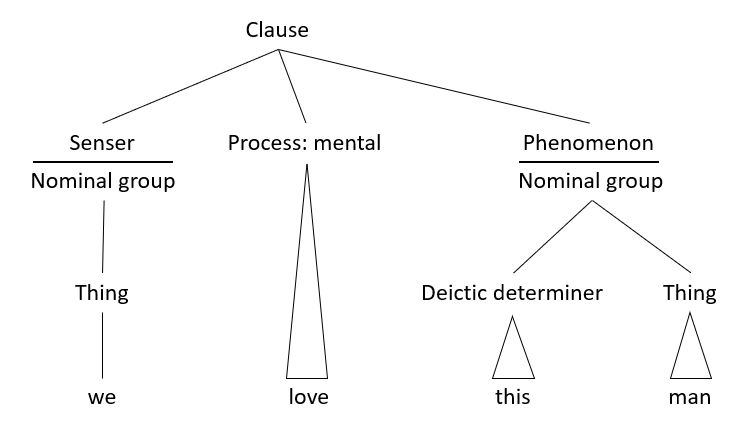
- Michael Halliday's systemic functional grammar (SFG) argues that the explanation of how language works "needed to be grounded in a functional analysis, since language had evolved in the process of carrying out certain critical functions as human beings interacted with their ... 'eco-social' environment".[34][35] Halliday draws on the work of Bühler and Malinowski, as well as his doctoral supervisor J.R. Firth. Notably, Halliday's former student Robin Fawcett has developed a version of SFG called the "Cardiff Grammar" which is distinct from the "Sydney Grammar" as developed by the later Halliday and his colleagues in Australia. The link between Firthian and Hallidayan linguistics and the philosophy of Alfred North Whitehead also deserves a mention.[36]
- Role and reference grammar, developed by Robert Van Valin employs functional analytical framework with a somewhat formal mode of description. In RRG, the description of a sentence in a particular language is formulated in terms of its semantic structure and communicative functions, as well as the grammatical procedures used to express these meanings.[37][38]
- Danish functional grammar combines Saussurean/Hjelmslevian structuralism with a focus on pragmatics and discourse.[39]
- Interactional linguistics, based on Conversation Analysis, considers linguistic structures as related to the functions of e.g. action and turn-taking in interaction.[40]
- Construction grammar is a family of different theories some of which may be considered functional, such as Croft's Radical Construction Grammar.[41]
- Relational Network Theory (RNT) or Neurocognitive Linguistics (NCL), originally developed by Sydney Lamb, may be considered functionalist in the sense of being a usage-based model. In RNT, the description of linguistic structure is formulated as networks of realizational relationships, such that all linguistic units are defined only by what they realize and are realized by. RNT networks have been hypothesized to be implemented by cortical minicolumns in the human neocortex.
See also
[edit]References
[edit]- ^ a b c d e f g Daneš, František (1987). "On Prague school functionalism in linguistics". In Dirven, R.; Fried, V. (eds.). Functionalism in Linguistics. John Benjamins. pp. 3–38. ISBN 9789027215246.
- ^ a b Hladký, Josef (ed.) 2003. Language and Function: To the memory of Jan Firbas, pp.60–61
- ^ a b Butler, Christopher S. (2003). Structure and Function: A Guide to Three Major Structural-Functional Theories, part 1 (PDF). John Benjamins. ISBN 9781588113580. Retrieved 2020-01-19.
- ^ Itkonen, Esa (1999). "Functionalism yes, biologism no". Zeitschrift für Sprachwissenschaft. 18 (2): 219–221. doi:10.1515/zfsw.1999.18.2.219. S2CID 146998564.
- ^ a b Butler, Christopher S. (2005). "Functional approaches to language". Pragmatics & Beyond. New Series. 140: 3–17. doi:10.1075/pbns.140.04but. ISBN 978-90-272-5383-5.
- ^ Van Valin (2003) pp.324–5, 329
- ^ Hejl, P. M. (2013). "The importance of the concepts of "organism" and "evolution" in Emile Durkheim's division of social labor and the influence of Herbert Spencer". In Maasen, Sabine; Mendelsohn, E.; Weingart, P. (eds.). Biology as Society, Society as Biology: Metaphors. Springer. pp. 155–191. ISBN 9789401106733.
- ^ de Saussure, Ferdinand (1959) [First published 1916]. Course in General Linguistics (PDF). New York: Philosophy Library. ISBN 9780231157278. Archived from the original (PDF) on 2019-08-08. Retrieved 2020-07-07.
{{cite book}}: ISBN / Date incompatibility (help) - ^ Sériot, Patrick (1999). "The Impact of Czech and Russian Biology on the Linguistic Thought of the Prague Linguistic Circle". In Hajičová; Hoskovec; Leška; Sgall; Skoumalová (eds.). Prague Linguistic Circle Papers, Vol. 3. John Benjamins. pp. 15–24. ISBN 9789027275066.
- ^ Andersen, Henning (2006). "Synchrony, diachrony, and evolution". In Nedergaard, Ole (ed.). Competing Models of Linguistic Change : Evolution and Beyond. John Benjamins. pp. 59–90. ISBN 9789027293190.
- ^ a b c d Newmeyer (2001) The Prague School and North American Functionalist Approaches to Syntax, in Journal of Linguistics, Mar., 2001, Vol. 37, No. 1 (Mar., 2001), pp. 101–126
- ^ Nichols, Johanna (1984). "Functional theories of grammar". Annual Review of Anthropology. 13 (1): 97–117. doi:10.1146/annurev.an.13.100184.000525.
- ^ a b Croft, William (1995). "Autonomy and functionalist linguistics". Language. 71 (3): 490–532. doi:10.2307/416218. JSTOR 416218.
- ^ Croft, William (2006). "The relevance of an evolutionary model to historical linguistics". In Nedergaard Thomsen, Ole (ed.). Competing Models of Linguistic Change: Evolution and Beyond. Current Issues in Linguistic Theory. Vol. 279. John Benjamins. pp. 91–132. doi:10.1075/cilt.279.08cro. ISBN 978-90-272-4794-0.
- ^ Croft, William (1995). "Autonomy and functionalist linguistics". Language. 71 (3): 490–532. doi:10.2307/416218. JSTOR 416218.
- ^ Croft, William (2015). "Functional approaches to grammar". In Wright, James (ed.). International Encyclopedia of the Social & Behavioral Sciences. Elsevier. ISBN 9780080970875.
- ^ Newmeyer, Frederick (1999). "Some remarks on the functionalist–formalist controversy in linguistics". In Darnell; Moravcsik; Noonan; Newmeyer; Wheatley (eds.). Functionalism and Formalism in Linguistics, Vol. 1. John Benjamins. pp. 469–486. ISBN 9789027298799.
- ^ Van Valin, Robert D. Jr. (1992). Advances in Role and Reference Grammar. John Benjamins. ISBN 9789027277510.
- ^ Couch, Mark. "Causal role theories of functional explanation". The Internet Encyclopedia of Philosophy. ISSN 2161-0002. Retrieved 2020-06-11.
- ^ Van Valin (2003) p.331
- ^ Everett, C. (2016) RRG and the Exploration of Syntactically Based Relativistic Effects in Fleischhauer, J., Latrouite, A., & Osswald, R. (2016) Explorations of the syntax-semantics interface (pp. 57–76). düsseldorf university press.
- ^ a b Vicentini, Alessandra (2003). "The economy principle in language. Notes and observations from early modern English grammars". Mots. Words. Palabras. 3: 37–57. CiteSeerX 10.1.1.524.700.
- ^ Firbas, Jan (1987). "On the delimitation of the theme in functional sentence perspective". In Dirven, R.; Fried, V. (eds.). Functionalism in Linguistics. John Benjamins. pp. 137–156. ISBN 9789027215246.
- ^ a b c Song, Jae Jung (2012). Word Order. Cambridge University Press. ISBN 9781139033930.
- ^ a b Payne, Doris (1987). "Information structuring in Papago narrative discourse". Language. 63 (4): 783–804. doi:10.2307/415718. JSTOR 415718.
- ^ a b Haberland, Hartmut; Heltoft, Lars (1992). "Universals, explanations and pragmatics". In Matras, Y; Kefer, M; Auwera, J V D (eds.). Meaning and Grammar: Cross-linguistic Perspectives. De Gruyter. pp. 17–26. ISBN 978-3-11-085165-6.
- ^ Austin, Patrik (2021). "A semantic and pragmatic explanation of harmony". Acta Linguistica Hafniensia. 54 (1): 1–23. doi:10.1080/03740463.2021.1987685. S2CID 244941417.
- ^ Newmeyer, Frederick. (2001). The Prague School and North American functionalist approaches to syntax. Journal of Linguistics vol. 37. 101 – 126
- ^ Novak, P., Sgall, P. 1968. On the Prague functional approach. Trav. Ling. Prague 3:291-97. Tuscaloosa: Univ. Alabama Press
- ^ Dik, S. C. 1980. Studies in Functional Grammar. London: Academic
- ^ Dik, S. C. 1981. Functional Grammar. Dordrecht/Cinnaminson NJ: Foris.
- ^ Hengeveld, Kees & Mackenzie, J. Lachlan (2010), Functional Discourse Grammar. In: Bernd Heine and Heiko Narrog eds, The Oxford Handbook of Linguistic Analysis. Oxford: Oxford University Press, 367–400.
- ^ Hengeveld, Kees & Mackenzie, J. Lachlan (2008), Functional Discourse Grammar: A typologically-based theory of language structure. Oxford: Oxford University Press.
- ^ Halliday, M.A.K. forthcoming. Meaning as Choice. In Fontaine, L, Bartlett, T, and O'Grady, G. Systemic Functional Linguistics: Exploring Choice. Cambridge University Press. p1.
- ^ Halliday, M. A. K. 1984. A Short Introduction to Functional Grammar. London: Arnold
- ^ See David G. Butt, Whiteheadian and Functional Linguistics in Michel Weber and Will Desmond (eds.). Handbook of Whiteheadian Process Thought (Frankfurt / Lancaster, Ontos Verlag, 2008, vol. II); cf. Ronny Desmet & Michel Weber (edited by), Whitehead. The Algebra of Metaphysics. Applied Process Metaphysics Summer Institute Memorandum, Louvain-la-Neuve, Les Éditions Chromatika, 2010.
- ^ Foley, W. A., Van Valin, R. D. Jr. 1984. Functional Syntax and Universal Grammar. Cambridge: Cambridge Univ. Press
- ^ Van Valin, Robert D., Jr. (Ed.). (1993). Advances in Role and Reference Grammar. Amsterdam: Benjamins.
- ^ Engberg-Pedersen, Elisabeth; Michael Fortescue; Peter Harder; Lars Heltoft; Lisbeth Falster Jakobsen (eds.). (1996) Content, expression and structure: studies in Danish functional grammar. John Benjamins Publishing Company.
- ^ Couper-Kuhlen, Elizabeth; Selting, Margaret (2001). Studies in Interactional Linguistics. John Benjamins.
- ^ Croft, William (2001). Radical construction grammar: syntactic theory in typological perspective. Oxford: Oxford University Press. ISBN 9780198299547.
Further reading
[edit]- Van Valin Jr, R. D. (2003) Functional linguistics, ch. 13 in The handbook of linguistics, pp. 319–336.
| Authority control databases: National |
|---|

Functional linguistics
View on GrokipediaOverview and Definition
Core Definition
Functional linguistics is an approach to the study of language that prioritizes the functions of linguistic forms in serving communicative purposes within social, cognitive, and interactive contexts, rather than treating language as an autonomous system governed by abstract formal rules.[4] This perspective posits that language structures emerge from and adapt to the practical needs of users, reflecting constraints on performance such as ease of processing, clarity, and efficiency in real-world usage.[5] At its core, functional linguistics examines how grammar, semantics, and discourse organize to fulfill roles in encoding mental representations and facilitating interaction, emphasizing that form is motivated by use.[4] The scope of functional linguistics encompasses the analysis of how linguistic elements—ranging from phonology and morphology to syntax and pragmatics—arise to meet communicative demands, including the conveyance of information, expression of attitudes, and negotiation of social relations.[5] A central tenet is that language form is shaped by its function; for instance, syntactic variations like alternative word orders may adapt to highlight new versus given information, thereby aligning with the speaker's intent to guide the hearer's attention in context-specific ways.[4] This usage-based view underscores that linguistic patterns are not arbitrary but evolve through recurrent processes driven by human experience and interactional pressures.[5] In functional linguistics, the term "function" refers to the purpose or role that language serves in communication, often categorized into distinct types such as referential (to describe or refer to reality), expressive (to convey the speaker's emotions or attitudes), and directive (to influence the hearer's actions).[6] These functions, as articulated by Roman Jakobson, illustrate how language operates as a multifaceted tool for achieving specific communicative goals, integrating cognitive and social dimensions.[6] Originating in the Prague School tradition, this approach contrasts with formal paradigms like generative grammar, which emphasize innate universal structures over context-dependent usage.[4]Distinction from Formal Approaches
Formal linguistics, particularly the Chomskyan generative grammar tradition, views language as governed by an innate Universal Grammar (UG) that defines the computational possibilities of human language, emphasizing the autonomy of syntax from other linguistic faculties such as semantics and pragmatics.[7] This approach seeks descriptive and explanatory adequacy through formal rules and hierarchical structures, treating language competence as an abstract, idealized system separate from performance in actual use.[5] For instance, generative models explain syntactic phenomena like word order through fixed hierarchical rules, such as X-bar theory, which posits universal structural constraints independent of discourse context.[5] In contrast, functional linguistics prioritizes empirical observation of language as it is used in social and communicative contexts, highlighting variability across languages and the interplay between form and function rather than abstract rule-based universals.[5] Functionalists argue that linguistic structures emerge from usage patterns and cognitive constraints, integrating pragmatics and semantics directly with syntax to explain phenomena like coreference or extraction preferences based on processing efficiency and discourse needs.[7] This usage-based perspective rejects the strict separation of competence and performance, viewing exceptions and diachronic changes as integral to understanding language evolution rather than deviations from innate principles.[5] Philosophically, functional linguistics aligns with empiricism by relying on observable typological data and cross-linguistic patterns to derive explanations, often embracing relativist views influenced by the Sapir-Whorf hypothesis that language use shapes cognitive categorization and habitual thought.[8] It rejects the modularity of formal approaches, which posit a biologically encapsulated language faculty, in favor of interconnected systems where meaning and context drive structural organization.[2] For example, in topic-prominent languages like Chinese, functional analysis attributes flexible word order to discourse prominence and information flow, whereas formal models might enforce rigid hierarchical rules regardless of communicative intent.[5]Historical Development
Early Foundations (1920s–1970s)
The foundations of functional linguistics emerged in the interwar period, primarily through the Prague School, which emphasized the functional aspects of language in communication rather than abstract form alone. The Prague Linguistic Circle was established on October 6, 1926, in Prague by Vilém Mathesius, a professor of English philology at Charles University, along with colleagues including Roman Jakobson and Bohumil Trnka, marking the formal inception of this influential group.[9][10] This circle shifted linguistic inquiry toward the purposive roles of linguistic elements, influenced by but distinct from Saussurean structuralism, by integrating semiotics, phonology, and syntax under a functional umbrella. Key figures such as Mathesius, Jakobson, and Jan Mukařovský advanced the school's core tenet of viewing language as a system oriented toward communicative efficacy, particularly through the development of functional phonology and syntax.[11][12] A pivotal contribution from the Prague School was the theory of functional sentence perspective (FSP), which analyzes sentence structure in terms of information distribution, distinguishing the theme (given information) from the rheme (new information). Mathesius introduced this concept in his 1929 address "The Importance of Functional Linguistics for the Cultivation and Criticism of Language," delivered at the Filological Circle, where he outlined how word order and intonation serve to organize communicative dynamism rather than fixed grammatical rules.[13][14] Jakobson extended these ideas to phonology, proposing that phonological oppositions function to distinguish meanings in context, while Mukařovský applied functional principles to literary aesthetics, emphasizing the interplay between linguistic form and social function.[15][16] These innovations positioned the Prague School as a bridge from early 20th-century structuralism to a more usage-oriented linguistics, influencing European thought though its activities ceased in 1952 due to political pressures in post-war Czechoslovakia, while its ideas persisted through émigré scholars like Jakobson.[17] In Britain during the 1930s–1950s, J.R. Firth developed contextualist approaches that paralleled and complemented Prague functionalism, focusing on language as embedded in social situations. Firth, professor of English at the School of Oriental and African Studies from 1944, introduced prosodic analysis, which examines phonological features like stress and intonation as meaningful units across stretches of speech rather than isolated segments, emphasizing their role in conveying contextual nuances.[18][19] Central to his framework was the "context of situation," a concept borrowed and expanded from Bronisław Malinowski, which posits that linguistic meaning arises from the interplay of verbal elements with non-linguistic factors such as participants, actions, and cultural setting.[20][21] Firth's London School of Linguistics, active in the mid-20th century, rejected universalist abstractions in favor of descriptive, context-sensitive analysis, laying groundwork for later functional traditions.[22] The Columbia School, emerging in the United States in the mid-1960s, provided another strand of functional thought, indirectly building on Leonard Bloomfield's descriptive linguistics while critiquing its form-centric limitations. Bloomfield's 1933 work Language advocated rigorous, empirical description of languages without preconceived categories, influencing a generation of American linguists to prioritize observable data over mentalist speculation.[23] Founded by William Diver at Columbia University, the Columbia School shifted this descriptivism toward functionalism by analyzing grammatical signals in terms of their communicative contributions, such as how form-function mappings serve speaker intent in specific contexts, rather than abstract rules.[24] In the 1970s, West Coast Functionalism emerged as a prominent American approach, led by Talmy Givón and associates, emphasizing how discourse patterns and cognitive processing influence grammatical structure. This strand explored processes like grammaticalization and cross-linguistic typology to explain how usage shapes language evolution, complementing other functional traditions.[2] By the 1960s, these threads converged in Michael Halliday's pioneering efforts, marking a broader shift from post-Saussurean structuralism—which treated language as a self-contained sign system—to functionalism, which foregrounded language's role in social interaction. Halliday, initially a student of Firth, published "Categories of the Theory of Grammar" in 1961, introducing scale-and-category grammar as a multidimensional model integrating rank scales (e.g., clause, group, word) with category scales (e.g., unit, structure, class, system), designed to capture how grammatical choices realize communicative functions.[25][26] This framework evolved through the 1960s and 1970s into systemic functional grammar, emphasizing language as a social semiotic resource where choices in systems (networks of options) are motivated by context, thus bridging Prague and British influences.[27] The decade's intellectual pivot reflected growing dissatisfaction with generative structuralism's focus on competence over performance, redirecting attention to usage-based explanations of linguistic phenomena.[28][29]Modern Evolution and Debates (1980s–present)
In the 1980s, functional linguistics experienced significant growth through the development of Simon Dik's Functional Grammar, which emphasized the pragmatic and semantic functions of linguistic structures in communication. This framework built on earlier typological insights by integrating discourse-level analysis, influencing subsequent models in the field. Concurrently, parallels emerged with cognitive linguistics, particularly Ronald Langacker's 1987 Cognitive Grammar, which shared functional linguistics' focus on usage and conceptualization while highlighting experiential motivations for language form. Christopher Butler's 1985 work on systemic linguistics further advanced applications of functional principles to text analysis and typology, underscoring efficiency in grammatical organization.[30] Debates over terminology intensified during this period, with critics like Frederick Newmeyer arguing in 1998 that "functionalism" served as a loose label lacking unified theoretical rigor, often conflating diverse approaches under a single banner.[31] This critique sparked discussions on the scope of functional linguistics, leading to the rise of "usage-based" linguistics as an alternative term that emphasized empirical patterns from actual language use over abstract universals.[5] Usage-based models gained traction for their alignment with functional explanations of variation, drawing on corpus data to model how frequency and context shape grammar. From the 1990s to the 2000s, functional linguistics increasingly incorporated corpus linguistics and cross-linguistic typology, enabling more data-driven analyses of functional motivations across languages.[32] These methods revealed patterns in how discourse functions adapt to communicative needs, as seen in Kees Hengeveld's 2008 Functional Discourse Grammar, which extended Dik's model to encompass multilayered discourse units.[33] Such integrations highlighted typology's role in testing functional hypotheses empirically. In the 2010s to the present, functional linguistics has incorporated artificial intelligence and multimodal analysis to examine language beyond text, including gesture and visual elements in communication.[34] AI tools facilitate large-scale typological comparisons, while multimodal approaches extend functional explanations to hybrid sign systems. Ongoing debates center on universality versus cultural specificity, questioning whether functional principles like iconicity hold across diverse contexts or are shaped by sociocultural factors.[35] Recent reviews in journals like Studies in Language underscore these tensions in functional typology, advocating for balanced accounts of universal constraints and variation.[36]Key Concepts in Functional Analysis
Analyzing Language Function
In functional linguistics, the core method of analysis involves function-to-form mapping, which examines how specific communicative functions—such as expressing agency, temporality, or referentiality—shape the selection and structure of linguistic forms like morphemes or syntactic constructions. This approach posits that grammatical choices are motivated by the need to convey intended meanings within a given context, with frequency of use influencing the development and accessibility of these mappings across languages. For instance, case marking systems in languages like Latin or Finnish encode agency by distinguishing agents from patients through morphological forms, ensuring clarity in role assignment during discourse.[37] Discourse analysis in this framework focuses on how cohesion and coherence create unified texts, where cohesion refers to explicit linguistic ties (e.g., reference, conjunction) that link elements, and coherence emerges from the overall semantic consistency and contextual relevance. Tools like markedness assess deviations from default structures, such as atypical word orders that signal emphasis or contrast, thereby highlighting functional shifts in information flow. This examination reveals how texts maintain unity despite surface variations, as seen in narrative sequences where anaphoric references (e.g., pronouns) tie back to prior elements for referential continuity.[38][39] Grammaticalization paths provide insight into how functional needs propel lexical items toward grammatical roles, often transforming content words into functional markers to express abstract concepts like tense or modality. For example, auxiliaries in English, such as "will" derived from a verb meaning 'want', grammaticalize to mark future temporality, driven by the communicative demand for precise aspectual distinctions in evolving discourses. This process underscores the adaptive nature of language forms to recurring functional pressures across historical stages.[40] Representative examples illustrate these analyses: in English, the passive voice functions to background agents and foreground patients, as in "The experiment was conducted" rather than "Researchers conducted the experiment," prioritizing the process or outcome in scientific texts for objectivity and focus. Cross-linguistically, Turkish evidentials demonstrate functional encoding of information source, with suffixes like -mIş marking inferential evidence (e.g., "gel-miş" for 'he has come, I infer') versus direct experience, contrasting with English's reliance on lexical adverbs and enabling nuanced speaker commitment in discourse.[41][42] Analytical steps in functional linguistics typically proceed as follows:- Identify context: Determine the situational variables, including field (topic), tenor (participant relations), and mode (channel), to frame the communicative setting.[43]
- Assign functions: Classify linguistic elements by metafunctions, such as ideational (referential, for content representation), interpersonal (for social interaction), or textual (for organization).[43]
- Evaluate form adequacy: Assess whether chosen forms (e.g., syntax, lexicon) effectively realize the assigned functions, considering efficiency and contextual fit.[43]