Hubbry Logo
Generative grammarGenerative grammarMain
Open search
Generative grammar
Community hub
Generative grammar
logo
8 pages, 0 posts
0 subscribers
Be the first to start a discussion here.
Generative grammar
Generative grammar
from Wikipedia
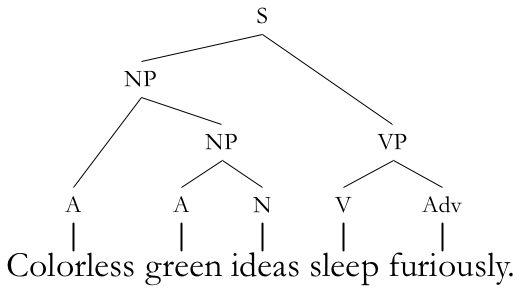
A syntax tree in which the sentence (S) breaks down into a noun phrase (NP) and a verb phrase (VP), both of which break down into additional smaller constituents.

Generative grammar is a research tradition in linguistics that aims to explain the cognitive basis of language by formulating and testing explicit models of humans' subconscious grammatical knowledge. Generative linguists tend to share certain working assumptions such as the competenceperformance distinction and the notion that some domain-specific aspects of grammar are partly innate in humans. These assumptions are often rejected in non-generative approaches such as usage-based models of language. Generative linguistics includes work in core areas such as syntax, semantics, phonology, psycholinguistics, and language acquisition, with additional extensions to topics including biolinguistics and music cognition.

Generative grammar began in the late 1950s with the work of Noam Chomsky, having roots in earlier approaches such as structural linguistics. The earliest version of Chomsky's model was called Transformational grammar, with subsequent iterations known as Government and binding theory and the Minimalist program. Other present-day generative models include Optimality theory, Categorial grammar, and Tree-adjoining grammar.

Principles

[edit]

Generative grammar is an umbrella term for a variety of approaches to linguistics. What unites these approaches is the goal of uncovering the cognitive basis of language by formulating and testing explicit models of humans' subconscious grammatical knowledge.[1][2]

Cognitive science

[edit]

Generative grammar studies language as part of cognitive science. Thus, research in the generative tradition involves formulating and testing hypotheses about the mental processes that allow humans to use language.[3][4][5]

Like other approaches in linguistics, generative grammar engages in linguistic description rather than linguistic prescription.[6][7]

Explicitness and generality

[edit]

Generative grammar proposes models of language consisting of explicit rule systems, which make testable falsifiable predictions. This is different from traditional grammar where grammatical patterns are often described more loosely.[8][9] These models are intended to be parsimonious, capturing generalizations in the data with as few rules as possible. As a result, empirical research in generative linguistics often seeks to identify commonalities between phenomena, and theoretical research seems to provide them with unified explanations. For example, Paul Postal observed that English imperative tag questions obey the same restrictions that second person future declarative tags do, and proposed that the two constructions are derived from the same underlying structure. This hypothesis was able to explain the restrictions on tags using a single rule.[8]

Particular theories within generative grammar have been expressed using a variety of formal systems, many of which are modifications or extensions of context free grammars.[8]

Competence versus performance

[edit]

Generative grammar generally distinguishes linguistic competence and linguistic performance.[10] Competence is the collection of subconscious rules that one knows when one knows a language; performance is the system which puts these rules to use.[10][11] This distinction is related to the broader notion of Marr's levels used in other cognitive sciences, with competence corresponding to Marr's computational level.[12]

For example, generative theories generally provide competence-based explanations for why English speakers would judge the sentence in (1) as odd. In these explanations, the sentence would be ungrammatical because the rules of English only generate sentences where demonstratives agree with the grammatical number of their associated noun.[13]

(1) *That cats is eating the mouse.

By contrast, generative theories generally provide performance-based explanations for the oddness of center embedding sentences like one in (2). According to such explanations, the grammar of English could in principle generate such sentences, but doing so in practice is so taxing on working memory that the sentence ends up being unparsable.[13][14]

(2) *The cat that the dog that the man fed chased meowed.

In general, performance-based explanations deliver a simpler theory of grammar at the cost of additional assumptions about memory and parsing. As a result, the choice between a competence-based explanation and a performance-based explanation for a given phenomenon is not always obvious and can require investigating whether the additional assumptions are supported by independent evidence.[14][15] For example, while many generative models of syntax explain island effects by positing constraints within the grammar, it has also been argued that some or all of these constraints are in fact the result of limitations on performance.[16][17]

Non-generative approaches often do not posit any distinction between competence and performance. For instance, usage-based models of language assume that grammatical patterns arise as the result of usage.[18]

Innateness and universality

[edit]

A major goal of generative research is to figure out which aspects of linguistic competence are innate and which are not. Within generative grammar, it is generally accepted that at least some domain-specific aspects are innate, and the term "universal grammar" is often used as a placeholder for whichever those turn out to be.[19][20]

The idea that at least some aspects are innate is motivated by poverty of the stimulus arguments.[21][22] For example, one famous poverty of the stimulus argument concerns the acquisition of yes–no questions in English. This argument starts from the observation that children only make mistakes compatible with rules targeting hierarchical structure even though the examples which they encounter could have been generated by a simpler rule that targets linear order. In other words, children seem to ignore the possibility that the question rule is as simple as "switch the order of the first two words" and immediately jump to alternatives that rearrange constituents in tree structures. This is taken as evidence that children are born knowing that grammatical rules involve hierarchical structure, even though they have to figure out what those rules are.[21][22][23] The empirical basis of poverty of the stimulus arguments has been challenged by Geoffrey Pullum and others, leading to back-and-forth debate in the language acquisition literature.[24][25] Recent work has also suggested that some recurrent neural network architectures are able to learn hierarchical structure without an explicit constraint.[26]

Within generative grammar, there are a variety of theories about what universal grammar consists of. One notable hypothesis proposed by Hagit Borer holds that the fundamental syntactic operations are universal and that all variation arises from different feature-specifications in the lexicon.[20][27] On the other hand, a strong hypothesis adopted in some variants of Optimality Theory holds that humans are born with a universal set of constraints, and that all variation arises from differences in how these constraints are ranked.[20][28] In a 2002 paper, Noam Chomsky, Marc Hauser and W. Tecumseh Fitch proposed that universal grammar consists solely of the capacity for hierarchical phrase structure.[29]

In day-to-day research, the notion that universal grammar exists motivates analyses in terms of general principles. As much as possible, facts about particular languages are derived from these general principles rather than from language-specific stipulations.[19]

Subfields

[edit]

Research in generative grammar spans a number of subfields. These subfields are also studied in non-generative approaches.

Syntax

[edit]

Syntax studies the rule systems which combine smaller units such as morphemes into larger units such as phrases and sentences.[30] Within generative syntax, prominent approaches include Minimalism, Government and binding theory, Lexical-functional grammar (LFG), and Head-driven phrase structure grammar (HPSG).[2]

Phonology

[edit]

Phonology studies the rule systems which organize linguistic sounds. For example, research in phonology includes work on phonotactic rules which govern which phonemes can be combined, as well as those that determine the placement of stress, tone, and other suprasegmental elements.[31] Within generative grammar, a prominent approach to phonology is Optimality Theory.[28]

Semantics

[edit]

Semantics studies the rule systems that determine expressions' meanings. Within generative grammar, semantics is a species of formal semantics, providing compositional models of how the denotations of sentences are computed on the basis of the meanings of the individual morphemes and their syntactic structure.[32]

Extensions

[edit]

Music

[edit]

Generative grammar has been applied to music theory and analysis.[33] One notable approach is Fred Lerdahl and Ray Jackendoff's 1983 Generative theory of tonal music, which formalized and extended ideas from Schenkerian analysis.[34] Though Lerdahl and Jackendoff observed that their model of musical syntax was quite different from then-current models of linguistic syntax, recent work by Jonah Katz and David Pesetsky has argued for a closer connection. According to Katz and Pesetsky's Identity Thesis for Language and Music, linguistic syntax and musical syntax are formally equivalent except that the former operates on morphemes while the latter operates on pitch classes.[35][36]

Biolinguistics

[edit]

Biolinguistics is the study of the biology of language. Recent work in generative-inspired biolinguistics has proposed the hypothesis that universal grammar consists solely of syntactic recursion, and that it arose recently in humans as the result of a random genetic mutation.[37]

History

[edit]

As a distinct research tradition, generative grammar began in the late 1950s with the work of Noam Chomsky.[38] However, its roots include earlier structuralist approaches such as glossematics which themselves had older roots, for instance in the work of the ancient Indian grammarian Pāṇini.[39][40][41] Military funding to generative research was an important factor in its early spread in the 1960s.[42]

The initial version of generative syntax was called transformational grammar. In transformational grammar, rules called transformations mapped a level of representation called deep structures to another level of representation called surface structure. The semantic interpretation of a sentence was represented by its deep structure, while the surface structure provided its pronunciation. For example, an active sentence such as "The doctor examined the patient" and "The patient was examined by the doctor", had the same deep structure. The difference in surface structures arises from the application of the passivization transformation, which was assumed to not affect meaning. This assumption was challenged in the 1960s by the discovery of examples such as "Everyone in the room knows two languages" and "Two languages are known by everyone in the room".[43]

After the Linguistics wars of the late 1960s and early 1970s, Chomsky developed a revised model of syntax called Government and binding theory, which eventually grew into Minimalism. In the aftermath of those disputes, a variety of other generative models of syntax were proposed including relational grammar, Lexical-functional grammar (LFG), and Head-driven phrase structure grammar (HPSG).[44]

Generative phonology originally focused on rewrite rules, in a system commonly known as SPE Phonology after the 1968 book The Sound Pattern of English by Chomsky and Morris Halle. In the 1990s, this approach was largely replaced by Optimality theory, which was able to capture generalizations called conspiracies which needed to be stipulated in SPE phonology.[28]

Semantics emerged as a subfield of generative linguistics during the late 1970s, with the pioneering work of Richard Montague. Montague proposed a system called Montague grammar which consisted of interpretation rules mapping expressions from a bespoke model of syntax to formulas of intensional logic. Subsequent work by Barbara Partee, Irene Heim, Tanya Reinhart, and others showed that the key insights of Montague Grammar could be incorporated into more syntactically plausible systems.[45][46]

See also

[edit]

References

[edit]

Further reading

[edit]
[edit]
Revisions and contributorsEdit on WikipediaRead on Wikipedia
from Grokipedia
Generative grammar is a theory of introduced by in the mid-20th century, positing that the human capacity for is governed by an innate, of rules that generates all and only the grammatical sentences of a given , complete with their structural descriptions. This approach emphasizes the speaker's internalized —the abstract knowledge enabling the production and comprehension of an infinite array of sentences from finite means—distinct from performance, which involves actual use influenced by factors like and attention. Chomsky's foundational work, (1957), critiqued earlier taxonomic models of grammar that focused on classifying observed utterances and instead advocated for generative models capable of predicting novel sentences based on underlying syntactic principles. In Aspects of the Theory of Syntax (1965), he further refined the framework, defining generative grammar as "a system of rules that in some explicit and well-defined way assigns structural descriptions to sentences," with the goal of achieving both descriptive adequacy (accurately capturing a language's structure) and explanatory adequacy (accounting for how children acquire language through innate universal principles). Central to this theory is the concept of , an inborn faculty shared across humans that constrains possible grammars and explains linguistic diversity and rapid acquisition. The theory revolutionized the study of syntax by introducing transformational rules, which derive surface structures from deeper, more abstract representations, influencing subsequent developments like the . Generative grammar has profoundly shaped , , and , underscoring language as a product of biological endowment rather than mere environmental stimulus.

Principles and Assumptions

Cognitive Basis

Generative grammar emerged as a foundational framework within , positing that human language is a distinct mental faculty governed by innate computational structures that enable the infinite generation of novel sentences from finite means. This approach views linguistic knowledge not as a product of general learning mechanisms but as an autonomous cognitive system wired into the , allowing speakers to intuitively judge and meaning beyond what explicit instruction provides. A key argument supporting this cognitive foundation is Chomsky's "poverty of the stimulus," which demonstrates that children acquire highly abstract and complex grammatical rules despite exposure to only fragmentary and imperfect linguistic input during early development. For instance, young learners master recursive structures and long-distance dependencies—features that rarely appear unambiguously in ambient speech—suggesting that such knowledge cannot arise solely from statistical patterns in the environment but must stem from pre-existing mental principles. This argument underscores the inadequacy of empiricist models reliant on environmental data alone, highlighting instead the role of biologically endowed constraints in guiding . Central to this process is the hypothesized (LAD), an innate cognitive module that interacts with primary linguistic data to parameterize the universal principles of grammar, enabling rapid and uniform mastery of across diverse human populations. The LAD is conceived as a specialized processor that filters input through innate biases, ensuring that acquisition occurs effortlessly within a and results in competence far exceeding the stimuli encountered. Generative grammar integrates with broader through concepts like the , influenced by theory that posits as an informationally encapsulated module operating independently of central reasoning processes and general . This modularity explains why linguistic processing exhibits domain-specific rapidity and autonomy, such as in real-time parsing, while distinguishing from other cognitive domains like or problem-solving. framework builds on generative principles to argue that the faculty functions as a dedicated input system, insulated from top-down beliefs yet interfacing with higher cognition for interpretation.

Explicitness and Generality

Generative grammar is defined as a system of explicit rules that, in a precise and well-defined manner, generates all and only the grammatical sentences of a , assigning structural descriptions to them. This formal approach contrasts with descriptive grammars by prioritizing mathematical rigor and over mere cataloging of observed forms. The rules must be finite yet capable of producing an infinite array of sentences, capturing the creative aspect of language use. A key aspect of this framework is the concept of generative capacity, which measures the expressive power of rule systems through the —a classification of formal grammars into four types based on their ability to generate language structures. Type-0 (unrestricted) grammars have the highest capacity, while Type-3 (regular) are the most limited; generative grammar posits that natural languages require at least Type-2 (context-free) grammars to account for syntactic dependencies, as finite-state models fail to handle center-embedding phenomena like "The rat the cat chased died." This hierarchy ensures that grammars are not only explicit but also hierarchically organized to reflect linguistic complexity without unnecessary power. Central to the methodology is an emphasis on generality, where rules apply broadly across diverse sentence types and constructions, avoiding ad hoc exceptions or language-specific stipulations that reduce explanatory adequacy. Generalization is achieved when multiple similar rules are unified into a single, more abstract one, enhancing the grammar's simplicity and universality. For instance, early models employed to define basic syntactic categories, such as the rule SNPVPS \to NP \, VP, which recursively expands a sentence (S) into a (NP) and (VP), allowing systematic generation of hierarchical structures like "The cat sleeps" or more complex embeddings. This formal precision enables testable predictions about , distinguishing generative grammar's commitment to scientific formalism.

Competence versus Performance

In generative grammar, introduced a fundamental distinction between and in his work. Competence refers to the idealized, internalized knowledge that a speaker-hearer possesses about their , enabling the production and comprehension of an unlimited number of sentences according to the underlying rules of the . In contrast, encompasses the actual use of in real-world situations, which is inevitably shaped by extraneous factors such as memory limitations, attentional distractions, emotional states, and physiological constraints. This separation has profound implications for linguistic theory-building within the generative framework. Generative models aim to characterize competence by specifying formal rules that generate all and only the grammatical sentences of a , abstracting away from the imperfections and variability observed in data. By focusing on competence, theorists can construct explanatory grammars that account for the systematic of use—such as the ability to form sentences—without being derailed by processing errors or situational influences that do not reflect the underlying . This idealization allows to function as a , probing the mental representations that constitute linguistic ability rather than merely cataloging observed outputs. Performance factors manifest in various observable phenomena that deviate from the predictions of a competence grammar. For instance, slips of the tongue, such as unintended word substitutions or phonetic errors (e.g., saying "a whole nother" instead of "another whole"), arise from momentary lapses in articulation or lexical access, not flaws in the speaker's grammatical knowledge. Similarly, garden-path sentences like "The horse raced past the barn fell" trigger temporary ambiguities during comprehension, leading to misinterpretations that competent speakers quickly resolve upon reanalysis, highlighting limitations rather than incompetence. These examples illustrate how introduces noise—such as incomplete utterances or false starts—that generative theory sets aside to isolate the core rules of competence. The competence-performance distinction also served as a key critique of behaviorist approaches to , particularly B. F. Skinner's 1957 analysis in Verbal Behavior. Skinner treated as a form of operant shaped entirely by external stimuli and reinforcements, effectively conflating observable verbal output () with the internal (competence) that enables it. Chomsky argued that this reductionist view fails to explain the creative, rule-governed nature of , as it overlooks the speaker's innate capacity to generate novel expressions beyond simple environmental contingencies, thereby undermining behaviorism's empirical adequacy for linguistic phenomena.

Innateness and Universality

(UG) is posited as a biologically endowed of innate principles that constrain the form of possible grammars, forming the core of generative grammar's account of . These principles, such as those governing structure dependence and binding, are argued to be part of the human genetic endowment, enabling children to acquire complex linguistic knowledge from limited input. UG thus limits the hypothesis space for grammars, ensuring that only linguistically viable systems are learnable. A key mechanism within UG is the principles-and-parameters framework, where fixed principles are supplemented by a finite set of parameters that account for cross-linguistic variation. For instance, the head-directionality parameter determines whether the head of a phrase (e.g., a verb or noun) precedes or follows its complements, yielding head-initial orders in languages like English or head-final orders in Japanese, while preserving underlying universality. This approach explains how children "set" parameters based on exposure to their target language, rapidly converging on a specific grammar without requiring exhaustive evidence for every rule. Evidence for the innateness of UG draws from the emergence of grammar in creole languages and pidgins, where children exposed to unstructured input develop full-fledged systems exhibiting consistent syntactic structures not derivable from the superstrate languages alone. Derek Bickerton's controversial bioprogram hypothesis, based on analysis of Hawaiian Creole, for example, proposes that children impose hierarchical phrase structure and tense-marking systems resembling those in unrelated languages, suggesting activation of innate bioprogram features. Similarly, the critical period hypothesis supports innateness, positing a maturationally bounded window—typically from infancy to puberty—during which the language faculty is optimally plastic for acquiring UG-constrained grammars. Cases like feral children or second-language learners post-puberty demonstrate diminished proficiency in subtle syntactic aspects, underscoring the biological timing of this capacity. Cross-linguistic typology reveals strong tendencies rooted in UG, such as a distinction between nominal and verbal elements in most languages' lexical inventories, constraining morphological and syntactic operations accordingly, though some exhibit more flexible categorial distinctions. , enabling phrases within phrases (e.g., relative clauses modifying nouns iteratively), is a core computational property invariant across languages, distinguishing human syntax from other cognitive systems. These hierarchies, including preferences for certain relativization strategies, reflect innate biases that guide acquisition universally.

Core Components

Syntax

In generative grammar, syntax is primarily concerned with the hierarchical organization of sentence , capturing how words combine into phrases and clauses through rule-governed processes. Central to early formulations is the use of , which generate the constituent structure of sentences via recursive application. These rules specify the possible configurations of syntactic categories, such as s (NPs), verb phrases (VPs), and sentences (S). A example is the rule NPDet NNP \to Det\ N, which derives a from a (e.g., "the") followed by a (e.g., "book"), as illustrated in Chomsky's foundational work. Such rules produce tree diagrams that visually represent constituency, where nodes denote phrases and branches show dominance relations; for instance, the sentence "The cat sleeps" yields a tree with S dominating NP and VP, the NP branching to Det ("the") and N ("cat"), and VP to V ("sleeps"). This approach emphasizes the binary branching and labeling of s, distinguishing hierarchical from linear word order. To relate systematically different sentence forms, generative syntax employs , which posits an abstract deep structure generated by and a surface structure derived through transformations like movement and deletion. Transformations operate on deep structures to yield surface forms, accounting for syntactic relations such as active-passive pairs or declaratives-questions. In question formation, for example, the moves from its deep structure position to the sentence-initial position (Spec-CP), as in transforming "John is happy" (deep structure) to "Is John happy?" (surface structure via T-to-C movement). This mechanism, introduced in early generative models, resolves limitations of alone by permitting a finite set of rules to generate infinite sentence varieties while capturing paraphrases and ambiguities. The Principles and Parameters framework refines these ideas by positing a universal core of syntactic principles alongside language-specific parameters that account for cross-linguistic variation. Core principles include subjacency, a locality constraint that bounds the distance of movement operations, prohibiting extractions across certain bounding nodes like NPs or S-bar (e.g., blocking "Who did you see the man who __?" but allowing "Who did you see __?"). This principle unifies diverse island constraints, ensuring movements respect structural barriers. Parameters, in contrast, are binary switches set during ; a prominent example is the pro-drop parameter, which permits null subjects in languages like Spanish ("Habla inglés" meaning "He/she speaks English") but requires overt pronouns in English, tied to properties of the inflectional system. This framework, articulated in , balances innateness with empirical diversity. Building on these foundations, the seeks maximal simplicity by reducing syntactic operations to a single primitive: Merge, which recursively combines two syntactic elements (e.g., a lexical item and a previously built phrase) to form a new set, labeled by the head of the operation. External Merge introduces new elements from the , while Internal Merge (disguised movement) remerges a subtree within a larger structure, deriving phenomena like economically without extraneous rules. This approach minimizes theoretical apparatus, assuming syntax interfaces directly with phonological and semantic systems via and interpretation procedures, as explored in Chomsky's 1995 collection.

Phonology

In generative phonology, the sound systems of languages are modeled through abstract underlying representations that undergo systematic transformations to yield surface forms, as formalized in the seminal work The Sound Pattern of English (SPE) by Noam Chomsky and Morris Halle. This approach posits that phonological knowledge consists of a finite set of rules operating on feature-based segments to account for alternations and regularities, emphasizing the generative capacity to produce all and only the well-formed phonetic outputs of a language. Underlying forms capture morpheme-invariant properties, while rules derive contextually conditioned variants, distinguishing phonology from mere phonetic description by focusing on competence rather than performance. Phonological rules in this framework are typically context-sensitive rewrite operations that modify segments based on adjacent elements, capturing processes like assimilation where a adopts features from a neighbor to facilitate articulation. For instance, in English, the /n/ assimilates in to a following bilabial, as in the underlying form /ɪn + bɪl/ deriving the surface [ɪm bɪl] for "impossible," where /n/ becomes before /b/. Such rules are ordered sequentially in derivations, applying from underlying to phonetic levels, and are constrained by universal markedness principles to ensure naturalness and cross-linguistic generality. Beyond segmental rules, generative phonology incorporates prosodic structure to organize sounds into hierarchical domains that govern suprasegmental phenomena like stress and intonation. The prosodic hierarchy posits layered constituents—syllable, foot, phonological word—as recursive units built from the linear string, with the as the minimal domain grouping segments into onset, nucleus, and coda. Feet aggregate for rhythmic purposes, such as in iambic patterns where stress falls on the second , while the phonological word encompasses clitics and affixes into a cohesive unit, influencing rule application across boundaries. This structure, developed by researchers like Elisabeth Selkirk and Marina Nespor, ensures that phonological processes respect domain edges, providing a unified account of phrasing in diverse languages. A significant evolution within generative phonology is the integration of Optimality Theory (OT), which shifts from rule-based derivations to parallel evaluation of candidate outputs against ranked universal constraints. Introduced by Alan Prince and Paul Smolensky, OT models variation and opacity by having higher-ranked constraints (preserving underlying forms) compete with constraints (favoring simplicity), with the optimal form emerging as the one incurring the fewest violations. For example, in assimilation scenarios, a constraint like Place-Agreements may outrank faithfulness to nasal place, yielding surface harmony without sequential rules, thus accommodating dialectal differences through reranking. This framework retains SPE's emphasis on underlying representations while enhancing explanatory power for cross-linguistic patterns and learnability.

Semantics

In generative grammar, semantics is understood as a compositional system where the meaning of a sentence is derived systematically from the meanings of its syntactic constituents and the rules combining them, ensuring that complex expressions receive interpretations based on their hierarchical structure. This approach aligns semantic interpretation closely with the syntactic derivations outlined in the grammar, treating meaning as an output of the same generative mechanisms that produce phonetic forms. Compositional semantics in this framework relies on formal tools like to build meanings hierarchically, mirroring syntactic phrase structure; for instance, the meaning of a such as "loves a woman" can be represented as applying the predicate "love" to an individual via abstraction, λx.y[woman(y)love(x,y)]\lambda x . \exists y [woman(y) \land love(x, y)], which then composes with a subject to yield the full . This method ensures that semantic values propagate upward through the , preserving the finite nature of the while accounting for infinite expressive potential. Such compositionality was pivotal in integrating logical precision into generative models, avoiding ad hoc stipulations for semantic relations. A key representational level for semantics is (LF), an abstract syntactic structure derived by covert movements that resolves ambiguities involving scope and quantifiers, interfacing directly with interpretive rules. In sentences like "Every man loves a ," LF allows quantifiers such as "every" and "a" to take wide or narrow scope through quantifier raising; for example, raising "every man" above "a " yields the reading where each man loves some (possibly different) , while the reverse order produces a collective interpretation. This mechanism, introduced in the Government and Binding framework, ensures that semantic scope relations are syntactically encoded, facilitating uniform interpretation across languages. The integration of formal semantics into generative grammar draws heavily from , which provided a model-theoretic foundation for treating fragments as intensional logics amenable to syntactic rules, influencing later developments like the direct compositionality in LF interpretations. Montague's approach demonstrated how categorial grammars could synchronize syntactic and semantic derivations, paving the way for generative syntacticians to adopt lambda-based translations without abandoning phrase-structure rules. This synthesis resolved early tensions between interpretive and generative semantics camps by embedding Montague-style semantics within Chomsky's modular architecture. Theta theory complements these components by governing argument structure, specifying how verbs assign thematic roles (such as agent or ) to their within verb phrases, ensuring a bijective mapping between syntactic positions and semantic roles via the criterion. For a like "love," the external receives the agent role, while the internal gets the theme role, with projections like VP and S imposing structural constraints on role assignment. This theory links lexical properties to syntactic configurations, preventing violations like unassigned roles or over-assignment, and interfaces with LF to support coherent propositional meanings.

Extensions and Applications

Biolinguistics

Biolinguistics, a subfield of generative grammar, examines the biological foundations of as a natural object, emphasizing its and neural implementation. has framed the language faculty as an "organ of the mind," comparable to other cognitive systems like vision, emerging through biological processes that enable the generation of infinite expressions from finite means. This perspective posits language growth as the interaction of three factors: genetic endowment providing principles, experience shaping individual variation, and third-factor principles of efficient computation and structural architecture that apply beyond language to constrain outcomes and optimize . These third factors, including principles of and organism-external laws, are seen as driving evolutionary innovations, such as the introduction of the computational operation Merge around 50,000 years ago, marking a "" in human cognitive capacity. Central to biolinguistics is the faculty of language in the narrow sense (FLN), hypothesized as the uniquely human core computational system responsible for recursion—the ability to embed structures within themselves to produce hierarchical complexity. FLN is distinguished from the broader faculty of language (FLB), which includes sensory-motor and conceptual-intentional interfaces shared with other species; in contrast, FLN consists primarily of recursion, implemented via Merge, a basic operation that combines elements to form new ones iteratively. This minimalist mechanism is proposed to have evolved for potentially non-communicative purposes, such as navigation or social cognition, underscoring language's biological specificity while inviting interdisciplinary evidence from genetics and comparative biology. Recent biolinguistic research (as of 2024) contrasts the innate, rule-based approach with statistical methods in large language models (LLMs), emphasizing that LLMs lack the biological constraints of and may not explain acquisition's efficiency. Evolutionary for generative grammar's biological roots includes genetic markers like the gene, which underwent positive selection in the hominin lineage and is associated with speech and impairments when mutated. Initially dubbed the "grammar gene" due to observed deficits in morphosyntax among affected families, primarily influences sensorimotor coordination for articulation and vocal learning, with secondary impacts on grammatical processing through disruptions in motor sequencing essential for . Comparative studies with animals reveal limitations in ; for instance, while Bengalese finches demonstrate sensitivity to center-embedded sequences in artificial grammars, akin to basic phrase structure learning in human infants, their natural birdsong lacks the unbounded hierarchical central to human syntax, highlighting FLN's uniqueness. Neuroscience interfaces further illuminate biolinguistics by linking generative mechanisms to function, particularly in (left BA 44), which activates during syntactic processing tasks involving demands, such as resolving long-distance dependencies in sentences. Functional MRI studies show increased activity in for complex wh-questions requiring syntactic integration over extended spans, supporting its role in maintaining hierarchical structures rather than mere semantic interpretation. Recent findings (as of 2024) indicate plays a supplementary role, with compensation by broader cortical and subcortical networks in cases of damage like Broca's aphasia, which impairs but does not eliminate grammatical judgments and sentence comprehension, providing clinical evidence for the neural embodiment of generative syntax.

Music

The application of generative grammar principles to music has been notably advanced through the Generative Theory of Tonal Music (GTTM), developed by music theorist Fred Lerdahl and linguist in their 1983 book. GTTM posits that listeners perceive and mentally represent tonal music via hierarchical structures generated by formal rules, mirroring the syntactic processes in generative . Central to this theory are that organize musical events into grouped hierarchies, analogous to how syntactic rules build phrase structures in , such as nesting smaller units like motifs into larger phrases. A key feature of GTTM is the use of recursive , where musical elements are hierarchically nested to create complex forms, similar to the embedding of clauses within sentences in linguistic . For instance, a basic motif can be embedded within a , which in turn embeds into sections, allowing for unbounded hierarchical depth in tonal compositions like those of Bach. This enables the generation of varied musical structures from a of rules, emphasizing in auditory processing. GTTM also incorporates transformational analogies through reduction rules, such as time-span reduction and prolongational reduction, which simplify surface-level musical details to reveal underlying structures, akin to syntactic transformations like deletions that derive surface forms from deep structures. These reductions highlight functional relations, such as harmonic progressions, by eliminating non-essential elements, thereby paralleling how generative grammar derives observable sentences from abstract representations. Cognitive studies reveal overlaps in the neural resources engaged by linguistic and musical processing, particularly in areas involving hierarchical and syntactic integration. evidence shows co-activation in brain regions like the during both musical tension-resolution patterns and linguistic syntax comprehension, suggesting shared mechanisms for processing recursive structures. This overlap supports the idea that generative principles may underpin broader human faculties for structuring sequential information, extending beyond to .

Computational Linguistics

Generative grammar's reliance on context-free grammars (CFGs) has profoundly influenced computational linguistics, particularly in developing efficient parsing algorithms for syntactic analysis. The Cocke-Younger-Kasami (CYK) algorithm, a cornerstone of this integration, employs dynamic programming to determine whether a given string belongs to the language generated by a CFG in Chomsky normal form, enabling bottom-up construction of parse trees in O(n³) time complexity for a string of length n. This approach directly operationalizes the formal rules of generative syntax, allowing computational systems to verify sentence well-formedness and recover hierarchical structures, as seen in early applications to natural language processing tasks like sentence parsing. To address the inherent ambiguities in —where multiple parse trees may derive the same —probabilistic context-free grammars (PCFGs) extend CFGs by assigning probabilities to production rules, facilitating statistical disambiguation through . Developed in the late 1970s, PCFGs integrate techniques, such as the inside-outside , to learn rule probabilities from annotated corpora like treebanks, thereby resolving syntactic ambiguities by selecting the most probable parse. In practice, this has enabled robust parsers that achieve high accuracy on benchmark datasets, with F-scores often exceeding 85% on Wall Street Journal sections of the Penn Treebank, underscoring PCFGs' role in bridging generative theory with data-driven NLP. Tree-adjoining grammars (TAGs), an extension of generative frameworks, further enhance computational models by incorporating mild context-sensitivity to model long-distance dependencies, such as in relative clauses, which CFGs handle less elegantly. In AI language models, TAGs support structured generation by allowing adjunction operations that insert subtrees at designated sites, improving handling of dependencies spanning multiple clauses without exponential blowup in parsing complexity. Recent implementations in neural architectures, like those combining TAG derivations with recurrent networks, have demonstrated superior performance in tasks requiring dependency resolution, such as , where they outperform purely CFG-based systems by 10-15% in dependency accuracy. Despite these advances, scaling generative rules to large corpora poses significant challenges, including the of rule interactions and the difficulty of maintaining linguistic fidelity amid vast, noisy data. Post-2020 hybrid approaches mitigate this by fusing generative components with neural networks; for instance, models that inject CFG constraints into transformer-based architectures enforce syntactic during training, reducing hallucinations in generation tasks while preserving efficiency on corpora exceeding billions of tokens. These hybrids, as explored in recent works, achieve up to 20% improvements in syntactic consistency over end-to-end neural models on benchmarks , highlighting a resurgence of generative principles in scalable NLP. Ongoing debates (as of 2025) explore whether LLMs exhibit innate generative syntax or rely on statistical patterns, with evidence suggesting complementarity between generative theory and LLM capabilities rather than replacement.

Historical Development

Origins and Early Formulations

In the mid-20th century, particularly during the , generative grammar emerged as a response to the limitations of post-Bloomfieldian , which was dominated by figures like and . Structuralist approaches emphasized distributional analysis and discovery procedures based on observable data, but they were critiqued for failing to achieve explanatory adequacy by not accounting for the underlying principles that enable speakers to generate novel sentences or the innate that underlies . This critique highlighted how structuralism's focus on surface-level descriptions, such as phonemic and morphemic segmentation, neglected deeper syntactic regularities and the creative aspect of language use. Noam Chomsky's seminal work, (1957), marked the foundational formulation of generative grammar, introducing and transformations as core mechanisms. Phrase structure grammars consist of rewrite rules (e.g., Sentence → NP + VP) that generate hierarchical syntactic trees from an initial symbol, representing the immediate constituents of sentences like "the man hit the ball." Transformations, in turn, operate on these structures to derive more complex forms, such as questions or passives, from simpler base strings, thereby simplifying the overall grammar while capturing linguistic relations that pure phrase structure analysis could not. Central to this framework are kernel sentences—basic, declarative forms directly generated by the , serving as the foundation from which transformations derive all other sentence types. These innovations were heavily influenced by theory and , drawing from Alan Turing's computational models and Emil Post's work on production systems and rewrite rules. Chomsky adapted these concepts to , classifying grammars hierarchically (as in his 1956 paper) and emphasizing finite rule sets that generate infinite linguistic outputs through . This mathematical orientation shifted toward a , prioritizing explicit, formal models over intuitive or taxonomic methods prevalent in .

Key Theoretical Shifts

In the mid-1960s, generative grammar underwent a foundational shift with the formulation of Standard Theory, as outlined by in his seminal work Aspects of the Theory of Syntax. This framework posited a modular architecture where syntax was generated by a base component producing deep structures, which were then transformed into surface structures via obligatory and optional rules, while semantics and interfaced separately. The theory emphasized the autonomy of syntax, aiming to capture the innate that enables speakers to produce and understand infinite sentences from finite means. By the 1970s, this evolved into the Extended Standard Theory (EST), which integrated semantic interpretation more directly into the syntactic framework, addressing limitations in the earlier model's handling of meaning. EST introduced interpretive rules that applied to deep and surface structures to derive semantic representations, reflecting a recognition that syntax alone could not fully account for linguistic phenomena without semantic constraints. Key developments included conditions on transformations to restrict the power of rules, ensuring greater empirical adequacy across languages. A critical innovation during this period was the advent of trace theory, which accompanied the refinement of movement rules in transformational syntax. Traces were posited as empty categories left behind by displaced elements, allowing for principled explanations of dependencies in sentences; for instance, NP-movement rules, such as those raising subjects from embedded clauses, bound these traces to maintain . This approach, formalized in works like Chomsky's 1977 paper on and NP-movement, resolved issues in earlier deletion analyses by preserving structural information for interpretive modules. The 1980s marked a major to Government and Binding (GB) , a modular system that decomposed grammar into interacting subsystems governed by universal principles. Central modules included Binding Theory, which regulates and anaphora (e.g., Principle A requiring anaphors like "himself" to be bound within their local domain), and Case Theory, which ensures that noun phrases receive abstract case assignments from finite verbs or prepositions to avoid violations like the ill-formed "*John ". These principles, along with others like Theta Theory for argument roles, replaced construction-specific rules with parameterizable universals. This modularization culminated in the framework, articulated in Chomsky's 1981 Lectures on Government and Binding, which recast language variation as settings of finite parameters within a fixed set of principles, facilitating explanations of acquisition and cross-linguistic diversity. GB thus shifted generative grammar toward a more constrained, explanatory model, emphasizing innate universals over language-particular rules.

Contemporary Advances and Critiques

The , initiated by in the mid-1990s, sought to streamline generative grammar by deriving core structures from general cognitive principles rather than language-specific rules. Central to this program is bare phrase structure, which replaces traditional with a simpler system where phrases are built solely via binary merge operations, eliminating redundant projections like intermediate bars. Economy principles further enforce efficiency, prioritizing derivations with the fewest steps, shortest movements, and minimal structure to align with broader computational constraints. A key shift involved diminishing the role of parameters in (UG), proposing instead that variation arises primarily from lexical differences or third-factor principles like interface conditions, thereby reducing the innate apparatus to bare essentials. Building on minimalism, phase theory emerged in the early 2000s as a mechanism for managing syntactic complexity through cyclic domains, such as CP and vP phases, where subarrays of the structure are progressively sent to spell-out at the phonological form (PF) and logical form (LF) interfaces. This allows for incremental computation and interface satisfaction, addressing issues like locality and cyclicity in derivations. Complementing this, nanosyntax refines the syntax-morphology interface by decomposing lexical items into atomic features at syntactic terminals, with morpheme realization occurring via post-syntactic matching and spell-out, enabling fine-grained analysis of morphological irregularities within a generative framework. Despite these advances, generative grammar has faced sharp critiques in recent decades, particularly regarding its biolinguistic foundations. In 2025, Paul Postal's analysis in Generative Grammar's Grave Foundational Errors exposed ontological flaws in Chomsky's assumptions, such as the unsubstantiated positing of an innate faculty and the idealization of I-language as a computational organ, arguing these lack empirical grounding and lead to inconsistent theoretical commitments. Usage-based alternatives, advanced by researchers like Joan Bybee and , counter innateness claims by prioritizing corpus-derived patterns, frequency-driven learning, and emergent generalizations from actual use, positing that grammatical knowledge arises through general cognitive mechanisms without dedicated UG. Ongoing debates highlight tensions and potential syntheses, including attempts to reconcile with by treating constructions as stored form-function pairings integrated into the merge-based computational system. Empirical testing via has intensified since 2020, with studies revealing abstract syntactic representations in the temporal cortex that support generative production of novel utterances, providing neural evidence for hierarchical structure processing while challenging purely usage-based accounts.

References

Add your contribution
Related Hubs
User Avatar
No comments yet.