


Community hub
Recent from talks
Contribute something
Nothing was collected or created yet.
Futian, Shenzhen
View on Wikipedia | This article has multiple issues. Please help improve it or discuss these issues on the talk page. (Learn how and when to remove these messages)
|


Futian District (simplified Chinese: 福田区; traditional Chinese: 福田區; pinyin: Fútián Qū; Jyutping: fuk1tin4 keoi1) is one of the nine districts comprising the city of Shenzhen, China. The district is home to the government and Municipal Committee of Shenzhen, as well as one of the city's central business district (CBD).
Key Information


Name
[edit]There are two theories concerning the origin of the district's name:
- From an inscription dating to the Song dynasty (960–1297) which reads: "Lakes and mountains are blessed with fertile farmlands" (湖山擁福, 田地生輝).
- Written records showing that people from Shangsha Village built houses in Songziling in 1192; their farmlands were cultivated in lattice shapes, which in Chinese is a homophone for "Futian" meaning "blessed fields".
History
[edit]Luohu District was established in April 1979, one month after Shenzhen was promoted to city status. Futian, and another area called Fucheng (附城), became communes within the Luohu District.
Futian became part of the Shenzhen Special Economic Zone after it was designated in 1980. It then became a subdistrict under the district of Shangbu (上步).
Futian, along with Nanshan, was promoted to district status in October 1990. The Shangbu district, which had governed the Futian subdistrict the previous decade, became a part of the Futian district. The district government was established on Shennan Middle Road.
Rapid urbanization occurred in the late 20th century; the agricultural land which once made up a vast majority of Luohu had shrunk to an area of only 12.26 km2 (4.73 sq mi) by 2003.[1]
Economy
[edit]As of 2022, the nominal Gross Domestic Product (GDP) of Futian District is 551.45 billion CNY (US$ 81.85 billion), second in the city behind neighboring Nanshan District. This figure is the third highest of all districts belonging to municipal-level cities in China. The Central Business District (CBD) of Shenzhen is a planned development project that began in the early 1990s. Located within the Futian district, it comprises an area of 607 hectares. The four sides of the district are delineated by Binhe Dadao, Lianhua Road, Xinzhou Road and Caitian Road.
Many office high-rises and government buildings are located in the CBD, some of which are prominent buildings in Shenzhen, such as the Shenzhen City Hall (Civic Center), Shenzhen Library, Shenzhen Concert Hall, Shenzhen Development Bank building and the Shenzhen Convention and Exhibition Center. Located directly north of the CBD is Lianhuashan Park.
Located in Futian District, Shenzhen City, Guangdong Province, Lotus Hill Park is an urban oasis of natural beauty, cultural heritage and recreation. Covering an area of about 194 hectares, the park was completed in 1997 and consists of several major parts, including a tropical-style lawn area in the south of the park, an artificial lake, Lotus Lake, and forested green areas in the west and north. Lotus Hill Park is not only an important place for citizens to relax and exercise, but also an excellent choice for tourists to explore the natural scenery and cultural heritage of Shenzhen.
There are numerous skyscrapers in the CBD such as the SEG Tower, the Shum Yip Up Hills Twin Towers, China Merchants Bank Tower, the twin towers of East Pacific Center, and the 599 m (1969 ft) Ping An Finance Centre, which is the second tallest building in China and the fourth tallest in the world.
Wal-Mart China has its headquarters in Towers 2 and 3 of SZITIC Square[note 1] in Futian District.[2]
The headquarters of OnePlus is in the Tairan Building [note 2] in Chegongmiao [note 3], Futian District.[3]
Everbright International has its Shenzhen Offices in Oriental Xintiandi Plaza[note 4] in Futian District.[4]
The hotel chain Vienna Hotels formerly had its headquarters in Lüjing Garden,[note 5] Futian District.[5]
Ping An Finance Group and China Merchants Bank both placed their corporate headquarters in the Futian District.
Subdistricts
[edit]| Name | Chinese (S) | Hanyu Pinyin | Canton Romanization | Population (2010)[6] | Area (km2) |
|---|---|---|---|---|---|
| Shatou Subdistrict | 沙头街道 | Shātóu Jiēdào | sa1 teo4 gai1 dou6 | 226,061 | 18.90 |
| Nanyuan Subdistrict | 南园街道 | Nányuán Jiēdào | nam4 yun4 gai1 dou6 | 108,398 | 3.00 |
| Yuanling Subdistrict | 园岭街道 | Yuánlǐng Jiēdào | yun4 léng5 gai1 dou6 | 88,261 | 3.67 |
| Huafu Subdistrict | 华富街道 | Huáfù Jiēdào | wa4 fu3 gai1 dou6 | 70,834 | 5.75 |
| Futian Subdistrict | 福田街道 | Fútián Jiēdào | fug1 tin4 gai1 dou6 | 234,861 | 12.25 |
| Xiangmihu Subdistrict | 香蜜湖街道 | Xiāngmìhú Jiēdào | hêng1 med6 wu4 gai1 dou6 | 89,471 | 9.98 |
| Lianhua Subdistrict | 莲花街道 | Liánhuā Jiēdào | lin4 fa1 gai1 dou6 | 168,392 | 9.60 |
| Meilin Subdistrict | 梅林街道 | Méilín Jiēdào | mui4 lem4 gai1 dou6 | 168,506 | 34.30 |
| Huaqiangbei Subdistrict | 华强北街道 | Huáqiángběi Jiēdào | wa4 kêng4 beg1 gai1 dou6 | 54,067 | 2.90 |
| Fubao Subdistrict | 福保街道 | Fúbǎo Jiēdào | fug1 bou2 gai1 dou6 | 106,811 | 3.75 |
Transport
[edit]Shenzhen Metro
[edit]Futian is currently served by ten metro lines operated by Shenzhen Metro. These lines and their stations and connections are:
 Line 1 – Science Museum 6, Huaqiang Road, Gangxia 10, Convention and Exhibition Center 4, Shopping Park 3, Xiangmihu, Chegongmiao 7 9 11, Zhuzilin, Qiaocheng East
- Line 2 – Shenkang, Antuo Hill 7, Qiaoxiang, Xiangmi, Xiangmei North, Jingtian 9, Lianhua West, Futian 3 11, Civic Center 4, Gangxia North 10 11 14, Huaqiang North 7, Yannan
- Line 3 – Futian Bonded Area, Yitian, Shixia 7, Shopping Park 1, Futian 2 11, Children's Palace 4, Lianhuacun 10, Huaxin 7, Tongxinling 6, Hongling 9
- Line 4 – Futian Checkpoint 10 ( via Lok Ma Chau), Fumin 7 10, Convention and Exhibition Center 1, Civic Center 2, Children's Palace 3, Lianhua North, Shangmeilin 9
- Line 6 – Science Museum 1, Tongxinling 3, Sports Center, Bagualing 7, Hanling
- Line 7 - Autuo Hill 2, Nonglin, Chegongmiao 1 9 11, Shangsha, Shawei, Shixia 3, Huanggangcun, Fumin 4 10, Huanggang Checkpoint, Chiwei, Huaqiang South, Huaqiang North 2, Huaxin 3, Huangmugang 14, Bagualing 6, Hongling North 9
- Line 9 - Xiasha, Chegongmiao 1 7 11, Xiangmei, Jingtian 2, Meijing, Xiameilin, Meicun, Shangmeilin 4, Maling 10, Hongling North 7, Yuanling, Hongling 3, Hongling South
- Line 10 – Futian Checkpoint 4 ( via Lok Ma Chau), Fumin 4 7, Gangxia 1, Gangxia North 2 11 14, Lianhuacun 3, Donggualing, Maling 9
- Line 11 – Chegongmiao 1 7 9 , Futian 2 3, Gangxia North 2 10 14
- Line 14 – Gangxia North 2 10 11, Huangmugang 7

High-speed railway
[edit]Futian is currently served by the Futian Railway station, with the high speed rail from Guangzhou to Hong Kong.
Shopping centers
[edit]Central Walk Shopping Mall[note 6]
The mall is located at the Convention and Exhibition Center metro station and features three levels of shopping, entertainment, and dining.
COCO Park
COCO Park is an upscale retail complex in Futian Central Business District. Aside from a shopping mall, it also features a popular street bar, large open public spaces and restaurants.
Huaqiangbei
Huaqiangbei is known for its electronics market, the largest of its kind in China. It also offers a variety of men's and women's fashions, shoes, bags and leather goods.
Education
[edit]There are now[when?] 83 schools delivering primary and secondary education holding 111,982 students and 11,503 teaching staff. Futian is also home to 140 kindergartens.
Secondary schools
[edit]Secondary schools include those operated by the Shenzhen municipal government and by the Futian district government.
Schools operated by the Shenzhen municipal government in Futian District include:[7]
- Shenzhen Senior High School - Central Campus (中心校区) and the South Campus (南校区)[8]
- Shenzhen Experimental School[9]
- Shenzhen Foreign Languages School Junior High School Division[10]
- Shenzhen No. 3 Senior High School (深圳市第三高级中学) Junior High School Division[11]
- Shenzhen Arts School (深圳艺术学校) - Baishaling[12]
- The First Vocational Technical School of Shenzhen (深圳市第一职业技术学校)[13]
- Shenzhen Pengcheng Technical College (深圳鹏城技师学院),[14] previously Shenzhen Second Senior Technical School - Fuqiang and Qiaocheng campuses[15]
Schools operated by the Futian District government include:[16]
- Shenzhen Futian High School[note 7] - In 2018 it had about 2,600 students. It has a 40,000 m2 (430,000 sq ft) campus.[17]
- Shenzhen Fujing Foreign Language School[note 8] - It was created in April 1999 and in 2018 it had over 2,000 students.[18]
- Shenzhen Futian BeiHuan Middle School[note 9]
- Futian Foreign Languages High School[note 10]
- Hongling Middle School
- Shenzhen Futian Huafu Middle School[note 11]
- Shenzhen Futian Huanggang Middle School[note 12]
- Shenzhen Futian Lianhua Middle School[note 13]
- Shenzhen Futian Meilin Middle School
- Shenzhen Futian Meishan Middle School[note 14]
- Shenzhen Futian Science Middle School[note 15]
- Shenzhen Futian Shangbu Middle School[note 16]
- Shenzhen Futian Shangsha Middle School[note 17]
- Shenzhen Futian Xinzhou Middle School[note 18]
- Shenzhen Yongyuan Experimental School[citation needed]
Other:
- Xinsha Middle School[citation needed]
International schools
[edit]QSI International School of Shenzhen previously had a campus in Honeylake, Futian District, adjacent to the Shenzhen Celebrities Club.[19][20]
Higher education
[edit]Futian District is the location of the University of Hong Kong–Shenzhen Hospital, a municipally-funded public teaching hospital.
Immigration port of entry
[edit]One of the immigration control points that lies within Futian is known as the Futian Port. Its counterpart in Hong Kong is Lok Ma Chau Spur Line Control Point, connected through a pedestrian bridge. The port is served by Futian Checkpoint Station on the Shenzhen Metro, itself being located within the port building.
Another immigration checkpoint is located 150 m east of Futian Port. This is the only one of the six immigration checkpoints between Shenzhen and Hong Kong that is open 24 hours. The crossing is highway-only and used mostly by trucks and busses, with the mainland and Hong Kong crossings being on opposite sides of a bridge over the Shenzhen River. Its counterpart in Hong Kong is Lok Ma Chau Control Point. It also marks the terminus of the G4 Beijing–Hong Kong and Macau Expressway.
Gallery
[edit]-
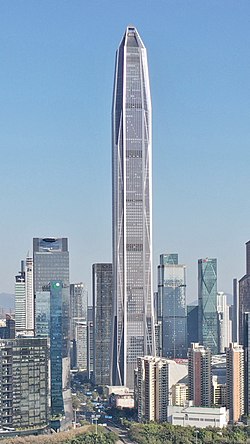 Ping An Finance Centre in 2020
 -
 Hon Kwok City Center in 2021
 -
 East Pacific Business Center in 2021
 -
 China Merchants Bank Tower in 2021
 -
 Shenzhen Energy Headquarters in 2021
 -

-
 Huaqiangbei & Shennan Road Cross with SEG Plaza in 2021
 -
 CEIEC Building in 2021
 -
 Skyline of Futian CBD as viewed from Binhe Boulevard
 -

-

-
 Shennan Road with Zhuzilin Junction East in 2021
 -
 Futian section of Shennan Road
 -


2021.jpg)


See also
[edit]
Notes
[edit]- ^ 深国投广场; 深國投廣場; Shēnguótóu Guǎngchǎng; sam1 gwok3 tau4 gwong2 coeng4
- ^ 泰然大厦; 泰然大廈; Tàirán Dàshà; taai3 jin4 daai6 haa6
- ^ 车公庙; 車公廟; Chēgōngmiào; ce1 gung1 miu6
- ^ 东方新天地广场; 東方新天地廣場; Dōngfāng Xīntiāndì Guǎngchǎng; dung1 fong1 san1 tin1 dei6 gwong2 coeng4
- ^ 绿景花园; 綠景花園; Lǜjǐng Huāyuán; luk6 ging2 faa1 jyun4*2
- ^ 中心城; Zhōngxīn Chéng; zung1 sam1 sing4; 'Center City'
- ^ 福田中学; 福田中學; Fútián Zhōngxué; fuk1 tin4 zung1 hok6
- ^ 福景外国语学校; 福景外國語學校; Fújǐng Wàiguóyǔ Xuéxiào; fuk1 ging2 ngoi6 gwok3 jyu5 hok6 haau6
- ^ 北环中学; 北環中學; Běihuán Zhōngxué; bak1 waan4 zung1 hok6
- ^ 福田区外国语高级中学; 福田區外國語高級中學; Fútiánqū Wàiguóyǔ Gāojízhōngxué; fuk1 tin4 keoi1 ngoi6 gwok3 jyu5 gou1 kap1 zung1 hok6
- ^ 华富中学; 華富中學; Huáfù Zhōngxué; waa4 fu3 zung1 hok6
- ^ 皇岗中学; 皇崗中學; Huánggǎng Zhōngxué; wong4 gong1 zung1 hok6
- ^ 莲花中学; 蓮花中學; Liánhuā Zhōngxué; lin4 faa1 zung1 hok6
- ^ 梅山中学; 梅山中學; Méishān Zhōngxué; mui4 saan1 zung1 hok6
- ^ 科技中学; 科技中學; Kējì Zhōngxué; fo1 gei6 zung1 hok6
- ^ 上步中学; 上步中學; Shàngbù Zhōngxué; soeng5 bou6 zung1 hok6
- ^ 上沙中学; 上沙中學; Shàngshā Zhōngxué; soeng5 saa1 zung1 hok6
- ^ 新洲中学; 新洲中學; Xīnzhōu Zhōngxué; san1 zau1 zung1 hok6
References
[edit]- ^ 福田区历史沿革. Archived from the original on 2015-09-30.
- ^ "Wal-Mart China Home Office Archived 2016-10-10 at the Wayback Machine." Wal-Mart China. Retrieved on September 30, 2016. "Address: 2-5/F, Tower 2 and 1-12/F, Tower 3, SZITIC Square, 69 Nonglin Road, Futian District, Shenzhen" - Chinese address Archived 2016-10-13 at the Wayback Machine: "地 址: 深圳市福田区农林路69号深国投广场二号楼2-5层及三号楼1-12层"
- ^ "Privacy Policy". OnePlus. Retrieved 2019-10-10.
Postal address: F18, Block C, Tairan Building, Tairan 8th Road, Chegongmiao, Futian District, Shenzhen, China, Zip Code: 518040
// Address in Chinese: "快递地址:中国深圳市福田区车公庙泰然八路泰然大厦C座18楼,邮编: 518040" - ^ "Contact Us". Everbright International. Retrieved 2019-03-04.
25/F., Block A, Oriental Xintiandi Plaza, No. 1003 Shennan Avenue, Futian, Shenzhen, China
- Traditional Chinese address: " 深圳市福田區深南大道1003號東方新天地廣場A座25樓" - Simplified Chinese address: "深圳市福田区深南大道1003号东方新天地广场A座25楼" - ^ "联系方式 Archived 2012-10-19 at the Wayback Machine." Vienna Hotels. Retrieved on October 24, 2012. "总 部 总部地址:深圳市福田区福强路绿景花园首层"
- ^ shi, Guo wu yuan ren kou pu cha ban gong; council, Guo jia tong ji ju ren kou he jiu ye tong ji si bian = Tabulation on the 2010 population census of the People's Republic of China by township / compiled by Population census office under the state; population, Department of; statistics, employment statistics national bureau of (2012). Zhongguo 2010 nian ren kou pu cha fen xiang, zhen, jie dao zi liao (Di 1 ban. ed.). Beijing Shi: Zhongguo tong ji chu ban she. ISBN 978-7-5037-6660-2.
{{cite book}}: CS1 maint: numeric names: authors list (link) - ^ "Municipal Schools". Government of Shenzhen. Retrieved 2020-06-20. and "市属学校" (in Chinese). Government of Shenzhen. Retrieved 2020-06-20.
- ^ "Home". Shenzhen Senior High School Group. Retrieved 2022-02-14.
中心校区(南):深圳市福田区春田路2号 中心校区(北):深圳市福田区泽田路8号[...]南 校 区:深圳市福田区农林路28号
Identified as a municipal school here: "Shenzhen Senior High School Group". Shenzhen Municipal Government. Retrieved 2022-02-14. - ^ "Shenzhen Experimental School". Shenzhen Municipal Government. Retrieved 2022-02-14.
Add: 4 Baihua Road 6, Futian District, Shenzhen (深圳市福田区百花六路四号)
- ^ "Shenzhen Foreign Languages School". Shenzhen Municipal Government. Retrieved 2022-02-14.
Add: 2005 Hongli Road, Futian District, Shenzhen (Junior High School Department) (深圳市福田区红荔路2005号)
- ^ "Shenzhen No. 3 Senior High School". Shenzhen Municipal Government. Retrieved 2022-02-14.
Add: In the east of Yitiancun housing estate, Yitian Road, Futian District, Shenzhen (Junior High School Department) (深圳市福田区益田路益田村住宅区东部)
- ^ "Shenzhen Arts School". Shenzhen Municipal Government. Retrieved 2022-02-14.
Add: 16 Baihua Road 2, Baishaling, Futian District, Shenzhen (south of Shenzhen Gymnasium) (深圳市福田区白沙岭百花二路16号,体育馆南侧)
- ^ "The First Vocational Technical School of Shenzhen". Shenzhen Municipal Government. Retrieved 2022-02-14.
Add: 3009 Huanggang Road, Futian District, Shenzhen (深圳市福田区皇岗路3009号)
- ^ "联系我们" [Contact Us]. Shenzhen Pengcheng Technical College. Retrieved 2022-02-14.
学校地址:深圳市福田区福强路1007号(福强校区) [...] 学校地址:深圳市福田区职教街10号(侨城校区)
- ^ "Shenzhen Second Senior Technical School". Shenzhen Municipal Government. Retrieved 2022-02-14.
Add: 1007 Fuqiang Road, Futian District, Shenzhen (Fuqiang Campus) (深圳市福田区福强路1007号) 10 Zhijiao Street, Futian District, Shenzhen (Qiaocheng Campus) (深圳市福田区职教街10号)
- ^ "Middle schools From: Futian District". City of Shenzhen. 2019-09-28. Retrieved 2020-06-20. - Listing of Futian District-operated schools in Chinese: "福田区属学校 中学". City of Shenzhen. Retrieved 2020-06-20.
- ^ "Brief Introduction to the School". Shenzhen Futian High School. 2017-05-18. Retrieved 2020-06-20.
- ^ "Fujing Foreign Language School". China Daily. 2018-03-23. Retrieved 2020-06-20.
- ^ "Shenzhen Home" (). Quality Schools International. August 2, 2009. Retrieved on May 15, 2016.
- ^ "School Contact Info" (). QSI International School of Shenzhen. August 16, 2009. Retrieved on May 15, 2016. "8063 Hongli West Road Futian District, Shenzhen Guangdong, P.R. China"
External links
[edit]

- Futian Government Online (in Chinese)
| Administrative divisions |  .svg)  | ||||||||||||
|---|---|---|---|---|---|---|---|---|---|---|---|---|---|
| Notable visitor attractions |
| ||||||||||||
| Education | |||||||||||||
| Transport |
| ||||||||||||
| Ports of entry connecting Hong Kong | |||||||||||||
| Notable businesses | |||||||||||||
| Notable skyscrapers |
| ||||||||||||
| Sports venues | |||||||||||||
| Major roads | |||||||||||||
| Geography | |||||||||||||
| Literature | |||||||||||||

| Sub-provincial cities |
| ||||||||||||||||||||||||||||||||||||||||||||||||||||||||||||||||||||
|---|---|---|---|---|---|---|---|---|---|---|---|---|---|---|---|---|---|---|---|---|---|---|---|---|---|---|---|---|---|---|---|---|---|---|---|---|---|---|---|---|---|---|---|---|---|---|---|---|---|---|---|---|---|---|---|---|---|---|---|---|---|---|---|---|---|---|---|---|---|
| Prefecture-level cities |
| ||||||||||||||||||||||||||||||||||||||||||||||||||||||||||||||||||||
| International | |
|---|---|
| National | |
| Other | |

- ^ "福田区文化局历史沿革 - 历史 - 福田区政府在线". Archived from the original on 2015-09-24.
- ^ "Futian at a Glance-FUTIAN GOVERNMENT ONLINE". Archived from the original on 2014-04-27.
Futian, Shenzhen
View on GrokipediaEtymology
Name Origins
The name "Futian" (福田, Fútián) literally translates to "blessed fields" or "fields of fortune" in Mandarin Chinese, reflecting the area's historical agricultural character amid fertile lowlands and waterways.[5] One primary etymological theory traces the name to a Song dynasty (960–1279) inscription describing the local landscape as "lakes and mountains embrace fortune, fields shine with brilliance" (湖山擁福,田地生輝), evoking imagery of prosperous, auspicious terrain conducive to rice cultivation.[6] An alternative account, drawn from local genealogical and historical records, links the name to the founding of Futian Village in 1192 during the Southern Song dynasty's Shaoxi era. Huang Xisun, fourth son of Huang Jintang (ancestor of nearby Shangsha Village's Huang clan), relocated to the southern slopes of Songziling Hill, where his descendants reclaimed marshy land into neatly gridded paddy fields known initially as "Getian" (格田, meaning "grid fields" due to their rectangular layout). Over time, this evolved into "Futian" (福田), substituting homophonous characters for auspicious connotations of abundance and Buddhist merit, as "fútián" also denotes a field yielding blessings in religious contexts.[7][8] These origins underscore Futian's pre-modern identity as a rural enclave of Bao'an County, with the name retained and formalized when the district was delineated in 1990 amid Shenzhen's post-1979 economic reforms, transitioning the term from denoting agrarian hamlets to a central urban administrative division.[6] Local histories emphasize the Huang clan's role in land development, though primary evidence relies on clan genealogies and gazetteers rather than contemporaneous imperial documents, warranting caution against unsubstantiated familial lore.[7]History
Pre-Modern Era
Prior to the establishment of Shenzhen as a special economic zone, the territory of modern Futian District formed part of Xin'an County (renamed Bao'an County in the late Qing dynasty), a peripheral administrative division in Guangdong Province characterized by low population density and subsistence-based economies. Established during the Ming dynasty (1368–1644), Xin'an encompassed rural landscapes with scattered villages engaged primarily in rice farming, fishing along the Shenzhen River, and limited salt evaporation in nearby coastal pans, though Futian's inland position emphasized agrarian activities over maritime pursuits.[9] The region's isolation from Guangzhou's major trade routes, compounded by defensive policies like the Ming-era maritime bans and the Qing Great Clearance of 1661—which evacuated approximately 16,000 residents inland to counter pirate threats—resulted in prolonged depopulation and minimal economic surplus, with recovery slow and uneven by the early 18th century.[9] Small Hakka and Cantonese villages, such as those in the Futian vicinity governed from the distant Nantou administrative center, relied on fortified enclosures for protection against banditry and natural hazards like Pearl River Delta flooding and typhoons, which frequently disrupted fragile polder systems used for wet-rice cultivation. Infrastructure remained rudimentary, consisting of earthen paths and basic irrigation ditches, with no evidence of urban settlements or large-scale commerce; imperial gazetteers from the Qing era describe the area as underutilized marshlands and hills supporting only hundreds of households per township.[9] This subsistence orientation exposed communities to chronic vulnerabilities, including crop failures from erratic monsoons and reliance on barter rather than markets, perpetuating a cycle of low productivity and emigration to denser inland regions.[10] By the early 20th century, Futian's precursor areas retained their agrarian character, with population densities far below those of central Guangdong hubs—estimated at under 50 persons per square kilometer based on late Qing land surveys—lacking roads, schools, or industry beyond household crafts.[11] The absence of integration into broader imperial networks, due to geographic barriers like encircling hills and riverine wetlands, ensured that development stalled at village-level scales until Republican-era administrative tweaks, which introduced minor market towns but no transformative infrastructure.[9]Establishment as a District
Futian District was formally established in 1990 as part of Shenzhen's administrative reorganization, carving out territory from the former Shangbu district to create a centralized hub for municipal governance.[1] This formation aligned with the expansion of Shenzhen's boundaries, initially limited to the southern Luohu area upon the city's designation as a Special Economic Zone (SEZ) in 1980, but extended northward in 1982 to encompass the Futian region, facilitating state-directed land use for urban development.[12] The district's creation reflected policy decisions to relocate key government functions from Luohu, positioning Futian—spanning approximately 78 square kilometers—as the new seat of Shenzhen's municipal committee and people's government.[1] The administrative boundaries were delineated to prioritize state-led planning, incorporating subdistricts such as Futian and Nanyuan, which had previously operated under looser zoning within the evolving SEZ framework.[13] This restructuring was causally tied to Deng Xiaoping's post-1978 economic reforms, which authorized experimental zones like Shenzhen to test market-oriented policies, including land reallocation from agricultural to urban-industrial uses, thereby enabling the district's role in concentrating administrative authority amid accelerating urbanization. Such changes addressed the limitations of the original 1980 SEZ confines, which had constrained development potential, without relying solely on top-down mandates but leveraging incentives for investment that emerged from the reform environment.[14]Post-Reform Urbanization
Following Shenzhen's establishment as a Special Economic Zone in 1980, the Futian area transitioned rapidly from rural farmland—previously used for grain and sugarcane cultivation—to a core urban district driven by foreign investment inflows, particularly from Hong Kong.[15] This shift attracted substantial rural migrant labor, with Shenzhen's floating population exceeding its permanent residents by the 1990s, providing the workforce for large-scale infrastructure and building projects amid annual GDP growth rates averaging 30 percent during the decade.[16] [17] Private sector initiatives in property development and real estate markets outpaced state planning, accelerating the conversion of agricultural land into commercial zones through market-driven land leasing and construction booms.[18] Urban planning in the early 1990s designated a 4 square kilometer site in Futian for a new central business district, marking the onset of high-rise development that transformed the skyline with initial skyscrapers along Shennan Road.[19] By the 2000s, this escalated with the completion of multiple towers over 200 meters, including structures like the China Merchants Bank Tower, establishing Futian as Shenzhen's financial hub and contributing to the city's record of constructing more such buildings than many nations combined in peak years.[16] Land values in Futian surged correspondingly, reflecting heightened demand; residential pre-sold prices averaged 28,892 RMB per square meter by late 2010, underscoring the economic pull of migrant-driven urbanization.[20] [21] The 2019 Outline Development Plan for the Guangdong-Hong Kong-Macao Greater Bay Area integrated Futian into regional strategies, enhancing connectivity and positioning the district as a nexus for cross-border economic activities within the cluster's projected status as a global innovation hub.[22] This milestone built on prior growth metrics, where migrant influxes—facilitating labor for over three decades of expansion—sustained construction rates that elevated Futian's built-up area density far beyond pre-reform projections.[23]Geography and Demographics
Location and Physical Features
Futian District occupies a central position within Shenzhen Municipality in Guangdong Province, southern China, with geographic coordinates centered at approximately 22°31′21″N 114°03′21″E.[24] It spans 78.66 square kilometers, representing about 4% of Shenzhen's total land area.[3] This compact urban core lies in the south-central part of the Pearl River Delta, bounded by other Shenzhen districts including Luohu to the east, Nanshan to the west, and Bao'an farther northwest.[25] To the south, Futian directly borders Hong Kong across the Shenzhen River, with the Huanggang Port (also known as Futian Checkpoint) connecting to Lok Ma Chau via a bridge and rail links, facilitating cross-border passenger and freight movement.[26] This proximity underscores its role in regional connectivity, though the international boundary imposes strict control measures.[27] Physically, Futian consists predominantly of low-lying coastal plains and reclaimed flatlands, with average elevations around 48 meters above sea level and much of the terrain under 50 meters.[28] Originally featuring wetlands and mangroves, extensive urban reclamation has transformed the landscape into engineered flat expanses, heightening vulnerability to typhoons and pluvial flooding due to poor natural drainage and impermeable surfaces.[29] These characteristics necessitate elevated infrastructure standards to mitigate inundation risks from seasonal storms prevalent in the subtropical monsoon climate.[30]Population Composition and Growth
The permanent population of Futian District surged from fewer than 100,000 residents in the rural expanse of the early 1980s to 1.55 million by the 2020 national census, reflecting the transformative influx triggered by Shenzhen's designation as a special economic zone in 1980.[31][32] This growth stemmed from policies incentivizing internal migration for industrial and commercial opportunities, concentrating labor in Futian's central position as Shenzhen's political and financial hub. However, China's hukou system constrains local registration, with only about one-third of Shenzhen's permanent residents holding city hukou, a ratio likely mirrored in Futian where non-hukou migrants dominate daily residency and activity.[33] Demographically, Futian features a high share of young, working-age migrants from other Chinese provinces, comprising over 60% of Shenzhen's population overall and drawn to skilled roles in the district's tech, finance, and service sectors.[34] Native locals, descendants of pre-urbanization villagers from Bao'an County, form a minority and exhibit aging trends amid nationally low fertility rates below replacement level, further pressured by urban migration patterns that prioritize economic mobility over family expansion. The district's population density reaches approximately 20,000 persons per square kilometer across its 78.7 km² area, though core commercial zones sustain higher effective densities from commuter inflows, elevating the functional population beyond census figures during peak hours.[25]Government and Administration
Administrative Structure
Futian District functions as a county-level administrative division under the direct oversight of the Shenzhen Municipal People's Government, forming part of China's standard hierarchical structure where municipal authorities delegate operational responsibilities to district-level bodies. The district is led by the Futian District People's Congress, which serves as the legislative organ, and the Futian District People's Government, responsible for executive functions, with the latter established in January 1990 as the administrative authority.[35][36] The district is subdivided into 11 subdistricts (街道, jiēdào), including Huaqiangbei Subdistrict, Meilin Subdistrict, and Yuanling Subdistrict, each administered by a subdistrict office that coordinates local public services, urban management, and community governance. These subdistricts further incorporate residents' committees (居民委员会) at the community level, which manage grassroots affairs such as neighborhood maintenance, dispute resolution, and resident welfare, enabling decentralized decision-making to address localized needs efficiently within the broader municipal framework. Administrative operations emphasize streamlined bureaucracy, with reforms in the 2020s incorporating digitization initiatives to minimize procedural delays and facilitate integrated services across subdistrict boundaries, as seen in the district-wide adoption of efficient one-matter completion mechanisms.[37] This structure supports responsive local administration while maintaining alignment with Shenzhen's overarching policies.Governance Role and Innovations
Futian District serves as the political and administrative core of Shenzhen, housing the Shenzhen Municipal People's Government and the Municipal Committee since its establishment on March 6, 1990, when it was carved out from Luohu District to centralize policy formulation and executive functions.[1] This positioning has enabled streamlined decision-making, with the district coordinating municipal-level initiatives in economic planning and urban development under China's special economic zone framework.[38] Futian has pioneered AI-driven governance innovations, deploying Huawei Cloud's CityCore platform in April 2022 to create a unified digital government service system integrating data twins for real-time urban management, public security, and administrative efficiency.[39][40] This system leverages AI for predictive analytics and automated processes, reducing administrative bottlenecks as evidenced by the district's receipt of the Economy Award in the 2022 World Smart City Awards (China Region) for economic governance advancements.[40] Such tech integrations reflect a hybrid model of state oversight combined with market incentives, which empirical outcomes in Shenzhen's GDP growth—outpacing more rigidly planned inland cities—demonstrate as causally superior for resource allocation and innovation.[41] Efficacy metrics underscore these approaches: Futian consistently ranks first among Shenzhen districts in GDP per capita, with regional GDP exceeding 550 billion yuan by 2022 and reaching 594.882 billion yuan in 2024, signaling effective policy execution that prioritizes high-value sectors like finance and technology over uniform central directives.[42][2] This outperformance aligns with causal evidence from Shenzhen's SEZ reforms since 1980, where localized autonomy and private enterprise incentives have generated sustained per capita gains exceeding national averages, contrasting with slower growth in areas lacking such flexibility.[43]Economy
Industrial Composition
Futian's industrial composition is predominantly service-based, with the tertiary sector encompassing finance, information technology, trade, and professional services as the core drivers of economic activity. The district serves as a central hub for financial institutions, hosting the Shenzhen Stock Exchange at 2012 Shennan Boulevard.[44] It is also the location of the headquarters for Ping An Insurance Group Company of China, Ltd., based in the Ping An Finance Centre at 5033 Yitian Road.[45] The financial industry stands out as a key pillar, generating an added value of 245 billion yuan in 2023.[46] Complementary sectors include software and information services, digital creativity, and modern logistics, forming specialized clusters that leverage the district's proximity to innovation ecosystems. Trade-related activities, particularly in electronics components and technology exchange, are concentrated in areas like Huaqiangbei, which has evolved into a center for global supply chain integration rather than traditional assembly manufacturing.[47][48] This service dominance reflects a post-2000s transition from light manufacturing toward knowledge-intensive industries, with primary and secondary sectors contributing minimally—such as primary industry output of 134 million yuan in recent quarters—to the overall structure.[49] The tertiary sector's emphasis aligns with Futian's role as Shenzhen's central business district, prioritizing high-value activities over industrial production.Growth Metrics and Achievements
Futian's gross domestic product (GDP) reached 570.45 billion yuan (approximately US$80 billion) in 2023, maintaining its position as one of Shenzhen's leading districts by economic output, driven by market-oriented reforms that facilitated private sector expansion and foreign investment since the district's formal establishment in the 1990s.[50] This figure reflects an annual growth rate of 2.8% that year, following stronger pre-COVID averages of around 6-8% sustained through the 2010s, attributable to deregulation and entrepreneurial incentives rather than centralized planning.[50] By 2024, GDP climbed to 594.882 billion yuan (US$82.75 billion), underscoring resilience amid global challenges, with per capita GDP consistently topping Shenzhen's districts due to high-value services concentration.[2] Key achievements include pioneering cross-border financial innovations, such as the launch of China's first digital finance pilot zones and expanded digital yuan usage in Shenzhen-Hong Kong transactions, enhancing efficiency through technological integration post-2010s reforms.[51][52] Foreign direct investment (FDI) inflows hit US$2.506 billion in 2023, the highest among Shenzhen districts, signaling robust entrepreneurial vitality as firms capitalized on proximity to Hong Kong and policy liberalization.[53] Patent filings, while more pronounced city-wide, proxy broader innovation spurred by market competition, with Futian's fintech ecosystem contributing to Shenzhen's status as a national leader in intellectual property generation. Poverty eradication efforts, bolstered by job creation in the reform era, lifted millions through employment opportunities in emerging industries, contrasting with inefficiencies of prior state-monopoly models by emphasizing merit-based growth that raised incomes without distorting resource allocation.[54] This approach generated inequality as a natural outcome of differential productivity gains, yet overall prosperity metrics—evidenced by sustained GDP per capita leadership—demonstrate net elevation of living standards via causal links to private initiative and FDI-driven development.[2]Infrastructure
Transport Networks
Futian District's road network includes key arterials such as Shennan Avenue, a 25.6-kilometer east-west corridor serving as a primary urban spine, and Binhe Avenue, which parallels the Shenzhen River and handles substantial traffic volumes. These routes support efficient vehicular mobility within the district and connect to broader Shenzhen infrastructure.[55] Cross-border connectivity is facilitated by the Futian Checkpoint, which links directly to Hong Kong's Lok Ma Chau Control Point via a pedestrian bridge, enabling seamless passenger and rail integration for overland travel. The checkpoint operates in conjunction with Shenzhen Metro Line 4, reducing reliance on road vehicles for border crossings.[26][27] The Shenzhen Metro provides extensive coverage in Futian through Lines 1, 2, 3, 4, 7, 9, 10, and 11, operating more than 10 stations including Futian, Gangxia North, and Convention and Exhibition Center. This network alleviates road congestion by accommodating high passenger volumes; the citywide system achieves daily ridership peaks above 10 million, with intensity metrics reaching 17,000 passengers per kilometer during peak operations.[56][57] Futian Station anchors high-speed rail integration, with metro services commencing on June 28, 2011, and high-speed operations on the Guangzhou–Shenzhen–Hong Kong Express Rail Link starting December 30, 2015, at design speeds of 350 km/h. As Asia's largest underground railway station, it connects to the national rail grid and Hong Kong's West Kowloon Station, handling about 19.4 million annual departing passengers and enhancing intercity efficiency.[58][59]Utilities and Digital Infrastructure
Futian's electricity grid is engineered for high-density urban demands, featuring advanced smart grid technologies that enable rapid fault detection and self-healing capabilities. The district's central area records an average annual power outage duration of just 1.93 minutes per customer, reflecting investments in automated monitoring and restoration systems integrated across the network.[60] Shenzhen's broader grid, encompassing Futian, achieves 100% self-healing coverage, reducing outage recovery times from hours to minutes through AI-driven algorithms that isolate faults and reroute power autonomously.[61] Water supply infrastructure in Futian supports the district's population density via pressurized secondary systems, though these have historically consumed significant energy in distribution phases. Municipal efforts focus on efficiency upgrades, including corrosion-resistant piping to minimize losses, as part of Shenzhen's citywide utility enhancements. Electricity and water grids collectively provide near-universal coverage, with Shenzhen's urban reliability metrics exceeding 99.9% for essential services, scaled through redundant substations and reservoirs to accommodate commercial and residential loads.[62] Digital infrastructure in Futian emphasizes pervasive connectivity, with full 5G network coverage achieved citywide by August 2020 via over 46,000 base stations, enabling low-latency applications in governance and industry. Fiber-optic broadband, including gigabit services, reaches substantial portions of households and businesses, underpinning AI-driven urban management pilots such as digital twins that fuse spatial data with real-time analytics for resource optimization. Expansions in the 2020s include data center facilities like the GDS Shenzhen Futian site in the Free Trade Zone, designed to Tier 3 standards to support growing computational demands for AI and cloud services.[63][64][41][65]Education
Compulsory Education
Compulsory education in Futian District encompasses nine years, comprising six years of primary schooling followed by three years of junior secondary education, administered through public institutions adhering to China's national curriculum framework. Enrollment rates for school-age children exceed 99%, reflecting near-universal access in this urban district, supported by policies ensuring free education and proximity-based admissions.[66][67] As of September 2025, Futian operates 130 primary and secondary schools dedicated to these stages, catering to a dense population of residents and migrant families.[68] Prominent public institutions include Shenzhen Experimental School, headquartered in Futian and established in 1985 as the city's inaugural government-run experimental school, which integrates primary through senior levels under a demonstration model emphasizing innovative pedagogy.[69] Other examples encompass Shenzhen Baihua Primary School and Shenzhen Futian Caitian School (a nine-year institution), which provide standardized instruction in core subjects like Chinese, mathematics, and English, supplemented by moral education and physical training.[70][71] The curriculum aligns with Ministry of Education mandates but incorporates local enhancements in science, technology, engineering, and mathematics (STEM), driven by Futian's role in Shenzhen's high-tech ecosystem, including early exposure to AI and coding via district-wide initiatives.[72] Quality indicators demonstrate strong outcomes, with junior secondary graduates transitioning at rates above national averages (95.7% consolidation for nine-year compulsory education in 2023), feeding into senior high schools that achieve Gaokao (national college entrance exam) admission scores surpassing Guangdong provincial benchmarks, as evidenced by Shenzhen's top rankings in university placements.[73][74] This performance underscores the district's emphasis on rigorous preparation amid competitive urban pressures.Higher and Specialized Education
Futian District emphasizes specialized higher education through collaborative institutes affiliated with leading mainland universities, targeting fields such as finance, digital economy, and technology innovation to support Shenzhen's status as a hub for high-tech industries. The Shenzhen Institute of Economics and Management (SIEM), Tsinghua University, established in 2020 via a partnership between Tsinghua's School of Economics and Management and the Futian District Government, operates in Futian and focuses on graduate-level research and training in financial technology, digital economy, and related interdisciplinary areas.[75][76] This institute integrates academic expertise with local industry needs, fostering programs that align with Futian's central business district ecosystem of finance and innovation firms.[77] Additional specialized education in Futian includes research-oriented facilities like the Nankai International Advanced Research Institute, which supports advanced studies and postdoctoral programs across disciplines, contributing to the district's knowledge economy.[78] These institutions prioritize practical, industry-aligned curricula, including elements of artificial intelligence applications in finance and management, though primary undergraduate campuses of major universities like Shenzhen University remain outside Futian in districts such as Nanshan.[79] Vocational and professional training in Futian ties directly to district industries, with expansions in the 2020s emphasizing skills for tech and finance sectors; for instance, public vocational schools like the First Vocational Technical School of Shenzhen, located at 3009 Huanggang Road, provide foundational specialized training that feeds into higher-level programs.[80] Graduates from Shenzhen's higher education system, including those from Futian-based institutes, exhibit employment rates exceeding 95%, with many securing positions in local tech, finance, and digital firms, thereby bolstering Futian's role as an economic engine.[81]Urban Development
Redevelopment Projects
Futian District has undergone extensive redevelopment of its urban villages, transforming low-density informal settlements into high-rise developments to accommodate rapid urbanization. Between the 2000s and 2020s, at least 15 urban villages in Futian were targeted for demolition or renewal, reclaiming approximately 390 hectares of land previously occupied by these enclaves, which housed around 572,100 migrants and 19,300 local villagers.[82] These state-led initiatives, often involving partnerships between district government and developers, prioritized villagers with local hukou for compensation in the form of relocated housing or monetary payments, while migrants—lacking such residency status—faced eviction without equivalent benefits, exacerbating hukou-linked disparities.[83][21] Prominent projects include the demolition of Gangxia Village, completed around 2011, which displaced an estimated 100,000 residents and cleared land for modern residential and commercial towers, and Shixia Village, where redevelopment involved partial land return to collectives as compensation amid fiscal constraints.[83][21] Similarly, early renewals in Xinzhou Village focused on removing traditional settlements to enable higher-density construction.[83] These efforts have sparked protests, such as those in 2007 by residents demanding fairer compensation against undervalued payouts and forced demolitions, highlighting tensions over opaque valuation processes and relocation terms.[84][85] Empirically, the redevelopments have boosted land efficiency by converting underutilized village plots into high-rises, contributing to net increases in housing supply through expanded construction land and floor-area ratios, alongside an enlarged municipal tax base from commercial properties.[86][82] However, outcomes disproportionately favored local villagers, who gained equity shares in new developments, while migrant tenants experienced housing insecurity without systemic gains, underscoring causal links to residency biases rather than broad affordability improvements.[82] Recent policy shifts in Shenzhen, including 2024 regulations requiring two-thirds owner consent for demolitions, reflect efforts to mitigate such conflicts by favoring renovation over wholesale clearance.[87]Environmental and Social Challenges
Rapid urbanization in Futian has caused significant loss of wetlands and mangroves, with much of the pre-1990s landscape—once supporting over 70,000 migratory birds in adjacent areas—converted for development, reducing biodiversity and ecosystem services by up to 54% in broader Shenzhen wetlands from 1990 to 2015.[88][89] While greening efforts have progressed, spatial inequities persist, with only about 50% of Futian districts balancing green space supply and demand, and uneven distribution favoring central zones over peripheries.[90] Flood risks have intensified due to increased impervious surfaces and stormwater runoff, with Shenzhen recording 40 waterlogging events from 1980 to 2014 that resulted in 120 deaths and affected 5.2 million people; Futian-specific vulnerabilities, including river overflows, prompted ecological renovations like the 2009 Futian River project to mitigate urban flooding.[91][92] Air quality in Futian has reached satisfactory levels recently, with AQI often below 50 indicating low pollution risk, though episodic dips tied to construction booms highlight ongoing trade-offs from growth.[93] In the 2020s, AI-driven monitoring systems, integrating drones and real-time analytics, have enhanced proactive environmental management in high-density areas like Shenzhen.[94] Social challenges include prohibitive housing costs, where Shenzhen properties average over 40 times annual resident salaries, rendering homeownership inaccessible for many of the city's 300 million migrant workers concentrated in districts like Futian, exacerbating health burdens from rental instability.[95][96] Hukou-based exclusion limits migrants' access to local services, contributing to a Gini coefficient of approximately 0.45 in Shenzhen, reflecting high income disparities despite policy efforts.[97] Economic opportunities in Futian's tech and finance sectors have, however, facilitated mobility for skilled migrants, tempering absolute inequality through job access rather than redistribution alone.[98]Culture and Landmarks
Commercial Hubs
Futian District hosts vibrant retail and business districts that drive market-oriented economic activity, including major shopping complexes and specialized markets. COCO Park, opened in December 2006, operates as Shenzhen's inaugural thematic park-style shopping center, encompassing leisure, shopping, dining, and entertainment facilities across 85,000 square meters on five levels.[99][100] KK One, launched in May 2016, covers approximately 100,000 square meters and positions itself as a fashion-oriented retail destination with diverse stores and eateries.[101] These hubs feature international brands alongside local outlets, fostering consumer spending that contributes to Futian's share of about one-quarter of Shenzhen's total retail sales.[46] Huaqiangbei stands as the world's largest electronics market, concentrated in Futian, with over 20 specialized sub-markets spanning more than 3 million square meters.[102] It generates annual sales exceeding 20 billion CNY and employs roughly 130,000 individuals, bolstering Shenzhen's high-tech sector, which represented 20% of the city's economy in 2020.[103][104] The district attracts global buyers for components and gadgets, enhancing tourism inflows and foreign direct investment in related industries.[48] Post-2000s developments saw informal trading areas evolve into structured, regulated commercial zones, aligning with Shenzhen's retail sales expansion of 10-20% yearly since 2004.[105] This maturation has sustained resilience, as evidenced by ongoing high occupancy and sales volumes amid economic fluctuations, underscoring market-driven adaptability in Futian's commercial landscape.[104]Cultural and Historical Sites
Futian District, transformed from agricultural land into a modern urban center since Shenzhen's designation as a special economic zone in 1980, features limited pre-modern historical sites due to rapid development, with cultural and historical significance centered on symbols of China's reform era.[106] Preservation efforts prioritize green spaces and monumental architecture amid high-density construction, though authenticity debates arise over recreated heritage versus genuine artifacts in a city lacking deep antiquity.[107] Lianhuashan Park, spanning 150 hectares and opened in 1997, serves as Futian's primary green lung and recreational hub, attracting approximately 10 million visitors annually.[108][109] At its summit stands a 4.5-meter bronze statue of Deng Xiaoping, erected to commemorate his 1992 Southern Tour that accelerated economic reforms, symbolizing Shenzhen's pivot to market-oriented growth.[110] The park integrates natural trails, lotus ponds, and panoramic views of the Futian skyline, balancing ecological preservation with urban expansion pressures.[111] The Shenzhen Civic Center, completed in the late 1990s as the core of Futian's master plan, exemplifies reform-era architectural ambition through its multifunctional design housing government offices, the Shenzhen Museum, and performance halls.[112] Its inverted pyramid structure and expansive plaza host public events and light displays, underscoring the district's role in showcasing technological and administrative progress.[113] Preservation here focuses on maintaining this modern landmark as a functional heritage site, reflecting selective urban memory over traditional relics in a development-driven context.[114]References
- https://en.wiktionary.org/wiki/Futian