Hubbry Logo
Minsk WorldMinsk WorldMain
Open search
Minsk World
Community hub
Minsk World
logo
8 pages, 0 posts
0 subscribers
Be the first to start a discussion here.
Minsk World
Minsk World
from Wikipedia

The flight deck of the Minsk

Key Information

The Minsk from the starboard side.

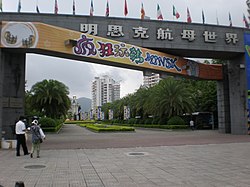
Minsk World (Chinese: 明思克航母世界; pinyin: Míngsīkè Hángmǔ Shìjiè) was a military theme park located in Dapeng Bay, Shatoujiao, Shenzhen, Guangdong, China. It included the former Soviet (later Russian) aircraft carrier Minsk, redesigned as a tourist attraction. The theme park opened on 10 May 2000. As of 2005, it had attracted more than five million visitors and generated 450 million yuan in revenue.[1] The park closed in February 2016 and the aircraft carrier was moved to Zhoushan for repairs, after which it would be moved to another theme park in Nantong, Jiangsu.[2]

History

[edit]

The aircraft carrier Minsk was part of the Soviet Pacific Fleet. It had to be retired as a result of a major accident which could only be repaired at Chernomorski's facility, located in the newly independent Ukraine. In 1995, it was sold to a South Korean businessman, and later resold to Shenzhen Minsk Aircraft Carrier Industry Co. Ltd., a Chinese company. Until 2006, when the company went bankrupt, Minsk was the centrepiece of a military theme park in Shatoujiao (沙头角) district, Shenzhen, called Minsk World. The aircraft carrier was put up for auction on 22 March 2006. No bids at the starting price of 128 million RMB were received, so the carrier was withdrawn from sale.

On 31 May 2006, the ship was auctioned off in Shenzhen for 128 million RMB to CITIC Shenzhen,[citation needed] which operated the carrier as the CITIC Minsk World military theme park. The ship was painted with the hull number 015, matching the Chinese Navy's first aircraft carrier Liaoning (16).[3]

After a decline in visitor numbers, the park closed in 2016 when the local government decided to reclaim land in the area. The aircraft carrier was moved to Zhoushan for repairs, after which it will be moved to another theme park in Nantong, Jiangsu.[2]

On 16 August 2024, the ship caught fire during further refit work in Nantong. Although the fire could be extinguished, the future of the ship as a centerpiece of another theme park became uncertain.[4][5][6]

Facilities

[edit]

In addition to the island, four of the carrier's decks, including the flight deck and hangar deck, were open to visitors. Various aspects of the Minsk, such as its living quarters and armament, were set up as exhibits. The staff were dressed in mock military uniforms, while regular choreographed musical performances were held on the flight and hangar decks.[7] It was also possible to take a quick ride around the starboard side of the Minsk via motorboat.

In 2006, Chinese filmmaker Cheng Xiaoxing made a documentary about "Minsk World", broadcast on Arte TV.

Static display

[edit]

There were a number of military aircraft and armaments on display on the deck and on the mainland area:

[edit]

See also

[edit]

References

[edit]
[edit]
Revisions and contributorsEdit on WikipediaRead on Wikipedia
from Grokipedia
Minsk World was a military-themed in , Province, , built around the decommissioned Soviet aircraft carrier Minsk as its central attraction. The park opened in 2000 after the carrier, a 41,380-ton Kiev-class vessel commissioned in 1978 for the Soviet Pacific Fleet, was acquired by Chinese investors in 1998 following its retirement and brief stint as scrap-bound property. The attraction showcased the carrier's decks and hangars, which housed exhibits of Soviet-era military hardware, including MiG fighter jets, helicopters, anti-ship missiles, torpedoes, and artillery, alongside mini-museums detailing Red history through films and artifacts. Visitors could explore replica military bases, an armory, a navy port simulation, and a 3D demonstration area, with daily performances featuring Russian-style dancing to enhance the immersive experience. Marketed with the slogan "Go to Shenzhen, see the aircraft carrier!", it drew tourists interested in naval history and provided interactive educational content on aviation and maritime warfare. Ownership changed in 2006 when the original operators went bankrupt, leading to its acquisition by the state-owned , which continued operations until the park's closure in 2016. The carrier was then relocated approximately 50 miles northwest of to a man-made in , Province, with plans to convert it into a new and national defense education base by 2022—a timeline that was not met. By 2021, the site had deteriorated into an abandoned state, and in August 2024, a major fire severely damaged the vessel during stalled renovation efforts, raising uncertainties about its future preservation or repurposing. As of 2025, the carrier remains severely damaged and the project has not reopened to the public. Despite its closure, Minsk World remains a notable example of repurposed military assets in global .

Overview

Location and site history

Minsk World is located in the Kastrychnitski District of , , adjacent to the Aerodromnaya along Mira Avenue, and spans over 340 hectares of land. The development site occupies the former grounds of Minsk-1 Airport, which served as the city's primary aviation facility from its opening on November 7, 1933, until its closure on December 23, 2015, operating for more than 80 years. During , the airport was utilized by the , and post-war, it handled commercial and general aviation until the opening of shifted major operations eastward. By the early , the site's outdated runways, hangars, and infrastructure—plagued by urban encroachment and safety concerns over low-altitude flights—rendered it obsolete, prompting its decommissioning and subsequent demolition starting around 2016 to facilitate urban regeneration. Positioned about 3 kilometers south of Minsk's city center, the project integrates seamlessly into the urban fabric through direct access to the Minsk Metro's third line via the Aerodromnaya station, which opened in late 2024, and complementary road infrastructure upgrades currently underway to enhance vehicular access and reduce congestion.

Project scope and significance

Minsk World is a multifunctional urban complex that integrates residential, cultural, , sports, , and financial components into a cohesive development. Spanning a total built area of approximately 3 million square meters upon completion, the project encompasses over 340 hectares of land and features 24 distinct quarters named after notable historical figures, countries, and achievements. The primary objectives of Minsk World are to establish a self-contained urban district that fosters integrated living, working, and leisure environments, thereby transforming traditional commuter-focused residential areas into vibrant, multifunctional communities. This approach aims to accommodate up to 35,000 residents and create around 25,000 jobs through the provision of 14,000 new homes, over 305,000 square meters of office space, and 150,000 square meters of retail facilities. Additionally, the project seeks to attract international investment, with an estimated total investment of $5 billion, supporting broader economic diversification in . As Belarus's largest investment , Minsk World holds significant economic and strategic importance, positioning Minsk as a key bridge between , , and by enhancing regional connectivity and trade opportunities. The complex's international financial center, modeled after global hubs such as Dubai's International Financial Centre, , and , is designed to draw foreign capital and foster high-tech growth. Furthermore, the promotes economic resilience through substitution, leveraging local Belarusian manufacturers for materials and thereby boosting domestic industry and GDP contributions.

History

Planning and initiation

The history of Minsk World traces back to the decommissioning of the in 1993, following its service in the Soviet Pacific Fleet from 1978 to 1991. After being sold for scrap to in 1995, the carrier was rescued from dismantlement in 1998 by a group of Chinese investors, primarily arcade game operators, who formed the Shenzhen Minsk Investment Company. They purchased the vessel for approximately US$16 million and planned to repurpose it as the centerpiece of a military-themed in Shenzhen, Guangdong Province, to capitalize on interest in Cold War-era Soviet military hardware. The initiative aimed to create an immersive showcasing the carrier's decks, hangars, and Soviet naval artifacts, supplemented by additional exhibits and simulations. Planning involved towing the 41,380-ton Kiev-class carrier over 15,000 kilometers from to Shenzhen's Dapeng Bay, a journey that took several months and required significant engineering to navigate coastal waters. approvals were secured in the late , with the project receiving support as a novel venture to boost Shenzhen's offerings. Conversion work began upon arrival in 1999, focusing on stabilizing the hull in a dry dock-like setup and adapting interiors for public access.

Construction milestones

Construction and conversion of Minsk World progressed rapidly after the carrier's arrival in in 1999. Initial efforts transformed the ship's hangars and decks into exhibit spaces housing MiG jets, helicopters, missiles, and , while building surrounding including bases, an armory, and performance areas. The park officially opened on May 10, 2000, attracting visitors with interactive displays, films on Red history, and daily shows. Early expansions added a 3D theater and navy port simulation by 2002, enhancing the 20-hectare site. By 2005, financial difficulties emerged, with operators accumulating debts of around 800 million yuan due to high maintenance costs and underinvestment. The park declared in early 2006, leading to an auction where state-owned acquired it, stabilizing operations and investing in upgrades until . During this period, attendance peaked, drawing over a million visitors annually in the mid-2000s. The park closed on , , as part of a lease expiration and urban plans in . Post-closure, the carrier was relocated in 2017 to a man-made in , Province, approximately 50 miles northwest of , for a planned revival as a tourism and national defense education base. Initial targets for reopening by 2022 were missed due to delays, and by 2021, the site had deteriorated significantly. A major fire on August 14, 2024, damaged the vessel during stalled renovation efforts, but as of November 2025, restoration plans continue with intentions to reopen to tourists.

Facilities

Residential developments

The residential developments in Minsk World comprise 24 themed quarters inspired by global cities and regions, including Happy Planet, Champions, Emirates, , , Asia, and , forming the core living spaces of this multifunctional complex. These quarters offer diverse housing options ranging from studios and one- to six-room apartments to premium penthouses, with free layouts allowing customization to suit individual needs. Apartments are designed with modern amenities, featuring ceiling heights of 2.7 meters in standard units and up to 3 meters on ground and top floors, panoramic or floor-to-ceiling windows for abundant , and energy-efficient glazing. Each quarter includes designer lobbies and high-speed Otis elevators for quiet operation, while many units provide views of the adjacent . Select premium apartments incorporate smart home systems for enhanced convenience and . Pricing spans from affordable entry-level options starting around $47,000 for studios (as of late 2024) to luxury penthouses exceeding $300,000, catering to a broad economic spectrum through installment plans and financing. These developments target families, young professionals, and international residents seeking integrated community living, with on-site schools, playgrounds, and recreational areas fostering a environment. The emphasis on proximity to educational and leisure facilities supports long-term residency and social cohesion within the complex.

Commercial and business centers

The Minsk World International Financial Center serves as the core of the project's commercial infrastructure, designed to host a diverse array of professional operations within a modern urban framework. This multi-tower complex, comprising five high-rise buildings, draws inspiration from global financial hubs such as those in , , and , aiming to position Minsk as a regional node. At its heart, the center is projected to accommodate over 1,000 companies, providing Class A spaces tailored for , , and emerging sectors. Commercial premises in the stylobate levels— the elevated base structures of the residential towers—offer accessible locations for startups and small businesses, fostering an where innovative ventures can establish operations alongside established firms. These ground-level areas integrate seamlessly with the surrounding environment, enhancing foot traffic and collaboration opportunities. Supporting these professional spaces are essential amenities, including multi-level facilities with capacity for 2,500 vehicles, both surface and underground, to accommodate daily commuters and visitors. Business support services, such as conference halls and flexible workspaces, are incorporated to facilitate meetings, networking, and , making the center a comprehensive hub for corporate activities. Economically, the International Financial Center is intended to draw foreign investment by creating specialized zones for and , leveraging Belarus's strategic location to stimulate cross-border commerce. Its integration with adjacent residential developments promotes a live-work-play model, reducing commute times and enhancing overall urban livability, while proximity to retail areas like Avia Mall provides convenient access to shopping and leisure for professionals.

Entertainment and retail spaces

Avia Mall, which opened in May 2025, serves as the primary entertainment and retail hub within Minsk World and is recognized as the largest shopping and entertainment center in Belarus. Spanning over 138,000 square meters, it houses more than 500 shops and boutiques offering diverse retail experiences, from fashion and electronics to local goods. The facility includes an expansive public catering zone of 9,000 square meters, featuring a major food court alongside numerous restaurants and cafes catering to various cuisines. A state-of-the-art multi-screen cinema anchors the entertainment offerings, complemented by a bowling alley, billiards club, and dedicated children's entertainment center. The mall's design incorporates aviation-themed interiors, reflecting the site's as the former location of Minsk's first , where runways have been repurposed for the development. Additional attractions include themed cafes that enhance the dining experience with unique motifs, summer entertainment zones integrated into the levels for outdoor leisure during warmer months, and cultural sculptures dispersed throughout the retail areas to add artistic flair. Tailored for families and tourists, Avia Mall emphasizes visitor appeal through family-friendly amenities and hosts regular events alongside seasonal activities, such as holiday festivals and promotional gatherings, to foster and draw crowds to the complex.

Sports and recreational amenities

Minsk World incorporates a variety of dedicated sports facilities designed to encourage among residents and visitors. These include outdoor courts for , , , and mini-football, strategically placed within the complex's to facilitate team sports and individual practice. areas and workout zones provide opportunities for dynamic fitness training, while extensive paths and routes connect the various quarters, promoting cardiovascular exercise and sustainable mobility. Fitness centers and wellness amenities are integrated into the residential and commercial spaces, with provisions for activities such as and general to support holistic health. Two modern schools within the complex—Public School No. 226 (opened 2023) and School No. 227 (opened 2025)—feature dedicated 25-meter pools, enabling aquatic sports and programs for students. These facilities emphasize , located within a short walking distance from residential buildings and connected to the Aerodromnaya , ensuring ease of use for all community members. Recreational options extend to family-oriented spaces, including colorful and eco-friendly playgrounds for children, alongside multi-use sports grounds that accommodate casual games and group activities. Wellness programs focused on healthy lifestyles are promoted through these amenities, fostering and long-term well-being. The sports infrastructure integrates seamlessly with the adjacent , supporting organized events such as marathons and team competitions to enhance social cohesion. Adjacent retail areas offer convenient post-activity dining options for participants.

Parks and green areas

The in Minsk World spans approximately 40 hectares and serves as the green heart of the complex, featuring a network of alleys, fountains, an Alpine garden, and extensive green zones designed to foster relaxation and community interaction. The includes dedicated bike paths and shaded walkways that encourage active yet leisurely exploration, integrating seamlessly with the surrounding urban to promote physical well-being among residents and visitors. Key design elements enhance its appeal, such as sculptures lining the central alley, seasonal summer cafes for casual gatherings, and family-oriented playgrounds equipped with colorful, safe, and eco-friendly features. Sustainable practices are emphasized throughout, incorporating native plants and various water features like fountains to support , reduce urban heat, and maintain ecological balance in this expansive development. In its role within the complex, the central park functions as a vital between residential and commercial areas, mitigating noise and visual disruptions while advancing eco-friendly urban living principles that prioritize access to nature for improved . This integration not only enhances the aesthetic appeal but also contributes to the overall livability by providing serene green spaces that offer panoramic views to nearby residential developments.

Architecture and design

Key architects and influences

Minsk World in was designed as a military-themed centered on the decommissioned , with the ship's original structure serving as the primary architectural feature. The project was initiated by Chinese investors who acquired the carrier in 1998, and to convert it into a was completed by 2000. Specific architects are not widely documented, but the design emphasized preserving the carrier's industrial, utilitarian Soviet-era aesthetics, including its angled and hangar bays, to evoke naval history. Influences drew from the carrier's heritage, incorporating immersive elements like replica bases and interactive exhibits to blend historical authenticity with entertainment. The overall layout divided the site into the "Minsk Carrier" (on water) and "Minsk Square" (on land), creating a cohesive naval simulation environment.

Innovative features and sustainability

The park's innovative repurposed the 273-meter-long, 41,380-ton Kiev-class carrier, with its top deck spanning the length of three football fields and a total walkable area of 17 kilometers, allowing visitors to explore internal corridors, cabins, and decks converted into themed spaces. Hangars and storehouses were transformed into exhibit areas housing Soviet-era , , and artifacts, while dining areas became restaurants simulating officer and soldier messes. A carrier mansion, covering nearly 20,000 square meters, provided multifunctional spaces for , , and rest, uniquely designed to complement the ship's maritime theme. On land, the design included replica installations, such as a simulation and armory, using sound, light, and electrical effects for dynamic demonstrations, including a 3D theater and performance stages for Russian-style dances. These features enhanced visitor immersion without altering the carrier's core structure. was not a primary focus, given the era of development, but the reuse of the decommissioned vessel prevented scrapping and promoted educational on naval . The park integrated the carrier into Dapeng Bay's coastal setting, though accessibility relied on buses rather than modern green transport. As of its 2016 closure, the design had successfully attracted over 3 million visitors annually at its peak, showcasing of assets.

Current status and future

Recent developments and challenges

Minsk World has been closed since February 2016, when the original operators faced financial difficulties, leading to the park's shutdown in . The Minsk was subsequently relocated to a in for repairs and then towed to a man-made in , Province, approximately 50 miles northwest of , in May 2016. Plans to reopen it as part of a new military-themed and national defense base were announced, with an initial target opening by 2018, but these were repeatedly delayed. By 2021, the site had fallen into a state of abandonment and deterioration, with the carrier exposed to the elements and attracting urban explorers rather than tourists. efforts resumed sporadically, but progress stalled. On August 16, 2024, a major broke out during ongoing work on the carrier in , causing extensive damage to the deck and superstructure, with thick smoke and flames visible for hours. The blaze, which produced explosions, was brought under control without reported injuries, but it severely impacted the already weathered vessel. As of November 2025, post- assessments have confirmed significant structural damage, though no official reports of total loss have been issued. These challenges, including financial issues, logistical delays in relocation and repairs, and the 2024 fire, have hindered revival efforts. The uncertain future of the site raises concerns about preservation of this artifact amid environmental degradation and stalled tourism development.

Completion plans and economic impact

As of November 2025, there are no firm timelines for reopening the Minsk World attraction in , despite earlier ambitions to create a 300,000-square-meter resort complex integrating the carrier with exhibits, simulations, and educational facilities by 2022—a goal that was not met. Developers have expressed intentions to resume renovations and open the site to tourists following the 2024 fire, but no concrete progress or new target dates have been announced. The project's economic viability remains in question, given the history of operational failures and the carrier's diminished condition. Originally, the revival was envisioned to boost local in , drawing visitors interested in naval history and providing educational value on Soviet . However, the prolonged abandonment and recent have limited any potential economic impact, with the site contributing little to regional GDP or job creation beyond sporadic work. Preservation efforts may now focus on stabilizing the carrier to prevent further decay, potentially transitioning it into a static museum rather than an interactive park, though funding and feasibility are uncertain. The overall saga underscores the challenges of repurposing large military relics for commercial in post-Cold War contexts.

References

Add your contribution
Related Hubs
User Avatar
No comments yet.