Hubbry Logo
The Glasshouse, GatesheadThe Glasshouse, GatesheadMain
Open search
The Glasshouse, Gateshead
Community hub
The Glasshouse, Gateshead
logo
8 pages, 0 posts
0 subscribers
Be the first to start a discussion here.
The Glasshouse, Gateshead
from Wikipedia
Not found
Revisions and contributorsEdit on WikipediaRead on Wikipedia
from Grokipedia
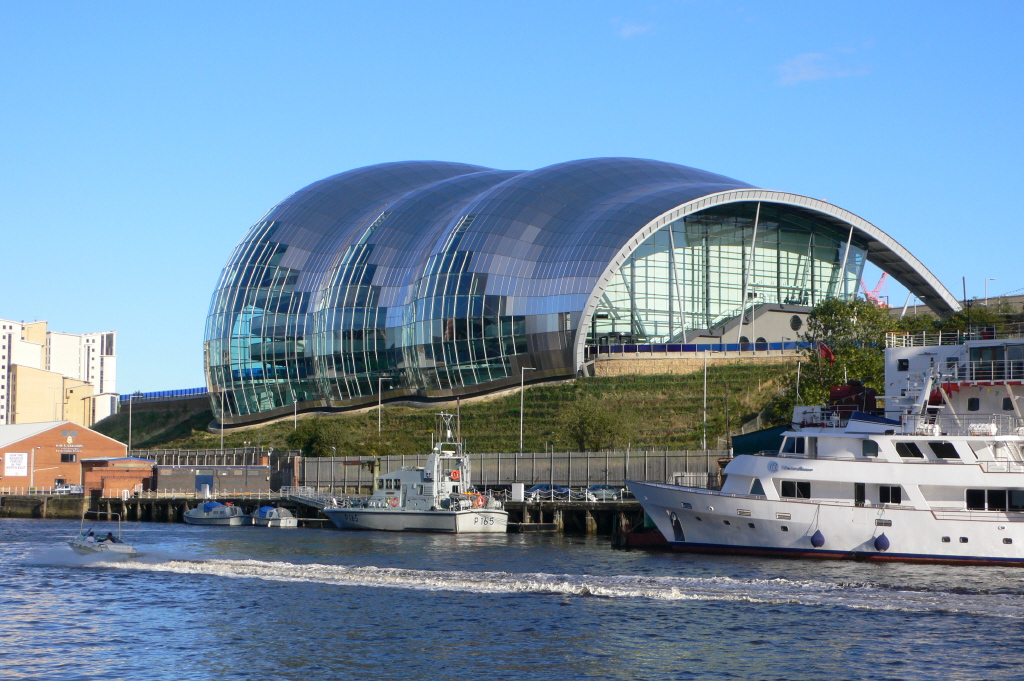
The Glasshouse International Centre for Music is an independent charity operating a concert venue and facility on Gateshead Quays, south of the River Tyne in , , . Opened in December 2004 as Sage Gateshead, the building was designed by Foster + Partners with acoustics engineered by Arup to create flexible spaces for diverse musical performances. Its distinctive form features interlocking helical glass shards forming an undulating exterior that symbolizes fluidity and innovation in music. Renamed The Glasshouse International Centre for Music in September 2023, the rebranding coincided with plans for a new Sage Arena adjacent to the site, aiming to highlight the venue's and focus on musical discovery. The facility includes three main auditoria—Sage One seating up to 1,650 for orchestral concerts, the variable-capacity Sage Two for 400 to 850, and Foundation Hall for 350—alongside education rooms and public spaces supporting learning and community programs. Operated by the North Music Trust, it hosts international artists across genres, nurtures resident ensembles like the Royal Northern Sinfonia, and emphasizes for broad audiences. Over its first two decades, The Glasshouse has drawn millions of visitors, generated £681 million in economic impact for the region, and established itself as a of cultural regeneration on the Tyne, with elements including natural ventilation and energy-efficient glazing. Its role extends to artistic partnerships with figures like and John Wilson, fostering new music creation and initiatives that engage over 1.8 million young people.

History

Origins and Development

The origins of The Glasshouse, Gateshead, stem from a 1996 initiative by Council to transform a derelict industrial site along the River Tyne into a world-class , as part of the Gateshead Quays regeneration scheme aimed at cultural revitalization and economic development. This project sought to establish a hub for creation, performance, and , collaborating with entities such as Northern Arts (predecessor to North East), Folkworks, and the Northern Sinfonia orchestra to build regional support and expertise. The effort built on prior successes like the sculpture and the , demonstrating the council's commitment to iconic cultural infrastructure. Development progressed over eight years, securing £47 million from the National Lottery—the largest such arts grant outside at the time—along with additional public and private funding to reach a total cost of £70 million. The North Music Trust was formed as the operating charity to manage the facility and host the Royal Northern Sinfonia as its resident orchestra. Founding principles emphasized inclusivity and diversity, inspired by venues like Vienna's , with a focus on programming across genres from hip-hop to classical, alongside education and community engagement to promote and participation. In 1997, Foster + Partners won an international architectural competition with a design featuring a curved glass-and-steel exterior that harmonized with the quayside landscape, prioritizing acoustic excellence and public accessibility. Construction began in 2001, culminating in the venue's opening on 17 December 2004 as Sage Gateshead, named in honor of principal sponsor the software company. The facility was envisioned as a "living room" for the community, operating extended hours to encourage broad usage beyond performances.

Construction and Opening

The construction of the venue, initially named Sage Gateshead, formed part of a broader initiative to regenerate 's quayside, transforming former industrial wasteland into a cultural hub alongside the nearby . Site work commenced in 2001 under the design leadership of Foster + Partners, with engineering contributions from firms specializing in acoustic and structural innovation. The project, spanning three years of intensive building, culminated in a structure covering approximately 20,000 square meters, featuring a distinctive undulating and exterior. Funding for the £70 million development was primarily sourced from National Lottery grants, totaling around £50 million, supplemented by contributions from , the Department for Culture, Media and Sport, and a naming rights sponsorship from local software firm . This public-private financing model underscored the venue's role in regional economic revitalization, with construction managed by main contractor to ensure integration of advanced acoustic halls within the iconic "blobitecture" shell. Sage Gateshead opened to the public on December 17, 2004, with inaugural performances marking its debut as an international music centre operated by the North Music Trust and serving as home to the . The opening events included a series of concerts and community engagements, drawing immediate acclaim for the facility's superior sound quality and architectural presence on the River Tyne waterfront. Formal inauguration by Queen Elizabeth II followed in 2005, affirming its status as a flagship project in the North East's cultural landscape.

Operational Milestones and Rebranding

The Glasshouse initiated full operations on 17 December 2004, marking the start of its role as an international centre for music under the management of the North Music Trust. The venue quickly positioned itself as a hub for diverse performances, accommodating over 400 events annually across its halls and supporting resident ensembles like the Royal Northern Sinfonia, which relocated there as its primary base. Early operations focused on blending world-class acoustics with broad programming, from orchestral concerts to contemporary music, fostering regional cultural regeneration on the Gateshead Quays. By its 20th year, operational metrics underscored sustained growth: the venue had attracted more than 8 million visitors since inception, generating £681.2 million in economic contributions to the , including £36 million annually through direct spending, jobs, and supply chains. These figures reflect consistent audience engagement, with programming expansions into , , and digital initiatives amplifying reach beyond physical attendance. Key operational adaptations included resilience during the , with temporary closures followed by hybrid events to maintain programming continuity. On 13 September 2023, the venue rebranded from Sage Gateshead to The Glasshouse International Centre for Music, a decision driven by the announcement of an adjacent 54,500 square metre arena and conference centre named The Sage, set to open in phases from 2025. The original Sage Gateshead name stemmed from sponsorship by the Sage Group software company, but the proximity of the new development risked consumer confusion, prompting North Music Trust to pursue independence in branding. Community focus groups initiated in June 2022 informed the selection of "The Glasshouse," symbolizing the building's translucent, nurturing environment for music akin to a greenhouse for plants. The rebranding entailed minimal disruption to operations, primarily involving updates, migrations, and e-ticket reissuances by 15 September 2023, while preserving printed tickets and core programming. It aligned with strategic goals for the venue's third decade, emphasizing artistic partnerships—such as with and the Sinfonia of London—and enhanced focus on North East England's musical ecosystem, without altering governance or facilities. This milestone coincided with preparations for 20th anniversary celebrations in 2024–2025, reinforcing operational commitments to accessibility and innovation.

Architecture and Design

Structural Features

The Glasshouse, Gateshead, exhibits a blob-like architectural form characterized by its undulating, organic silhouette, achieved through a grid shell structure clad in and . Designed by Foster + Partners under Norman Foster, the building reaches a height of over 40 meters at its peak, with the exterior envelope comprising a continuous facade that wraps around three distinct performance halls. The roof stands as the building's defining structural element, functioning as an independent shell supported by four primary steel arches spanning 80 meters north to south. Engineered by Buro Happold and fabricated by Waagner Biro, this roof weighs 750 tonnes and is covered by approximately 3,000 stainless steel panels alongside 250 trapezoidal glass panels, creating a reflective, wave-like surface that enhances the building's visual integration with the River Tyne quayside. Internally, the performance halls are constructed primarily from , incorporating spaceframe roofs topped with 300 mm thick slabs for durability and acoustic performance. A specialized mix with elevated was employed throughout to optimize sound absorption and control, distinguishing the from conventional builds. The overall prioritizes flexibility, with the glass enclosure allowing natural light penetration while the and framework ensures seismic and environmental resilience in its riverside location.

Acoustic and Technical Specifications

The primary performance spaces at The Glasshouse feature acoustics engineered by Arup Acoustics to support a range of musical genres, with particular emphasis on symphonic performances. Sage One, the main concert hall, accommodates 1,640 seated audience members across stalls and balconies, with capacity for up to 400 performers on stage divided into three tiers. Its interior employs American ash timber cladding on walls, panels, and battens, selected for density and steam-bending properties to enable convex curvatures that diffuse mid- and high-frequency sounds, complemented by (MLS) diffusers of varying depths for multi-directional sound scattering. Adjustable timber ceiling panels allow reconfiguration for diverse events, including conferences, enhancing versatility while maintaining low non-diffuse sound characteristics optimized for orchestral clarity. Sage Two, a flexible ten-sided auditorium spanning three levels, seats up to 430 in theatre configuration or 330 standard, expandable to 600 for standing events. Its design supports intimate recitals and amplified performances, contributing to the venue's overall acoustic isolation via standalone concrete structures for each hall. The Northern Rock Foundation Hall, a smaller wood-lined space, hosts 200-300 seated for chamber music, leveraging natural acoustics suitable for unamplified ensembles. Technical systems include state-of-the-art amplification, with Sage One upgraded in 2023 to RCF components for improved coverage amid flexible seating: dual hangs of twelve HDL 30-A line arrays for main and areas, ground stacks of three HDL 30-A plus one SUB 9004-AS per side for front rows, four HDL 26-A for frontfill, TT 10-A units for outfill, and ten SUB 9006-AS subwoofers integrated via RDNet control and BSS Soundweb for EQ and delay management. These enhancements address low ambient noise requirements while preserving inherent room acoustics for both natural and reinforced sound. All halls incorporate framing with dense block infill for structural and acoustic integrity, ensuring minimal external interference.

Facilities and Operations

Performance Spaces

The Glasshouse features three primary performance spaces designed for diverse musical presentations, with emphasis on superior acoustics and flexibility. Sage One serves as the flagship concert hall, accommodating up to 1,640 seated patrons across three tiers in a configuration inspired by classical venues like Vienna's . This hall, home to the Royal Northern Sinfonia, employs advanced acoustic engineering, including vine-shaped reflectors and timber paneling, to optimize sound distribution for orchestral and large-scale performances. Sage Two, the venue's versatile secondary auditorium, offers seating for up to 330 in a unique ten-sided layout, expandable to 600 for standing events. This space supports both acoustic and amplified contemporary acts, with modular staging and technical capabilities for varied productions. The Foundation Hall provides an intimate setting for up to 200 attendees, featuring 10-meter-high ceilings, wood-paneled walls, and expansive windows overlooking the River Tyne. Primarily utilized for rehearsals, workshops, and smaller recitals, it maintains high-fidelity acoustics suitable for ensemble practice and community engagements. These spaces collectively enable the venue to host over 400 events annually, ranging from concerts to sessions.

Additional Amenities and Accessibility

The Glasshouse features a café offering refreshments on a 'pay as you feel' basis, alongside and coffee services, with full stocking of baby changing facilities and free sanitary products in toilets. A provides dining options, open for select performances, while four internal bars serve visitors across levels. Accessibility encompasses level access to the , performance spaces, , , and bars, with a standard public lift at the rear of reception serving multiple floors. Disabled parking is available with level access to the main entrance, though the primary car park has limitations for users. The venue maintains 35 accessible toilets across levels, featuring pictorial, tactile, and signage, plus facilities with hoists, adult changing, and showering areas. An Access Scheme provides complimentary tickets for personal assistants accompanying d/Deaf or disabled ticket holders unable to attend independently, requiring prior registration via box office or online form. is permitted throughout, and exceptions to the bag policy apply for medical or access needs upon advance notification. Public transport options include nearby metro and bus services, with step-free access from stations.

Programming and Events

Musical Performances

The Glasshouse International Centre for Music hosts a broad spectrum of musical performances, encompassing classical orchestral works, , folk, , and contemporary popular genres in its dedicated spaces, Sage One and Sage Two. The resident Royal Northern Sinfonia, based at the venue since its inception, performs over 100 concerts annually, including symphonies by composers such as Mahler, Beethoven, and Berio, often blending classical repertoire with modern arrangements like Beatles-inspired pieces. Since opening on 17 December 2004, the venue has featured opening and milestone events led by the Royal Northern Sinfonia, establishing its role as a hub for orchestral music in Northeast . Notable collaborations include Sting's 2010 Symphonicity tour performance with the orchestra, adapting his rock catalog for symphonic accompaniment. In July 2023, it hosted the ' first regional mini-festival on the River Tyne, presenting diverse acts including singer alongside orchestral programs, marking a historic expansion of the 128-year-old series beyond . The programming extends to film score concerts, such as live-to-projection in October 2025, and jazz seasons featuring ensembles like the Ligeti Quartet with innovative composers. By February 2024, over 10,000 performances had occurred, attracting 4.7 million ticket sales across genres from global stars to emerging artists. Additional highlights include folk-orchestral fusions, such as Spell Songs with during Proms events, and tributes to big band eras with groups like the . The venue's acoustic design in Sage One supports intimate recitals and large-scale symphonies, hosting annual seasons that integrate regional talent with international visitors like and [Level 42](/page/Level 42) in upcoming 2025-2026 programming.

Educational and Community Initiatives

The Glasshouse International Centre for Music maintains extensive educational programs emphasizing music learning for young people, with annual participation exceeding 200,000 individuals across more than 10,000 events and activities. These initiatives, delivered through the dedicated Centre—a 26-room facility for teaching, practice, workshops, and recording—prioritize skill development, confidence-building, and community integration, extending services throughout the North East of England and . Core offerings for children include the Children’s Room, where participants up to age 7 engage in singing and interactive play to introduce foundational musical experiences. The Weekend School targets ages 4-19, providing structured classes, choirs, ensembles, and performance platforms designed to foster friendships, joy, and technical proficiency. Complementary sessions under Make Music: SEND deliver tailored, ability-focused activities for individuals with special educational needs and disabilities, including bespoke external packages. Advanced training occurs via the Centre for Advanced Training (CAT), funded through the Department for Education's Music and Dance Scheme and open to auditioned participants aged 10-18 proficient in classical, folk, contemporary styles, or voice. Weekly Sunday sessions during term time feature 60-minute individual lessons, music theory, ensemble work, composition, artist-led workshops, and enrichment like improvisation, culminating in public performances such as lunchtime concerts and year-end showcases to prepare students for professional or academic pathways. In March 2025, the organization announced The Glasshouse Academy, a £20 million fundraising-backed expansion to double youth enrollment and establish regional "hot spots" in , Carlisle, , and for comprehensive training from early years to career levels across genres including classical, folk, jazz, songwriting, and production. Bolstered by a £2 million commitment from The Foyle Foundation—including £100,000 annual support—the promotes via instrument subsidies and an inclusive youth blending disabled and non-disabled musicians, aiming to overhaul regional . Community engagement encompasses adult choirs, drumming classes, and creativity-focused events that support over 300 artists yearly while tackling socioeconomic barriers, with programs interlinked to performances for sustained inclusion and progression. and adult offerings for ages 18-35, such as specialized choirs and year-round courses, further embed music within local networks.

Conferences and Non-Musical Uses

The Glasshouse International Centre for Music accommodates conferences and corporate events through its versatile spaces, including a 1,640-seat suitable for plenary sessions, a 330-seat intimate stage for smaller presentations, and 1,800 m² of exhibition space for trade shows or networking areas. Breakout rooms support up to 330 delegates, with smaller meeting options for groups of 4 to 12 people, available at rates of £30–£90 per half or full day. The central concourse serves as a flexible venue for dinners, parties, or exhibitions, enhanced by panoramic views of the , on-site , free , and 270 parking bays including 36 accessible spaces. These facilities, certified for under BEAM and AIM standards, feature advanced acoustics, lighting, tech support, and 24-hour security, enabling adaptation for client-specific needs. Non-musical uses extend to award ceremonies, brand launches, and professional gatherings, with the venue hosting over 60 such events annually, often involving full-building takeovers. Examples include international medical conventions and conferences, leveraging the site's and proximity to hotels like the Hilton Newcastle Gateshead, 320 meters away. In September 2024, it hosted the British Society of Medicine's annual , attracting delegates for sessions on interventions from 19th to 21st. These activities have generated £10.6 million in revenue since opening, funding the charity's music and education programs amid its primary focus on performances.

Reception and Legacy

Awards and Accolades

The Glasshouse, , originally opened as Sage Gateshead in 2004, has garnered recognition primarily for its innovative , acoustic , and public . In 2005, it received the RIBA Award for from the Royal Institute of British Architects, acknowledging its high architectural standards and contribution to the regional . That same year, the venue won the RIBA Inclusive Design Award, highlighting its exemplary provisions for users with disabilities, including advanced acoustic isolation and adaptable spaces. The project also secured the Local Authority Building of the Year category in the 2005 British Construction Industry , praising its integration of complex —such as the helium-filled glass cladding—with urban regeneration goals along the River Tyne quayside. In 2006, it earned the Civic Trust for its outstanding enhancement of the realm through curved, reflective forms that echo local industrial heritage while fostering community engagement. Additional honors include a finalist position in the Prime Minister's Better Building that year and the RICS North East for Design in 2013, which commended its enduring role in revitalizing Gateshead's . More recent accolades have focused on operational sustainability and inclusivity, such as a Silver award for Accessible & Inclusive Tourism at the 2023 North East England Tourism Awards. These awards underscore the venue's evolution from architectural icon to a multifaceted cultural hub, though evaluations of long-term impact vary based on metrics like visitor numbers and economic returns rather than design alone.

Economic and Cultural Impact

The Glasshouse International Centre for Music has generated £681.2 million in gross value added (GVA) to the UK economy since its opening in 2004, primarily through direct operations, visitor spending, and supply chain effects. Over the same period, it has attracted more than 8 million visitors, contributing £14.1 million in annual social value via employment, skills development, and health improvements. These figures stem from a 2025 independent economic impact assessment commissioned by the venue, highlighting sustained revenue from ticket sales, hospitality, and ancillary services despite fluctuations in post-pandemic attendance. As a flagship element of Gateshead Quays regeneration, the venue has spurred and in the North East, with events regionally drawing 714,000 visitors, supporting 3,080 jobs, and injecting £364 million into the local economy in recent years. It has facilitated job creation through direct employment (around 200 staff) and indirect opportunities in and , while catalyzing further developments like a proposed £200 million Sage Arena and conference centre, expected to add 2,000 jobs and attract international visitors. Government levelling-up funds totaling £20 million allocated in 2024 underscore its role in area-wide economic uplift, though some analyses note that broader regeneration benefits from cultural icons like the venue remain debated due to baseline comparisons with pre-development trends. Culturally, The Glasshouse has elevated the North East's music ecosystem by hosting over 5,000 performances and filling a regional gap for high-quality acoustic spaces, fostering collaborations with orchestras, ensembles, and emerging artists. Its programming has driven and cohesion, with initiatives reaching thousands annually through free events, youth ensembles, and educational partnerships that promote musical participation across demographics. As a hub for the 2024-launched Newcastle Music City initiative, it aims to expand the sector's footprint, targeting 2,000–4,000 additional music-related jobs and £750 million in by amplifying local talent and . This positions it as a pragmatic catalyst for cultural vitality in a historically industrial area, though its influence is amplified by synergies with nearby venues rather than standalone transformation.

Criticisms and Operational Challenges

The Glasshouse, formerly known as Sage Gateshead, encountered significant operational difficulties during the COVID-19 pandemic, projecting a £10 million financial shortfall due to venue closures and lost revenue from performances, conferencing, and trading activities. In response, the organization initiated a redundancy process in September 2020, initially placing 180 jobs at risk before confirming the elimination of 110 positions following consultation, reducing its workforce from approximately 500 staff, many of whom had been furloughed under government schemes. These cuts were attributed directly to the crisis's impact on box office income and ancillary operations, with the charity relying on public donations—raising £1 million through a fan-led recovery campaign—to mitigate further losses. Post-pandemic recovery has remained challenging, with leadership acknowledging in 2023 that external factors such as , disruptions, and reduced audience spending continued to strain operations, even as the venue pursued to The Glasshouse to refresh its identity and programming. Employee feedback has highlighted internal issues, including reports of poor management, low morale, passive-aggressive communication, and incompetence in handling staff relations, as reflected in aggregated reviews on platforms like (average rating 2.8 out of 5) and (3.3 out of 5). Visitor criticisms have centered on service and pricing, with some attendees noting indifferent or slow staff responses, exorbitant drink prices deterring interval purchases, and cost-cutting measures—such as restricted seating views—perceived as neglecting during events. These operational hurdles underscore broader vulnerabilities in a publicly funded dependent on ticket sales, sponsorships, and , amid fluctuating economic conditions and from regional venues.

References

Add your contribution
Related Hubs
User Avatar
No comments yet.