Hubbry Logo
search
logo
2263275

George Inness

logo
Community Hub0 Subscribers
Read side by side
from Wikipedia

George Inness (May 1, 1825 – August 3, 1894) was an American landscape painter.

Key Information

Now recognized as one of the most influential American artists of the nineteenth century, Inness was influenced by the Hudson River School at the start of his career. He also studied the Old Masters, and artists of the Barbizon school during later trips to Europe. There he was introduced to the theology of Emanuel Swedenborg, which was significant for him; he expressed that spiritualism in the works of his maturity (1879–1894).

Although Inness's style evolved through distinct stages over a prolific career that spanned more than forty years and 1,000 paintings, his works consistently earned acclaim for their powerful, coordinated efforts to elicit depth of mood, atmosphere, and emotion. Neither pure realist nor impressionist, Inness was a transitional figure. He worked to combine both the earthly and the ethereal in order to capture the complete essence of a locale in his works. A master of light, color, and shadow, he became noted for creating highly ordered and complex scenes that often juxtaposed hazy or blurred elements with sharp and refined details to evoke an interweaving of both the physical and the spiritual nature of experience. In Inness's words, he attempted through his art to demonstrate the "reality of the unseen"[1] and to connect the "visible upon the invisible."[2]

Within his lifetime, art critics hailed Inness as one of America's greatest artists.[3] Often called "the father of American landscape painting,"[4][5] Inness is best known for his mature works that not only exemplified the Tonalist movement but also displayed an original and uniquely American style.

Youth

[edit]

George Inness was born in Newburgh, New York.[6] He was the fifth of thirteen children born to John William Inness, a farmer, and his wife, Clarissa Baldwin.

His family moved to Newark, New Jersey when he was about five years of age.[7] In 1839 he studied for several months with an itinerant painter, John Jesse Barker.[6]

In his teens, Inness worked as a map engraver in New York City, first for Sherman & Smith, and then N. Currier.[8] During this time he attracted the attention of French landscape painter Régis François Gignoux, with whom he subsequently studied.[6] Throughout the mid-1840s he also attended classes at the National Academy of Design, and studied the work of Hudson River School artists Thomas Cole and Asher Durand; "If," Inness later recalled thinking, "these two can be combined, I will try."[9] He debuted his work at the National Academy in 1844.[6]

Inness opened his first studio in New York in 1848.[6] In 1849, he married Delia Miller, who died a few months later. The next year he married Elizabeth Abigail Hart, with whom he would have six children.[10]

Early career

[edit]
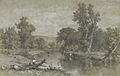
In the Berkshires, 1850
The Lackawanna Valley, c. 1856, National Gallery of Art

In 1851 a patron named Ogden Haggerty sponsored Inness's first trip to Europe to paint and study. Inness spent fifteen months in Rome, where he studied landscapes by French artists Claude Lorrain and Nicolas Poussin.[6] He rented a studio there above that of painter William Page, who likely introduced the artist to Swedenborgianism. He returned to America with his wife on the SS Great Britain in May 1852.[11] In 1853 he was elected to the National Academy of Design as an Associate member and became a full Academician in 1868.

During trips to Paris in the early 1850s, Inness came under the influence of artists working in the Barbizon school of France. Barbizon landscapes were noted for their looser brushwork, darker palette, and emphasis on mood. Inness quickly became the leading American exponent of Barbizon-style painting, which he developed into a highly personal style. In 1854 during one of these trips, his son George Inness, Jr., who also became a landscape painter of note, was born in Paris.

In the mid-1850s, Inness was commissioned by the Delaware, Lackawanna and Western Railroad to create paintings which documented the progress of DLWRR's growth in early Industrial America. The Lackawanna Valley, painted c. 1855, represents the railroad's first roundhouse at Scranton, Pennsylvania.[12] It integrates technology and wilderness within an observed landscape; in time, not only would Inness shun the industrial presence in favor of bucolic or agrarian subjects, but he would produce much of his mature work in the studio, drawing on his visual memory to produce scenes that were often inspired by specific places. But the artist was increasingly concerned with formal considerations.[13]

Mid-career

[edit]
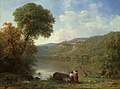
Lake Albano, 1869, Phillips Collection
Inness in his studio, 1890

Inness moved from New York City to Medfield, Massachusetts in 1860, where he converted a barn into a studio. In 1862–63, he was an art teacher to Charles Dormon Robinson, who became known for works of California.[14]

Inness moved to Perth Amboy, New Jersey in 1864.[6] (See George Inness House.) He returned to Europe in the spring of 1870, living in Rome and touring Tivoli, Lake Albano, and Venice.[6] In 1878, he returned to New York City, taking a studio in the New York University Building.[6] The same year, he also participated in the Universal Exposition in Paris. In addition to painting, he published art criticism in the New York Evening Post and Harper's New Monthly Magazine.[6]

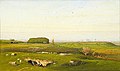
His work of the 1860s and 1870s often tended toward the panoramic and picturesque, topped by cloud-laden and threatening skies. It included views of his native country (Autumn Oaks, 1878, Metropolitan Museum of Art;[15] Catskill Mountains, 1870, Art Institute of Chicago), as well as scenes inspired by numerous travels overseas, especially to Italy and France (The Monk, 1873, Addison Gallery of American Art;[16] Etretat, 1875, Wadsworth Atheneum). In terms of composition, precision of drawing, and the emotive use of color, these paintings placed Inness among the best and most successful landscape painters in America.[17]

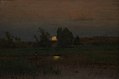
In 1877 Inness built a home and studio at Tarpon Springs, Florida. He ignored the characteristic palm and painted what some considered the drab pine woods. His painting Early Morning – Tarpon Springs depicts this environment.[18]

Eventually Inness's art expressed the influence of the theology of Emanuel Swedenborg. Of particular interest to Inness was the notion that everything in nature had a corresponding relationship with something spiritual and so received an "influx" from God in order to continually exist. Another influence upon Inness's thinking was William James, also an adherent of Swedenborgianism. In particular, Inness was inspired by James's idea of consciousness as a "stream of thought", as well as his ideas concerning how mystical experience shapes one's perspective toward nature.[19]

Inness was the subject of a major retrospective in 1884, organized by the American Art Association, which brought him acclaim in the United States.[6] He earned international fame when he received a gold medal at the 1889 Paris Exposition.[6]

Late career

[edit]
The Storm, oil on canvas, 1885, Reynolda House Museum of American Art
George Inness signature from 1885

After Inness settled in Montclair, New Jersey in 1885,[20] and particularly in the last decade of his life, he expressed this mystical component by a more abstracted handling of shapes, softened edges, and saturated color (October, 1886, Los Angeles County Museum of Art), a profound and dramatic juxtaposition of sky and earth (Early Autumn, Montclair, 1888, Montclair Art Museum),[21] an emphasis on the intimate landscape view (Sunset in the Woods, 1891, Corcoran Gallery of Art), and an increasingly personal, spontaneous, and often violent handling of paint.[22][23] It is this last quality in particular which distinguishes Inness from those painters of like sympathies who are characterized as Luminists.[24]

In a published interview, Inness maintained that "The true use of art is, first, to cultivate the artist's own spiritual nature."[25] His abiding interest in spiritual and emotional considerations did not preclude Inness from undertaking a scientific study of color,[26] nor a mathematical,[27] structural approach to composition: "The poetic quality is not obtained by eschewing any truths of fact or of Nature...Poetry is the vision of reality."[28]

Inness died in 1894 at Bridge of Allan in Scotland.[6] According to his son, he was viewing the sunset, when he threw up his hands into the air and exclaimed, "My God! oh, how beautiful!", fell to the ground, and died minutes later.[29] A public funeral for Inness was held at the National Academy of Design. A memorial exhibition was conducted at the Fine Arts Building in New York City.[6]

He is buried in Montclair, New Jersey's Rosedale Cemetery, as is his namesake son.[30] The Montclair Art Museum is the only museum in the world that has a gallery dedicated to Inness and as of 2023 has a renowned collection of 24 works by Inness.[31]

[edit]

Works

[edit]

References

[edit]
[edit]
Revisions and contributorsEdit on WikipediaRead on Wikipedia
from Grokipedia
George Inness (1825–1894) was an influential American landscape painter of the nineteenth century, celebrated for his atmospheric and poetic interpretations of nature that evolved from the detailed realism of the Hudson River School toward a more subjective, tonalist style emphasizing spiritual and emotional resonance.[1] Born on May 1, 1825, in Newburgh, New York, Inness grew up in a family that soon relocated to Newark, New Jersey, where he developed an early affinity for the natural world amid rural surroundings.[2] Largely self-taught, he received limited formal training, including brief instruction from itinerant artist John Jesse Barker and lessons from landscape painter Régis François Gignoux in 1843, while studying works by European old masters such as Claude Lorrain and American predecessors like Thomas Cole and Asher B. Durand.[1] Inness's career spanned nearly five decades, marked by extensive travel and artistic development; he first exhibited at the National Academy of Design in 1844, opened a studio in New York City by 1848, and made significant trips to Europe in 1851–1852 and 1870, where exposure to the Barbizon school's loose brushwork profoundly shaped his technique.[1] Elected an associate member of the National Academy in 1853 and a full academician in 1868, he produced over 1,150 works, including oils, watercolors, and sketches, often depicting evocative scenes of the American countryside, such as pastoral fields, woodlands, and sunsets, rather than grand wilderness vistas.[1] His style underwent notable evolution: early paintings adhered to Hudson River School conventions with precise, luminous details, but by the 1860s, influenced by Barbizon artists and his deepening engagement with the mystical theology of Emanuel Swedenborg, Inness adopted a "synthetic" approach using thin glazes and diffused light to capture the "reality of the unseen"—the spiritual essence beneath physical forms.[1][3] Key works exemplify this progression, such as Delaware Water Gap (1861), which retains topographic clarity while hinting at emotional depth, and later masterpieces like Peace and Plenty (1865) and Sunrise (1887), where hazy atmospheres and rich, harmonious colors evoke contemplation and unity with the divine.[1] Inness resided primarily in New York and New Jersey, settling on a farm in Montclair in 1885, and briefly taught at Eagleswood Military Academy in 1863; his output also included explorations of international subjects from his European sojourns and American sites like Niagara Falls and the Catskills.[4][1] Deeply philosophical, he viewed painting as a means to awaken the soul's perception of nature's poetry, integrating scientific ideas from optics and perception with Swedenborgian pantheism to transcend mere representation.[3] Inness died suddenly on August 3, 1894, of a stroke while viewing a sunset in Bridge of Allan, Scotland, during a trip abroad, leaving a legacy as one of America's foremost artist-philosophers who bridged romanticism and modernism in landscape art.[1][2]

Early Life and Education

Childhood and Family Background

George Inness was born on May 1, 1825, in Newburgh, New York, as the fifth of thirteen children to John William Inness, a Scottish immigrant who worked as a farmer and grocer, and Clarissa Baldwin.[5] The family background reflected a well-to-do household in early 19th-century rural America, with Inness's father having immigrated from Scotland and prospered as a merchant before retiring to farming. Inness's delicate health from a young age, including bouts of epilepsy, further shaped his early experiences, fostering a sensitive and introspective nature within a large household.[6] The Inness family's frequent relocations, driven by the father's farming and business ventures, instilled a sense of transience in young George. Shortly after his birth, they moved from Newburgh to nearby areas in New York before settling in Newark, New Jersey, around 1829 when he was about four years old.[6] These shifts exposed him to varied rural landscapes, from the Hudson Valley's rolling hills to New Jersey's countryside, which later influenced his artistic sensibility. Inness received only limited formal education, attending a local academy in Newark but struggling academically due to his health and disinterest in traditional studies, leading his father to briefly apprentice him in the family grocery business at age twelve.[6] Largely self-taught from around age eight, he began sketching local scenery and was inspired by glimpsing a landscape painter at work in a field during childhood, sparking his early fascination with art despite scarce resources for formal pursuits. His initial exposure came through family Bible illustrations and engravings of old masters that his father provided, alongside the natural surroundings of his rural upbringing, which encouraged solitary observation and rudimentary drawing without structured guidance.[6]

Initial Training and Formative Influences

Around 1839, George Inness received brief formal instruction from the itinerant artist John Jesse Barker in Newark, New Jersey, marking his initial structured exposure to artistic techniques.[1] By his mid-teens, around 1841, Inness turned to self-study, examining prints and engravings of works by old masters such as Claude Lorrain and Nicolas Poussin, whose classical landscapes inspired his first tentative experiments in oil painting.[1] These reproductions, encountered during his time at engraving firms like Sherman & Smith in New York City, provided models of balanced composition and atmospheric depth, fostering Inness's early fascination with idealized natural scenes over literal representation.[1] In the early 1840s, Inness relocated to New York City and apprenticed at engraving firms including Sherman & Smith and N. Currier, where he honed drawing skills despite his fragile health, supported by his family's encouragement to pursue art.[1] In 1843, he studied under the French landscape painter Régis François Gignoux, absorbing the Romantic traditions of emotive, poetic depictions of nature.[1] This mentorship refined his approach to landscape, emphasizing mood and light. These influences collectively shaped his formative vision, blending technical proficiency with an appreciation for philosophical depth in art.[7]

Professional Development

Early Career in New York and Europe

Inness established his first studio in New York City in 1848, marking the beginning of his professional career as a landscape painter influenced by the Hudson River School. He began exhibiting at the National Academy of Design (NAD) as early as 1844, with his work gaining notice in the burgeoning American art scene. By 1848, he had opened a dedicated studio and continued to show pieces there, including landscapes that reflected his early training in engraving and study of Old Masters through prints. In 1853, Inness was elected an associate member of the NAD, a significant recognition that affirmed his rising status among contemporaries like Asher B. Durand and Thomas Cole.[1] Financial pressures shaped much of Inness's early output, as sales were inconsistent and he relied on supplementary work to sustain himself. In 1849, he married Delia Miller, but she died just a few months later; the following year, he wed Elizabeth Abigail Hart, with whom he would raise six children. To make ends meet, Inness took on portrait commissions and continued engraving maps and illustrations, skills honed during his teenage apprenticeship in New York. These practical endeavors allowed him to focus on landscape painting while navigating the competitive New York art market.[6][1] Inness's first extended European sojourn from 1851 to 1852 took him to Italy, where he studied the Old Masters in Rome and Florence, immersing himself in the works of Titian, Claude Lorrain, and others that emphasized luminous atmospheres and structured compositions. Sponsored by patron Ogden Haggerty, this trip expanded his technical repertoire beyond American precedents. Returning briefly to New York, Inness embarked on a second journey in 1853, visiting France, where he encountered the Barbizon school's plein-air approach through artists like Jean-Baptiste-Camille Corot, whose subtle tonal effects and naturalism profoundly impacted his evolving style. He also traveled to Holland and England, absorbing influences from 17th-century Dutch landscapists such as Meindert Hobbema.[1][8] Upon his final return to the United States in 1854, Inness settled in Brooklyn and began producing landscapes that blended Hudson River School grandeur with emerging European subtleties, often depicting American scenes with a sense of atmospheric depth. Works like The Lackawanna Valley (ca. 1855) exemplify this phase, portraying industrialized rural vistas in Pennsylvania with meticulous detail and a nod to national progress, commissioned by the Delaware, Lackawanna & Western Railroad. These paintings established his reputation for capturing the American countryside's poetic essence during the 1850s, even as he grappled with stylistic integration from abroad. By the end of the decade, Inness had transitioned to more rural settings, laying the groundwork for further experimentation.[1][9]

Mid-Career Shifts and Experimentation

In the mid-1850s, following his early associations with the Hudson River School, George Inness undertook a second European sojourn from 1853 to 1854, traveling through France, the Netherlands, and England, where he encountered the works of Dutch landscape masters like Meindert Hobbema and was profoundly influenced by the French Barbizon school artists, including Théodore Rousseau and Jean-Baptiste-Camille Corot. This exposure prompted a significant stylistic shift, as Inness began adopting looser, more expressive brushwork and a focus on atmospheric effects over precise detail, evident in his post-trip landscapes that emphasized emotional depth and natural harmony.[1][6][10] Inness's third extended stay in Europe, from 1870 to 1874, centered primarily in Italy—beginning in Rome and extending to sites like Tivoli and Ariccia—further deepened his immersion in Barbizon principles while incorporating Italian pastoral traditions. Supported by arrangements with American dealers, he produced works such as Olive Grove Near Rome (1870) and Pines and Olives at Albano (1873), which featured softened edges, tonal subtlety, and a sense of luminous haze, marking a maturation in his experimental approach to light and form. This period reinforced his departure from rigid compositions toward more poetic, introspective scenes that blended European influences with American subject matter.[11][12][13] During the 1860s, amid the American Civil War, Inness relocated to Medfield, Massachusetts, near Boston, where he created paintings that subtly reflected national turmoil and themes of resilience, such as the allegorical The Valley of the Shadow of Death (1867), part of his "Triumph of the Cross" series, depicting a shadowed landscape evoking loss and redemption. This work, now in the Frances Lehman Loeb Art Center at Vassar College, exemplifies his growing emphasis on ethereal atmospheres and symbolic depth, as seen also in Delaware Water Gap (1861), a panoramic view infused with misty veils and harmonious tones that captured the interplay of industry and nature in Pennsylvania's iconic valley. In 1868, Inness achieved a milestone of recognition with his election to full membership in the National Academy of Design, affirming his evolving status within the American art establishment.[1][6]

Late Career Maturity and Innovation

Inness's late career, from the 1880s until his death in 1894, marked the pinnacle of his artistic achievement, where he refined his vision into increasingly innovative landscapes that emphasized atmospheric depth and spiritual resonance. After relocating to Montclair, New Jersey, in 1885, he established a home and studio there, drawing inspiration from the surrounding brooks, meadows, and woods to fuel his prolific output.[14][4] This period saw him produce dozens of luminous, abstract paintings, with forms blending into misty veils of color that evoked a transcendent unity between the material and ethereal worlds.[15] Building on mid-career experiments with Barbizon-style naturalism, Inness's Montclair years yielded works of heightened maturity, such as Spring Blossoms, Montclair, New Jersey (ca. 1891), which captures the subtle interplay of light filtering through budding trees in soft, diffused tones.[15] Another exemplar, In the Orchard, Milton (1881), demonstrates his innovative use of saturated hues and sinuous lines to suggest depth and movement in an orchard scene, prefiguring the even more abstracted visions of his final decade.[16] In Montclair, Inness also took on a mentorship role, guiding younger artists in his studio and sharing his philosophical approach to art, though his own health began to falter in the early 1890s. Afflicted by declining physical condition, he created intensified, spiritually charged abstractions in his last years, culminating in works painted just before he died suddenly of a heart attack while on a trip to Scotland in August 1894.[17]

Artistic Style and Philosophy

Landscape Techniques and Aesthetic Evolution

George Inness's early landscape techniques were marked by precise and detailed rendering, heavily influenced by the Hudson River School, where he employed meticulous brushwork to capture natural forms with clarity and depth.[1] Drawing from artists like Thomas Cole and Asher B. Durand, Inness used glazing—a method of applying thin, translucent layers of oil paint—to build luminous effects and spatial recession, creating a sense of atmospheric perspective that enhanced the grandeur of American scenery.[1] This approach emphasized topographical accuracy and narrative detail, aligning with the school's romantic idealization of nature as a divine manifestation.[6] In his mid-career, Inness underwent a significant aesthetic shift toward Barbizon-inspired techniques, adopting looser brushwork and the principles of Tonalism to prioritize mood and tonal harmony over literal representation.[1] Influenced by French artists such as Théodore Rousseau and Jean-François Millet during his European travels, he softened edges and blended colors to evoke subtle emotional resonances, moving away from the Hudson River School's crisp delineations toward a more interpretive, atmospheric style.[6] This evolution reflected Tonalism's focus on unified color palettes and diffused light, where Inness used broad, fluid strokes to suggest rather than define forms, fostering a contemplative intimacy with the landscape.[1] By his late career, Inness's techniques advanced into greater abstraction, characterized by simplified forms, vibrant color harmonies, and pronounced atmospheric effects designed to stir profound emotional responses.[6] He reduced compositional elements to essential shapes, employing bold yet harmonious color contrasts and misty veils of pigment to convey a sense of ethereal unity, often blurring boundaries between earth, sky, and horizon.[1] This maturation represented a culmination of his aesthetic philosophy, where technical innovation served to express spiritual correspondences in nature.[6] Throughout his career, Inness combined plein air sketching for direct observation with extensive studio elaboration, allowing him to infuse personal interpretation into his compositions while rejecting photographic realism in favor of subjective evocation.[1] He viewed the artist's role as suggesting reality through idealized vision rather than mechanical reproduction, stating, "You must suggest to me reality, you can never show me reality."[6] This practice enabled a harmonious balance between empirical study and imaginative synthesis, underscoring his commitment to landscape as a medium for emotional and spiritual insight.[1]

Spiritual Influences and Swedenborgianism

George Inness's engagement with Swedenborgianism began in the early 1850s when he encountered the writings of Emanuel Swedenborg through the painter William Page during a trip to Florence, though his deeper commitment developed in the 1860s.[1] By 1863, while teaching at the Eagleswood Military Academy in New Jersey, Inness immersed himself in Swedenborg's theology, which profoundly shaped his worldview.[10] This culminated in his formal conversion, as he was baptized into the Church of the New Jerusalem, the primary Swedenborgian denomination, in 1868 by Reverend Dr. John Curtis Ager.[1][18] Swedenborg's ideas, particularly those outlined in works like Heaven and Hell, resonated with Inness, portraying the afterlife as realms of spiritual progression and emphasizing the interconnectedness of the physical and divine.[19] Central to Inness's adoption of Swedenborgianism was the doctrine of correspondences, which posited that the natural world serves as a symbolic veil revealing spiritual truths, with elements like colors and forms embodying divine meanings.[1][18] He embraced the notion that landscapes could manifest spiritual realms, viewing nature not as mere scenery but as a medium through which the soul discerns higher realities, such as the progression from earthly existence to divine harmony.[1][20] Inness articulated this in his 1867 article "Colors and Their Correspondences," published in the New Jerusalem Messenger, where he explored how specific hues correspond to spiritual identities, rejecting literal representation in favor of intuitive perception.[18] This philosophy positioned art as a transcendent vision, enabling the artist to convey the soul's journey toward enlightenment rather than documenting the material world.[1] Inness's late works exemplify this spiritual influence, characterized by an ethereal quality that symbolizes the soul's ascent, with diffused light often representing divine presence and unity.[1][10] Paintings such as Sunrise (1887) employ incandescent, atmospheric effects to evoke spiritual realms beyond the visible, integrating subtle symbolism to suggest the interplay of natural and supernatural forces.[1] Earlier pieces like In the Evening (1866) already hint at this shift, using contrasts of light and shadow to pierce the "veil" of the physical world and reveal underlying spiritual essence.[20] These developments aligned with his technical evolution toward impressionistic techniques, which allowed for the suggestive ambiguity essential to Swedenborgian expression.[10] Inness actively participated in Swedenborgian circles, particularly the New Church community in New York, where he published his writings and received spiritual guidance from figures like Ager, who later eulogized him in 1894 for finding in Swedenborg "the basis for his theories of art."[18] He also connected with like-minded individuals in Boston's Swedenborgian networks during his travels, fostering discussions on mystical theology.[1] This involvement reinforced his rejection of materialism, as he prioritized intuition and symbolic depth over empirical detail, declaring that art should "suggest to me reality" rather than "show me reality."[1] Through these beliefs, Inness transformed landscape painting into a vehicle for spiritual insight, aligning his practice with Swedenborg's vision of a harmonious universe.[18]

Major Works and Recognition

Iconic Paintings and Series

George Inness's "The Lackawanna Valley," painted around 1856, presents a panoramic vista of northeastern Pennsylvania's landscape, where a newly constructed railroad roundhouse and locomotive dominate the middle ground amid a foreground of freshly cleared tree stumps and a single surviving large tree on the left.[21] The composition employs atmospheric perspective, with distant mountains fading into a sky transitioning from pink to blue, underscoring the intrusion of industrialization upon the natural environment through visible signs of deforestation and the train's billowing smoke.[22] This early work critiques the environmental cost of progress, as the detailed rendering of industrial elements contrasts with the looser, more romantic depiction of the untouched valley beyond, highlighting a tension between human advancement and ecological loss.[23] In his mid-career painting "The Rainbow in the Berkshire Hills" from 1869, Inness captures a post-storm landscape in Massachusetts, where a vivid rainbow arcs across rolling green hills, golden fields, and a winding road receding into the hazy distance.[24] The dramatic lighting breaks through scattered clouds, illuminating the scene with warm tones that evoke renewal and divine promise, influenced by Barbizon techniques of loose brushwork and subtle color modulation to convey depth and mood.[25] This oil on canvas emphasizes the transient beauty of nature's recovery, with the rainbow serving as a focal motif symbolizing hope amid the remnants of turmoil, such as darkened storm clouds lingering on the horizon.[24] "Delaware Water Gap" (1861) exemplifies Inness's transition, retaining topographic clarity of the Hudson River School while introducing emotional depth through softer edges and luminous details, depicting the gap's river valley with a sense of meditative harmony.[26] During the 1880s, Inness developed a series of ethereal late-afternoon landscapes characterized by soft, diffused light and tonal harmony, reflecting his mature Tonalist approach where forms dissolve into atmospheric veils.[1] These works often feature glowing horizons and muted palettes, capturing the fleeting quality of twilight hours to suggest spiritual introspection and the impermanence of the visible world.[27] A prime example is his abstraction of Niagara Falls from the mid-1880s, where cascading waters merge into misty veils of blue and white, viewed from an elevated vantage that obscures human intrusions and amplifies the sublime power of nature through layered glazes and vaporous effects.[28] Inness produced multiple variations on this subject during the decade, each prioritizing ethereal abstraction over literal topography to evoke awe and the transient force of elemental energy.[29] "Sunrise" (1887) captures a hazy dawn over a pastoral landscape, with diffused light blending sky and earth in harmonious tones that convey unity with the divine and the spiritual essence of nature.[30] Inness frequently returned to thematic series of orchards in his later oeuvre, portraying apple groves in Montclair, New Jersey, as serene enclosures bathed in dappled sunlight filtering through leafy canopies, symbolizing natural abundance and cyclical renewal.[31] Paintings like "Apple Orchard" (1892) integrate farm buildings and undulating terrain into harmonious compositions, where vibrant greens and earth tones blend to convey the transience of seasonal bloom against enduring rural rhythms.[31] These motifs underscore a philosophical balance between growth and decay, with light piercing the foliage to highlight the ephemeral beauty of fruit-laden branches.[1] His Italian scenes, drawn from sojourns in the 1850s and 1870s, form another recurring series, depicting Roman Campagna vistas and hill towns like Ariccia with luminous skies and olive groves that evoke classical serenity and the passage of time. Works such as "Italian Landscape" (c. 1874), depicting the area around Ariccia, employ warm earth hues and subtle gradations to portray expansive plains dotted with ancient ruins, emphasizing motifs of pastoral harmony where human elements recede into the landscape's timeless flux.[32] These paintings capture the transient play of Mediterranean light over verdant fields and distant aqueducts, blending observation with a mystical sense of unity between earth and ether.[33]

Exhibitions, Collections, and Critical Reception

Inness began exhibiting his work at the National Academy of Design (NAD) in 1844 with Evening, a Composition, and continued to show there frequently throughout the 1840s to 1880s, establishing his presence in New York City's art scene.[34] He also participated in the American Art-Union exhibition in 1845, which helped distribute his early landscapes to subscribers across the country.[35] Internationally, Inness gained exposure at the Universal Exposition in Paris in 1867, where his evolving style drew attention from European audiences familiar with Barbizon influences.[36] His participation in the Philadelphia Centennial Exposition of 1876 marked a pivotal moment, with critics praising the poetic and atmospheric quality of works like Peace and Plenty, which evoked a dreamy, emotional response to nature rather than literal depiction.[37] Early reviews often compared Inness to the Hudson River School, noting his departure from their detailed realism toward more suggestive, intimate landscapes that prioritized mood over topography.[5] Inness's works are prominently featured in major institutional collections, including the Metropolitan Museum of Art, which holds 15 paintings spanning 1861 to circa 1892–93, such as Peace and Plenty (1865) and Spring Blossoms, Montclair, New Jersey (ca. 1894).[38] The National Gallery of Art houses key pieces like The Lackawanna Valley (c. 1856), an early commission highlighting industrial themes within a natural setting.[39] The Montclair Art Museum serves as the primary repository, with over 20 paintings, two watercolors, and one etching, including late Montclair views that capture his mature tonal harmonies.[14] During the 20th century, a revival of interest in Tonalism repositioned Inness as a foundational figure, moving beyond earlier dismissals of his work as hazy or unconventional to celebrate its innovative blend of spirituality and subtlety.[7] Posthumous auctions underscored his market value, with paintings like Peace and Plenty contributing to sales records that reflected growing appreciation; for instance, Inness works routinely achieved high prices at venues such as Christie's, often exceeding six figures for mature landscapes.[40]

Personal Life and Legacy

Family, Health, and Personal Beliefs

George Inness married Delia Miller in 1849, but she died a few months later. He remarried Elizabeth Abigail Hart in 1850, with whom he had six children, two of whom were sons.[6][41] The family provided crucial support during periods of financial instability, as Inness struggled with inconsistent patronage and economic pressures throughout much of his career.[6][42] His eldest son, George Inness Jr. (1854–1926), followed in his footsteps as a landscape painter, while the family relocated frequently to accommodate Inness's travels and health needs, settling in places like Medfield, Massachusetts, and Montclair, New Jersey.[6][41] Inness faced chronic health challenges from childhood, including epilepsy that rendered him physically frail and unfit for military service during the Civil War.[43][41] He also suffered from rheumatism, dyspepsia, nervous disorders, and later eye problems that affected his vision and mobility, prompting winter stays in warmer climates like Florida for relief.[44][41] These issues contributed to bouts of depression, including a reported suicide attempt in his youth, and exacerbated his overall frailty, leading to his death at age 69 while traveling in Scotland.[6][41] Beyond his Swedenborgian faith, which emphasized spiritual correspondences in the natural world, Inness held broader convictions shaped by social reform.[6] He supported economist Henry George's single-tax theory on land ownership, viewing it as a means to address agrarian dispossession and promote equitable access to nature as a communal resource.[41] This aligned with his advocacy for a socialistic republic, reflecting a belief in American democracy's potential to foster moral harmony through nature's role in revealing divine truths and human sentiment.[41] Inness saw nature not merely as scenery but as a moral guide, embodying eternal repose, serenity, and ethical lessons for society.[41]

Death and Posthumous Impact

George Inness died suddenly on August 3, 1894, at the age of 69, while on a family trip to Scotland. Suffering from declining health in his late career, he collapsed from a heart attack in Bridge of Allan after exclaiming at the beauty of a sunset he was watching.[6] His remains were returned to the United States, where a funeral service was held at the National Academy of Design on August 23, 1894, before his burial in Rosedale Cemetery, Montclair, New Jersey.[13][17] In the immediate aftermath, Inness's widow, Elizabeth Abigail Hart Inness, and son, George Inness Jr., played key roles in preserving his artistic archive. Julia Goodrich Smith, wife of George Inness Jr., compiled photographs of his works circa 1926-1929.[45] The estate auction, held at the Fifth Avenue Art Galleries from February 12 to 14, 1895, sold over 300 paintings from his studio, dispersing much of his remaining oeuvre to collectors and institutions.[46] Inness's immediate legacy was marked by a memorial exhibition at the American Fine Arts Society in New York from December 27, 1894, to February 1, 1895, featuring 240 of his paintings and underscoring his stature as a leading American landscapist.[47] His atmospheric, spiritually infused landscapes profoundly influenced the Tonalist movement and elements of American Impressionism, with artists adopting his emphasis on mood, subtle tonalities, and ethereal effects over literal representation.[48] Early recognition continued through biographies, notably Elliott Daingerfield's George Inness: The Man and His Art (1911), which drew on personal recollections and family insights to affirm Inness's philosophical depth and technical innovation in landscape painting.[49]

Modern Scholarship and Recent Exhibitions

Modern scholarship on George Inness has deepened understandings of his mystical and philosophical dimensions, building on earlier catalogs while incorporating interdisciplinary approaches. Adrienne Baxter Bell's 2005 publication, George Inness and the Visionary Landscape, provides a focused examination of the artist's spiritual influences, particularly his Swedenborgian beliefs, through analysis of key paintings that evoke transcendent states of nature.[50] This work accompanied a 2003–2004 exhibition and remains a seminal text for exploring Inness's evolution toward ethereal, light-infused landscapes. Complementing this, Nicolai Cikovsky Jr.'s 1985 catalog George Inness, produced for the Metropolitan Museum of Art exhibition, offers a comprehensive overview of the artist's oeuvre with detailed annotations on 63 paintings, establishing a foundational reference that continues to inform subsequent studies.[51] Recent exhibitions have revitalized interest in Inness's visionary approach, particularly through presentations that highlight his mystical interpretations of the American landscape. The Montclair Art Museum's "George Inness: Visionary Landscapes," installed in 2022 and extended through June 2024, features 19 paintings from the museum's renowned collection of 24 Inness works, emphasizing themes of spirituality and perceptual ambiguity in pieces like Early Autumn, Montclair. A Wall Street Journal review praised the show for capturing Inness's enchantment with shifting light and atmospheric effects, underscoring his role as a bridge between Romanticism and modernism.[52][53] In 2025, marking the bicentennial of Inness's birth, the museum opened a reinstallation, "George Inness: Visionary Landscapes–NEW WORKS AND NATIVE VIEWS," on May 18, including three new paintings to the gallery, alongside programming such as "George Inness at 200: Legacy Landscapes, Fresh Visions" on May 31. His works also appear in broader surveys, such as the 2023 Hunter Museum of American Art's "In Nature's Studio: Two Centuries of American Landscape Painting," and the 2025 group exhibition "Dawn & Dusk: Tonalism in Connecticut" at Fairfield University Art Museum (January 17–April 12), which includes one Inness painting among 70 works by 22 artists.[54][55][56] Contemporary research has addressed previous gaps by integrating environmental and social lenses into analyses of Inness's landscapes, revealing connections to ecological awareness and familial dynamics. Post-2020 studies, including examinations of his use of turpentine in painting processes, have highlighted proto-environmentalist themes in his depictions of harmonized nature, linking them to broader 19th-century resource extraction concerns.[57] Additionally, scholarship has begun to explore gender influences within Inness's family context, noting how domestic roles shaped his artistic milieu, though such inquiries remain emerging. These developments extend posthumous critical foundations by applying modern methodologies to Inness's spiritual environmentalism.

References

User Avatar
No comments yet.