


Community hub
Recent from talks
Contribute something to knowledge base
Content stats: 0 posts, 0 articles, 1 media, 0 notes
Members stats: 0 subscribers, 0 contributors, 0 moderators, 0 supporters
Subscribers
Supporters
Contributors
Moderators
Hub AI
Gerald Templer AI simulator
(@Gerald Templer_simulator)
Hub AI
Gerald Templer AI simulator
(@Gerald Templer_simulator)
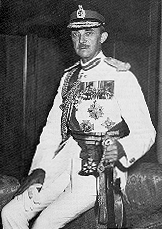
Gerald Templer
Field Marshal Sir Gerald Walter Robert Templer (11 September 1898 – 25 October 1979) was a senior British Army officer. He fought in both the world wars and took part against the Arab Resistance in Palestine. As Chief of the Imperial General Staff, the professional head of the British Army between 1955 and 1958, Templer was Prime Minister Anthony Eden's chief military adviser during the Suez Crisis. He is also credited as a founder of the United Kingdom's National Army Museum.
Templer is best known for implementing strategies that heavily contributed to the defeat of the Malayan National Liberation Army (MNLA) during the Malayan Emergency. Some historians have described his methods as a successful example of a "hearts and minds" campaign, while other scholars have dismissed this as a myth due to his over-reliance on population control and coercion. Templer also oversaw, ordered, and personally approved of many controversial policies and numerous atrocities committed by his troops. These including the use of internment camps called "New Villages", the forced relocation of ethnic minorities, forced conscription, collective punishment against civilians, the hiring of specialist Iban-headhunters to decapitate suspected communists, pioneering the use of Agent Orange (later used in Vietnam), and the use of scorched earth policies deprive the MNLA of resources.
Many of the counter-insurgency strategies he pioneered were later imitated by the United States in Vietnam.
Gerald Walter Robert Templer was born on 11 September 1898 at 15 Wellesley Road, in Colchester, Essex, the son (and only child) of Lieutenant-Colonel Walter Francis Templer, of the Royal Irish Fusiliers, and Mabel Eileen Templer (née Johnston). Of Irish descent, Templer attended an infant school at Rosslyn, Scotland, before being sent to Edinburgh Academy in 1904, later attending a preparatory boarding school at Connaught House, Weymouth, from 1909 until 1911. In January 1912 he was sent to Wellington College, Berkshire and stayed there until shortly after his 17th birthday in September 1915, a year into the First World War. His time at Wellington was, due mainly to initially being severely bullied, not the happiest period of his life, as he later wrote "I loathed and detested my four years at Wellington", although he also admitted to making numerous friends there.
From Wellington he then entered the Royal Military College, Sandhurst in December 1915 and, after attending a shortened course for the war, was commissioned as a second lieutenant into his father's regiment, the Royal Irish Fusiliers, on 16 August 1916, just under a month before his 18th birthday. In contrast to his time at Wellington, Templer greatly enjoyed Sandhurst, and later wrote with amusement that he "was a completely undistinguished cadet from every point of view and passed out – nobody failed at that stage of the First World War because we were so badly needed as cannon fodder – in July 1916, a couple of months before my eighteenth birthday". Due to his age, however, he was unable to serve overseas and was sent to the 3rd (Reserve) Battalion in Buncrana in Inishowen, on the north coast of County Donegal, in Ulster, Ireland.
Templer remained with the battalion until mid-October 1917 when, now aged 19, he was sent to the 7th/8th (Service) Battalion on the Western Front. The battalion was a Kitchener's Army unit serving as part of the 49th Brigade of the 16th (Irish) Division. However, he was posted to 'C' Company of the 1st Battalion in mid-November a Regular Army unit, then serving in the 107th Brigade of the 36th (Ulster) Division. Soon after Templer's arrival, the battalion took part in the Battle of Cambrai in late November, although Templer himself took no part in the battle and the battalion, and his 'C' Company in particular, sustained heavy losses. In early February 1918 Templer's battalion, the 1st Irish Fusiliers, was transferred to the 108th Brigade, due to a severe manpower shortage in the British Expeditionary Force (BEF) on the Western Front, which necessitated the reduction of all British brigades from four to three battalions. He was promoted to lieutenant on 16 February 1918. On 20 March Templer, seriously ill, passed out while in the trenches, suffering from acute diphtheria, and he was later evacuated to England. The German Army launched their Spring Offensive the day after and, while he was away his battalion sustained over 770 casualties out of a strength of some 800 men. He returned to the battalion, now composed of mainly teenagers, and fought with it in the Hundred Days Offensive, which saw the war turn in favour of the Allies and eventually resulted in the Armistice with Germany being signed and the war ending on 11 November 1918. Templer was considerably lucky during the war, having not been wounded, although, as with many others of his generation, it left its mark on him in other ways. He wrote, many years later, "I still sometimes in my sleep at night hear the screams of the wounded horses, galloping on the ground, tripping over barbed wire, and treading on their own guts. It was a terrible thing to have to witness, worse in some ways than the human casualties". A week before his death Templer had this dream again, over sixty years after the war.
He remained in the army during the interwar period and served with his battalion, still the 1st Irish Fusiliers, after briefly returning to England, in operations in Persia (now Iran) and Iraq in 1919–20 as part of a multi-national attempt to prevent the spread of bolshevism, which was followed by service in Egypt. Returning to England with the battalion, where it was amalgamated with the 2nd Battalion in November 1922, Templer was a reserve for the 1924 Summer Olympics as a 120-yard hurdler, although in the end he did not compete. In January 1925 the battalion again returned to Egypt, where it remained until October 1927 when it was sent to India, although Templer did not accompany them. Just before the battalion sailed for India he had returned to England to attend the Staff College, Camberley, which he did from 1928 to 1929, and was the youngest student there, aged just 29. Among his many fellow students were men such as John Harding, Richard McCreery, Gordon MacMillan, Alexander Galloway, Gerard Bucknall, Philip Gregson-Ellis, Alexander Cameron and Cameron Nicholson. In the year senior to him were Eric Dorman-Smith, John Hawkesworth, John Whiteley, Evelyn Barker, Oliver Leese, Ronald Penney, Robert Bridgeman, Philip Christison and numerous others while, in Templer's second year, in the year below, were George Erskine, Harold Freeman-Attwood, Neil Ritchie, Herbert Lumsden, Reginald Denning and Maurice Chilton. Templer's instructors there included Bernard Paget, Henry Pownall and Bernard Montgomery. Due to the Royal Irish Fusiliers being reduced to a single battalion in 1922, and thus promotion in the regiment being slower than in the rest of the army, Templer was forced to transfer to the Loyal Regiment (North Lancashire), to gain a promotion to captain, which was backdated to 11 August 1928. After graduation from the Staff College, Templer joined the 2nd Battalion of his new regiment, then stationed at Aldershot, in January 1930.
He later became a General Staff Officer Grade 3 (GSO3) with the 3rd Division on Salisbury Plain in 1931. While there his immediate superior, Colonel Edmund Osborne, the division's GSO1, who took a disliking to Templer, wrote a confidential report, severely criticizing Templer's performance and recommending he be retired from the army. Surviving this, Templer then was GSO2 at HQ Northern Command in York in 1933 before returning to the 2nd Loyals to be a company commander at Tidworth in April 1935. While at Northern Command he first met Harold Alexander, then a colonel, who was his superior as GSO1, and the two remained great friends until Alexander's death in 1969. In January 1936 Templer, along with a large draft of replacements from the 2nd Loyals, was deployed to Palestine to serve with the 1st Loyals, with Templer commanding 'A' Company, during the Arab revolt there, for which he was awarded the Distinguished Service Order (DSO) on 6 November 1936 and mentioned in dispatches. His experience in Palestine had a profound impact on him, as he said in 1970 in a BBC interview, "I've felt terribly strongly all my life, from my youth, on racial and religious clashes – ever since my boyhood in Ireland. That was a feeling that which was strengthened by my service in Palestine in 1935–6, the Jew-Arab problems: I felt them bitterly in my heart". In July 1937 he left Palestine and returned to England, where he became GSO2 of the 53rd (Welsh) Infantry Division, a Territorial Army (TA) formation, where he came to the attention of senior officers. In April 1938 Templer transferred back as a captain in the Royal Irish Fusiliers, although he remained seconded for staff duties. He was promoted to major on 1 August 1938 and posted to the War Office as a GSO2 at the Directorate of Military Intelligence (DMI) in October. In this role he helped in the creation and training of the Intelligence Corps.
Gerald Templer
Field Marshal Sir Gerald Walter Robert Templer (11 September 1898 – 25 October 1979) was a senior British Army officer. He fought in both the world wars and took part against the Arab Resistance in Palestine. As Chief of the Imperial General Staff, the professional head of the British Army between 1955 and 1958, Templer was Prime Minister Anthony Eden's chief military adviser during the Suez Crisis. He is also credited as a founder of the United Kingdom's National Army Museum.
Templer is best known for implementing strategies that heavily contributed to the defeat of the Malayan National Liberation Army (MNLA) during the Malayan Emergency. Some historians have described his methods as a successful example of a "hearts and minds" campaign, while other scholars have dismissed this as a myth due to his over-reliance on population control and coercion. Templer also oversaw, ordered, and personally approved of many controversial policies and numerous atrocities committed by his troops. These including the use of internment camps called "New Villages", the forced relocation of ethnic minorities, forced conscription, collective punishment against civilians, the hiring of specialist Iban-headhunters to decapitate suspected communists, pioneering the use of Agent Orange (later used in Vietnam), and the use of scorched earth policies deprive the MNLA of resources.
Many of the counter-insurgency strategies he pioneered were later imitated by the United States in Vietnam.
Gerald Walter Robert Templer was born on 11 September 1898 at 15 Wellesley Road, in Colchester, Essex, the son (and only child) of Lieutenant-Colonel Walter Francis Templer, of the Royal Irish Fusiliers, and Mabel Eileen Templer (née Johnston). Of Irish descent, Templer attended an infant school at Rosslyn, Scotland, before being sent to Edinburgh Academy in 1904, later attending a preparatory boarding school at Connaught House, Weymouth, from 1909 until 1911. In January 1912 he was sent to Wellington College, Berkshire and stayed there until shortly after his 17th birthday in September 1915, a year into the First World War. His time at Wellington was, due mainly to initially being severely bullied, not the happiest period of his life, as he later wrote "I loathed and detested my four years at Wellington", although he also admitted to making numerous friends there.
From Wellington he then entered the Royal Military College, Sandhurst in December 1915 and, after attending a shortened course for the war, was commissioned as a second lieutenant into his father's regiment, the Royal Irish Fusiliers, on 16 August 1916, just under a month before his 18th birthday. In contrast to his time at Wellington, Templer greatly enjoyed Sandhurst, and later wrote with amusement that he "was a completely undistinguished cadet from every point of view and passed out – nobody failed at that stage of the First World War because we were so badly needed as cannon fodder – in July 1916, a couple of months before my eighteenth birthday". Due to his age, however, he was unable to serve overseas and was sent to the 3rd (Reserve) Battalion in Buncrana in Inishowen, on the north coast of County Donegal, in Ulster, Ireland.
Templer remained with the battalion until mid-October 1917 when, now aged 19, he was sent to the 7th/8th (Service) Battalion on the Western Front. The battalion was a Kitchener's Army unit serving as part of the 49th Brigade of the 16th (Irish) Division. However, he was posted to 'C' Company of the 1st Battalion in mid-November a Regular Army unit, then serving in the 107th Brigade of the 36th (Ulster) Division. Soon after Templer's arrival, the battalion took part in the Battle of Cambrai in late November, although Templer himself took no part in the battle and the battalion, and his 'C' Company in particular, sustained heavy losses. In early February 1918 Templer's battalion, the 1st Irish Fusiliers, was transferred to the 108th Brigade, due to a severe manpower shortage in the British Expeditionary Force (BEF) on the Western Front, which necessitated the reduction of all British brigades from four to three battalions. He was promoted to lieutenant on 16 February 1918. On 20 March Templer, seriously ill, passed out while in the trenches, suffering from acute diphtheria, and he was later evacuated to England. The German Army launched their Spring Offensive the day after and, while he was away his battalion sustained over 770 casualties out of a strength of some 800 men. He returned to the battalion, now composed of mainly teenagers, and fought with it in the Hundred Days Offensive, which saw the war turn in favour of the Allies and eventually resulted in the Armistice with Germany being signed and the war ending on 11 November 1918. Templer was considerably lucky during the war, having not been wounded, although, as with many others of his generation, it left its mark on him in other ways. He wrote, many years later, "I still sometimes in my sleep at night hear the screams of the wounded horses, galloping on the ground, tripping over barbed wire, and treading on their own guts. It was a terrible thing to have to witness, worse in some ways than the human casualties". A week before his death Templer had this dream again, over sixty years after the war.
He remained in the army during the interwar period and served with his battalion, still the 1st Irish Fusiliers, after briefly returning to England, in operations in Persia (now Iran) and Iraq in 1919–20 as part of a multi-national attempt to prevent the spread of bolshevism, which was followed by service in Egypt. Returning to England with the battalion, where it was amalgamated with the 2nd Battalion in November 1922, Templer was a reserve for the 1924 Summer Olympics as a 120-yard hurdler, although in the end he did not compete. In January 1925 the battalion again returned to Egypt, where it remained until October 1927 when it was sent to India, although Templer did not accompany them. Just before the battalion sailed for India he had returned to England to attend the Staff College, Camberley, which he did from 1928 to 1929, and was the youngest student there, aged just 29. Among his many fellow students were men such as John Harding, Richard McCreery, Gordon MacMillan, Alexander Galloway, Gerard Bucknall, Philip Gregson-Ellis, Alexander Cameron and Cameron Nicholson. In the year senior to him were Eric Dorman-Smith, John Hawkesworth, John Whiteley, Evelyn Barker, Oliver Leese, Ronald Penney, Robert Bridgeman, Philip Christison and numerous others while, in Templer's second year, in the year below, were George Erskine, Harold Freeman-Attwood, Neil Ritchie, Herbert Lumsden, Reginald Denning and Maurice Chilton. Templer's instructors there included Bernard Paget, Henry Pownall and Bernard Montgomery. Due to the Royal Irish Fusiliers being reduced to a single battalion in 1922, and thus promotion in the regiment being slower than in the rest of the army, Templer was forced to transfer to the Loyal Regiment (North Lancashire), to gain a promotion to captain, which was backdated to 11 August 1928. After graduation from the Staff College, Templer joined the 2nd Battalion of his new regiment, then stationed at Aldershot, in January 1930.
He later became a General Staff Officer Grade 3 (GSO3) with the 3rd Division on Salisbury Plain in 1931. While there his immediate superior, Colonel Edmund Osborne, the division's GSO1, who took a disliking to Templer, wrote a confidential report, severely criticizing Templer's performance and recommending he be retired from the army. Surviving this, Templer then was GSO2 at HQ Northern Command in York in 1933 before returning to the 2nd Loyals to be a company commander at Tidworth in April 1935. While at Northern Command he first met Harold Alexander, then a colonel, who was his superior as GSO1, and the two remained great friends until Alexander's death in 1969. In January 1936 Templer, along with a large draft of replacements from the 2nd Loyals, was deployed to Palestine to serve with the 1st Loyals, with Templer commanding 'A' Company, during the Arab revolt there, for which he was awarded the Distinguished Service Order (DSO) on 6 November 1936 and mentioned in dispatches. His experience in Palestine had a profound impact on him, as he said in 1970 in a BBC interview, "I've felt terribly strongly all my life, from my youth, on racial and religious clashes – ever since my boyhood in Ireland. That was a feeling that which was strengthened by my service in Palestine in 1935–6, the Jew-Arab problems: I felt them bitterly in my heart". In July 1937 he left Palestine and returned to England, where he became GSO2 of the 53rd (Welsh) Infantry Division, a Territorial Army (TA) formation, where he came to the attention of senior officers. In April 1938 Templer transferred back as a captain in the Royal Irish Fusiliers, although he remained seconded for staff duties. He was promoted to major on 1 August 1938 and posted to the War Office as a GSO2 at the Directorate of Military Intelligence (DMI) in October. In this role he helped in the creation and training of the Intelligence Corps.
Recent media
Recent media