Hubbry Logo
Neil RitchieNeil RitchieMain
Open search
Neil Ritchie
Community hub
Neil Ritchie
logo
8 pages, 0 posts
0 subscribers
Be the first to start a discussion here.
Neil Ritchie
Neil Ritchie
from Wikipedia

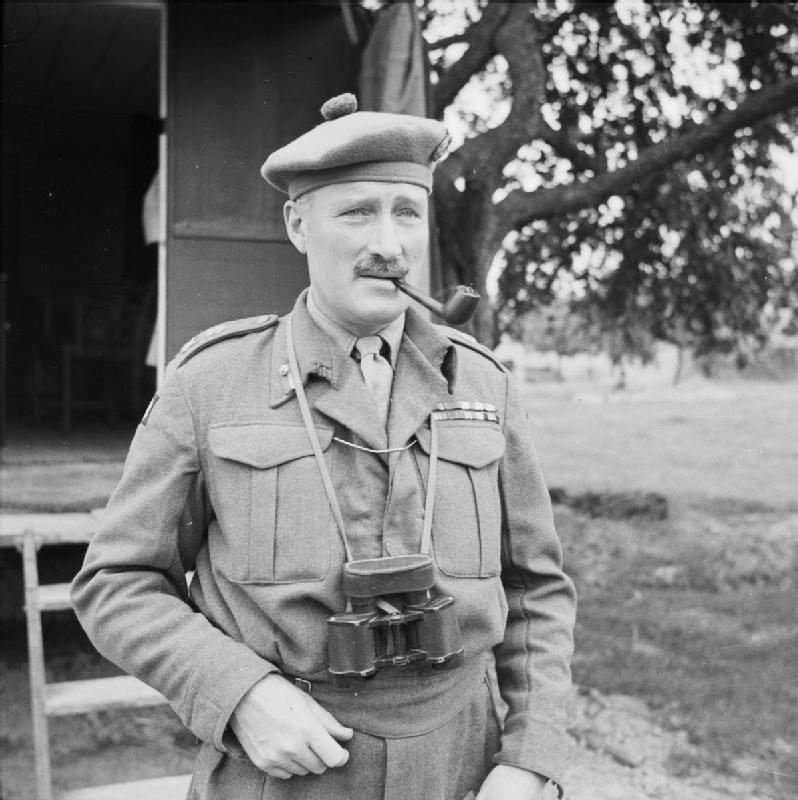
General Sir Neil Methuen Ritchie, GBE, KCB, DSO, MC, KStJ (29 July 1897 – 11 December 1983) was a British Army officer who served in the First and Second World Wars. During the Second World War he commanded the British Eighth Army in the North African campaign from November 1941 until he was dismissed in June 1942 after a disastrous defeat in the Battle of Gazala.

Key Information

A 1914 graduate of the Royal Military College, Sandhurst, Ritchie was commissioned into the Black Watch (Royal Highlanders). During the First World War he served on the Western Front, in the Mesopotamian campaign, where he earned the Distinguished Service Order and in the Sinai and Palestine campaign, where he was awarded the Military Cross. Between the wars he participated in the Occupation of the Rhineland, attended the Staff College, Camberley, and commanded a battalion in Palestine during the Arab revolt.

During the Second World War he served with the British Expeditionary Force in the Battle of France in 1940 as the Brigadier General Staff of II Corps, commanded by Lieutenant-General Sir Alan Brooke. Although Ritchie's career looked finished after Gazala, he was given command of XII Corps, which he led throughout the campaign in North West Europe, from June 1944 until Victory in Europe Day in May 1945.

After the war he was given the Scottish Command and was Governor of Edinburgh Castle from 1945 to 1947. He commanded Far East Land Forces from 1947 to 1949 and led the Joint Services Mission in Washington, DC, from 1949 until his retirement in 1951. Afterwards he emigrated to Canada, where he pursued a career in business.

Early life

[edit]

Neil Methuen Ritchie was born in Essequibo, British Guiana, on 29 July 1897, the third child of a Scottish planter, Dugald MacDougall Ritchie, and his wife Anna Catherine Leggatt. He had an older brother and sister, and a younger sister.[1] His brother Alan MacDougall Ritchie became a brigadier in the British Army.[2] His father's sugar cane business was ruined by a crop disease, and the family moved to British Malaya, where he established a rubber plantation. Ritchie was educated at Lancing College, a boarding school, and the Royal Military College, Sandhurst.[3]

First World War

[edit]

After the outbreak of the First World War in August 1914, Ritchie passed out from Sandhurst on 16 December and was, at the age of 17, commissioned as a second lieutenant in the Black Watch (Royal Highlanders). Among his fellow cadets was another future general, John Grover.[4] As he was too young, Ritchie was not sent overseas until 18 May 1915.[3] He served initially on the Western Front with the 1st Battalion, Black Watch, one of the two Regular Army battalions in the regiment, which was then part of the 1st Brigade of the 1st Division. He was wounded during the Battle of Loos on 26 September,[3] and was promoted to lieutenant on 2 October while he was in hospital.[5]

After recovering from his injuries, Ritchie was promoted to the temporary rank of captain on 2 March 1916,[6] and made an acting captain on 22 April.[7] He joined the 2nd Battalion, the other Regular Army battalion in the regiment, which was part of the 21st (Bareilly) Brigade in the 7th (Meerut) Division, a British Indian Army division, serving in the Middle East in the Mesopotamian campaign. He was designated acting battalion adjutant on 24 April,[8] and he was confirmed in the role on 5 January 1917.[9] The battalion participated in the capture of Baghdad in March, and was one of the first units to enter the city. It then fought in the Battle of Istabulat on 21 April. Ritchie contracted paratyphoid and was evacuated to Bombay.[8] For his services in Mesopotamia, he was mentioned in despatches.[10][11] He was made a Companion of the Distinguished Service Order on 25 August,[12] and promoted to the substantive rank of captain on 19 November.[13]

Ritchie rejoined the 2nd Battalion in December and resumed his role of adjutant. In late December the 7th (Meerut) Division was sent to Palestine to participate in the Sinai and Palestine campaign.[8] Ritchie was awarded the Military Cross on 15 February 1919 for his actions during the Battle of Sharon on 19 September 1918. His citation read:

During the action against the Turkish Tabsor position on September 19th, 1918, and during the subsequent advance, he was invariably to the fore and set a fine example of coolness, courage and utter disregard of danger. When the regiment occupied the El Medjel position on the evening of September 19th, 1918, Capt. Ritchie carried a Lewis gun up part of the way as its carrier was exhausted, and thereby materially assisted in driving off an enemy picquet which was holding up the attack on top of the hill. His services throughout the two attacks, and the subsequent trying marches, were of inestimable value to the regiment.[14]

Between the wars

[edit]

Ritchie remained in the army during the interwar period. The 2nd Battalion returned to Scotland in 1919. In 1920, it joined the Occupation of the Rhineland,[15] stationed at Marienburg, a suburb of Cologne.[16] Among the other officers in the 2nd Battalion at this time was Major Archibald Wavell, who commanded one of its companies.[17] Ritchie continued to serve as adjutant until 28 February 1921, when he returned to the regimental depot in Perth, Scotland, in command of a training company. Although he enjoyed the lifestyle of a regular army officer, with plenty of opportunities for shooting, fishing and dancing, he found it hard to make ends meet on a captain's salary, and considered leaving the army;[15] Wavell counselled him to remain. From 18 July 1923 until 5 October 1927, Ritchie served under Wavell as a General Staff Officer Grade 3 (GSO3) at the War Office.[18][19][20] Ritchie attended the Staff College, Camberley, as a student from 1929 to 1930.[11][18]

On completion of the staff college course, Ritchie returned to his regiment, which was now serving at Meerut in British India.[18] He was a General Staff Officer Grade 2 (GSO2) with Northern Command, India, from 2 April 1933 until 2 April 1937.[21][22] While there he was promoted for the first time in almost sixteen years, to brevet major on 1 July 1933,[23] followed by substantive major on 2 June 1934,[24] and brevet lieutenant colonel on 1 January 1936.[25][26] He encountered Brigadier Claude Auchinleck, who commanded the Peshawar Brigade in the region.[18] On 4 December 1937, Ritchie married Catherine Taylor of Kingston, Ontario, Canada, the daughter of James Arnott Minnes, a partner in a warehousing firm, in Chelsea, London. They had a son and a daughter.[1][10]

On 3 January 1938 Ritchie transferred from the Black Watch, which by now he had been with for just over twenty-three years, to the King's Own Royal Regiment (Lancaster), and was promoted to lieutenant colonel.[27] He became commanding officer of the 2nd Battalion, King's Own, on the same date. In September the battalion was sent to Palestine to perform internal security duties during the Arab revolt.[18] He commanded the battalion until August 1939, shortly before the Second World War began in September. For his services in Palestine Ritchie was mentioned in despatches.[28] Ritchie returned to England, where he was promoted to colonel on 26 August 1939 (with seniority backdated to 1 January)[29] and became a General Staff Officer Grade 1 (GSO1) at the Senior Officers' School at Sheerness, Kent.[18][30]

Second World War

[edit]

France and Belgium

[edit]

After being promoted to the acting rank of brigadier on 22 December 1939, Ritchie became the Brigadier General Staff (BGS) of II Corps, commanded by Lieutenant-General Sir Alan Brooke, which was serving in France as part of the British Expeditionary Force (BEF).[18][31] Ritchie seems to have impressed Brooke, as on 3 January 1940 the latter wrote in his diary that "Ritchie, my new BGS, seems to be turning out well and should, I think, be good".[32] When the so-called "Phoney War" came to an end in May with the German invasion of western Europe, Ritchie further impressed Brooke by controlling the corps headquarters in a calm and confident manner, thus enabling Brooke to concentrate on running the battle on his corps' front.[33]

After being evacuated to England Ritchie was requested by Brooke when the latter was appointed to command a new "Second BEF".[34] Accompanying Brooke to France, Ritchie was sent back to England again after Brooke realised that further efforts to fight the Germans were pointless and,[31] in his words, "I sent Neil Ritchie off home this evening [16 June] as I did not feel that any useful purpose could be served by retaining him any longer".[34] For his services in France and Belgium, Ritchie was made a Commander of the Order of the British Empire in the 1940 Birthday Honours on 11 July,[35] and was mentioned in despatches on 26 July.[36]

Service in the United Kingdom

[edit]

Ritchie served under Brooke as BGS of Southern Command until Brooke was appointed Commander-in-Chief, Home Forces, in July 1940. He then served Brooke's successor, Lieutenant-General Claude Auchinleck.[33] At the relatively young age of forty-three, Ritchie received a promotion to the acting rank of major-general on 28 October 1940, with service number 9334,[37] and became General Officer Commanding (GOC) of the 51st (Highland) Infantry Division. Most of the division had been destroyed in France but the decision was taken to reform it by absorbing the 9th (Highland) Infantry Division, the 51st (Highland) Infantry Division's second Line Territorial Army duplicate. Although not a Scot, Ritchie was a good choice for the role, as he had spent much of his career with the Black Watch, which contributed three of the division's nine infantry battalions, and had experience training troops.[38][39] Brooke was impressed when he visited the division in May 1941.[40]

North Africa and the Middle East

[edit]

Ritchie remained with the 51st (Highland) Infantry Division until June 1941, when he was sent to the Middle East, where he served as Deputy Chief of the General Staff (DCGS) to Wavell, the Commander-in-Chief of Middle East Command.[39] Ritchie's acting rank of major-general was made temporary on 28 October.[41] Auchinleck succeeded Wavell as C-in-C Middle East, and gave Ritchie his highest field command, the British Eighth Army, in November, following the dismissal of Lieutenant-General Alan Cunningham during Operation Crusader.[39] Although Ritchie had never commanded a division or corps in battle, he was available, whereas the Eighth Army's corps commanders, Lieutenant Generals Willoughby Norrie and Reade Godwin-Austen were fighting a battle, and other prospects were outside the theatre and unfamiliar with the situation.[42] He was promoted to the acting rank of lieutenant general on 27 November.[43] For his period of service in the Middle East from July to October 1941, he was mentioned in despatches.[44]

Ritchie (centre, with pipe) addresses other officers in North Africa on 31 May 1942. Also pictured are Willoughby Norrie, William Gott and, with his back facing the camera, George Erskine.

Auchinleck was himself present at Eighth Army headquarters from 1 to 10 December, when the battle was won.[42] The Siege of Tobruk and the German and Italian forces under Generaloberst Erwin Rommel were forced to retreat from Cyrenaica.[39] Auchinleck later wrote that:

Ritchie was perforce pitch-forked into a command at a desperate moment [really desperate], knowing little or nothing of his subordinate commanders or troops and told to retrieve an apparently lost battle. I, therefore, thought it only right to "hold his hand" and make myself very readily available for consultation at short notice.[45]

Ritchie's appointment was originally intended as a temporary one until a suitable commander could be found, but he ended up commanding the Eighth Army for nearly seven months. Auchinleck was satisfied with his performance in Operation Crusader, and thought that it would affect morale to remove another commander, and a victorious one at that, so he retained Ritchie in the post.[42] He was awarded the Polish Silver Cross of the Virtuti Militari for his part in Operation Crusader.[46]

In his book The Desert Generals, Corelli Barnett, a British military historian, wrote that:

[Ritchie] was vigorous and thorough. His personality and appearance made him the image of a British general. Ritchie was very tall and very big. He was handsome and authoritative; goodhumoured in a slightly heavy manner. There was a bovine strength about him. Yet his brain was good. He was liked and trusted. His immediate superior in Cairo, [Lieutenant-]General Sir Arthur Smith, said of him later: "He was straight-forward and absolutely honest. If one could criticise him, he was a little slow — but caution is often better than being too slick."[47]

Victory soon turned to defeat. Rommel struck back on 21 January 1942. At one point Ritchie bypassed Godwin-Austen and countermanded the latter's orders to Major-General Francis Tuker, the commander of the 4th Indian Division. Feeling that Ritchie had by this action displayed a lack of confidence in him, Godwin-Austen tendered his resignation to Auchinleck, which was reluctantly accepted.[42][48]

Ritchie was in command of the Eighth Army at the Battle of Gazala in May–June 1942, when he failed to exercise strong command over the Army. He lacked experience in handling large formations, particularly armoured ones. His more experienced subordinates, Norrie and William Gott saw him as little more than a mouthpiece for Auchinleck and often ignored or undermined him. Even his division commanders were more experienced. Auchinleck kept him on a short leash, paying frequent visits, sending lengthy instructions and positioning his DCGS, Brigadier Eric Dorman-Smith at Eighth Army headquarters.[49][50] The British and Commonwealth forces were soundly defeated, resulting in the Axis capture of Tobruk. On 25 June, Ritchie was sacked by Auchinleck, who assumed personal command of the Eighth Army.[51]

Michael Carver, who later served under Ritchie in North-West Europe, and became a field marshal and a military historian, wrote:

He was a good, professional, straightforward soldier. If he had not been, Alanbrooke would not have thought highly of him as his Brigadier General Staff. There is no doubt in my mind that he never recovered from starting off on the wrong foot with Auchinleck - as a chargé d'affaires, not a plenipotentiary. His opportunity to remedy that state of affairs came after the clash with Godwin-Austen in the Msus Stakes of February 1942. It is now clear that it was Auchinleck's intervention that caused the counter-order which led to disorder. Ritchie should then have demanded either that he should be allowed the freedom to command his army in his own way, or be replaced. But he was too decent, loyal and traditional a soldier to put his superior, whom he liked and admired, in such a difficult position. He was to suffer for it. High command in war requires tougher and more ruthless qualities.[52]

Return to the United Kingdom

[edit]

After being replaced as the Eighth Army commander Ritchie returned to the United Kingdom. He met with Brooke, who was now the Chief of the Imperial General Staff, at the War Office on 15 July 1942, and Brooke decided to give him a second chance. Brooke later wrote:

Neil Ritchie had done so wonderfully well in France during the fighting leading to Dunkirk, and I had grown so fond of him, that I hated seeing him subjected to this serious reverse. I told him that I considered that he had been pushed on much too fast by Auchinleck, to be put in command of 8th Army in the field when he had never even commanded a division in action. I told him he must regain confidence in himself. To do this he must go back to what he had done so efficiently before, namely the command of a division at home. I told him that when he had regained confidence in himself I would give him a corps.[53]

Ritchie was appointed to command the 52nd (Lowland) Infantry Division on 11 September 1942. The division was a first line Territorial Army formation made up of infantry battalions from all five Scottish Lowland regiments, and at the time was being trained in mountain warfare, in the United Kingdom in preparation for possible operations in Norway. The training took place in the Grampian Mountains and culminated in Exercise Goliath II in October 1943.[54][55] Judged fit to command a corps, Ritchie relinquished command to Major-General Edmund Hakewill-Smith on 11 November. He was selected to command XII Corps in place of Lieutenant-General Montagu Stopford, who was sent to India.[56][57] In the 1944 New Year Honours, Ritchie was made a Companion of the Order of the Bath.[58] He became a temporary lieutenant-general and war substantive major-general on 3 April 1944,[59] and a substantive major-general on 19 May, with seniority backdated to 25 December 1943.[60]

Northwest Europe

[edit]
Winston Churchill and Ritchie watch traffic moving across the Rhine on 26 March 1945.

Unlike his Eighth Army predecessor Cunningham, who never regained an active command following his dismissal, Ritchie's XII Corps was chosen to participate in the invasion of Normandy as part of Lieutenant-General Miles Dempsey's British Second Army, which in turn was part of General Sir Bernard Montgomery's 21st Army Group.[54] Although Ritchie was not one of Montgomery's protégés, the latter never considered removing him before or during the campaign.[61] When Ritchie asked for another division and more artillery after the breakout from Normandy, Montgomery provided it.[61]

James Cassels served as Ritchie's GSO1 in the 52nd (Lowland) Infantry Division and then, after a brief period as commanding officer of the Tyneside Scottish in the 49th (West Riding) Infantry Division, became Ritchie's BGS at XII Corps headquarters in January 1944. After Cassels was appointed commander of the 152nd Infantry Brigade on 27 June 1944,[62] Ritchie was not satisfied with his replacement, and asked Montgomery for Brigadier Gilbert Minto (Jim) Elliot, the Commander, Royal Artillery, of the 51st (Highland) Infantry Division, who had been a fellow student at the Staff College, Camberley. Montgomery granted this request, and Elliot served as Ritchie's BGS in the Battle of Normandy and the subsequent campaign in North Western Europe, ending in May 1945 with the end of the war in Europe.[63]

In the advance across France, Ritchie demonstrated a mastery of high-tempo operations and the employment of armour. He had the 15th (Scottish) Infantry Division seize a bridgehead over the Seine at Muids on 27 August. His 7th Armoured Division crossed the river on 1 September and reached its objective, Ghent, four days later.[54] The following year, during Operation Plunder, the crossing of the Rhine, Ritchie demonstrated technical acumen, sound planning, and the coordination of the forces under his command.[63]

King George VI (right) and Ritchie (left) inspect men of XII Corps near Nijmegen on 13 October 1944.

Ritchie could be tough and occasionally ruthless with his subordinates. One of his first actions as commander of XII Corps was to relieve Major-General William Bradshaw from command of the 59th (Shropshire) Infantry Division because Ritchie felt he was not up to the task of handling a division in operations. During the advance into Germany, Ritchie was concerned at the slow advance of the 52nd (Lowland) Infantry Division and went to see Hakewill-Smith for an explanation. When Hakewill-Smith seemed unsure of what troops were deployed to lead the advance, Ritchie said: "I'll tell you, I've just come down from there, you've got three squadrons of your Recce Regiment deployed, and there's not another bloody thing in your whole division deployed, and yet you say you're held up."[63] Ritchie then drew a line on the headquarters map with a grease pencil and told Hakewill-Smith that he would be going home if his units were not on that position by the next day. They were.[63]

For his service in North West Europe, Ritchie was knighted, being appointed a Knight Commander of the Order of the British Empire on 5 July 1945,[64] and he was mentioned in despatches for "gallant and distinguished services", on 22 March and 9 August 1945.[65][66] He also received several foreign awards, including being made a Commander of the Legion of Merit by the United States,[67] a Knight Grand Officer of the Order of Orange-Nassau with Swords by the Netherlands,[68] and a Commander of the Legion of Honour by France, which also awarded him the Croix de guerre.[10] He became a substantive lieutenant-general on 30 October 1945, with seniority backdated to 21 December 1944.[69]

The historian Richard Mead had kind words for Ritchie:

It is a pity that history will remember Ritchie primarily as the loser of the Battle of Gazala, as his overall achievements were not inconsiderable. He was a victim of promotion beyond his capabilities, where the fault lay substantially with his superior officer, Auchinleck. The continuing support of Brooke was the key factor in his recovery, whilst Montgomery, for whom sacking by Auchinleck was no disqualification, allowed him to play to his strengths. He was never heard to complain about his treatment and his willingness to step down and learn how to command smaller formations was truly admirable.[70]

Post-war

[edit]

After the war Ritchie remained in the British Army, becoming GOC Scottish Command and Governor of Edinburgh Castle in 1945 and GOC Far East Land Forces in 1947.[71] He was promoted to general on 23 April 1947, with seniority backdated to 9 October 1946.[72] His tenure coincided with the first year of the Malayan Emergency.[73][74] In his report on operations from June 1948 to June 1949, he described the communists as "terrorists and thugs" who "showed no more courage than any others of that ilk."[75]

In July 1949, Ritchie became the commander of the British Army Staff in Washington and Military member of the Joint Staff Mission there, and he served in this position until his retirement from the army.[71][76] He became a Knight Commander of the Order of the Bath in the 1947 Birthday Honours,[77] and was advanced to a Knight Grand Cross of the Order of the British Empire in the 1951 Birthday Honours.[78] From December 1948 until his retirement, Ritchie also held the ceremonial appointment of aide-de-camp general to the King,[79] and from September 1950 he was colonel-in-chief of the Black Watch (Royal Highland Regiment), his old regiment.[80] He retired from the Army on 29 August 1951.[81]

Following his retirement Ritchie emigrated to Canada, where he became a director of the Canadian subsidiary of Tanqueray Gordon & Co. and chairman of the Mercantile & General Reinsurance Co. of Canada, Macdonald-Buchanan Properties Ltd[1][10] and the Board of Governors of the Canadian Corps of Commissionaires.[82] He was appointed a Commander of the Order of St John on 2 August 1960,[83] and advanced to a Knight of the Order of St John on 2 July 1963.[84] He died at his home in Toronto on 11 December 1983 at the age of 86. His remains were cremated and the ashes scattered on his son Dugald's property near Claremont, Ontario.[1][10]

Dates of rank

[edit]
Second lieutenant Lieutenant Captain Major Lieutenant-Colonel
16 December 1914[4] 2 October 1915[5]
  • 2 March 1916 (temporary)[6]
  • 22 April 1916 (acting)[7]
  • 19 November 1917[13]
  • 1 July 1933 (brevet) [23]
  • 2 June 1934 [24]
  • 1 January 1936 (brevet)[25]
  • 3 January 1938 [27]
Colonel Brigadier Major-general Lieutenant-general General
  • 26 August 1939 (seniority 1 January 1939)[29]
  • 22 December 1939 (acting)[18]
  • 22 June 1940 (temporary)[18]
  • 28 October 1940 (acting)[37]
  • 28 October 1941 (temporary)[41]
  • 3 April 1944 (war substantive)[43]
  • 18 May 1944 (seniority 25 December 1943)[60]
  • 27 November 1941 (acting)[43]
  • 3 April 1944 (temporary)[59]
  • 30 October 1945 (seniority 21 December 1944)[69]
23 April 1947 (seniority 9 October 1946)[72]

Notes

[edit]

References

[edit]
[edit]
Revisions and contributorsEdit on WikipediaRead on Wikipedia
from Grokipedia
Sir Neil Methuen Ritchie (29 July 1897 – 11 December 1983) was a senior officer who served with distinction in both world wars, most notably as commander of the Eighth Army in the during the Second World War until his relief following the fall of . Born in to Scottish parents, Ritchie was educated at and the Royal Military Academy Sandhurst before being commissioned into the (Royal Highland Regiment) in 1914 at the outbreak of the First World War. During the war, he served in and , where he was awarded the in 1918 for gallantry in action. By the , Ritchie rose steadily through the ranks, serving in various staff and command roles, including as commanding officer of a battalion in in the late 1930s. In the early stages of the Second World War, Ritchie acted as to General Alan Brooke with the British Expeditionary Force in in 1939–1940 and later under General in Southern Command after the . Appointed to command the Eighth Army in on 27 November 1941, he successfully led , relieving the siege of and forcing Axis forces to retreat in December 1941. However, his tenure ended in controversy during the in May– 1942, where despite numerical superiority in troops and tanks, tactical setbacks allowed German Field Marshal to outmaneuver British forces, leading to the capture of on 21 1942 and the loss of over 35,000 prisoners; Ritchie was relieved of command on 25 1942 and replaced by . He was subsequently mentioned in despatches for his service. Ritchie later commanded the 52nd (Lowland) Division and then XII Corps during the and the subsequent advance through in 1944–1945, earning further recognition including appointment as a Knight Commander of the . Post-war, he served as Commanding-in-Chief Scottish Command from 1945 to 1947 and then as of British Land Forces in the until his retirement in 1949 at the rank of general; he was later advanced to Knight Grand Cross of the in 1951. After leaving the army, Ritchie chaired the Mercantile and General Reinsurance Company in . He died in on 11 December 1983 at the age of 86.

Early Life

Birth and Family

Neil Methuen Ritchie was born on 29 July 1897 in Essequibo, (now part of ). He was the second son of Dugald MacDougall Ritchie, a Scottish planter who managed sugar cane estates in , and Anna Catherine Leggatt Ritchie. The Ritchie family maintained strong colonial connections, with Dugald's career leading them from to around the early 1900s after a crop disease devastated the sugar industry; there, he established a rubber in . By Neil's adolescence, the family had relocated to , residing at Restholme in , where he grew up amid these shifting imperial ties. Ritchie had three siblings: an older brother, Alan MacDougall Ritchie, who rose to the rank of brigadier in the British Army; an older sister, Catherine Clare Ritchie; and a younger sister, Barbara Lilian Ritchie. His brother Alan also pursued a distinguished military career, serving in both world wars and earning the Distinguished Service Order and Officer of the Order of the British Empire. On 4 December 1937, Ritchie married Catherine Taylor Minnes (1901–1990), the daughter of James Arnott Minnes of Kingston, Ontario, Canada, in Chelsea, London. The couple had two children: a son born in 1940 and a daughter born in 1942. Ritchie's extensive military commitments often kept him away from home for years, particularly during the Second World War, leaving Catherine to oversee family matters in England while maintaining close ties to her Canadian roots. Following his retirement from the on 29 August 1951, Ritchie emigrated to in the early 1950s, settling in with his family. He died there on 11 December 1983 at the age of 86.

Education and Commissioning

Ritchie received his early education at , a public boarding school in , , where his family's colonial service in provided the necessary support for his schooling. Following this, in August 1914, immediately after the outbreak of the First World War, he entered the Royal Military College, Sandhurst, as part of the first accelerated wartime intake designed to rapidly train officers amid the national emergency. The shortened course, lasting just four months, emphasized practical leadership and tactical skills under the shadow of the escalating conflict, shaping Ritchie's foundational military outlook. Upon completing his training, Ritchie was commissioned as a in the (Royal Highland Regiment) on 16 December 1914, at the age of 17, joining a cohort of young officers rushed into service to bolster the expanding British Expeditionary Force. This early commissioning reflected the urgent demands of the war, propelling him directly into the regiment's ranks despite his youth.

First World War

Western Front Service

Neil Ritchie, having been commissioned into the earlier that year, arrived in on 18 May 1915 and joined the 1st Battalion as a , part of the 1st Brigade in the 1st Division. The battalion was engaged in routine duties along the Western Front, including patrols, repairs to fortifications, and minor raids amid the stalemate of the period. As a , Ritchie commanded a , leading his men in these hazardous tasks that demanded vigilance against artillery fire, snipers, and gas attacks, which had become increasingly common following their introduction earlier in 1915. Ritchie's first major combat experience came during the in late September 1915, a large-scale British offensive aimed at breaking through German lines near Lens. On 25 September, the 1st Battalion advanced as part of the 1st Division's assault on positions around , with B Company leading the attack at 9:10 a.m., supported by A and C Companies. Ritchie was slightly wounded the following day, 26 September, during ongoing fighting amid heavy casualties for the battalion, which suffered 4 officers and 38 other ranks killed, and 10 officers and 261 other ranks wounded in the assault. His injury occurred while performing tactical duties in the captured trenches, highlighting the intense close-quarters combat and exposure to machine-gun and fire that characterized the battle. Evacuated to a in the rear, Ritchie underwent treatment for his wounds, which were not severe enough to end his active service. While still recovering, he received a promotion to temporary , effective 2 October 1915, recognizing his service up to that point. He returned to duty in early 1916, continuing platoon command and staff roles with Black Watch units on the Western Front, including transfers that kept him involved in trench operations until the battalion's redeployment later that year. These experiences honed his understanding of in prolonged positional warfare, amid the mud, disease, and psychological strain of the trenches.

Middle Eastern Campaigns

In early 1916, following his recovery from wounds received on the Western Front, Ritchie joined the 2nd Battalion, (Royal Highlanders), which was dispatched to as part of the against Ottoman forces. The battalion, within the 21st () Brigade of the 7th (Meerut) Division, landed at on 31 December 1915, just as British and Indian troops were intensifying efforts to relieve the besieged garrison at Kut-al-Amara. It participated in the grueling advance through flooded terrain and defensive positions in efforts to relieve the besieged garrison at Kut-al-Amara, which ultimately surrendered on 29 April 1916 after a prolonged that had begun the previous year. Ritchie's prior combat experience from contributed to his adaptation to the harsh desert conditions and riverine operations in this theater. During the subsequent phase of the campaign in , Ritchie demonstrated exceptional leadership as acting captain and, from 5 January , as battalion adjutant. He played a key role in reconnaissance missions and coordinated assaults during the advance toward , including operations around the and the final push that captured the city on 11 March . For his services in these actions, he was awarded the , gazetted on 25 August . Illness forced him to be invalided to on 12 June , temporarily halting his frontline service. He was promoted to substantive captain on 19 November . Ritchie rejoined his battalion in December 1917, by which time it had been redeployed to the against Ottoman positions. Serving as , he contributed to the Egyptian Expeditionary Force's offensives, including the Battles of Gaza and the advance through the Judean Hills in 1917–1918. In the decisive on 19 September 1918—part of the larger Battle of Megiddo—he led reconnaissance efforts and directed assaults that broke through enemy lines, displaying "coolness, courage and utter disregard for danger" while under heavy artillery and machine-gun fire. For these actions, he was awarded the , gazetted on 30 July 1919 with the citation published on 15 February 1919. His service in continued into 1919, supporting stabilization efforts amid the , before his return to Britain.

Interwar Period

Staff Training and Early Commands

Following the First World War, Ritchie served with the 2nd Battalion, , during the British occupation of the , where the battalion was stationed near in 1920. His experiences on the Western Front and in the during the war had qualified him for advanced staff training. He acted as to the battalion until February 1921, after which he held routine regimental duties in Britain. From July 1923 to September 1927, Ritchie worked as a General Staff Officer Grade 3 at the in , gaining administrative experience in military planning and organization. In 1929–1930, Ritchie attended the at as a student, completing the two-year course alongside contemporaries such as Harold Redman and . Upon graduation, he rejoined his regiment in Cawnpore, , as a company commander in January 1931, followed by a posting as General Staff Officer Grade 2 with Northern Command in from April 1933 to April 1937. During this period, he received his first postwar promotion to substantive major on 2 June 1934. Ritchie's mid-1930s roles included serving as of his from December 1936, providing early leadership experience in unit training and operations. He was promoted to brevet lieutenant-colonel on 1 January 1936. Back in Britain by 1937, Ritchie took on routine administrative and training positions, including instruction duties at the Senior Officers' School in from August to December 1939, preparing officers for wartime responsibilities.

Service in Palestine

In January 1938, Neil Ritchie was promoted to substantive and transferred from the , where he had served for over two decades, to the King's Own Royal Regiment (Lancaster), assuming command of its 2nd Battalion. This marked his first independent battalion command, transitioning from staff roles to operational leadership in a tense colonial environment. The 2nd Battalion deployed to in September 1938, arriving at on 19 September, to reinforce British forces amid the escalating phase of the . Under Ritchie's command, the unit was stationed in key areas including Gaza, , Sarafand, Al Majdal, Deir Suneid, and Kuna Yudhs, focusing on internal security to counter Arab rebel activities such as and ambushes. Ritchie's command lasted until August 1939, while the battalion continued operations in the region until June 1940. Ritchie's leadership emphasized counter-insurgency tactics tailored to the revolt's irregular nature, including extensive foot and vehicle patrols to secure vital like railways, where platoons established defensive posts equipped with armoured trolleys and minesweepers to deter attacks. The conducted searches and cordon operations in villages, such as those around Ain Karim near , to disrupt rebel networks and gather intelligence. Punitive measures, including house demolitions in Gaza following sabotage incidents in November 1938, were also enforced to deter further unrest, reflecting the broader British strategy of combining military action with civil pacification. These duties exposed Ritchie to the challenges of colonial policing in a volatile Mandate territory, where British troops balanced suppression of the revolt against maintaining order among divided Arab and Jewish communities. The experiences honed his understanding of small-unit tactics in , including rapid response to ambushes and coordination with local auxiliaries, providing practical application of concepts from his earlier training.

Second World War

France and Belgium

In December 1939, Neil Ritchie was promoted to the acting rank of and appointed Brigadier General Staff (BGS) to II Corps of the British Expeditionary Force (BEF) in , serving under Lieutenant-General Sir Alan Brooke. His prior interwar staff training at institutions such as the , had equipped him effectively for this demanding role. From January to May 1940, during the , Ritchie coordinated II Corps' operational planning, including the fortification of defensive lines in the Lille area and the organization of training to maintain readiness amid the period of relative inactivity. When the German offensive commenced on 10 May 1940, Ritchie played a pivotal part in II Corps' response during the , assisting Brooke in managing the rapid retreat from through coordination of movements, intelligence dissemination, and supply lines under intense pressure. As the BEF withdrew toward the coast, he oversaw the execution of actions by divisions such as the 3rd and 4th Divisions, which delayed pursuing German forces and facilitated the consolidation at . Brooke later praised Ritchie's calm efficiency, noting it was instrumental in preserving corps cohesion amid the chaos. Ritchie was evacuated from as part of Operation Dynamo in late May or early . For his contributions to the campaign in and , he was appointed Commander of the (CBE) in July 1940.

Service in the United Kingdom

Following his service as Brigadier General Staff of II Corps during the , Neil Ritchie was promoted to acting major-general on 28 October 1940 and appointed (GOC) the 51st (Highland) Infantry Division. , which had suffered heavy losses and been largely destroyed during the evacuation at Saint-Valery-en-Caux in , required extensive rebuilding under Ritchie's leadership; he focused on reorganizing its structure by integrating returning veterans from —many of whom brought valuable combat experience—with new recruits and Territorial Army units to restore its fighting capability. Ritchie's recent firsthand observations of the rapid German advance and the challenges of retreat in directly influenced his emphasis on intensive training in mobile defense tactics, , and unit cohesion to prepare the reformed division for potential invasion scenarios. Under Ritchie's command, the 51st (Highland) Division was deployed to coastal defense roles along the southeast coast of England, including areas around Eastbourne and Newhaven, during the height of the Battle of Britain in summer and autumn 1940. This positioning was part of the broader British home defense strategy against Operation Sea Lion, the anticipated German invasion, where the division manned fortifications, conducted patrols, and rehearsed counter-attack maneuvers to repel amphibious landings. Ritchie's training regimen, which prioritized rapid mobilization and coordination with Royal Air Force elements, helped transform the rebuilt division into a cohesive force ready for defensive operations amid the ongoing threat of aerial and naval assaults. Ritchie's tenure with the division continued through early 1941, marked by ongoing home defense duties and further refinement of its operational readiness. On 28 October 1941, his rank of major-general was made temporary, reflecting his sustained performance in command. He relinquished command of the 51st (Highland) Division on 5 June 1941 to take up a posting as Deputy Chief of the General Staff in the Middle East Command.

North Africa and the Middle East

In November 1941, amid the ongoing Western Desert Campaign, Lieutenant-General Neil Ritchie was appointed General Officer Commanding (GOC) the British Eighth Army, succeeding Lieutenant-General Alan Cunningham, who had been relieved due to setbacks in the initial phases of Operation Crusader. This appointment came under the oversight of General Claude Auchinleck, Commander-in-Chief Middle East Command, who selected Ritchie for his prior staff experience in the theater. Concurrent with his new role on 26 November 1941, Ritchie was promoted to acting lieutenant-general, reflecting the scale of the command. Following his relief, Ritchie faced political scrutiny from Churchill and was without command for several months before his appointment to the 52nd Division. Ritchie's leadership proved pivotal in (18 November–30 December 1941), a major British offensive aimed at relieving the siege of and disrupting Axis supply lines. Assuming command mid-operation, he directed aggressive armored thrusts that broke through German-Italian defenses, successfully lifting the Tobruk siege on 10 December and forcing the to retreat westward to El Agheila by mid-January 1942. His bold tactics, including coordinated infantry-armor advances despite logistical strains, were commended by for restoring momentum to the Eighth Army and inflicting significant losses on Erwin Rommel's forces, estimated at over 38,000 casualties and 260 tanks. By early 1942, however, the Eighth Army encountered mounting challenges that tested Ritchie's command. Extended supply lines across the desert, vulnerable to Axis interdiction, hampered reinforcements and maintenance, while Rommel's swift counteroffensive in January—exploiting British overextension—recaptured and pushed Allied forces back to the Gazala Line. These issues, compounded by intelligence gaps and inter-allied coordination difficulties, eroded the gains of Crusader and set the stage for defensive preparations west of . The tide turned decisively against Ritchie during the (26 May–21 1942), where Rommel's Panzerarmee Afrika executed a daring "left hook" maneuver through the Gap, bypassing the fortified Gazala Line and isolating British units. Ritchie's response, involving fragmented counterattacks and failure to decisively engage the Axis breakthrough, resulted in heavy British losses—over 50,000 casualties and 400 tanks—and the encirclement of , which surrendered on 21 with 35,000 troops captured. On 25 1942, amid the retreat toward , relieved Ritchie of command under intense pressure from Prime Minister , who viewed the defeats as a strategic catastrophe. Historians have scrutinized Ritchie's strategic decisions at Gazala, including his decentralized control over corps commanders and reluctance to abandon the static line earlier, which some attribute to inexperience at army-level command rather than outright incompetence. Debates persist on whether he was scapegoated for systemic issues, such as inadequate air-ground integration and political interference from , with later assessments noting that his Crusader successes demonstrated potential unfairly overshadowed by the 1942 reversals.

Return to the United Kingdom

Following his relief from command of the Eighth Army after the , Ritchie returned to the in July 1942, where he reverted to the rank of on 13 July. On 11 September 1942, he was appointed (GOC) the 52nd (Lowland) Infantry Division and promoted to temporary major-general. Under Ritchie's leadership, the division, based in , conducted intensive training for mountain and airborne operations, including rigorous exercises in the to build expertise in harsh terrain and rapid deployment tactics. This preparation was geared toward potential roles in an invasion of or other amphibious assaults, reflecting the broader strategic uncertainties of the war at the time. Despite this focused readiness, the 52nd (Lowland) Infantry Division remained in the United Kingdom throughout Ritchie's command and saw no overseas deployment. Ritchie was promoted to substantive major-general on 18 May 1944 (with seniority from 25 December 1943) and relinquished command of the division on 11 November 1943.

Northwest Europe

In September 1943, Neil Ritchie was appointed General Officer Commanding (GOC) of XII Corps within the 21st Army Group, preparing for the forthcoming Allied invasion of Northwest Europe. He assumed formal command on 19 November 1943, succeeding Lieutenant-General Montagu Stopford, and led the corps through the major operations of the 1944-1945 campaign. Ritchie, supported by Brigadier General Staff James Cassels from September 1944, emphasized coordinated infantry-armor tactics informed by his earlier divisional training in the United Kingdom. On 3 April 1944, he was promoted to temporary lieutenant-general, reflecting his readiness for high-level operational command. For his leadership in these campaigns, Ritchie was appointed a Companion of the Order of the Bath (CB) in the 1944 New Year Honours and later advanced to Knight Commander (KCB) in the 1947 Birthday Honours. XII Corps played a key role in the Normandy campaign following the initial D-Day landings on 6 June 1944, with its headquarters landing in July and becoming fully operational on 16 July to secure the left flank of the Odon valley under the Second Army. Comprising the 43rd (Wessex), 53rd (Welsh), and later 59th Infantry Divisions, the corps supported the capture of Caen through flanking operations and contributed to the broader breakout from the beachhead in late July and August, advancing southeast toward Falaise on the right flank of the First Canadian Army. This positioning enabled close coordination with Canadian forces during the encirclement of German Army Group B in the Falaise Pocket, where XII Corps helped seal the trap and prevent enemy retreat. Ritchie's leadership emphasized rapid exploitation of armored breakthroughs, with divisions like the 7th Armoured integrating seamlessly to maintain momentum amid intense hedgerow fighting. As Allied forces advanced into and the in September 1944, XII Corps supported by securing the left flank of XXX Corps with the 7th Armoured, 15th (Scottish), and 53rd Infantry Divisions, aiding airborne efforts despite ultimate setbacks. In (20 October to 4 November 1944), the corps cleared German pockets in , liberating key Dutch cities including 's-Hertogenbosch on 27 October and on the same day, in coordination with Scottish and Welsh units that spearheaded urban assaults. Further operations in early 1945, such as Blackcock (14-26 January), eliminated enemy salients south of the around Limburg, with the 7th Armoured, 43rd, and 52nd Infantry Divisions overcoming flooded terrain and fortified positions at sites like Sint Joost on 20 January. These actions highlighted Ritchie's focus on joint Canadian-British maneuvers, as XII Corps operated under for much of the advance. In the , XII Corps participated in (8 February 1945), pushing through the Reichswald Forest alongside Canadian forces to link up with the U.S. Ninth Army and clear the west bank of the . The corps then executed the crossing during on 23-24 March 1945, with the 15th (Scottish) Division assaulting northwest of at 0200 hours after a massive barrage, securing a by day's end against light opposition due to prior interdiction. Supported by 2,070 guns and airborne operations, this effort involved the 7th Armoured, 15th, 52nd, and 53rd Divisions in rapid consolidation, enabling the advance into . In the final push, XII Corps drove northeast, capturing from the northwest in late April 1945 and reaching the River near Harburg, where the 7th Armoured Division seized crossings at Welle and Tostedt on 17 April, contributing to the collapse of German resistance in . The corps was disbanded on 29 May 1945, shortly after the war's end in .

Post-War Career

Commands in Britain and the Far East

Following the end of the Second World War, Neil Ritchie was appointed General Officer Commanding-in-Chief (GOC-in-C) Scottish Command on 16 June 1945, a role in which he also served as Governor of Edinburgh Castle until 31 January 1947. In this position, Ritchie oversaw the demobilization of British forces in Scotland, managing the orderly release of personnel amid the rapid transition to peacetime conditions. He also directed the reorganization of the Territorial Army, restructuring units to align with post-war defense needs and integrating returning veterans into reserve formations. His prior experience commanding XII Corps during the Northwest Europe campaign qualified Ritchie for these senior administrative responsibilities. In February 1947, Ritchie transferred to the as Commander-in-Chief of Far East Land Forces (FARELF), where he managed British ground troops across Malaya, , and during the ongoing post-war occupation and reconstruction efforts. During this tenure, which lasted until October 1949, he coordinated military administration in a region marked by political instability and the need to maintain order amid pressures. Following his command, Ritchie served as Head of the British Joint Services Mission in , from October 1949 until his retirement. Ritchie's promotion to the substantive rank of full general was confirmed on 23 April 1947, with seniority backdated to 9 October 1946. As the erupted in June 1948, Ritchie addressed early tensions by advocating for offensive counterinsurgency operations against communist insurgents led by the , including the establishment of the short-lived Ferret Force in July 1948 to conduct jungle patrols and intelligence gathering. He supported the formation of Local Defence Committees to foster civilian-military cooperation and emphasized improved intelligence coordination between military, police, and special branches to locate and disrupt rebel activities. Logistical challenges under Ritchie's command were formidable, including post-war infrastructure decay—such as damaged docks in and disrupted railway networks—and shortages of trained personnel in units like the Malayan Security Service, which operated with 13 fewer European officers than required in early 1947. The rugged terrain, combined with ethnic complexities and vulnerabilities in key economic sites like tin mines and rubber plantations, complicated troop deployments and supply lines, while initial inaccuracies delayed effective responses to insurgent tactics such as and ambushes in 1948. Despite these hurdles, Ritchie's oversight helped stabilize British military presence in the region through gradual enhancements in inter-agency collaboration and by mid-1949.

Retirement and Later Life

Ritchie retired from the on 31 August 1951 at the age of 54, shortly after being appointed to the King on 30 August 1951. His followed the award of the Knight Grand Cross of the (GBE) in June 1951, recognizing his distinguished . Following his , Ritchie emigrated to in the early with his family and settled in , . There, he pursued a business career, serving as a director of the Canadian subsidiary of Gordon & Co., a distilling firm, and as president and director of The Mercantile & General Co. of Ltd. starting in 1954. He also held directorships in other Canadian companies, including Macdonald-Buchanan Properties Ltd., and chaired the Board of Governors of the Canadian Corps of Commissionaires during the and 1960s. In his later years in , Ritchie remained engaged with military commemorations, attending events such as dinners honoring regiments like The Black Watch, where he joined veterans and officers at head tables in the 1950s and beyond. He occasionally delivered lectures on his wartime experiences to Canadian audiences, drawing on his leadership in key campaigns. Ritchie's health declined in his final years, and he died at his home in on 11 December 1983 at the age of 86.

Honours and Ranks

Awards and Decorations

Neil Methuen Ritchie received numerous British and foreign honors throughout his military career, totaling over a dozen decorations that recognized his gallantry, , and service from the First World War through his post-war commands. These awards, including multiple mentions in dispatches, underscored his progression from regimental officer to general, with key honors tied to specific operational contributions without overlapping detailed career narratives. Ritchie's British awards began with the , gazetted on 14 February 1919 for his courage and leadership during the advance against Turkish positions in on 19 September 1918, where he personally carried a to repel an enemy counterattack. He was subsequently awarded the on 25 August 1917 for distinguished service in during the First World War, reflecting his role in critical operations as an acting captain with the 2nd Battalion, . No bar to the DSO appears in official records. During the Second World War, Ritchie earned the on 1 January 1944 for services in Northwest while commanding XII Corps, alongside the on 11 July 1940 for his staff work as acting at II Corps headquarters, alongside his first mention in dispatches on 26 July 1940. He received a second mention in dispatches on 30 June 1942 while commanding the Eighth Army. His leadership of XII Corps in Northwest led to a third mention on 22 March 1945 and a fourth on 9 August 1945, culminating in the on 5 July 1945 for services in the campaign. Post-war, he was appointed on 12 June 1947 as commander of Far East Land Forces, and later elevated to on 7 June 1951 upon retirement. Finally, Ritchie received the Knight of the Venerable Order of Saint John (KStJ) on 2 July 1963. In addition to British honors, Ritchie was decorated by Allied nations for his contributions to joint operations. He received the Silver Cross of the Order Wojenny from on 15 May 1942 as temporary major-general commanding the Eighth Army, recognizing his role in supporting Polish forces in the . For services in Northwest , awarded him Commander of the Order of the and the Croix de Guerre 1939-1945 in 1944 as lieutenant-general of XII Corps. The conferred the (Degree of ) on 16 January 1948 for his cooperation with U.S. forces during the liberation of and the advance across the Roer River. The honored him with the Grand Officer of the with Swords on 17 October 1946 for commanding XII Corps in the liberation of .

Dates of Rank

Neil Ritchie's military career spanned both world wars, with promotions reflecting wartime accelerations and standard interwar progressions. The following table outlines his key dates of rank in the British Army, distinguishing between acting, temporary, and substantive appointments where applicable. These promotions were published in the London Gazette, the official record of British military appointments.
RankDateType/Notes
Second Lieutenant16 December 1914Commissioned into The Black Watch (Royal Highland Regiment). London Gazette, 15 December 1914, p. 10696
Lieutenant1916Substantive promotion during First World War service. London Gazette, various wartime supplements
Captain26 February 1917Substantive; preceded by temporary captaincy on 2 March 1916. London Gazette, 26 February 1917
Brevet Major1 July 1933Honorary rank without additional pay. London Gazette, 30 June 1933
Major2 June 1934Substantive. London Gazette, 1 June 1934, p. 3485
Brevet Lieutenant Colonel1 January 1936Honorary rank. London Gazette, 31 December 1935
Lieutenant Colonel3 January 1938Substantive; transferred to King's Own Royal Regiment (Lancaster). London Gazette, 4 January 1938
Colonel26 August 1939Substantive, with seniority backdated to 1 January 1939. London Gazette, 29 August 1939
Acting Brigadier22 December 1939For staff duties with II Corps. London Gazette, 26 December 1939
Temporary Brigadier22 June 1940Continued staff role. London Gazette, 25 June 1940
Temporary Major General28 October 1940Assumed command of 51st (Highland) Division. London Gazette, 29 October 1940
Acting Lieutenant General27 November 1941Command of Eighth Army in North Africa. London Gazette, 2 December 1941
Reverted to Colonel13 July 1942Following relief from Eighth Army command. London Gazette, 14 July 1942
Temporary Major General11 September 1942Returned to divisional command. London Gazette, 15 September 1942
Acting Lieutenant General19 November 1943Command of 12th Corps. London Gazette, 21 November 1943
Temporary Lieutenant General3 April 1944Continued corps command during Normandy campaign. London Gazette, 5 April 1944
Lieutenant General30 October 1945Substantive, with seniority backdated to 21 December 1944. London Gazette, 30 October 1945
General23 April 1947Substantive, with seniority backdated to 9 October 1946; appointed GOC Far East Land Forces. London Gazette, 25 April 1947
Ritchie retired on retired pay on 31 August 1951, at which point he held the rank of . London Gazette, 31 August 1951, p. 4593. He did not receive promotion to . Acting and temporary ranks were common during the Second World War to meet operational needs, often reverting during peacetime or upon reassignment.

References

Add your contribution
Related Hubs
User Avatar
No comments yet.