Hubbry Logo
Gibson RipperGibson RipperMain
Open search
Gibson Ripper
Community hub
Gibson Ripper
logo
8 pages, 0 posts
0 subscribers
Be the first to start a discussion here.
Gibson Ripper
Gibson Ripper
from Wikipedia

The Gibson L9-S Ripper is a model of electric bass guitar made by Gibson Guitar Corporation.

Key Information

The Ripper was designed by Bill Lawrence, and manufactured from 1973 until 1983, the peak year being 1976. Most had a maple body with laminated maple neck; however a significant number manufactured in 1975 had lighter alder bodies while retaining the maple neck. Also in 1975, a sharper-edged and slimmer body, with more beveling and contours around the horns of the bass, was introduced. The later models of 1976 and on featured a different routing in the body for the wires, and the pickups were screwed in by three posts as opposed to the old two-post variation.

The Ripper was initially available in three colors: natural, black, and tobacco sunburst. Natural Rippers received a maple fingerboard, while black or sunburst basses received an ebony fingerboard. A handful of 1974 basses were finished in cherry sunburst, which was never listed as a standard finish option. These basses are extremely rare.[1]

The headstocks were painted black and featured the "Gibson" logo in gold script. Most models feature a black pickguard, though closer inspection reveals that some pickguards only appear black and are actually a very dark tortoiseshell pattern. A few early basses were equipped with a bright red tortoiseshell pickguard.

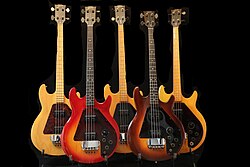
Several all-original Rippers from 1973 and 1974

The L9-S came equipped with two humbucking pickups designed especially for the Ripper by Bill Lawrence which were called "Super Humbuckers." The "Q System" tone circuit included a master volume, master tone, a midrange roll-off, and a four position pickup selector control:

Q-System Knob Settings
Knob Position Pickup Wiring Tone Description
1 Both pickups, in-phase, wired in series Brighter, full
2 Bridge pickup only Max treble
3 Both pickups, in-phase, wired in parallel Deeper, full
4 Both pickups, out-of-phase, wired in series Sharper, edgy

The original circuit had no provision for the neck pickup being soloed. Some owners had their basses modified to replace position 4 with that option, finding the out-of-phase, series wiring to be too brittle and biting.

There was also a fretless version of the Ripper – identical in all respects (fretboard aside).

The original Gibson model is now rare and has seen significant inflation in value over time. Epiphone offered a less expensive model that was produced for several years. Although it shared the same body style and aesthetic of the original, it was equipped with either a single humbucking pickup, or a P/J set instead of the original's Super Humbuckers. The circuits were simplified as well, and necks were typically bolt-on and not set.

Gibson re-introduced the Ripper in 2009 as the "Ripper II", with slightly different specs from the initial 1973–1983 run. The reissue featured a Corian nut, unlike the original which was a plastic material, and it featured a top-load tailpiece with no string-through-body option. The Super Humbuckers were wired differently, as they were reissues manufactured by Seymour Duncan for Gibson. The 2009 Rippers feature a master volume knob, a mid-range notch filter (captor/inductor), a master tone knob, and a six-position selector switch for choosing between different pickup configurations.[2]

The Ripper is "cousin" to the Gibson Grabber and Gibson G3 models also manufactured by Gibson around the same time. All three had the same body shape, but different appointments. The Grabber had a different headstock and featured a sliding pickup that could be moved between the neck and bridge positions. The G3 featured three single-coil pickups that could be selected in a variety of tonal options. The "Grabber II" was also re-released in 2009. The Ripper used set-neck construction, while both the G3 and Grabber had bolt-on necks.

Notable users

[edit]

References

[edit]
[edit]
Revisions and contributorsEdit on WikipediaRead on Wikipedia
from Grokipedia
The Gibson Ripper, officially designated the L-9S Ripper and designed by Bill Lawrence, is an model manufactured by the Gibson Guitar Corporation from 1973 to 1982, renowned for its bold, ergonomic design and versatile tonal range that bridged aggressive rock tones with clearer, more articulate sounds. Featuring a solid body typically made of (with used in some years), a set three-piece , and a 34.5-inch scale length, the Ripper offered a comfortable playing experience with its contoured edges and offset waist, setting it apart from Gibson's earlier short-scale EB basses. Its electronics, including two humbucking pickups designed by Bill Lawrence—known as Super Humbuckers or Ripper humbuckers—were paired with innovative controls: a volume knob, a tone knob, a passive midrange boost, and a four-way pickup selector switch that allowed for combinations like both pickups in series, parallel, or single-coil emulation. This setup provided six distinct tonal options, making the Ripper highly adaptable for genres from to . Introduced at the 1973 NAMM show and entering production the following year, the Ripper emerged as Gibson's response to the dominance of Fender's Precision and Jazz basses, aiming to refresh the company's bass lineup amid shifting market preferences in the early 1970s. Early models featured maple bodies and fingerboards in finishes like natural, ebony (black), and tobacco sunburst, with options for rosewood or ebony fingerboards on later variants; a fretless version was also produced from 1975 to 1979, totaling around 900 units. Hardware included a three-point Tune-o-matic style bridge and Schaller tuners, contributing to its stable intonation and playability. Over its production run, approximately 8,000 Rippers were shipped, with the highest numbers in natural gloss (4,348) and ebony (2,403) finishes, though exact figures vary slightly by source. The model's discontinuation in 1982 reflected broader changes at Gibson, but its legacy endured through reissues and its influence on subsequent bass designs. The Ripper gained cultural prominence in , notably wielded by of , who favored its powerful output for the band's high-energy performances starting in the mid-1970s, and by of Nirvana, whose use of a 1974 model amplified its grunge-era revival in the late 1980s and 1990s. Other early adopters included Dartanyan Brown of the jazz-rock band Chase, who road-tested prototypes. Today, vintage Rippers are collectible, with well-preserved examples from 1973 commanding premium prices due to their scarcity—only 39 were made that year—and the instrument's role in defining 1970s bass innovation.

History

Development and Introduction

The Gibson Ripper bass was developed in the early as part of Gibson's effort to modernize its lineup amid the evolving demands of and fusion genres, which required instruments capable of delivering louder, more aggressive, and versatile tones to cut through amplified ensembles. Designer Bill Lawrence, who joined Gibson in 1972, played a pivotal role in creating the Ripper, focusing on integrating high-output pickups and innovative electronics to address the limitations of the company's earlier EB-series basses, such as their heavier construction and less dynamic sound profiles. Lawrence's design emphasized Gibson's longstanding heritage—pioneered in the —to provide a competitive edge over popular Fender Precision and basses, offering enhanced sustain and tonal variety for contemporary players. Initial prototyping occurred between 1972 and 1973, involving early sketches of the Ripper's distinctive angular , which drew inspiration from the need for ergonomic playability and visual appeal in high-energy performances. Lawrence collaborated on testing integration and circuitry, resulting in a small batch of prototypes that incorporated experimental features like varied body contours and pickup configurations to ensure reliability under stage conditions. These prototypes were road-tested by musicians such as of and Dartanyan Brown of the fusion band Chase, whose feedback helped refine the bass's aggressive output and tonal flexibility for the era's rock and fusion scenes. The Ripper made its official debut at the June 1973 in , where it was showcased as the L-9S model and received positive attention for its modern aesthetics and performance capabilities. First production units began shipping in late 1973 from Gibson's Kalamazoo factory, marking a strategic launch to reposition the brand in the competitive electric bass market. Marketing materials highlighted the Ripper's humbucker-driven power and versatility, positioning it as an ideal instrument for the growing demand in amplified music, with promotional efforts including demonstration records featuring professional bassists to underscore its edge over single-coil competitors.

Production Timeline

The Gibson Ripper bass, designed by Bill Lawrence, entered production in late 1973 at Gibson's Kalamazoo factory, with initial shipments limited to a small batch of prototypes and early models featuring a wider, body design. By , production ramped up significantly, with 1,288 units shipped that year, primarily in natural finish, though a limited number of early examples appeared in tobacco or cherry sunburst variants. In 1975, Gibson shifted to an alder body construction exclusively for weight reduction, resulting in lighter instruments compared to the denser used previously; this change persisted into 1976 before reverting to in 1977 and continuing through the model's run. Production peaked in the mid-1970s, driven by strong demand for the updated and finishes like natural gloss (totaling 4,348 across the run) and (2,403 total). Production began to decline in the late , dropping to under 1,000 units by 1979, as Gibson faced broader economic pressures during the Norlin ownership, including rising costs and shifting market preferences toward active electronics in competitors' models. The introduction of the RD series basses in 1977, featuring active circuitry, further diverted resources and consumer interest from the passive Ripper design. By 1982–1983, annual output fell below 200 units, with only a trickle produced before discontinuation in 1983, marking the end of a ten-year run totaling under 10,000 instruments overall. The Ripper's relative rarity today stems from its modest production scale, with color variants like the 1974 cherry sunburst limited to fewer than 50 documented examples, enhancing collector interest in surviving originals.

Design and Specifications

Construction and Materials

The Gibson Ripper bass employs a featuring a distinctive double-cutaway shape, which facilitates improved access to the upper frets. The body measures approximately 14.5 inches wide, 21.5 inches long, and 1.25 inches deep, contributing to its balanced playability and tonal resonance. The body is primarily constructed from one-piece maple, selected for its resonance and sustain properties, resulting in an average weight of around 11 pounds. In 1975 and 1976, a variant using alder wood was introduced to achieve a lighter weight of approximately 9-10 pounds while maintaining structural integrity. The neck is a three-piece maple set-neck design with a 34.5-inch scale length, providing stability and enhanced sustain through its seamless integration with the body. Fretboard options included maple (for natural finish), ebony (for black and tobacco sunburst finishes), and rosewood, including for later variants; both featuring 20 frets and a nut width of 1.59 inches for comfortable playability. Fretless models used an ebony fretboard. Hardware consists of chrome-plated components, including a three-point adjustable bridge and a combination tailpiece that supports top-loading or string-through-body stringing for simplified setup and intonation adjustments. A fretless variant became available starting in , equipped with an fretboard to withstand the rigors of fingerstyle playing.

Electronics and Hardware

The Gibson Ripper bass features two Super Humbucker pickups designed by Bill Lawrence specifically for the model, providing a versatile tonal foundation with reduced hum and enhanced clarity due to their lower impedance construction. These deliver high-output signals suitable for amplified performance, emphasizing punchy mids and tight lows that pair well with the bass's or body for a bright, defined response. Central to the Ripper's electronics is the innovative Q System tone circuit, also developed by Bill Lawrence, which includes a master volume knob, a master tone control for overall treble adjustment, and a dedicated midrange contour knob (boost/cut) to shape frequencies around the mid spectrum. Complementing these is a four-position rotary selector switch that configures the pickups as follows: position 1 - both pickups in series (in-phase) for more bite; position 2 - bridge pickup only for maximum treble; position 3 - both pickups in parallel (in-phase) for more bottom end; position 4 - both pickups in series (out-of-phase) for funky, dirty tonality with single-coil emulation. The circuit employs CTS potentiometers for reliable control response and is wired point-to-point for durability and signal integrity. The output jack is a standard side-mounted 1/4-inch mono type, facilitating easy connectivity, while the rotary selector switch is designed as a non-reversible unit to prevent accidental shifts during play. Fretless Ripper models from 1975 onward retain the identical passive electronics configuration, without active preamplification, allowing the Super Humbuckers to capture the instrument's natural sustain and low-end depth.

Variants and Reissues

Original Models

The Gibson Ripper bass, designated as the L-9S model, was introduced in late as Gibson's innovative entry into the electric bass market, featuring a solid body, a three-piece set neck, and an fretboard for enhanced tonal clarity and playability. This standard configuration included two humbucking pickups designed by Bill Lawrence, along with a unique Q-system electronics setup comprising volume, tone, midrange controls, and a four-way pickup selector switch, which allowed for versatile sound shaping. Production of the maple-bodied version continued through 1974 and resumed from 1977 to 1982, with approximately 8,225 units shipped from to 1982, contributing to its status as a collectible instrument today. All models featured a 34.5-inch scale length. In 1975, Gibson introduced an alder-bodied variant of the Ripper to address concerns over the model's weight, resulting in a lighter instrument that emphasized natural finishes to highlight the wood's grain and aesthetics. This version retained the same neck and electronics as the standard model but was produced for a limited period, primarily in 1975 and 1976, making it scarcer than the counterparts. The fretless Ripper, Gibson's first production , was released in 1975, offering musicians a smooth, expressive option suited for and fusion styles with its or and the same body options as the fretted models. While early prototypes explored shorter scales, production models standardized at 34.5 inches for consistent intonation and playability, with around 350 units built before production tapered off by 1979. Original Rippers were available in a select range of finishes, with emerging as the most common black option for its sleek, professional appearance, while Tobacco Sunburst variants, introduced around 1975, added a warm, aesthetic particularly popular on alder bodies. Natural gloss and finishes dominated early production, underscoring the model's emphasis on wood visibility. Complementing the Ripper lineup were sibling models sharing its double-cutaway body design but adapted for different playing preferences: the , launched in 1973 as a single-cutaway variant with a bolt-on and single-coil pickup for brighter tones, and the G3, introduced in 1975 as a three-pickup evolution of the Grabber featuring stacked single-coils for expanded sonic versatility. These models diverged primarily in and construction while maintaining the Ripper's core ergonomic outline.

Modern Reissues

In 2009, Gibson reintroduced the Ripper design as the limited-edition Ripper II, producing 350 serialized units to revive the model's distinctive offset double-cutaway aesthetic and electronics. This reissue incorporated modern updates including a nut for enhanced sustain and tuning stability, a top-loading bridge for easier string changes and improved intonation, and two custom-wound humbucking pickups designed exclusively for Gibson. A six-position selector switch expanded tonal options, allowing configurations such as individual pickups, series, parallel, and out-of-phase modes, while retaining a passive circuit with master volume, tone, and midrange controls reminiscent of the original Q System. The body was constructed from solid with a gloss finish, paired with a three-piece set neck and fretboard, and originally priced between $1,500 and $2,000. The Ripper II featured a 34-inch scale length. The Ripper II production was confined to 2009, though subsequent limited runs in the early explored variations like natural finishes on bodies, emphasizing the model's lightweight playability and versatile voicing for rock and fusion genres. Key differences from the 1970s-1980s originals included refined hardware such as modern sealed tuners for better reliability and the serialized numbering to denote exclusivity, appealing to collectors seeking updated reliability without altering the core design.

Notable Users and Legacy

Prominent Musicians

, the bassist for Nirvana, prominently featured a 1974 Gibson L9-S Ripper bass in black during the band's 1990s tours, contributing to the raw, aggressive sound heard on albums like (1991). He often paired the instrument with an SVT-400T amplifier head to achieve its punchy, overdriven tone. Gene Simmons of Kiss used a black Gibson Ripper during the band's mid- tours and recordings, favoring its high-output humbuckers for aggressive rock tones. Greg Lake of utilized a 1970s black-finished Gibson Ripper bass during the progressive rock era, including on the album (1973), where its versatile Q-System electronics allowed for dynamic range in complex arrangements. The bass's bold output suited Lake's multifaceted role, blending melodic lines with high-gain textures. Peter Cetera, bassist and vocalist for , appeared in Gibson advertisements and used a Ripper in his 1970s setup for pop-rock, leveraging the Q-System's clean tone options. Other notable users include , who relied on a Gibson Ripper throughout the 1970s for her performances, appreciating its thick neck and woody tone on hits from albums like Suzi Quatro (1973). of incorporated a Ripper into his folk-rock arsenal, notably during the 1976 concert film , where it provided warm, rootsy depth. Louis Johnson of wielded a natural-finish Ripper for grooves, as seen in the music video for "" from Right on Time (1977). In salsa and , Bobby Valentín, known as "El Rey del Bajo," adopted the Ripper for its rhythmic punch in recordings during the 1970s. Jazz-fusion bassist Ralphe Armstrong, who contributed to the Ripper's development, frequently played it with ensembles like the , highlighting its adaptability in improvisational contexts from the mid-1970s onward.

Cultural Impact

The Gibson Ripper bass played a pivotal role in the evolution of , offering an aggressive, high-output tone that bridged traditional passive Gibson sounds with the active electronics increasingly favored in competition with Fender models, thereby influencing and emerging punk bass lines through its versatile Bill Lawrence-designed humbucking pickups and Q-system preamp. This design contributed to its adoption in heavier genres, where the instrument's punchy sustain and clarity cut through dense mixes, marking a shift toward more defined low-end presence in ensembles. Vintage Gibson Rippers have become highly collectible due to their limited production run from 1973 to 1982 and associations with prominent rock figures, with values for well-preserved originals rising from approximately $800 in the early 2000s to over $2,500 by 2025, and rare variants like early 1973 models or Tobacco Sunburst finishes fetching upwards of $9,000 at auction. Scarcity, with only about 39 units produced in the inaugural year and peak output around 1976, has driven this appreciation among enthusiasts seeking authentic 1970s hardware. The Ripper's legacy extends into indie and alternative scenes, where its raw, aggressive timbre inspired —exemplified by its use on Nirvana's album—and fueled a revival in circles, often referenced in bass communities and music documentaries for embodying vintage grit. In the , the bass has seen renewed endorsements through tutorials highlighting its "vintage aggressive tone" for modern players, with reissues like the 2011 Epiphone model contributing to Gibson's expanded presence in the bass market despite mixed reception on build quality. Critics and players praise the Ripper for its exceptional sustain, high output, and tonal versatility across genres, often citing the Super Humbucker pickups' bite and growl as ideal for rock applications. However, it faces for its substantial weight—typically around 9-10 pounds—and tendency toward neck dive during standing play, issues attributed to the body-neck balance that can challenge for extended performances.

References

Add your contribution
Related Hubs
User Avatar
No comments yet.