Hubbry Logo
Gibson HummingbirdGibson HummingbirdMain
Open search
Gibson Hummingbird
Community hub
Gibson Hummingbird
logo
8 pages, 0 posts
0 subscribers
Be the first to start a discussion here.
Gibson Hummingbird
Gibson Hummingbird
from Wikipedia

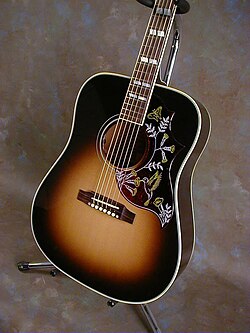
The Gibson Hummingbird is an acoustic guitar model/series produced by the Gibson Guitar Corporation.

Key Information

Unlike the other flat-top Gibson acoustics, the Hummingbird was Gibson's first square-shoulder dreadnought, similar to the dreadnoughts produced by C.F. Martin & Company. Introduced in 1960, the Hummingbird was Gibson's second-most expensive acoustic guitar, behind the Gibson J-200, until the introduction of the Gibson Dove in 1962, (a blend between the Hummingbird and the J-200.) and has remained in production ever since. In 2000 the Gibson Hummingbird was the winner of Acoustic Guitar's Player's Choice Award for the Dreadnought Category, and was described thus: "The Hummingbird has a very wide range of sound, from gutsy and loud, to sweet and soft. Superb for all styles of playing, whether just playing chords or intricate solos."

Models

[edit]

Historical models

[edit]

[1]

The first wave of Hummingbirds came with a solid Sitka spruce top and solid mahogany back. The sides are mahogany, but not all of them are solid, many are laminated. They have adjustable rosewood or ceramic saddles, three-ply maple bridge plates, single X-bracing, engraved hummingbird-butterfly trumpet-flower pickguards with two points on the upper treble bout and one point level with the bridge, as well as bound fretboards with double parallelogram inlays, a crown peghead inlay on the headstock, golden green button tulip tuners, and a cherryburst (a.k.a. cherry sunburst) finish.

A limited number of Hummingbirds produced in 1962 and 1963 have maple backs and sides. A natural top with cherry back-and-sides finish was available in 1963. Also since then, the size of the pickguard has been slightly reduced.

During 1965 the nut width decreased from 1 11/16 to 1 5/8 and in 1968 the bottom belly bridge became more square. At the same time the bracing became bulkier, which somewhat altered the sound of the guitar. A percentage of Hummingbirds with tobacco sunburst finish were produced and the pickguards were attached with five screws for between one and two years. A double X-bracing has been used between 1971 and the mid-80's.

Since 1970, the saddles are no longer adjustable, and the necks are made of laminated three-piece mahogany. The fretboard inlays were changed to block ones, then restored to double parallelograms in 1984.

Mass production models

[edit]

Standard models

[edit]

The name of standard models varies during the years, which could be simply Hummingbird with no suffix, Hummingbird Modern Classic or Hummingbird Standard. They often have AA or AAA-grade solid Sitka spruce tops, with mahogany back and sides. A Hummingbird of this category features a rosewood fretboard with double parallelogram inlays, a crown peghead inlay headstock, nickel Grover Rotomatic tuners and a custom-made Hummingbird tortoiseshell pickguard. An L.R. Baggs Element Active pickup system is also installed. This model is available in different cherryburst variations from strong orange to almost yellow, heritage cherryburst and natural finishes. They are also seen in wine red and black.

Vintage models

[edit]

Hummingbird Vintage, or formally Hummingbird True Vintage, features a vintage appearance and sound, from its "thermally cured" spruce top. It also has gold Gotoh green button tulip tuners and a vintage cherryburst finish, which make the guitar resemble its 1960s ancestors. Also it has the famous, often adored, pickguard wildlife motif engraved and hand-painted, not embedded as the standard. The vintage model has no electronics from the factory.

Small-batch, limited, and custom shop models

[edit]

Icon '60s

[edit]

The Icon '60s Hummingbird is a natural-finished model with block inlays in the fretboard rather than the double parallelograms. It also has an adjustable Tusq saddle and an original 1960s-style Hummingbird pickguard; all of these make it look like a 1960s vintage model.

Custom KOA

[edit]

The Hummingbird Custom KOA model is a custom model, with back and sides constructed from highly figured koa wood. It has gold Grover mother of pearl keystone tuners, a custom in-flight hummingbirds peghead logo and a hummingbird floral tortoiseshell pickguard, all expressed in genuine abalone and mother-of-pearl. It also has an ebony fretboard with rolled edges and Orpheum-style abalone inlays. This model has an antique natural finish.

Hummingbird Red Spruce

[edit]

Introduced as the monthly limited edition of December 2016, featuring select Adirondack red spruce top with mahogany back and sides.[2]

50th Anniversary

[edit]

In 2010, Gibson introduced the Limited Edition 50th Anniversary 1960 Hummingbird series, including the Standard (Heritage Dark Cherry Sunburst), the Rosewood (Heritage Dark Cherry Sunburst) and the KOA (Gold Honey Burst) models.

Eric Church Hummingbird Dark

[edit]

In 2016, Gibson produced a limited number of "Hummingbird Dark" guitars which are slightly thinner than a standard Hummingbird, use a black translucent finish, a red-filled pickguard, and carry the signature of country artist Eric Church.[3]

Hummingbird Silver Burst

[edit]

In 2007, Gibson produced a small batch of silver burst Hummingbird.

Hummingbird, Fuller's Vintage Edition

[edit]

In 2008 Gibson also released a very few Hummingbird Modern Classics with a Vintage Sunburst finish, the same finish seen on a J-45 Standard. The Gibson label found on the inside of this Hummingbird says "Hummingbird, Fuller's Vintage Edition". All the other specifications, such as materials and tuning keys, are the same as the specifications of the standard model.

Special models

[edit]

Artist

[edit]

The Hummingbird Artist model is quite different. It is a Guitar Center exclusive release. It has the body shape and forward shifted bracing of the Songwriter, only in mahogany. It does not have a Hummingbird pickguard (it uses a modern sculpted pickguard instead). An L.R. Baggs Element Active pickup system is also installed. This model has a washed heritage cherry finish.

Gibson Hummingbird Artist model

Pro

[edit]

The Hummingbird Pro model was released by Guitar Center and Musicians Friend but is available from other dealers, specially in Europe. It has the same shape as the Artist model. A cutaway model (Hummingbird Pro EC) is also available. The Hummingbird Pro comes with an L.R. Baggs Element Active pickup system, while the cutaway model has a Fishman Prefix Plus-T preamp system equipped. This model has a vintage sunburst finish. The Pro model shares most of the features of the standard Hummingbird and has a bone nut and saddle.

Epiphone versions

[edit]

A more affordable version of the Hummingbird is also made by the Epiphone branch of Gibson. The original Epiphone Hummingbird was available in natural, cherryburst and black. It was also made with more affordable woods but featured the same design fretboard inlays, bridge and similar pickguard, but without genuine mother-of-pearl. It also featured Grover tuners, rather than the unbranded tuners featured on cheaper Epiphone models.[4] The Epiphone Hummingbird was made in China.

Epiphone reintroduced their version of Gibson's Hummingbird in 2012. Called the Hummingbird Pro, it features a solid spruce top (instead of a laminate top), a mahogany body and neck, a Shadow ePerformer pickup system, and a heritage cherryburst finish. The Hummingbird Pros are made in Indonesia.

In 2021 Epiphone produced a line of acoustics “Inspired by Gibson”, all made in the Samick factory in Indonesia. This also includes a Hummingbird version (next to a j45 and a j200 model). The specifications of this Hummingbird are very close to the Gibson Standard Hummingbird original with spruce top and mahogany back and sides, all solid woods. The fretboard is made of Indian laurel, the inlays are mother of pearl and both nut and saddle are bone. There is a Fishman Sonicore under the saddle piezo pickup system.

Notable Hummingbird players

[edit]

In 1964, Keith Richards and Brian Jones brought the Gibson Hummingbird guitar to the UK. It was used to write songs like: "Play With Fire", "Good Times Bad Times", "As Tears Go By", "The Last Time", "Satisfaction", "Street Fighting Man", "Jumpin' Jack Flash", "Sympathy for the Devil" (as seen in the Jean-Luc Godard movie - One Plus One), "No Expectations", "Angie", "Wild Horses", "Brown Sugar".[5] In the video of "It's Only Rock & Roll", Mick Taylor uses the guitar. In 1968, Richards and Mick Jagger of The Rolling Stones both used a Gibson Hummingbird for the initial recordings of the melody for the song "Street Fighting Man".[6] Remi Matsuo,[7] Eric Church, Thom Yorke, Steve Wariner, Frank Turner, John McLaughlin, Dominic Miller, William Orbit, Tom Petty, Everlast, Shuggie Otis, Gillian Welch, Tom Wolk, Grace Potter, Brian May, Paolo Nutini, Twin Shadow, Børns, Darius Rucker, Justin Bieber, Yungblud, Michelle Branch, Jeff Lynne, Passenger (singer), Taylor Swift and Wesley Schultz are among other notable Hummingbird players.

References

[edit]
[edit]
Revisions and contributorsEdit on WikipediaRead on Wikipedia
from Grokipedia
The Gibson Hummingbird is an acoustic guitar model manufactured by the Gibson Guitar Corporation, introduced in 1960 as the company's first square-shouldered dreadnought design. It features a Sitka spruce top, mahogany back and sides, a 24.75-inch scale length, and a distinctive engraved thermoplastic pickguard depicting a hummingbird in flight, which gives the model its name. Known for its versatile tone—characterized by a warm, full-bodied sound with pronounced bass response and balanced projection—the Hummingbird was positioned as Gibson's premium acoustic offering during the 1960s folk revival, second only to the J-200 in price until the Dove model's debut. The Hummingbird's development stemmed from Gibson's efforts to compete in the booming acoustic market of the late 1950s, with its debut shipment of 156 units in 1960 quickly gaining traction; sales peaked at 1,364 instruments by 1963. Early models adhered closely to traditional specifications, including a neck with a rounded profile, Indian featuring mother-of-pearl parallelogram inlays, and an adjustable bridge. Over the decades, variations emerged, such as occasional 25.5-inch scale lengths in 1962–1963 prototypes with bodies akin to the Dove, a shift to Indian for the back/sides in 1969, and the addition of double-X bracing in 1971 for enhanced resonance. Production relocated to Gibson's Nashville facility in 1984, where modern iterations revived 1960s specifications, including multi-ply binding and nitrocellulose lacquer finishes in colors like Vintage Sunburst or Heritage Cherry Sunburst. Contemporary models often incorporate LR Baggs VTC electronics for amplified performance, with Rotomatic tuners and a Rounded SlimTaper neck profile for playability. The Hummingbird's cultural significance is underscored by its adoption by influential musicians across genres, cementing its status as a staple in history, and its role in the 1960s folk revival influenced Gibson's acoustic lineup, paving the way for models like the Dove. of used a Hummingbird for the acoustic rhythm track on "Street Fighting Man" from the 1968 album Beggars Banquet, capturing its raw, distorted edge through innovative recording techniques. frequently played the model during his electric and folk phases, valuing its projection and tonal clarity for songwriting and live performances. Other notable players include , , and , who leveraged its robust build and voice-like midrange for studio recordings and stage work. Today, the Hummingbird remains a benchmark for square-shoulder acoustics, available in standard, studio, and custom variants that honor its legacy while incorporating modern refinements for professional and amateur players alike.

History

Origins and Introduction

The Gibson Hummingbird debuted in 1960 as Gibson's first square-shouldered model, designed by company president in response to the burgeoning revival of the late 1950s and early 1960s. This period saw a surge in demand for flat-top acoustics suitable for strumming and fingerpicking, prompting Gibson to pivot from its traditional focus on archtop guitars, whose sales had waned amid shifting musical tastes toward folk and country styles. McCarty, who had overseen numerous innovations since joining Gibson in 1948, aimed to create a premium instrument that combined visual flair with robust projection, positioning the Hummingbird as a flagship offering in the company's acoustic lineup. The initial design featured a square-shouldered inspired by Martin Guitar's dreadnought models like the D-18, but adapted with Gibson's characteristic rounded lower bout for enhanced comfort and resonance. Constructed with a solid Sitka spruce top for bright, articulate highs and solid back and sides for warm depth, the guitar delivered a balanced tone with strong midrange and a full low end, ideal for both solo and ensemble play. It measured 24.75 inches in scale length and sported a cherry nitrocellulose finish, which highlighted the wood grains while evoking a premium aesthetic. A defining visual element was the introduction of the engraved pickguard bearing a stylized motif, designed by Hartford Snider to add a distinctive, ornamental touch that set it apart from competitors. In its production debut at the Kalamazoo factory, only 156 Hummingbird units were shipped in , reflecting Gibson's cautious entry into this market segment. Early marketing in Gibson's catalogs emphasized its suitability as a flat-picking instrument for folk and musicians, describing it as a "fabulous new" model with "big, round, full" sound perfect for vocal accompaniment and rhythmic drive. This positioning capitalized on the era's folk boom, targeting performers seeking an upmarket acoustic that blended showmanship with sonic versatility.

Evolution and Milestones

The Gibson Hummingbird experienced a surge in popularity during the 1960s folk revival, as it was embraced by prominent artists for its balanced tone and projection suitable for vocal accompaniment. Shipments grew from 156 units in 1960 to 595 in 1961 and 503 in 1962, tripling to 1,364 models plus 97 natural finishes by 1963, reflecting peak demand in the mid-decade amid the acoustic boom. In 1969, Gibson shifted the bridge and back/sides materials from to Indian rosewood, enhancing the tonal warmth. In the 1970s and under Norlin ownership, the underwent several modifications amid broader economic pressures on the guitar industry, including rising material costs and shifting market preferences toward electric instruments, which contributed to declining sales. Key changes included the addition of a at the neck-headstock joint in the mid-1970s for added strength, a shift to a three-piece neck, and the introduction of double-X bracing in 1971, alongside rectangular inlays and a non-adjustable bridge. Production moved to Nashville in , reverting to more traditional specifications to address quality concerns from the era. The 1990s marked a revival under Henry Juszkiewicz's leadership following his 1986 acquisition of Gibson, with the company reintroducing classic specifications through limited editions like the 1994 model, celebrating Gibson's 100th anniversary and restoring player confidence in the design's heritage tonewoods and appointments. Entering the and , milestones included the 2010 50th Anniversary reissue, a Custom Shop recreation faithful to the 1960 original with premium and an aged aesthetic to evoke vintage playability. In 2008, Gibson integrated LR Baggs Element electronics as a standard option on select models, enhancing amplified performance for stage use without altering the acoustic voice. Recent 2020s updates emphasize accessibility and innovation, such as the 2023 introduction of the Studio with a slimmer body depth for improved comfort and projection using solid tonewoods. Color expansions in 2025 added Translucent Teal, Purple Burst, and Cherry Burst finishes to the Standard lineup, alongside the Acoustic Specials series offering streamlined, USA-made variants at entry-level pricing with satin finishes. At NAMM 2025, Gibson unveiled new acoustic models including variants among over a dozen releases, while advancing through options like the 2019 Sustainable series' wax finishes replacing on select builds to reduce environmental impact.

Design and Construction

Body and Materials

The Gibson Hummingbird employs a square-shouldered body shape, renowned for delivering powerful volume and a rich, balanced tonal profile suitable for various musical styles. This design incorporates a 24.75-inch scale length, a 16-inch lower bout width, and a body depth of approximately 4.75 inches, providing ample resonance and playability. The soundboard consists of a solid Sitka spruce top, which offers bright articulation and , supported by traditional hand-scalloped X-bracing that enhances sustain while maintaining structural integrity for a well-rounded tone. In select limited-edition models, the top utilizes red spruce instead, prized for its stiffness and ability to produce clear, responsive overtones with added warmth. The back and sides are crafted primarily from solid , contributing warmth and midrange focus to the overall voice of the instrument. From the 2024 Standard models onward, options with solid back and sides became available, imparting deeper low-end response and improved bass projection compared to . Traditional finishes, as used on vintage-inspired models, allow to breathe and vibrate freely for authentic , while modern gloss variants provide enhanced protection against wear. Iconic patterns, such as Heritage Cherry , accentuate the figure of the top and evoke the model's classic aesthetic. The pickguard features a signature thermoplastic Hummingbird-shaped design in tortoise shell, measuring 0.060 inches thick, which has progressed from early celluloid constructions in 1960 to more stable modern composites that resist lifting and warping. Multi-ply ivoroid binding adorns the top and back, offering both decorative contrast and reinforcement to the body edges. The rosette incorporates a wood mosaic pattern, providing subtle visual detail around the soundhole that harmonizes with the guitar's organic materials.

Neck, Hardware, and Electronics

The Gibson Hummingbird features a one-piece neck designed for comfortable playability, with a rounded profile that provides a substantial yet accessible feel for a range of playing styles. Modern standard models incorporate this rounded profile, measuring approximately 1.725 inches at the nut width to accommodate finger placement without excessive crowding. Reissue and vintage-inspired variants often replicate the fuller rounded shape of originals, emphasizing a more substantial grip that enhances sustain and during extended sessions. The fretboard is typically crafted from Indian rosewood, offering a smooth surface with 20 standard frets that extend playability into higher registers. Inlays consist of mother-of-pearl parallelograms, providing subtle visual markers while maintaining a clean aesthetic. Some limited-edition and custom models, such as the EC, substitute for the fretboard to deliver enhanced brightness and durability. The frets are crowned for optimal contact and reduced string drag, contributing to precise intonation and effortless bending. Hardware on the Hummingbird includes Grover Rotomatic tuners with nickel plating, ensuring stable tuning retention even under stage conditions. An adjustable allows users to fine-tune for personalized action and response, accessible via a adjustment point. The compensated is made from TUSQ in contemporary models for consistent tone and sustain, though variants appear in reissues to evoke warmth. The bridge is a traditional reverse-belly design, securing strings with Tusq pins for reliable downward pressure and projection. Electronics were introduced to the Hummingbird lineup starting in , featuring the LR Baggs VTC system in acoustic-electric variants. This under-saddle pickup with integrated preamp provides natural amplified tone, controlled via soundhole-mounted volume and tone knobs for discreet adjustments during performance. In contrast, Hummingbird models often employ the simpler Fishman Sonitone system, offering basic onboard amplification suitable for entry-level use. Factory string setup utilizes light gauge strings (.012-.053), delivering balanced tension and warm projection across the dreadnought body.

Production Models

Standard Models

The Gibson Hummingbird Standard features a traditional square-shouldered body with a full depth of approximately 4.88 inches at the rim, constructed from a solid Sitka spruce top and back and sides for a balanced tone with rich projection. In a 2024 update, Gibson introduced a rosewood-backed version with solid Indian rosewood back and sides, enhancing the bass response while maintaining the classic Hummingbird warmth; available finishes include Vintage Sunburst, Natural, and limited options like Purple Burst or Wine Red. Priced around $3,400 to $4,000, it includes L.R. Baggs VTC electronics for amplified performance, a neck with Rounded profile, rosewood fretboard, and Grover Rotomatic tuners, all handcrafted in Bozeman, Montana. The Hummingbird Studio offers a more accessible entry into the lineup with a nitrocellulose finish and full-depth body—updated in 2024 from prior shallower designs—for improved volume and tonal depth without added weight. It pairs a solid Sitka spruce top with either or (2025 introduction) back and sides, an Advanced Response neck profile for enhanced playability, and L.R. Baggs Element Bronze electronics; finishes like Rosewood Burst or Tri-Burst are standard, with prices under $2,500. This model emphasizes stage-ready sound and slim aesthetics while preserving the Hummingbird's signature versatility. Introduced in late 2024, the Cutaway (EC) variants extend the core lineup with a Venetian cutaway for improved upper-fret access, standard across Standard, Studio, and EC models. These retain the respective body woods— or back and sides with Sitka tops—and include L.R. Baggs electronics as standard, with gloss or satin finishes in bursts like Tri-Burst or Rosewood Burst; the Standard EC, for instance, uses a neck and costs approximately $3,500. Designed for performers needing ergonomic enhancements, they maintain Bozeman craftsmanship with hardshell cases included. The 2025 Acoustic Specials series introduces the Special as an entry-level USA-built option with solid Sitka spruce top and solid back and sides, featuring a slightly shallower " depth" body for a tighter bass response and lighter feel, alongside a finish in colors like Vintage Cherry Sunburst, , or Wine . Priced at about $2,200, it includes L.R. Baggs VTC electronics, a Rounded profile, and focuses on affordability without compromising solid-wood tonewoods or Bozeman production standards. All standard Hummingbird models undergo rigorous in Bozeman, where the facility's 2021 expansion doubled acoustic production capacity to meet .

Reissue and Vintage Models

The Gibson Historic Series, launched in 1991 as part of the Custom Shop's efforts to recreate Golden Era instruments, produces faithful reissues of the 1960 Hummingbird with period-accurate features such as a long neck tenon for enhanced sustain and vibration transfer, a 1.75-inch bone nut, and hot hide glue for the compound dovetail neck joint. These models employ thermally aged Sitka spruce tops paired with back and sides, along with Murphy Lab aging techniques on the finish to achieve a relic'd appearance that evokes decades of play while preserving structural integrity. Traditional hand-scalloped X-bracing supports the top, contributing to the balanced, midrange-rich tone characteristic of early 1960s examples. The Original Series complements the Historic line by offering full-depth bodies inspired by designs, incorporating a vintage-correct at the neck heel for added strength and a slim-taper profile, alongside smaller crown frets for improved playability and feel. An fretboard option provides a darker, smoother surface with enhanced durability, while mother-of-pearl parallelogram inlays maintain the classic aesthetic. Like the Historic models, these feature a 24.75-inch scale length and nut and saddle for resonant projection. Reissue platforms for the Hummingbird often share foundational elements such as scalloped bracing, but are distinctly identified by the heritage cherry sunburst finish and the engraved celluloid Hummingbird pickguard. These models are available exclusively through Gibson's catalog releases, with prices starting above $4,000 depending on aging level and appointments, appealing primarily to collectors seeking historical fidelity over modern optimizations.

Limited Editions and Custom Variants

Custom Shop Releases

The Gibson Custom Shop, located in , specializes in hand-built Hummingbird models using premium tonewoods such as master-grade , with each instrument featuring unique serial numbering and a to ensure and quality. These small-batch releases emphasize meticulous craftsmanship, often incorporating thermally aged tops and traditional X-bracing for enhanced vintage-inspired resonance and projection. The Icon '60s replicates early 1960s specifications with a slim-taper neck profile for comfortable playability and a small pickguard for authentic aesthetics. The Custom variant utilizes solid Hawaiian koa back and sides, which contribute to a brighter, more articulate tone compared to traditional , paired with a figured Sitka top and elaborate hand-inlaid motifs on the , , pickguard, and bridge; it retails for approximately $8,999. The Red Spruce model features a hand-selected Adirondack red top, known for its stiffness and ability to deliver louder projection with balanced highs, tight bass, and rich , offered as a limited-edition release. Introduced in 2025, the Hummingbird Silver Burst showcases a distinctive metallic burst finish over a red spruce top, complemented by aged hardware for a relic'd appearance that evokes mid-century vibe while maintaining modern structural integrity.

Artist and Special Editions

The Gibson Hummingbird has been featured in several artist-endorsed and commemorative editions that highlight collaborations with musicians and special events, often incorporating unique finishes, , and limited production to appeal to performers and collectors. These models emphasize the guitar's iconic design while adding personalized elements tailored to the artist's preferences or the occasion's theme. In 2010, Gibson released the Limited Edition 50th Anniversary 1960 Hummingbird through its Custom Shop to mark the model's introduction in , featuring a square-shouldered body with a Sitka spruce top, back and sides, and traditional double-ring rosette, available in variants such as Heritage Cherry Sunburst and Exotic Rosewood. Three distinct versions were produced at the end of 2010, including commemorative details like a hand-painted pickguard and mother-of-pearl inlays on the denoting the anniversary. The Hummingbird Dark, endorsed by country artist , debuted in 2016 with production continuing into 2018, showcasing an all-black aesthetic with a Translucent Burst or Burst finish, fretboard, and LR Baggs VTC pickup system for enhanced stage performance. Church contributed to the design, resulting in a limited-run model built in , that delivers a warm, rich tone suited to vocals and low-position chords on its 24.75-inch scale. Gibson's Hummingbird Pro serves as a professional-grade variant optimized for live use, incorporating a cutaway body for improved access to upper frets, a solid Sitka spruce top with back and sides, and Fishman Prefix Plus-T onboard electronics with volume, bass, treble, and contour controls for versatile amplification. This model maintains the classic Hummingbird square-shoulder shape while adding balanced projection, making it a reliable choice for working musicians. Artist collaborations under Gibson's series include the 2022 Billy Reid x Gibson Collection, which paired fashion designer Billy Reid with the brand to create a Hummingbird Standard featuring Reid's original artwork on the pickguard and body, alongside apparel and accessories inspired by the guitar's motif. This thematic release highlighted the Hummingbird's status, with the guitar maintaining traditional top and construction for its signature balanced tone. Special runs tied to events encompass the 2025 Special unveiled at NAMM, a no-frills USA-made edition with a finish in options like Cherry or Wine , solid Sitka spruce top, and back and sides for warm, articulate tone at an accessible . Additionally, Gibson Gives supported in 2024-2025 through auctions and grants, including custom instruments with unique engravings, though specific charity models were part of broader philanthropic efforts rather than standalone releases. Holiday-themed variants have occasionally appeared in limited apparel-integrated collections, emphasizing festive engravings and cases.

Epiphone Versions

Development and Early Models

The Epiphone Hummingbird was introduced around 1995 as Gibson's budget-line interpretation of the iconic square-shouldered dreadnought design, offering an accessible entry point for players inspired by the original Gibson model while incorporating cost-effective materials like laminated woods. Early production emphasized affordability, with a laminated spruce top over mahogany back and sides, a cherry sunburst finish, and basic hardware suited for beginners. These initial models were manufactured in , reflecting Epiphone's broader shift from U.S. production in —where the brand's acoustics were built until 1970—to overseas facilities in , Korea, and eventually during the late . Unlike some other Epiphone acoustic lines that experienced a hiatus in the 1970s and 1980s, the was introduced around in Chinese-made form as a new model for a new generation, with no prior versions produced under the Epiphone name. Key distinctions from the Gibson Hummingbird included a 24.75-inch scale length, the same as the Gibson model, for comfortable playability, bound necks with simpler inlays, and entry-level tuners and bridges, all positioned to appeal to novice and budget-conscious musicians at prices typically under $600. Into the 2000s, select early variants saw upgrades such as solid tops for improved tonal resonance, marking a milestone in elevating the model's quality without straying from its value-oriented roots.

Modern Epiphone Offerings

The Hummingbird Studio, introduced in 2023 as part of the Studio Acoustic Collection, features a solid top paired with layered back and sides, providing a balanced tone suitable for stage and studio use. This model maintains the standard shape inspired by its Gibson counterpart, enhancing playability for extended sessions while preserving the iconic square-shouldered design. Priced at approximately $449, it includes Fishman Presys VT with a soundhole-mounted preamp for amplified performance, Rotomatic tuners, and a neck with a comfortable profile, making it an accessible entry into the Hummingbird lineage. In the Inspired by Gibson series, the Hummingbird Deluxe EC offers a cutaway design for improved upper-fret access, equipped with advanced eSonic2 in earlier variants, though recent iterations incorporate the L.R. Baggs Element Bronze VTC system for natural acoustic reproduction. Available in finishes such as vintage sunburst and , this model emphasizes versatility for performers, with a thermally aged solid top, solid back and sides, and a one-piece neck featuring a Rounded C profile. Its construction delivers rich projection and clarity, bridging traditional aesthetics with modern functionality at a street price around $1,299. The Masterbilt Collection represents Epiphone's higher-end Hummingbird offerings, utilizing all-solid woods including a Sitka top and back and sides to achieve a tone closer to vintage Gibson models, with enhanced resonance and sustain. These guitars feature a V-shaped profile for an authentic feel, Fishman Sonitone electronics, bone nut and , and premium appointments like multi-ply binding and a Kalamazoo-style . Priced starting at $849, they target players seeking professional-grade quality without the premium cost of Gibson equivalents. For 2025, introduced updates across its lineup, including new finishes that mirror Gibson's vibrant options such as Purple Burst and Autumn Burst, alongside the integration of L.R. Baggs systems in professional models for superior onboard amplification. These enhancements focus on thermal aging for tops to evoke vintage warmth and improved electronics for live applications, available in both and Deluxe EC variants. Modern Hummingbirds are primarily assembled in the factory in , with quality control overseen by Gibson Brands to ensure consistency before distribution. Backed by a limited lifetime for the original purchaser covering defects in materials and workmanship, these instruments emphasize value and reliability for intermediate players entering the acoustic-electric market.

Notable Players

Iconic Musicians

Keith Richards of the Rolling Stones popularized the Gibson Hummingbird during the band's late 1960s acoustic experiments, notably using a 1960s model to record the rhythm track for "Street Fighting Man" from the 1968 album Beggars Banquet. The song's raw, cassette-recorded acoustic riff, captured on the Hummingbird in open D tuning, captured the era's revolutionary energy and influenced rock's blend of acoustic and electric elements. Richards also employed the same guitar for the riff in "Jumpin' Jack Flash," released as a single in 1968, solidifying the Hummingbird's role in defining the Stones' gritty sound. Bob Dylan embraced the Gibson Hummingbird during his 1960s folk transition, integrating it into his evolving acoustic style as he shifted toward electric instrumentation. The model supported his songwriting and performances during the folk revival. Emmylou Harris, a cornerstone of , has utilized Gibson acoustic guitars, including the Hummingbird, to complement her ethereal vocals and bridge folk and country genres. Eric Church, a prominent modern country artist, endorsed the Gibson Hummingbird Dark in 2018, a limited-edition variant he co-designed with its slimmer body depth for enhanced tonal balance during live sets. Church has prominently used the model in concerts, leveraging its LR Baggs VTC pickup for amplified performances that blend traditional country with rock edges, as seen in tours supporting albums like Desperate Man (2018). Among other notable players, of Led Zeppelin incorporated the Gibson Hummingbird into the band's acoustic arrangements during the late 1960s and 1970s, favoring its balanced projection for tracks like "" from the 1969 debut album. has leveraged the Hummingbird's robust build and voice-like for studio recordings and stage work across her career. has included the Hummingbird in her guitar collection and performances, appreciating its versatile tone in her transition from country to pop.

Cultural Impact

The Gibson Hummingbird emerged as a defining symbol of the 1960s folk revival and rock movements, aligning closely with the era's countercultural ethos through its bold design and versatile tone suited for singer-songwriters. Introduced in 1960 as Gibson's inaugural square-shouldered dreadnought, it catered to the burgeoning folk scene by offering a balanced projection with strong midrange and low-end warmth, ideal for accompanying vocals in intimate performances and recordings. Its cherry sunburst finish and ornate engraved pickguard became visual hallmarks of the period's acoustic authenticity, influencing the aesthetic shift toward more decorative yet playable instruments amid the folk boom. In the realm of and Americana, the gained prominence in the Nashville music scene following the 1970s, evolving from its folk roots to embody songwriting acoustics with a rich, resonant voice that supported narrative-driven genres. Post-1970s production shifts, including the adoption of and refined bracing, enhanced its appeal for studio work and live settings, where artists leveraged its for heartfelt ballads and roots-oriented tracks. By the 1980s and beyond, it became a staple in Nashville's evolving , contributing to the blend of traditional with broader Americana influences through its reliable projection and warm . The Hummingbird's presence in media has cemented its cultural footprint, notably appearing in the 1968 Sympathy for the Devil, where and showcased it during sessions, highlighting its role in raw, recordings. On albums like the Stones' (1968), Richards' use of a Hummingbird on ""—recorded via a cassette recorder for a gritty, distorted acoustic effect—pioneered innovative production techniques that bridged folk intimacy with rock aggression, influencing countless subsequent recordings. Among collectors, 1960s original Hummingbirds have seen a marked rise in value, with well-preserved cherry examples fetching $7,500–$10,000 as of 2025, driven by their and —only 156 units sold in 1960. This appreciation underscores the model's status in the guitar collecting community, where pristine early-to-mid 1960s variants are prized for their authentic voicing and cosmetic details, fostering a dedicated market for vintage acoustics. In its modern legacy, the Hummingbird continues to inspire through 2025 reissues and sustainable innovations, such as the Hummingbird Sustainable model featuring responsibly harvested North American and Richlite components derived from recycled paper, aligning with Gibson's broader environmental commitments to reduce waste and integrate eco-friendly materials without compromising tone. These revivals, including new color variants like and Burst, maintain the model's iconic silhouette while appealing to contemporary players. Furthermore, its design principles have influenced boutique builders, who often draw on the square-shouldered form for custom instruments emphasizing vintage-inspired projection and aesthetics.

References

Add your contribution
Related Hubs
User Avatar
No comments yet.