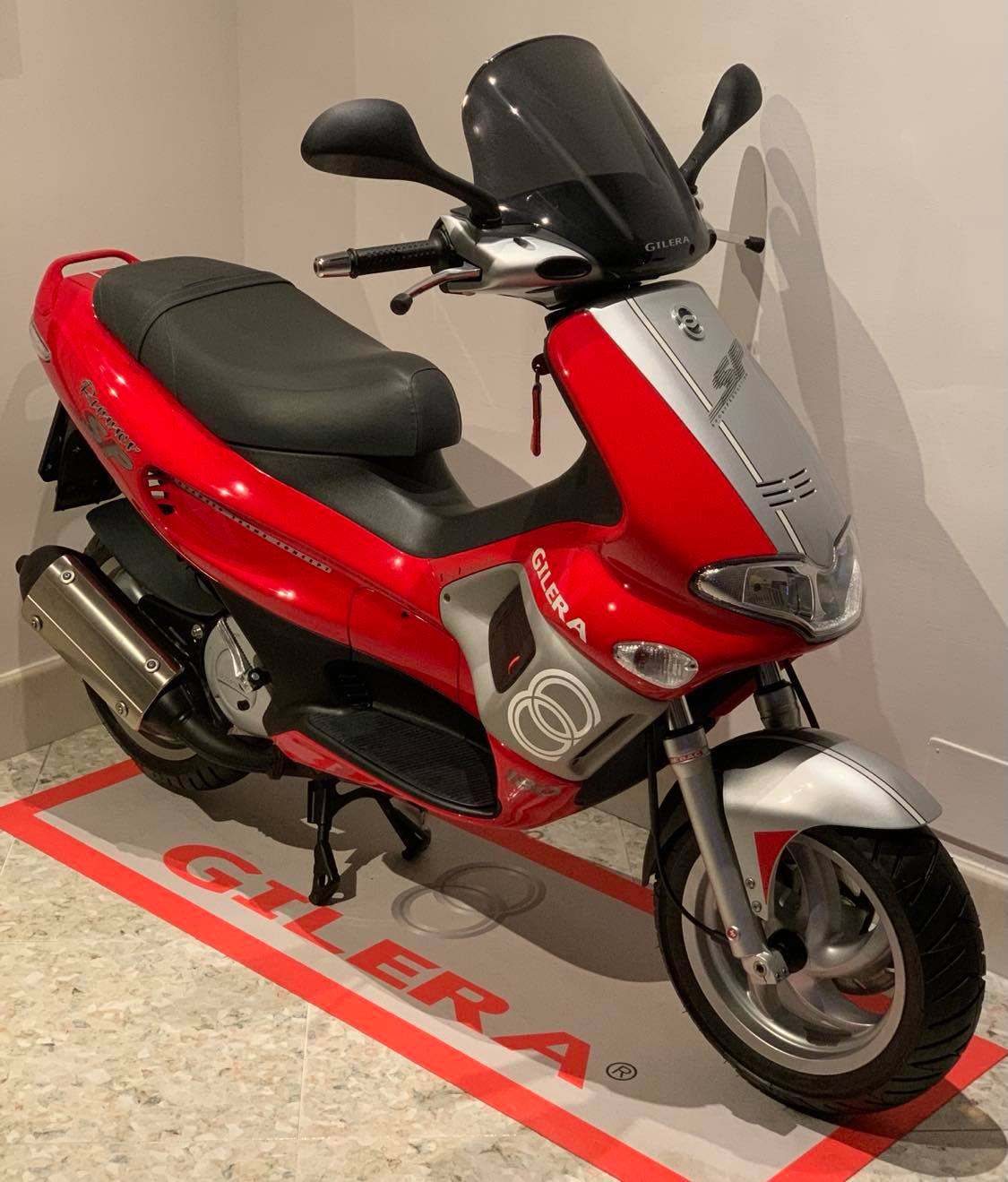

Gilera Runner
View on Wikipedia Gilera Runner SP FXR180 | |
| Manufacturer | Gilera |
|---|---|
| Parent company | Piaggio & Co. SpA |
| Production | 1997–2020 |
| Class | Scooter |
| Engine | Two-stroke water cooled 50 cc (3.1 cu in), 125 cc (7.6 cu in), 180 cc (11 cu in), single Four-stroke water cooled 125 cc (7.6 cu in), 180 cc (11 cu in), 200 cc (12 cu in) four valve SOHC single |
| Ignition type | Capacitor discharge ignition |
| Transmission | Belt-driven continuously variable transmission (CVT) |
| Related | Gilera DNA |
The Gilera Runner is a scooter manufactured by Italian company Piaggio under the Gilera brand, designed by Luciano Marabese of Marabese Design Srl.[1] It is noted for its unusual style, high performance and good handling.[2] The Runner was initially only available with two stroke engines with 125 cc and 180 cc four stroke versions arriving in 1998 and the larger two stroke versions phased out. The model range was revised in 2005 with an all new model introduced in 2009. All 50 cc Runner models were restricted to 28 mph (45 km/h) to comply with European law.[3] The 125, 180 and 200cc models were not restricted.
Two stroke models
[edit]The first incarnation of the Gilera Runner was a 50 cc that was released in 1997 in Europe. The 50cc model went through a number of revisions; in 1998, a rear disc brake was added with the Gilera Runner 50DD (Double Disc). The colour scheme was also revised with the release of the Runner 50SP. The direct injection Runner Purejet 50 was released in 2003 with lower emissions.[4]

In 1998, the 125 cc (7.6 cu in) FX Runner was introduced which had the same styling as the 50cc. In 1999, the SP model was released. The biggest difference between the FX (FXR) and the SP is the FX had a 9 L (2.0 imp gal; 2.4 US gal) petrol tank and battery stowed near the spark plug and a rear drum brake. The SP has a 12 L (2.6 imp gal; 3.2 US gal) petrol tank, the battery is stowed under the seat and it has a rear disc brake.[4]

In 1999, the FXR 180 cc (11 cu in) was introduced and was by far the fastest of the Runners including the new generation 200 cc (12 cu in) four strokes.[4][failed verification] It was noted for its high performance and great handling. Unfortunately it has a high fuel consumption.[2]
| 50/DD/SP[5] | Purejet | FX125[6] | FXR180[6] | |
|---|---|---|---|---|
| Engine | ||||
| Engine Type | 49.3 cc (3.01 cu in) single cylinder two stroke | 123.5 cc (7.54 cu in) single cylinder two stroke | 175.8 cc (10.73 cu in) single cylinder two stroke | |
| Bore/Stroke | 40.0 mm × 39.3 mm (1.57 in × 1.55 in) | 55.0 mm × 52.0 mm (2.17 in × 2.05 in) | 65.6 mm × 52 mm (2.58 in × 2.05 in) | |
| Compression Ratio | 11.5:1 (±0.9) | 9.8:1 | 9.9:1 | |
| Fuel system | Carburetor | PHVA 17.5mm Dell'Orto Carburetor | Fuel injection | Carburetor | PHVB 20.5mm Dell'Orto / Mikuni VM 20mm | Carburetor | PHVB 20.5mm Dell'Orto / Mikuni VM 20mm |
| Drivetrain | ||||
| Transmission | CVT | |||
| Front Suspension | Upside-down telescopic forks | Upside-down forks with double acting hydraulic damper; 83 mm (3.3 in) travel | ||
| Rear Suspension | Swingarm and hydraulic monoshock | Swingarm and hydraulic monoshock | Hydraulic monoshock and coiler spring with four position rate adjustment
Engine frame linkage with swinging arm; 60 mm (2.4 in) travel | |
| Front Brakes | Single disc | Ø 220 mm (8.7 in) disc brake with hydraulic linkage | ||
| Rear Brakes | Drum (50)
Single disc (DD/SP) |
Single disc | Ø 140 mm (5.5 in) drum brake with mechanical linkage
Ø 240 mm (9.4 in) disc brake with hydraulic linkage (1999-on) | |
| Front Tire | 120/70-12" | |||
| Rear Tire | 130/70-12" | 130/70-12" for rear drum brake models (1998)
130/60-13" for rear Disc brakes models (1999-on) | ||
| Ignition | Electronic CDI with internal H.T. coil | Electronic ignition with H.T. coil controlled by the ECU | Variable ignition timing electronic CDI module with separate H.T. coil | |
| Dimensions | ||||
| Trail | 71 mm (2.8 in) | |||
| Wheelbase | 1,290 mm (51 in) | 1,303 mm (51.3 in) | ||
| Length | 1,780 mm (70 in) | 1,800 mm (71 in) | 1,780 mm (70 in) | |
| Width | 720 mm (28 in) | |||
| Seat Height | 815 mm (32.1 in) | 830 mm (33 in) | 815 mm (32.1 in) | |
| Kerb weight | 98 kg (216 lb) (50)
93 kg (205 lb) (DD/SP) |
89 kg (196 lb) | 115 kg (254 lb)[7] | |
| Liquids capacity | ||||
| Fuel | 8.5 L (1.9 imp gal; 2.2 US gal) (50/DD)
12 L (2.6 imp gal; 3.2 US gal) (SP) |
12 L (2.6 imp gal; 3.2 US gal) | 9 L (2.0 imp gal; 2.4 US gal) (1998) 12 L (2.6 imp gal; 3.2 US gal) (1999–on) | |
| Fuel reserve | 1.5 L (0.33 imp gal; 0.40 US gal) (50/DD)
3 L (0.66 imp gal; 0.79 US gal) (SP) |
3 L (0.66 imp gal; 0.79 US gal) | 1.5 L (0.33 imp gal; 0.40 US gal) (1998)
3 L (0.66 imp gal; 0.79 US gal) (1999-on) | |
| Engine oil | 1.8 L (0.40 imp gal; 0.48 US gal) | |||
| Engine oil reserve | 0.4 L (0.088 imp gal; 0.11 US gal) | |||
| Cooling system | 0.9 L (0.20 imp gal; 0.24 US gal) | 1.7 L (0.37 imp gal; 0.45 US gal)[7] | ||
Four stroke models
[edit]The first generation of Gilera Runner had four-stroke variants added initially in VX 125 (124 cc) and VXR 180 guises. The VXR 180 was replaced by the larger capacity VXR 200 (198 cc) in mid 2002.[8] The four-stroke Runner was equipped with a liquid cooled, four valve version of Piaggio's LEADER engine. All of these models came with an immobiliser with programmed keys.
| VX[9] | VXR[9] | |
|---|---|---|
| Engine | 124.2 cc (7.58 cu in) single cylinder four-stroke | 181.7 cc (11.09 cu in) & 197.7 cc (12.06 cu in)
single cylinder four-stroke |
| Bore/Stroke | 57.0 mm × 72.0 mm (2.24 in × 2.83 in) | 69.0 mm × 72.0 mm (2.72 in × 2.83 in) (180)
73.0 mm × 72.0 mm (2.87 in × 2.83 in) (200) |
| Compression ratio | 10.5:1 | 10.5:1 |
| Drivetrain | ||
| Transmission | CVT | |
| Front suspension | Conventional telescopic forks | |
| Rear suspension | Swingarm and adjustable twin shock | |
| Front brakes | Ø 220 mm (8.7 in) disc brake with hydraulic linkage | |
| Rear brakes | Ø 220 mm (8.7 in) disc brake with hydraulic linkage | |
| Front Tire | 120/70-12" | |
| Rear Tire | 130/70-12" | |
| Ignition | Electronic CDI module | |
| Dimensions | ||
| Wheelbase | 1,350 mm (53 in) | |
| Length | 1,900 mm (75 in) | |
| Width | 750 mm (30 in) | |
| Seat height | 815 mm (32.1 in) | |
| Kerb weight | 132 kg (291 lb) | |
| Liquids capacity | ||
| Fuel | 12 L (2.6 imp gal; 3.2 US gal) | |
| Fuel reserve | 3 L (0.66 imp gal; 0.79 US gal) | |
| Engine oil | 1 L (0.22 imp gal; 0.26 US gal) | |
| Cooling system | 0.9 L (0.20 imp gal; 0.24 US gal) | |
Second Generation (2005)
[edit] | |
| Engine | Two-stroke water cooled Piaggio Hi-PER2 PRO 49.4 cc (50SP) Four-stroke water cooled 124.0 cc (125), 198.0 cc (200) |
|---|---|
| Transmission | Belt-driven continuously variable transmission (CVT) |

A second generation of the Runner saw the first major redesign since its original introduction. The revised models were launched in 2005 with a line up of three models which consisted of the two-stroke carburetor SP 50, fuel injected Purejet 50 and the four-stroke VX 125.[10] A revised VXR 200 became available in spring 2006.[11]
The current model line up consists of Runner ST 125 and Runner ST 200 which utilize the LEADER 4-valve engine. Now Runner has an analog-digital board, bigger wheels, the seat opens by pressing the steering wheel lock.
On two-stroke models the oil filler hole has now been moved under the front of the seat, and there is a basic tool in the small compartment at the back.
The 2008 models had minor updates.
| 50SP[12] | Purejet[13] | VX/ST[14] | VXR/ST[14] | |
|---|---|---|---|---|
| Engine | 49.4 cc (3.01 cu in) single cylinder two-stroke | 124.0 cc (7.57 cu in) single cylinder four-stroke | 198 cc (12.1 cu in) single cylinder four-stroke | |
| Bore × stroke | 40 mm × 39.3 mm (1.57 in × 1.55 in) | 57.0 mm × 48.6 mm (2.24 in × 1.91 in) | 72.0 mm × 48.6 mm (2.83 in × 1.91 in) | |
| Compression ratio | 12:1 (±0.7) | 11.5:1 (±0.9) | 12:1 (±0.5) | 11.5:1 (±0.5) |
| Carburation | Carburetor Dell'Orto PHVA 17.5 ID | N/A | 30mm Keihin CVK30 Carburetor | |
| Drivetrain | ||||
| Transmission | CVT | |||
| Front suspension | Upside-down telescopic forks
with Ø 30 mm stanchion and dual-effect damper |
Hydraulic double-acting telescopic forks
with Ø 35 mm stems | ||
| Rear suspension | Single hydraulic shock absorber, coaxial helical spring, frame engine attachment with swinging arm | Coaxial spring and hydraulic shock absorber.
Chassis to engine support with swinging arm | ||
| Front brake | Ø 220 mm (8.7 in) disc brake with hydraulic linkage (r.h. brake lever) | Ø 240 mm (9.4 in) disc brake with hydraulic control activated by handlebar right lever | ||
| Rear brake | Ø 175 mm (6.9 in) disc brake (hydraulically controlled via lever on left hand side of handlebar) | Ø 220 mm (8.7 in) disc brake with twin plunger calipers, with hydraulic control by a handlebar left lever. | ||
| Front tire | 120/70-14" | |||
| Rear tire | 140/60-13" | |||
| Ignition | Electronic CDI module with incorporated H.T. coil | Electronic ignition with H.T. coil controlled by the ECU | Electronic CDI and variable advance, with separate H.T. coil | |
| Dimensions | ||||
| Wheelbase | 1,270 mm (50 in) | 1,340 mm (53 in) | ||
| Length | 1,840 mm (72 in) | 1,890 mm (74 in) | ||
| Width | 750 mm (30 in) | |||
| Seat height | 815 mm (32.1 in) | |||
| Fuel capacity | 7 L (1.5 imp gal; 1.8 US gal) | 8.5 L (1.9 imp gal; 2.2 US gal) | ||
References
[edit]- ^ Josh Sims (10 Sep 2015). Scootermania: A Celebration of Style and Speed. A&C Black. ISBN 978-1844862771. Retrieved 2015-06-14.
- ^ a b Sterling, Ketzal. "Gilera Runner 180 SP - The Scooter Review". thescooterreview.com.
- ^ "Annex 2. Motorcycle licence requirements - The Highway Code - Guidance - GOV.UK". www.direct.gov.uk.
- ^ a b c "Bike reviews, New & Used motorcycle reviews & ratings - MCN". www.motorcyclenews.com.
- ^ Runner 50, Runner 50 Dd, Runner 50 Sp Model Identification; Runner 50, Runner 50 Dd, Runner 50 Sp Servicing Specifications And Lubricants - Gilera Runner 50 1997 Service And Repair Manual, p. 18
- ^ a b Haynes Book 4163Gilera Runner, DNA, Ice & SKP/Stalker (97 - 07) . ISBN 978-1-84425-765-2
- ^ a b Runner Fx125 And Fxr180 Model Identification; Runner Fx125 And Fxr180 Servicing Specifications And Lubricants - Gilera Runner 50 1997 Service And Repair Manual, p. 22
- ^ "Bigger Runner at the ready". Motorcycle News. 10 June 2002.
- ^ a b Runner Vx125 And Vxr180/200 Model Identification; Runner Vx125 And Vxr180/200 Servicing Specifications And Lubricants - Gilera Runner 50 1997 Service And Repair Manual, p. 24
- ^ Farquhar (12 August 2005). "We ride New Runner". Motorcycle News. Retrieved 2015-06-14.
- ^ "Gilera's new Runner 200". Motorcycle News. 8 April 2006. Retrieved 2015-06-14.
- ^ "Manual GILERA Runner SP 50 - [PDF Document]". vdocuments.mx. Retrieved 2021-05-18.
- ^ "Gilera Runner RST Purejet (EN) - [PDF Document]". vdocuments.mx. Retrieved 2021-05-18.
- ^ a b "Gilera Runner 125 - 200 (EN) - [PDF Document]". vdocuments.mx. Retrieved 2021-05-18.
External links
[edit]
Gilera Runner
View on GrokipediaOverview
Production History
The Gilera Runner scooter entered production in 1997, marking the debut of a sporty model designed for urban commuting and leisure riding, primarily targeting riders in the European market.[5] Manufactured by the Italian company Gilera, the Runner was produced continuously until 2020 as part of Gilera's lineup of innovative scooters.[7] Gilera, founded in 1909, became a subsidiary of Piaggio & C. SpA in 1969, a pivotal acquisition that integrated the brand into a larger group and supported the development of models like the Runner through shared resources and production facilities.[1] Following the closure of Gilera's historic Arcore factory in 1993, Runner production shifted to Piaggio's Pontedera plant, enabling continued output under the Gilera badge.[7] The model's production concluded in 2020, coinciding with the discontinuation of the entire Gilera brand's active lineup in Europe, though exact total units produced remain unspecified in available records.[1] Throughout its run, the Runner maintained a focus on European consumers, contributing to Gilera's reputation for performance-oriented scooters within the Piaggio Group.[5]Design and Features
The Gilera Runner embodies a sporty design philosophy characterized by aggressive angular lines, a stepped dual seating arrangement, and compact ergonomics that prioritize agile urban handling and rider confidence. This styling approach, crafted by designer Luciano Marabese of Marabese Design Srl, draws on Italian industrial aesthetics to balance visual impact with practical mobility, featuring a low-slung profile and integrated fairing that enhances aerodynamics without compromising accessibility. The overall form supports quick maneuvers in city environments while maintaining a premium, performance-oriented appearance suitable for both solo and pillion use. The chassis utilizes a robust steel tubular frame, often reinforced with pressed sheet metal for added rigidity, paired with telescopic front forks providing approximately 85 mm of travel for responsive steering.[8] Suspension is completed by two dual-effect hydraulic rear shock absorbers with adjustable preload, ensuring stability across varied road conditions. Key dimensions include a wheelbase of approximately 1,340 mm for larger-displacement models, contributing to nimble cornering, and a seat height of around 815 mm, accommodating riders of average stature while keeping the center of gravity low for better control.[6] Standard features across variants include a belt-driven continuously variable transmission (CVT) for seamless acceleration, a hydraulic disc brake on the front (220 mm diameter) and rear (on models over 50 cc, 220 mm) for effective stopping power, and an analog-digital instrument cluster displaying speed, fuel level, and basic diagnostics.[9] Four-stroke variants incorporate an electronic immobilizer for enhanced security. Unique to the Runner are its water-cooled engines, which improve thermal management and longevity compared to air-cooled alternatives, a 7- to 8.7-liter fuel tank depending on displacement for practical range, and curb weights spanning 115-132 kg depending on engine displacement, optimizing the power-to-weight ratio for spirited performance.[10] The Runner offered both two-stroke and four-stroke engine options, with the latter emphasizing refined operation through liquid cooling.First Generation (1997–2004)
Two-Stroke Models
The two-stroke models of the first-generation Gilera Runner, produced between 1997 and 2004, utilized single-cylinder engines that delivered strong low-end torque and lightweight agility, making them particularly suitable for urban commuting and short-distance travel. These engines emphasized simple mechanics and high-revving performance typical of two-stroke designs, providing responsive acceleration without the complexity of multi-cylinder setups.[11] The 50 cc variants, available from 1997 to 2003 in DD, SP, and Purejet configurations, featured a displacement of 49.4 cc and were liquid-cooled for reliable operation in city conditions. The carbureted DD and SP models, equipped with the Dell'Orto PHVA Ø17.5 mm carburetor as original equipment, produced approximately 4.5 hp; this carburetor was compatible with the standard oil pump mixer system (automatic oil injection), as oil was injected separately into the intake/engine rather than mixed in the fuel. The Purejet variant employed direct fuel injection to improve fuel efficiency and reduce emissions, delivering around 4.2 hp (3.1 kW). All were restricted to a top speed of 45 km/h (28 mph) to comply with learner regulations in various markets, with dry weights around 89–99 kg contributing to their nimble handling. The models shared a steel double-cradle frame and front disc brake with a rear drum.[12][13][14][15] Introduced in 1998 and continuing through 2003, the 125 cc FX Runner and SP models offered a step up in performance with a 124 cc liquid-cooled engine, generating 15 hp at 9,750 rpm via carburetion and reed valve intake. These variants achieved 0–100 km/h acceleration in approximately 12 seconds, balancing sporty responsiveness with practical usability for longer rides. Their dry weight hovered around 120 kg, enhancing the scooter's stability on varied urban roads.[16][8][17] The top-tier 180 cc FXR variant, produced from 1999 to 2003, featured a water-cooled 175.8 cc engine with a 9.8:1 compression ratio and carbureted fuel delivery, outputting 21 hp at 8,000 rpm for dynamic performance. This model reached a top speed of up to 120 km/h and had a dry weight of 107–115 kg, allowing for agile maneuvering while carrying two passengers. Its torquey delivery at low revs excelled in stop-start traffic, though later regulations prompted a shift toward four-stroke alternatives for stricter emissions standards. Higher variants included a rear disc brake.[18][4][19]Four-Stroke Models
The Gilera Runner's four-stroke models were introduced in the first generation to address environmental regulations and rider preferences for smoother operation, debuting alongside the two-stroke variants. These engines utilized liquid-cooled, single-cylinder designs with four valves and single overhead camshaft (SOHC) configurations, providing refined performance suitable for urban and light highway commuting. All shared the steel double-cradle frame with front disc and rear drum or disc brakes depending on the variant.[20][21] The VX 125, produced from 1998 to 2004, featured a 124 cc displacement engine delivering 15 hp at 9,700 rpm with carbureted fuel delivery. It achieved a top speed of approximately 108 km/h and had a dry weight of 119 kg, making it agile for city use while offering reliable power delivery.[22][20][23] The VXR 180, available from 2001 to 2003, expanded the lineup with a 180 cc engine producing 19 hp at 8,500 rpm and a compression ratio of around 10:1. This model emphasized smoother power delivery compared to two-stroke counterparts, with torque of 11.7 Nm at 8,000 rpm supporting highway speeds up to 108 km/h. It targeted riders seeking extended-range capability without the vibratory characteristics of two-strokes.[24][25][26] In 2002, the VXR 200 succeeded the 180 as a 198 cc evolution, featuring a 10.5:1 compression ratio, 20 hp at 9,000 rpm, and enhanced torque of 17 Nm at 8,000 rpm. Carburetion was standard, contributing to precise throttle response and reduced emissions relative to two-strokes. This variant improved low-end torque for better acceleration, maintaining a top speed near 108 km/h while weighing around 123 kg dry.[27][28][29] Overall, these four-stroke models offered advantages in lower emissions, quieter operation, and superior fuel economy of about 3-4 L/100 km over two-stroke versions, aligning with stricter Euro emission norms and appealing to eco-conscious urban riders.[30][31]Second Generation (2005–2020)
Key Updates
The second generation of the Gilera Runner, launched in 2005, introduced revised styling characterized by more angular bodywork and updated fairings, enhancing aerodynamics and providing better stability at higher speeds compared to the first-generation models.[2] Engine refinements for the 125 cc and 200 cc models featured water-cooled, four-valve single overhead camshaft (SOHC) units, with enhanced fuel injection systems implemented to achieve Euro 3 emissions compliance. The Purejet 50 variant incorporated direct injection technology in its two-stroke engine, delivering improved fuel efficiency and reduced emissions relative to carbureted predecessors, initially meeting Euro 2 standards. Later models from around 2016 transitioned to Euro 4 compliance.[32][33][34] Chassis enhancements included a stiffer frame for improved rigidity and front disc brakes measuring 220 mm in diameter, similar to the first generation's 220 mm setups.[32][35] Additional updates encompassed a digital dashboard for clearer instrumentation, alongside refinements emphasizing rider comfort through adjustable suspension components.[2]Model Variants
The second-generation Gilera Runner lineup, produced from 2005 to 2020, offered variants in 50 cc, 125 cc, and 200 cc displacements, each tailored for urban commuting with a focus on performance and efficiency. The 50 cc models, including the SP and Purejet variants, featured a 49 cc two-stroke liquid-cooled engine delivering 4 hp at 7,250 rpm, with a top speed limited to 45 km/h for learner riders and a curb weight of approximately 114 kg. The carbureted versions (such as the SP) of the 2005-2017 Runner 50 2T E2 models used the Dell'Orto PHVA Ø17.5 mm carburetor with oil pump mixer (automatic oil injection) system, where oil is injected separately into the intake/engine, not mixed in the fuel. Replacements include genuine Dell'Orto or aftermarket options (e.g., Naraku, Polini) matching the same mounting and specifications.[36][37][38][39][12] The 125 cc models encompassed the VX and ST 125, powered by a 124 cc four-stroke liquid-cooled single-cylinder engine producing 15 hp at 9,750 rpm and 11 Nm of torque at 8,000 rpm, achieving 0–100 km/h in about 11 seconds and fuel economy of around 3.5 L/100 km.[40][41][5] For higher performance, the 200 cc variants such as the VXR and ST 200 utilized a 198 cc four-stroke engine with 20 hp at 8,750 rpm and 18 Nm of torque, reaching a top speed of 120 km/h while maintaining a dry weight of 132 kg.[42][43][44] Limited special editions appeared during this period, such as the Black Soul variant of the 125 cc model introduced in 2017, which retained standard mechanical specifications but featured custom blacked-out graphics and trim for a distinctive aesthetic without altering core performance.[6]| Model Variant | Displacement | Power | Torque | Top Speed | Weight | Key Focus |
|---|---|---|---|---|---|---|
| 50 cc (SP/Purejet) | 49 cc | 4 hp | N/A | 45 km/h | 114 kg (curb) | Learner riders |
| 125 cc (VX/ST) | 124 cc | 15 hp | 11 Nm | ~108 km/h | ~134 kg (curb) | Urban efficiency |
| 200 cc (VXR/ST) | 198 cc | 20 hp | 18 Nm | 120 km/h | 132 kg (dry) | Performance commuting |