Hubbry Logo
GileraGileraMain
Open search
Gilera
Community hub
Gilera
logo
8 pages, 0 posts
0 subscribers
Be the first to start a discussion here.
Gilera
Gilera
from Wikipedia
Gilera 600 SuperSport

Key Information

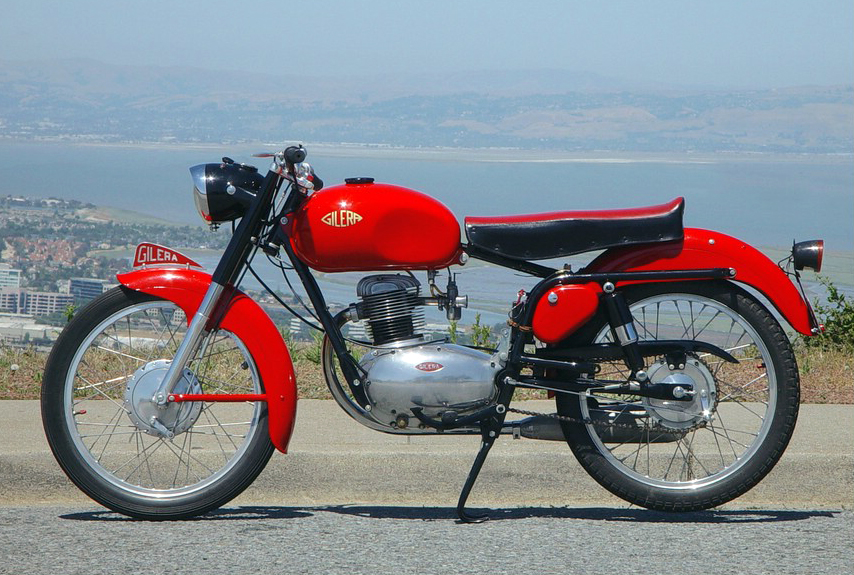
1954 Gilera 150 Sport

Gilera is an Italian motorcycle manufacturer founded in Arcore in 1909 by Giuseppe Gilera (1887–1971). In 1969, the company was purchased by Piaggio.

History

[edit]

Giuseppe Gilera founded his self-named motorcycle company in 1909 (aged 22) near Milan, Italy. His first model used a 317cc single-cylinder overhead-valve engine (67x90mm bore/stroke) with a single-speed belt drive in a simple open frame with the engine as a stressed member of the frame, and no suspension. It produced 7 hp, weighed 75 kg, and had a top speed of 105 km/h (65 mph).[1]

Gilera subsequently produced a series of V-twins and single-cylinder models with sidevalve, F-head, and overhead-valve configurations. After WW1, the factory was moved to Arcore, between Milan and Lecco, very near the Monza racing circuit. Racing was always a focus for the brand, with Giusseppe's brother Luigi a successful ISDT participant in the early 1930s. [2] After withdrawing from competition in 1957, Gilera changed direction abruptly. They downplayed their hitherto successful line of four-stroke singles and began to focus on motocross and off-road events in association with independent specialist Elmeca. Sales declined through the 1960s and by 1968 the company was in receivership.[3]

In 1969, Gilera became part of the Piaggio group. In 1992, Gilera made a return to the Grand Prix arena and Piaggio continues to produce small-displacement motorcycles with the Gilera name. The famous factory of Arcore was closed in 1993 and now the motorcycles (only scooters) bearing the name Gilera are produced by Piaggio in Pontedera.

Racing history

[edit]

In 1935, Gilera acquired rights to the CNA Rondine. It had double-over-head camshafts, forced-inducting supercharger and was water-cooled, producing 60 kW (80 hp)@9000 and had a top speed of 140 mph (230 km/h).[4] This formed the basis for Gilera' s racing machines for nearly forty years. From the mid-thirties, Gilera developed a range of four-stroke engine machines. The engines ranged from 100 to 500 cc, the most famous being the 1939 Saturno. Designed by Giuseppe Salmaggi, the Saturno was inspired by the pre-war Gilera VTEGS 500 cc “Otto Bulloni” yet was quite different due to its unit construction.[5]

Twin-torpedo bodied Gilera TARF I (late 1940s - early 1950s)

After World War II, Gilera dominated Grand Prix motorcycle racing, winning the 500 cc road racing world championship six times in eight years.[6] Facing a downturn in motorcycle sales due to the increase in the popularity of automobiles after the war, Gilera made a gentleman's agreement with the other Italian motorcycle makers to quit Grand Prix racing after the 1957 season as a cost-cutting measure.[7]

The 1957 500 cc machines on which former World Champion rider Geoff Duke had much success were resurrected in 1963, but with the benefit of newer, upgraded Tyre technology of the 1960s were considered still competitive. The team was devised by Duke to challenge the domination of Mike Hailwood on the MV and had early successes with riders Derek Minter and teammate John Hartle at Silverstone, Brands Hatch and Imola, Italy.

In May 1963 Minter suffered serious injuries when racing a Norton at Brands Hatch, and his place in the team for the TT races was taken by Phil Read, who came third to second-place teammate Hartle. The team only raced for one season in selected races.

In 1966 Minter arranged to ride the Gileras at the TT in June,[8] again without success as he crashed on a wet road surface after a rain shower at Brandish Corner during the last practice before race-week, breaking his left wrist which ended his racing for the rest of the race season. The bikes were raced at Brands Hatch later in the year.[9]

The four-cylinder Gilera engine was also used successfully for world championship sidecar races. Eight victories in the sidecar class, as well as four runners-up in the world championship from 1949 to 1952 (three times Ercole Frigerio and one Albino Milani), showed the potential of the engine. In 1954, the Gilera four-cylinder was used by Piero Taruffi for the record-breaking TARF vehicle.[10][11][Note 1] The Swiss driver Florian Camathias won a sidecar race with a Gilera four-cylinder engine for the last time in 1964.[citation needed]

European championships

[edit]
Year Class Rider
1939 500 cc Kingdom of Italy Dorino Serafini

MotoGP World Championship

[edit]

Gilera won the following World Titles:

Year Class Rider
1950 500 cc Italy Umberto Masetti
1952 500 cc Italy Umberto Masetti
1953 500 cc United Kingdom Geoff Duke
1954 500 cc United Kingdom Geoff Duke
1955 500 cc United Kingdom Geoff Duke
1957 500 cc Italy Libero Liberati
Year Class Rider
2008 250 cc Italy Marco Simoncelli
Year Class Rider
2001 125 cc San Marino Manuel Poggiali

MotoGP World Constructors champions

[edit]
  • 500 cc class
    • 1952, 1953, 1955, 1957

Isle of Man Tourist Trophy

[edit]
  • 350 cc class
Year Champion Class Motorcycle
1957 Isle of Man TT United Kingdom Bob McIntyre Class 350 cc
  • 500 cc class
Year Champion Class Motorcycle
1955 Isle of Man TT United Kingdom Geoff Duke Class 500 cc
1957 Isle of Man TT United Kingdom Bob McIntyre Class 500 cc
1963 Isle of Man TT United Kingdom John Hartle
Second
Class 500 cc Team Scuderia Duke Gilera
1963 Isle of Man TT United Kingdom Phil Read
Third
Class 500 cc Team Scuderia Duke Gilera

Motorcycles

[edit]

Racing motorcycles

[edit]
Model Engine Years Notes Image
Gilera 500 Rondine ()
Gilera 5004C ()
Gilera 5004C (1957)
Gilera RSA 250 ()
Gilera RSA 250, 2008, Marco Simoncelli.

Historic

[edit]
Model Engine Years Notes Image
500 LTE () Produced during World War II for the Italian army.
1939, Gilera 500 LTE
Marte () Produced during World War II for the Italian army, the Marte was a 498 cc (30.4 cu in) OHV single with 14 bhp (10 kW). Intended for use with a sidecar, the Marte had a shaft drive and hand-operated transmission.
Saturno () Produced after World War II until 1959 as a 498 cc (30.4 cu in) OHV single with 22 bhp (16 kW) @ 5,000 rpm and swinging-arm rear suspension using parallel, twin horizontal coil springs. The racing version designated Saturno San Remo was campaigned with success in Italian national and international races but was unable to compete with the multi-cylinder and overhead camshaft opposition.[12]
1947 Gilera Saturno.

Modern

[edit]
Model Engine Years Notes Image
Coguar ()
Ice ()
Storm ()
RV 124,3 cc, Single, Two-stroke engine, Reed valve, liquid cooling (1984–1987)
RX 124,3 cc, Single, Two-stroke engine, Reed valve, liquid cooling (1984-)
KK 124,38 cc, Single, Two-stroke engine, Reed valve, liquid cooling (1986–1987)
KZ 124,38 cc, Single, Two-stroke engine, Reed valve, liquid cooling (1986–1987)
Gilera KZ
Saturno Bialbero 500 (1987–1991) Produced from the late 1980s as a modern version of the historic Saturno using a 491 cc DOHC engine with 45 bhp @ 7,500 rpm[12][13]
1989, Gilera Saturno Bialbero 500
XR1 124,3 cc, Single, Two-stroke engine, Reed valve, liquid cooling (1988–1989)
MX1 / MXR 124,38 cc, Single, Two-stroke engine, Reed valve, liquid cooling (1988–1990)
Gilera MX1
SP 01 / SP 02 124,38 cc, Single, Two-stroke engine, Reed valve, liquid cooling (1988–1991)
Gilera SP 01
RC 600 (1989–1994)
Nordwest 600 (1991–1994)
Freestyle 125 124,38 cc, Single, Two-stroke engine, Reed valve, liquid cooling (1991–1994)
Freestyle 125
CX 124,38 cc, Single, Two-stroke engine, Reed valve, liquid cooling (1991–1993)
1991 Gilera 125 CX
Crono 124,38 cc, Single, Two-stroke engine, Reed valve, liquid cooling (1991–1992)
Gilera Crono
GFR (1993–1994)
DNA (1996–2009)
Runner (1997–2020)
Nexus (2003–2012)
GP800 (2006–2013)
Gilera GP800
Fuoco (2007–2017)
Gilera Fuoco
Ice (2001–2003)

Moped

[edit]
Model Engine Years Notes Image
Eco / EC1 / Città (1979–1989) (moped)
Gilera Città
Stalker (1996–2012) (also known as SKP)
Gilera Stalker
SMT / RCR (2003–2020)
Gilera RCR
Gilera SMT

See also

[edit]

References

[edit]
[edit]
Revisions and contributorsEdit on WikipediaRead on Wikipedia
from Grokipedia
Gilera is an Italian motorcycle manufacturer founded in 1909 by Gellera in and renowned for its pioneering contributions to and . The company, initially established as a workshop in before relocating to , quickly gained prominence in the early for producing innovative , including the iconic Rondine 500 in 1936, an advanced transverse four-cylinder design. Under Gilera's leadership, the brand achieved extraordinary success in Grand Prix racing, dominating the 500cc class alongside rivals like from 1949 to 1957 and securing six World Championships between 1950 and 1957 through riders such as Umberto Masetti (1950), (1952–1955), and Libero Liberati (1957). Key milestones include being the first manufacturer to exceed 100 mph at the Isle of Man Tourist Trophy and amassing 40 Grand Prix victories by 1957, with legendary models like the Saturno 500 Sport and Quattro Cilindri embodying Gilera's engineering prowess in both road and competition machines. The brand also achieved success in the 250cc class, winning the 2008 World Championship with . In 1969, Gilera was acquired by the Group, which expanded its portfolio to include off-road models like the 50 Trial 5V and, in the early 2000s, sporty scooters such as the Runner, DNA, Nexus, and GP 800. Although production under the Gilera name ceased in 2020, the brand's legacy endures as a symbol of Italian speed and , influencing modern mobility within the Group's diverse lineup of two-wheeled vehicles.

History

Founding and Early Years

Giuseppe Gilera, born in 1887 near , began his career as a apprenticed at age 15 with the Bianchi and later worked for Moto Rêve in , , at age 19, where he honed his skills in and repair. His early involvement in during the shaped his passion for performance-oriented machines, influencing the 's future emphasis on speed and . In 1909, at age 22, Giuseppe Gilera founded the company in a small on Corso XXII Marzo in , , where he designed and built his first , the VT 317—a 317 cc single-cylinder model with overhead valves, producing 7 horsepower, weighing 75 kg, and capable of a top speed of 105 km/h. The VT 317 achieved immediate racing success that year, winning a hill-climb event and establishing Gilera's reputation for competitive engineering. Shortly after, the company relocated to , near , to expand production. During the and , Gilera grew by developing a range of sidevalve single-cylinder and V-twin models, focusing on reliability and performance for both road use and competition, which helped the brand become a fixture in Italian races. By the mid-, the company introduced overhead-valve technology in its racers, culminating in victories such as the 1930 International Six Days Trial in , where Gilera machines excelled in regularity, cross-country, and speed events. In 1935, Gilera launched the Quattro Bulloni 500, a 500 cc single-cylinder overhead-valve racer named for its four-bolt cylinder-head fastening, which powered successes in national Italian championships and marked a shift toward advanced designs. The 1930s saw further innovation with the Rondine, a supercharged 500 cc four-cylinder racer developed from designs by engineers Carlo Gianini and Piero Remor, producing up to 90 horsepower at 10,000 rpm and achieving top speeds exceeding 150 mph. In 1937, rider Piero Taruffi set multiple world speed records on the Rondine, including an absolute motorcycle land speed record of 274.181 km/h (170.4 mph) on the Bergamo-Brescia motorway, a mark that stood unbeaten for nearly 15 years; the bike also contributed to Gilera's dominance in Italian national championships during the pre-war era. These achievements solidified Gilera's position as a leading Italian manufacturer before the disruptions of World War II.

World War II and Post-War Expansion

During , the Gilera factory in was requisitioned for military production, focusing on motorcycles such as the 500 Marte model for the , which halted civilian motorcycle output until the war's end. Following the 1945 armistice, Gilera relaunched civilian production with the Saturno 500, a reliable four-stroke single-cylinder model introduced in 1946 that emphasized durability for everyday use and drew on pre-war engineering for post-war road machines. In the , Gilera adopted mass-production techniques to scale operations amid Italy's , enabling export growth to markets in and the while introducing accessible models like the 1959 Gilera Giubileo 98, a 98cc four-stroke for urban commuting, and the updated 1954 Saturno 500, both of which achieved strong commercial sales through their affordability and performance. This expansion capitalized on rising demand during Italy's post-war boom, with annual production surpassing 10,000 units by the late 1950s, primarily lightweight models under 175cc that supported broader market penetration. Under Giuseppe Gilera's leadership until his retirement in 1958, the company transitioned to family management led by his sons, while diversifying into smaller-displacement bikes to meet urban mobility needs and fiscal incentives for low-cc engines. Early racing successes provided a technical foundation for these post-war engineering advancements, enhancing Gilera's reputation for innovative four-stroke designs.

Acquisition by and Modern Era

In 1969, acquired Gilera amid the company's financial difficulties, which had led to the previous year, integrating it into the Piaggio Group and enabling shared resources and technology transfers between the brands. This move allowed Gilera to leverage 's manufacturing expertise while preserving its racing heritage. During the 1970s and 1980s, Gilera faced ongoing challenges, with reduced independent production and a strategic shift toward smaller-displacement vehicles, including scooters and off-road models in the 50cc to 200cc range. By 1993, closed Gilera's historic factory, halting motorcycle manufacturing there and relocating production to 's facilities, where the focus narrowed primarily to scooters. The and marked a revival under , with Gilera relaunching models that incorporated the parent company's advanced engine technology, such as the maxi-scooter introduced in late 2003 and the GP800 in 2007, which emphasized performance in the 500cc and larger classes. These efforts briefly revitalized the brand's presence in the scooter market before a period of dormancy set in during the , where it was used sparingly for limited editions. Production of Gilera-branded vehicles ceased globally around 2020, transitioning the brand into a heritage status within the Group, though its legacy is preserved through initiatives like the Gilera Historical Registry founded in 1999 to safeguard technical and cultural artifacts. In the 2020s, the brand maintains a regional footprint, such as in with models like the Sahel 150 enduro (as of 2025). A global revival is underway through Piaggio's with , with announcements in April 2025 for two new V-twin models derived from technology.

Racing Achievements

Grand Prix World Championships

Gilera entered the 500cc in 1950 with its innovative four-cylinder racer, derived from pre-war prototypes and refined post-World War II, marking the brand's debut in the premier class of . The machine, designed by Piero Remor, featured an inline-four engine with gear-driven overhead cams and four carburetors, delivering approximately 60 horsepower and enabling competitive performance against established rivals like Norton. This entry culminated in Gilera securing its first Constructors' that year, with factory rider Umberto Masetti clinching the Riders' after victories at key rounds including the . Building on this success, Gilera dominated the 500cc class throughout the early , winning additional Constructors' titles in 1952, 1953, 1954, and 1955. Masetti repeated as 500cc Riders' World Champion in 1952, securing wins in and the aboard the evolved four-cylinder machine. British star , switching from Norton to Gilera in 1953, then claimed back-to-back-to-back Riders' titles from 1953 to 1955, leveraging the bike's superior power and handling to win multiple Grands Prix, including the prestigious . The four-cylinder engine's continuous development, including improved aerodynamics and suspension, allowed top speeds exceeding 170 mph by the mid-1950s, establishing Gilera as a technological leader in the class. In 1957, Gilera achieved its final 500cc Constructors' title, with Italian rider Libero Liberati earning the Riders' championship through four victories, including a decisive win at the Nations Grand Prix in that clinched the title over rival Bob McIntyre. The 1957 model retained the inline-four configuration with gear-driven valves, producing around 70 horsepower at 10,500 rpm, but rising competition costs prompted Gilera, alongside and Mondial, to withdraw from Grand Prix racing at the end of the season. Following 's acquisition of Gilera in 1969, the brand re-entered Grand Prix racing in the 2000s, providing factory support for the 125cc and 250cc classes. In 2001, rider won the 125cc Riders' World Championship on a Gilera machine, also securing the Constructors' title and marking the brand's first title in over four decades. Similarly, in 2008, secured the 250cc Riders' title aboard a Gilera RSA 250, with the team achieving six victories and the Constructors' title that season. Despite these successes in lighter classes, Gilera did not return to premier-class contention post-1957, focusing instead on smaller-displacement development under Piaggio.

European Championships and Records

Gilera's early endeavors in the and focused on innovative designs like the Quattro Bulloni 500, introduced in 1933 with overhead valves, which secured victories in Italian hill-climb events and contributed to broader European successes on the circuit. The model, known for its robust four-bolt design, helped establish Gilera as a formidable contender in continental competitions, including hill-climbs across and , where it outperformed rivals in demanding terrain events. The pinnacle of pre-war achievements came with the supercharged four-cylinder Rondine in 1939, when rider Dorino Serafini clinched the European 500cc Championship through victories at the German, Swedish, and Grands Prix. This triumph underscored Gilera's engineering prowess, as the Rondine combined advanced and power output exceeding 90 horsepower to dominate the series. Complementing these championship wins, Gilera pursued speed records with the Rondine, where achieved the world 500cc flying kilometer record of 170.3 mph (274.2 km/h) in 1937 on the Brescia-Bergamo autostrada. That year, the machine set 46 (FAI) world records, including advancements in one-hour and flying-start categories, highlighting Gilera's focus on absolute performance. Following , Gilera's return to competition emphasized European dominance through the evolving international series. In 1949, Nello Pagani rode the Gilera Quattro to a runner-up finish in the inaugural 500cc —then a predominantly European event—while securing the 125cc title on a Mondial, bolstering Gilera's continental legacy. The following year, Umberto Masetti captured the 500cc title on the Gilera Quattro, affirming the marque's resurgence in European racing circuits. In the , Gilera continued pursuing FAI-sanctioned speed records with models like the Saturno 500 Piuma, which exceeded 200 km/h (124 mph) during the 1957 Gran Premio delle Nazioni, contributing to multiple class records amid attempts to push beyond 200 mph barriers. Gilera's pre- and European campaigns, spanning 1935 to 1957, yielded seven major championships (one European and six World) in the 500cc class, showcasing Italian engineering innovation and paving the way for global Grand Prix extensions. These accomplishments elevated Gilera's status, with designs influencing continental racing standards through superior power delivery and reliability.

Isle of Man TT and Endurance Races

Gilera's involvement in the Isle of Man Tourist Trophy (TT) races began in the early 1950s, marking the company's entry into one of motorcycling's most demanding events and showcasing the reliability of its four-cylinder DOHC racers. The Italian manufacturer fielded competitive teams during this decade, leveraging advanced engineering to challenge British dominance on the challenging 37.73-mile Mountain Course. Consistent participation highlighted Gilera's focus on high-speed endurance, with riders achieving notable results in the 500cc Senior and 350cc Junior classes. A pivotal victory came in 1955 when claimed the Senior TT on a Gilera 500cc four-cylinder machine, finishing with an average speed of 97.93 mph over six laps. This win established Gilera as a force in the event, with Duke's performance underscoring the bike's superior power delivery and handling under race conditions. Earlier, in 1953 and 1954, Reg Armstrong secured third and fourth places respectively in the Senior TT, while in 1955 he took second, contributing to multiple finishes for the team in the 500cc category. These results demonstrated Gilera's growing prowess, as the machines consistently placed among the leaders despite the event's grueling demands. The TT season represented Gilera's pinnacle at the event, with Bob McIntyre delivering a double triumph by winning both the Junior and Senior races on 350cc and 500cc variants. In the TT, McIntyre became the first rider to the course at over 100 mph, clocking 101.12 mph on his record-setting en route to victory. This achievement not only secured team successes but also pushed the boundaries of speed at the TT, with Gilera's four-cylinder engine providing the necessary torque and top-end performance. Technical innovations, such as partial streamlining introduced in —including dustbin fairings over the front —played a key role in these results, aiding and contributing to near-100 mph like Duke's 99.97 mph effort in 1955. Beyond the TT, Gilera excelled in other endurance events during the and , emphasizing machine durability. Following the manufacturer's withdrawal from Grand Prix racing in 1957, efforts shifted toward trials and long-distance competitions, including successes in the International Six Days Trial (ISDT). In the , Gilera machines supported the Italian national team, earning prestige with multiple gold medals and contributing to overall team victories in this demanding multi-day event that tested reliability over varied terrain. These achievements reinforced Gilera's reputation for building robust motorcycles capable of withstanding prolonged high-stress conditions. In the later era under ownership from 2001 onward, Gilera's TT involvement became sporadic, focusing more on production scooters and small-displacement bikes rather than full factory racing efforts. While no victories were recorded, the brand participated in heritage demonstrations and exhibition laps during the , honoring its storied racing legacy without competitive contention. This shift aligned with Piaggio's strategy to revive Gilera as a marque, drawing on historical successes to appeal to enthusiasts.

Motorcycle Lineup

Historic Models

Gilera's production of motorcycles began with the VT series in the early , featuring in displacements from 250cc to 500cc, starting with the landmark VT 317 model launched in by founder Giuseppe Gellera. This initial design incorporated a reinforced with a 317cc equipped with mechanically operated overhead valves and , marking Gilera's entry into motorized two-wheelers and achieving early competition successes that established the brand's reputation for engineering innovation. During the 1920s, Gilera focused on 500cc side-valve singles that contributed to the company's growing prominence in international competitions, laying the groundwork for more advanced designs in the following decade. By the 1930s, the brand introduced overhead-valve technology with models like the Quattro Bulloni 500 in 1933, emphasizing improved performance and reliability for both road and sporting use. The iconic Saturno 500 roadster debuted in 1938 at the Milan show, powered by a 498cc overhead-valve single-cylinder unit-construction engine delivering approximately 25 horsepower, celebrated for its robust build and versatility as a reliable daily rider. Military adaptations of the Saturno, including the rugged Marte and LTE variants with sidecar options, were produced during World War II to meet Italian armed forces demands, showcasing Gilera's adaptability in wartime manufacturing. Post-war recovery saw the Saturno evolve into a of Gilera's lineup, with the models continuing production of the 500cc single in Turismo and configurations, emphasizing durability and ease of maintenance amid Italy's economic rebuilding. In the , Gilera expanded into accessible mobility with small-displacement options like the 98cc Turismo commuter introduced around 1957, designed for urban use with a simple for efficient short-distance travel. The decade also featured innovative accessories such as clip-on engines compatible with bicycles, reflecting the era's focus on affordable post-war transportation solutions. By the , Gilera introduced touring-oriented models like the parallel-twin, a 298cc overhead-valve twin-cylinder machine produced from 1954 through 1970, offering enhanced comfort and power for longer journeys with around 15 horsepower. Overall, the Saturno series achieved significant commercial success, with more than 6,000 units produced between 1940 and 1959 across variants. These historic models profoundly influenced Italian , blending functional with aesthetic elegance that became synonymous with mobility and national recovery. The Saturno, in particular, symbolized aspirational freedom and reliability, appearing in Italian neo-realist films and cultural narratives as an emblem of everyday resilience and style during the mid-20th century. Brief racing adaptations of road models like the Saturno Competizione underscored Gilera's dual focus on production and performance heritage.

Racing Models

Gilera's racing heritage began in the pre-war era with innovative designs that pushed engineering boundaries. The 1933 Quattro Bulloni 500 featured an overhead-valve , marking a shift toward more advanced technology for competitive performance. This model, known for its robust construction with four bolts securing key components, laid groundwork for Gilera's pursuit of speed records and race wins. By 1935, Gilera acquired rights to the CNA Rondine, a groundbreaking supercharged four-cylinder 500cc racer that produced approximately 80 horsepower at 9,000 rpm, enabling speeds exceeding 240 km/h in record attempts. The Rondine's water-cooled, twin-overhead-cam design and integrated represented an early milestone in multi-cylinder racing motorcycles, influencing Gilera's post-war developments. In the , Gilera's Grand Prix machines dominated the premier 500cc class with the evolution of the Quattro Cilindri, or 500/4, an inline-four-cylinder derived from the Rondine platform. Designed by Piero Remor in and refined through the decade, the 500/4 delivered around 70 horsepower at 10,500 rpm by 1957, thanks to dual overhead cams driven by gears and a five-speed gearbox. Weighing approximately 150 kg, it emphasized with a tubular steel frame and advanced , including full enclosures for reduced drag. Gilera also explored the 350cc class with a scaled-down four-cylinder variant, producing about 50 horsepower, though efforts remained secondary to the flagship 500cc machine. For smaller displacements, Gilera developed four-stroke 250cc racers, such as the Nettuno-based models, focusing on reliability and power delivery in international events. The 1960s saw Gilera scale back factory Grand Prix involvement after withdrawing from full competition in 1957, but prototypes and efforts continued to innovate. Limited 350cc developments persisted, adapting four-cylinder for mid-capacity , while experimental 250cc singles incorporated advanced for improved two-stroke in non-GP formats. Technical advancements from the era included ongoing refinements in weight reduction—achieving under 150 kg for 500cc prototypes—and the legacy of 1930s supercharging techniques, which informed forced-induction experiments before international bans. These machines prioritized conceptual , such as compact cylinder layouts and precise fuel metering, over exhaustive power metrics. Following Piaggio's 1969 acquisition, Gilera re-entered competitive racing in the with support for smaller classes, particularly 125cc Grand Prix machines. The Piaggio-backed 125cc racers, developed from 2001, featured two-stroke engines for enhanced throttle response and emissions control, marking a shift toward modern electronics in Gilera's lineup. These lightweight prototypes, often around 100 kg, emphasized agility and integrated Piaggio's group-wide engineering, allowing Gilera to compete in international championships while focusing on developmental tech rather than outright dominance.

Modern Production Models

In the 1980s, Gilera revived its off-road offerings with the RC 125 Rally, a liquid-cooled, two-stroke single-cylinder enduro motorcycle featuring a 124cc and six-speed transmission, produced from 1987 to 1989. The model emphasized lightweight handling for , drawing on the brand's heritage while complying with emerging emissions standards of the era. Later in the decade, the CX 125 trail bike debuted in 1991 as a street-legal dual-sport option, powered by a 124cc two-stroke producing around 30 horsepower, notable for its futuristic bodywork and monoshock suspension. Following Piaggio's full integration in the early , Gilera shifted toward adventure and styles, launching the Nordwest 500 in 1993 as an entry into the growing dual-purpose segment. This model featured a liquid-cooled, four-stroke of 558cc delivering 46 horsepower at 7,000 rpm, paired with a five-speed gearbox and long-travel suspension for mixed on- and off-road use. By the early , the lineup included the SM 125 , introduced in 2001, which utilized a 124cc four-stroke with electronic for agile urban performance, achieving approximately 15 horsepower and emphasizing nimble handling on paved surfaces. (Note: Similar variants like the SMT series extended this concept into the mid-.) The 2010s saw limited but innovative production, highlighted by the 2012 Fuoco 500, a three-wheeled hybrid motorcycle with a 493cc four-stroke single-cylinder engine producing 40 horsepower, incorporating fuel injection and a tilting front suspension for enhanced stability. This model, produced until around 2013, represented Gilera's exploration of advanced safety features like optional ABS in later variants, though overall motorcycle output dwindled as the brand focused more on scooters. (Related to Saturno lineage.) In the 2020s, Gilera announced a potential relaunch in 2023 through a Piaggio-Zongshen partnership in , targeting street motorcycles with modern features such as ABS, , and Euro 5 compliance. The planned GLR900, based on an 896cc derived from the Shiver 900 (yielding about 95 horsepower), was patented as a naked bike design, signaling a return to mid-capacity production adventure and models. Regional efforts, including Argentina's Giubileo 450 retro variant, explored 450cc singles for local markets but remained in stages without confirmed 2025 output. As of late 2025, no new full-scale production has materialized beyond these announcements, with emphasis on eco-friendly engineering to meet global standards.

Scooters and Mopeds

Gilera's involvement in scooters and mopeds began in earnest after its acquisition by the Group in 1969, which prompted the development of new small-displacement two-stroke engines ranging from 49cc to 125cc for urban and light utility applications. These models marked a shift toward affordable, vehicles suited for , building on Piaggio's expertise in scooter production. By the 1970s, Gilera introduced mopeds like the 50 Touring, a 49.8cc two-stroke with a four-speed gearbox capable of reaching 40 mph, emphasizing reliability and ease of use for everyday transport. In the early 1980s, Gilera launched the 125 Twin Cylinder Cross, a futuristic 125cc two-stroke model that blended cross-country capabilities with road usability, helping the brand reestablish its presence in smaller engine categories. The saw further expansion with hybrids like the 1974 Gilera 125, a versatile 125cc roadster-style machine that combined scooter-like accessibility with ergonomics for mixed urban and light off-road duties. These vehicles prioritized and low maintenance, reflecting post-acquisition efforts to target younger riders and emerging markets. Following Piaggio's deeper integration, Gilera entered the modern scooter era in with the Runner 125, a liquid-cooled two-stroke 125cc model delivering approximately 14 hp for spirited urban performance and equipped with 12-inch front and 13-inch rear wheels for agile handling. The Runner's emphasized sporty and quick , making it popular for riders seeking more power than traditional mopeds. The early 2000s brought maxi-scooters like the 2000 Nexus 250 and 500, featuring continuously variable transmissions (CVT) and liquid-cooled —the 250cc version producing 22 hp for comfortable highway cruising, while the 500cc variant offered enhanced torque for travel. These models incorporated advanced suspension and disc brakes, positioning Gilera as a leader in premium urban mobility scooters. In 2004, the DNA 180 naked scooter followed, with a 180cc rated at 16 hp, blending exposed frame styling with practical storage for daily commutes. The 2010s introduced innovative three-wheeled designs, such as the 2012 Fuoco 500 LPV, a leaning trike powered by a 493cc producing 39 hp, featuring front suspension for motorcycle-like cornering stability and enhanced in wet conditions. This model targeted riders desiring scooter convenience with added security, including ABS options in later variants. In recent years, production has shifted toward emerging markets, with the Argentine-made 150 off-road launched in the 2020s as a 149cc air-cooled four-stroke with 10.7 hp, incorporating a digital dashboard for modern appeal. The emphasizes versatility for light trails and city use, reflecting Gilera's focus on economical, feature-rich small-displacement vehicles under Piaggio's global umbrella.

References

Add your contribution
Related Hubs
User Avatar
No comments yet.