Hubbry Logo
Golden spikeGolden spikeMain
Open search
Golden spike
Community hub
Golden spike
logo
8 pages, 0 posts
0 subscribers
Be the first to start a discussion here.
Golden spike
Golden spike
from Wikipedia

The original "golden spike" is on display at the Cantor Arts Museum at Stanford University.

The golden spike (also known as the last spike[1]) is the ceremonial 17.6-karat gold spike driven to mark the completion of the first transcontinental railroad across the United States. It was driven by Leland Stanford to connect the Central Pacific Railroad from Sacramento and the Union Pacific Railroad from Omaha on May 10, 1869, at Promontory Summit, Utah Territory. The spike is now displayed in the Cantor Arts Center at Stanford University.[2]

The term last spike has since been used to refer to a spike driven at the usually ceremonial completion of a railroad construction project, particularly one in which construction is undertaken from two origins toward a meeting point.

History

[edit]

Completing the last link in the transcontinental railroad with a spike of gold was the brainchild of David Hewes, a San Francisco financier and contractor.[3] The spike was manufactured in 1869 especially for the May event by the William T. Garratt Foundry in San Francisco. Two of the sides were engraved with the names of the railroad officers and directors.[3] A special tie of polished California laurel was chosen to complete the line where the spike would be driven.[3] The ceremony was planned to be held on May 8 (the date engraved on the spike), but it was postponed two days because of bad weather and a labor dispute that delayed the arrival of the Union Pacific side of the rail line.[3]

The Last Spike painting by Thomas Hill (1881)

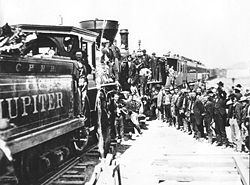
On May 10, in anticipation of the ceremony, Union Pacific No. 119 and Central Pacific No. 60 (better known as the Jupiter) locomotives were drawn up face-to-face on Promontory Summit.[4] How many people attended the event is unknown; estimates run from as few as 500 to as many as 3,000; government and railroad officials and track workers were present to witness the event.[3]

Before the last spike was driven, three other commemorative spikes, presented on behalf of the three other members of the Central Pacific's Big Four who did not attend the ceremony, had been driven into their places in a pre-bored laurel tie:

  • a second, lower-quality gold spike, supplied by the San Francisco News Letter, was made of what in 1869 was $200 worth of gold and inscribed: With this spike the San Francisco News Letter offers its homage to the great work which has joined the Atlantic and Pacific Oceans.
  • a silver spike, supplied by the State of Nevada; forged, rather than cast, of 25 troy ounces (780 g) of unpolished silver
  • a blended iron, silver, and gold spike, supplied by the Arizona Territory, engraved: Ribbed with iron clad in silver and crowned with gold Arizona presents her offering to the enterprise that has banded a continent and dictated a pathway to commerce.[5] This spike was given to Union Pacific president, Oliver Ames, following the ceremony. The spike was donated to the Museum of the City of New York in 1943, by a descendant of Sidney Dillon.[6] It was, for a time, on display at the Union Pacific Railroad Museum in Council Bluffs, Iowa.[7] The Museum of the City of New York sold the spike in January 2023, via auction, to benefit other items in its collection. The winning bid totaled US$2.2 million[6]

The golden spike was made of 17.6-karat (73%) copper-alloyed gold, and weighed 14.03 troy ounces (436 g). It was dropped into a drilled hole in the ceremonial last tie and gently tapped into place with a ceremonial silver spike maul. The golden spike was engraved on all four sides:

  • The Pacific Railroad ground broken January 8, 1863, and completed May 8, 1869
  • Directors of the C. P. R. R. of Cal. Hon. Leland Stanford. C. P. Huntington. E. B. Crocker. Mark Hopkins. A. P. Stanford. E. H. Miller Jr.
  • Officers. Hon. Leland Stanford. Presdt. C. P. Huntington Vice Presdt. E. B. Crocker. Atty. Mark Hopkins. Tresr. Chas Crocker Gen. Supdt. E. H. Miller Jr. Secty. S. S. Montague. Chief Engr.
  • May God continue the unity of our Country, as this Railroad unites the two great Oceans of the world. Presented by David Hewes San Francisco.[3]

The original golden spike was removed immediately after being hammered in, to prevent it from being stolen.

Duplicate Hewes Family Golden Spike (California State Railroad Museum)

A duplicate golden spike, exactly like the one used in the ceremony (except for the date), was cast at the same time, but engraved at a later time and bearing the correct Promontory date of May 10, 1869. It has been noted that the first Golden Spike engraving appeared "rushed". The duplicate golden spike, the Hewes family spike, bears lettering that appeared more polished. Unknown to the public, the duplicate golden spike was held by the Hewes family until 2005 and it is now on permanent display, along with Thomas Hill's famous painting The Last Spike, at the California State Railroad Museum in Sacramento.[8]

With the locomotives drawn so near, the crowd pressed so closely around Stanford and the other railroad officials that the ceremony became somewhat disorganized, leading to varying accounts of the events. On the Union Pacific side, thrusting westward, the last two rails were laid by Irishmen; on the Central Pacific side, thrusting eastward, the last two rails were laid by the Chinese![9] A. J. Russell stereoview No. 539 photograph shows the "Chinese at Laying Last Rail UPRR". Eight Chinese workers laid the last rail, and three of these men, Ging Cui, Wong Fook, and Lee Shao, lived long enough to participate in the 50th anniversary parade. At the conclusion of the ceremony, the participating Chinese workers were honored and cheered by the CPRR officials and that road's construction chief, J. H. Strobridge, at a dinner in his private railroad car.[10]

To drive the final spike, Stanford lifted a silver spike maul and drove the spike into the tie, completing the line. Stanford and Hewes missed the spike, but the single word "done" was nevertheless flashed by telegraph around the country. In the United States, the event has come to be considered one of the first nationwide media events. The locomotives were moved forward until their cowcatchers met, and photographs were taken. Immediately afterward, the golden spike and the laurel tie were removed, lest they be stolen. They were replaced with a regular iron spike and normal railroad tie. At exactly 12:47 pm, the last iron spike was driven, finally completing the line.[3]

After the ceremony, the Golden Spike used in the ceremony was donated to the Stanford Museum (now Cantor Arts Center) in 1898. The ceremonial laurel tie was destroyed in the fires caused by the 1906 San Francisco earthquake.[3] A replica of the laurel tie, dedicated in late 2024, is on display in the Gravity Car Barn Museum on Mount Tamalpais.[11]

Aftermath

[edit]

Although the Promontory event marked the completion of the transcontinental railroad from Omaha to Sacramento on May 10, 1869, it did not mark the completion of the Pacific Railroad "from the Missouri river to the Pacific" authorized by the Pacific Railroad Acts, much less a seamless coast-to-coast rail network: neither Sacramento nor Omaha was a seaport, nor did they have rail connections until after they were designated as the termini. Western Pacific completed the westernmost transcontinental leg from Sacramento to San Francisco Bay on September 6, 1869, with the last spike at the Mossdale bridge across the San Joaquin River near Lathrop, California.[12][13][14][15] The official completion date of the Pacific Railroad as called for by Section 6 of the Pacific Railroad Act of 1862, et seq. was determined to be November 6, 1869, by the U.S. Supreme Court in Part I of the Court Opinion and Order dated January 27, 1879, in re Union Pacific Railroad vs. United States (99 U.S. 402).[16][17]

Passengers were required to cross the Missouri River between Council Bluffs, Iowa, and Omaha, Nebraska, by boat until the building of the Union Pacific Missouri River Bridge in March 1872. In the meantime, a coast-to-coast rail link was achieved in August 1870 in Strasburg, Colorado, by the completion of the Denver extension of the Kansas Pacific Railway.[18]

In 1904, a new railroad route called the Lucin Cutoff was built by-passing the Promontory location to the south. By going west across the Great Salt Lake from Ogden, Utah, to Lucin, Utah, the new railroad line shortened the distance by 43 miles and avoided curves and grades. Main line trains no longer passed over Promontory Summit.

Transcontinental Railroad 75th Anniversary Issue of 1944

In 1942, the old rails over Promontory Summit were salvaged for the war effort; the event was marked by a ceremonial "undriving" of the last iron spike. The original event had been all but forgotten except by local residents, who erected a commemorative marker in 1943. The following year a commemorative postage stamp was issued to mark the 75th anniversary. The years after the war saw a revival of interest in the event; the first re-enactment was staged in 1948.

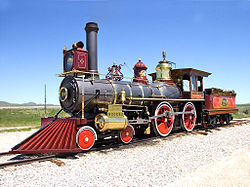
In 1957, Congress established the Golden Spike National Historic Site to preserve the area around Promontory Summit as closely as possible to its appearance in 1869. O'Connor Engineering Laboratories in Costa Mesa, California, designed and built working replicas of the locomotives present at the original ceremony for the Park Service. These engines are drawn up face-to-face each Saturday during the summer for a re-enactment of the event.[19][20][21][22][23][24][25][26][27]

The Utah state quarter

For the May 10, 1969, centennial of the driving of the last spike, the High Iron Company ran a steam-powered excursion train round trip from New York City to Promontory. The Golden Spike Centennial Limited transported more than 100 passengers including, for the last leg into Salt Lake City, actor John Wayne. The Union Pacific Railroad also sent a special display train and the U.S. Army Transportation Corps sent a steam-powered 3-car special from Fort Eustis, Virginia.

On May 10, 2006, on the anniversary of the driving of the spike, Utah announced that its state quarter design would be a depiction of the driving of the spike. The Golden Spike design was selected as the winner from among several others by Utah's governor, Jon Huntsman Jr., following a period during which Utah residents voted and commented on their favorite of three finalists.[28]

On May 10, 2019, the United States Postal Service issued a set of three new commemorative postage stamps to mark the 150th anniversary of the driving of the golden spike: one stamp for the Jupiter locomotive, one stamp for locomotive #119, and one stamp for the golden spike.[29]

Stanford University has identified the two men shown in this detail of the Andrew J. Russell "handshake" photograph at the Golden Spike ceremony as Chinese workers.

It remains a common myth that Chinese workers are not visible in the famous Andrew J. Russell "champagne photograph" of the last spike ceremony. Many Chinese workers were absent from the Golden Spike ceremony in 1869 despite their tremendous contribution in the completion of the railroad. More than 12,000 Chinese had labored to build the rail line from the west, 80% of the railroad workers were Chinese.

On the 145th anniversary of the Golden Spike ceremony, Corky Lee gathered more than 200 Chinese, Chinese Americans and other Asian Pacific American groups to create what he called "photographic justice".[30][31]

Research conducted by the Stanford University "Chinese Railroad Workers in North America Project" disproved the myth, identifying two Chinese laborers who were photographed in the famous Andrew J. Russell photograph.[32] More Chinese laborers who attended the last spike ceremony are visible in Russell's "stereo view # 539 Chinese at Laying Last Rail UPRR", although the Chinese laborers who attended the ceremony only represented a small fraction of the total Chinese workforce on the railroad.

Original workers from the project, Wong Fook, Lee Chao, and Ging Cui are shown in front of a parade float in Ogden, Utah, during a 1919 parade to celebrate the 50th anniversary of the completion of the Transcontinental Railroad.

Three of the Chinese workers who helped build the railroad in 1869, Wong Fook, Lee Chao, and Ging Cui were given a place in the celebratory 50th anniversary parade at Ogden, Utah, in 1919.[33][34] However, during the 1969 ceremony no Chinese representatives spoke during the dedication of a plaque memorializing Chinese railroad workers.[35] The 2019 ceremony brought an intentionally greater focus on the Chinese contribution with then United States Secretary of Transportation Elaine Chao speaking at the event.[35] The Chinese Railway Workers Descendants Association continues to hold annual gatherings at Chinese Arch near Promontory.[35] A monument dedicated to Chinese workers on the railroad was installed at the Utah State capitol building to correspond with the 155th anniversary.[36]

A Utah state park, planned to celebrate the Golden Spike opening in Brigham City, Utah in 2025, will feature a 43 feet tall statue depicting the Golden Spike.[36] The statue, mounted on the back of a truck; has toured various parts of America throughout 2023 and 2024.

Golden Spike Days Celebration (1939)

[edit]
Golden Spike Days program, Omaha, 1939

An elaborate four-day event called the Golden Spike Days Celebration was held in Omaha, Nebraska, from April 26 to 29, 1939, to commemorate the 70th anniversary of the joining of the UP and CPRR rails and driving of the Last Spike at Promontory Summit, Utah, in 1869. The centerpiece event of the celebration occurred on April 28 with the world premiere of the Cecil B. DeMille feature motion picture Union Pacific that took place simultaneously in the city's Omaha, Orpheum, and Paramount theaters. The film features an elaborate reenactment of the original Golden Spike ceremony (filmed in Canoga Park, California) as the closing scene of the motion picture, for which DeMille borrowed the actual Golden Spike from Stanford University to be held by Dr. W. H. Harkness (Stanley Andrews) as he delivered his remarks prior to its driving to complete the railroad. (A prop spike was used for the hammering sequence.)[37]

The Golden Spike Monument, Council Bluffs, Iowa, 1939

Also included as a part of the overall celebration's major attractions was the Golden Spike Historical Exposition, a large assemblage of artifacts (including the Golden Spike), tools, equipment, photographs, documents, and other materials from the construction of the Pacific Railroad that were put on display at Omaha's Municipal Auditorium. The four days of events drew more than 250,000 people to Omaha during its run, a number roughly equivalent to the city's then population.[38] The celebration was opened by President Franklin D. Roosevelt who inaugurated it by pressing a telegraph key at the White House in Washington, D.C.[39][40][41]

On the same day as the premiere of the movie, a gold-colored concrete spike called the "Golden Spike Monument", measuring some 56 feet (17 m) in height, was unveiled at 21st Street and 9th Avenue in Council Bluffs, Iowa, adjacent to the UP's main yard, the location of milepost 0.0 of that road's portion of the Pacific Railroad.[42][43][44] The concrete spike remains on display at the site.

[edit]

Music

[edit]

In 2010, the band Railroad Earth released a song called The Jupiter & the 119. The song references building the railroad and mentions that "they nailed the golden spike".

Artwork

[edit]

Films

[edit]
  • The first motion picture depiction of the driving of the golden spike occurred in The Iron Horse (1924), a silent film directed by John Ford and produced by Fox Film.[47] In 2011, this film was deemed "culturally, historically, or aesthetically significant" by the United States Library of Congress and selected for preservation in the National Film Registry.[48]
  • In the fictional action comedy film Wild Wild West (1999), the joining ceremony is the setting of an assassination attempt on then U.S. President Ulysses S. Grant by the film's antagonist Dr. Arliss Loveless. (In reality Grant did not attend the Golden Spike ceremony.) The extensive Promontory Summit set for the film's Golden Spike ceremony scenes was built at the 20,000-acre Cook's Ranch near Santa Fe, New Mexico.[49]
  • In the Western action film "The Lone Ranger" (2013), the joining of two railroads was commenced by the film's antagonist, Latham Cole. However, it was interrupted by the start of a chase. Instead of Union Pacific #119, they used a scratch-built locomotive entitled, Constitution (A locomotive based on Illinois Central 382 that Casey Jones drove on his final trip on April 30, 1900).

Television

[edit]
  • The Batman: The Animated Series episode "Showdown" features an extended flashback taking place in the Utah Territory in 1883, with the territorial governor (voiced by Patrick Leahy) presiding over the ceremony to drive home the Golden Spike, before they are interrupted by an aerial attack by Ra's al Ghul. In reality, 1883 was the year in which the southern section of the Southern Pacific railroad (the second transcontinental line) was completed; the completion ceremony took place in Texas rather than Utah, and the ceremonial spikes driven were silver, not gold.
  • Hell on Wheels presents a multi-season arc on the construction of the transcontinental railroad. In Season 5, Episode 11, a flash forward sequence includes a picture of the railroad ceremony and a main character claiming to possess a ring made of gold crafted from part of the ceremonial golden spike.[50]
  • In Syfy original series Warehouse 13, the golden spike is featured as an artifact that was used by Pete & Myka to temporarily negate the effects of the Rhodes Bowl. Later, the spike is depicted as stuck within the Warehouse expansion joints as it expanded to accommodate additional artifacts.

Trains

[edit]
  • The Inyo, a 4-4-0 steam locomotive built for the Virginia & Truckee Railroad (V&T #22) in 1875 by the Baldwin Locomotive Works in Philadelphia, appeared in both the Golden Spike ceremony scene in Union Pacific (1939) and in the 1960s television series The Wild Wild West. It appears briefly as the Jupiter in Go West. In May 1969, the Inyo participated in the Golden Spike Centennial at Promontory, Utah, and then served for ten years as the replica of the Central Pacific's Jupiter (CPRR #60) at the Golden Spike National Historical Site, until the current replica was built in 1979. Purchased by the Nevada State Railroad Museum in Carson City, Nevada, in 1974, it was eventually brought back to Nevada and fully restored there in 1983, where it remains operational.[51]

See also

[edit]

References

[edit]
[edit]
Revisions and contributorsEdit on WikipediaRead on Wikipedia
from Grokipedia
The Golden Spike was a ceremonial spike made of 17.6-karat , presented by David Hewes and driven by on May 10, 1869, at Promontory Summit in the , to symbolize the linkage of the Union Pacific and Central Pacific railroads, thereby completing the . The spike measured 5 9/16 inches in length, weighed 14.03 ounces, and featured engravings on its four sides and top, including names of railroad officers and the inscription "The Pacific Railroad ground broke January 8th 1869." Although the actual final rail connection used an iron spike and laurel wood tie, which were promptly removed after the ceremony to allow trains to pass, the golden spike's driving marked the official culmination of the project authorized by the Pacific Railway Acts of 1862 and 1864. The event, attended by railroad officials, workers, and a small crowd, concluded with locomotives (Central Pacific No. 60) and No. 119 (Union Pacific) facing each other as a telegraph operator transmitted the single word "DONE" to the nation, triggering celebrations from coast to coast. Unlike popular depictions, the ceremony was impromptu, hastened by the delayed arrival of Union Pacific Vice President due to weather and financial disputes, leading to the use of special spikes including gold, silver, and others made of copper and iron. The golden spike itself was not left in the rail but was removed and later displayed, with the original now housed at in . This linkage of 1,911 miles of track revolutionized American transportation, reducing cross-country travel from months to days, facilitating , and enabling rapid movement of goods, , and people, though it also intensified pressures on Native American lands and ecosystems along the route. The site's legacy is preserved at , where replicas of the locomotives and annual reenactments commemorate the engineering feat achieved primarily by immigrant Chinese and Irish laborers under challenging conditions. While romanticized in later accounts, contemporary records reveal the ceremony's brevity and the railroads' competitive race for federal subsidies as key drivers, underscoring the project's roots in government-backed private enterprise rather than unadulterated heroic narrative.

Historical Context and Railroad Development

Origins of the Transcontinental Railroad Project

The concept of , which held that the was divinely ordained to expand across the North American continent, provided a foundational ideological impetus for the , aiming to facilitate rapid settlement, resource exploitation, and territorial integration from the Atlantic to the Pacific. Economic motivations were equally compelling, as proponents envisioned the railroad accelerating trade by connecting eastern industrial centers with western agricultural and mineral wealth, while reducing overland freight costs and travel times that previously deterred large-scale commerce. During the Civil War, strategic imperatives emerged to bind western territories to the Union amid fears of Confederate influence or foreign intervention, with completion post-1865 underscoring the need for physical infrastructure to promote national cohesion and forestall regional fragmentation. Theodore D. Judah, a experienced in California's early rail lines, emerged as a key advocate after identifying a viable central route through extensive personal surveys of the Sierra Nevada in the late and early . Judah's expeditions, often self-funded and arduous, pinpointed a passable path avoiding prohibitive gradients, which he detailed in reports and lobbying efforts to , demonstrating engineering feasibility where skeptics saw insurmountable barriers. His persistence secured initial investor backing from Sacramento merchants, known as the "Big Four," and influenced federal policy by emphasizing a northern alignment post-southern secession, which eliminated rival southern routes. Enacted on July 1, 1862, the Pacific Railway Act authorized the Company to construct westward from a point on the and the Company eastward from , meeting somewhere in the territories. To stimulate private investment, the legislation offered subsidies including 10 sections of public land (alternating with government reserves) per mile of track—equivalent to roughly 6,400 acres—and government bonds as loans: $16,000 per mile for plains and $48,000 per mile for mountainous or difficult terrain, repayable only upon completion. The 1864 amendments doubled land grants to 20 miles, permitted retention of incidental resources like timber and stone during construction, and expedited bond issuance to address funding shortfalls amid wartime inflation. These incentives reflected a pragmatic federal strategy to leverage private capital for a project deemed too vast for direct government financing, while ensuring strategic oversight through requirements for government approval of routes and directors.

Construction Efforts by Union Pacific and Central Pacific

The commenced construction at , on December 2, 1863, advancing westward across the relatively flat terrain toward the . This route facilitated grading and track-laying at rates of approximately 2 miles per day in the mid-1860s, though progress was intermittently disrupted by raids from Native American tribes, particularly the , who targeted supply lines and workers in 1867, leading to temporary halts and the need for military escorts. By late 1868, Union Pacific crews accelerated to peaks of over 8 miles in a single day on easier ground, ultimately completing 1,086 miles of track by May 1869. In contrast, the began laying track eastward from , on January 8, 1863, confronting the steep gradients and granite formations of the Sierra Nevada mountains, which demanded extensive blasting and excavation. Workers, predominantly Chinese immigrants, constructed 15 tunnels totaling 6,213 feet in length, including the challenging Summit Tunnel (No. 10) at 1,659 feet through solid granite, where initial advances measured mere inches per day per face before the adoption of explosives improved efficiency. Track-laying rates in the Sierras averaged far below those on the plains, often limited to fractions of a mile daily amid harsh winters and avalanches, though post-mountain progress quickened to record feats like 10 miles in one day by April 1869, enabling completion of 690 miles overall. Both companies operated under incentives from the Pacific Railroad Act of 1862, receiving government bonds and land grants scaled to mileage completed, which fostered intense competition to extend lines as far as possible before meeting. This rivalry culminated in redundant grading and parallel tracks near Promontory Summit, , where Union Pacific pushed beyond designated boundaries in a rush to claim additional subsidies, resulting in negotiated realignments after the lines joined on May 10, 1869.

The Completion Ceremony

Key Participants and Preparations

, president of the , performed the ceremonial driving of the golden spike on May 10, 1869, at Promontory Summit, . David Hewes, a contractor and associate of Stanford, commissioned and donated the 5.5-ounce golden spike, engraved with the names of Central Pacific directors and intrinsically valued at $350. Three additional ceremonial spikes—a silver one from , a silver-capped iron one from , and a copper one from the Northern Railroad—were prepared alongside the gold spike to symbolize contributions from western territories. Preparations included the arrival of Central Pacific's (No. 60), a that transported Stanford and the spike from Sacramento, and Union Pacific's No. 119, which met it at the summit after rescuing delayed dignitaries. A special laurel wood tie, measuring 7.5 feet long by 8 by 6 inches and bearing a silver plaque inscribed "The last tie laid on completion of the Pacific Railroad, May, 1869," was laid between the final rails for the symbolic joining. These elements underscored the event's focus on executive symbolism rather than the prior technical rail-laying. The festivities emphasized railroad principals and invited guests, such as Union Pacific vice president and chief engineer , while excluding the approximately 20,000 laborers—predominantly Chinese for Central Pacific and Irish for Union Pacific—who had endured hazardous conditions to construct the lines. This omission highlighted the ceremony's orientation toward corporate and political elites over the workforce essential to the project's completion.

Events of May 10, 1869, at Promontory Summit

The ceremony commenced around noon with Edgar Mills reading the program, followed by a from Rev. Dr. John Todd. , president of the , and , vice president of the , then delivered brief speeches emphasizing the railroad's completion and its implications for national unity and commerce. Four ceremonial spikes—a spike from , a silver spike from , an spike plated in and silver, and one from the Daily News Letter—were presented for the symbolic driving into a polished laurel tie placed atop the final rail, which had been laid earlier that morning by Chinese tracklayers under the supervision of superintendents James Strobridge and Samuel B. Reed. Stanford swung first at the gold spike but missed, striking the tie instead; Durant followed with a feeble attempt that missed the tie entirely. The ceremonial spikes were then set aside, and the actual connection proceeded using three ordinary iron spikes driven into a pine tie, with a fourth iron spike hammered into place by a regular rail worker using an iron maul wired to the telegraph line to transmit the blows nationwide. At 12:47 p.m. Promontory time, the final blow signaled completion, prompting the telegraph operator to transmit the single word "Done," which was relayed across the continent, triggering celebrations including cannon fire, bell ringing, and parades in cities from New York to . Approximately 1,000 attendees, including dignitaries, railroad workers, soldiers, and reporters, witnessed the event amid a muddy encampment. Festivities ensued with the locomotives No. 119 (Union Pacific) and (Central Pacific) touching pilots for photographs by Andrew J. Russell, champagne toasts in Durant's railcar, cheers from the crowd, and an impromptu evening torchlight parade. Trains departed by 5:00 p.m., marking the end of the on-site gathering.

Ceremonial Artifacts

Description of the Golden Spike and Other Items

The primary ceremonial artifact, known as the Golden Spike, was a 17.6-karat gold spike measuring 5 5/8 inches in length and weighing 14.03 ounces, cast using approximately $350 worth of gold alloyed with copper at the William T. Garrett Foundry in San Francisco. Presented by David Hewes to Leland Stanford, president of the Central Pacific Railroad, it featured engravings on all four sides, including "The Pacific Railroad ground broke January 8th 1869" on one face, the names of Central Pacific directors on another, and the inscription "May God continue the unity of our country as this railroad unites the two great oceans of the world. David Hewes San Francisco" on the base. A second gold spike was contributed by the Nevada Territory, symbolizing the mining wealth and support from western states for the railroad's completion. Complementing the spikes was a silver spike donated by citizens of the , valued at around $200 and intended to represent the region's mineral resources. These spikes underscored the industrial and economic symbolism of the project, with and silver evoking the prosperity and unity fostered by transcontinental connectivity, though only standard iron spikes were driven into the rails for practical purposes. The ceremonial spikes were instead placed into pre-bored holes in a special tie. The laurel wood tie, sourced from California laurel and polished for the occasion, measured 7 1/2 feet long by 8 by 6 inches, donated by Central Pacific tie contractor West Evans and transported from Leland Stanford's private railroad coach. It bore a centered silver plaque inscribed "The last tie laid on completion of the Pacific Railroad, May, 1869," highlighting its role in the symbolic joining of the Union Pacific and Central Pacific lines. This tie, along with the spikes, was prepared to elevate the event beyond mere engineering to a national milestone of progress.

Post-Ceremony Handling and Current Locations

Immediately after the Golden Spike Ceremony on May 10, 1869, workers carefully extracted the ceremonial spikes and laurel wood tie from the rail joint at Promontory Summit to preserve these symbolic items, replacing them with standard iron spikes and a conventional wooden tie to enable regular train operations, as the precious materials were unsuitable for practical rail use. The gold spike, commissioned by David Hewes, was returned to him shortly thereafter for safekeeping and display. In 1892, Hewes donated the spike as part of his art collection to , and it remains in the permanent collection of the Iris & B. Gerald Cantor Center for at . The Nevada silver spike, presented to Central Pacific president during the event, was retained in his possession until his death in 1893, after which it was melted down to fabricate a bust of Stanford himself. The Arizona iron spike, the fourth ceremonial item, was removed alongside the others but subsequently lost or discarded, with no verified record of its preservation. Replicas of the gold and silver spikes, crafted for commemorative purposes, are displayed at institutions such as the in Sacramento. The laurel tie, sourced from , was also extracted post-ceremony and briefly exhibited before its fate became uncertain, likely lost during later events including the and fires. These actions highlighted the artifacts' role as transient symbols rather than functional components of the enduring rail line.

Immediate Aftermath and Technical Realities

Telegraph Announcement and Rail Realignments

At 2:47 p.m. on , 1869, telegraph operators at Promontory Summit transmitted the message "DONE" simultaneously eastward and westward upon the driving of the final spike, announcing the completion of the . This coordinated signal, facilitated by wires connected to the last rail, reached major cities within minutes, triggering nationwide celebrations including the ringing of bells in New York and , cannon salutes in , and displays from the Atlantic seaboard to San Francisco's . The instantaneous communication highlighted the integration of rail and telegraph infrastructure, enabling real-time confirmation of the continental linkage from both coasts. The Promontory Summit junction, while symbolically significant, was soon deemed impractical for regular operations owing to its isolation, circuitous deviation from surveyed alignments, and challenging grades. In September 1869, the purchased roughly 53 miles of Union Pacific grade extending from a point five miles west of Ogden to , shifting ownership and effectively repositioning the primary interchange to the Ogden vicinity. This realignment, operational by 1870, established Ogden as the key hub for connecting to regional lines like the Utah Central Railroad, bypassing 's temporary role and favoring a more direct path for through traffic. Initial rail usage remained sparse, with celebratory excursions giving way to prioritized improvements on the revised route, as the original summit alignment saw limited freight and passenger volume pending full grading and ballasting.

Engineering and Logistical Outcomes

The completed transcontinental railroad formed a continuous 1,911-mile line connecting Omaha, Nebraska, to Sacramento, California. The Union Pacific constructed 1,085 miles eastward from Omaha to Promontory Summit, Utah, while the Central Pacific built 690 miles westward from Sacramento, resulting in approximately 100 miles of overlapping or redundant track due to the intense competition between the companies, which prioritized speed over optimal routing. Construction costs for the two railroads totaled roughly $100 million, with federal subsidies under the Pacific Railway Acts providing critical support through $64 million in 30-year government bonds—valued at $16,000 per mile on level terrain and up to $48,000 per mile in mountainous areas—and land grants encompassing about 12 million acres of in alternate sections along the route. These incentives offset the high expenses of grading, tunneling, and bridging across diverse terrains, including the Sierra Nevada mountains and . The line achieved operational readiness immediately upon completion, with regular passenger and freight trains beginning service within days of the May 10, 1869, ceremony; an later demonstrated the potential by crossing the nation in 83 hours by 1876. Pre-railroad overland travel required 3–6 months by or 20–25 days by for the roughly 2,000-mile journey, whereas rail service reduced passenger transit to 5–7 days and freight delivery from months to a comparable timeframe, fundamentally enhancing logistical efficiency despite initial reliance on averaging 20–30 . Early operations encountered technical hurdles inherent to 1860s rail technology, such as wood- and coal-burning locomotives that emitted sparks capable of igniting dry vegetation or wooden cars, contributing to frequent fires along the rights-of-way. Competitive haste also produced uneven grading and bridges in overlap zones, necessitating prompt repairs and contributing to derailments, though iron rails and basic signaling enabled reliable through-service and validated the engineering feat of spanning harsh environments with minimal prior .

Economic and Strategic Achievements

National Unification and Trade Expansion

The completion of the first transcontinental railroad on May 10, 1869, played a pivotal role in fostering national cohesion following the Civil War by physically linking the eastern and western United States, thereby reinforcing political and economic integration across a divided continent. President Abraham Lincoln had envisioned such a line as a means to unite the nation, promoting a shared sense of continental identity and countering sectionalism that had fueled the recent conflict. The railroad's 1,911-mile span from Omaha, Nebraska, to Sacramento, California, enabled rapid communication and movement of people and goods, transforming the West from a remote frontier into an accessible extension of the national economy. Travel times between New York and plummeted from four to seven months by or clipper ship around to approximately seven days by rail by , dramatically expanding commerce in time-sensitive such as , which could now reach eastern markets fresh rather than spoiled. This connectivity spurred volumes, with the railroad facilitating the eastward shipment of western agricultural outputs and the westward flow of manufactured , thereby integrating regional economies into a national market. Freight transportation costs also declined substantially due to the efficiency of rail over previous overland or routes, lowering barriers to intercontinental exchange. The line accelerated westward migration by making relocation feasible for settlers and entrepreneurs, contributing to the and statehood of territories including in 1876 and others in the ensuing decades. It further enabled resource extraction by providing outlets for commodities like timber, minerals, and agricultural products from the interior West, fueling industrial production and across the continent. Enhanced military logistics supported federal operations in remote areas, underscoring the railroad's strategic value in consolidating national authority. Overall, these developments symbolized America's industrial prowess and laid groundwork for sustained .

Long-Term Infrastructure Benefits

The completion of the established a model for federal-private partnerships in infrastructure development, as authorized by the Pacific Railway Act of July 1, 1862, which granted land subsidies and loans to the Union Pacific and Central Pacific railroads while relying on private capital and management for construction. This approach influenced subsequent projects, including the , which received similar federal land grants totaling over 47 million acres and achieved completion on September 8, 1883, at Gold Creek, , thereby extending transcontinental connectivity northward. Such collaborations demonstrated the feasibility of leveraging public resources to incentivize private risk-taking in large-scale endeavors, setting precedents for over 200 million acres of land grants across U.S. railroads by 1871 that spurred further network expansion without direct government operation. Construction techniques pioneered during the project advanced surveying and blasting methods critical for overcoming topographic barriers, with pre-1862 Pacific Railroad Surveys documenting routes through the Rockies and Sierra Nevada using barometric altimeters and chronometers for precise elevation and longitude measurements. In the Sierra Nevada, Central Pacific engineers employed nitroglycerin for blasting tunnels—despite its volatility, which caused numerous accidents—supplementing black powder to excavate 15 tunnels totaling 6,213 feet, a scale unmatched in prior U.S. projects and informed later dynamite applications after Alfred Nobel's 1867 patent. These innovations, combined with extended supply chains that transported iron rails from Pennsylvania mills via Cape Horn and Cape Good Hope routes, established logistical frameworks for sustaining remote operations, enabling the project's 1,912-mile track despite 19th-century limitations in mechanization. The railroad causally accelerated U.S. industrialization by integrating distant basins into national markets, facilitating the extraction and of timber, minerals, and agricultural that fueled manufacturing booms; for instance, freight tonnage grew from 2.6 billion ton-miles in 1870 to 13.8 billion by 1880, directly linking western outputs to eastern factories. It enabled rapid mass troop deployments, as evidenced by post-1869 that supported campaigns against Native American resistance through swift supply movements across previously impassable terrains, a capability absent in or alternatives. Urban growth ensued, with railroad hubs like Omaha and expanding populations by factors of 10 or more between 1870 and 1890 via immigrant settlement and , as no contemporaneous could replicate rail's efficiency in scaling human and material flows over continental distances.

Criticisms and Human Costs

Treatment of Chinese and Irish Laborers

The Central Pacific Railroad employed approximately 12,000 to 15,000 Chinese laborers by 1867, constituting over 90 percent of its workforce, recruited initially from and later directly from province through intermediaries amid economic hardships including the aftermath of the and regional famines. These workers, organized into self-managed "companies" of 12 to 20 men each under elected headmen, demonstrated high retention rates due to their disciplined approach and the relative stability of railroad employment compared to alternatives in or local mining. Contracts were voluntary, specifying hazardous duties such as blasting tunnels through Sierra Nevada granite and handling nitroglycerin explosives, with no historical evidence of coerced labor akin to slavery. Chinese laborers received $27 to $30 per month, 30 to 50 percent less than the $35 paid to white workers, who also typically received free food and lodging, while Chinese workers often had to cover such costs or relied on company-provided but inferior provisions in segregated camps. Working conditions involved 10- to 12-hour shifts in extreme weather, exposing them to avalanches, misfires, and cave-ins; estimates indicate over 1,000 deaths from such accidents, though precise figures are unavailable due to incomplete records. In June 1867, thousands struck near Cisco, California, demanding pay parity, a 10-hour workday, and an end to by overseers, halting construction for about a week until the company withheld food supplies, forcing a return without concessions. Despite these disparities, Chinese workers' efficiency enabled feats like laying 10 miles of track in a single day in 1869, yet they were deliberately excluded from the Promontory Summit ceremony on May 10, 1869, reflecting racial prejudices of the era. The Union Pacific Railroad relied on around 10,000 Irish immigrant laborers, many Civil War veterans seeking economic advancement in post-famine Ireland and an industrializing America, with voluntary enlistment driven by promises of steady pay amid limited alternatives. These workers faced comparable perils, including prairie hazards, explosive accidents, and disease outbreaks in makeshift camps with basic diets of beef, bread, and coffee, often compounded by poor sanitation leading to water-borne illnesses. Wages stood at $35 per month plus board, but dissatisfaction prompted frequent walk-offs and strikes over reductions or delays, as in early construction phases where crews abandoned sites en masse, pressuring management to import more labor. Union Pacific suppressed unrest through tactics like food embargoes and threats, without formalized unions, yet Irish workers' mobility allowed many to exit for better prospects, underscoring the contractual nature of their involvement rather than bondage. Like their Chinese counterparts, Irish laborers received no formal recognition at the golden spike event, their contributions overshadowed by executives.

Effects on Native American Tribes and Wildlife

The completion of the First Transcontinental Railroad in 1869 facilitated a rapid influx of white settlers into the , accelerating the encroachment on Native American territories and disrupting traditional and migration patterns for tribes such as the , , and . Railroad companies received federal land grants totaling approximately 130 million acres, many of which overlapped or disregarded treaty-recognized Indigenous lands, enabling homesteaders to claim areas previously secured for tribal use through agreements like the . This demographic shift intensified pre-existing conflicts, as construction crews and surveyors directly invaded grounds, prompting attacks by tribes defending their resources. The railroad played a causal role in the near-extinction of the , whose herds numbered an estimated 30 million in the early 1800s but plummeted to fewer than 1,000 by the mid-1880s, primarily due to commercial hunting enabled by rail access. Trains allowed hunters to reach remote Plains herds efficiently, with carcasses processed for hides and meat shipped eastward; for instance, in 1872-1873 alone, professional hunters killed over 3 million animals, exacerbating starvation among dependent tribes like the , whose nomadic economies relied on the animal for food, clothing, and shelter. This ecological collapse, compounded by fencing and from rail lines, forced many Plains groups into dependency on U.S. government rations, undermining their . Tribal responses varied, with some groups mounting armed resistance—such as the Lakota under , whose 1866-1868 campaign delayed Union Pacific progress by targeting supply lines and forts built to secure the route—while others allied with federal forces for survival advantages. , numbering around 100 warriors, protected railroad construction from and raids in and during the late 1860s, earning wages and temporary protection against their traditional enemies in exchange. Similarly, Crow tribes cooperated with the U.S. Army, providing scouts and labor amid the railroad's advance, which offered short-term economic opportunities but ultimately accelerated land loss for all Indigenous groups. Enhanced rail logistics boosted U.S. mobility, enabling faster troop deployments and supply lines that curtailed Native nomadic warfare tactics and hastened subjugation in subsequent conflicts like the Great Sioux War of 1876-1877. By 1890, the combination of settler expansion, , and military reinforcement via rail had largely confined Plains tribes to reservations, marking the effective end of their pre-contact lifestyles amid irreversible demographic pressures from an estimated 20-fold increase in non-Indigenous western population over the following decades.

Legacy and Modern Commemorations

Establishment of Golden Spike National Historical Park

The Golden Spike National Historic Site was authorized on April 2, 1957, by the U.S. Congress to preserve the Promontory Summit location where the was completed on May 10, 1869. Initially under non-federal ownership, the site aimed to commemorate the engineering achievement of linking the Union Pacific and Central Pacific Railroads through interpretive programs focused on railroad construction and operations. Federal ownership was established on July 30, 1965, placing it under administration to maintain the 2,735 acres encompassing original railroad grades and the Last Spike Site. Key interpretive features include full-scale, operational replicas of the Central Pacific Railroad's (No. 60) and Union Pacific's No. 119 locomotives, delivered to the park on May 4, 1979, and used to demonstrate steam-powered rail technology during scheduled operating days. These replicas, built to historical specifications, allow visitors to witness reenactments of the joining ceremony and explore exhibits on track-laying techniques, grading, and bridging that enabled the rapid transcontinental connection. The park's original mandate emphasized preserving physical remnants of the railroad's engineering feats, such as 15 miles of graded right-of-way, over broader social histories. On March 12, 2019, the site was redesignated as under 116-9, expanding its scope to include broader network interpretation while retaining focus on Promontory's core events. This change integrated it more fully into the System, enhancing resources for public education on the logistical and technical innovations of 19th-century railroading, including annual steam demonstrations that draw visitors to experience the site's preserved landscape and artifacts.

Reenactments, Anniversaries, and Educational Efforts

The first major post-1930s commemoration, Golden Spike Days, occurred in , from April 26 to 29, , coinciding with the world premiere of Cecil B. DeMille's film Union Pacific. This event featured parades, dinners, and appearances by film cast members, emphasizing the railroad's historical significance through public spectacles. The 100th anniversary in 1969 marked a pivotal celebration at Promontory Summit, , with the debut of new facilities at the nascent Golden Spike National Historic Site. Events included a reenactment of the rail joining, attended by officials and rail enthusiasts, alongside special excursion trains like the Golden Spike Centennial Limited, which traversed routes evoking the original journey. Speeches highlighted engineering triumphs, drawing crowds to witness displays symbolizing progress. The 150th anniversary on May 10, 2019, drew nearly 20,000 spectators to a full reenactment using operational replicas of locomotives No. 119 and Jupiter at . Dignitaries delivered remarks, including a keynote by historian , while Union Pacific sponsored related events to underscore the project's enduring legacy of national connectivity. These gatherings prioritized fidelity to 1869 accounts, focusing on logistical feats over revisionist narratives. Educational efforts at the emphasize hands-on learning about railroad techniques, including track laying and , through year-round field trips aligned with state standards. Programs feature interactive demonstrations with replica steam engines, fostering understanding of 19th-century without contemporary ideological overlays. Junior Ranger activities engage youth in historical , while Union Pacific's heritage initiatives, such as promotional trains during anniversaries, reinforce the original of industrial advancement. During the , the expanded virtual tours and online resources to maintain public access to these materials.

Cultural Representations

In Art, Literature, and Music

Thomas Hill's monumental The Driving of the Last Spike, completed circa 1881, depicts the ceremonial joining of the Central Pacific and Union Pacific railroads at Promontory Summit on May 10, 1869, featuring locomotives and No. 119, railroad leaders like and Thomas Durant, and a crowd of workers and dignitaries. Measuring 243.8 cm by 367 cm, the work romanticizes American industrial progress and , emphasizing unity and triumph while largely omitting the contributions of Chinese and Irish laborers central to the construction. Housed at the , it exemplifies 19th-century artistic portrayals that prioritized elite figures and technological achievement over labor realities. In literature, the transcontinental railroad's completion inspired reflections on national expansion and connectivity, as seen in Mark Twain's Roughing It (1872), which contrasts grueling pre-rail journeys across the West with the era's emerging rail networks, underscoring the shift from isolation to integration post-1869. Twain's semi-autobiographical account, drawing from his travels, alludes to the railroad's transformative role without directly narrating the spike ceremony, yet captures the cultural optimism it symbolized. , such as the concluding volume Golden Spike in Robert D. San Souci's Iron Horse Chronicles trilogy (2012), fictionalizes the event through a young engineer's perspective, blending verifiable details like the spike's driving with dramatic narrative to evoke the era's engineering feats and personal stakes. Musical commemorations include 19th-century ballads and celebrating the "wedding of the rails," such as tunes evoking the May 10, 1869, ceremony's telegraph announcement of "Done," which proclaimed national unity from coast to coast. The traditional Irish-American "Drive the Golden Spike" references the event's symbolism, linking it to broader railroad . Later folk traditions incorporate laborers' work songs, collected in the early , which highlight the grueling toil of Irish and Chinese tracklayers—often sung in chants like "John Henry" variants—contrasting triumphant anthems by critiquing exploitation amid industrial hymns to progress.

In Film, Television, and Physical Models

The 1939 film Union Pacific, directed by , depicts the construction of the culminating in a dramatized golden spike ceremony at Promontory Summit. The production borrowed the original 1869 golden spike from for authenticity in recreating the event, though the film inaccurately portrays the spike being hammered into a tie, whereas historical accounts indicate it was gently placed into a pre-drilled hole due to gold's softness, and immediately removed afterward to preserve it. Released to coincide with the 70th anniversary of the railroad's completion, the movie emphasizes heroic struggles, Irish immigrant labor, and conflicts with Native Americans and outlaws, but prioritizes spectacle over precise chronology, loosely basing characters on figures like while fabricating plot elements such as romantic subplots and exaggerated rivalries between railroad companies. The AMC television series Hell on Wheels (2011–2016) portrays the Union Pacific's advance westward, with its series finale episode "Done" (Season 5, Episode 14, aired July 23, 2016) centering on the golden spike ceremony amid government hearings and personal reckonings for protagonist Cullen Bohannon. The show highlights exploitative labor conditions, including the roles of Irish and Chinese workers, and critiques railroad barons' corruption, drawing from real events like the , but amplifies interpersonal vices, violence, and moral ambiguities for narrative tension, often at the expense of broader historical context such as the coordinated efforts of both Union Pacific and Central Pacific lines. While praised for evoking the era's grit, the series takes liberties with timelines and character arcs, such as Bohannon's fictional quest, and underrepresents Chinese contributions in key scenes despite their documented 90% share of Central Pacific tunneling work. Physical models of the golden spike and related artifacts include museum-quality replicas of the four ceremonial spikes (from , , , and the "last spike"), cast in metal or alloy to replicate the originals' dimensions and inscriptions, often displayed in railroad heritage collections. Hobbyist model railroads frequently recreate the Promontory Summit ceremony in scales like HO or O gauge, using custom golden spikes—typically brass or painted wood—to mark layout completions, as suggested in modeling guides that recommend staging personal "spike-driving" events with replica locomotives facing off. These tangible representations, such as dioramas at venues like the Hostler Model Railroad Museum, aim for visual fidelity to period photographs but simplify engineering feats like the locomotive designs of (Central Pacific No. 60) and No. 119 (Union Pacific), prioritizing scenic drama over operational accuracy in static displays. Unlike cinematic versions, model enthusiasts often reference primary sources for spike details, though commercial kits may gloss over the ceremony's brevity and the spikes' immediate removal to avoid damage.

References

Add your contribution
Related Hubs
User Avatar
No comments yet.