Recent from talks
Nothing was collected or created yet.
Golden ratio base
View on WikipediaThis article includes a list of references, related reading, or external links, but its sources remain unclear because it lacks inline citations. (August 2018) |
| Part of a series on |
| Numeral systems |
|---|
| List of numeral systems |
Golden ratio base is a non-integer positional numeral system that uses the golden ratio (the irrational number ≈ 1.61803399 symbolized by the Greek letter φ) as its base. It is sometimes referred to as base-φ, golden mean base, phi-base, or, colloquially, phinary. Any non-negative real number can be represented as a base-φ numeral using only the digits 0 and 1, and avoiding the digit sequence "11" – this is called a standard form. A base-φ numeral that includes the digit sequence "11" can always be rewritten in standard form, using the algebraic properties of the base φ — most notably that φn + φn − 1 = φn + 1. For instance, 11φ = 100φ.
Despite using an irrational number base, when using standard form, all non-negative integers have a unique representation as a terminating (finite) base-φ expansion. The set of numbers which possess a finite base-φ representation is the ring Z[]; it plays the same role in this numeral systems as dyadic rationals play in binary numbers, providing a possibility to multiply.
Other numbers have standard representations in base-φ, with rational numbers having recurring representations. These representations are unique, except that numbers with a terminating expansion also have a non-terminating expansion. For example, 1 = 0.1010101… in base-φ just as 1 = 0.99999… in decimal.
Examples
[edit]| Decimal | Powers of φ | Base φ |
|---|---|---|
| 1 | φ0 | 1 |
| 2 | φ1 + φ−2 | 10.01 |
| 3 | φ2 + φ−2 | 100.01 |
| 4 | φ2 + φ0 + φ−2 | 101.01 |
| 5 | φ3 + φ−1 + φ−4 | 1000.1001 |
| 6 | φ3 + φ1 + φ−4 | 1010.0001 |
| 7 | φ4 + φ−4 | 10000.0001 |
| 8 | φ4 + φ0 + φ−4 | 10001.0001 |
| 9 | φ4 + φ1 + φ−2 + φ−4 | 10010.0101 |
| 10 | φ4 + φ2 + φ−2 + φ−4 | 10100.0101 |
Writing golden ratio base numbers in standard form
[edit]In the following example of conversion from non-standard to standard form, the notation 1 is used to represent the signed digit −1.
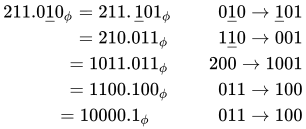
211.01φ is not a standard base-φ numeral, since it contains a "11" and additionally a "2" and a "1" = −1, which are not "0" or "1".
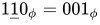
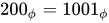
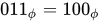
To put a numeral in standard form, we may use the following substitutions: , , , . The substitutions may be applied in any order we like, as the result will be the same. Below, the substitutions applied to the number on the previous line are on the right, the resulting number on the left.
Any positive number with a non-standard terminating base-φ representation can be uniquely standardized in this manner. If we get to a point where all digits are "0" or "1", except for the first digit being negative, then the number is negative. (The exception to this is when the first digit is negative one and the next two digits are one, like 1111.001=1.001.) This can be converted to the negative of a base-φ representation by negating every digit, standardizing the result, and then marking it as negative. For example, use a minus sign, or some other significance to denote negative numbers.
Representing integers as golden ratio base numbers
[edit]We can either consider our integer to be the (only) digit of a nonstandard base-φ numeral, and standardize it, or do the following:
1 × 1 = 1, φ × φ = 1 + φ and 1/φ = −1 + φ. Therefore, we can compute
- (a + bφ) + (c + dφ) = ((a + c) + (b + d)φ),
- (a + bφ) − (c + dφ) = ((a − c) + (b − d)φ)
and
- (a + bφ) × (c + dφ) = ((ac + bd) + (ad + bc + bd)φ).
So, using integer values only, we can add, subtract and multiply numbers of the form (a + bφ), and even represent positive and negative integer powers of φ.
(a + bφ) > (c + dφ) if and only if 2(a − c) − (d − b) > (d − b) × √5. If one side is negative, the other positive, the comparison is trivial. Otherwise, square both sides, to get an integer comparison, reversing the comparison direction if both sides were negative. On squaring both sides, the is replaced with the integer 5.
So, using integer values only, we can also compare numbers of the form (a + bφ).
- To convert an integer x to a base-φ number, note that x = (x + 0φ).
- Subtract the highest power of φ, which is still smaller than the number we have, to get our new number, and record a "1" in the appropriate place in the resulting base-φ number.
- Unless our number is 0, go to step 2.
- Finished.
The above procedure will never result in the sequence "11", since 11φ = 100φ, so getting a "11" would mean we missed a "1" prior to the sequence "11".
Start, e.g., with integer = 5, with the result so far being ...00000.00000...φ
Highest power of φ ≤ 5 is φ3 = 1 + 2φ ≈ 4.236067977
Subtracting this from 5, we have 5 − (1 + 2φ) = 4 − 2φ ≈ 0.763932023..., the result so far being 1000.00000...φ
Highest power of φ ≤ 4 − 2φ ≈ 0.763932023... is φ−1 = −1 + 1φ ≈ 0.618033989...
Subtracting this from 4 − 2φ ≈ 0.763932023..., we have 4 − 2φ − (−1 + 1φ) = 5 − 3φ ≈ 0.145898034..., the result so far being 1000.10000...φ
Highest power of φ ≤ 5 − 3φ ≈ 0.145898034... is φ−4 = 5 − 3φ ≈ 0.145898034...
Subtracting this from 5 − 3φ ≈ 0.145898034..., we have 5 − 3φ − (5 − 3φ) = 0 + 0φ = 0, with the final result being 1000.1001φ.
Non-uniqueness
[edit]Just as with any base-n system, numbers with a terminating representation have an alternative recurring representation. In base-10, this relies on the observation that 0.999... = 1. In base-φ, the numeral 0.1010101... can be seen to be equal to 1 in several ways:
- Conversion to nonstandard form: 1 = 0.11φ = 0.1011φ = 0.101011φ = ... = 0.10101010...φ
- Geometric series: 1.0101010...φ is equal to
- Difference between "shifts": φ2 x − x = 10.101010...φ − 0.101010...φ = 10φ = φ so that x = φ/φ2 − 1 = 1
This non-uniqueness is a feature of the numeration system, since both 1.0000 and 0.101010... are in standard form.
In general, the final 1 of any number in base-φ can be replaced with a recurring 01 without changing the value of that number.
Representing rational numbers as golden ratio base numbers
[edit]Every non-negative rational number can be represented as a recurring base-φ expansion, as can any non-negative element of the field Q[√5] = Q + √5Q, the field generated by the rational numbers and . Conversely any recurring (or terminating) base-φ expansion is a non-negative element of Q[√5]. For recurring decimals, the recurring part has been overlined:
- 1/2 = 0.010φ
- 1/3 = 0.00101000φ
- 1/4 = 0.001000φ
- 1/5 = 0.001001010100100100φ
- 1/10 = 0.000010000100010100001010001010101000100101000001001000100000φ
The justification that a rational gives a recurring expansion is analogous to the equivalent proof for a base-n numeration system (n = 2,3,4,...). Essentially in base-φ long division there are only a finite number of possible remainders, and so once there must be a recurring pattern. For example, with 1/2 = 1/10.01φ = 100φ/1001φ long division looks like this (note that base-φ subtraction may be hard to follow at first):
.0 1 0 0 1
________________________
1 0 0 1 ) 1 0 0.0 0 0 0 0 0 0 0
1 0 0 1 trade: 10000 = 1100 = 1011
------- so 10000 − 1001 = 1011 − 1001 = 10
1 0 0 0 0
1 0 0 1
-------
etc.
The converse is also true, in that a number with a recurring base-φ; representation is an element of the field Q[√5]. This follows from the observation that a recurring representation with period k involves a geometric series with ratio φ−k, which will sum to an element of Q[√5].
Representing irrational numbers of note as golden ratio base numbers
[edit]The base-φ representations of some interesting numbers:
Addition, subtraction, and multiplication
[edit]It is possible to adapt all the standard algorithms of base-10 arithmetic to base-φ arithmetic. There are two approaches to this:
Calculate, then convert to standard form
[edit]For addition of two base-φ numbers, add each pair of digits, without carry, and then convert the numeral to standard form. For subtraction, subtract each pair of digits without borrow (borrow is a negative amount of carry), and then convert the numeral to standard form. For multiplication, multiply in the typical base-10 manner, without carry, then convert the numeral to standard form.
For example,
- 2 + 3 = 10.01 + 100.01 = 110.02 = 110.1001 = 1000.1001
- 2 × 3 = 10.01 × 100.01 = 1000.1 + 1.0001 = 1001.1001 = 1010.0001
- 7 − 2 = 10000.0001 − 10.01 = 10010.0101 = 1110.0101 = 1001.0101 = 1000.1001
Avoid digits other than 0 and 1
[edit]A more "native" approach is to avoid having to add digits 1 + 1 or to subtract 0 − 1. This is done by reorganising the operands into nonstandard form so that these combinations do not occur. For example,
- 2 + 3 = 10.01 + 100.01 = 10.01 + 100.0011 = 110.0111 = 1000.1001
- 7 − 2 = 10000.0001 − 10.01 = 1100.0001 − 10.01 = 1011.0001 − 10.01 = 1010.1101 − 10.01 = 1000.1001
The subtraction seen here uses a modified form of the standard "trading" algorithm for subtraction.
Division
[edit]No non-integer rational number can be represented as a finite base-φ number. In other words, all finitely representable base-φ numbers are either integers or (more likely) an irrational in a quadratic field Q[√5]. Due to long division having only a finite number of possible remainders, a division of two integers (or other numbers with finite base-φ representation) will have a recurring expansion, as demonstrated above.
Relationship with Fibonacci coding
[edit]Fibonacci coding is a closely related numeration system used for integers. In this system, only digits 0 and 1 are used and the place values of the digits are the Fibonacci numbers. As with base-φ, the digit sequence "11" is avoided by rearranging to a standard form, using the Fibonacci recurrence relation Fk+1 = Fk + Fk−1. For example,
- 30 = 1×21 + 0×13 + 1×8 + 0×5 + 0×3 + 0×2 + 1×1 + 0×1 = 10100010fib.
Practical usage
[edit]It is possible to mix base-φ arithmetic with Fibonacci integer sequences. The sum of numbers in a General Fibonacci integer sequence that correspond with the nonzero digits in the base-φ number, is the multiplication of the base-φ number and the element at the zero-position in the sequence. For example:
- product 10 (10100.0101 base-φ) and 25 (zero position) = 5 + 10 + 65 + 170 = 250
- base-φ: 1 0 1 0 0. 0 1 0 1
- partial sequence: ... 5 5 10 15 25 40 65 105 170 275 445 720 1165 ...
- product 10 (10100.0101 base-φ) and 65 (zero position) = 10 + 25 + 170 + 445 = 650
- base-φ: 1 0 1 0 0. 0 1 0 1
- partial sequence: ... 5 5 10 15 25 40 65 105 170 275 445 720 1165 ...
See also
[edit]- Beta encoder – Originally used golden ratio base
- Ostrowski numeration
References
[edit]- Bergman, George (1957). "A Number System with an Irrational Base". Mathematics Magazine. 31 (2): 98–110. doi:10.2307/3029218. JSTOR 3029218.
- Eggan, L. C.; vanden Eynden, C. L. (1966). "Decimal expansions to nonintegral bases". Amer. Math. Monthly. 73 (73): 576–582. doi:10.2307/2314786. JSTOR 2314786.
- Plojhar, Jozef (1971). "The Good natured Rabbit breeder". Manifold. 11: 26–30.
External links
[edit]Golden ratio base
View on GrokipediaFundamentals
Definition
The golden ratio, denoted by , is an irrational number defined as , which satisfies the quadratic equation .[2] This defining relation implies that and , making it suitable as a base for a positional numeral system where the digits are restricted to 0 and 1 to avoid exceeding the base value in any position.[2] The concept of a numeral system using the irrational base was first introduced by George Bergman in his 1957 paper.[4] It is also known as base- or, colloquially, the phinary system.[3] In this system, numbers are expressed as sums of powers of multiplied by the digits 0 or 1, analogous to how decimal systems use powers of 10 with digits 0-9.[2] Algebraically, the golden ratio base is supported by the ring , which consists of integer linear combinations of powers of and forms the ring of integers in the quadratic field .[5] This structure ensures that finite representations in base correspond to elements within this ring.[4]Properties
The golden ratio satisfies the minimal polynomial equation , or equivalently . This algebraic relation directly impacts representations in base , as it implies that the digit string , allowing multiple equivalent expansions for the same number without further restrictions. To resolve this non-uniqueness, the standard (or normal) form of a base- representation is defined as one using only digits 0 and 1 with no two consecutive 1's (i.e., avoiding the substring "11"). Under this constraint, every non-negative real number admits a standard representation in base , which is unique except for numbers that have a terminating expansion, which also admit an equivalent non-terminating representation.[1] The base- system is connected to the quadratic number field , where is a unit in the ring of integers , and (finite) representations correspond to elements in this ring via the powers of . The greedy algorithm generates the standard form: starting from a positive real number , the highest digit position is determined by the largest such that , the digit is set to 1 if applicable, and the remainder is recursively processed by subtracting and scaling. This method, akin to the standard conversion in integer bases, ensures the no-adjacent-1's condition and finite expansions for integers.[6]Notation and Examples
Standard Notation
In the golden ratio base, also known as base-φ or phinary, numbers are represented using the golden ratio φ = (1 + √5)/2 ≈ 1.618 as the radix, with digits restricted to 0 and 1. The standard notation employs a subscript φ to indicate the base, as in 101.01_φ, where the sequence of digits precedes or follows the radix point. This positional system allows for the representation of both integer and fractional parts, with only binary digits ensuring that every non-negative real number can be expressed, though representations are not always unique without additional constraints.[4][1] The value of a number in this base is interpreted as the sum ∑ d_k φ^k, where the d_k are the digits (0 or 1) and k ranges over all integers corresponding to the positions. Positions to the left of the radix point (typically denoted by a dot ".") represent non-negative exponents (k ≥ 0), while those to the right correspond to negative exponents (k < 0), enabling the encoding of fractional components. For instance, the radix point separates the integer part from the fractional part, with each successive position to the right dividing by φ, analogous to how decimal fractions work but scaled by powers of φ. This summation formula directly follows from the positional nature of the system, where each digit multiplies its positional weight φ^k.[4][2] To achieve a canonical or standard form, representations must avoid adjacent 1's, as consecutive 1's lead to multiple equivalent expressions due to the algebraic properties of φ. Normalization is performed by replacing any occurrence of "11" with "100", leveraging the identity φ² = φ + 1, which shifts the value equivalently without altering the total. This rule extends recursively to longer strings of adjacent 1's and applies across the radix point, ensuring a unique minimal representation with the fewest 1's and no consecutive digits of 1. Such standardization is essential for unambiguous parsing and computational efficiency in base-φ arithmetic.[4][3]Illustrative Examples
To illustrate representations in the golden ratio base (also known as phinary), consider the standard forms for small positive integers, which use digits 0 and 1 with no adjacent 1's for uniqueness. These are constructed as sums of distinct powers of φ ≈ 1.618034, where φ satisfies φ² = φ + 1. The table below shows the standard phinary representations for integers from 1 to 10, along with their decimal equivalents and brief value decompositions.| Decimal | Phinary | Value Decomposition |
|---|---|---|
| 1 | 1_φ | φ⁰ = 1 |
| 2 | 10.01_φ | φ¹ + φ⁻² ≈ 1.618 + 0.382 = 2 |
| 3 | 100.01_φ | φ² + φ⁻² ≈ 2.618 + 0.382 = 3 |
| 4 | 101.01_φ | φ² + φ⁰ + φ⁻² ≈ 2.618 + 1 + 0.382 = 4 |
| 5 | 1000.1001_φ | φ³ + φ⁻¹ + φ⁻⁴ ≈ 4.236 + 0.618 + 0.146 = 5 |
| 6 | 1010.0001_φ | φ³ + φ¹ + φ⁻⁴ ≈ 4.236 + 1.618 + 0.146 = 6 |
| 7 | 10000.0001_φ | φ⁴ + φ⁻⁴ ≈ 6.854 + 0.146 = 7 |
| 8 | 10001.0001_φ | φ⁴ + φ⁰ + φ⁻⁴ ≈ 6.854 + 1 + 0.146 = 8 |
| 9 | 10010.0101_φ | φ⁴ + φ¹ + φ⁻² + φ⁻⁴ ≈ 6.854 + 1.618 + 0.382 + 0.146 = 9 |
| 10 | 10100.0101_φ | φ⁴ + φ² + φ⁻² + φ⁻⁴ ≈ 6.854 + 2.618 + 0.382 + 0.146 = 10 |
1.11_φ = φ⁰ + φ⁻¹ + φ⁻² = 1 + (φ + 1) × φ⁻² = 1 + φ⁻² × φ² = 1 + 1 = 2,
using the substitution φ⁻¹ + φ⁻² = 1 derived from the defining equation. The standard form avoids such adjacent 1's via a normalization rule.[3][1]
Number Representations
Integers
In the golden ratio base, also known as the phinary system, every positive integer has a unique finite representation as a sum of distinct powers of the golden ratio , using coefficients 0 or 1 and avoiding any two adjacent 1's in the digit sequence (including across the radix point). This standard form ensures no overlaps or gaps in the representations, leveraging the identity , which allows rewriting consecutive 1's (e.g., ) to eliminate adjacencies. Without this restriction, multiple representations exist for the same integer; for instance, implies that 3 can be written as in standard form but also admits non-standard forms with adjacent 1's after expansion. The uniqueness in the standard form follows from the minimal length property and the avoidance of the forbidden "11" substring, as established in the foundational work on irrational bases.[4][7] The representation is constructed using a greedy algorithm: at each step, subtract the largest power of less than or equal to the current remainder, assigning a coefficient of 1 to that position, and continue with the updated remainder until it reaches zero. This process naturally avoids adjacent 1's for base due to its value being the smallest greater than 1 for which the digit set {0,1} provides complete coverage without redundancy. The completeness for all positive integers stems from and the digit set {0,1}, which allows the positional system to span all non-negative reals, with finiteness for integers arising from the algebraic closure under the minimal polynomial , ensuring remainders terminate exactly after finitely many steps. For example, to represent 13:- Largest : , remainder .
- Largest : , remainder .
- Largest : , remainder 0.
Rational Numbers
In the golden ratio base, denoted as base where , rational numbers admit representations using digits 0 and 1 that are either finite or infinite and purely periodic. This property arises from the fact that is an algebraic integer of degree 2, generating the quadratic field , within which all rational numbers reside. Finite representations occur only for elements of the ring , which includes certain irrationals but excludes proper rational fractions; consequently, no nonzero rational fraction terminates in this base.[8] Infinite representations of rationals are purely periodic due to the periodic nature of the powers of modulo the denominator when expressed in the field. To compute the representation of a rational , one employs a division algorithm adapted to the base : multiply the number by , record the integer part (0 or 1) as the next digit, take the fractional part, and repeat, optionally applying the relation to normalize by avoiding consecutive 1s. Alternatively, since any rational lies in , express it as with rational , rewrite in the basis using , and expand the resulting linear combination into a series of powers of via the greedy or standard algorithm. For denominators that are Fibonacci numbers (closely tied to powers of ), representations often exhibit short periods, simplifying computation.[8] Representative examples illustrate these patterns. The fraction has the periodic representation , with period 3 and no adjacent 1s. Similarly, , periodic with period 8. For , the representation is infinite and periodic, though with a longer period due to the denominator 5 dividing the discriminant of the field; it begins as under the standard normalization.[8] Under the standard form prohibiting adjacent 1s, representations of rational numbers in base are unique, ensuring a canonical expansion for each. This normalization leverages the identity , allowing equivalent forms to be rewritten without consecutive digits.[8]Irrational Numbers
In the golden ratio base, denoted as base where , irrational numbers generally exhibit infinite expansions that are non-terminating and non-periodic, mirroring the behavior of irrational numbers in integer bases like base 10. However, due to the algebraic structure of base , certain irrationals related to the field possess terminating expansions, consisting of trailing zeros after a finite number of digits. This contrasts with the typical case for transcendental irrationals, whose expansions continue indefinitely without repetition. The greedy algorithm is employed to compute these expansions: starting with the number , the next digit is the integer part of (which is 0 or 1), and the process iterates on the fractional part, ensuring convergence because . A notable example is the golden ratio itself, which has the terminating representation , by definition of the base. Similarly, admits a finite expansion derived from its algebraic relation to : since and , it follows that . These terminating cases arise because and are elements of the ring , allowing exact polynomial expressions in powers of . For transcendental irrationals, the expansions are infinite and non-periodic. For instance, (with further digits 1001000101010001010...), as computed via the greedy method. Likewise, (continuing with 00000001000...). These sequences of digits, avoiding consecutive 1's for uniqueness, are cataloged in mathematical databases and demonstrate the non-repeating nature inherent to transcendentals outside . Under the standard convention prohibiting consecutive 1's, every positive real number possesses a unique representation in base , with partial sums converging to the exact value and finite approximations forming a dense subset of the positive reals. This completeness ensures that irrational expansions provide arbitrarily precise approximations, with the density of such representations facilitating applications in approximation theory.Arithmetic Operations
Addition and Subtraction
Addition in the golden ratio base, also known as phinary, follows a schoolbook approach adapted to the irrational base , where digits are restricted to 0 and 1 with no adjacent 1s in the standard form. To add two phinary numbers, align their phigital points (analogous to decimal points) and add the digits in each position independently, resulting in possible sums of 0, 1, or 2 per position. The resulting non-standard form, which may contain 2s or the forbidden sequence "11", is then normalized using rewrite rules derived from the identity .[4][9] The primary normalization rules are as follows: a pair of adjacent 1s at positions and (representing ) is replaced by a single 1 at position (since ), effectively rewriting "11" as "100" shifted to the appropriate positions. For a digit sum of 2 at position (representing ), it is replaced by 1s at positions and (since ), setting the original position to 0. These rules are applied iteratively, starting from the rightmost affected position, until no 2s or adjacent 1s remain, yielding the standard form. This process handles carries non-locally, as the replacement for 2 introduces a digit two positions to the right, which may propagate further.[4][9] For example, adding 1 (represented as ) and 1 () gives a sum of 2 at position 0. Applying the rule for 2: replace with 1 at position 1 and 1 at position -2, resulting in , which equals 2 in decimal and has no adjacent 1s. Another example is adding () and 1 (): the digit sums yield 1 at position 1 and 1 at position 0, forming "11", which is replaced by 1 at position 2, giving .[9] Subtraction proceeds similarly but incorporates borrowing through temporary negative digits. Represent the subtrahend by negating its digits (1 becomes -1), then perform column-wise addition with the minuend, canceling any +1 and -1 in the same position (resulting in 0). The intermediate form may include -2, -1, 0, 1, or 2; extend the normalization rules to handle negatives, such as rewriting -2 or using the inverse relation for borrowing (expanding a 1 at position into 1s at and when subtracting from a 0). Iterate the simplification and expansion until the standard form is achieved, ensuring no adjacent 1s and digits in {0, 1}. For instance, subtracting 1 () from () yields 1 at position 1 and -1 at position 0; canceling requires expansion, ultimately resulting in . This maintains the unique standard representation post-operation.[4]Multiplication
Multiplication in the golden ratio base, or phinary system, can be accomplished through native algorithms that adapt standard positional multiplication techniques to the base-φ constraints, where digits are limited to 0 and 1, and representations are normalized to avoid consecutive 1s.[4] One approach evaluates the phinary operands to their real-number equivalents using standard arithmetic, performs the multiplication, and reconverts the result to phinary form via a greedy or lazy expansion algorithm; this method is conceptually simple but inefficient for computation in the base itself, as it requires external precision handling.[10] The preferred native method mirrors long multiplication in integer bases: since multiplier digits are 0 or 1, partial products consist solely of the multiplicand (or zero) shifted by the position of each 1 in the multiplier. These partial products are then summed using phinary addition, which may produce temporary digits greater than 1 or consecutive 1s in the sum. The result is normalized to the standard form—no adjacent 1s—by propagating carries based on the identity φ² = φ + 1, which implies φ^{k+1} + φ^k = φ^{k+2} for any integer k. This allows replacement of any "11" pattern (consecutive 1s at positions k+1 and k) with "100" (a 1 at position k+2 and 0s at k+1 and k), potentially cascading through the representation.[4][3] During the initial multiplication step, no carries arise from digit products, as 1 × 1 = 1, simplifying the process compared to higher-digit bases.[10] For instance, consider multiplying 10_φ (representing φ) by 11_φ (temporarily allowing the non-standard consecutive 1s for illustration, equivalent to φ + 1 = φ²). The partial products are: for the 1 at position 1, shift 10_φ left by 1 to get 100_φ; for the 1 at position 0, use 10_φ unshifted. Summing yields 100_φ + 10_φ = 110_φ. Normalizing the "11" at positions 2 and 1: add 1 to position 3, set positions 2 and 1 to 0, resulting in 1000_φ (φ³), which correctly equals φ × φ² = φ³.[4] In general, for n-digit operands, the algorithm requires generating up to n partial products, each of length O(n), followed by O(n) additions and a linear normalization pass, yielding O(n²) time complexity, analogous to standard base multiplication but with added overhead from carry propagation during summation and normalization.[10] This ensures the final product uses only digits 0 and 1 in a valid phinary representation.[4]Division
Division in the golden ratio base, also known as base φ or phinary, employs a long division procedure adapted from integer-base methods to accommodate the irrational base φ ≈ 1.618 and the restricted digit set {0, 1}. The process begins by aligning the dividend and divisor according to their highest powers of φ. For each quotient position k (starting from the highest relevant power and proceeding downward), the digit q_k is determined greedily: q_k = 1 if the current partial remainder is at least the divisor multiplied by φ^k; otherwise, q_k = 0. If q_k = 1, subtract the scaled divisor (divisor × φ^k) from the partial remainder to update it; if q_k = 0, no subtraction occurs. The remainder is then shifted by multiplying by φ to incorporate the next digit of the dividend or to continue into the fractional part. This greedy choice leverages the property that φ > 1 ensures convergence, and the base's minimal polynomial prevents digit values exceeding 1. Handling fractional parts in the quotient or dividend extends the algorithm seamlessly across the radix point. After processing the integer portion, the process continues by appending "zero" digits in base φ to the remainder as needed and determining subsequent q_k using the same comparison and subtraction steps. The updated remainder, multiplied by φ at each iteration, effectively brings down the next lower-power contribution. Due to φ being a Pisot-Vijayaraghavan number, the expansions of rational numbers in this base are either finite or eventually periodic, allowing the algorithm to generate accurate approximations or exact forms through continuation. Subtraction within the process may involve borrowing across positions, akin to standard long division, but adjusted for the relation φ^{m+1} = φ^m + φ^{m-1} to handle any negative remainders or carries.[10] A special case arises when dividing by powers of φ, which simplifies due to the algebraic properties of φ satisfying the equation φ^2 = φ + 1. For instance, division by φ yields 1/φ = φ - 1, which has the finite base-φ representation 0.1_φ since φ^{-1} = φ - 1. Higher negative powers φ^{-k} can be expressed finitely using the same recurrence, as each satisfies a linear relation derived from the characteristic polynomial x^2 - x - 1 = 0, enabling direct computation without iteration.[11] Consider the example of 100_φ ÷ 10_φ, equivalent to φ^2 / φ = φ ≈ 1.618 (noting that 3 / φ ≈ 1.854 provides context for a related non-integer quotient, but the steps here focus on the integer dividend case). The dividend 100_φ represents φ^2, and the divisor 10_φ represents φ.- Initialize remainder r = φ^2 (aligned at power 2).
- For quotient position k=1: Compute scaled divisor = 10_φ × φ^1 = φ × φ = φ^2. Since r = φ^2 ≥ φ^2, set q_1 = 1; subtract to get r = φ^2 - φ^2 = 0.
- For position k=0: Shift r by × φ, yielding 0 × φ = 0. Scaled divisor = 10_φ × φ^0 = φ. Since 0 < φ, set q_0 = 0; r remains 0.
- Subsequent positions yield q_k = 0 as r = 0, terminating the process.
Related Concepts
Fibonacci Coding
Phinary representations in the golden ratio base φ establish a direct correspondence with Zeckendorf's theorem, which asserts that every positive integer can be uniquely expressed as a sum of non-consecutive Fibonacci numbers, where the Fibonacci sequence is defined by F_1 = 1, F_2 = 1, and F_n = F_{n-1} + F_{n-2} for n > 2.[9] In this system, the place values φ^k for k ≥ 0 align closely with the Fibonacci numbers via Binet's formula, F_{k+2} ≈ φ^k / √5, ensuring that the binary digit string (using 0s and 1s with no adjacent 1s) in standard phinary form indicates the selection of non-adjacent Fibonacci terms in the sum.[12] This uniqueness avoids the redundancy possible in unrestricted base-φ expansions, mirroring the greedy algorithm of Zeckendorf representations.[13] The mapping between phinary and Zeckendorf is straightforward: the digit sequence d_m d_{m-1} ... d_0 in phinary for an integer n equals the Zeckendorf binary indicator string, where n = ∑{k=0}^m d_k F{k+2}.[9] For instance, the integer 5 corresponds to F_5 = 5, yielding the Zeckendorf representation 1000 (selecting only the fifth Fibonacci number) and the phinary representation 1000.1001_φ, whose integer part digits are 1000_φ, since φ^3 + φ^{-1} + φ^{-4} = 5 (with the value of 1000_φ ≈ 4.236 and ceiling 5, but the full sum exact).[12] This equivalence holds because φ^k = F_k φ + F_{k-1}, allowing the phinary expansion to compute exactly as the Fibonacci sum when normalized to avoid consecutive 1s.[13] Fibonacci coding builds on this foundation as a variable-length prefix code for positive integers, derived from the Zeckendorf representation by appending a terminating 1 to the binary string of non-adjacent 1s, ensuring self-synchronizing decodability without ambiguity.[13] For the example of 5, the Zeckendorf string 1000 becomes the Fibonacci codeword 10001, where the final 1 marks the end and enforces the no-adjacent-1s rule across codewords in a stream.[14] Phinary extends this coding paradigm to real numbers by incorporating fractional parts after the radix point, using the same digit constraints (0s and 1s, no consecutive 1s) for the negative powers of φ, whereas traditional Fibonacci coding is restricted to encoding positive integers.[9] This extension enables phinary to represent irrational and rational numbers beyond integers, leveraging the golden ratio's algebraic properties for denser, unique encodings in computational contexts.[12]Beta-Expansions
Beta-expansions generalize positional numeral systems to non-integer bases β > 1, where real numbers x ∈ [0, 1) are represented as x = ∑_{k=1}^∞ d_k β^{-k} with digits d_k ∈ {0, 1, ..., ⌊β⌋}. For β = φ ≈ 1.618, the golden ratio satisfying φ² = φ + 1, the digits are restricted to {0, 1}, forming the foundation of the golden ratio base, also known as phinary. The golden ratio φ is a Pisot number, an algebraic integer greater than 1 whose other Galois conjugates have absolute value less than 1. This property ensures that all rational numbers in [0, 1) ∩ ℚ have purely periodic β-expansions in base φ. More broadly, elements of the field ℚ(φ) ∩ [0, 1) admit eventually periodic expansions.[15] In non-integer bases like φ, representations are generally not unique without additional constraints, unlike integer bases where the standard digit set ensures uniqueness. For φ, the greedy algorithm—selecting the largest possible digit at each step—yields a unique representation when forbidding adjacent 1's (i.e., no two consecutive digits both equal to 1), a condition arising from the relation φ^{-1} + φ^{-2} = 1. The lazy expansion, using the smallest possible digits, provides an alternative representation, but the no-adjacent-1's rule in the greedy form eliminates redundancy for natural numbers and certain reals. The mathematical framework for admissible digit sequences in β-expansions is provided by Parry's theorem, which states that an infinite sequence (d_1 d_2 ...) is the greedy β-expansion of some x ∈ [0, 1) if and only if every suffix (d_{k+1} d_{k+2} ...) is lexicographically less than or equal to the infinite repetition of the greedy expansion of 1. For β = φ, the greedy expansion of 1 is the finite sequence 11, making φ a simple Parry number and simplifying the admissibility condition to the no-adjacent-1's prohibition.[16]Applications
Practical Uses
The golden ratio base, introduced by George Bergman in 1957, was motivated by its potential in algebraic number theory to represent and study algebraic integers within the quadratic field , providing a framework for testing properties of numbers related to the golden ratio . Bergman's system uses digits 0 and 1 with powers of , leveraging the relation where are Fibonacci numbers, to explore unique representations without direct computational emphasis.[4] In coding theory, the phinary system enables efficient data representations akin to binary but based on , connecting directly to Fibonacci coding schemes that support compression and error detection. These codes represent integers using Fibonacci numbers without consecutive 1s (Zeckendorf representation), minimizing redundancy for storage and transmission. For instance, in telecommunications, Fibonacci-octal codes—derived from such representations—facilitate end-to-end monitoring with high error detection rates and simple binary conversions, enhancing reliability in digital systems. Alexey Stakhov has further proposed phinary for computer number systems, where minimal digit forms reduce data size compared to binary, offering compression benefits through optimized 0-1 sequences.[17][18] The golden ratio and associated Fibonacci sequences appear in natural patterns, such as phyllotaxis, where plant organs arrange at the golden angle of approximately 137.5° (derived from ) to optimize light exposure and packing density. This angle emerges from divergence ratios approximating , and the prevalence of Fibonacci spirals in sunflowers and pinecones links to evolutionary adaptations for resource efficiency, with indirect ties to phinary through the relation between powers of and Fibonacci numbers.[19] The golden ratio is widely used in aesthetics and design to generate layouts and fractals incorporating proportions, promoting visual harmony by scaling elements according to golden ratio divisions. Designers apply these to create balanced compositions in architecture or graphics, where iterative sequences based on mimic natural fractals for aesthetically pleasing, non-repetitive patterns, though direct use of phinary representations remains theoretical.[20] The non-integer nature of the golden ratio base suggests potential in cryptography for unconventional encoding, as its irrational powers complicate reverse-engineering compared to integer bases. However, non-unique representations (e.g., ) limit security, restricting applications to niche schemes like sequence generation rather than robust systems. Seminal work on golden matrices, generalizing Fibonacci for cryptographic keys, hints at extensions but underscores implementation challenges.[21]Computational Implementations
The conversion of positive integers to phinary representation employs a greedy algorithm, where the largest power of φ less than or equal to the remaining value is identified, the corresponding digit is set to 1, and the value is subtracted before repeating the process until the remainder is zero. This method ensures the standard form without consecutive 1s, as proven in foundational work on irrational bases. For integers, representations may require negative exponents, and practical computation often uses the equivalence to Zeckendorf representations via Fibonacci numbers, where the integer n corresponds to sum d_k F_{k+1}.[10] For converting from phinary back to a decimal integer, the representation is evaluated as a sum of digits multiplied by powers of φ, where each power φ^k can be computed exactly using the recurrence φ^k = F_k φ + F_{k-1}, with F_k denoting the k-th Fibonacci number, avoiding direct irrational computations.[11] Programming implementations often leverage dynamic programming or recursion for efficiency in the greedy extraction, or use algebraic number libraries for exactness. For example, in Python, one can approximate using floating-point for small n, but for precision, employ sympy for algebraic computation:from sympy import [phi](/page/Phi), N
def to_phinary_approx(n, max_k=20):
if n == 0:
return '0'
digits = []
for k in range(max_k, -1, -1):
pk = N([phi](/page/Phi)**k)
if pk <= n:
digits.append('1')
n -= pk
else:
digits.append('0')
return ''.join(reversed(digits)).lstrip('0') or '0'
from sympy import [phi](/page/Phi), N
def to_phinary_approx(n, max_k=20):
if n == 0:
return '0'
digits = []
for k in range(max_k, -1, -1):
pk = N([phi](/page/Phi)**k)
if pk <= n:
digits.append('1')
n -= pk
else:
digits.append('0')
return ''.join(reversed(digits)).lstrip('0') or '0'