
Recent from talks
Greek genocide
Knowledge base stats:
Talk channels stats:
Members stats:
Greek genocide
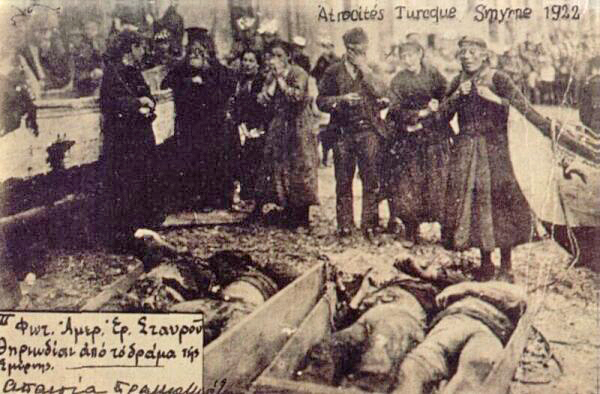
The Greek genocide (Greek: Γενοκτονία των Ελλήνων, romanized: Genoktonía ton Ellínon), which included the Pontic genocide, was the systematic killing of the Christian Ottoman Greek population of Anatolia, which was carried out mainly during World War I and its aftermath (1914–1922) – including the Turkish War of Independence (1919–1923) – on the basis of their religion and ethnicity. It was perpetrated by the government of the Ottoman Empire led by the Three Pashas and by the Government of the Grand National Assembly led by Mustafa Kemal Atatürk, against the indigenous Greek population of the Empire. The genocide included massacres, forced deportations involving death marches through the Syrian Desert, expulsions, summary executions, and the destruction of Eastern Orthodox cultural, historical, and religious monuments. Several hundred thousand Ottoman Greeks died during this period. Most of the refugees and survivors fled to Greece (adding over a quarter to the prior population of Greece). Some, especially those in Eastern provinces, took refuge in the neighbouring Russian Empire.
By late 1922, most of the Greeks of Asia Minor had either fled or had been killed. Those remaining were transferred to Greece under the terms of the later 1923 population exchange between Greece and Turkey, which formalized the exodus and barred the return of the refugees. Other ethnic groups were similarly attacked by the Ottoman Empire during this period, including Assyrians and Armenians, and some scholars and organizations have recognized these events as part of the same genocidal policy.
The Allies of World War I condemned the Ottoman government–sponsored massacres. In 2007, the International Association of Genocide Scholars passed a resolution recognising the Ottoman campaign against its Christian minorities, including the Greeks, as genocide. Some other organisations have also passed resolutions recognising the Ottoman campaign against these Christian minorities as genocide, as have the national legislatures of Greece, Cyprus, the United States, Sweden, Armenia, the Netherlands, Germany, Austria and the Czech Republic.
At the outbreak of World War I, Asia Minor was ethnically diverse, its population included Turks and Azeris, as well as groups that had inhabited the region prior to the Ottoman conquest, including Pontic Greeks, Caucasus Greeks, Cappadocian Greeks, Armenians, Kurds, Zazas, Georgians, Circassians, Assyrians, Jews, and Laz people.
Among the causes of the Turkish campaign against the Greek-speaking Christian population was a fear that they would welcome liberation by the Ottoman Empire's enemies, and a belief among some Turks that to form a modern country in the era of nationalism it was necessary to purge from their territories all minorities who could threaten the integrity of an ethnically based Turkish nation.[page needed]
According to a German military attaché, the Ottoman minister of war Ismail Enver had declared in October 1915 that he wanted to "solve the Greek problem during the war … in the same way he believe[d] he solved the Armenian problem", referring to the Armenian genocide. Germany and the Ottoman Empire were allies immediately before, and during World War I. By 31 January 1917, the Chancellor of Germany Theobald von Bethmann Hollweg, reported that:
The indications are that the Turks plan to eliminate the Greek element as enemies of the state, as they did earlier with the Armenians. The strategy implemented by the Turks is of displacing people to the interior without taking measures for their survival by exposing them to death, hunger, and illness. The abandoned homes are then looted and burnt or destroyed. Whatever was done to the Armenians is being repeated with the Greeks.
— Chancellor of Germany in 1917, Theobald von Bethmann Hollweg, The Killing Trap: Genocide in the Twentieth Century
Hub AI
Greek genocide AI simulator
(@Greek genocide_simulator)
Greek genocide
The Greek genocide (Greek: Γενοκτονία των Ελλήνων, romanized: Genoktonía ton Ellínon), which included the Pontic genocide, was the systematic killing of the Christian Ottoman Greek population of Anatolia, which was carried out mainly during World War I and its aftermath (1914–1922) – including the Turkish War of Independence (1919–1923) – on the basis of their religion and ethnicity. It was perpetrated by the government of the Ottoman Empire led by the Three Pashas and by the Government of the Grand National Assembly led by Mustafa Kemal Atatürk, against the indigenous Greek population of the Empire. The genocide included massacres, forced deportations involving death marches through the Syrian Desert, expulsions, summary executions, and the destruction of Eastern Orthodox cultural, historical, and religious monuments. Several hundred thousand Ottoman Greeks died during this period. Most of the refugees and survivors fled to Greece (adding over a quarter to the prior population of Greece). Some, especially those in Eastern provinces, took refuge in the neighbouring Russian Empire.
By late 1922, most of the Greeks of Asia Minor had either fled or had been killed. Those remaining were transferred to Greece under the terms of the later 1923 population exchange between Greece and Turkey, which formalized the exodus and barred the return of the refugees. Other ethnic groups were similarly attacked by the Ottoman Empire during this period, including Assyrians and Armenians, and some scholars and organizations have recognized these events as part of the same genocidal policy.
The Allies of World War I condemned the Ottoman government–sponsored massacres. In 2007, the International Association of Genocide Scholars passed a resolution recognising the Ottoman campaign against its Christian minorities, including the Greeks, as genocide. Some other organisations have also passed resolutions recognising the Ottoman campaign against these Christian minorities as genocide, as have the national legislatures of Greece, Cyprus, the United States, Sweden, Armenia, the Netherlands, Germany, Austria and the Czech Republic.
At the outbreak of World War I, Asia Minor was ethnically diverse, its population included Turks and Azeris, as well as groups that had inhabited the region prior to the Ottoman conquest, including Pontic Greeks, Caucasus Greeks, Cappadocian Greeks, Armenians, Kurds, Zazas, Georgians, Circassians, Assyrians, Jews, and Laz people.
Among the causes of the Turkish campaign against the Greek-speaking Christian population was a fear that they would welcome liberation by the Ottoman Empire's enemies, and a belief among some Turks that to form a modern country in the era of nationalism it was necessary to purge from their territories all minorities who could threaten the integrity of an ethnically based Turkish nation.[page needed]
According to a German military attaché, the Ottoman minister of war Ismail Enver had declared in October 1915 that he wanted to "solve the Greek problem during the war … in the same way he believe[d] he solved the Armenian problem", referring to the Armenian genocide. Germany and the Ottoman Empire were allies immediately before, and during World War I. By 31 January 1917, the Chancellor of Germany Theobald von Bethmann Hollweg, reported that:
The indications are that the Turks plan to eliminate the Greek element as enemies of the state, as they did earlier with the Armenians. The strategy implemented by the Turks is of displacing people to the interior without taking measures for their survival by exposing them to death, hunger, and illness. The abandoned homes are then looted and burnt or destroyed. Whatever was done to the Armenians is being repeated with the Greeks.
— Chancellor of Germany in 1917, Theobald von Bethmann Hollweg, The Killing Trap: Genocide in the Twentieth Century
Recent media